THEORY OF

“DEMAND”
INTRODUCTION
• How much to produce and what price
to charge?
• Factors determining demand for a
product.
• Explores the relationship between
price and demand for a product.
• Examines likely impact of the potential
factors that influence its demand.
WHAT IS DEMAND?
The quantity of a product consumers are willing and able to
buy at different prices in a specified time period.

Types of Demand
-Direct and derived demands
-Individual and market demand
-Recurring and replacement
-Complementary and competing
-New and replacement demands
DETERMINANTS OF DEMAND
•
•
•
•
•
•
•
•
•

Price of Product
Income of Consumer
Price of Related Good
Tastes and Preferences
Advertising
Consumer’s expectation of future Income and Price
Growth of Economy
Seasonal conditions
Population
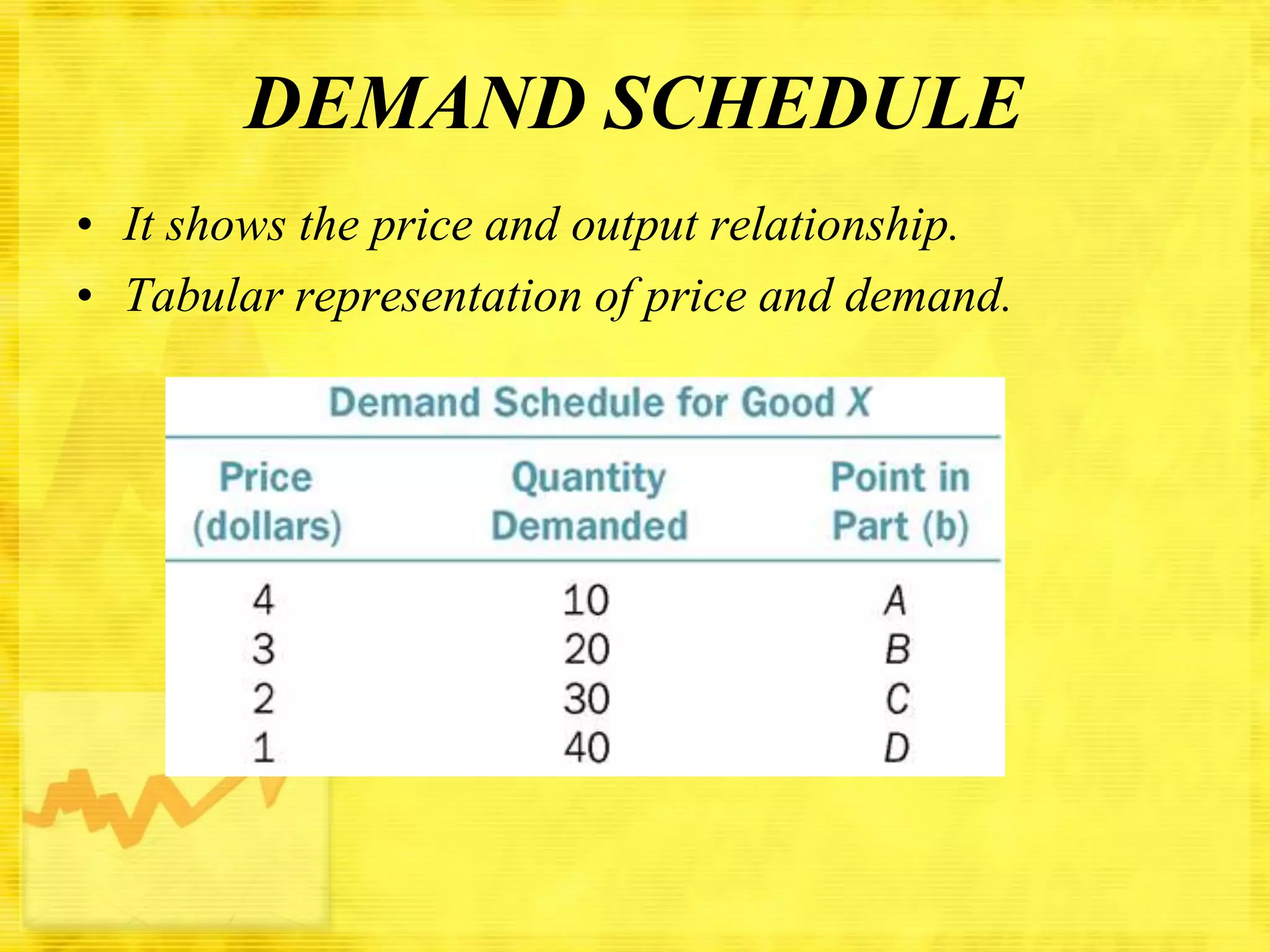
DEMAND SCHEDULE
• It shows the price and output relationship.
• Tabular representation of price and demand.
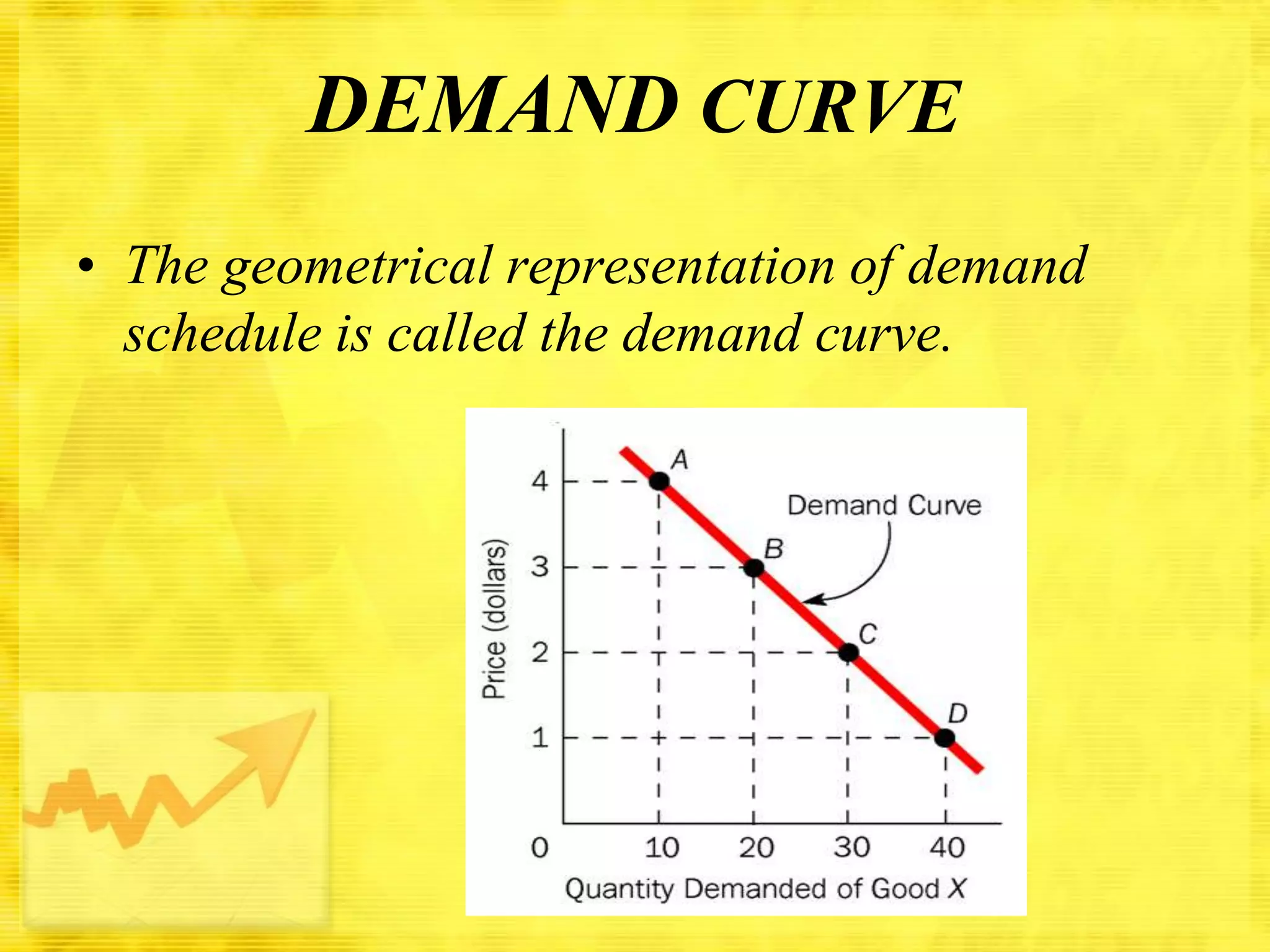
DEMAND CURVE
• The geometrical representation of demand
schedule is called the demand curve.
LAW OF DEMAND
• As the price of a good rises, quantity demanded
of that good falls.
• As the price of a good falls, quantity demanded of
that good rises.
• Ceteris paribus.
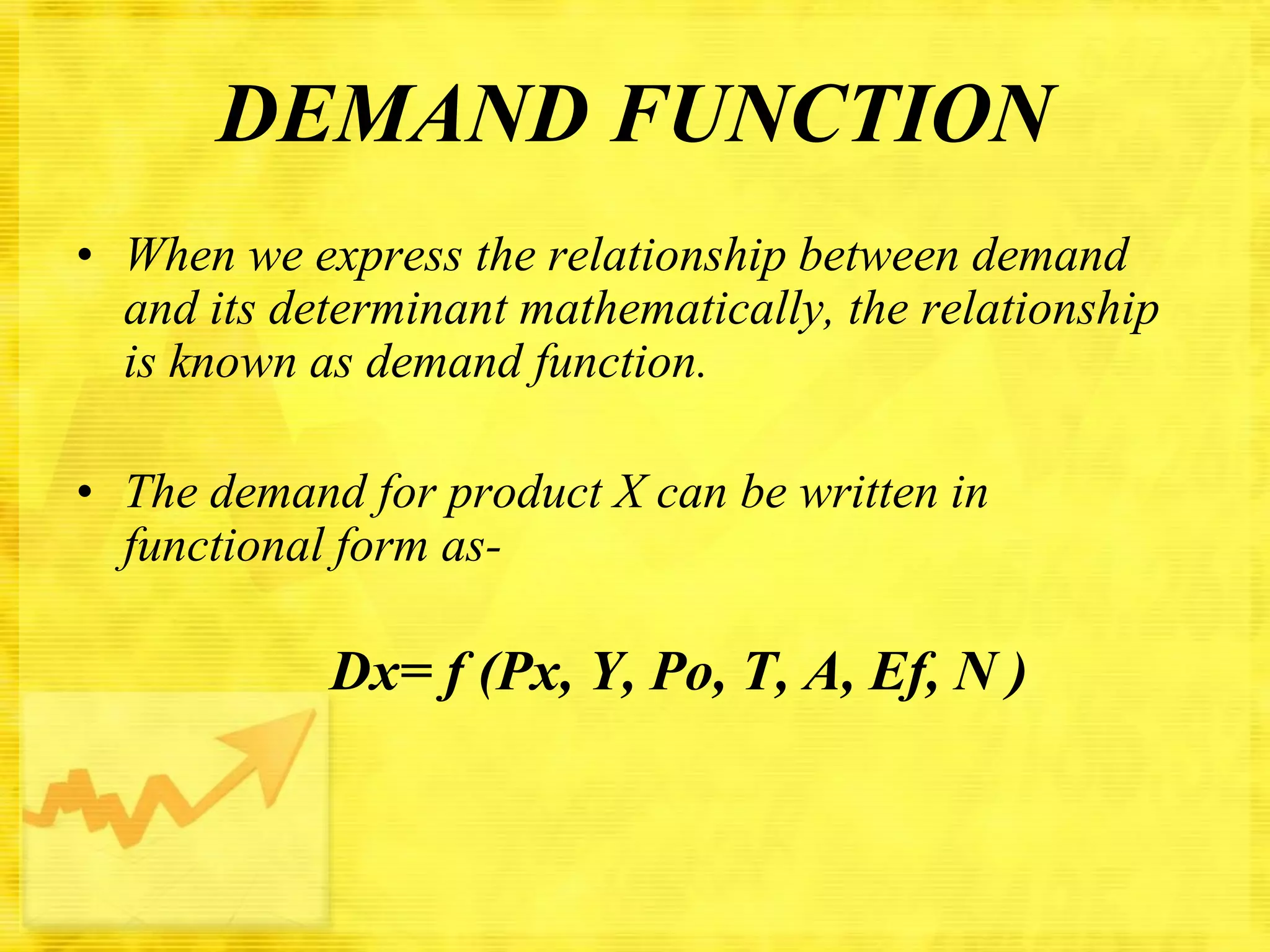
DEMAND FUNCTION
• When we express the relationship between demand
and its determinant mathematically, the relationship
is known as demand function.
• The demand for product X can be written in
functional form as-

Dx= f (Px, Y, Po, T, A, Ef, N )
EXCEPTIONS TO THE LAW OF
DEMAND
•
•
•
•
•
•

Inferior Goods
Snob Appeal
Demonstration Effect
Future Expectation of Prices
Insignificant proportion of income spent
Goods with no Substitutes
CHANGE IN DEMAND VS. CHANGE IN
QUANTITY DEMANDED
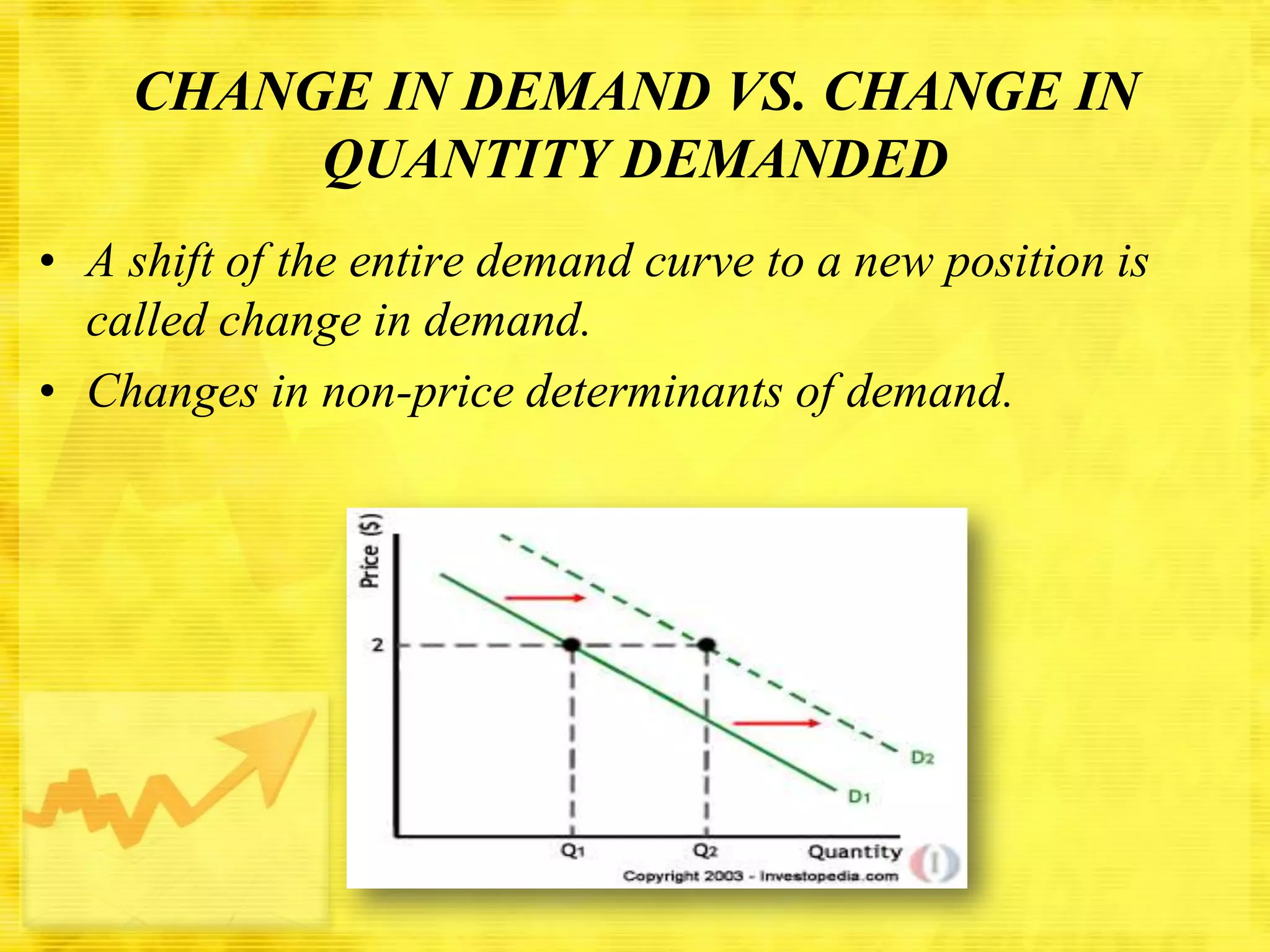
• A shift of the entire demand curve to a new position is
called change in demand.
• Changes in non-price determinants of demand.
QUANTITY DEMANDED
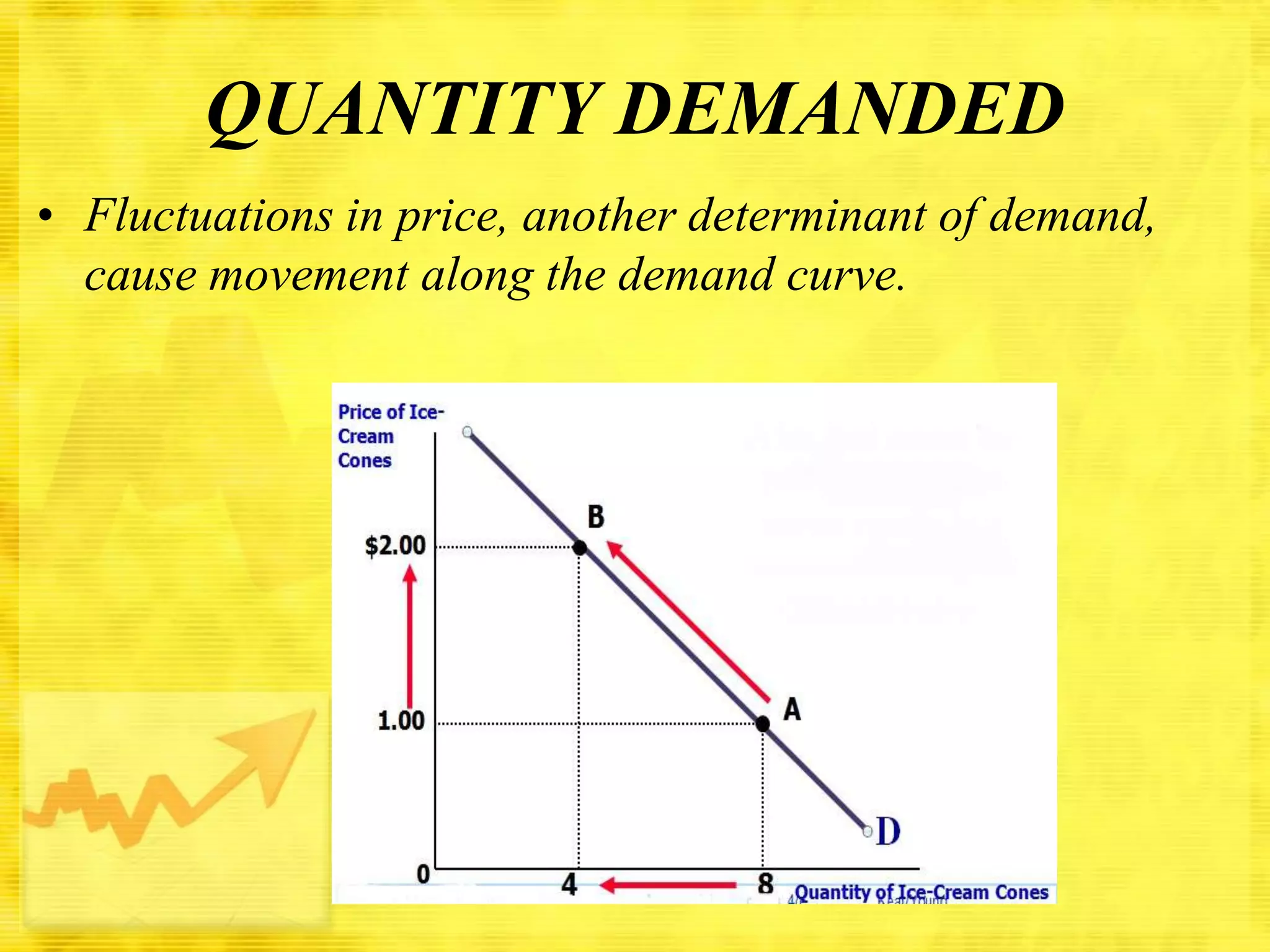
• Fluctuations in price, another determinant of demand,
cause movement along the demand curve.
Why the demand curve slope
downwards?
•
•
•
•
•

Law of diminishing marginal utility.
Income effect.
Substitution effect.
New consumers.
Multiple use of commodity.
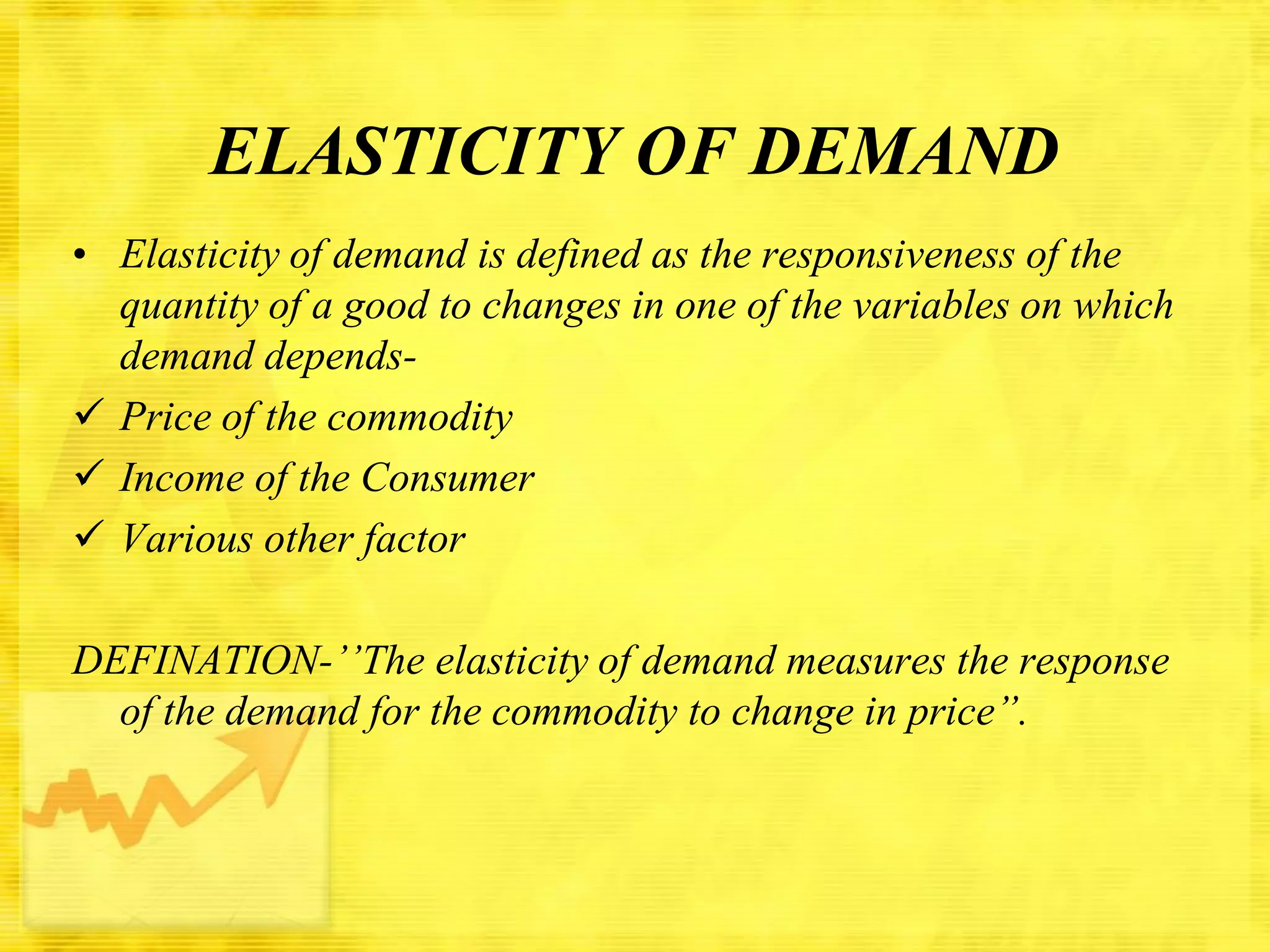
ELASTICITY OF DEMAND
• Elasticity of demand is defined as the responsiveness of the
quantity of a good to changes in one of the variables on which
demand depends Price of the commodity
 Income of the Consumer
 Various other factor
DEFINATION-’’The elasticity of demand measures the response
of the demand for the commodity to change in price”.
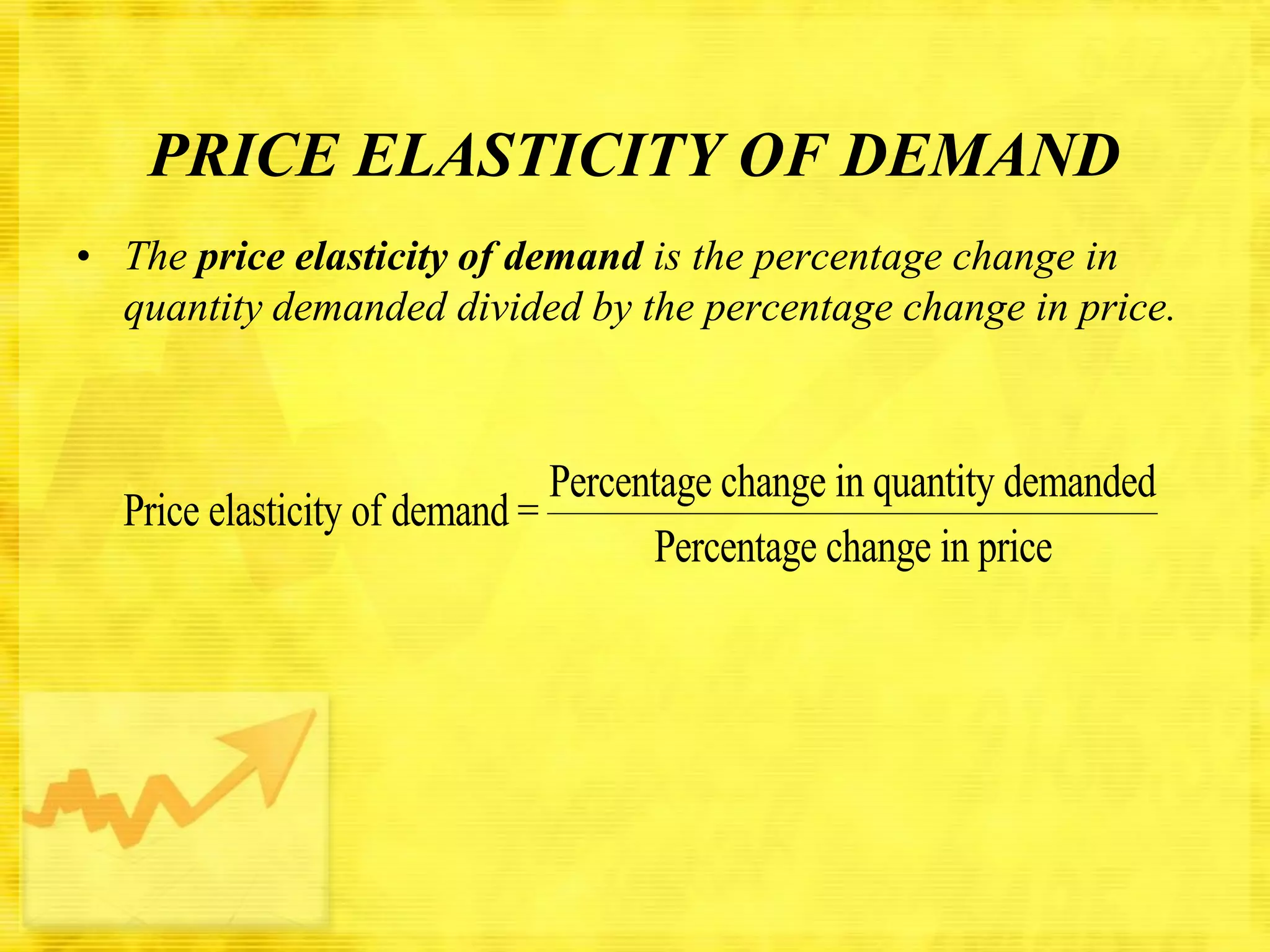
PRICE ELASTICITY OF DEMAND
• The price elasticity of demand is the percentage change in
quantity demanded divided by the percentage change in price.

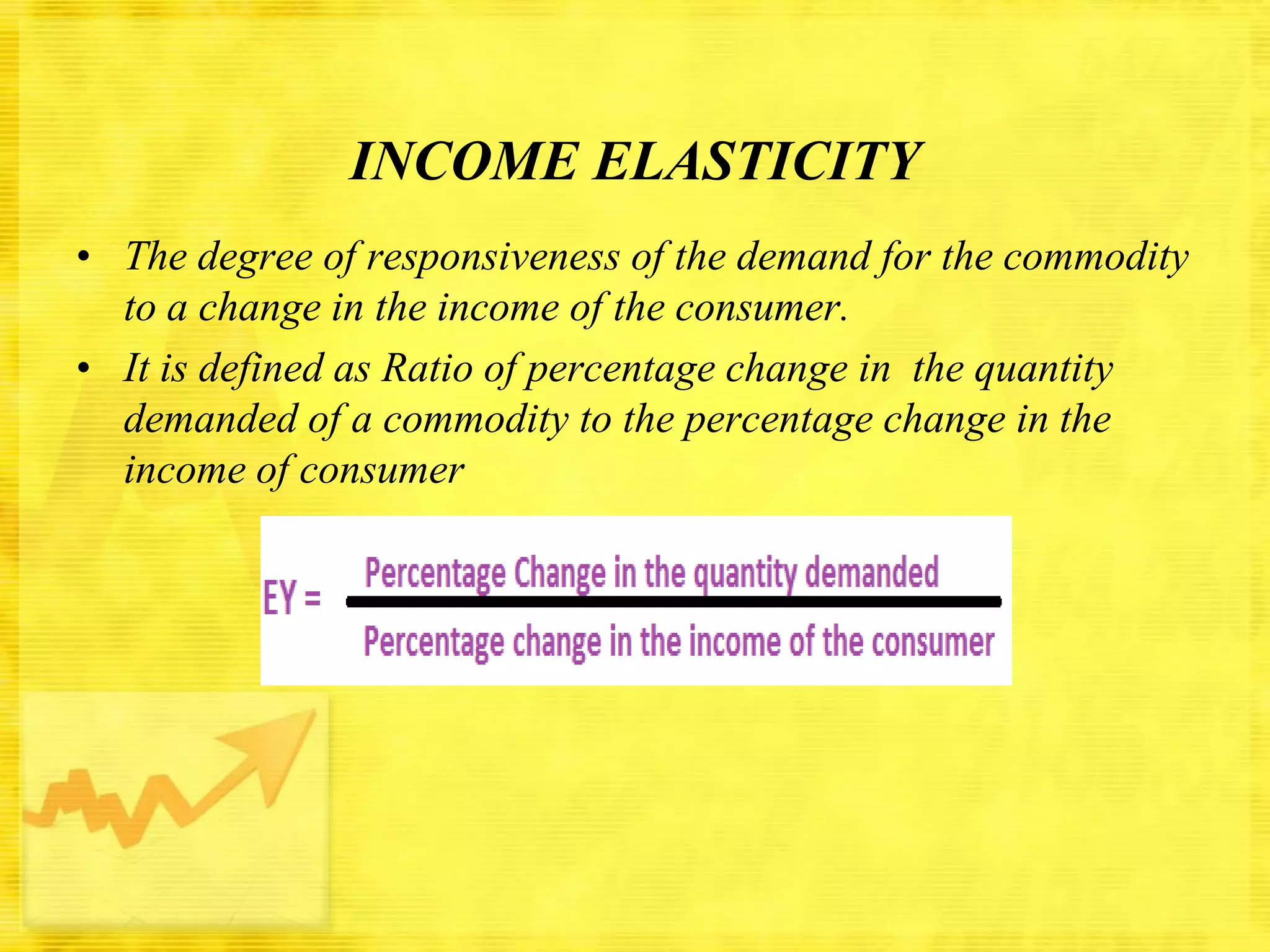
Percentage change in quantity demanded
Price elasticity of demand =
Percentage change in price
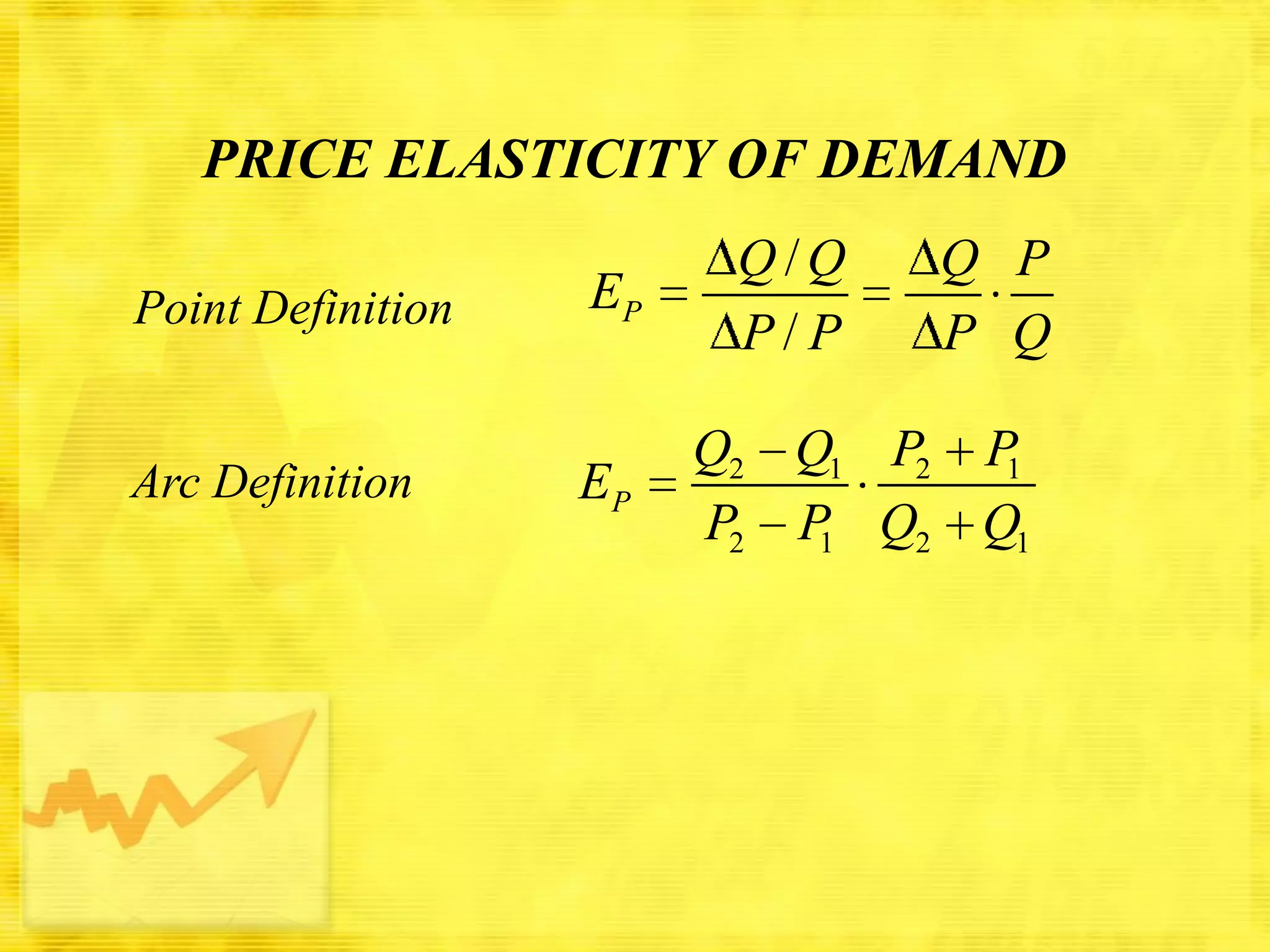
PRICE ELASTICITY OF DEMAND
Point Definition

Arc Definition

EP

EP

Q/Q
P/P

Q P
P Q

Q2 Q1 P2 P
1
P2 P Q2 Q1
1
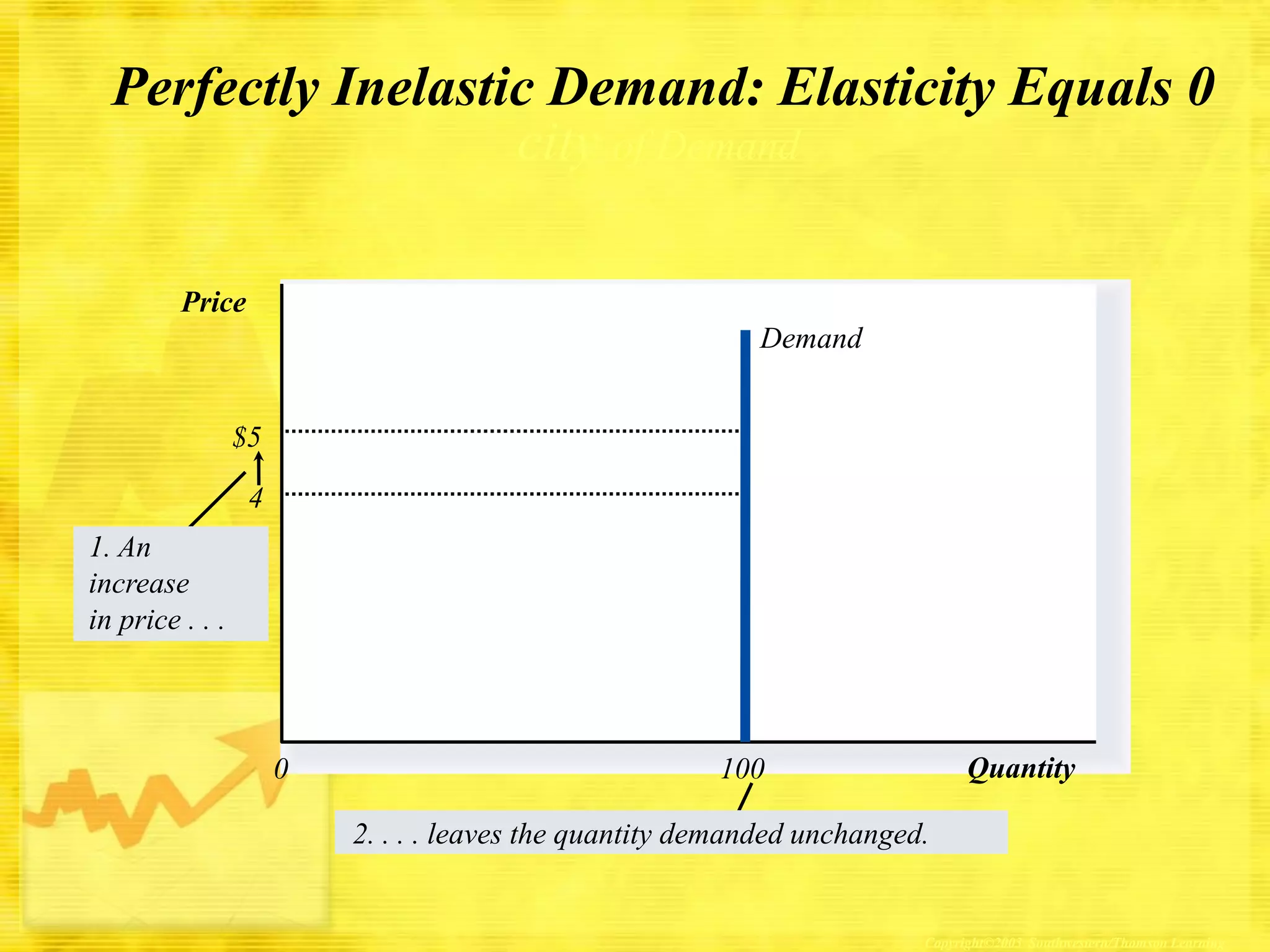
Perfectly Inelastic Demand: Elasticity Equals 0
city of Demand
Price
Demand
$5
4
1. An
increase
in price . . .

0

Quantity

100
2. . . . leaves the quantity demanded unchanged.

Copyright©2003 Southwestern/Thomson Learning
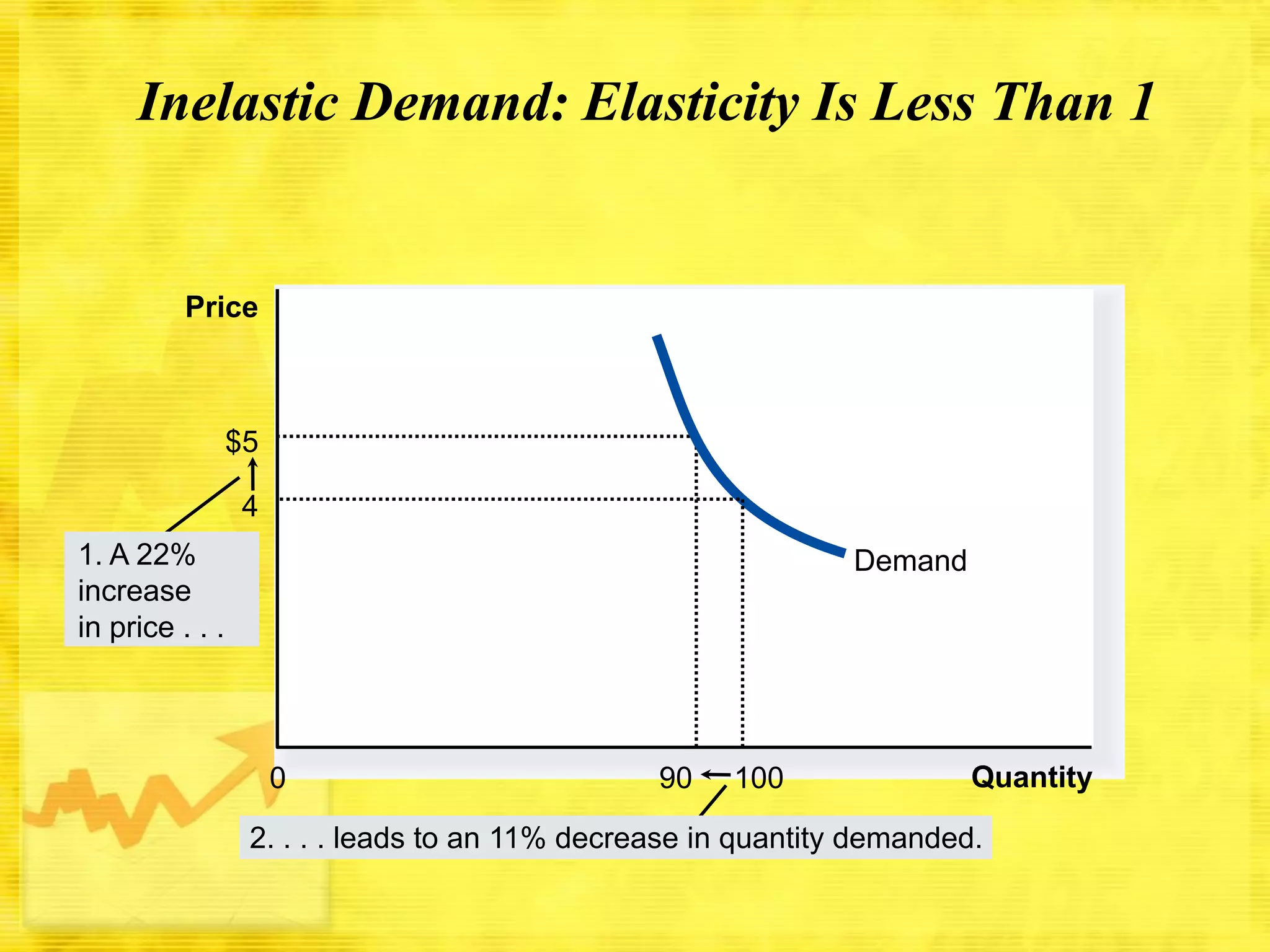
Inelastic Demand: Elasticity Is Less Than 1

Price

$5
4
1. A 22%
increase
in price . . .

Demand

0

90

100

Quantity

2. . . . leads to an 11% decrease in quantity demanded.
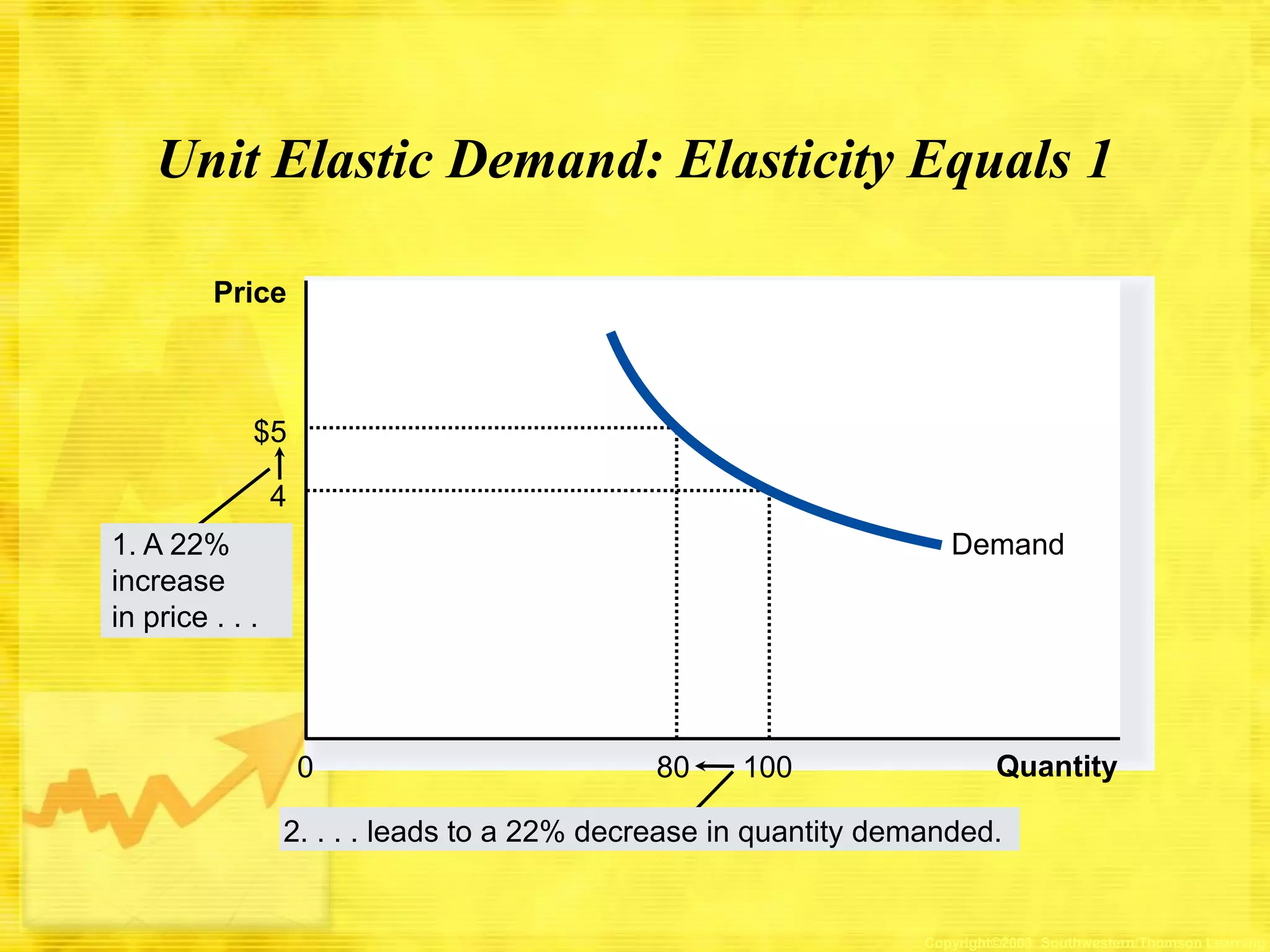
Unit Elastic Demand: Elasticity Equals 1
Price

$5
4
Demand

1. A 22%
increase
in price . . .

0

80

100

Quantity

2. . . . leads to a 22% decrease in quantity demanded.

Copyright©2003 Southwestern/Thomson Learning
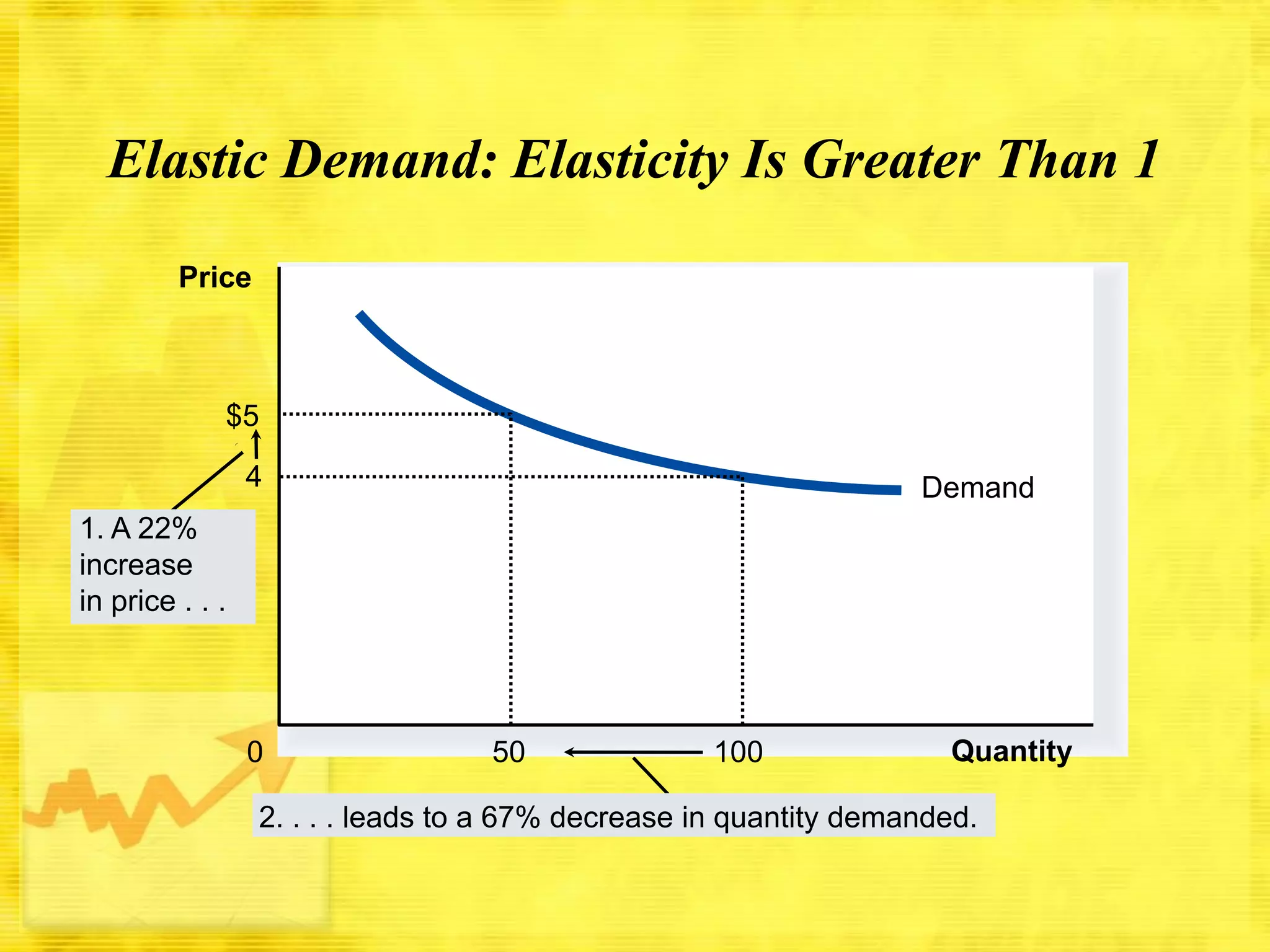
Elastic Demand: Elasticity Is Greater Than 1
Price

$5

4

Demand

1. A 22%
increase
in price . . .

0

50

100

Quantity

2. . . . leads to a 67% decrease in quantity demanded.
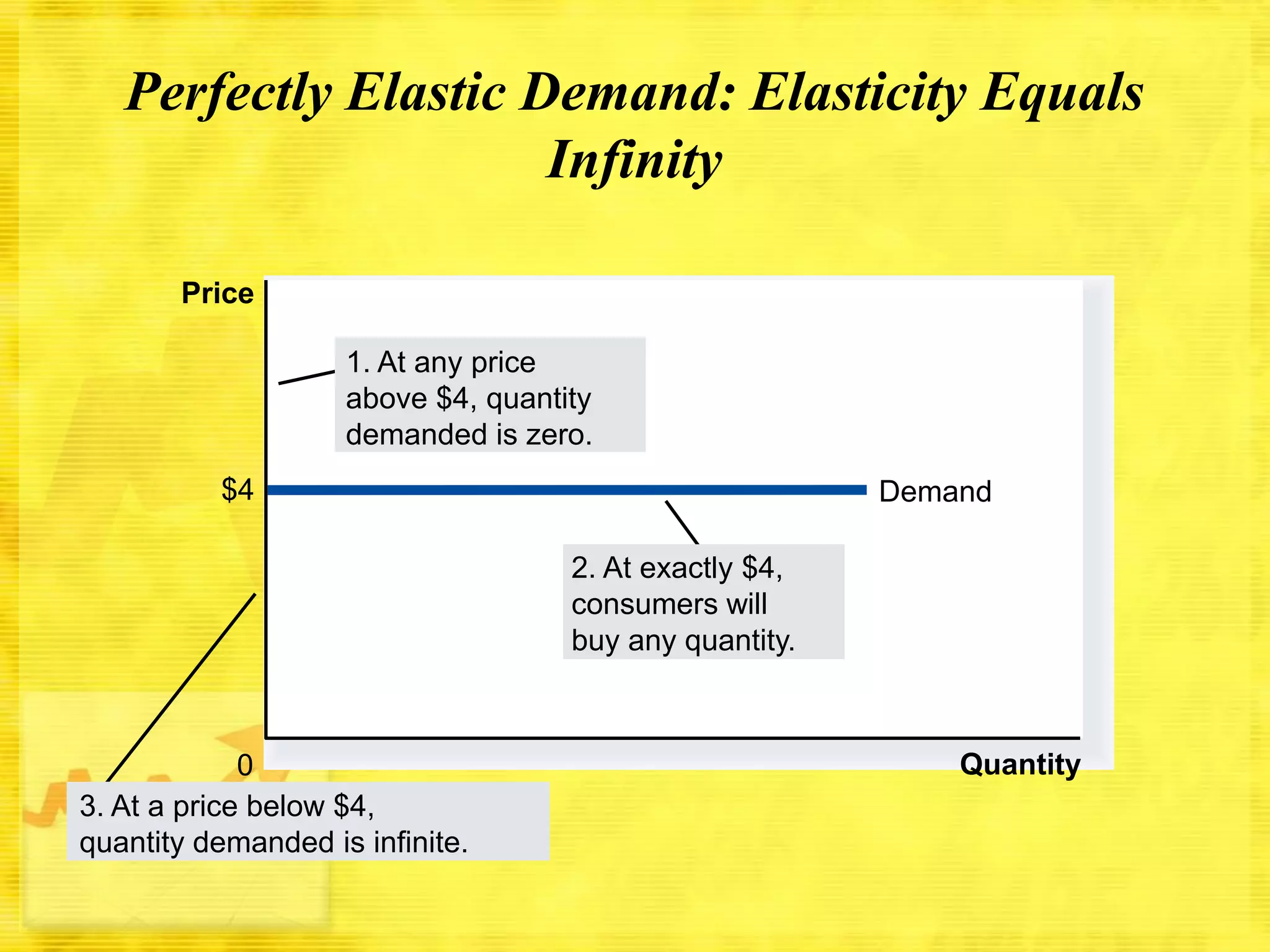
Perfectly Elastic Demand: Elasticity Equals
Infinity
Price
1. At any price
above $4, quantity
demanded is zero.
$4

Demand
2. At exactly $4,
consumers will
buy any quantity.

0
3. At a price below $4,
quantity demanded is infinite.

Quantity
INCOME ELASTICITY
• The degree of responsiveness of the demand for the commodity
to a change in the income of the consumer.
• It is defined as Ratio of percentage change in the quantity
demanded of a commodity to the percentage change in the
income of consumer
INCOME ELASTICITY
• Negative ( inferior commodities )
• Zero ( neutral commodities )
• Greater than zero but less than 1( normal
commodities )
• Greater than unity ( Luxurious commodity )
INCOME ELASTICITY
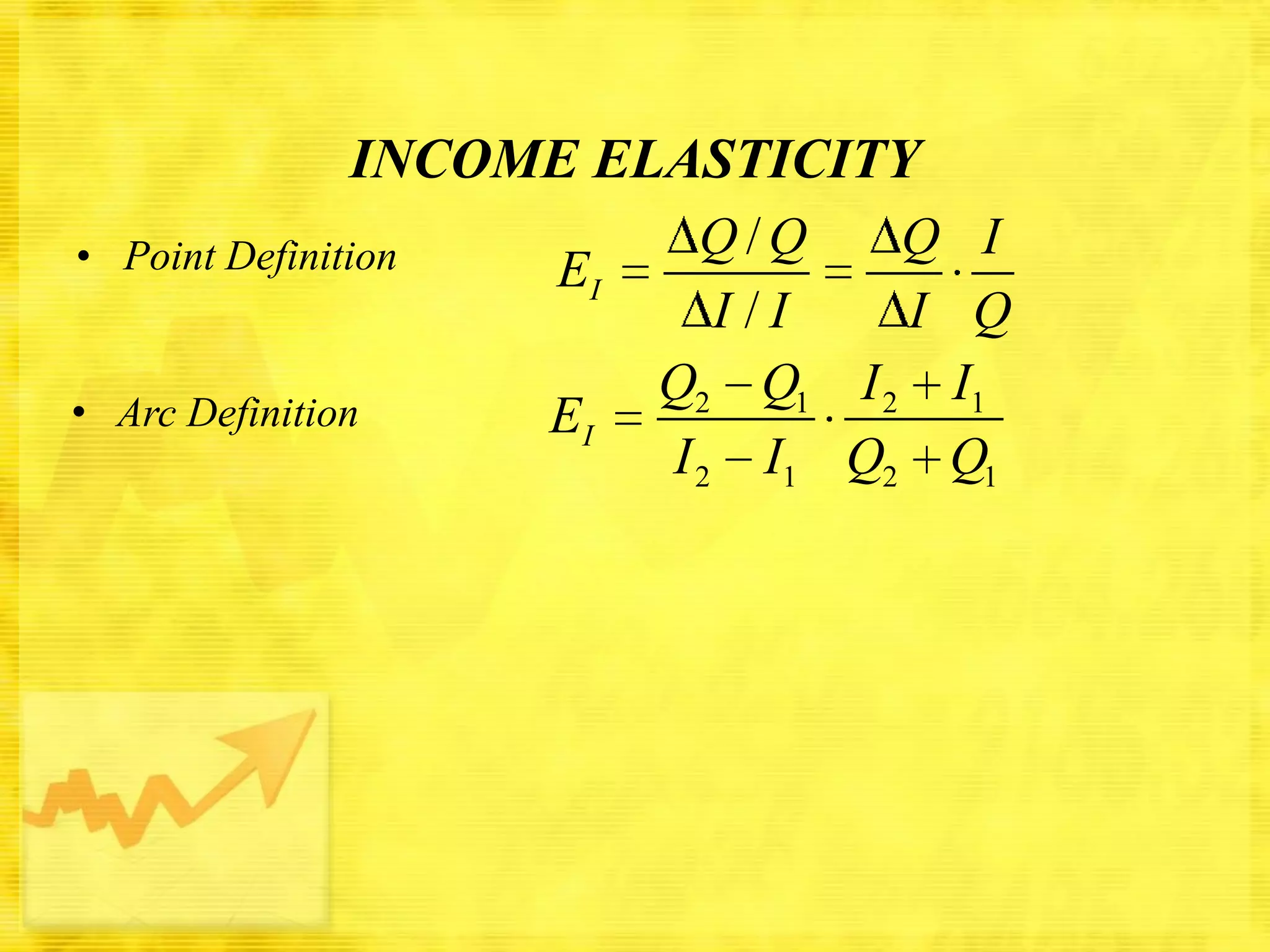
• Point Definition

EI

• Arc Definition

EI

Q/Q
Q I
I/I
I Q
Q2 Q1 I 2 I1
I 2 I1 Q2 Q1
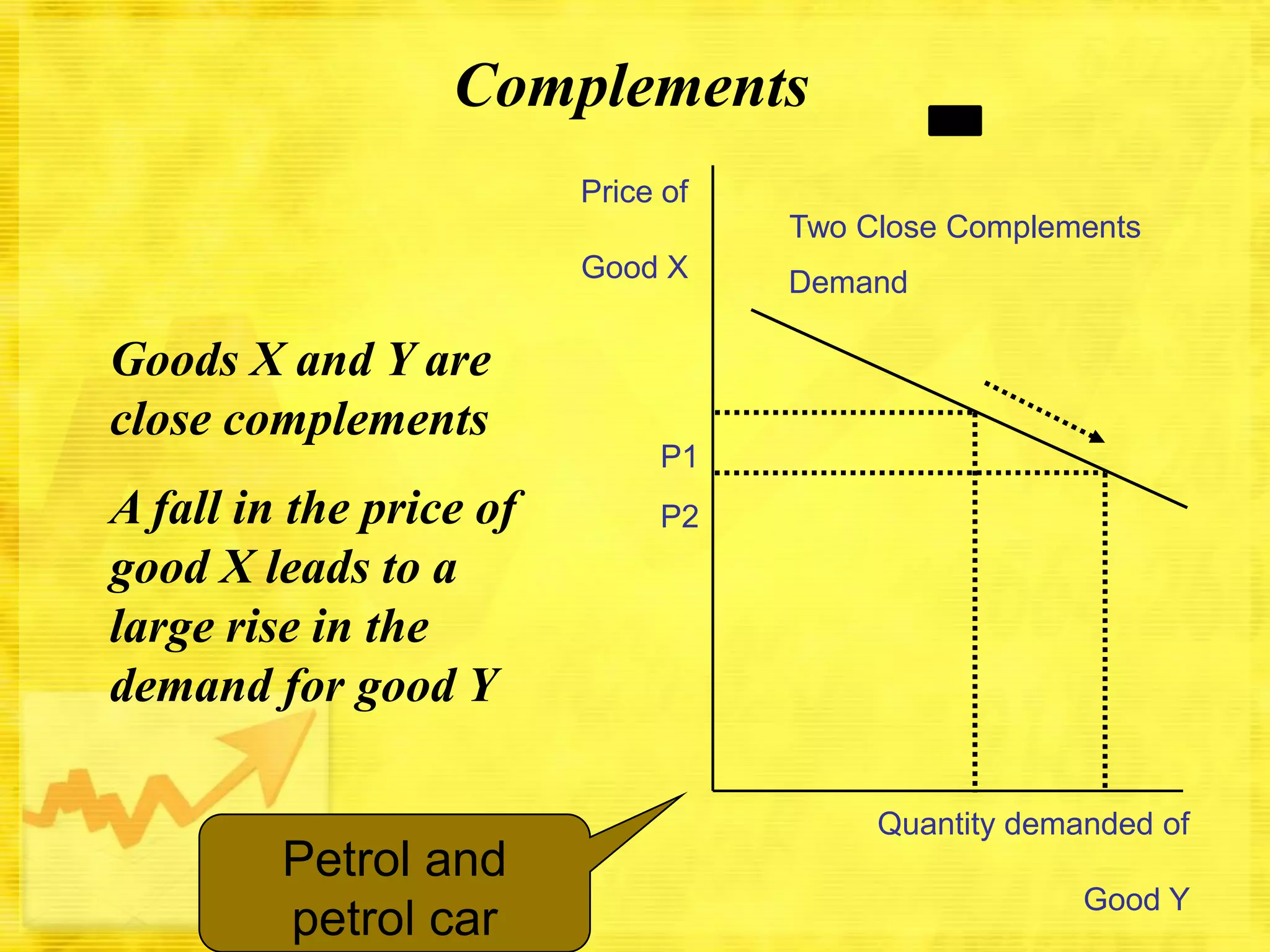
Cross Elasticity of Demand (CED)
• Cross price elasticity (CED) measures the responsiveness of
demand for good X following a change in the price of good Y
(a related good)
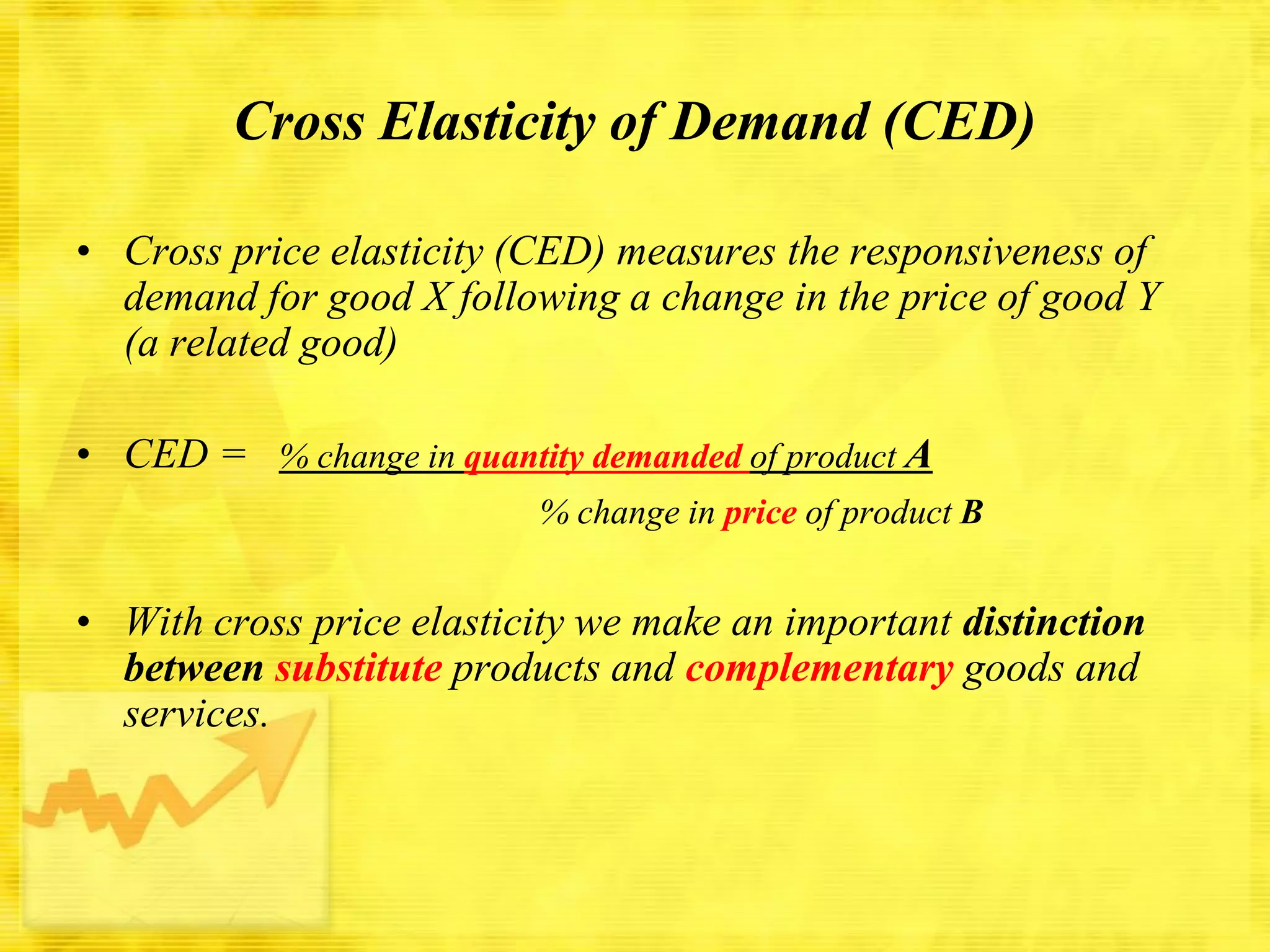
• CED = % change in quantity demanded of product A
% change in price of product B

• With cross price elasticity we make an important distinction
between substitute products and complementary goods and
services.
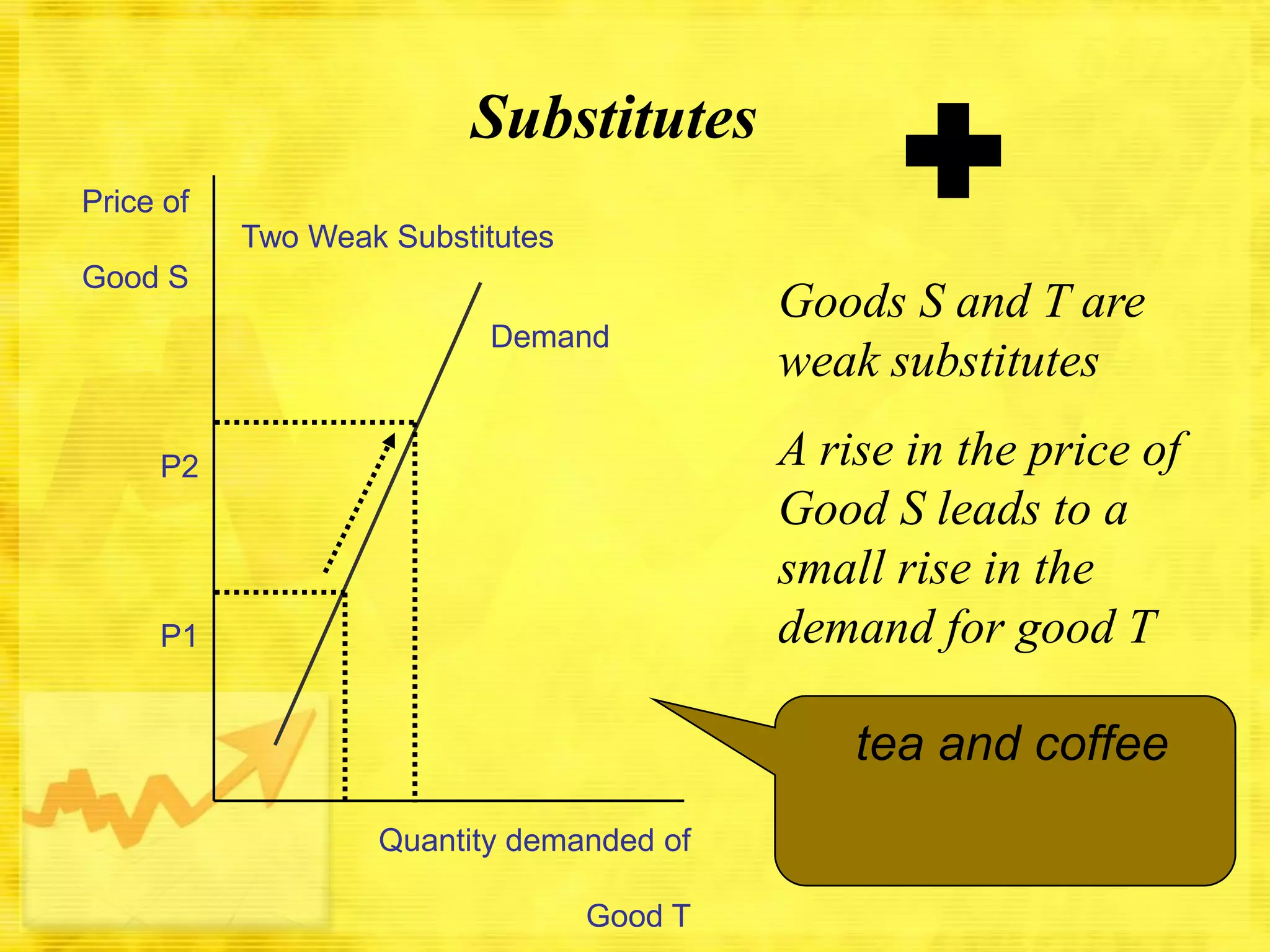
Substitutes
Price of
Two Weak Substitutes
Good S
Demand

+
Goods S and T are
weak substitutes
A rise in the price of
Good S leads to a
small rise in the
demand for good T

P2

P1

tea and coffee
Quantity demanded of

Good T
-

Complements
Price of

Two Close Complements
Good X

Goods X and Y are
close complements

A fall in the price of
good X leads to a
large rise in the
demand for good Y

Petrol and
petrol car

Demand

P1
P2

Quantity demanded of
Good Y
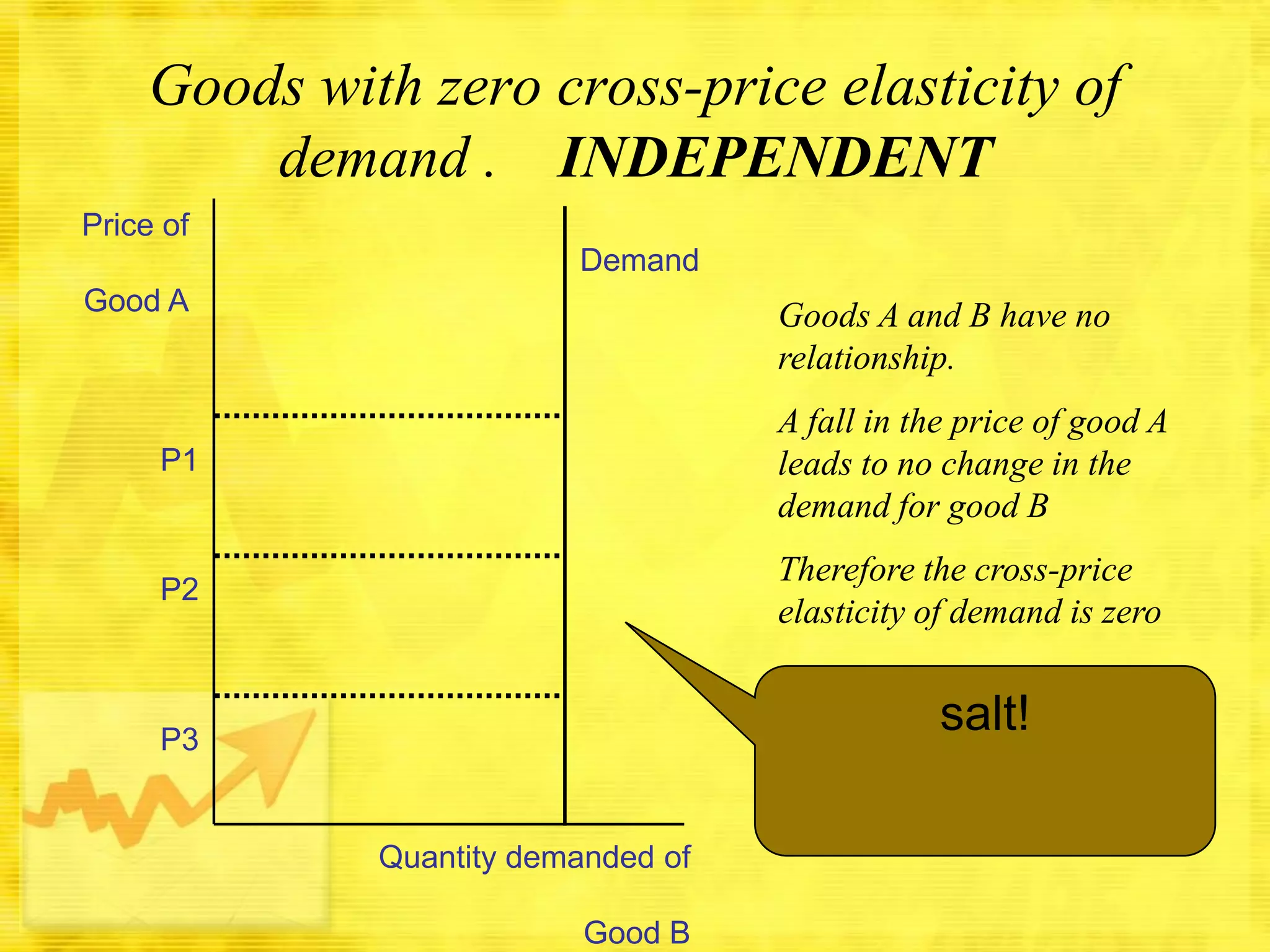
Goods with zero cross-price elasticity of
demand . INDEPENDENT
Price of

Demand
Good A

Goods A and B have no
relationship.

P1

A fall in the price of good A
leads to no change in the
demand for good B

P2

Therefore the cross-price
elasticity of demand is zero

salt!

P3

Quantity demanded of
Good B
THEORY OF DEMAND

THEORY OF DEMAND

  • 1.
  • 2.
    INTRODUCTION • How muchto produce and what price to charge? • Factors determining demand for a product. • Explores the relationship between price and demand for a product. • Examines likely impact of the potential factors that influence its demand.
  • 3.
    WHAT IS DEMAND? Thequantity of a product consumers are willing and able to buy at different prices in a specified time period. Types of Demand -Direct and derived demands -Individual and market demand -Recurring and replacement -Complementary and competing -New and replacement demands
  • 4.
    DETERMINANTS OF DEMAND • • • • • • • • • Priceof Product Income of Consumer Price of Related Good Tastes and Preferences Advertising Consumer’s expectation of future Income and Price Growth of Economy Seasonal conditions Population
  • 5.
    DEMAND SCHEDULE • Itshows the price and output relationship. • Tabular representation of price and demand.
  • 6.
    DEMAND CURVE • Thegeometrical representation of demand schedule is called the demand curve.
  • 7.
    LAW OF DEMAND •As the price of a good rises, quantity demanded of that good falls. • As the price of a good falls, quantity demanded of that good rises. • Ceteris paribus.
  • 8.
    DEMAND FUNCTION • Whenwe express the relationship between demand and its determinant mathematically, the relationship is known as demand function. • The demand for product X can be written in functional form as- Dx= f (Px, Y, Po, T, A, Ef, N )
  • 9.
    EXCEPTIONS TO THELAW OF DEMAND • • • • • • Inferior Goods Snob Appeal Demonstration Effect Future Expectation of Prices Insignificant proportion of income spent Goods with no Substitutes
  • 10.
    CHANGE IN DEMANDVS. CHANGE IN QUANTITY DEMANDED • A shift of the entire demand curve to a new position is called change in demand. • Changes in non-price determinants of demand.
  • 11.
    QUANTITY DEMANDED • Fluctuationsin price, another determinant of demand, cause movement along the demand curve.
  • 12.
    Why the demandcurve slope downwards? • • • • • Law of diminishing marginal utility. Income effect. Substitution effect. New consumers. Multiple use of commodity.
  • 13.
    ELASTICITY OF DEMAND •Elasticity of demand is defined as the responsiveness of the quantity of a good to changes in one of the variables on which demand depends Price of the commodity  Income of the Consumer  Various other factor DEFINATION-’’The elasticity of demand measures the response of the demand for the commodity to change in price”.
  • 14.
    PRICE ELASTICITY OFDEMAND • The price elasticity of demand is the percentage change in quantity demanded divided by the percentage change in price. Percentage change in quantity demanded Price elasticity of demand = Percentage change in price
  • 15.
    PRICE ELASTICITY OFDEMAND Point Definition Arc Definition EP EP Q/Q P/P Q P P Q Q2 Q1 P2 P 1 P2 P Q2 Q1 1
  • 16.
    Perfectly Inelastic Demand:Elasticity Equals 0 city of Demand Price Demand $5 4 1. An increase in price . . . 0 Quantity 100 2. . . . leaves the quantity demanded unchanged. Copyright©2003 Southwestern/Thomson Learning
  • 17.
    Inelastic Demand: ElasticityIs Less Than 1 Price $5 4 1. A 22% increase in price . . . Demand 0 90 100 Quantity 2. . . . leads to an 11% decrease in quantity demanded.
  • 18.
    Unit Elastic Demand:Elasticity Equals 1 Price $5 4 Demand 1. A 22% increase in price . . . 0 80 100 Quantity 2. . . . leads to a 22% decrease in quantity demanded. Copyright©2003 Southwestern/Thomson Learning
  • 19.
    Elastic Demand: ElasticityIs Greater Than 1 Price $5 4 Demand 1. A 22% increase in price . . . 0 50 100 Quantity 2. . . . leads to a 67% decrease in quantity demanded.
  • 20.
    Perfectly Elastic Demand:Elasticity Equals Infinity Price 1. At any price above $4, quantity demanded is zero. $4 Demand 2. At exactly $4, consumers will buy any quantity. 0 3. At a price below $4, quantity demanded is infinite. Quantity
  • 21.
    INCOME ELASTICITY • Thedegree of responsiveness of the demand for the commodity to a change in the income of the consumer. • It is defined as Ratio of percentage change in the quantity demanded of a commodity to the percentage change in the income of consumer
  • 22.
    INCOME ELASTICITY • Negative( inferior commodities ) • Zero ( neutral commodities ) • Greater than zero but less than 1( normal commodities ) • Greater than unity ( Luxurious commodity )
  • 23.
    INCOME ELASTICITY • PointDefinition EI • Arc Definition EI Q/Q Q I I/I I Q Q2 Q1 I 2 I1 I 2 I1 Q2 Q1
  • 24.
    Cross Elasticity ofDemand (CED) • Cross price elasticity (CED) measures the responsiveness of demand for good X following a change in the price of good Y (a related good) • CED = % change in quantity demanded of product A % change in price of product B • With cross price elasticity we make an important distinction between substitute products and complementary goods and services.
  • 25.
    Substitutes Price of Two WeakSubstitutes Good S Demand + Goods S and T are weak substitutes A rise in the price of Good S leads to a small rise in the demand for good T P2 P1 tea and coffee Quantity demanded of Good T
  • 26.
    - Complements Price of Two CloseComplements Good X Goods X and Y are close complements A fall in the price of good X leads to a large rise in the demand for good Y Petrol and petrol car Demand P1 P2 Quantity demanded of Good Y
  • 27.
    Goods with zerocross-price elasticity of demand . INDEPENDENT Price of Demand Good A Goods A and B have no relationship. P1 A fall in the price of good A leads to no change in the demand for good B P2 Therefore the cross-price elasticity of demand is zero salt! P3 Quantity demanded of Good B

Editor's Notes