StuDocu is not sponsored or endorsed by any college or university
Economics notes
Engineering Economics (Kalinga Institute of Industrial Technology)
StuDocu is not sponsored or endorsed by any college or university
Economics notes
Engineering Economics (Kalinga Institute of Industrial Technology)
Downloaded by Ashok D (shivashakthi0912@gmail.com)
lOMoARcPSD|3746387
Lecture Note on Production Economics Prepared by Sayan Doloi
Meaning of Demand
The demand for a commodity is its quantity which consumers are able and willing to buy
at various prices during a given period of time.
Demand is a function of price (p) , income (y), prices of related goods (pr) and tastes(t)
and is expressed as:
D = f ( p , y , pr , t )
When income , prices of related goods and tastes are given , the demand function ,
D = f(p)
Factors influencing demand
1) Price : The higher the price of a commodity , the lower the quantity demanded . The
lower the price , the higher the quantity demanded.
2) Prices of other commodities :
There are three types of commodities in this context :
Substitutes
If a rise (or fall) in the price of one commodity leads to an increase (or decline) in the
demand for another commodity , the two commodities are said to be substitutes .
In other words , subtitutes are those comodities which satisfy similar wants , such as
tea and coffee.
Complementary commodities
Where the demand for two commodities is linked to each other , such as petrol cars
and petrol , bread and butter , tea and sugar etc. These are said to be complementary
goods . Complementary goods are those which can not be generally used without
each other.
If the price of the petrol cars falls and these become cheaper , the demand for
these will increase and so the demand for petrol will also rise.
Unrelated goods
If the two commodities are unrelated , say refrigerator and bicycle , a change in the
price of one will have no effect on the quantity demanded of the other.
3) Income :
Downloaded by Ashok D (shivashakthi0912@gmail.com)
lOMoARcPSD|3746387
A rise in the consumer’s income raises the demand for a commodity and a fall in
his income reduces the demand for it .
4) Tastes :
When there is a change in the tastes of consumers in favour of a commodity , say
due to fashion , its demand will rise , with no change in its price , in the price of other
commodities , and in the income of the consumer . On the other hand , change in tastes
against a commodity leads to a fall in its demand , other factors affecting demand
remaining unchanged .
The Law of Demand
The law of demand expresses a relationship between the quantity demanded and its
price .
According to Marshall : the amount demanded increases with a fall in price and
diminishes with a rise in price .
It expresses an inverse relation between price and demand . It is represented by the slope
of the demand curved which is normally negative throughout its length .
Causes for downward sloping demand curve
 Every commodity has certain consumers but when its price falls , new consumers
start consuming it as a result demand increases .
On the contrary , with the increase in the price of the product , many consumers
will either stop or reduce its consumption and the demand will be reduced . This
is known as price effect.
Income effect
Under the influence of this effect , with the fall in the price of the commodity the
consumer buys more of it and also spends a portion of the increased income in buying
other commodities .
Substitution effect
With the fall in the price of the commodity , the prices of its substitutes remaining same ,
consumers will buy more of this commodity rather than the substitues . As a result
demand will increase . example tea and coffee.
Different uses of certain commodity
When the price falls , these will be used for various uses and their demand will rise . For
instance , the increase in the electricity changes the electrical power will be used for
Downloaded by Ashok D (shivashakthi0912@gmail.com)
lOMoARcPSD|3746387
domestic lighting only , but if the changes is reduced , people will use electricity for
cooking heaters etc .
Effect of Different income group
There are persons in different income groups in every society but the majorities in low
income group.
Ordinary people buy more when price falls and less when prices rises . The rich people
do not have any effect on the demand curve because they are capable of buying the same
quantity even at a higher price .
Exceptions to the law of demand
Causes for upward sloping demand curve
1) Shortage
If storage of commodity is anticipated due to war etc. , people may start buying for
building stocks or for hoarding even when the prices rises .
2) Lack of purchasing power
The prices of commodity is very low but the demand is less .
3) Ignorance effect
Consumers by more at a higher price under the influence of the ignorance effect ,
where a commodity may be mistaken for some other commodity , due to deceptive
packing , label etc.
4) Fear of any disease or bad effect of the commodity
Due to this effect , the price of the commodity falls but the consumers do not want
to buy it and the demand decreases.
An individual’s demand schedule and curve
Demand Schedule
Price Quantity
6 10
5 20
4 30
3 40
2 60
1 80
Downloaded by Ashok D (shivashakthi0912@gmail.com)
lOMoARcPSD|3746387
Market Demand Schedule
Quantity demanded Total
Price (p) A B C Demand
6 10 20 40 70
5 20 40 60 120
4 30 60 80 170
3 40 80 100 220
2 60 100 120 280
1 80 120 160 360
Law of Income demand
Income Demand :
It indicates the relationship between income and
the quantity of commodity demanded .
The demand for a commodity increases with the rise
in income and decreases with the fall in income .
The Elasticity of Demand
 Prices elasticity of demand
 It is the degree of responsiveness of demand to change in price.
 It is defined as the ratio of the percentage change in demand to the
percentage change in price .
 The co-efficient of price elasticity of demand is always negative because
when price changes the demand moves in opposite direction .
Ep = Percentage change in quantity demanded / Percentage change in
price
= (ΔD/D) / (ΔP/P) = (dD/dP)
Linear demand curve
Downloaded by Ashok D (shivashakthi0912@gmail.com)
lOMoARcPSD|3746387
D = b0 − b1 P then dD/dP = − b1 , εP = − b1 (P/D)
Price elasticity of demand may be unity , greater than unity , less than unity , zero or
infinite .
 Price elasticity of demand is unity when the change in demand is exactly
proportionate to the change in price . It is unitary elasticity of demand .
 When the change in demand is more than proportionate to the change in price ,
then price elasticity of demand is greater than unity. It is also known as relativity
elastic demand .
 If the change in demand is less than proportionate to the change in price , price
elasticity of demand is less than unity . It is also known as relatively inelastic
demand .
 If the price elasticity of demand is zero , then whatever the change in price , there
is absolutely no change in demand . Price elasticity of demand is perfectly
inelastic in this case. It is perfectly inelastic demand .
 If the price elasticity of demand is infinity i.e. the demand changes but no
change in price . It is perfectly elastic demand .
 The demand for a commodity is more elastic if there are close substitutes for it .
Downloaded by Ashok D (shivashakthi0912@gmail.com)
lOMoARcPSD|3746387
 Luxury goods are price elastic , while necessities are price inelastic .
The range of values of the elasticity are : 0 ≤ εP ≤ ∞
If εP = 0 then the demand is perfectly inelastic .
If εP = 1 then the demand has unitary elasticity .
If εP = ∞ then the demand is perfectly elastic .
If 0 < εP < 1 , we say that the demand is inelastic .
If 1 < εP < ∞ , we say that the demand is elastic .
Methods of Measuring Price Elasticity of Demand
There are four methods of measuring price elasticity of demand :
1) Percentage method
2) Point method
3) Arc method
4) Expenditure method
Income Elasticity of Demand
The concept of income elasticity of demand ( EI ) expresses the responsiveness of a
consumers demand for any good to the change in his income .
It may be defined as the ratio of percentage change in the quantity demanded of a
commodity to the percentage change in income .
EI = Percentage change in the quantity demanded / Percentage change in income
= (ΔD/D) / (ΔI/I)
The co-efficient EI may be positive , negative or zero depending upon the nature of
a commodity .
If the income elasticity of demand is positive , then the commodity is a normal good
because more of it is purchased as the consumer’s income increases .
If the income elasticity of demand is negative , then the commodity is called inferior
good because less of it is purchased as the consumer’s income increases .
Normal goods are the three types
 Luxuries − the co-efficient of income elasticity is positive but high .
 Necessifies − the co-efficient of income elasticity is positive but low .
 Comforts − the co-efficient of income elasticity is unity .
Cross Elasticity of Demand
Downloaded by Ashok D (shivashakthi0912@gmail.com)
lOMoARcPSD|3746387
The cross-elasticity of demand is the relation between percentage change in the
quantity demanded of a good to the percentage change in the price of a related good .The
cross-elasticity of demand between good A and B is
EAB = Percentage change in the quantity of good B / Percentage change in price of A
= (ΔDB / DB) / (ΔpA / pA )
= (ΔDB / ΔpA) × (pA / DB)
The sign of cross elasticity is negative if A & B are complementary goods , and it is
positive if A & B are substitutes.
The higher the value of cross-elasticity the stronger will be the degree of
substitutability or complementarity of A and B .
Supply
Downloaded by Ashok D (shivashakthi0912@gmail.com)
lOMoARcPSD|3746387
The term ‘supply’ means the quantities of a commodity or service which a seller is
willing and able to offer for sale at various prices during a given period of time .
The higher the price , the greater will be the quantity of a commodity that will be
supplied by a producer and vice versa .
Factors influencing supply
There are various factors influency the supply of a commodity .
 Price of a commodity : As price increases , the supply increases .
 Price of other commodity :
The change in the price of another commodity also affects the supply of a
commodity . For instance , if the price of good A rises , the producer of good B
may produce less of good B and switch over to the production of good A in
order to sell more of it.
 Prices of factors used in its production :
If the price of factors of production increases , then the cost of production will
increase . As a result , its output will fall and the supply will be reduced .
 Goods of producers :
If a producer who aims at maximising his sales will produce more and sell more
 State of Technology :
If a new and improved methods of production are used , they tend to increase
the supply of commodities .
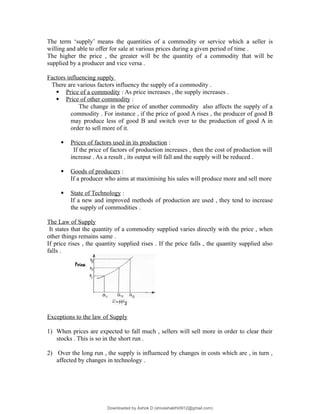
The Law of Supply
It states that the quantity of a commodity supplied varies directly with the price , when
other things remains same .
If price rises , the quantity supplied rises . If the price falls , the quantity supplied also
falls .
Exceptions to the law of Supply
1) When prices are expected to fall much , sellers will sell more in order to clear their
stocks . This is so in the short run .
2) Over the long run , the supply is influenced by changes in costs which are , in turn ,
affected by changes in technology .
Downloaded by Ashok D (shivashakthi0912@gmail.com)
lOMoARcPSD|3746387
3) Changes in habits , tastes , fashions , weather , and national and in ternational
disturbances also affect the supplies of commodities .
4) Lastly, the rise in the price of a good or service sometimes leads to a fall in its supply.
This happens particularly in the case of labour supply . When the wage rises to a level
where the workers full satisfied , they will work less than before in order to have
more leisure. They will also have a tendency to educate their children rather than send
them to work . The supply curve in such a situation is backward sloping .
The Elasticity of Supply
The elasticity of supply is the degree of responsiveness of a change in supply to a change
in price on the part of sellers.
The co-efficient of elasticity of supply is :
ES = (ΔQ / Q) / (ΔP / P)
The value of co-efficient of supply is always positive .
There are five cases of the elasticity of supply .
A)
Supply is relatively elastic when a given change in price ΔP causes a more than
proportionate change in the amount supplied ΔQ .
S1 is a relatively elastic supply curve .
(ΔP/P) < (ΔQ/Q)
B)
Downloaded by Ashok D (shivashakthi0912@gmail.com)
lOMoARcPSD|3746387
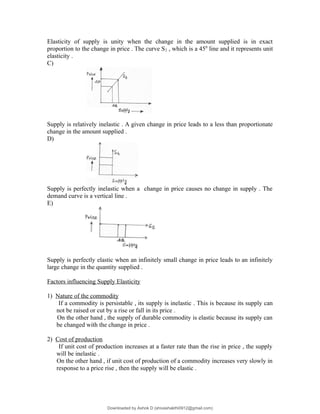
Elasticity of supply is unity when the change in the amount supplied is in exact
proportion to the change in price . The curve S2 , which is a 450
line and it represents unit
elasticity .
C)
Supply is relatively inelastic . A given change in price leads to a less than proportionate
change in the amount supplied .
D)
Supply is perfectly inelastic when a change in price causes no change in supply . The
demand curve is a vertical line .
E)
Supply is perfectly elastic when an infinitely small change in price leads to an infinitely
large change in the quantity supplied .
Factors influencing Supply Elasticity
1) Nature of the commodity
If a commodity is persistable , its supply is inelastic . This is because its supply can
not be raised or cut by a rise or fall in its price .
On the other hand , the supply of durable commodity is elastic because its supply can
be changed with the change in price .
2) Cost of production
If unit cost of production increases at a faster rate than the rise in price , the supply
will be inelastic .
On the other hand , if unit cost of production of a commodity increases very slowly in
response to a price rise , then the supply will be elastic .
Downloaded by Ashok D (shivashakthi0912@gmail.com)
lOMoARcPSD|3746387
3) Time element
The longer the time period , the more elastic will be the supply of a commodity . The
shorter the time period, the more inelastic will be the supply of a commodity.
4) Producer’s expectations
If the producer expect a rise in the price of a commodity in the future , they will cut
down the present supply . As a result , the supply will be inelastic.
On the other hand , if they expect the price will fall in the near future , they will
increase the present supply , consequently , the supply will become elastic .
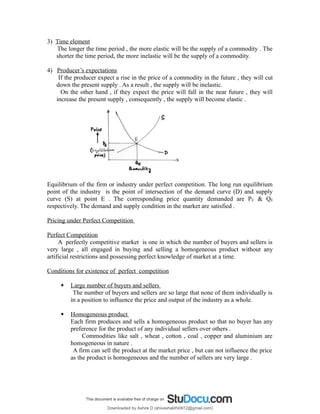
Equilibrium of the firm or industry under perfect competition. The long run equilibrium
point of the industry is the point of intersection of the demand curve (D) and supply
curve (S) at point E . The corresponding price quantity demanded are PE & QE
respectively. The demand and supply condition in the market are satisfied .
Pricing under Perfect Competition
Perfect Competition
A perfectly competitive market is one in which the number of buyers and sellers is
very large , all engaged in buying and selling a homogeneous product without any
artificial restrictions and possessing perfect knowledge of market at a time.
Conditions for existence of perfect competition
 Large number of buyers and sellers
The number of buyers and sellers are so large that none of them individually is
in a position to influence the price and output of the industry as a whole.
 Homogeneous product
Each firm produces and sells a homogeneous product so that no buyer has any
preference for the product of any individual sellers over others .
Commodities like salt , wheat , cotton , coal , copper and aluminium are
homogeneous in nature .
A firm can sell the product at the market price , but can not influence the price
as the product is homogeneous and the number of sellers are very large .
Downloaded by Ashok D (shivashakthi0912@gmail.com)
lOMoARcPSD|3746387
 Absence of Artificial Restrictions
There is complete openness in buying and selling of goods. There is no
discrimination on the part of buyers and sellers. Moreover the prices are liable
to change freely in response to demand supply conditions.
 Freedom of Entry and Exit of firms
The firms should be free to enter or leave the industry .
 Perfect mobility of goods and factors
Goods are free to move to those places where they can fetch the highest price .
Factors can also move from a low paid to high paid industry .
 Perfect knowledge of market conditions
This condition implies a close contact between buyers and sellers . Buyers and
sellers possess complete knowledge about the prices at which goods are being
bought and sold , and of the prices at which others are prepared to buy and sell .
They have also perfect knowledge of the place where the transactions are being
carried on . Such perfect knowledge of the market conditions forces the sellers
to sell their product at the prevailing market price and the buyers to buy at that
price .
 Absence of Transport Costs
There are no transport costs in carrying a product from one place to another .
This condition is essential for the existance of perfect competition which
requires that a commodity must have the same price every where at any time. If
transport costs are added to the price of the product , even a homogeneous
commodity will have different prices depending upon transport from the place
of supply.
Equilibrium price under perfect competition
 There are two parties which bargain in a market − the buyers and the sellers .
 It is only when they agree , a commodity can be bought and sold at a certain
price.
 The product pricing is influenced both by buyers and sellers that is by demand
and supply.
 The law of demand is applicable to buyers.
 The law of supply is applicable to sellers.
 Thus the demand and supply are the two counteracting forces which move in the
opposite direction.
Downloaded by Ashok D (shivashakthi0912@gmail.com)
lOMoARcPSD|3746387
 Price is determined at a point where both supply and demand are equal .
 The corresponding price is known as equilibrium price.
 The corresponding quantity is known as equilibrium quantity.
E is the equilibrium point .
If there is a change in demand and supply , then the equilibrium price will be changed .
Downloaded by Ashok D (shivashakthi0912@gmail.com)
lOMoARcPSD|3746387
Market Situation
Monopoly
 Monopoly is a market situation in which there is only one seller of a product with
barriers to entry of others .
 The product has no close substitutes i.e. ; no other firms produce a similar
product .
 The monopoly firm is itself an industry .
 Monopolist is a price maker who can set the price to his maximum advantage . He
can set both price and output .
 The price is determined by the demand curve , once he selects the output level .
 Or once he sets the price for the product , the output is determined by what
consumers will take at that price .
 In any situation , the ultimate aim of the monopololist is to have a maximum
profit .
 Monopolist equates his marginal cost with his marginal revenue to maximise
profit .
Sources and types of monopoly
First
 Grant of a patent right to a firm by the government to make , use or sell its own
invention .
Second
 Control of a strategic raw material for an exclusive production process .
Third
 A natural monoploy enjoyed by a firm when it supplies the entire market at a
lower unit cost due to increasing economics , just as in the supply of electricity or
gas etc .
Fourth
 Government may grant exclusive right to a private firm to opearate under its
regulation .
 Such privacy owned and government regulated monopolies are mostly in public
utilities and are called legal monopolies such as in transport and communications
etc .
Fifth
 There may be government owned and regulated monopolies such as postal
services , water and sewage system of municipal corporation .
Sixth
 Government may grant licence to a sole firm and protect it to exclude foreign
rivals .
Seventh
 The sole manufacturer of a product may adopt a limit pricing policy in order to
prevent the entry of new firms .
Downloaded by Ashok D (shivashakthi0912@gmail.com)
lOMoARcPSD|3746387
Monopsony
 Monopsony refers to a market situation where there is a single buyer of a
commodity or service .
 It applies to any situation in which there is a monopoly element in buying .
 Monopsony can be formally defined in the works of Professor Leibhafsky , as
“ the case of a single buyer who is not in competition with any other buyers for
the output which he seeks to purchase and as a situation in which entry into the
market by other buyers is impossible” .
 Monopsonist is able to influence the supply price of his purchases by the amount
he buys.
 Monopsonist aims at the maximisation of his surplus .
 The monopsonist regulates his purchases in such a way that marginal cost equals
marginal utility whereby his consumers surplus is maximum.
 For example , when the consumers of a certain commodity are organised or when
a socialist government regulates imports or when a certain individual happens to
have a taste of some commodity which one else requires
 When a single big factory is an isolated locality is the sole buyer of some grades
of labour , there is monosony .
Note : Utility is measurable in terms of money .
The want satisfying power of a commodity is utility .
It is quantity possessed by a commodity or service to satisfy human wants. Utility
can also be defined as value in use of a commodity because the satisfaction which
we get from the consumption of a commodity is its value in-use.
Bilateral Monopoly
Bilateral monopoly refers to a market situation in which a single producer (monopolist)
of a product faces a single buyer (monopsonist) of that product .
 Bilateral monopoly exists in a labour market.
 There is only a single commodity with no close substitute.
 Monopolist is its sole producer or seller .
 Monopolist is its only buyer .
 The monopolist and monopsonist are both free to maximise their own individual
profits .
Duopoly
 Duopoly is the market situation in which there are only two sellers of similar
product . Both the sellers are completely independent and no agreement exists
between them .
 Even though they are independent , a change in the price and output of one will
affect the other .
Downloaded by Ashok D (shivashakthi0912@gmail.com)
lOMoARcPSD|3746387
 A seller may however assume that his rival is unaffected by what he does , in that
case he takes only his own direct influence on the price .
 On the other hand , each seller takes into account the effect of his policy on that of
his rival and the reaction of the rival .
 Moreover , a rival seller’s policy may remain unaltered either to the amount
offered for sale or to the price at which he offers his product .
 Thus the duopoly problem can be considered as either ignoring mutual
dependence or recognising it .
Oligopoly
Oligopoly is a market situation in which there are a few firms selling homogeneous or
differential products .
 There may be three to five firms .
 With only a few firms in the market , the action of one firm is likely to affect the
others .
 When the product is homogeneous , then it is pure or perfect oligopoly .
 When the product is heterogeneous , then it is imperfect or differentiated
oligopoly .
 Pure oligopoly is found primarily among producers of industrial products such as
aluminium , cement , copper , steel , zinc etc .
 Imperfect oligopoly is found among producers of such consumers goods as
automobiles , cigarettes , soaps and detergents , TVs , rubber tyres , refrigerator
etc .
Downloaded by Ashok D (shivashakthi0912@gmail.com)
lOMoARcPSD|3746387
The Indifference Curve Theory
 The indifference curve explains the consumer behavious in terms of his
preferences or ranking for different combinations of two goods , say X and Y .
 The indifference curve is drawn from the indifference schedule of the consumer .
 The indifference schedule shows the various combinations of the two
commodities such that the consumer is indifferent to those combinations .
 An indifference schedule is a list of combination of two commodities the list
being so arranged that a consumer is indifferent to the combinations , preferring
none of any other .
 All combinations give him equal satisfaction .
Indifference schedule
Consumers prefers to the higher level of satisfaction
Combination Good X Good Y
1 1 18
2 2 13
3 3 9
4 4 6
5 5 4
6 6 3
Downloaded by Ashok D (shivashakthi0912@gmail.com)
lOMoARcPSD|3746387
 I1 curve is the locus of the points representing the pairs of quantities between
which the individual is indifference so it is termed as indifference curve .
 It is in fact , iso-utility curve showing equal satisfaction at all points .
 A single indifference curve concerns only one level of satisfaction .
Properties of indifference curve
1) A higher indifference curve to the right of another represents a higher level of
satisfaction and preferable combination of the two goods .
2) In between two indifference curves there can be a number of other indifference
curves .
3) The slope of an indifference curve is negative , downward sloping and from left to
write . It means that the consumer to be indifferent to all combination on an
indifference curve must leave less units of good Y and in order to have more of good
X .
4) Indifference curves can nither touch nor intersect each other so that one indifference
curve passes only through one point on an indifference map .
5) An indifference curve can not touch either axis .
6) An important property of indifference curve is that they are convex to the origin .
7) Indifference curves are not necessarily parallel to each other .
8) In reality indifference curves are like bangles .
Downloaded by Ashok D (shivashakthi0912@gmail.com)
lOMoARcPSD|3746387
Effective region of the circular curve will be
convex portion .
Consumer’s Equilibrium
A consumer is in equilibrium when given his tastes and price of two goods , he spends a
given money income on the purchase of two goods in such a way so to get the maximum
satisfaction .
Conditions of consumer’s equilibrium
1) The budget line should be tangent to the indifference curve .
Budget equation , I = OA . Px + OB . Py
Where Px and Py are the unit price of Good X and Y respectively.
I = Budget
2) At the point of equilibrium the slope of the indifference curve and of the budget line
should be the same .
Slope of indifference curve = Slope of the budget line , PQ
= (I / Py) / (I / Px) = Px / Py
Also the slope of I3 curve is MRSxy , MRSxy = Px / Py at point S
This is a necessary but not sufficient condition for consumer’s equilibrium .
3) Indifference curve should be convex to the origin at the equilibrium point
Downloaded by Ashok D (shivashakthi0912@gmail.com)
lOMoARcPSD|3746387
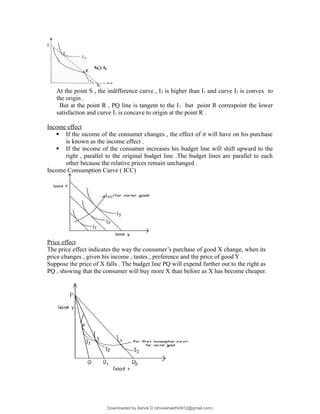
At the point S , the indifference curve , I2 is higher than I1 and curve I2 is convex to
the origin .
But at the point R , PQ line is tangent to the I1 but point R correspoint the lower
satisfaction and curve I1 is concave to origin at the point R .
Income effect
 If the income of the consumer changes , the effect of it will have on his purchase
is known as the income effect .
 If the income of the consumer increases his budget line will shift upward to the
right , parallel to the original budget line .The budget lines are parallel to each
other because the relative prices remain unchanged .
Income Consumption Curve ( ICC)
Price effect
The price effect indicates the way the consumer’s purchase of good X change, when its
price changes , given his income , tastes , preference and the price of good Y .
Suppose the price of X falls . The budget line PQ will expend further out to the right as
PQ , showing that the consumer will buy more X than before as X has become cheaper.
Downloaded by Ashok D (shivashakthi0912@gmail.com)
lOMoARcPSD|3746387

economics-notes.pdf

  • 1.
    StuDocu is notsponsored or endorsed by any college or university Economics notes Engineering Economics (Kalinga Institute of Industrial Technology) StuDocu is not sponsored or endorsed by any college or university Economics notes Engineering Economics (Kalinga Institute of Industrial Technology) Downloaded by Ashok D (shivashakthi0912@gmail.com) lOMoARcPSD|3746387
  • 2.
    Lecture Note onProduction Economics Prepared by Sayan Doloi Meaning of Demand The demand for a commodity is its quantity which consumers are able and willing to buy at various prices during a given period of time. Demand is a function of price (p) , income (y), prices of related goods (pr) and tastes(t) and is expressed as: D = f ( p , y , pr , t ) When income , prices of related goods and tastes are given , the demand function , D = f(p) Factors influencing demand 1) Price : The higher the price of a commodity , the lower the quantity demanded . The lower the price , the higher the quantity demanded. 2) Prices of other commodities : There are three types of commodities in this context : Substitutes If a rise (or fall) in the price of one commodity leads to an increase (or decline) in the demand for another commodity , the two commodities are said to be substitutes . In other words , subtitutes are those comodities which satisfy similar wants , such as tea and coffee. Complementary commodities Where the demand for two commodities is linked to each other , such as petrol cars and petrol , bread and butter , tea and sugar etc. These are said to be complementary goods . Complementary goods are those which can not be generally used without each other. If the price of the petrol cars falls and these become cheaper , the demand for these will increase and so the demand for petrol will also rise. Unrelated goods If the two commodities are unrelated , say refrigerator and bicycle , a change in the price of one will have no effect on the quantity demanded of the other. 3) Income : Downloaded by Ashok D (shivashakthi0912@gmail.com) lOMoARcPSD|3746387
  • 3.
    A rise inthe consumer’s income raises the demand for a commodity and a fall in his income reduces the demand for it . 4) Tastes : When there is a change in the tastes of consumers in favour of a commodity , say due to fashion , its demand will rise , with no change in its price , in the price of other commodities , and in the income of the consumer . On the other hand , change in tastes against a commodity leads to a fall in its demand , other factors affecting demand remaining unchanged . The Law of Demand The law of demand expresses a relationship between the quantity demanded and its price . According to Marshall : the amount demanded increases with a fall in price and diminishes with a rise in price . It expresses an inverse relation between price and demand . It is represented by the slope of the demand curved which is normally negative throughout its length . Causes for downward sloping demand curve  Every commodity has certain consumers but when its price falls , new consumers start consuming it as a result demand increases . On the contrary , with the increase in the price of the product , many consumers will either stop or reduce its consumption and the demand will be reduced . This is known as price effect. Income effect Under the influence of this effect , with the fall in the price of the commodity the consumer buys more of it and also spends a portion of the increased income in buying other commodities . Substitution effect With the fall in the price of the commodity , the prices of its substitutes remaining same , consumers will buy more of this commodity rather than the substitues . As a result demand will increase . example tea and coffee. Different uses of certain commodity When the price falls , these will be used for various uses and their demand will rise . For instance , the increase in the electricity changes the electrical power will be used for Downloaded by Ashok D (shivashakthi0912@gmail.com) lOMoARcPSD|3746387
  • 4.
    domestic lighting only, but if the changes is reduced , people will use electricity for cooking heaters etc . Effect of Different income group There are persons in different income groups in every society but the majorities in low income group. Ordinary people buy more when price falls and less when prices rises . The rich people do not have any effect on the demand curve because they are capable of buying the same quantity even at a higher price . Exceptions to the law of demand Causes for upward sloping demand curve 1) Shortage If storage of commodity is anticipated due to war etc. , people may start buying for building stocks or for hoarding even when the prices rises . 2) Lack of purchasing power The prices of commodity is very low but the demand is less . 3) Ignorance effect Consumers by more at a higher price under the influence of the ignorance effect , where a commodity may be mistaken for some other commodity , due to deceptive packing , label etc. 4) Fear of any disease or bad effect of the commodity Due to this effect , the price of the commodity falls but the consumers do not want to buy it and the demand decreases. An individual’s demand schedule and curve Demand Schedule Price Quantity 6 10 5 20 4 30 3 40 2 60 1 80 Downloaded by Ashok D (shivashakthi0912@gmail.com) lOMoARcPSD|3746387
  • 5.
    Market Demand Schedule Quantitydemanded Total Price (p) A B C Demand 6 10 20 40 70 5 20 40 60 120 4 30 60 80 170 3 40 80 100 220 2 60 100 120 280 1 80 120 160 360 Law of Income demand Income Demand : It indicates the relationship between income and the quantity of commodity demanded . The demand for a commodity increases with the rise in income and decreases with the fall in income . The Elasticity of Demand  Prices elasticity of demand  It is the degree of responsiveness of demand to change in price.  It is defined as the ratio of the percentage change in demand to the percentage change in price .  The co-efficient of price elasticity of demand is always negative because when price changes the demand moves in opposite direction . Ep = Percentage change in quantity demanded / Percentage change in price = (ΔD/D) / (ΔP/P) = (dD/dP) Linear demand curve Downloaded by Ashok D (shivashakthi0912@gmail.com) lOMoARcPSD|3746387
  • 6.
    D = b0− b1 P then dD/dP = − b1 , εP = − b1 (P/D) Price elasticity of demand may be unity , greater than unity , less than unity , zero or infinite .  Price elasticity of demand is unity when the change in demand is exactly proportionate to the change in price . It is unitary elasticity of demand .  When the change in demand is more than proportionate to the change in price , then price elasticity of demand is greater than unity. It is also known as relativity elastic demand .  If the change in demand is less than proportionate to the change in price , price elasticity of demand is less than unity . It is also known as relatively inelastic demand .  If the price elasticity of demand is zero , then whatever the change in price , there is absolutely no change in demand . Price elasticity of demand is perfectly inelastic in this case. It is perfectly inelastic demand .  If the price elasticity of demand is infinity i.e. the demand changes but no change in price . It is perfectly elastic demand .  The demand for a commodity is more elastic if there are close substitutes for it . Downloaded by Ashok D (shivashakthi0912@gmail.com) lOMoARcPSD|3746387
  • 7.
     Luxury goodsare price elastic , while necessities are price inelastic . The range of values of the elasticity are : 0 ≤ εP ≤ ∞ If εP = 0 then the demand is perfectly inelastic . If εP = 1 then the demand has unitary elasticity . If εP = ∞ then the demand is perfectly elastic . If 0 < εP < 1 , we say that the demand is inelastic . If 1 < εP < ∞ , we say that the demand is elastic . Methods of Measuring Price Elasticity of Demand There are four methods of measuring price elasticity of demand : 1) Percentage method 2) Point method 3) Arc method 4) Expenditure method Income Elasticity of Demand The concept of income elasticity of demand ( EI ) expresses the responsiveness of a consumers demand for any good to the change in his income . It may be defined as the ratio of percentage change in the quantity demanded of a commodity to the percentage change in income . EI = Percentage change in the quantity demanded / Percentage change in income = (ΔD/D) / (ΔI/I) The co-efficient EI may be positive , negative or zero depending upon the nature of a commodity . If the income elasticity of demand is positive , then the commodity is a normal good because more of it is purchased as the consumer’s income increases . If the income elasticity of demand is negative , then the commodity is called inferior good because less of it is purchased as the consumer’s income increases . Normal goods are the three types  Luxuries − the co-efficient of income elasticity is positive but high .  Necessifies − the co-efficient of income elasticity is positive but low .  Comforts − the co-efficient of income elasticity is unity . Cross Elasticity of Demand Downloaded by Ashok D (shivashakthi0912@gmail.com) lOMoARcPSD|3746387
  • 8.
    The cross-elasticity ofdemand is the relation between percentage change in the quantity demanded of a good to the percentage change in the price of a related good .The cross-elasticity of demand between good A and B is EAB = Percentage change in the quantity of good B / Percentage change in price of A = (ΔDB / DB) / (ΔpA / pA ) = (ΔDB / ΔpA) × (pA / DB) The sign of cross elasticity is negative if A & B are complementary goods , and it is positive if A & B are substitutes. The higher the value of cross-elasticity the stronger will be the degree of substitutability or complementarity of A and B . Supply Downloaded by Ashok D (shivashakthi0912@gmail.com) lOMoARcPSD|3746387
  • 9.
    The term ‘supply’means the quantities of a commodity or service which a seller is willing and able to offer for sale at various prices during a given period of time . The higher the price , the greater will be the quantity of a commodity that will be supplied by a producer and vice versa . Factors influencing supply There are various factors influency the supply of a commodity .  Price of a commodity : As price increases , the supply increases .  Price of other commodity : The change in the price of another commodity also affects the supply of a commodity . For instance , if the price of good A rises , the producer of good B may produce less of good B and switch over to the production of good A in order to sell more of it.  Prices of factors used in its production : If the price of factors of production increases , then the cost of production will increase . As a result , its output will fall and the supply will be reduced .  Goods of producers : If a producer who aims at maximising his sales will produce more and sell more  State of Technology : If a new and improved methods of production are used , they tend to increase the supply of commodities . The Law of Supply It states that the quantity of a commodity supplied varies directly with the price , when other things remains same . If price rises , the quantity supplied rises . If the price falls , the quantity supplied also falls . Exceptions to the law of Supply 1) When prices are expected to fall much , sellers will sell more in order to clear their stocks . This is so in the short run . 2) Over the long run , the supply is influenced by changes in costs which are , in turn , affected by changes in technology . Downloaded by Ashok D (shivashakthi0912@gmail.com) lOMoARcPSD|3746387
  • 10.
    3) Changes inhabits , tastes , fashions , weather , and national and in ternational disturbances also affect the supplies of commodities . 4) Lastly, the rise in the price of a good or service sometimes leads to a fall in its supply. This happens particularly in the case of labour supply . When the wage rises to a level where the workers full satisfied , they will work less than before in order to have more leisure. They will also have a tendency to educate their children rather than send them to work . The supply curve in such a situation is backward sloping . The Elasticity of Supply The elasticity of supply is the degree of responsiveness of a change in supply to a change in price on the part of sellers. The co-efficient of elasticity of supply is : ES = (ΔQ / Q) / (ΔP / P) The value of co-efficient of supply is always positive . There are five cases of the elasticity of supply . A) Supply is relatively elastic when a given change in price ΔP causes a more than proportionate change in the amount supplied ΔQ . S1 is a relatively elastic supply curve . (ΔP/P) < (ΔQ/Q) B) Downloaded by Ashok D (shivashakthi0912@gmail.com) lOMoARcPSD|3746387
  • 11.
    Elasticity of supplyis unity when the change in the amount supplied is in exact proportion to the change in price . The curve S2 , which is a 450 line and it represents unit elasticity . C) Supply is relatively inelastic . A given change in price leads to a less than proportionate change in the amount supplied . D) Supply is perfectly inelastic when a change in price causes no change in supply . The demand curve is a vertical line . E) Supply is perfectly elastic when an infinitely small change in price leads to an infinitely large change in the quantity supplied . Factors influencing Supply Elasticity 1) Nature of the commodity If a commodity is persistable , its supply is inelastic . This is because its supply can not be raised or cut by a rise or fall in its price . On the other hand , the supply of durable commodity is elastic because its supply can be changed with the change in price . 2) Cost of production If unit cost of production increases at a faster rate than the rise in price , the supply will be inelastic . On the other hand , if unit cost of production of a commodity increases very slowly in response to a price rise , then the supply will be elastic . Downloaded by Ashok D (shivashakthi0912@gmail.com) lOMoARcPSD|3746387
  • 12.
    3) Time element Thelonger the time period , the more elastic will be the supply of a commodity . The shorter the time period, the more inelastic will be the supply of a commodity. 4) Producer’s expectations If the producer expect a rise in the price of a commodity in the future , they will cut down the present supply . As a result , the supply will be inelastic. On the other hand , if they expect the price will fall in the near future , they will increase the present supply , consequently , the supply will become elastic . Equilibrium of the firm or industry under perfect competition. The long run equilibrium point of the industry is the point of intersection of the demand curve (D) and supply curve (S) at point E . The corresponding price quantity demanded are PE & QE respectively. The demand and supply condition in the market are satisfied . Pricing under Perfect Competition Perfect Competition A perfectly competitive market is one in which the number of buyers and sellers is very large , all engaged in buying and selling a homogeneous product without any artificial restrictions and possessing perfect knowledge of market at a time. Conditions for existence of perfect competition  Large number of buyers and sellers The number of buyers and sellers are so large that none of them individually is in a position to influence the price and output of the industry as a whole.  Homogeneous product Each firm produces and sells a homogeneous product so that no buyer has any preference for the product of any individual sellers over others . Commodities like salt , wheat , cotton , coal , copper and aluminium are homogeneous in nature . A firm can sell the product at the market price , but can not influence the price as the product is homogeneous and the number of sellers are very large . Downloaded by Ashok D (shivashakthi0912@gmail.com) lOMoARcPSD|3746387
  • 13.
     Absence ofArtificial Restrictions There is complete openness in buying and selling of goods. There is no discrimination on the part of buyers and sellers. Moreover the prices are liable to change freely in response to demand supply conditions.  Freedom of Entry and Exit of firms The firms should be free to enter or leave the industry .  Perfect mobility of goods and factors Goods are free to move to those places where they can fetch the highest price . Factors can also move from a low paid to high paid industry .  Perfect knowledge of market conditions This condition implies a close contact between buyers and sellers . Buyers and sellers possess complete knowledge about the prices at which goods are being bought and sold , and of the prices at which others are prepared to buy and sell . They have also perfect knowledge of the place where the transactions are being carried on . Such perfect knowledge of the market conditions forces the sellers to sell their product at the prevailing market price and the buyers to buy at that price .  Absence of Transport Costs There are no transport costs in carrying a product from one place to another . This condition is essential for the existance of perfect competition which requires that a commodity must have the same price every where at any time. If transport costs are added to the price of the product , even a homogeneous commodity will have different prices depending upon transport from the place of supply. Equilibrium price under perfect competition  There are two parties which bargain in a market − the buyers and the sellers .  It is only when they agree , a commodity can be bought and sold at a certain price.  The product pricing is influenced both by buyers and sellers that is by demand and supply.  The law of demand is applicable to buyers.  The law of supply is applicable to sellers.  Thus the demand and supply are the two counteracting forces which move in the opposite direction. Downloaded by Ashok D (shivashakthi0912@gmail.com) lOMoARcPSD|3746387
  • 14.
     Price isdetermined at a point where both supply and demand are equal .  The corresponding price is known as equilibrium price.  The corresponding quantity is known as equilibrium quantity. E is the equilibrium point . If there is a change in demand and supply , then the equilibrium price will be changed . Downloaded by Ashok D (shivashakthi0912@gmail.com) lOMoARcPSD|3746387
  • 15.
    Market Situation Monopoly  Monopolyis a market situation in which there is only one seller of a product with barriers to entry of others .  The product has no close substitutes i.e. ; no other firms produce a similar product .  The monopoly firm is itself an industry .  Monopolist is a price maker who can set the price to his maximum advantage . He can set both price and output .  The price is determined by the demand curve , once he selects the output level .  Or once he sets the price for the product , the output is determined by what consumers will take at that price .  In any situation , the ultimate aim of the monopololist is to have a maximum profit .  Monopolist equates his marginal cost with his marginal revenue to maximise profit . Sources and types of monopoly First  Grant of a patent right to a firm by the government to make , use or sell its own invention . Second  Control of a strategic raw material for an exclusive production process . Third  A natural monoploy enjoyed by a firm when it supplies the entire market at a lower unit cost due to increasing economics , just as in the supply of electricity or gas etc . Fourth  Government may grant exclusive right to a private firm to opearate under its regulation .  Such privacy owned and government regulated monopolies are mostly in public utilities and are called legal monopolies such as in transport and communications etc . Fifth  There may be government owned and regulated monopolies such as postal services , water and sewage system of municipal corporation . Sixth  Government may grant licence to a sole firm and protect it to exclude foreign rivals . Seventh  The sole manufacturer of a product may adopt a limit pricing policy in order to prevent the entry of new firms . Downloaded by Ashok D (shivashakthi0912@gmail.com) lOMoARcPSD|3746387
  • 16.
    Monopsony  Monopsony refersto a market situation where there is a single buyer of a commodity or service .  It applies to any situation in which there is a monopoly element in buying .  Monopsony can be formally defined in the works of Professor Leibhafsky , as “ the case of a single buyer who is not in competition with any other buyers for the output which he seeks to purchase and as a situation in which entry into the market by other buyers is impossible” .  Monopsonist is able to influence the supply price of his purchases by the amount he buys.  Monopsonist aims at the maximisation of his surplus .  The monopsonist regulates his purchases in such a way that marginal cost equals marginal utility whereby his consumers surplus is maximum.  For example , when the consumers of a certain commodity are organised or when a socialist government regulates imports or when a certain individual happens to have a taste of some commodity which one else requires  When a single big factory is an isolated locality is the sole buyer of some grades of labour , there is monosony . Note : Utility is measurable in terms of money . The want satisfying power of a commodity is utility . It is quantity possessed by a commodity or service to satisfy human wants. Utility can also be defined as value in use of a commodity because the satisfaction which we get from the consumption of a commodity is its value in-use. Bilateral Monopoly Bilateral monopoly refers to a market situation in which a single producer (monopolist) of a product faces a single buyer (monopsonist) of that product .  Bilateral monopoly exists in a labour market.  There is only a single commodity with no close substitute.  Monopolist is its sole producer or seller .  Monopolist is its only buyer .  The monopolist and monopsonist are both free to maximise their own individual profits . Duopoly  Duopoly is the market situation in which there are only two sellers of similar product . Both the sellers are completely independent and no agreement exists between them .  Even though they are independent , a change in the price and output of one will affect the other . Downloaded by Ashok D (shivashakthi0912@gmail.com) lOMoARcPSD|3746387
  • 17.
     A sellermay however assume that his rival is unaffected by what he does , in that case he takes only his own direct influence on the price .  On the other hand , each seller takes into account the effect of his policy on that of his rival and the reaction of the rival .  Moreover , a rival seller’s policy may remain unaltered either to the amount offered for sale or to the price at which he offers his product .  Thus the duopoly problem can be considered as either ignoring mutual dependence or recognising it . Oligopoly Oligopoly is a market situation in which there are a few firms selling homogeneous or differential products .  There may be three to five firms .  With only a few firms in the market , the action of one firm is likely to affect the others .  When the product is homogeneous , then it is pure or perfect oligopoly .  When the product is heterogeneous , then it is imperfect or differentiated oligopoly .  Pure oligopoly is found primarily among producers of industrial products such as aluminium , cement , copper , steel , zinc etc .  Imperfect oligopoly is found among producers of such consumers goods as automobiles , cigarettes , soaps and detergents , TVs , rubber tyres , refrigerator etc . Downloaded by Ashok D (shivashakthi0912@gmail.com) lOMoARcPSD|3746387
  • 18.
    The Indifference CurveTheory  The indifference curve explains the consumer behavious in terms of his preferences or ranking for different combinations of two goods , say X and Y .  The indifference curve is drawn from the indifference schedule of the consumer .  The indifference schedule shows the various combinations of the two commodities such that the consumer is indifferent to those combinations .  An indifference schedule is a list of combination of two commodities the list being so arranged that a consumer is indifferent to the combinations , preferring none of any other .  All combinations give him equal satisfaction . Indifference schedule Consumers prefers to the higher level of satisfaction Combination Good X Good Y 1 1 18 2 2 13 3 3 9 4 4 6 5 5 4 6 6 3 Downloaded by Ashok D (shivashakthi0912@gmail.com) lOMoARcPSD|3746387
  • 19.
     I1 curveis the locus of the points representing the pairs of quantities between which the individual is indifference so it is termed as indifference curve .  It is in fact , iso-utility curve showing equal satisfaction at all points .  A single indifference curve concerns only one level of satisfaction . Properties of indifference curve 1) A higher indifference curve to the right of another represents a higher level of satisfaction and preferable combination of the two goods . 2) In between two indifference curves there can be a number of other indifference curves . 3) The slope of an indifference curve is negative , downward sloping and from left to write . It means that the consumer to be indifferent to all combination on an indifference curve must leave less units of good Y and in order to have more of good X . 4) Indifference curves can nither touch nor intersect each other so that one indifference curve passes only through one point on an indifference map . 5) An indifference curve can not touch either axis . 6) An important property of indifference curve is that they are convex to the origin . 7) Indifference curves are not necessarily parallel to each other . 8) In reality indifference curves are like bangles . Downloaded by Ashok D (shivashakthi0912@gmail.com) lOMoARcPSD|3746387
  • 20.
    Effective region ofthe circular curve will be convex portion . Consumer’s Equilibrium A consumer is in equilibrium when given his tastes and price of two goods , he spends a given money income on the purchase of two goods in such a way so to get the maximum satisfaction . Conditions of consumer’s equilibrium 1) The budget line should be tangent to the indifference curve . Budget equation , I = OA . Px + OB . Py Where Px and Py are the unit price of Good X and Y respectively. I = Budget 2) At the point of equilibrium the slope of the indifference curve and of the budget line should be the same . Slope of indifference curve = Slope of the budget line , PQ = (I / Py) / (I / Px) = Px / Py Also the slope of I3 curve is MRSxy , MRSxy = Px / Py at point S This is a necessary but not sufficient condition for consumer’s equilibrium . 3) Indifference curve should be convex to the origin at the equilibrium point Downloaded by Ashok D (shivashakthi0912@gmail.com) lOMoARcPSD|3746387
  • 21.
    At the pointS , the indifference curve , I2 is higher than I1 and curve I2 is convex to the origin . But at the point R , PQ line is tangent to the I1 but point R correspoint the lower satisfaction and curve I1 is concave to origin at the point R . Income effect  If the income of the consumer changes , the effect of it will have on his purchase is known as the income effect .  If the income of the consumer increases his budget line will shift upward to the right , parallel to the original budget line .The budget lines are parallel to each other because the relative prices remain unchanged . Income Consumption Curve ( ICC) Price effect The price effect indicates the way the consumer’s purchase of good X change, when its price changes , given his income , tastes , preference and the price of good Y . Suppose the price of X falls . The budget line PQ will expend further out to the right as PQ , showing that the consumer will buy more X than before as X has become cheaper. Downloaded by Ashok D (shivashakthi0912@gmail.com) lOMoARcPSD|3746387