Demand Analysis
What is Demand? “ Demand means effective desire or want for a commodity which is backed up by the ability (purchasing power) and willingness to pay for it”.  Demand = Desire + Ability to pay + Willingness to spend Demand is a relative concept – not absolute It is related to price , time and place. “ The demand for a commodity refers to the amount of it which will be bought per unit of time at a particular price ( in a particular market)”.
Individual and Market demand Individual Demand  : Individual demand for a product is the quantity of it a consumer would buy at a given price, during a given period of time. Market demand  : Market demand for a product is the total demand of all the buyers in the market taken together at a given price during a given period of time. Demand Schedule:  ‘ A tabular statement of price – quantity (demanded) relationship at a given period of time’    Individual demand schedule     Market demand schedule.
Types of demand Individual demand & Market demand Demand for capital goods and demand for consumer goods Autonomous demand & Derived demand - Direct & indirect demand Demand for durable & non-durable goods - Replacement demand in case of durable goods Short term demand & Long term demand
Determinants of Demand Price of the product Price of the related goods Consumer’s income level Distribution pattern of national income Consumer’s taste and preferences Advertisement of the product Consumer’s expectation about future price and supply position Demonstration effect and Band-Wagon effect Consumer credit facility Demography and growth rate of population General std. of living and spending habits Climatic and weather conditions Customs     Demand Function:  It states the (functional/mathematical) relationship between the demand for the product ( dependent variable) and its determinants ( independent variables).
Law of demand Statement of Law  : “ Other things being equal, the higher the price of a commodity, the smaller is the quantity demanded and lower the price, larger the quantity demanded”.   Factors behind Law of demand Substitution effect Income effect Utility Maximising behaviour Exceptions to Law of demand Expectation regarding future prices Giffen goods Articles of snob appeal / Veblen effect  Consumer’s psychological bias ( about quality and price relationship)
Changes in quantity demanded & Changes in demand Changes in quantity demanded is related to law of demand i.e. due to changes in price . When with a fall in price more of a commodity is demanded, there is EXTENSION of demand & when with a rise in price  less of a commodity is purchased, there is CONTRACTION of demand.   Changes in demand  is caused by changes in various other determinants of demand, the price remaining unchanged. When more of a commodity is bought than before at any given price there is INCREASE in demand & when less of a commodity is bought than before at any given price there is DECREASE in demand.
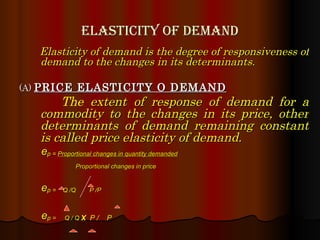
Elasticity of demand Elasticity of demand is the degree of responsiveness of demand to the changes in its determinants. (A)  PRICE ELASTICITY O DEMAND The  extent of response of demand for a commodity to the changes in its price, other determinants of demand remaining constant is called price elasticity of demand.  e p =  Proportional changes in quantity demanded Proportional changes in price   e p =  Q /Q  P /P e p =  Q / Q  X   P /   P e p =  Q /  P  X  P / Q
   Types of price elasticity of demand Perfectly elastic demand Perfectly inelastic demand Relatively elastic demand Relatively inelastic demand Unitary elastic demand      Determinants of price elasticity  of demand - Nature of commodity  - Uses of commodity  - Availability of substitutes  - Durability of commodity - Possibility of postponement  - Income level of consumers - Price range of the product  - Complementary relationship - Knowledge level of consumers  - Frequency of purchase - Proportion of expenditure on the product  - Time period
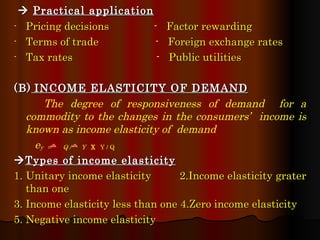
   Practical application Pricing decisions  -  Factor rewarding  Terms of trade  -  Foreign exchange rates  Tax rates  -  Public utilities  (B)   INCOME ELASTICITY OF DEMAND The degree of responsiveness of demand  for a commodity to the changes in the consumers’  income is known as income elasticity of  demand e y   =  Q /  Y  X  Y / Q  Types of income elasticity 1. Unitary income elasticity  2.Income elasticity grater than one 3. Income elasticity less than one 4.Zero income elasticity  5. Negative income elasticity
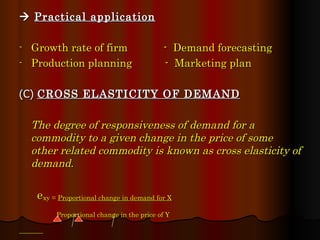
   Practical application Growth rate of firm  -  Demand forecasting  Production planning  -  Marketing plan  (C)  CROSS ELASTICITY OF DEMAND The degree of responsiveness of demand for a commodity to a given change in the price of some other related commodity is known as cross elasticity of demand. e xy =  Proportional change in demand for X Proportional change in the price of Y e xy =  Qx  Py  X   Py  Qx
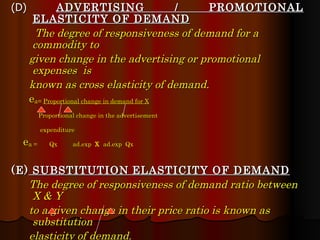
(D)  ADVERTISING / PROMOTIONAL ELASTICITY OF DEMAND The degree of responsiveness of demand for a commodity to given change in the advertising or promotional expenses  is known as cross elasticity of demand. e a=  Proportional change in demand for X Proportional change in the advertisement expenditure e a =  Qx  ad.exp  X   ad.exp  Qx (E)  SUBSTITUTION   ELASTICITY OF DEMAND The degree of responsiveness of demand ratio between X & Y to a given change in their price ratio is known as substitution  elasticity of demand. e s =  Proportional change in the ratio of demand for X & demand for Y Proportional change in the ratio of price of X & price of Y e s =  (Qx / Qy)   (Px / Py) (Qx / Qy)  (Px / Py)
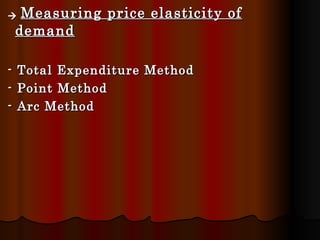
   Measuring price elasticity of demand - Total Expenditure Method  - Point Method - Arc Method
Demand forecasting Demand forecasting is predicting or anticipating the future demand for a product .    Micro level    Industry level    Macro level   USES OF DEMAND FORECASTING DATA Short term demand forecasting   Evolving production policy Determining price policy Evolving purchase policy Fixation of sales targets Short term financial policy Long term demand forecasting Business planning Man power planning Long term financial planning
Individual Demand Analysis
Basis of Individual demand Utility   -   From the commodity point of view - From Consumers’ point of view Approaches to Consumer Demand Analysis Cardinal Utility approach -  Total utility - Marginal utility    LAW OF DIMINISHING MARGINALUTILITY Assumptions underlying cardinality approach - Rationality - Limited money income - maximisation of satisfaction - Utility is cardinally measurable - Diminishing marginal utility - Constant marginal utility of money
Consumer’s equilibrium - One commodity model - Multiple commodity model  – THE LAW OF EQUIMARGINAL UTILITY Ordinal Utility Approach    Assumptions underlying ordinal approach Rationality Ordinal utility Transitivity & consistency in choice Nonsatiety Diminishing marginal rate of substitution Marginal rate of  substitution   -  MRS is the rate at which one commodity can be substituted for another, the level of satisfaction remaining the same.  Diminishing MRS   –  The quantity of a commodity that the quantity of a commodity that a consumer is willing to sacrifice for an additional unit of another goes on decreasing when he goes on substituting one commodity for another. Indifference Curve   - Indifference curve is a locus of points, each representing a different combination of two substitute goods, which yield the same level of utility or satisfaction to the consumer. Indifferent Map
   Properties of Indifference curve Indifference curves have a negative slope Indifference curves are convex to the origin Indifference curves do not intersect with each other Indifference curves are not tangent to one another Upper indifference curve always indicate a higher level of satisfaction    Budgetary constraint  &  The Budget Line The limitedness  of the income acts as a constraint on how high a consumer can ride on his/her indifference map.    Consumer’s Equilibrium

Demand Analysis

  • 1.
  • 2.
    What is Demand?“ Demand means effective desire or want for a commodity which is backed up by the ability (purchasing power) and willingness to pay for it”. Demand = Desire + Ability to pay + Willingness to spend Demand is a relative concept – not absolute It is related to price , time and place. “ The demand for a commodity refers to the amount of it which will be bought per unit of time at a particular price ( in a particular market)”.
  • 3.
    Individual and Marketdemand Individual Demand : Individual demand for a product is the quantity of it a consumer would buy at a given price, during a given period of time. Market demand : Market demand for a product is the total demand of all the buyers in the market taken together at a given price during a given period of time. Demand Schedule: ‘ A tabular statement of price – quantity (demanded) relationship at a given period of time’  Individual demand schedule  Market demand schedule.
  • 4.
    Types of demandIndividual demand & Market demand Demand for capital goods and demand for consumer goods Autonomous demand & Derived demand - Direct & indirect demand Demand for durable & non-durable goods - Replacement demand in case of durable goods Short term demand & Long term demand
  • 5.
    Determinants of DemandPrice of the product Price of the related goods Consumer’s income level Distribution pattern of national income Consumer’s taste and preferences Advertisement of the product Consumer’s expectation about future price and supply position Demonstration effect and Band-Wagon effect Consumer credit facility Demography and growth rate of population General std. of living and spending habits Climatic and weather conditions Customs  Demand Function: It states the (functional/mathematical) relationship between the demand for the product ( dependent variable) and its determinants ( independent variables).
  • 6.
    Law of demandStatement of Law : “ Other things being equal, the higher the price of a commodity, the smaller is the quantity demanded and lower the price, larger the quantity demanded”. Factors behind Law of demand Substitution effect Income effect Utility Maximising behaviour Exceptions to Law of demand Expectation regarding future prices Giffen goods Articles of snob appeal / Veblen effect Consumer’s psychological bias ( about quality and price relationship)
  • 7.
    Changes in quantitydemanded & Changes in demand Changes in quantity demanded is related to law of demand i.e. due to changes in price . When with a fall in price more of a commodity is demanded, there is EXTENSION of demand & when with a rise in price less of a commodity is purchased, there is CONTRACTION of demand. Changes in demand is caused by changes in various other determinants of demand, the price remaining unchanged. When more of a commodity is bought than before at any given price there is INCREASE in demand & when less of a commodity is bought than before at any given price there is DECREASE in demand.
  • 8.
    Elasticity of demandElasticity of demand is the degree of responsiveness of demand to the changes in its determinants. (A) PRICE ELASTICITY O DEMAND The extent of response of demand for a commodity to the changes in its price, other determinants of demand remaining constant is called price elasticity of demand. e p = Proportional changes in quantity demanded Proportional changes in price e p = Q /Q P /P e p = Q / Q X P / P e p = Q / P X P / Q
  • 9.
    Types of price elasticity of demand Perfectly elastic demand Perfectly inelastic demand Relatively elastic demand Relatively inelastic demand Unitary elastic demand  Determinants of price elasticity of demand - Nature of commodity - Uses of commodity - Availability of substitutes - Durability of commodity - Possibility of postponement - Income level of consumers - Price range of the product - Complementary relationship - Knowledge level of consumers - Frequency of purchase - Proportion of expenditure on the product - Time period
  • 10.
    Practical application Pricing decisions - Factor rewarding Terms of trade - Foreign exchange rates Tax rates - Public utilities (B) INCOME ELASTICITY OF DEMAND The degree of responsiveness of demand for a commodity to the changes in the consumers’ income is known as income elasticity of demand e y = Q / Y X Y / Q  Types of income elasticity 1. Unitary income elasticity 2.Income elasticity grater than one 3. Income elasticity less than one 4.Zero income elasticity 5. Negative income elasticity
  • 11.
    Practical application Growth rate of firm - Demand forecasting Production planning - Marketing plan (C) CROSS ELASTICITY OF DEMAND The degree of responsiveness of demand for a commodity to a given change in the price of some other related commodity is known as cross elasticity of demand. e xy = Proportional change in demand for X Proportional change in the price of Y e xy = Qx Py X Py Qx
  • 12.
    (D) ADVERTISING/ PROMOTIONAL ELASTICITY OF DEMAND The degree of responsiveness of demand for a commodity to given change in the advertising or promotional expenses is known as cross elasticity of demand. e a= Proportional change in demand for X Proportional change in the advertisement expenditure e a = Qx ad.exp X ad.exp Qx (E) SUBSTITUTION ELASTICITY OF DEMAND The degree of responsiveness of demand ratio between X & Y to a given change in their price ratio is known as substitution elasticity of demand. e s = Proportional change in the ratio of demand for X & demand for Y Proportional change in the ratio of price of X & price of Y e s = (Qx / Qy) (Px / Py) (Qx / Qy) (Px / Py)
  • 13.
    Measuring price elasticity of demand - Total Expenditure Method - Point Method - Arc Method
  • 14.
    Demand forecasting Demandforecasting is predicting or anticipating the future demand for a product .  Micro level  Industry level  Macro level USES OF DEMAND FORECASTING DATA Short term demand forecasting Evolving production policy Determining price policy Evolving purchase policy Fixation of sales targets Short term financial policy Long term demand forecasting Business planning Man power planning Long term financial planning
  • 15.
  • 16.
    Basis of Individualdemand Utility - From the commodity point of view - From Consumers’ point of view Approaches to Consumer Demand Analysis Cardinal Utility approach - Total utility - Marginal utility  LAW OF DIMINISHING MARGINALUTILITY Assumptions underlying cardinality approach - Rationality - Limited money income - maximisation of satisfaction - Utility is cardinally measurable - Diminishing marginal utility - Constant marginal utility of money
  • 17.
    Consumer’s equilibrium -One commodity model - Multiple commodity model – THE LAW OF EQUIMARGINAL UTILITY Ordinal Utility Approach  Assumptions underlying ordinal approach Rationality Ordinal utility Transitivity & consistency in choice Nonsatiety Diminishing marginal rate of substitution Marginal rate of substitution - MRS is the rate at which one commodity can be substituted for another, the level of satisfaction remaining the same. Diminishing MRS – The quantity of a commodity that the quantity of a commodity that a consumer is willing to sacrifice for an additional unit of another goes on decreasing when he goes on substituting one commodity for another. Indifference Curve - Indifference curve is a locus of points, each representing a different combination of two substitute goods, which yield the same level of utility or satisfaction to the consumer. Indifferent Map
  • 18.
    Properties of Indifference curve Indifference curves have a negative slope Indifference curves are convex to the origin Indifference curves do not intersect with each other Indifference curves are not tangent to one another Upper indifference curve always indicate a higher level of satisfaction  Budgetary constraint & The Budget Line The limitedness of the income acts as a constraint on how high a consumer can ride on his/her indifference map.  Consumer’s Equilibrium