Chapter 5

Elasticity of Demand
Lecture plan











Objectives
Elasticity of demand
Price elasticity of demand
Degrees of price elasticity of demand
Methods of measuring elasticity
Revenue and price elasticity of demand
Income elasticity of demand
Cross elasticity of demand
Promotional elasticity of demand
Importance of elasticity
Objectives







To understand the meaning of responsiveness
of demand to changes in determinants of
demand.
To lay down the degrees of responsiveness of
demand.
To discuss various types of elasticities of
demand.
To learn how to measure elasticity by various
methods.
To understand the relevance and application of
elasticities of demand
Elasticity of Demand


“Elasticity” is a standard measure of the degree of
responsiveness (or sensitivity) of one variable to changes
in another variable.



Elasticity of Demand measures the degree of
responsiveness of demand for a commodity to a given
change in any of the independent variables that influence
demand for that commodity, such as price of the
commodity, price of the other commodities, income, taste,
preferences of the consumer and other factors.



Responsiveness implies the proportion by which the
quantity demanded of a commodity changes, in response
to a given change in any of its determinants .
Elasticity of Demand


Mathematically, it is the percentage change in
quantity demanded of a commodity to a percentage
change in any of the (independent) variables that
determine demand for the commodity.



Four major types of elasticity:



Income elasticity,



Cross elasticity





Price elasticity,

Advertising (or promotional) elasticity.

In order to assess the impact of one variable on demand,
we assume other variables as constant (ceteris paribus)
Price Elasticity of Demand
Price is most important among all the
independent variables that affect the demand for
any commodity.


Hence Price elasticity of demand ( “ep” or “e”) is
considered to be the most important of all types of
elasticity of demand.


Price elasticity of demand means the sensitivity
of quantity demanded of a commodity to a given
change in its own price.

Degrees of Price Elasticity
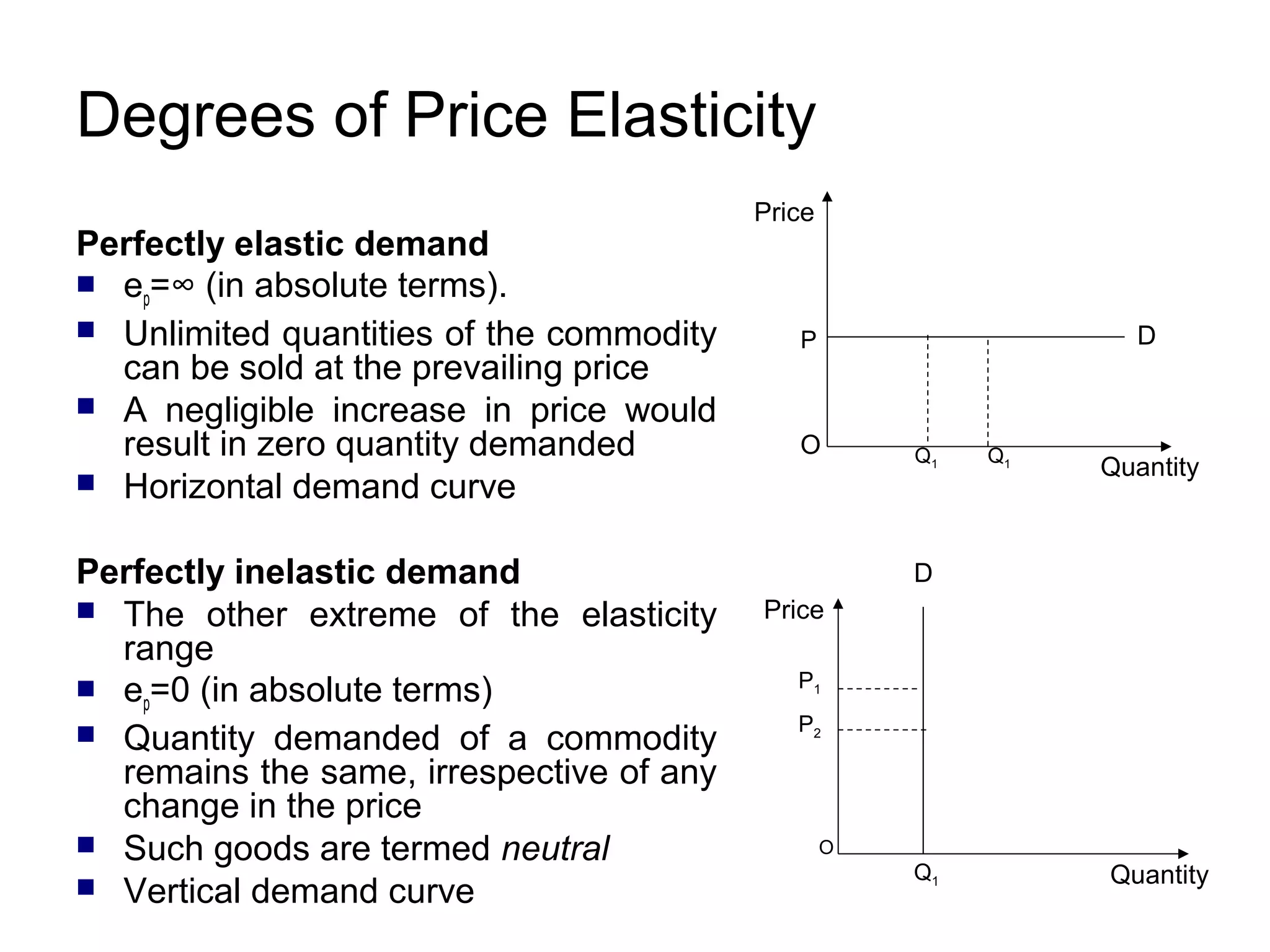
Perfectly elastic demand
 ep=∞ (in absolute terms).
 Unlimited quantities of the commodity
can be sold at the prevailing price
 A negligible increase in price would
result in zero quantity demanded
 Horizontal demand curve
Perfectly inelastic demand
 The other extreme of the elasticity
range
 ep=0 (in absolute terms)
 Quantity demanded of a commodity
remains the same, irrespective of any
change in the price
 Such goods are termed neutral
 Vertical demand curve

Price

D

P

O

Q1

Q1

Quantity

D
Price
P1
P2

O

Q1

Quantity
Degrees of Price Elasticity
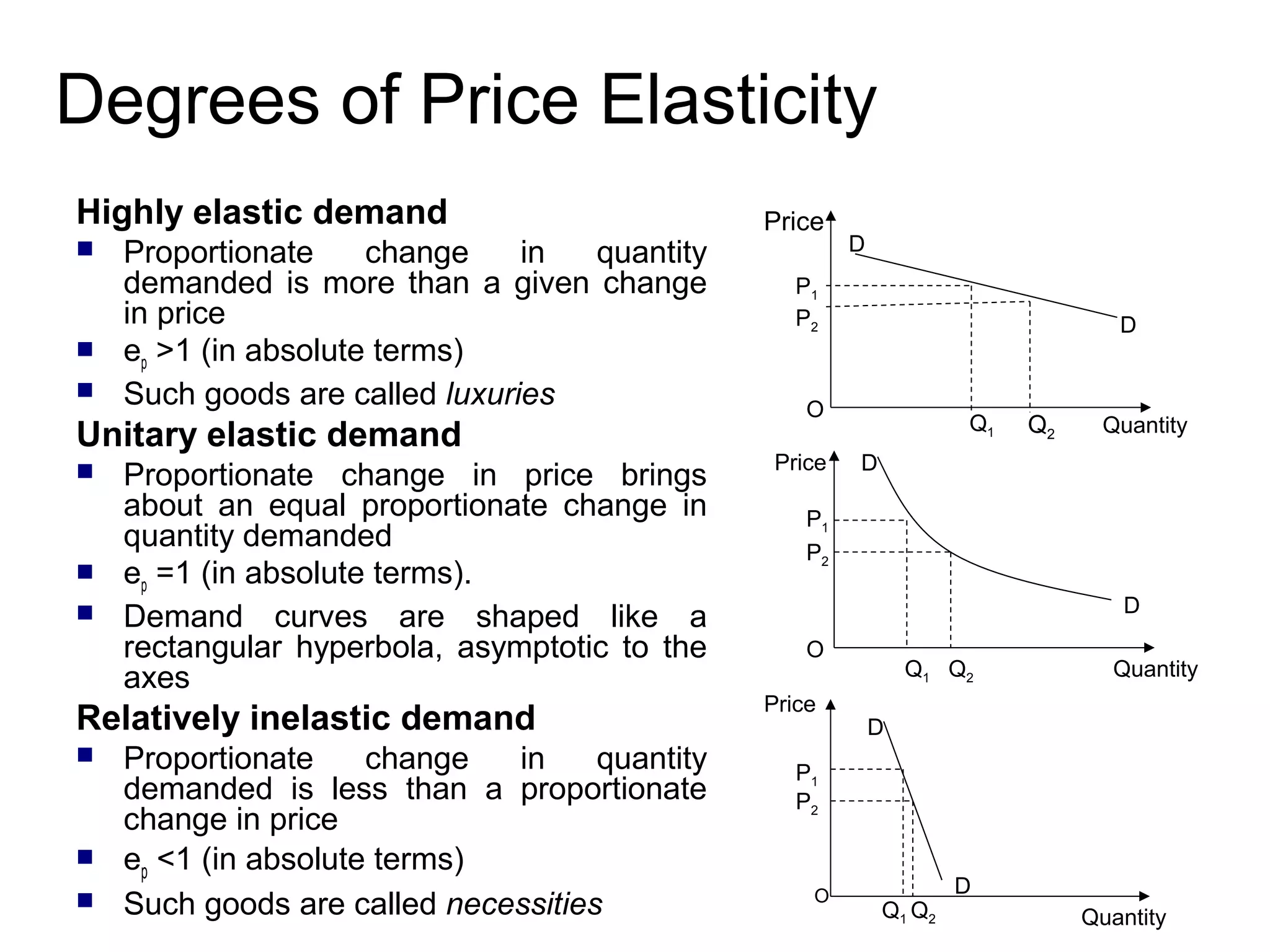
Highly elastic demand





Proportionate
change
in
quantity
demanded is more than a given change
in price
ep >1 (in absolute terms)
Such goods are called luxuries

Unitary elastic demand





Proportionate change in price brings
about an equal proportionate change in
quantity demanded
ep =1 (in absolute terms).
Demand curves are shaped like a
rectangular hyperbola, asymptotic to the
axes

Relatively inelastic demand





Proportionate
change
in
quantity
demanded is less than a proportionate
change in price
ep <1 (in absolute terms)
Such goods are called necessities

Price

D

P1
P2

D

O
Price

Q1

Q2

Quantity

D

P1
P2
D
O
Price

Q1 Q2

Quantity

D

P1
P2

O

Q1 Q2

D
Quantity
Methods of Measuring Elasticity


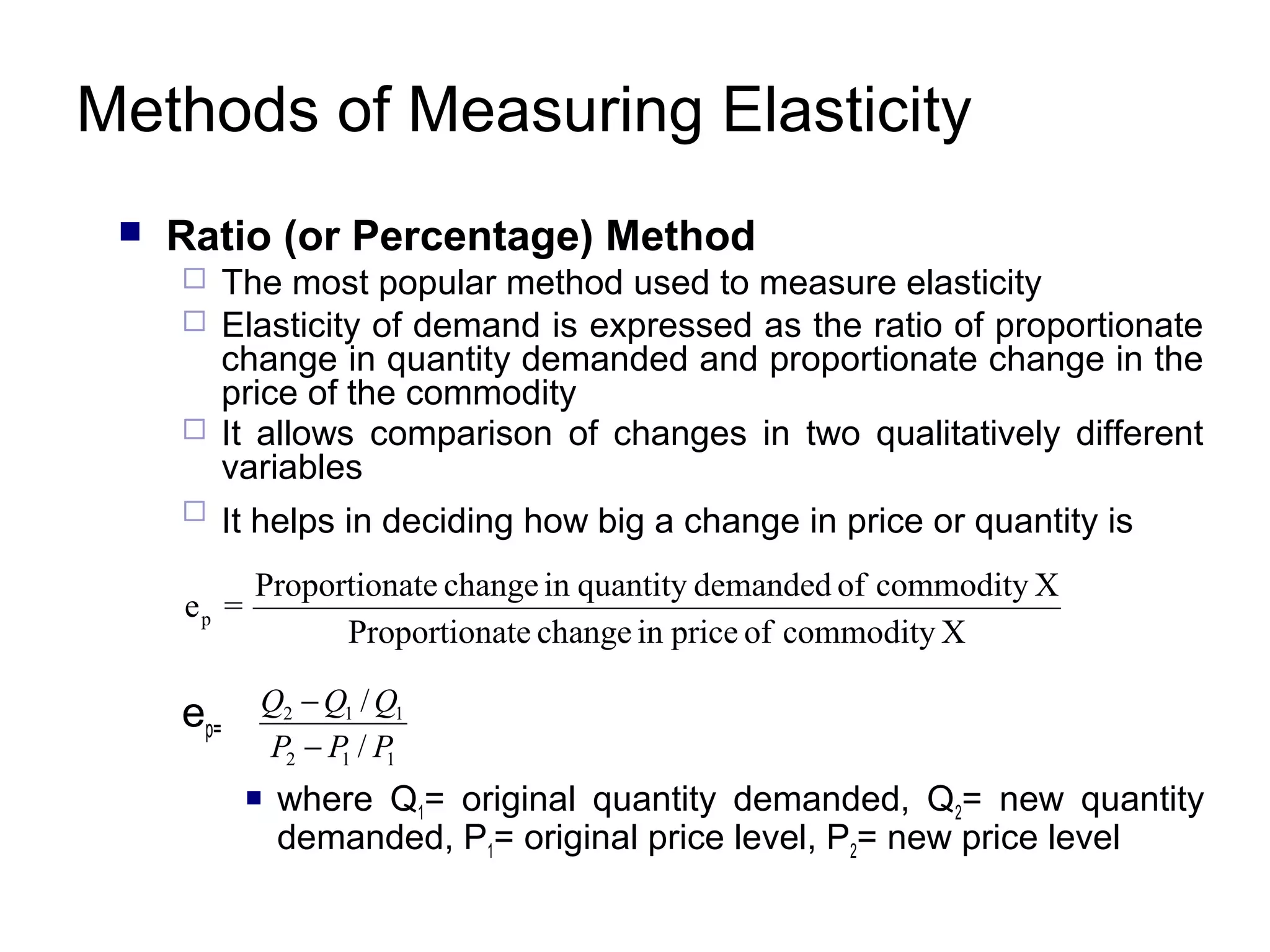
Ratio (or Percentage) Method






The most popular method used to measure elasticity
Elasticity of demand is expressed as the ratio of proportionate
change in quantity demanded and proportionate change in the
price of the commodity
It allows comparison of changes in two qualitatively different
variables
It helps in deciding how big a change in price or quantity is

ep =

Proportionate change in quantity demanded of commodity X
Proportionate change in price of commodity X

ep=

Q2 − Q1 / Q1
P2 − P / P
1
1


where Q1= original quantity demanded, Q2= new quantity
demanded, P1= original price level, P2= new price level
Methods of Measuring Elasticity
Contd…


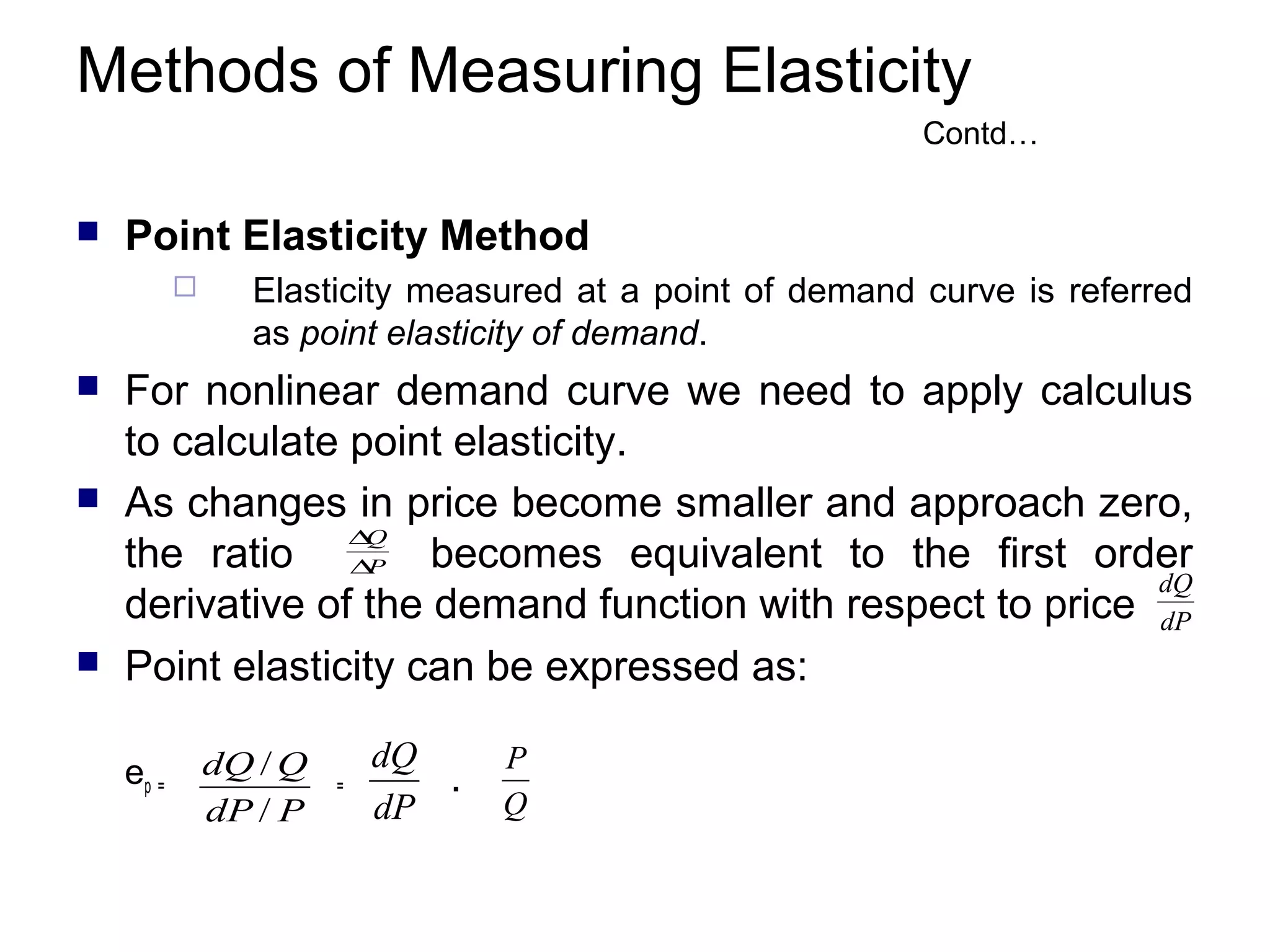
Point Elasticity Method








Elasticity measured at a point of demand curve is referred
as point elasticity of demand.

For nonlinear demand curve we need to apply calculus
to calculate point elasticity.
As changes in price become smaller and approach zero,
∆
Q
the ratio ∆P becomes equivalent to the first order
dQ
derivative of the demand function with respect to price dP
Point elasticity can be expressed as:
ep =

dQ / Q
dP / P

=

dQ
.
dP

P
Q
Methods of Measuring Elasticity
Contd…



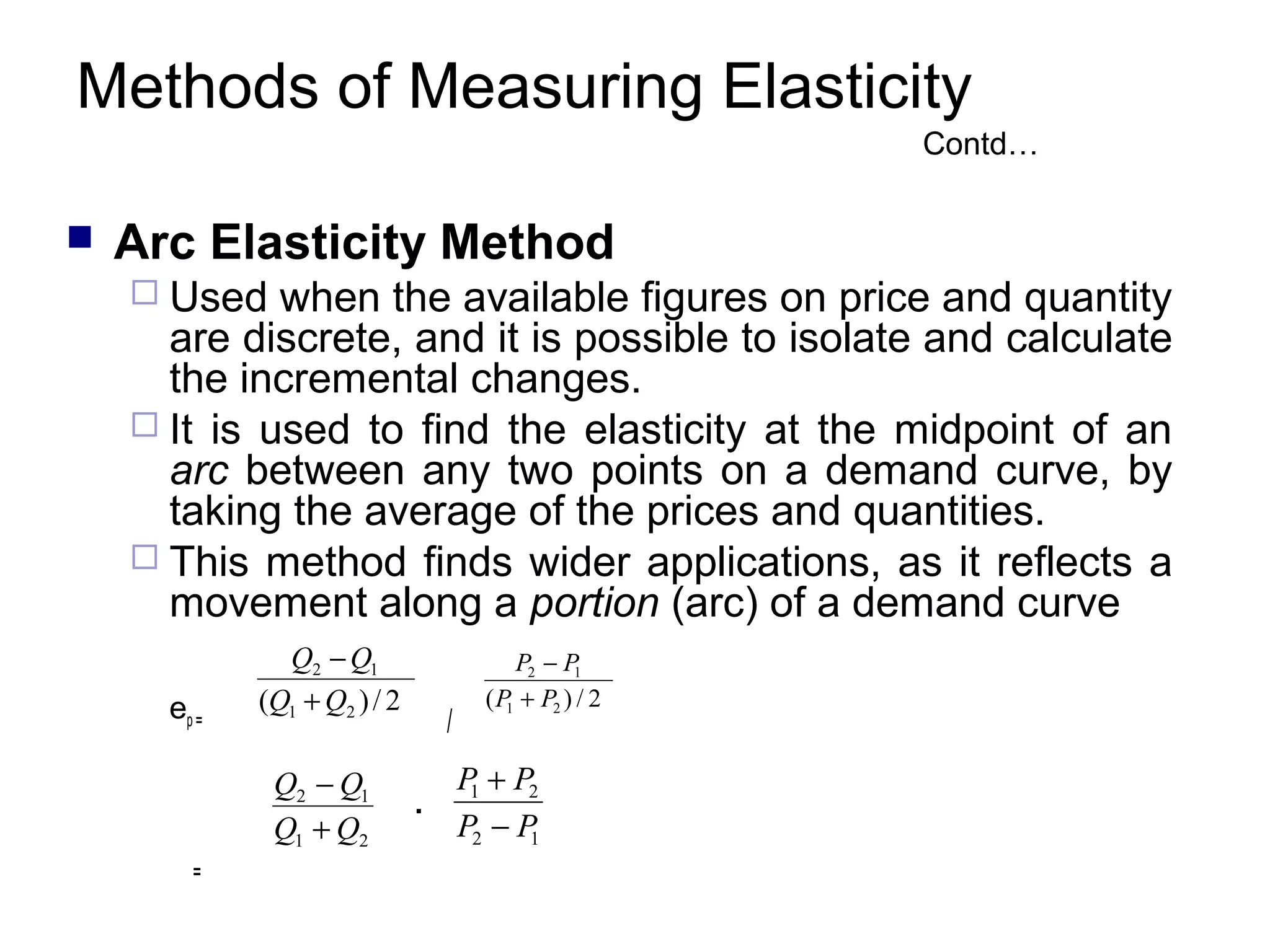
Arc Elasticity Method
 Used

when the available figures on price and quantity
are discrete, and it is possible to isolate and calculate
the incremental changes.
 It is used to find the elasticity at the midpoint of an
arc between any two points on a demand curve, by
taking the average of the prices and quantities.
 This method finds wider applications, as it reflects a
movement along a portion (arc) of a demand curve
ep =

Q2 − Q1
(Q1 + Q2 ) / 2

Q2 − Q1
Q1 + Q2
=

/

.

P2 − P1
( P1 + P2 ) / 2

P + P2
1
P2 − P
1
Methods of Measuring Elasticity


Contd…

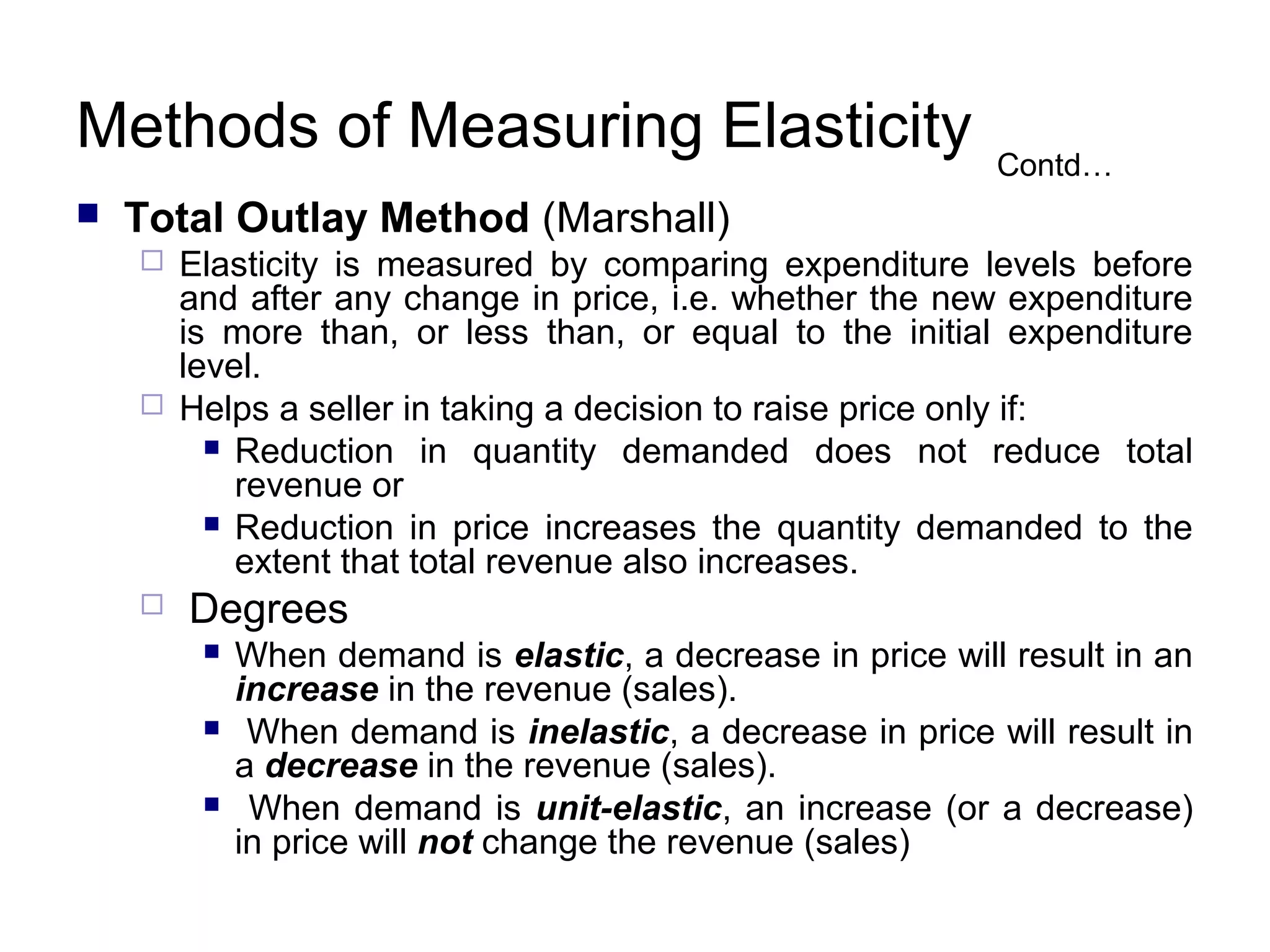
Total Outlay Method (Marshall)






Elasticity is measured by comparing expenditure levels before
and after any change in price, i.e. whether the new expenditure
is more than, or less than, or equal to the initial expenditure
level.
Helps a seller in taking a decision to raise price only if:
 Reduction in quantity demanded does not reduce total
revenue or
 Reduction in price increases the quantity demanded to the
extent that total revenue also increases.

Degrees




When demand is elastic, a decrease in price will result in an
increase in the revenue (sales).
When demand is inelastic, a decrease in price will result in
a decrease in the revenue (sales).
When demand is unit-elastic, an increase (or a decrease)
in price will not change the revenue (sales)
Determinants of Price Elasticity of
Demand


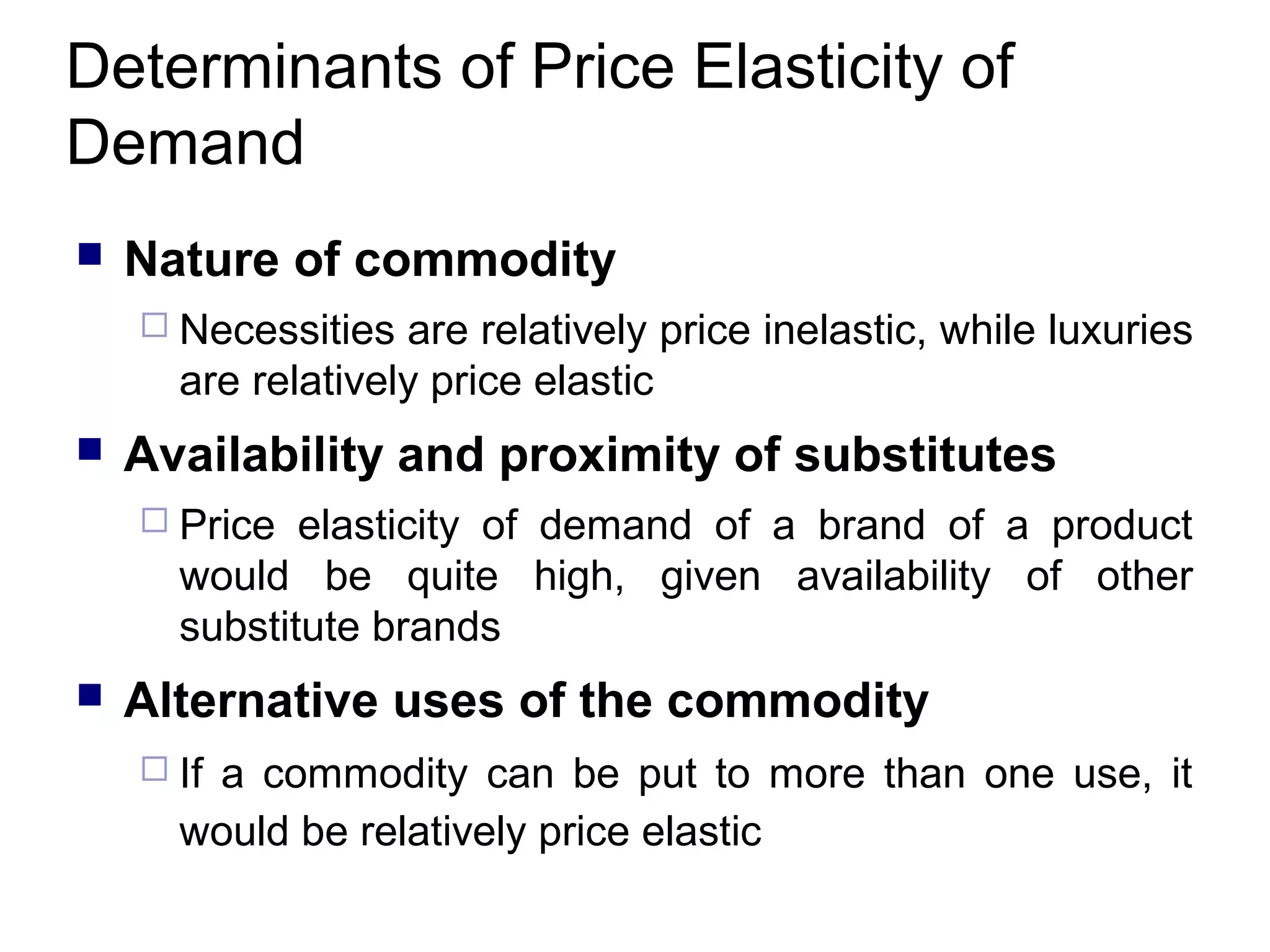
Nature of commodity
 Necessities

are relatively price inelastic, while luxuries
are relatively price elastic



Availability and proximity of substitutes
 Price

elasticity of demand of a brand of a product
would be quite high, given availability of other
substitute brands



Alternative uses of the commodity
 If

a commodity can be put to more than one use, it
would be relatively price elastic
Determinants of Price Elasticity of
Demand


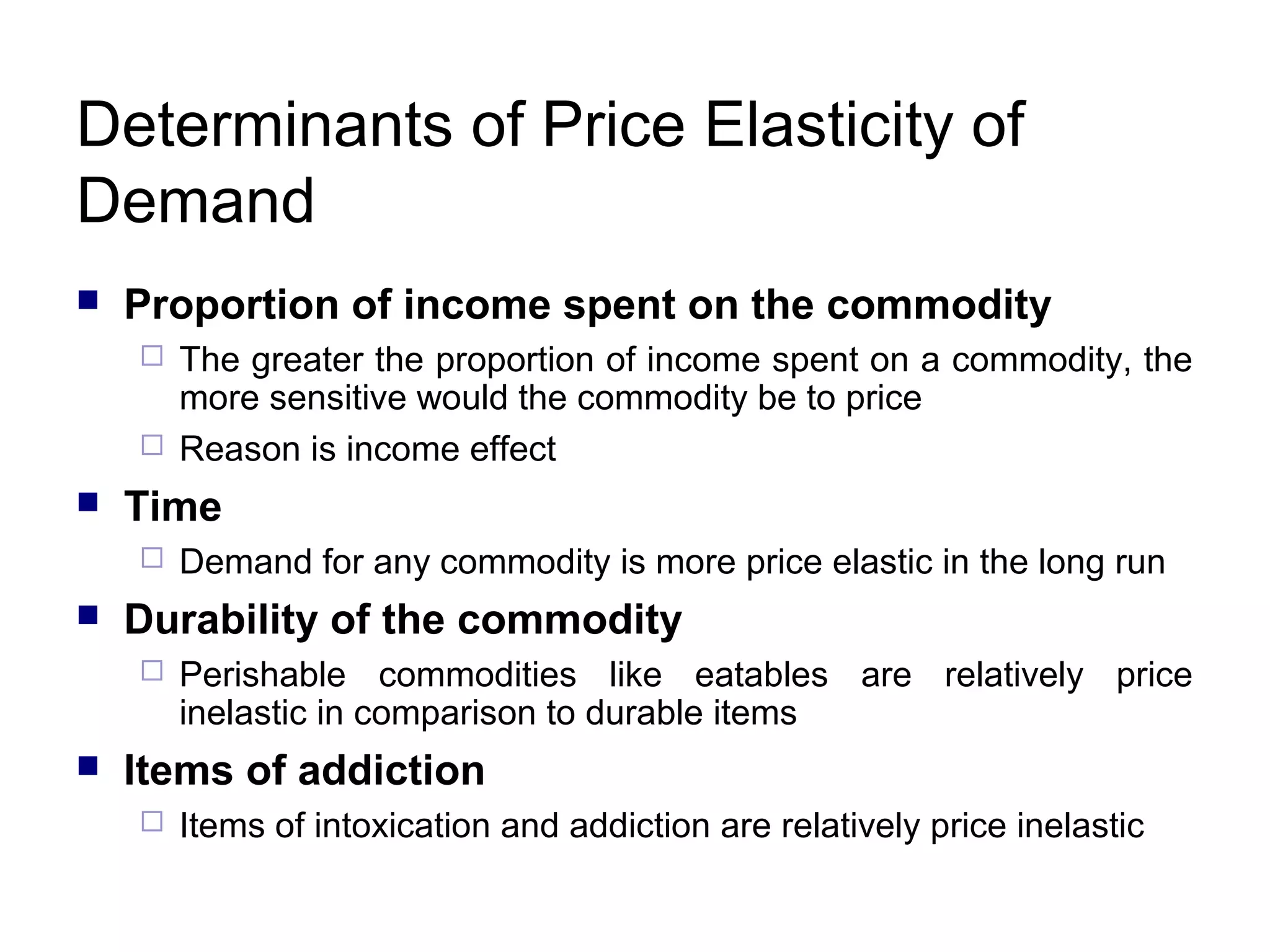
Proportion of income spent on the commodity





Time




Demand for any commodity is more price elastic in the long run

Durability of the commodity




The greater the proportion of income spent on a commodity, the
more sensitive would the commodity be to price
Reason is income effect

Perishable commodities like eatables are relatively price
inelastic in comparison to durable items

Items of addiction


Items of intoxication and addiction are relatively price inelastic
Revenue and Price Elasticity of
Demand




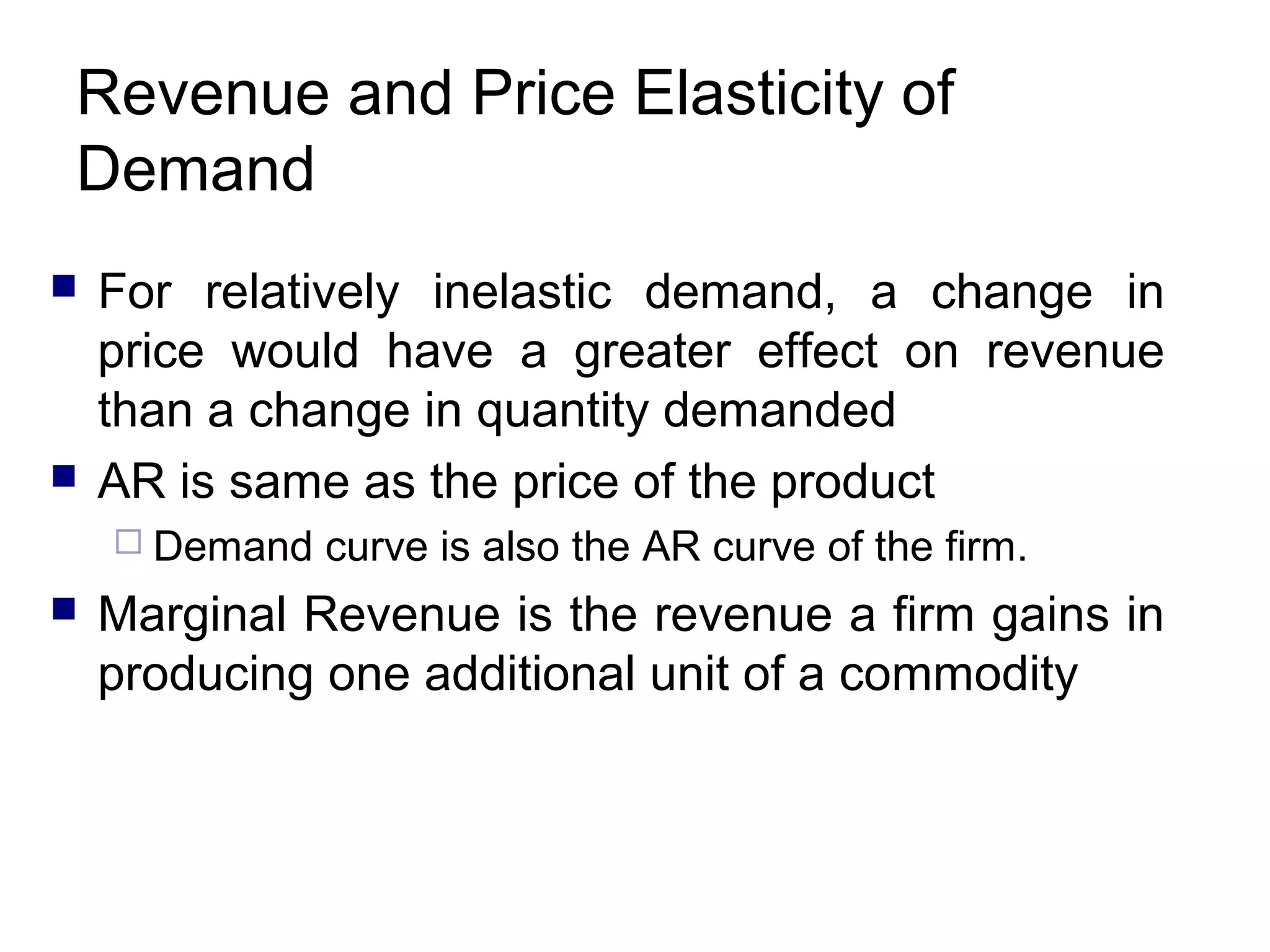
For relatively inelastic demand, a change in
price would have a greater effect on revenue
than a change in quantity demanded
AR is same as the price of the product
 Demand



curve is also the AR curve of the firm.

Marginal Revenue is the revenue a firm gains in
producing one additional unit of a commodity
Revenue and Price Elasticity of
Demand







Till ep>1 MR is
positive and TR is
rising
At the midpoint of
the demand curve,
ep=1 and MR is
equal to 0 and TR
is at its peak
When ep<1, MR is
negative
MR= AR[1- ep]

Price,
Revenue ep=∞
ep>1
ep=1
ep<1
ep=0

O
Price,
Revenue

O

Quantity

MR

TR

Quantity
Income Elasticity of Demand (ey)
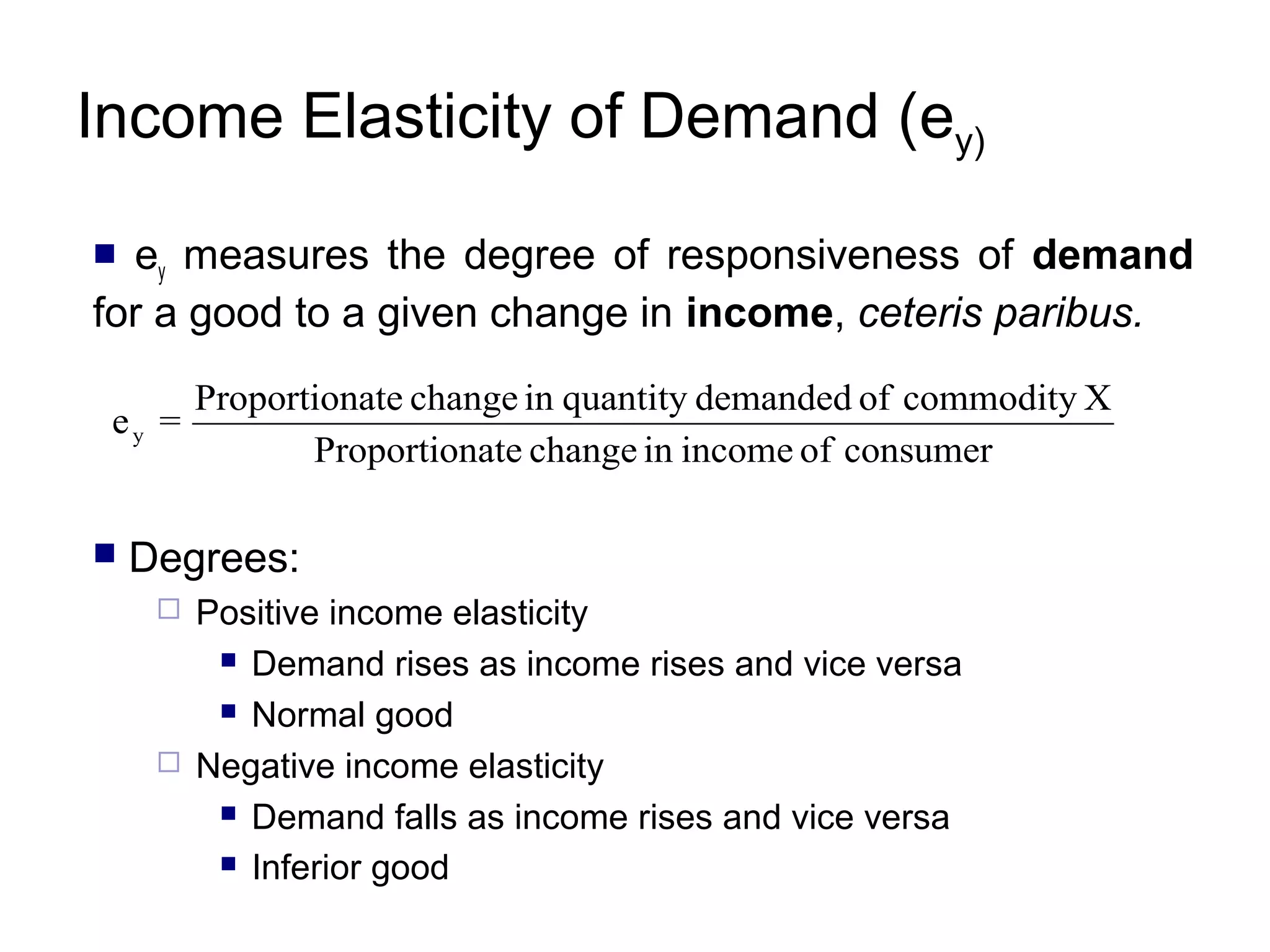
ey measures the degree of responsiveness of demand
for a good to a given change in income, ceteris paribus.


ey =


Proportionate change in quantity demanded of commodity X
Proportionate change in income of consumer

Degrees:




Positive income elasticity
 Demand rises as income rises and vice versa
 Normal good
Negative income elasticity
 Demand falls as income rises and vice versa
 Inferior good
Cross Elasticity of Demand


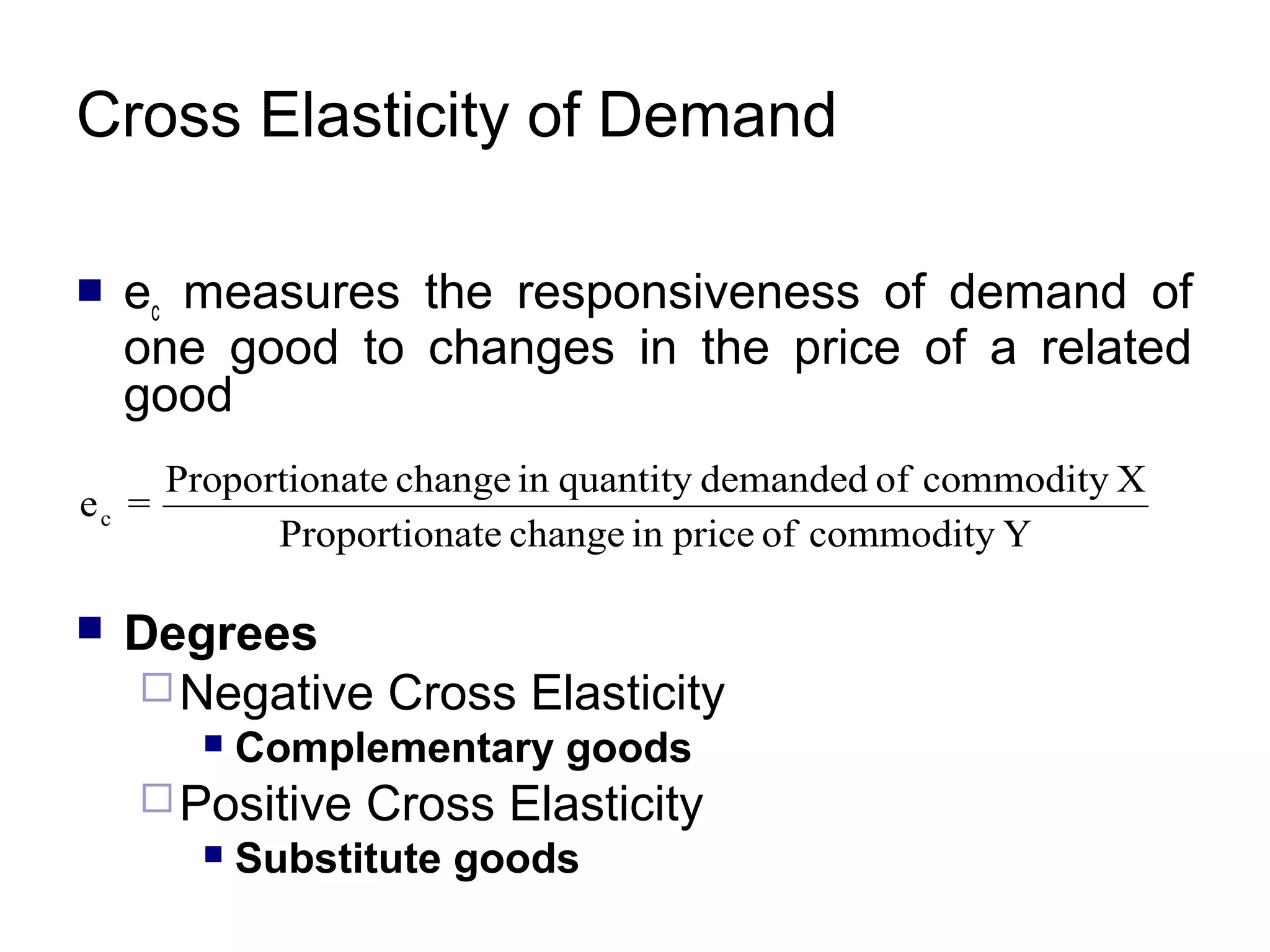
ec measures the responsiveness of demand of
one good to changes in the price of a related
good

Proportionate change in quantity demanded of commodity X
ec =
Proportionate change in price of commodity Y


Degrees
 Negative Cross Elasticity


Complementary goods

 Positive


Cross Elasticity

Substitute goods
Promotional Elasticity of Demand




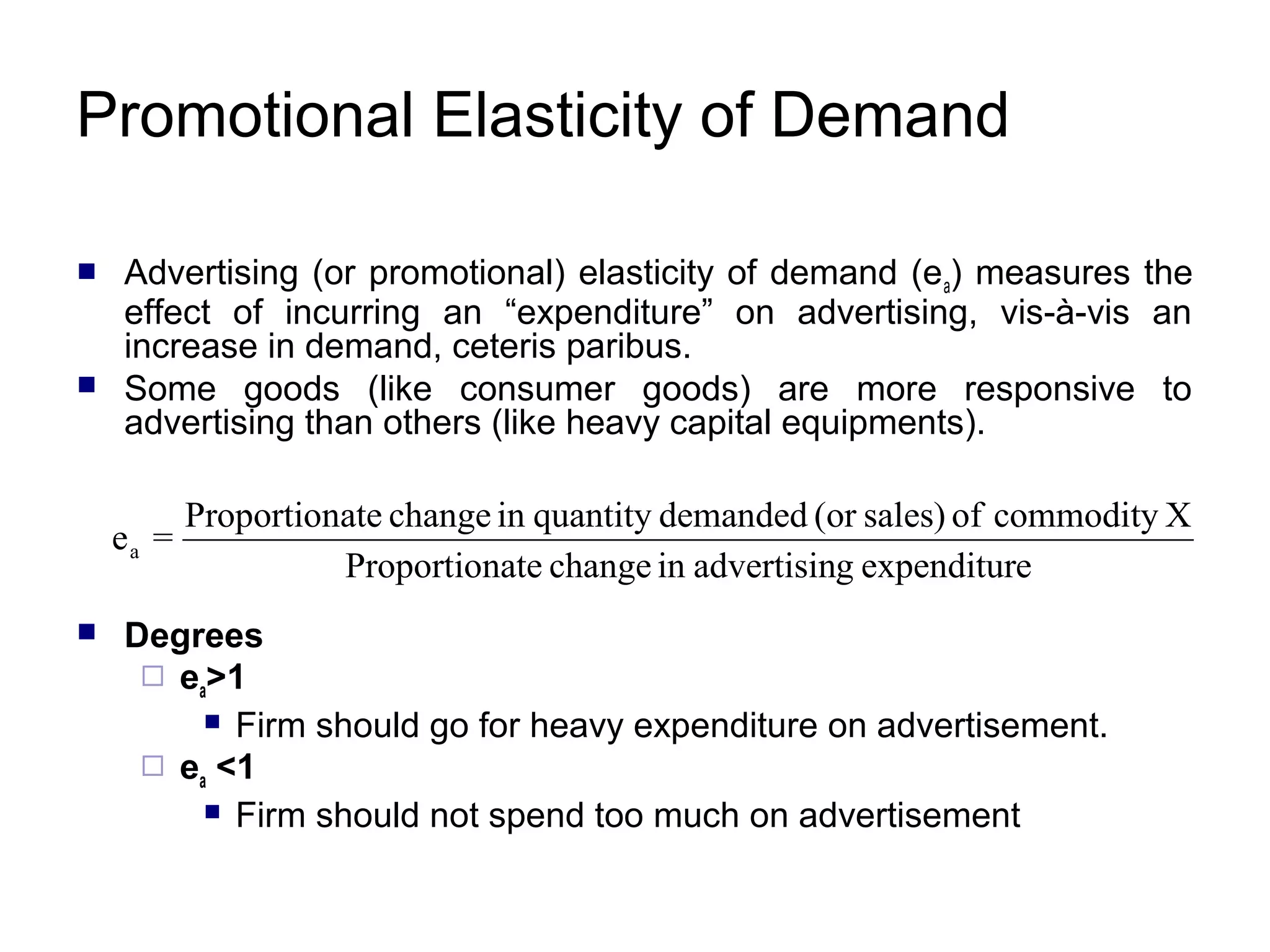
Advertising (or promotional) elasticity of demand (e a) measures the
effect of incurring an “expenditure” on advertising, vis-à-vis an
increase in demand, ceteris paribus.
Some goods (like consumer goods) are more responsive to
advertising than others (like heavy capital equipments).

ea =


Proportionate change in quantity demanded (or sales) of commodity X
Proportionate change in advertising expenditure

Degrees
 ea>1
 Firm should go for heavy expenditure on advertisement.
 ea <1
 Firm should not spend too much on advertisement
Importance of Elasticity


Determination of price




Basis of price discrimination




Products having elastic demand may be sold at lower price,
while those having inelastic demand may be sold at high prices

Determination of rewards of factors of production




Elasticity is the basis of determining the price of a product
keeping its possible effects on the demand of the product in
perspective

Factors having inelastic demand are rewarded more than factors
that have relatively elastic demand.

Government policies of taxation


Goods having relatively elastic demand are taxed less than
those having relatively inelastic demand.
Summary
 Elasticity of demand measures the degree of responsiveness of the

quantity demanded of a commodity to a given change in any of the
independent variables that influence demand for that commodity.
Price elasticity of demand (ep) measures the degree of responsiveness
of the quantity demanded of a commodity to a given change in its
price, other things remaining the same.
By the percentage method ep is expressed as the ratio of proportionate
change in quantity demanded and proportionate change in price of the
commodity.
As per the total outlay method elasticity is measured by comparing
expenditure levels before and after any change in price, i.e. whether
the new expenditure is more than, or less than, or equal to the initial
expenditure level.
Arc elasticity is used to calculate price elasticity of demand at the
midpoint of an arc between any two points on the demand curve, by
taking the average of the prices and quantities; point elasticity can be
approximated by calculating the arc elasticity for a very small arc on
the demand curve.
Summary











If the demand curve is a straight line, price elasticity of demand
at different points of the demand curve can be calculated by the
ratio of the lower segment and upper segment of the demand
curve.
MR= AR[1- ep]
Income elasticity of demand (ey) measures the degree of
responsiveness of the quantity demanded of a commodity to a
given change in consumer’s income. For normal goods e y is
positive; for neutral goods ey is zero; for inferior goods ey is
negative.
Cross elasticity of demand (ec) shows how changes in prices of
other goods would affect the demand for a particular good. For
substitutes ec is positive; and for complements ec is negative.
Advertising (or promotional) elasticity of demand (e a) measures
the effect of incurring an “expenditure” on advertising of a firm on
the demand for its product at constant price.
Elasticity is used for determination of right price by seller and for
taxation by government.

Elasticity of demand

  • 1.
  • 2.
    Lecture plan           Objectives Elasticity ofdemand Price elasticity of demand Degrees of price elasticity of demand Methods of measuring elasticity Revenue and price elasticity of demand Income elasticity of demand Cross elasticity of demand Promotional elasticity of demand Importance of elasticity
  • 3.
    Objectives      To understand themeaning of responsiveness of demand to changes in determinants of demand. To lay down the degrees of responsiveness of demand. To discuss various types of elasticities of demand. To learn how to measure elasticity by various methods. To understand the relevance and application of elasticities of demand
  • 4.
    Elasticity of Demand  “Elasticity”is a standard measure of the degree of responsiveness (or sensitivity) of one variable to changes in another variable.  Elasticity of Demand measures the degree of responsiveness of demand for a commodity to a given change in any of the independent variables that influence demand for that commodity, such as price of the commodity, price of the other commodities, income, taste, preferences of the consumer and other factors.  Responsiveness implies the proportion by which the quantity demanded of a commodity changes, in response to a given change in any of its determinants .
  • 5.
    Elasticity of Demand  Mathematically,it is the percentage change in quantity demanded of a commodity to a percentage change in any of the (independent) variables that determine demand for the commodity.  Four major types of elasticity:   Income elasticity,  Cross elasticity   Price elasticity, Advertising (or promotional) elasticity. In order to assess the impact of one variable on demand, we assume other variables as constant (ceteris paribus)
  • 6.
    Price Elasticity ofDemand Price is most important among all the independent variables that affect the demand for any commodity.  Hence Price elasticity of demand ( “ep” or “e”) is considered to be the most important of all types of elasticity of demand.  Price elasticity of demand means the sensitivity of quantity demanded of a commodity to a given change in its own price. 
  • 7.
    Degrees of PriceElasticity Perfectly elastic demand  ep=∞ (in absolute terms).  Unlimited quantities of the commodity can be sold at the prevailing price  A negligible increase in price would result in zero quantity demanded  Horizontal demand curve Perfectly inelastic demand  The other extreme of the elasticity range  ep=0 (in absolute terms)  Quantity demanded of a commodity remains the same, irrespective of any change in the price  Such goods are termed neutral  Vertical demand curve Price D P O Q1 Q1 Quantity D Price P1 P2 O Q1 Quantity
  • 8.
    Degrees of PriceElasticity Highly elastic demand    Proportionate change in quantity demanded is more than a given change in price ep >1 (in absolute terms) Such goods are called luxuries Unitary elastic demand    Proportionate change in price brings about an equal proportionate change in quantity demanded ep =1 (in absolute terms). Demand curves are shaped like a rectangular hyperbola, asymptotic to the axes Relatively inelastic demand    Proportionate change in quantity demanded is less than a proportionate change in price ep <1 (in absolute terms) Such goods are called necessities Price D P1 P2 D O Price Q1 Q2 Quantity D P1 P2 D O Price Q1 Q2 Quantity D P1 P2 O Q1 Q2 D Quantity
  • 9.
    Methods of MeasuringElasticity  Ratio (or Percentage) Method     The most popular method used to measure elasticity Elasticity of demand is expressed as the ratio of proportionate change in quantity demanded and proportionate change in the price of the commodity It allows comparison of changes in two qualitatively different variables It helps in deciding how big a change in price or quantity is ep = Proportionate change in quantity demanded of commodity X Proportionate change in price of commodity X ep= Q2 − Q1 / Q1 P2 − P / P 1 1  where Q1= original quantity demanded, Q2= new quantity demanded, P1= original price level, P2= new price level
  • 10.
    Methods of MeasuringElasticity Contd…  Point Elasticity Method     Elasticity measured at a point of demand curve is referred as point elasticity of demand. For nonlinear demand curve we need to apply calculus to calculate point elasticity. As changes in price become smaller and approach zero, ∆ Q the ratio ∆P becomes equivalent to the first order dQ derivative of the demand function with respect to price dP Point elasticity can be expressed as: ep = dQ / Q dP / P = dQ . dP P Q
  • 11.
    Methods of MeasuringElasticity Contd…  Arc Elasticity Method  Used when the available figures on price and quantity are discrete, and it is possible to isolate and calculate the incremental changes.  It is used to find the elasticity at the midpoint of an arc between any two points on a demand curve, by taking the average of the prices and quantities.  This method finds wider applications, as it reflects a movement along a portion (arc) of a demand curve ep = Q2 − Q1 (Q1 + Q2 ) / 2 Q2 − Q1 Q1 + Q2 = / . P2 − P1 ( P1 + P2 ) / 2 P + P2 1 P2 − P 1
  • 12.
    Methods of MeasuringElasticity  Contd… Total Outlay Method (Marshall)    Elasticity is measured by comparing expenditure levels before and after any change in price, i.e. whether the new expenditure is more than, or less than, or equal to the initial expenditure level. Helps a seller in taking a decision to raise price only if:  Reduction in quantity demanded does not reduce total revenue or  Reduction in price increases the quantity demanded to the extent that total revenue also increases. Degrees    When demand is elastic, a decrease in price will result in an increase in the revenue (sales). When demand is inelastic, a decrease in price will result in a decrease in the revenue (sales). When demand is unit-elastic, an increase (or a decrease) in price will not change the revenue (sales)
  • 13.
    Determinants of PriceElasticity of Demand  Nature of commodity  Necessities are relatively price inelastic, while luxuries are relatively price elastic  Availability and proximity of substitutes  Price elasticity of demand of a brand of a product would be quite high, given availability of other substitute brands  Alternative uses of the commodity  If a commodity can be put to more than one use, it would be relatively price elastic
  • 14.
    Determinants of PriceElasticity of Demand  Proportion of income spent on the commodity    Time   Demand for any commodity is more price elastic in the long run Durability of the commodity   The greater the proportion of income spent on a commodity, the more sensitive would the commodity be to price Reason is income effect Perishable commodities like eatables are relatively price inelastic in comparison to durable items Items of addiction  Items of intoxication and addiction are relatively price inelastic
  • 15.
    Revenue and PriceElasticity of Demand   For relatively inelastic demand, a change in price would have a greater effect on revenue than a change in quantity demanded AR is same as the price of the product  Demand  curve is also the AR curve of the firm. Marginal Revenue is the revenue a firm gains in producing one additional unit of a commodity
  • 16.
    Revenue and PriceElasticity of Demand     Till ep>1 MR is positive and TR is rising At the midpoint of the demand curve, ep=1 and MR is equal to 0 and TR is at its peak When ep<1, MR is negative MR= AR[1- ep] Price, Revenue ep=∞ ep>1 ep=1 ep<1 ep=0 O Price, Revenue O Quantity MR TR Quantity
  • 17.
    Income Elasticity ofDemand (ey) ey measures the degree of responsiveness of demand for a good to a given change in income, ceteris paribus.  ey =  Proportionate change in quantity demanded of commodity X Proportionate change in income of consumer Degrees:   Positive income elasticity  Demand rises as income rises and vice versa  Normal good Negative income elasticity  Demand falls as income rises and vice versa  Inferior good
  • 18.
    Cross Elasticity ofDemand  ec measures the responsiveness of demand of one good to changes in the price of a related good Proportionate change in quantity demanded of commodity X ec = Proportionate change in price of commodity Y  Degrees  Negative Cross Elasticity  Complementary goods  Positive  Cross Elasticity Substitute goods
  • 19.
    Promotional Elasticity ofDemand   Advertising (or promotional) elasticity of demand (e a) measures the effect of incurring an “expenditure” on advertising, vis-à-vis an increase in demand, ceteris paribus. Some goods (like consumer goods) are more responsive to advertising than others (like heavy capital equipments). ea =  Proportionate change in quantity demanded (or sales) of commodity X Proportionate change in advertising expenditure Degrees  ea>1  Firm should go for heavy expenditure on advertisement.  ea <1  Firm should not spend too much on advertisement
  • 20.
    Importance of Elasticity  Determinationof price   Basis of price discrimination   Products having elastic demand may be sold at lower price, while those having inelastic demand may be sold at high prices Determination of rewards of factors of production   Elasticity is the basis of determining the price of a product keeping its possible effects on the demand of the product in perspective Factors having inelastic demand are rewarded more than factors that have relatively elastic demand. Government policies of taxation  Goods having relatively elastic demand are taxed less than those having relatively inelastic demand.
  • 21.
    Summary  Elasticity ofdemand measures the degree of responsiveness of the quantity demanded of a commodity to a given change in any of the independent variables that influence demand for that commodity. Price elasticity of demand (ep) measures the degree of responsiveness of the quantity demanded of a commodity to a given change in its price, other things remaining the same. By the percentage method ep is expressed as the ratio of proportionate change in quantity demanded and proportionate change in price of the commodity. As per the total outlay method elasticity is measured by comparing expenditure levels before and after any change in price, i.e. whether the new expenditure is more than, or less than, or equal to the initial expenditure level. Arc elasticity is used to calculate price elasticity of demand at the midpoint of an arc between any two points on the demand curve, by taking the average of the prices and quantities; point elasticity can be approximated by calculating the arc elasticity for a very small arc on the demand curve.
  • 22.
    Summary       If the demandcurve is a straight line, price elasticity of demand at different points of the demand curve can be calculated by the ratio of the lower segment and upper segment of the demand curve. MR= AR[1- ep] Income elasticity of demand (ey) measures the degree of responsiveness of the quantity demanded of a commodity to a given change in consumer’s income. For normal goods e y is positive; for neutral goods ey is zero; for inferior goods ey is negative. Cross elasticity of demand (ec) shows how changes in prices of other goods would affect the demand for a particular good. For substitutes ec is positive; and for complements ec is negative. Advertising (or promotional) elasticity of demand (e a) measures the effect of incurring an “expenditure” on advertising of a firm on the demand for its product at constant price. Elasticity is used for determination of right price by seller and for taxation by government.

Editor's Notes

  • #21 This slide also has an automatic response with ten second gaps in between each point. At this stage we have tried to keep things as simple as possible but to introduce issues that will be dealt with later in the course.