Demand
Definition of Demand
 Demand in economics is the consumer's desire and ability to purchase a good or
service. It's the underlying force that drives economic growth and expansion.
Without demand, no business would ever bother producing anything.
 Demand can mean either market demand for a specific good or aggregate
demand for the total of all goods in an economy.
 Types of Demand
1. Price demand
2. Income demand
3. Cross demand
Law of demand
 The law of demand states that as price increases (decreases) consumers will
purchase less (more) of the specific commodity, ceteris paribus. In other words,
there is an inverse relationship between the quantity demanded and the price of
a particular commodity.
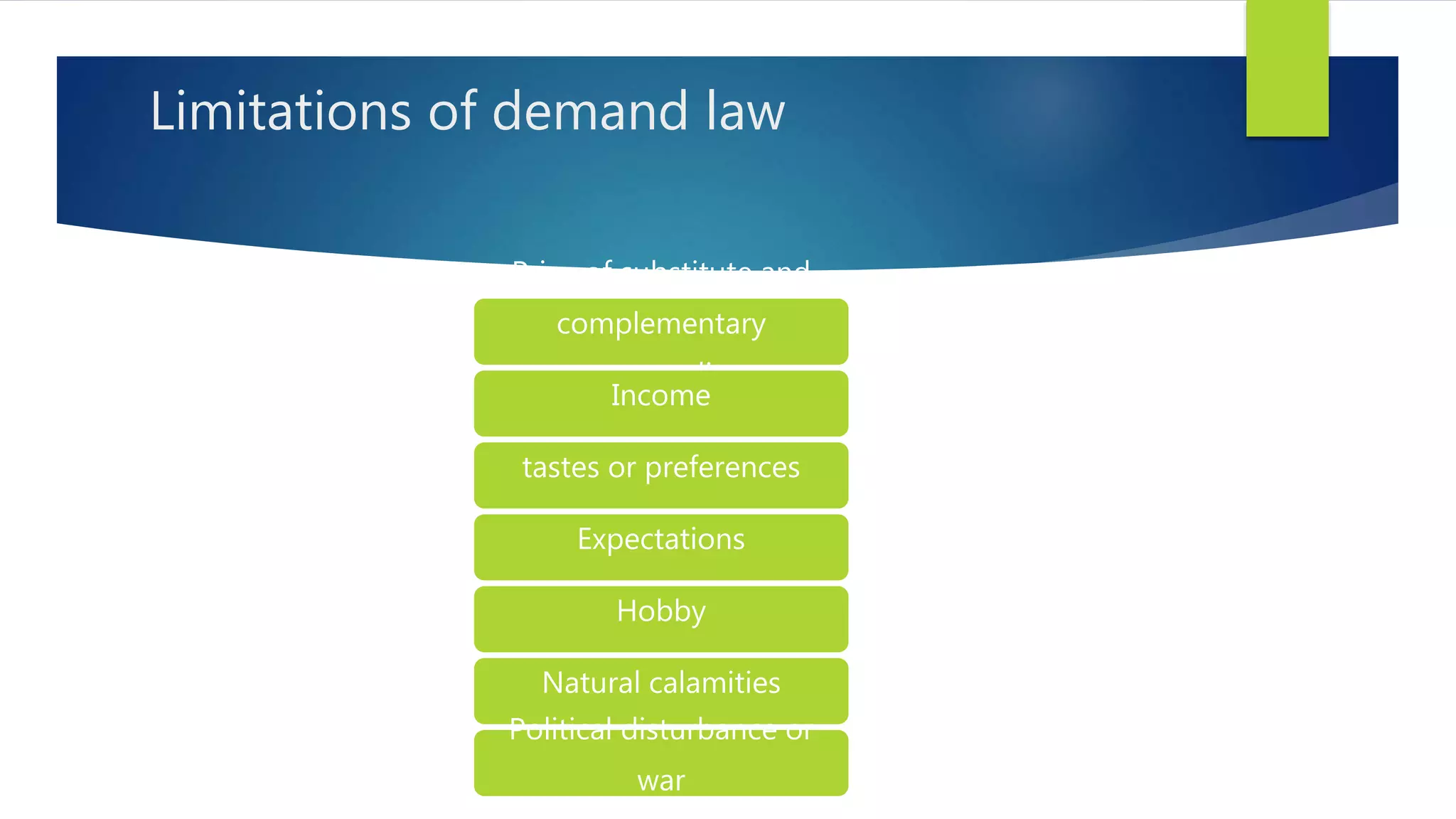
Limitations of demand law
Price of substitute and
complementary
commodity
Income
tastes or preferences
Expectations
Hobby
Natural calamities
Political disturbance or
war
Demand Schedule
Price of X product Quantity of X product
10 60
15 50
20 40
25 30
30 20
35 10
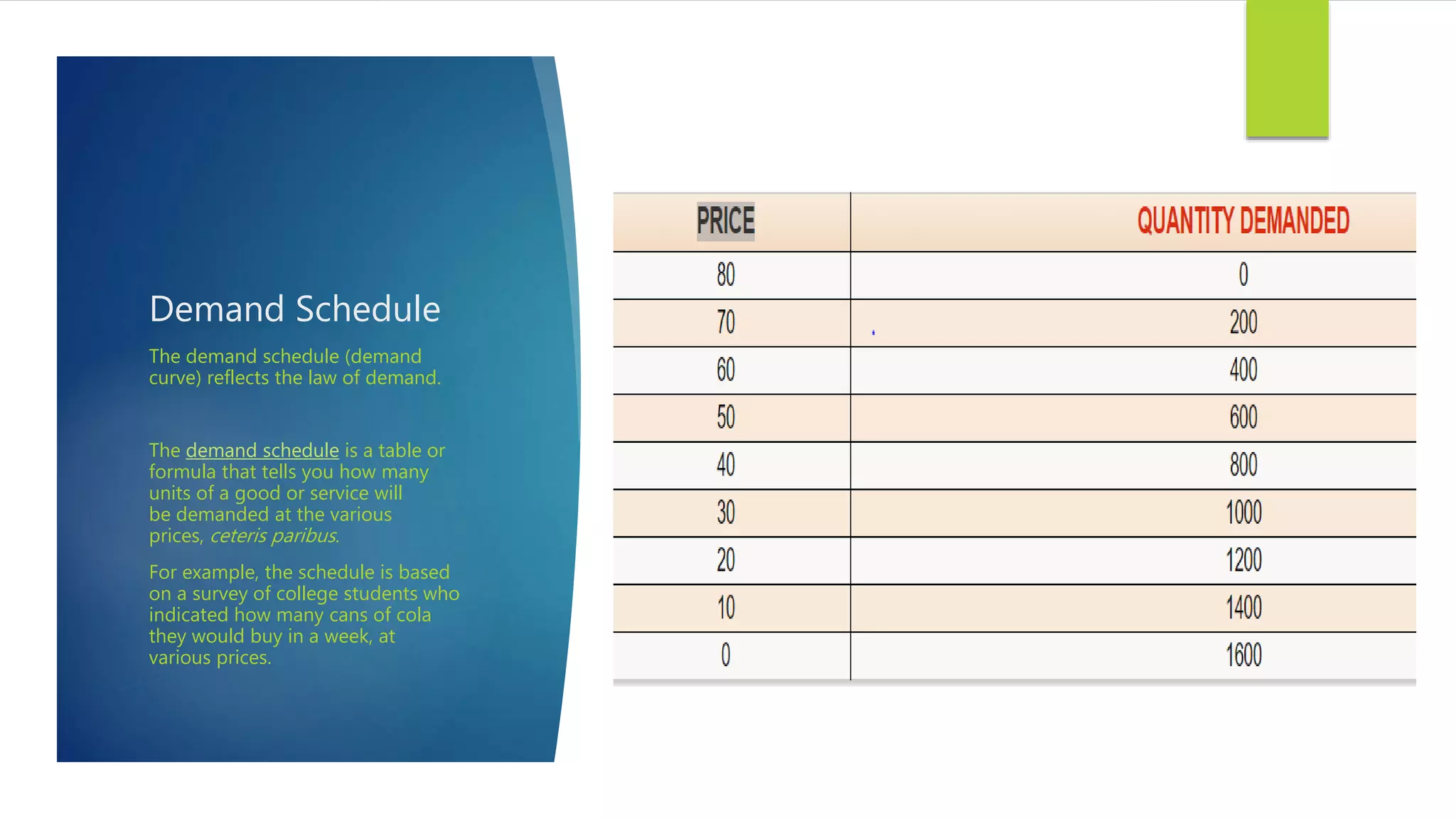
The demand schedule (demand
curve) reflects the law of demand.
The demand schedule is a table or
formula that tells you how many
units of a good or service will
be demanded at the various
prices, ceteris paribus.
For example, the schedule is based
on a survey of college students who
indicated how many cans of cola
they would buy in a week, at
various prices.
Demand curve
In economics, a demand curve is a
graph depicting the relationship
between the price of a certain
commodity and the quantity of that
commodity that is demanded at that
price.
the demand function is Qd = 1600 –
20p. From this we can arrive at the
intersepts for the graph – in this
equation, p = 80 – i.e. {when Qd is
zero, p must be 80 to make bP 1600}
and a = 1600, so the intersepts are
p=80 and Qd= 1600. We can then
solve for any points along the curve.
For example, if we make p=40, then
Qd = 1600 – 40×20, which is 1600 –
800, which is 800, and so on..
Why demand curve slopes downward?
There are at least three accepted explanations of why demand curves slope downwards:
1. The law of diminishing marginal utility: This law suggests that as more of a product is
consumed the marginal (additional) benefit to the consumer falls, hence consumers are
prepared to pay less.
2. The income effect: If we assume that money income is fixed, the income effect
suggests that, as the price of a good falls, real income – that is, what consumers can buy
with their money income – rises and consumers increase their demand.
3. substitution effect: as the price of one good falls, it becomes relatively less expensive.
Therefore, assuming other alternative products stay at the same price, at lower prices the
good appears cheaper, and consumers will switch from the expensive alternative to the
relatively cheaper one.
Extension & Contraction of demand
 Changes in the price of a commodity causes movements along the demand
curve; such movements are called changes in the quantity demanded.
 If price decreases, then we move down and to the right along the demand curve;
this is an increase in the quantity demanded which is known as extension of
demand.
 If price increases, then we move upward and to left along the demand curve, this
is a decrease in the quantity demanded which is called contraction of demand.
Extension &
Contraction of
demand
Assuming other things such as
income, tastes and fashion, prices of
related goods remaining constant, a
demand curve DD has been drawn. It
will be seen in this figure that when
the price of the good is OP, then the
quantity demanded of the good is
OM.
Now, if the price of the good falls to
OP’ the quantity demanded of the
good rises to ON. Thus, there is
extension in demand by the amount
MN. On the other hand, if price of the
good rises from OP to OP” the
quantity demanded of the good falls
to OL. Thus, there is contraction in
demand by ML.
Increase and Decrease of demand
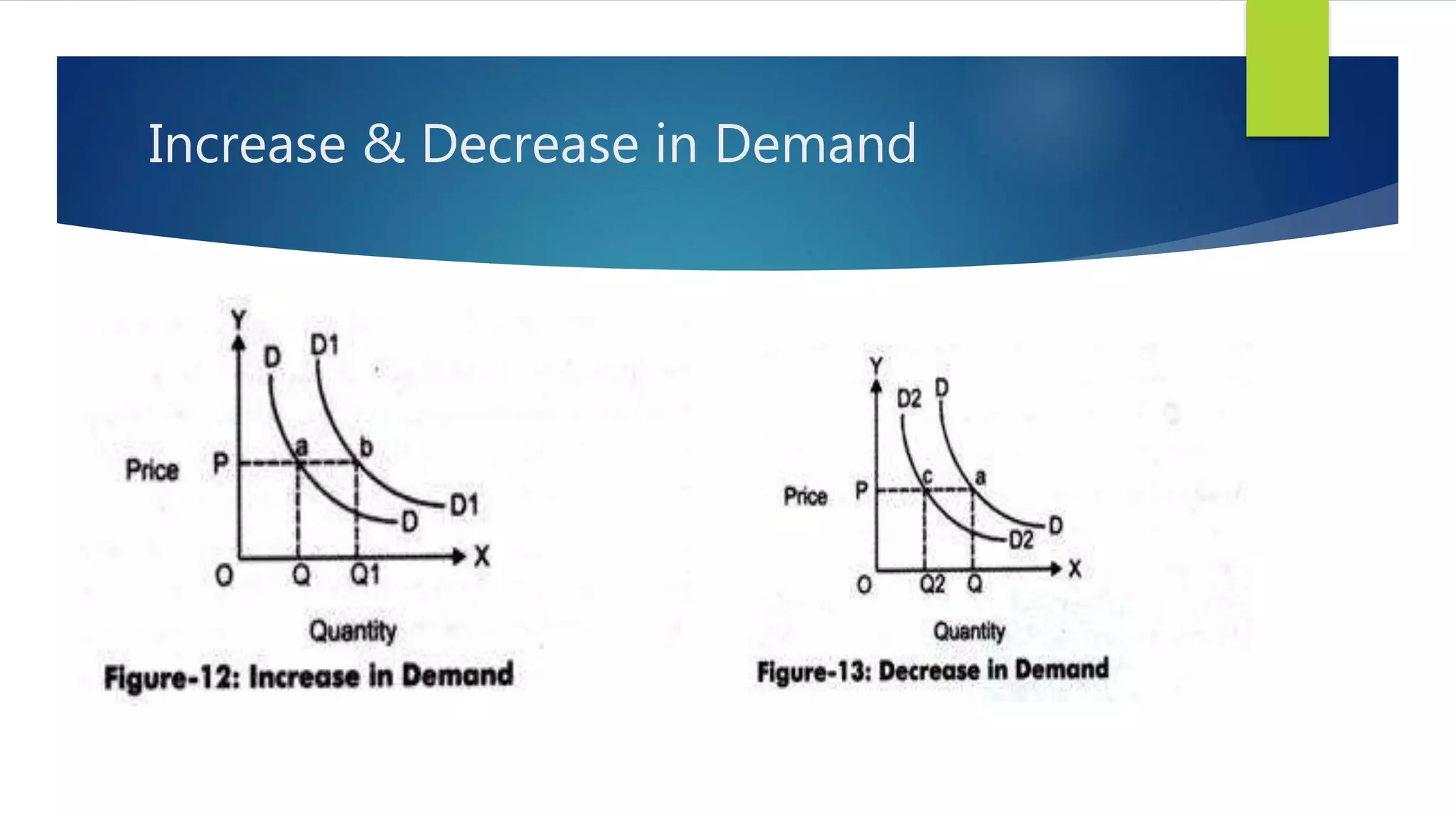
 Increase and decrease in demand are referred to change in demand due to
changes in various other factors such as change in income, distribution of income,
change in consumer’s tastes and preferences, change in the price of related
goods, while Price factor is kept constant Increase in demand refers to the rise in
demand of a product at a given price. On the other hand, decrease in demand
refers to the fall in demand of a product at a given price.
 In case of increase in demand, the demand curve shifts to right, while in case of
decrease in demand, it shifts to left of the original demand curve.
Increase & Decrease in Demand
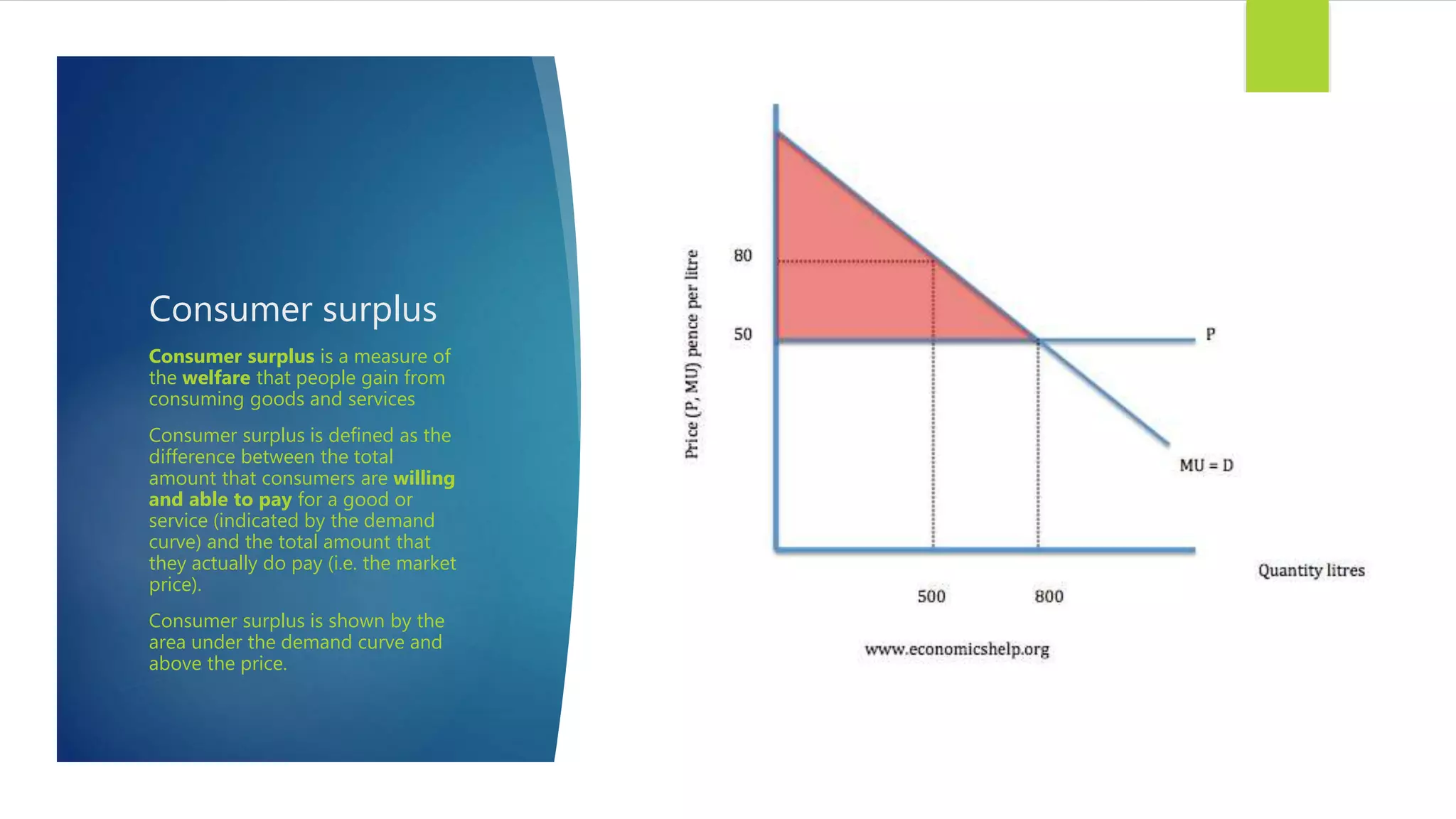
Consumer surplus
Consumer surplus is a measure of
the welfare that people gain from
consuming goods and services
Consumer surplus is defined as the
difference between the total
amount that consumers are willing
and able to pay for a good or
service (indicated by the demand
curve) and the total amount that
they actually do pay (i.e. the market
price).
Consumer surplus is shown by the
area under the demand curve and
above the price.
Elasticity of demand
 Elasticity is an economics concept that measures the responsiveness of one
variable to changes in another variable.
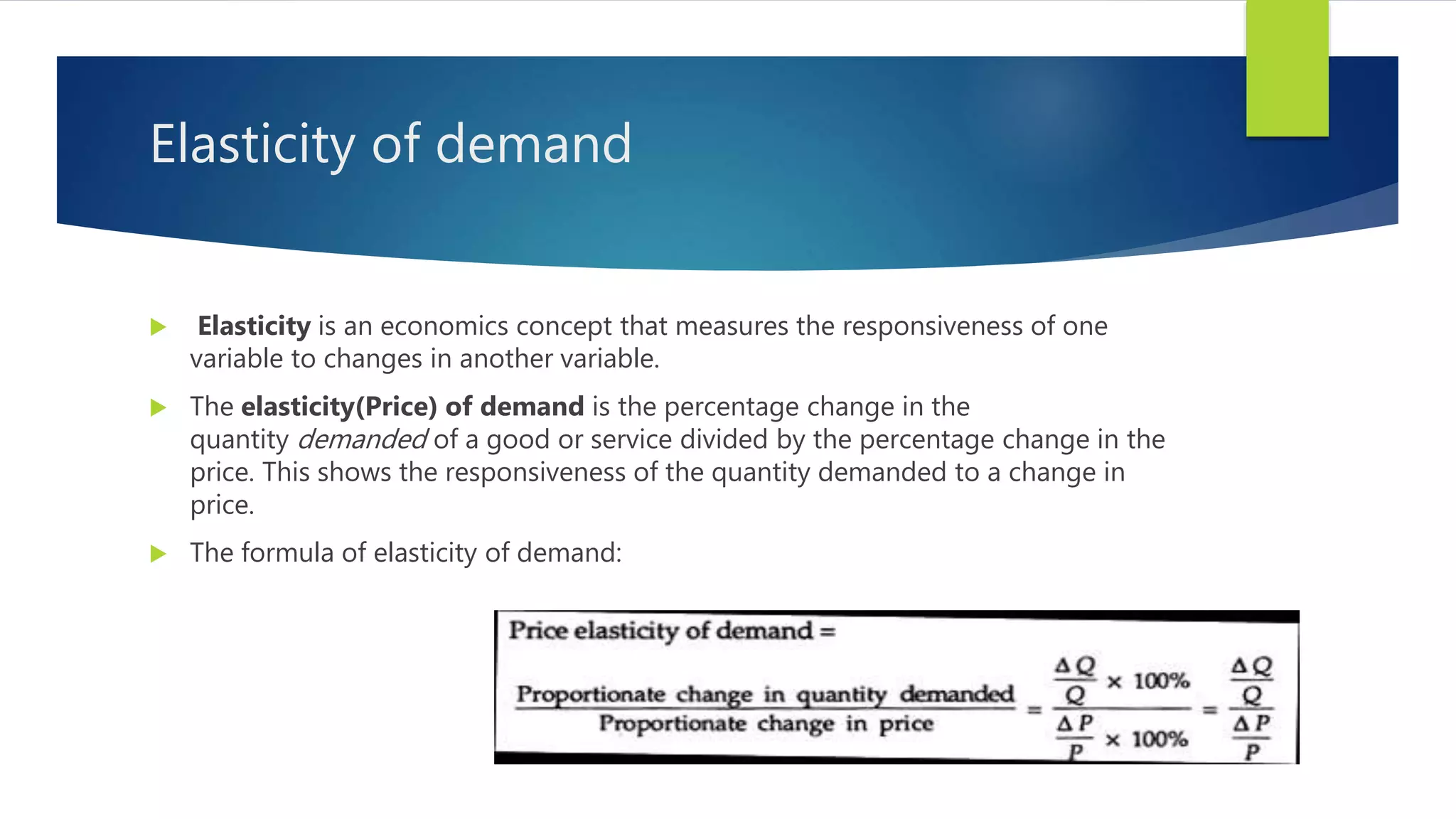
 The elasticity(Price) of demand is the percentage change in the
quantity demanded of a good or service divided by the percentage change in the
price. This shows the responsiveness of the quantity demanded to a change in
price.
 The formula of elasticity of demand:
Types of elasticity of demand
 There are 3 types of elasticity:
1. Price elasticity
2. Income elasticity
3. Cross elasticity
 On the basis of demand there are 2 types of elasticity
1. Elastic demand
2. Inelastic demand
Income elasticity
 Income Elasticity of Demand (YED) is defined as the responsiveness of demand when a
consumer’s income changes. It is defined as the ratio of the change in quantity demanded
over the change in income.
 YED is useful for governments and firms to help them decide what goods to produce and how a
change in overall income in the economy affects the demand for their products, i.e., whether it’s
inelastic or elastic. YED can be positive or negative. This depends on the type of good. A normal
good has a positive sign, while an inferior good has a negative sign.
 An inferior good has an Income Elasticity of Demand < 0.
A normal good has an Income Elasticity of Demand > 0.
Luxury goods usually have Income Elasticity of Demand > 1
0 < Income Elasticity of Demand < 1 are goods that are relatively inelastic.
Income Elasticity of Demand = 0 means that the demand for the good isn’t affected by a
change in income.
Cross-Price Elasticity of Demand
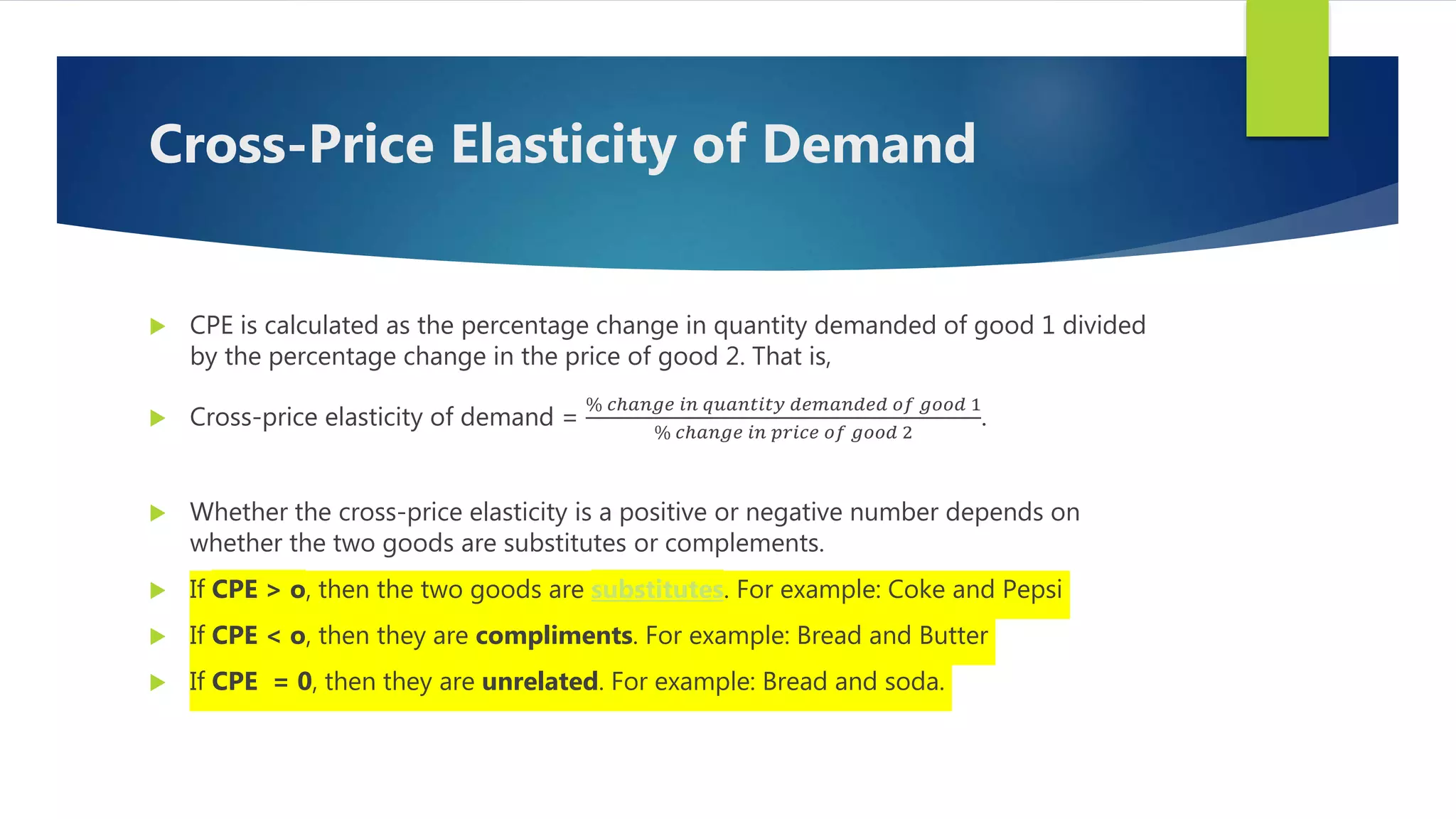
 CPE is calculated as the percentage change in quantity demanded of good 1 divided
by the percentage change in the price of good 2. That is,
 Cross-price elasticity of demand =
% 𝑐ℎ𝑎𝑛𝑔𝑒 𝑖𝑛 𝑞𝑢𝑎𝑛𝑡𝑖𝑡𝑦 𝑑𝑒𝑚𝑎𝑛𝑑𝑒𝑑 𝑜𝑓 𝑔𝑜𝑜𝑑 1
% 𝑐ℎ𝑎𝑛𝑔𝑒 𝑖𝑛 𝑝𝑟𝑖𝑐𝑒 𝑜𝑓 𝑔𝑜𝑜𝑑 2
.
 Whether the cross-price elasticity is a positive or negative number depends on
whether the two goods are substitutes or complements.
 If CPE > o, then the two goods are substitutes. For example: Coke and Pepsi
 If CPE < o, then they are compliments. For example: Bread and Butter
 If CPE = 0, then they are unrelated. For example: Bread and soda.
Elastic & Inelastic demand
 The degree to which the quantity demanded of a commodity responds to a
change in its own price is known as ‘price elasticity of demand’.
 If a change in price leads to a relatively large change in quantity demanded, then
demand for the commodity is said to be elastic. again, The demand for a product
is considered price elastic whenever the ratio of percentage change of demand
divided by the percentage change in price is greater than one.
 If the change in quantity demanded is relatively small, demand is said to be
inelastic. The demand for a product is considered price elastic whenever the ratio
of percentage change of demand divided by percentage change in price is less
than one.
Distinguish between elastic & inelastic
demand
Elastic Demand
 Demand happens to be elastic for
luxurious commodities
 Elasticity is greater than 1
 Elastic demand curve is shallow
 Price and total revenue go on opposite
direction
 Substitute for the product is available
Inelastic Demand
 Demand happens to be inelastic for
necessary & semi necessary commodities
 Elasticity is less than 1
 Inelastic demand curve is steep
 Price and total revenue go on same
direction
 Less or no Substitute for the product is
available
Total Quantity Price per unit Total Revenue Elasticity
1 7 7
}+5 Elastic
>+3 Elastic
>+1 Elastic
}-1 Inelastic
}-3 Inelastic
>-5 Inelastic
2 6 12
3 5 15
4 4 16
5 3 15
6 2 12
7 1 7
Consider the following numerical example:
Total Revenue Test
Supply
 Supply is the willingness and ability of producers to create goods and services to
take them to market.
 Supply is positively related to price given that at higher prices there is an
incentive to supply more as higher prices may generate increased revenue and
profits.
 Supply and stock are not the same thing. example of stock and supply will be
suppose a television manufacturer has 20000 television stock, out of which the
manufacturer supplies only 2000 television at prevailing market price. Hence
remaining 18000 units will be called stock and 2000 units will be called as supply.
Differences
Supply
 supply refers to the quantity which the
seller is prepared to sell in the market at
given price at any point of time.
 Supply can be increased and decreased
depending on the price prevailing in the
market
 supply is dependent on the price
Stock
 stock refers to total available quantity with
the seller at any given point of time.
 stock at a particular point of time is fixed
and it cannot be increased or decreased,
 stock is not dependent on the price.
Law of supply
 The law of supply is
the microeconomic law that states
that, all other factors being equal, as
the price of a good or service
increases, the quantity of goods or
services that suppliers offer will
increase, and vice versa.
 The supply function can also be
expressed in symbols.
 Qx
S = Φ (Px, Tech, Si, Fn, X,........)
Here:
 Qx
s =Quantity supplied of commodity
x by the producers.
 Φ = Function of.
 Px = Price of commodity x.
 Tech = Technology.
 S = Supplies of inputs.
 F = Features of nature.
 X = Taxes/Subsidies
Supply Schedule & Supply curve
 Supply schedule shows a tabular representation of law of supply. It presents the
different quantities of a product that a seller is willing to sell at different price
levels of that product.
 The graphical representation of supply schedule is called supply curve. In a graph,
price of a product is represented on Y-axis and quantity supplied is represented
on X-axis.
S = f (P)
THANK YOU

Demand

  • 1.
  • 2.
    Definition of Demand Demand in economics is the consumer's desire and ability to purchase a good or service. It's the underlying force that drives economic growth and expansion. Without demand, no business would ever bother producing anything.  Demand can mean either market demand for a specific good or aggregate demand for the total of all goods in an economy.  Types of Demand 1. Price demand 2. Income demand 3. Cross demand
  • 3.
    Law of demand The law of demand states that as price increases (decreases) consumers will purchase less (more) of the specific commodity, ceteris paribus. In other words, there is an inverse relationship between the quantity demanded and the price of a particular commodity.
  • 4.
    Limitations of demandlaw Price of substitute and complementary commodity Income tastes or preferences Expectations Hobby Natural calamities Political disturbance or war
  • 5.
    Demand Schedule Price ofX product Quantity of X product 10 60 15 50 20 40 25 30 30 20 35 10 The demand schedule (demand curve) reflects the law of demand. The demand schedule is a table or formula that tells you how many units of a good or service will be demanded at the various prices, ceteris paribus. For example, the schedule is based on a survey of college students who indicated how many cans of cola they would buy in a week, at various prices.
  • 6.
    Demand curve In economics,a demand curve is a graph depicting the relationship between the price of a certain commodity and the quantity of that commodity that is demanded at that price. the demand function is Qd = 1600 – 20p. From this we can arrive at the intersepts for the graph – in this equation, p = 80 – i.e. {when Qd is zero, p must be 80 to make bP 1600} and a = 1600, so the intersepts are p=80 and Qd= 1600. We can then solve for any points along the curve. For example, if we make p=40, then Qd = 1600 – 40×20, which is 1600 – 800, which is 800, and so on..
  • 7.
    Why demand curveslopes downward? There are at least three accepted explanations of why demand curves slope downwards: 1. The law of diminishing marginal utility: This law suggests that as more of a product is consumed the marginal (additional) benefit to the consumer falls, hence consumers are prepared to pay less. 2. The income effect: If we assume that money income is fixed, the income effect suggests that, as the price of a good falls, real income – that is, what consumers can buy with their money income – rises and consumers increase their demand. 3. substitution effect: as the price of one good falls, it becomes relatively less expensive. Therefore, assuming other alternative products stay at the same price, at lower prices the good appears cheaper, and consumers will switch from the expensive alternative to the relatively cheaper one.
  • 8.
    Extension & Contractionof demand  Changes in the price of a commodity causes movements along the demand curve; such movements are called changes in the quantity demanded.  If price decreases, then we move down and to the right along the demand curve; this is an increase in the quantity demanded which is known as extension of demand.  If price increases, then we move upward and to left along the demand curve, this is a decrease in the quantity demanded which is called contraction of demand.
  • 9.
    Extension & Contraction of demand Assumingother things such as income, tastes and fashion, prices of related goods remaining constant, a demand curve DD has been drawn. It will be seen in this figure that when the price of the good is OP, then the quantity demanded of the good is OM. Now, if the price of the good falls to OP’ the quantity demanded of the good rises to ON. Thus, there is extension in demand by the amount MN. On the other hand, if price of the good rises from OP to OP” the quantity demanded of the good falls to OL. Thus, there is contraction in demand by ML.
  • 10.
    Increase and Decreaseof demand  Increase and decrease in demand are referred to change in demand due to changes in various other factors such as change in income, distribution of income, change in consumer’s tastes and preferences, change in the price of related goods, while Price factor is kept constant Increase in demand refers to the rise in demand of a product at a given price. On the other hand, decrease in demand refers to the fall in demand of a product at a given price.  In case of increase in demand, the demand curve shifts to right, while in case of decrease in demand, it shifts to left of the original demand curve.
  • 11.
  • 12.
    Consumer surplus Consumer surplusis a measure of the welfare that people gain from consuming goods and services Consumer surplus is defined as the difference between the total amount that consumers are willing and able to pay for a good or service (indicated by the demand curve) and the total amount that they actually do pay (i.e. the market price). Consumer surplus is shown by the area under the demand curve and above the price.
  • 13.
    Elasticity of demand Elasticity is an economics concept that measures the responsiveness of one variable to changes in another variable.  The elasticity(Price) of demand is the percentage change in the quantity demanded of a good or service divided by the percentage change in the price. This shows the responsiveness of the quantity demanded to a change in price.  The formula of elasticity of demand:
  • 14.
    Types of elasticityof demand  There are 3 types of elasticity: 1. Price elasticity 2. Income elasticity 3. Cross elasticity  On the basis of demand there are 2 types of elasticity 1. Elastic demand 2. Inelastic demand
  • 15.
    Income elasticity  IncomeElasticity of Demand (YED) is defined as the responsiveness of demand when a consumer’s income changes. It is defined as the ratio of the change in quantity demanded over the change in income.  YED is useful for governments and firms to help them decide what goods to produce and how a change in overall income in the economy affects the demand for their products, i.e., whether it’s inelastic or elastic. YED can be positive or negative. This depends on the type of good. A normal good has a positive sign, while an inferior good has a negative sign.  An inferior good has an Income Elasticity of Demand < 0. A normal good has an Income Elasticity of Demand > 0. Luxury goods usually have Income Elasticity of Demand > 1 0 < Income Elasticity of Demand < 1 are goods that are relatively inelastic. Income Elasticity of Demand = 0 means that the demand for the good isn’t affected by a change in income.
  • 17.
    Cross-Price Elasticity ofDemand  CPE is calculated as the percentage change in quantity demanded of good 1 divided by the percentage change in the price of good 2. That is,  Cross-price elasticity of demand = % 𝑐ℎ𝑎𝑛𝑔𝑒 𝑖𝑛 𝑞𝑢𝑎𝑛𝑡𝑖𝑡𝑦 𝑑𝑒𝑚𝑎𝑛𝑑𝑒𝑑 𝑜𝑓 𝑔𝑜𝑜𝑑 1 % 𝑐ℎ𝑎𝑛𝑔𝑒 𝑖𝑛 𝑝𝑟𝑖𝑐𝑒 𝑜𝑓 𝑔𝑜𝑜𝑑 2 .  Whether the cross-price elasticity is a positive or negative number depends on whether the two goods are substitutes or complements.  If CPE > o, then the two goods are substitutes. For example: Coke and Pepsi  If CPE < o, then they are compliments. For example: Bread and Butter  If CPE = 0, then they are unrelated. For example: Bread and soda.
  • 18.
    Elastic & Inelasticdemand  The degree to which the quantity demanded of a commodity responds to a change in its own price is known as ‘price elasticity of demand’.  If a change in price leads to a relatively large change in quantity demanded, then demand for the commodity is said to be elastic. again, The demand for a product is considered price elastic whenever the ratio of percentage change of demand divided by the percentage change in price is greater than one.  If the change in quantity demanded is relatively small, demand is said to be inelastic. The demand for a product is considered price elastic whenever the ratio of percentage change of demand divided by percentage change in price is less than one.
  • 20.
    Distinguish between elastic& inelastic demand Elastic Demand  Demand happens to be elastic for luxurious commodities  Elasticity is greater than 1  Elastic demand curve is shallow  Price and total revenue go on opposite direction  Substitute for the product is available Inelastic Demand  Demand happens to be inelastic for necessary & semi necessary commodities  Elasticity is less than 1  Inelastic demand curve is steep  Price and total revenue go on same direction  Less or no Substitute for the product is available
  • 21.
    Total Quantity Priceper unit Total Revenue Elasticity 1 7 7 }+5 Elastic >+3 Elastic >+1 Elastic }-1 Inelastic }-3 Inelastic >-5 Inelastic 2 6 12 3 5 15 4 4 16 5 3 15 6 2 12 7 1 7 Consider the following numerical example: Total Revenue Test
  • 22.
    Supply  Supply isthe willingness and ability of producers to create goods and services to take them to market.  Supply is positively related to price given that at higher prices there is an incentive to supply more as higher prices may generate increased revenue and profits.  Supply and stock are not the same thing. example of stock and supply will be suppose a television manufacturer has 20000 television stock, out of which the manufacturer supplies only 2000 television at prevailing market price. Hence remaining 18000 units will be called stock and 2000 units will be called as supply.
  • 23.
    Differences Supply  supply refersto the quantity which the seller is prepared to sell in the market at given price at any point of time.  Supply can be increased and decreased depending on the price prevailing in the market  supply is dependent on the price Stock  stock refers to total available quantity with the seller at any given point of time.  stock at a particular point of time is fixed and it cannot be increased or decreased,  stock is not dependent on the price.
  • 24.
    Law of supply The law of supply is the microeconomic law that states that, all other factors being equal, as the price of a good or service increases, the quantity of goods or services that suppliers offer will increase, and vice versa.  The supply function can also be expressed in symbols.  Qx S = Φ (Px, Tech, Si, Fn, X,........) Here:  Qx s =Quantity supplied of commodity x by the producers.  Φ = Function of.  Px = Price of commodity x.  Tech = Technology.  S = Supplies of inputs.  F = Features of nature.  X = Taxes/Subsidies
  • 25.
    Supply Schedule &Supply curve  Supply schedule shows a tabular representation of law of supply. It presents the different quantities of a product that a seller is willing to sell at different price levels of that product.  The graphical representation of supply schedule is called supply curve. In a graph, price of a product is represented on Y-axis and quantity supplied is represented on X-axis. S = f (P)
  • 27.