Indifference
Curve
Analysis
Rambabu Sambattina
Ordinal Utility Approach
Ordinal Utility Approach:
The basic idea behind ordinal utility approach is that a
consumer keeps number of pairs of two commodities in
his mind which give him equal level of satisfaction.
This means that the utility can be ranked qualitatively.
The ordinal utility approach differs from the cardinal
utility approach (also called classical theory) in the
sense that the satisfaction derived from various
commodities cannot be measured objectively.
Rambabu Sambattina
Ordinal theory is also known as neo-classical theory of
consumer equilibrium, Hicksian theory of consumer
behavior, indifference curve theory, optimal choice
theory. This approach also explains the consumer's
equilibrium who is confronted with the multiple
objectives and scarcity of money income.
The important tools of ordinal utility are:
1. The concept of indifference curves.
2. The slop of I.C. i.e. marginal rate of substitution.
3. The budget line.
Rambabu Sambattina
Indifference Curve
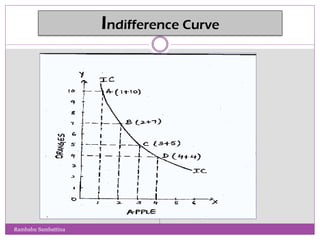
Indifference Curve is a locus of all such points
which shows different combination of two
commodities which yield equal satisfaction to the

consumer, so that he is indifferent to the particular
combination he consumes.
Rambabu Sambattina
Indifference Curve schedule
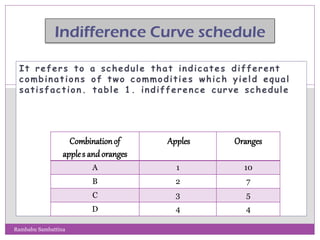
It refers to a schedule that indicates different
combinations of two commodities which yield equal
satisfaction. table 1. indifference curve schedule
Combinationof
apples andoranges
Apples Oranges
A 1 10
B 2 7
C 3 5
D 4 4
Rambabu Sambattina
Indifference Curve
Rambabu Sambattina
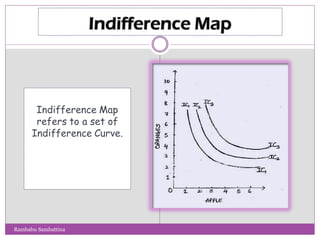
Indifference Map
refers to a set of
Indifference Curve.
Rambabu Sambattina
Assumptions of
Indifference Curve Analysis:
a) Consumer is rational.
b) Utility can be measured in Ordinal numbers.
c) Marginal rate of substitution (MRS) diminishes
(marginal rate of substitution is the rate at which a
consumer is ready to give up one good in exchange
for another good while maintaining the same level of
utility)
Rambabu Sambattina
d) Consumer’s behavior is Consistent.
E.g. if consumer prefers A combination > B combination
at one time, then at another time he will not prefer
more of B combination than A combination.
e) Transitivity.
E.g. if consumer prefers A combination to B
combination and B combination to C combination, then
he will definitely prefer A combination to C
combination.
f) Consumer’s scale of Preference is Independent of his
income and prices of goods in the market.
Rambabu Sambattina
Rambabu Sambattina
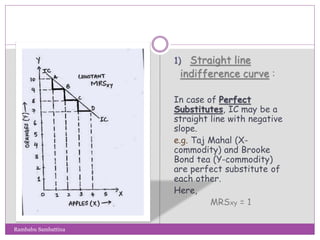
1) Straight line
indifference curve :
In case of Perfect
Substitutes, IC may be a
straight line with negative
slope.
e.g. Taj Mahal (X-
commodity) and Brooke
Bond tea (Y-commodity)
are perfect substitute of
each other.
Here,
MRSxy = 1
Rambabu Sambattina
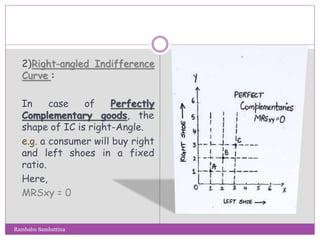
2)Right-angled Indifference
Curve :
In case of Perfectly
Complementary goods, the
shape of IC is right-Angle.
e.g. a consumer will buy right
and left shoes in a fixed
ratio.
Here,
MRSxy = 0
Rambabu Sambattina
Rambabu Sambattina
The Budget line shows all different combinations of
the two commodities that a consumer can purchase
given his money income and price of two commodities.
Slope of Price line = Px/Py
Here;
Px= price of apples
Py = price of oranges
Rambabu Sambattina
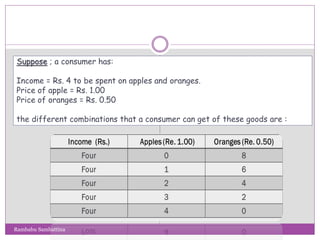
Suppose ; a consumer has:
Income = Rs. 4 to be spent on apples and oranges.
Price of apple = Rs. 1.00
Price of oranges = Rs. 0.50
the different combinations that a consumer can get of these goods are :
Rambabu Sambattina
From Figure;
Budget line = AB
 If there is any point outside
or to the right of price line
AB, the consumer will not be
able to buy that combination
of two goods because of his
limited income.
 If there is any point inside or
to the left of price line AB,
then the consumer will be
unable to spend all his income.
Rambabu Sambattina
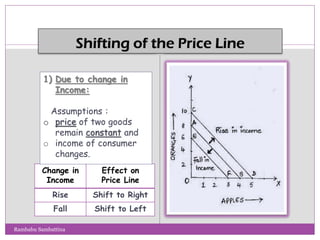
Change in
Income
Effect on
Price Line
Rise Shift to Right
Fall Shift to Left
1) Due to change in
Income:
Assumptions :
o price of two goods
remain constant and
o income of consumer
changes.
Rambabu Sambattina
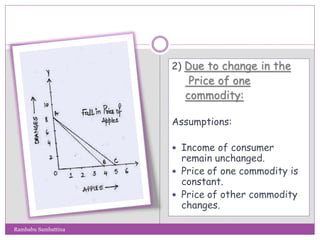
2) Due to change in the
Price of one
commodity:
Assumptions:
 Income of consumer
remain unchanged.
 Price of one commodity is
constant.
 Price of other commodity
changes.
Rambabu Sambattina
Rambabu Sambattina
Consumer’s equilibrium refers to a situation in
which a consumer with given income and given
prices purchases such a combination of goods and
services which gives him maximum satisfaction
and he is not willing to make any change in it.
It is struck when
“what he is willing to buy coincides with what
he can buy”
Rambabu Sambattina
 Prices of goods are constant.
 Consumer’s income is also constant.
 Consumer knows the prices of all things.
 Consumer can spend his income in small quantities.
 Consumer is rational.
 Consumer is fully aware of Indifference map.
 Perfect competition in the market.
Rambabu Sambattina
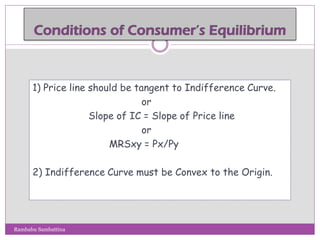
1) Price line should be tangent to Indifference Curve.
or
Slope of IC = Slope of Price line
or
MRSxy = Px/Py
2) Indifference Curve must be Convex to the Origin.
Rambabu Sambattina
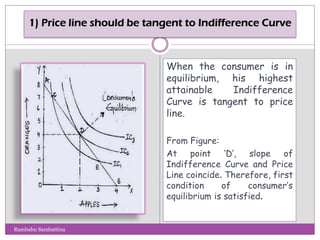
When the consumer is in
equilibrium, his highest
attainable Indifference
Curve is tangent to price
line.
From Figure:
At point ‘D’, slope of
Indifference Curve and Price
Line coincide. Therefore, first
condition of consumer’s
equilibrium is satisfied.
Rambabu Sambattina
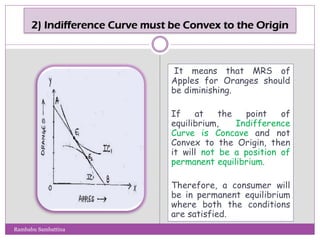
It means that MRS of
Apples for Oranges should
be diminishing.
If at the point of
equilibrium, Indifference
Curve is Concave and not
Convex to the Origin, then
it will not be a position of
permanent equilibrium.
Therefore, a consumer will
be in permanent equilibrium
where both the conditions
are satisfied.
Rambabu Sambattina
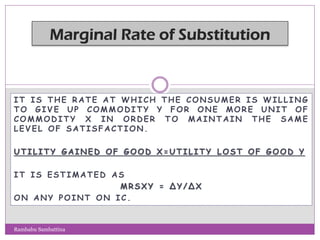
IT IS THE RATE A T WHICH THE CONSUMER IS WILLING
TO GIV E UP COMMODITY Y FOR ONE MORE UNIT OF
COMMODITY X IN ORDER TO MAINTAIN THE SAME
LEVEL OF SATISFACTION.
UTILITY GAINED OF GOOD X=UTILITY LOST OF GOOD Y
IT IS ESTIMATED AS
MRSXY = ΔY/ΔX
ON ANY POINT ON IC.
Rambabu Sambattina
According to this Law, “ as a consumer gets
more and more units of X , he will be willing
to give up less and less units of Y”
In other words, the marginal rate of
substitution of X for Y will go on diminishing
while the level of satisfaction of the consumer
remains the sameRambabu Sambattina
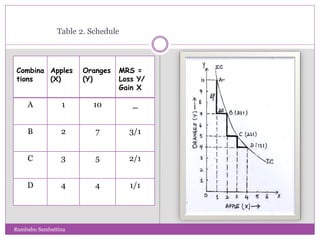
Combina
tions
Apples
(X)
Oranges
(Y)
MRS =
Loss Y/
Gain X
A 1 10 _
B 2 7 3/1
C 3 5 2/1
D 4 4 1/1
Table 2. Schedule
Rambabu Sambattina
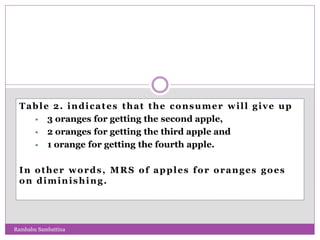
Table 2. indicates that the consumer will give up
 3 oranges for getting the second apple,
 2 oranges for getting the third apple and
 1 orange for getting the fourth apple.
In other words, MRS of apples for oranges goes
on diminishing.
Rambabu Sambattina
?
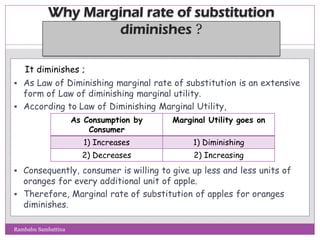
It diminishes ;
 As Law of Diminishing marginal rate of substitution is an extensive
form of Law of diminishing marginal utility.
 According to Law of Diminishing Marginal Utility,
 Consequently, consumer is willing to give up less and less units of
oranges for every additional unit of apple.
 Therefore, Marginal rate of substitution of apples for oranges
diminishes.
As Consumption by
Consumer
Marginal Utility goes on
1) Increases 1) Diminishing
2) Decreases 2) Increasing
Rambabu Sambattina
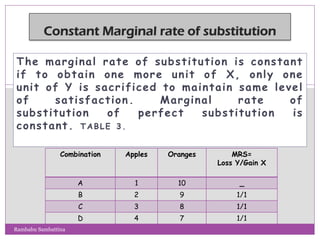
The marginal rate of substitution is constant
if to obtain one more unit of X, only one
unit of Y is sacrificed to maintain same level
of satisfaction. Marginal rate of
substitution of perfect substitution is
constant. TABLE 3.
Combination Apples Oranges MRS=
Loss Y/Gain X
A 1 10 _
B 2 9 1/1
C 3 8 1/1
D 4 7 1/1
Rambabu Sambattina
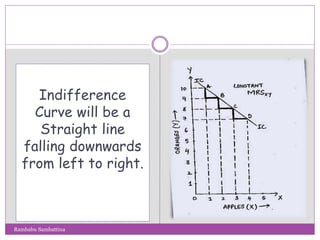
Indifference
Curve will be a
Straight line
falling downwards
from left to right.
Rambabu Sambattina
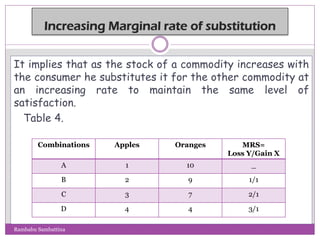
It implies that as the stock of a commodity increases with
the consumer he substitutes it for the other commodity at
an increasing rate to maintain the same level of
satisfaction.
Table 4.
Combinations Apples Oranges MRS=
Loss Y/Gain X
A 1 10 _
B 2 9 1/1
C 3 7 2/1
D 4 4 3/1
Rambabu Sambattina
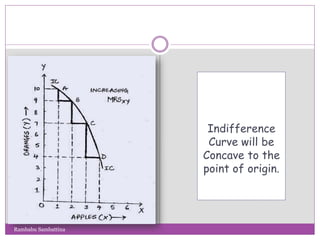
Indifference
Curve will be
Concave to the
point of origin.
Rambabu Sambattina
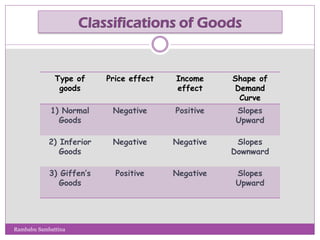
Type of
goods
Price effect Income
effect
Shape of
Demand
Curve
1) Normal
Goods
Negative Positive Slopes
Upward
2) Inferior
Goods
Negative Negative Slopes
Downward
3) Giffen’s
Goods
Positive Negative Slopes
Upward
Rambabu Sambattina
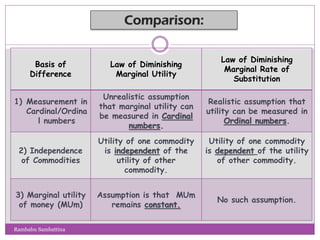
Basis of
Difference
Law of Diminishing
Marginal Utility
Law of Diminishing
Marginal Rate of
Substitution
1) Measurement in
Cardinal/Ordina
l numbers
Unrealistic assumption
that marginal utility can
be measured in Cardinal
numbers.
Realistic assumption that
utility can be measured in
Ordinal numbers.
2) Independence
of Commodities
Utility of one commodity
is independent of the
utility of other
commodity.
Utility of one commodity
is dependent of the utility
of other commodity.
3) Marginal utility
of money (MUm)
Assumption is that MUm
remains constant.
No such assumption.
Rambabu Sambattina
Rambabu Sambattina

Indifference curve analysis

  • 1.
  • 2.
    Ordinal Utility Approach OrdinalUtility Approach: The basic idea behind ordinal utility approach is that a consumer keeps number of pairs of two commodities in his mind which give him equal level of satisfaction. This means that the utility can be ranked qualitatively. The ordinal utility approach differs from the cardinal utility approach (also called classical theory) in the sense that the satisfaction derived from various commodities cannot be measured objectively. Rambabu Sambattina
  • 3.
    Ordinal theory isalso known as neo-classical theory of consumer equilibrium, Hicksian theory of consumer behavior, indifference curve theory, optimal choice theory. This approach also explains the consumer's equilibrium who is confronted with the multiple objectives and scarcity of money income. The important tools of ordinal utility are: 1. The concept of indifference curves. 2. The slop of I.C. i.e. marginal rate of substitution. 3. The budget line. Rambabu Sambattina
  • 4.
    Indifference Curve Indifference Curveis a locus of all such points which shows different combination of two commodities which yield equal satisfaction to the consumer, so that he is indifferent to the particular combination he consumes. Rambabu Sambattina
  • 5.
    Indifference Curve schedule Itrefers to a schedule that indicates different combinations of two commodities which yield equal satisfaction. table 1. indifference curve schedule Combinationof apples andoranges Apples Oranges A 1 10 B 2 7 C 3 5 D 4 4 Rambabu Sambattina
  • 6.
  • 7.
    Indifference Map refers toa set of Indifference Curve. Rambabu Sambattina
  • 8.
    Assumptions of Indifference CurveAnalysis: a) Consumer is rational. b) Utility can be measured in Ordinal numbers. c) Marginal rate of substitution (MRS) diminishes (marginal rate of substitution is the rate at which a consumer is ready to give up one good in exchange for another good while maintaining the same level of utility) Rambabu Sambattina
  • 9.
    d) Consumer’s behavioris Consistent. E.g. if consumer prefers A combination > B combination at one time, then at another time he will not prefer more of B combination than A combination. e) Transitivity. E.g. if consumer prefers A combination to B combination and B combination to C combination, then he will definitely prefer A combination to C combination. f) Consumer’s scale of Preference is Independent of his income and prices of goods in the market. Rambabu Sambattina
  • 10.
  • 11.
    1) Straight line indifferencecurve : In case of Perfect Substitutes, IC may be a straight line with negative slope. e.g. Taj Mahal (X- commodity) and Brooke Bond tea (Y-commodity) are perfect substitute of each other. Here, MRSxy = 1 Rambabu Sambattina
  • 12.
    2)Right-angled Indifference Curve : Incase of Perfectly Complementary goods, the shape of IC is right-Angle. e.g. a consumer will buy right and left shoes in a fixed ratio. Here, MRSxy = 0 Rambabu Sambattina
  • 13.
  • 14.
    The Budget lineshows all different combinations of the two commodities that a consumer can purchase given his money income and price of two commodities. Slope of Price line = Px/Py Here; Px= price of apples Py = price of oranges Rambabu Sambattina
  • 15.
    Suppose ; aconsumer has: Income = Rs. 4 to be spent on apples and oranges. Price of apple = Rs. 1.00 Price of oranges = Rs. 0.50 the different combinations that a consumer can get of these goods are : Rambabu Sambattina
  • 16.
    From Figure; Budget line= AB  If there is any point outside or to the right of price line AB, the consumer will not be able to buy that combination of two goods because of his limited income.  If there is any point inside or to the left of price line AB, then the consumer will be unable to spend all his income. Rambabu Sambattina
  • 17.
    Change in Income Effect on PriceLine Rise Shift to Right Fall Shift to Left 1) Due to change in Income: Assumptions : o price of two goods remain constant and o income of consumer changes. Rambabu Sambattina
  • 18.
    2) Due tochange in the Price of one commodity: Assumptions:  Income of consumer remain unchanged.  Price of one commodity is constant.  Price of other commodity changes. Rambabu Sambattina
  • 19.
  • 20.
    Consumer’s equilibrium refersto a situation in which a consumer with given income and given prices purchases such a combination of goods and services which gives him maximum satisfaction and he is not willing to make any change in it. It is struck when “what he is willing to buy coincides with what he can buy” Rambabu Sambattina
  • 21.
     Prices ofgoods are constant.  Consumer’s income is also constant.  Consumer knows the prices of all things.  Consumer can spend his income in small quantities.  Consumer is rational.  Consumer is fully aware of Indifference map.  Perfect competition in the market. Rambabu Sambattina
  • 22.
    1) Price lineshould be tangent to Indifference Curve. or Slope of IC = Slope of Price line or MRSxy = Px/Py 2) Indifference Curve must be Convex to the Origin. Rambabu Sambattina
  • 23.
    When the consumeris in equilibrium, his highest attainable Indifference Curve is tangent to price line. From Figure: At point ‘D’, slope of Indifference Curve and Price Line coincide. Therefore, first condition of consumer’s equilibrium is satisfied. Rambabu Sambattina
  • 24.
    It means thatMRS of Apples for Oranges should be diminishing. If at the point of equilibrium, Indifference Curve is Concave and not Convex to the Origin, then it will not be a position of permanent equilibrium. Therefore, a consumer will be in permanent equilibrium where both the conditions are satisfied. Rambabu Sambattina
  • 25.
    IT IS THERATE A T WHICH THE CONSUMER IS WILLING TO GIV E UP COMMODITY Y FOR ONE MORE UNIT OF COMMODITY X IN ORDER TO MAINTAIN THE SAME LEVEL OF SATISFACTION. UTILITY GAINED OF GOOD X=UTILITY LOST OF GOOD Y IT IS ESTIMATED AS MRSXY = ΔY/ΔX ON ANY POINT ON IC. Rambabu Sambattina
  • 26.
    According to thisLaw, “ as a consumer gets more and more units of X , he will be willing to give up less and less units of Y” In other words, the marginal rate of substitution of X for Y will go on diminishing while the level of satisfaction of the consumer remains the sameRambabu Sambattina
  • 27.
    Combina tions Apples (X) Oranges (Y) MRS = Loss Y/ GainX A 1 10 _ B 2 7 3/1 C 3 5 2/1 D 4 4 1/1 Table 2. Schedule Rambabu Sambattina
  • 28.
    Table 2. indicatesthat the consumer will give up  3 oranges for getting the second apple,  2 oranges for getting the third apple and  1 orange for getting the fourth apple. In other words, MRS of apples for oranges goes on diminishing. Rambabu Sambattina
  • 29.
    ? It diminishes ; As Law of Diminishing marginal rate of substitution is an extensive form of Law of diminishing marginal utility.  According to Law of Diminishing Marginal Utility,  Consequently, consumer is willing to give up less and less units of oranges for every additional unit of apple.  Therefore, Marginal rate of substitution of apples for oranges diminishes. As Consumption by Consumer Marginal Utility goes on 1) Increases 1) Diminishing 2) Decreases 2) Increasing Rambabu Sambattina
  • 30.
    The marginal rateof substitution is constant if to obtain one more unit of X, only one unit of Y is sacrificed to maintain same level of satisfaction. Marginal rate of substitution of perfect substitution is constant. TABLE 3. Combination Apples Oranges MRS= Loss Y/Gain X A 1 10 _ B 2 9 1/1 C 3 8 1/1 D 4 7 1/1 Rambabu Sambattina
  • 31.
    Indifference Curve will bea Straight line falling downwards from left to right. Rambabu Sambattina
  • 32.
    It implies thatas the stock of a commodity increases with the consumer he substitutes it for the other commodity at an increasing rate to maintain the same level of satisfaction. Table 4. Combinations Apples Oranges MRS= Loss Y/Gain X A 1 10 _ B 2 9 1/1 C 3 7 2/1 D 4 4 3/1 Rambabu Sambattina
  • 33.
    Indifference Curve will be Concaveto the point of origin. Rambabu Sambattina
  • 34.
    Type of goods Price effectIncome effect Shape of Demand Curve 1) Normal Goods Negative Positive Slopes Upward 2) Inferior Goods Negative Negative Slopes Downward 3) Giffen’s Goods Positive Negative Slopes Upward Rambabu Sambattina
  • 35.
    Basis of Difference Law ofDiminishing Marginal Utility Law of Diminishing Marginal Rate of Substitution 1) Measurement in Cardinal/Ordina l numbers Unrealistic assumption that marginal utility can be measured in Cardinal numbers. Realistic assumption that utility can be measured in Ordinal numbers. 2) Independence of Commodities Utility of one commodity is independent of the utility of other commodity. Utility of one commodity is dependent of the utility of other commodity. 3) Marginal utility of money (MUm) Assumption is that MUm remains constant. No such assumption. Rambabu Sambattina
  • 36.