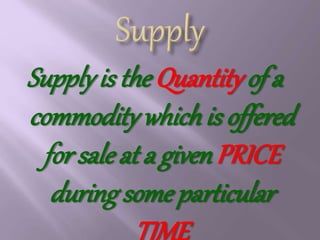
Supply is the Quantity of a
commodity which is offered
for sale at a givenPRICE
during some particular
TIME
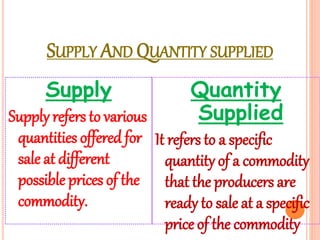
SUPPLY AND QUANTITY SUPPLIED
Supply
Supply refers to various
quantities offered for
sale at different
possible prices of the
commodity.
Quantity
Supplied
It refers to a specific
quantity of a commodity
that the producers are
ready to sale at a specific
price of the commodity
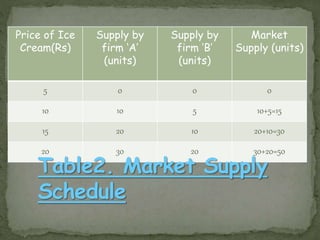
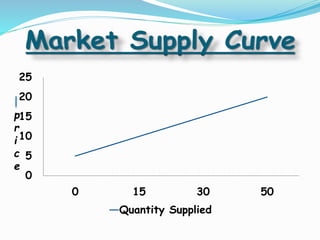
Market Supplyrefers
to the sum total of
various quantities
offeredfor sale by all the
individual firms at
different prices
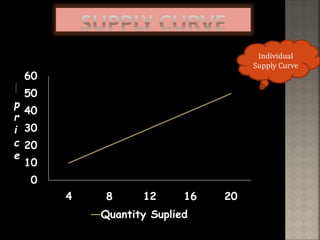
Individual supply refers
to different quantities
offered for sale by an
individual firm at different
prices
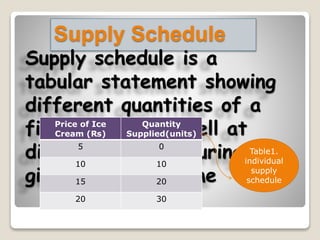
Supply Schedule
Supply schedule is a
tabular statement showing
different quantities of a
firm is ready to sell at
different prices during a
given period of time
Price of Ice
Cream (₨)
Quantity
Supplied(units)
5 0
10 10
15 20
20 30
Table1.
individual
supply
schedule
Price of Ice
Cream(Rs)
Supply by
firm ‘A’
(units)
Supply by
firm ‘B’
(units)
Market
Supply (units)
5 0 0 0
10 10 5 10+5=15
15 20 10 20+10=30
20 30 20 30+20=50
0
10
20
30
40
50
60
4 8 12 16 20
Quantity Suplied
Individual
Supply Curve
p
r
i
c
e
0
5
10
15
20
25
0 15 30 50
Quantity Supplied
p
r
i
c
e
Supply Function
It is a functional relationship between
quantity supplied of a commodity and
factors affecting it.
Supply of commodity by a firm depends on
price of the commodity itself(Pn), prices of
other commodities(Pr), state of
technology(T), cost of factors of
production(F), objectives of the firm(O)
etc.
This can be mathematically as shown
below:
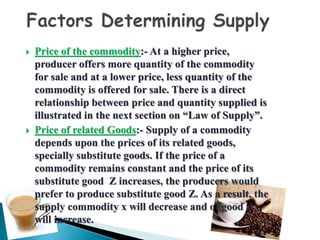
 Price of the commodity:- At a higher price,
producer offers more quantity of the commodity
for sale and at a lower price, less quantity of the
commodity is offered for sale. There is a direct
relationship between price and quantity supplied is
illustrated in the next section on “Law of Supply”.
 Price of related Goods:- Supply of a commodity
depends upon the prices of its related goods,
specially substitute goods. If the price of a
commodity remains constant and the price of its
substitute good Z increases, the producers would
prefer to produce substitute good Z. As a result, the
supply commodity x will decrease and of good Z
will increase.
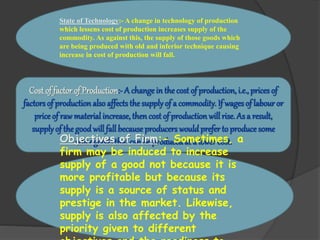
State of Technology:- A change in technology of production
which lessens cost of production increases supply of the
commodity. As against this, the supply of those goods which
are being produced with old and inferior technique causing
increase in cost of production will fall.
Cost of factor of Production:- A change in the cost of production, i.e., prices of
factors of production also affects the supplyof a commodity. If wages of labour or
price of raw material increase,then cost of production will rise. As a result,
supplyof the good willfall because producerswouldprefer to produce some
other goods that can be producedat a lower cost.Objectives of Firm:- Sometimes, a
firm may be induced to increase
supply of a good not because it is
more profitable but because its
supply is a source of status and
prestige in the market. Likewise,
supply is also affected by the
priority given to different
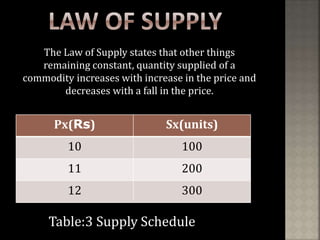
The Law of Supply states that other things
remaining constant, quantity supplied of a
commodity increases with increase in the price and
decreases with a fall in the price.
Px(Rs) Sx(units)
10 100
11 200
12 300
Table:3 Supply Schedule
9
9.5
10
10.5
11
11.5
12
12.5
100 200 300
Supply Curve
P
r
i
c
e
Supply
S
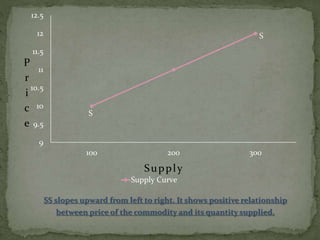
SS slopes upward from left to right. It shows positive relationship
between price of the commodity and its quantity supplied.
S
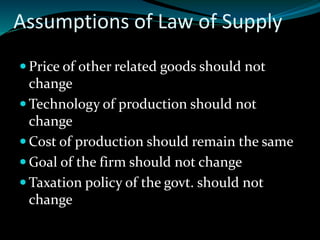
Assumptions of Law of Supply
 Price of other related goods should not
change
 Technology of production should not
change
 Cost of production should remain the same
 Goal of the firm should not change
 Taxation policy of the govt. should not
change
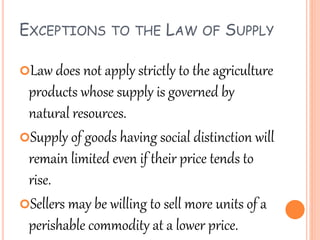
EXCEPTIONS TO THE LAW OF SUPPLY
Law does not apply strictly to the agriculture
products whose supply is governed by
natural resources.
Supply of goods having social distinction will
remain limited even if their price tends to
rise.
Sellers may be willing to sell more units of a
perishable commodity at a lower price.
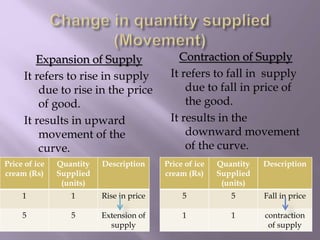
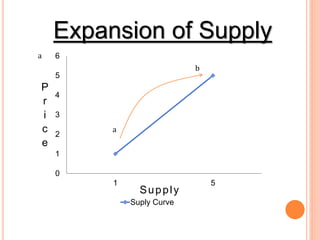
Expansion of Supply
It refers to rise in supply
due to rise in the price
of good.
It results in upward
movement of the
curve.
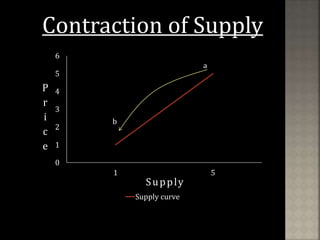
Contraction of Supply
It refers to fall in supply
due to fall in price of
the good.
It results in the
downward movement
of the curve.
Price of ice
cream (Rs)
Quantity
Supplied
(units)
Description
1 1 Rise in price
5 5 Extension of
supply
Price of ice
cream (Rs)
Quantity
Supplied
(units)
Description
5 5 Fall in price
1 1 contraction
of supply
0
1
2
3
4
5
6
1 5
Suply Curve
a
a
b
P
r
i
c
e
Supply
Expansion of Supply
0
1
2
3
4
5
6
1 5
Supply curve
b
Supply
P
r
i
c
e
Contraction of Supply
a
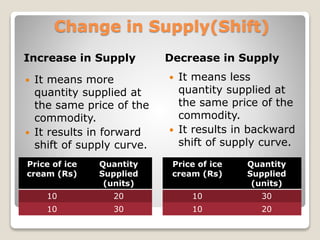
Change in Supply(Shift)
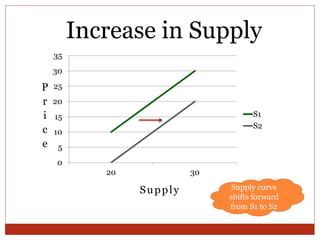
Increase in Supply
 It means more
quantity supplied at
the same price of the
commodity.
 It results in forward
shift of supply curve.
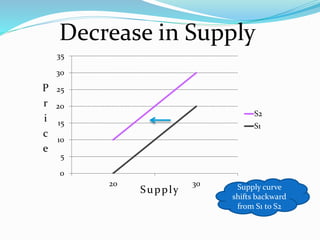
Decrease in Supply
 It means less
quantity supplied at
the same price of the
commodity.
 It results in backward
shift of supply curve.
Price of ice
cream (Rs)
Quantity
Supplied
(units)
10 20
10 30
Price of ice
cream (Rs)
Quantity
Supplied
(units)
10 30
10 20
0
5
10
15
20
25
30
35
20 30
S1
S2
Increase in Supply
Supply
P
r
i
c
e
Supply curve
shifts forward
from S1 to S2
0
5
10
15
20
25
30
35
20 30
S2
S1
Supply
P
r
i
c
e
Decrease in Supply
Supply curve
shifts backward
from S1 to S2
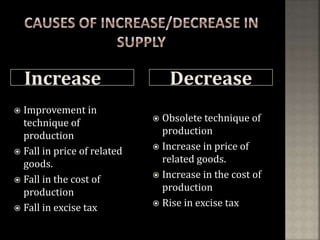
Increase Decrease
 Improvement in
technique of
production
 Fall in price of related
goods.
 Fall in the cost of
production
 Fall in excise tax
 Obsolete technique of
production
 Increase in price of
related goods.
 Increase in the cost of
production
 Rise in excise tax
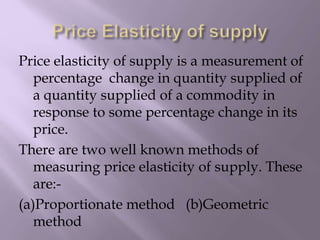
Price elasticity of supply is a measurement of
percentage change in quantity supplied of
a quantity supplied of a commodity in
response to some percentage change in its
price.
There are two well known methods of
measuring price elasticity of supply. These
are:-
(a)Proportionate method (b)Geometric
method
According to this method, elasticity of supply is
the ratio between ‘percentage change in
quantity supplied’ and ‘percentage change in
price’ of the commodity.
Es= Percentage Change in Quantity Supplied
Percentage change in Price
Es= ∆Q×P
∆P×Q
Geometric Method
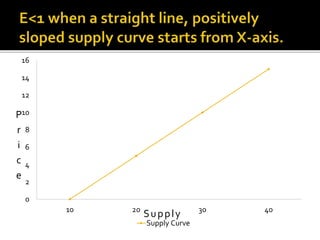
Geometrically, elasticity of supply depends
on the ‘origin’ of the supply curve.
Assuming the supply curve to be a
straight line and positively sloped, we
can conceive three possible situations of
elasticity of supply as in the following
diagrams:
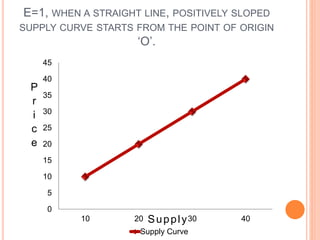
E=1, WHEN A STRAIGHT LINE, POSITIVELY SLOPED
SUPPLY CURVE STARTS FROM THE POINT OF ORIGIN
‘O’.
0
5
10
15
20
25
30
35
40
45
10 20 30 40
Supply Curve
P
r
i
c
e
Supply
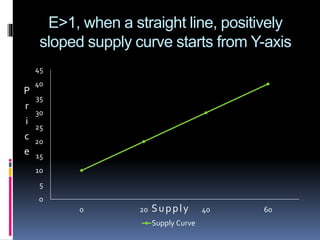
E>1, when a straight line, positively
sloped supply curve starts from Y-axis
0
5
10
15
20
25
30
35
40
45
0 20 40 60
Supply Curve
P
r
i
c
e
Supply
0
2
4
6
8
10
12
14
16
10 20 30 40
Supply Curve
P
r
i
c
e
Supply
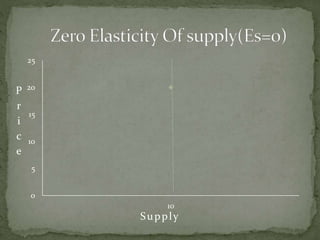
0
5
10
15
20
25
10
P
r
i
c
e
Supply
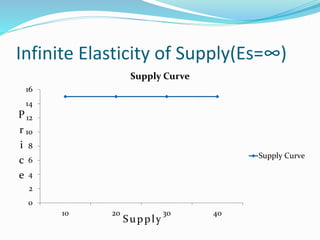
Infinite Elasticity of Supply(Es=∞)
0
2
4
6
8
10
12
14
16
10 20 30 40
Supply Curve
Supply Curve
Supply
P
r
i
c
e

Theory of supply

  • 2.
    Supply is theQuantity of a commodity which is offered for sale at a givenPRICE during some particular TIME
  • 3.
    SUPPLY AND QUANTITYSUPPLIED Supply Supply refers to various quantities offered for sale at different possible prices of the commodity. Quantity Supplied It refers to a specific quantity of a commodity that the producers are ready to sale at a specific price of the commodity
  • 4.
    Market Supplyrefers to thesum total of various quantities offeredfor sale by all the individual firms at different prices Individual supply refers to different quantities offered for sale by an individual firm at different prices
  • 5.
    Supply Schedule Supply scheduleis a tabular statement showing different quantities of a firm is ready to sell at different prices during a given period of time Price of Ice Cream (₨) Quantity Supplied(units) 5 0 10 10 15 20 20 30 Table1. individual supply schedule
  • 6.
    Price of Ice Cream(Rs) Supplyby firm ‘A’ (units) Supply by firm ‘B’ (units) Market Supply (units) 5 0 0 0 10 10 5 10+5=15 15 20 10 20+10=30 20 30 20 30+20=50
  • 7.
    0 10 20 30 40 50 60 4 8 1216 20 Quantity Suplied Individual Supply Curve p r i c e
  • 8.
    0 5 10 15 20 25 0 15 3050 Quantity Supplied p r i c e
  • 9.
    Supply Function It isa functional relationship between quantity supplied of a commodity and factors affecting it. Supply of commodity by a firm depends on price of the commodity itself(Pn), prices of other commodities(Pr), state of technology(T), cost of factors of production(F), objectives of the firm(O) etc. This can be mathematically as shown below:
  • 10.
     Price ofthe commodity:- At a higher price, producer offers more quantity of the commodity for sale and at a lower price, less quantity of the commodity is offered for sale. There is a direct relationship between price and quantity supplied is illustrated in the next section on “Law of Supply”.  Price of related Goods:- Supply of a commodity depends upon the prices of its related goods, specially substitute goods. If the price of a commodity remains constant and the price of its substitute good Z increases, the producers would prefer to produce substitute good Z. As a result, the supply commodity x will decrease and of good Z will increase.
  • 11.
    State of Technology:-A change in technology of production which lessens cost of production increases supply of the commodity. As against this, the supply of those goods which are being produced with old and inferior technique causing increase in cost of production will fall. Cost of factor of Production:- A change in the cost of production, i.e., prices of factors of production also affects the supplyof a commodity. If wages of labour or price of raw material increase,then cost of production will rise. As a result, supplyof the good willfall because producerswouldprefer to produce some other goods that can be producedat a lower cost.Objectives of Firm:- Sometimes, a firm may be induced to increase supply of a good not because it is more profitable but because its supply is a source of status and prestige in the market. Likewise, supply is also affected by the priority given to different
  • 12.
    The Law ofSupply states that other things remaining constant, quantity supplied of a commodity increases with increase in the price and decreases with a fall in the price. Px(Rs) Sx(units) 10 100 11 200 12 300 Table:3 Supply Schedule
  • 13.
    9 9.5 10 10.5 11 11.5 12 12.5 100 200 300 SupplyCurve P r i c e Supply S SS slopes upward from left to right. It shows positive relationship between price of the commodity and its quantity supplied. S
  • 14.
    Assumptions of Lawof Supply  Price of other related goods should not change  Technology of production should not change  Cost of production should remain the same  Goal of the firm should not change  Taxation policy of the govt. should not change
  • 15.
    EXCEPTIONS TO THELAW OF SUPPLY Law does not apply strictly to the agriculture products whose supply is governed by natural resources. Supply of goods having social distinction will remain limited even if their price tends to rise. Sellers may be willing to sell more units of a perishable commodity at a lower price.
  • 16.
    Expansion of Supply Itrefers to rise in supply due to rise in the price of good. It results in upward movement of the curve. Contraction of Supply It refers to fall in supply due to fall in price of the good. It results in the downward movement of the curve. Price of ice cream (Rs) Quantity Supplied (units) Description 1 1 Rise in price 5 5 Extension of supply Price of ice cream (Rs) Quantity Supplied (units) Description 5 5 Fall in price 1 1 contraction of supply
  • 17.
  • 18.
  • 19.
    Change in Supply(Shift) Increasein Supply  It means more quantity supplied at the same price of the commodity.  It results in forward shift of supply curve. Decrease in Supply  It means less quantity supplied at the same price of the commodity.  It results in backward shift of supply curve. Price of ice cream (Rs) Quantity Supplied (units) 10 20 10 30 Price of ice cream (Rs) Quantity Supplied (units) 10 30 10 20
  • 20.
    0 5 10 15 20 25 30 35 20 30 S1 S2 Increase inSupply Supply P r i c e Supply curve shifts forward from S1 to S2
  • 21.
    0 5 10 15 20 25 30 35 20 30 S2 S1 Supply P r i c e Decrease inSupply Supply curve shifts backward from S1 to S2
  • 22.
    Increase Decrease  Improvementin technique of production  Fall in price of related goods.  Fall in the cost of production  Fall in excise tax  Obsolete technique of production  Increase in price of related goods.  Increase in the cost of production  Rise in excise tax
  • 23.
    Price elasticity ofsupply is a measurement of percentage change in quantity supplied of a quantity supplied of a commodity in response to some percentage change in its price. There are two well known methods of measuring price elasticity of supply. These are:- (a)Proportionate method (b)Geometric method
  • 24.
    According to thismethod, elasticity of supply is the ratio between ‘percentage change in quantity supplied’ and ‘percentage change in price’ of the commodity. Es= Percentage Change in Quantity Supplied Percentage change in Price Es= ∆Q×P ∆P×Q
  • 25.
    Geometric Method Geometrically, elasticityof supply depends on the ‘origin’ of the supply curve. Assuming the supply curve to be a straight line and positively sloped, we can conceive three possible situations of elasticity of supply as in the following diagrams:
  • 26.
    E=1, WHEN ASTRAIGHT LINE, POSITIVELY SLOPED SUPPLY CURVE STARTS FROM THE POINT OF ORIGIN ‘O’. 0 5 10 15 20 25 30 35 40 45 10 20 30 40 Supply Curve P r i c e Supply
  • 27.
    E>1, when astraight line, positively sloped supply curve starts from Y-axis 0 5 10 15 20 25 30 35 40 45 0 20 40 60 Supply Curve P r i c e Supply
  • 28.
    0 2 4 6 8 10 12 14 16 10 20 3040 Supply Curve P r i c e Supply
  • 29.
  • 30.
    Infinite Elasticity ofSupply(Es=∞) 0 2 4 6 8 10 12 14 16 10 20 30 40 Supply Curve Supply Curve Supply P r i c e