MANAGERIAL
ECONOMICS
Teacher:-
Ms. Shruti Mishra
Parul Singh (Group Leader)
Shivani Singh
Mohd. Nadeem
Mohd. Baizad Malik
Mohd. Atif
Topic:-
DEMAND
DEMAND
Demand is a buyer's willingness and ability to pay a price
for a specific quantity of a good or service. Demand refers
to how much (quantity) of a product or service is desired
by buyers at various prices. The quantity demanded is the
amount of a product people are willing or able to buy at a
certain price; the relationship between price and quantity
demanded is known as the demand.
Demand Schedule:-
Demand schedule refers to a tabular
representation of the relationship between
price and quantity demanded.
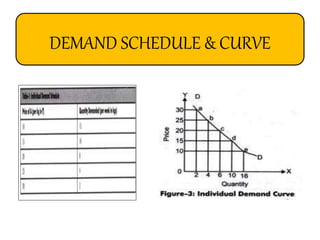
Demand Curve:-
Demand curve shows a graphical
representation of demand schedule. It can be
made by plotting price and quantity demanded
on a graph.
DEMAND SCHEDULE & CURVE
INDIVIDUAL DEMAND AND
MARKET DEMAND FUNCTION
Demand function shows the
relationship between quantity
demanded for a particular
commodity and the factors
influencing it.
INDIVIDUAL DEMAND FUNCTION
• Individual demand
function refers to the
functional
relationship between
individual demand
and the factors
affecting individual
demand.
It is expressed as:
• Dx = f (Px, Pr, Y, T, F)
Where,
• Dx = Demand for Commodity x;
• Px = Price of the given Commodity x;
• Pr = Prices of Related Goods;
• Y = Income of the Consumer;
• T = Tastes and Preferences;
• F = Expectation of Change in Price in future.
Market Demand Function:
Market demand function refers to the
functional relationship between market
demand and the factors affecting market
demand.
As mentioned before, market demand is
affected by all factors affecting individual
demand.
In addition, it is also affected by size and
composition of population, season and
weather and distribution of income.
Market demand function can be expressed as:
Dx = f (Px, Pr, Y, T, F, PD, S, D)
Where,
•Dx = Market demand of commodity x;
•Px = Price of given commodity x;
•Pr = Prices of Related Goods;
•Y = Income of the consumers;
•T = Tastes and Preferences;
• F = Expectation of Change in Price in future;
•P0 = Size and Composition of population;
•S = Season and Weather;
• D = Distribution of Income.
LAW OF DEMAND
• The law of demand states that, other things remaining the
same, there is inverse relationship between price and
quantity demanded of a product, i.e. increase in price
reduces the quantity demanded and decrease in price
increases the quantity.
• MARSHALL, the originator of the law, has defined the
law of demand as, “the amount demanded increases with a
fall in price and diminishes with a rise in price”. This law
holds under ceteris paribus assumption, that is, all other
things remain unchanged.
Determinants Of The Law Of
Demand
 Price of the product
 Price of related goods
 Level of income
 Taste and preferences of consumers
 Future trend of prices
 Change in population
 State of business
 Distribution of income and wealth
 Availability of consumer credit
 Propensity to save
 Advertisement expenditure
 others
Exceptions to the Law of Demand
 Giffen goods
 Conspicuous consumption
 Conspicuous necessities
 Ignorance
 Emergencies
 Future changes in price
 Change in fashion
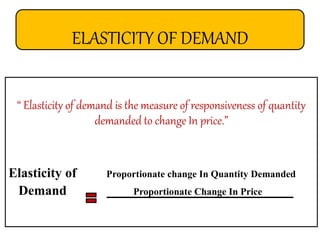
ELASTICITY OF DEMAND
“ Elasticity of demand is the measure of responsiveness of quantity
demanded to change In price.”
Elasticity of Proportionate change In Quantity Demanded
Demand Proportionate Change In Price
PRICE
ELASTICITY
INCOME
ELASTICITY
CROSS
ELASTICITY
TYPES OF ELASTICITY OF DEMAND
PRICE ELASTICITY OF DEMAND
The Price Elasticity of Demand may be defined as the ratio of relative change
in demand and price variables.
Ed Percentage / Proportional Change In Quantity Demanded
Percentage / Proportional Change In Price
TYPES OF PRICE ELASTICITY
Perfectly
Inelastic
Perfectly
Elastic
Price
Elasticity
Relatively
Elastic
Relativel
y
Inelastic
Unitary
Elastic
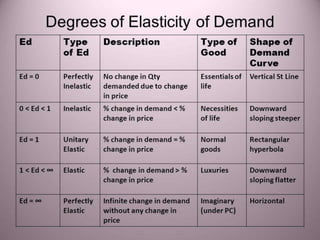
Where:-
D1 = Perfectly
Elastic
Demand (ed=∞)
D2 = Relatively
Elastic Demand
(ed > 1)
D3 = Unitary
Elastic Demand
(ed = 1)
D4 = Relatively
Inelastic
Demand (ed < 1)
D5 = Perfectly
Inelastic
Demand (ed = 0)
GRAPHICAL REPRESENTATION OF DEGRESS OF
ELASTICITY OF DEMAND
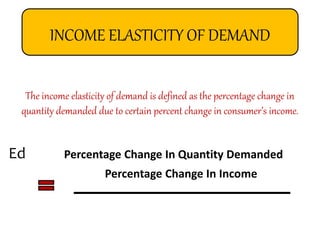
INCOME ELASTICITY OF DEMAND
The income elasticity of demand is defined as the percentage change in
quantity demanded due to certain percent change in consumer’s income.
Ed Percentage Change In Quantity Demanded
Percentage Change In Income
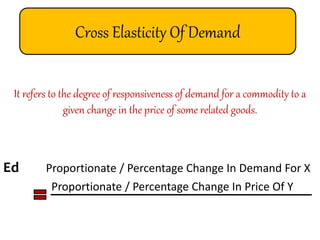
Cross Elasticity Of Demand
It refers to the degree of responsiveness of demand for a commodity to a
given change in the price of some related goods.
Ed Proportionate / Percentage Change In Demand For X
Proportionate / Percentage Change In Price Of Y
Determinants of elasticity of demand
The elasticity of demand of any commodity is determined by a number of factors which are
explained below:
• Nature of commodity
• Substitutes
• Goods having several uses
• Joint demand
• Postpone of the consumption
• Income of the consumer
• Proportion of income spent
• Price level
Importance of elasticity of demand
• Formulation of government policies
• Businessman
• Decision of monopolist
• Case of joint products
• Industries
• Determination of wages
• Advertisements
• International trade
The concept of elasticity is useful for the followings
decision making activities-
• In production i.e. in deciding the quantity of goods to
be produced.
• Price fixation i.e. in fixing the prices not only on the
cost basis but also on the basis of prices of related
goods.
• In distribution i.e. to decide as to where, when, and
how much etc.
• In international trade i.e. what to export, where to
export
• In foreign exchange
• For nationalizing an industry
• In public finance
The independent variables can be classified under two
categories:-
• 1)- Controllable variables, and
• 2)- Uncontrollable variables.
Demand

Demand

  • 1.
  • 2.
    Parul Singh (GroupLeader) Shivani Singh Mohd. Nadeem Mohd. Baizad Malik Mohd. Atif Topic:- DEMAND
  • 3.
    DEMAND Demand is abuyer's willingness and ability to pay a price for a specific quantity of a good or service. Demand refers to how much (quantity) of a product or service is desired by buyers at various prices. The quantity demanded is the amount of a product people are willing or able to buy at a certain price; the relationship between price and quantity demanded is known as the demand.
  • 4.
    Demand Schedule:- Demand schedulerefers to a tabular representation of the relationship between price and quantity demanded. Demand Curve:- Demand curve shows a graphical representation of demand schedule. It can be made by plotting price and quantity demanded on a graph.
  • 5.
  • 6.
    INDIVIDUAL DEMAND AND MARKETDEMAND FUNCTION Demand function shows the relationship between quantity demanded for a particular commodity and the factors influencing it.
  • 7.
    INDIVIDUAL DEMAND FUNCTION •Individual demand function refers to the functional relationship between individual demand and the factors affecting individual demand.
  • 8.
    It is expressedas: • Dx = f (Px, Pr, Y, T, F) Where, • Dx = Demand for Commodity x; • Px = Price of the given Commodity x; • Pr = Prices of Related Goods; • Y = Income of the Consumer; • T = Tastes and Preferences; • F = Expectation of Change in Price in future.
  • 9.
  • 10.
    Market demand functionrefers to the functional relationship between market demand and the factors affecting market demand. As mentioned before, market demand is affected by all factors affecting individual demand. In addition, it is also affected by size and composition of population, season and weather and distribution of income.
  • 11.
    Market demand functioncan be expressed as: Dx = f (Px, Pr, Y, T, F, PD, S, D) Where, •Dx = Market demand of commodity x; •Px = Price of given commodity x; •Pr = Prices of Related Goods; •Y = Income of the consumers; •T = Tastes and Preferences; • F = Expectation of Change in Price in future; •P0 = Size and Composition of population; •S = Season and Weather; • D = Distribution of Income.
  • 12.
    LAW OF DEMAND •The law of demand states that, other things remaining the same, there is inverse relationship between price and quantity demanded of a product, i.e. increase in price reduces the quantity demanded and decrease in price increases the quantity. • MARSHALL, the originator of the law, has defined the law of demand as, “the amount demanded increases with a fall in price and diminishes with a rise in price”. This law holds under ceteris paribus assumption, that is, all other things remain unchanged.
  • 13.
    Determinants Of TheLaw Of Demand  Price of the product  Price of related goods  Level of income  Taste and preferences of consumers  Future trend of prices  Change in population  State of business  Distribution of income and wealth  Availability of consumer credit  Propensity to save  Advertisement expenditure  others
  • 14.
    Exceptions to theLaw of Demand  Giffen goods  Conspicuous consumption  Conspicuous necessities  Ignorance  Emergencies  Future changes in price  Change in fashion
  • 15.
    ELASTICITY OF DEMAND “Elasticity of demand is the measure of responsiveness of quantity demanded to change In price.” Elasticity of Proportionate change In Quantity Demanded Demand Proportionate Change In Price
  • 16.
  • 17.
    PRICE ELASTICITY OFDEMAND The Price Elasticity of Demand may be defined as the ratio of relative change in demand and price variables. Ed Percentage / Proportional Change In Quantity Demanded Percentage / Proportional Change In Price
  • 18.
    TYPES OF PRICEELASTICITY Perfectly Inelastic Perfectly Elastic Price Elasticity Relatively Elastic Relativel y Inelastic Unitary Elastic
  • 19.
    Where:- D1 = Perfectly Elastic Demand(ed=∞) D2 = Relatively Elastic Demand (ed > 1) D3 = Unitary Elastic Demand (ed = 1) D4 = Relatively Inelastic Demand (ed < 1) D5 = Perfectly Inelastic Demand (ed = 0) GRAPHICAL REPRESENTATION OF DEGRESS OF ELASTICITY OF DEMAND
  • 20.
    INCOME ELASTICITY OFDEMAND The income elasticity of demand is defined as the percentage change in quantity demanded due to certain percent change in consumer’s income. Ed Percentage Change In Quantity Demanded Percentage Change In Income
  • 21.
    Cross Elasticity OfDemand It refers to the degree of responsiveness of demand for a commodity to a given change in the price of some related goods. Ed Proportionate / Percentage Change In Demand For X Proportionate / Percentage Change In Price Of Y
  • 22.
    Determinants of elasticityof demand The elasticity of demand of any commodity is determined by a number of factors which are explained below: • Nature of commodity • Substitutes • Goods having several uses • Joint demand • Postpone of the consumption • Income of the consumer • Proportion of income spent • Price level
  • 23.
    Importance of elasticityof demand • Formulation of government policies • Businessman • Decision of monopolist • Case of joint products • Industries • Determination of wages • Advertisements • International trade
  • 27.
    The concept ofelasticity is useful for the followings decision making activities- • In production i.e. in deciding the quantity of goods to be produced. • Price fixation i.e. in fixing the prices not only on the cost basis but also on the basis of prices of related goods.
  • 28.
    • In distributioni.e. to decide as to where, when, and how much etc. • In international trade i.e. what to export, where to export • In foreign exchange • For nationalizing an industry • In public finance
  • 29.
    The independent variablescan be classified under two categories:- • 1)- Controllable variables, and • 2)- Uncontrollable variables.