Skilbeck Model
HADEEQA WALEED
EDUCATIONIST
Skilbeck Model of Curriculum Development
 Skilbeck’s curriculum model develop in 1976.
 Skill beck suggested an approach for devising curriculum at
the school level by which teacher could realistically develop
appropriate curriculum. The model claims that for SBCD
(School Based Curriculum Development) to work effectively
five steps are required in the curriculum process.
Skilbeck Model of Curriculum Development
 Skilbeck model locates curriculum design and development firmly
within a cultural framework. It views such design as a means whereby
teachers modify and transform pupil experience through providing
insights into cultural values, interpretative frameworks and symbolic
systems.
 It is a more comprehensive framework, which can encompass either
the process model or the objective model depending on which aspects
of the curriculum are being designed. It is flexible, adaptable and open
to interpretation in the light of changing circumstances.
Skilbeck Model of Curriculum Development
 It does not presuppose a linear progression through its
components. Teachers can begin at any stage and activities can
develop concurrently. .
 The model outlined does not presuppose a means-end analysis
at all; it simple encourages teams or groups of curriculum
developers to take into account different elements and aspects
of the curriculum- development process, to see the process as an
organic whole, and to work in a moderately systematic way.
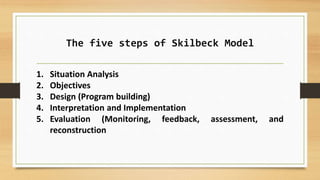
The five steps of Skilbeck Model
1. Situation Analysis
2. Objectives
3. Design (Program building)
4. Interpretation and Implementation
5. Evaluation (Monitoring, feedback, assessment, and
reconstruction
1.Situation Analysis
Skilbeck describes the situational analysis phase both external
and internal to the school.
1. External Situational Analysis
2. Internal Situation Analysis:
External Situational Analysis
Culture And Social Changes And Expectation Including Parents’
Expectations, Employer Requirements, Community Assumptions And Values,
Changing Relationships (Adults And Children), Ideology.
Educational System Requirements And Challenges E.G. Policy Statements,
Examinations, Local Authority Demands And Expectation Or Pressure,
Curriculum Project, Educational Research.
The Changing Nature Of Subject Matter To Be Taught.
The Potential Contribution Of Teacher Support System E.G. Teacher
Training Institutions And Research Institutes.
Flow Of Resources In School.
Internal Situation Analysis:
 Pupils: aptitudes, abilities and define educational needs
 Teacher: Values, attitudes, skills, knowledge, experience, special
strength and weakness.
 Perceive and felt problems and shortcoming in existing curriculum
 Material resources including plant, equipment’s and potential for
enhancing these.
2.Objectives:
• Skilbeck assigns a decision making role to teachers,
senior staff and principals in the development of
objectives for the school-based curriculum.
• Skilbeck does not categorically state the degree of
participation of the school staff at the various
levels in the school organization.
2.Objectives:
According to Skilbeck:
The curriculum is, for the learner and the teacher,
made up of experiences; these should be experiences
of value, developed by the teacher and learner
together from a close and sympathetic appraisal of the
learner's needs and his characteristics as a learner."
Action research:
• Action research is based on the assumption that
the involvement of teachers in a scientific study of
an on-the-job problem is a promising approach.
• Our experience as consultants in action research
shows that this involvement is also a source of great
difficulties.
According to skilbeck interest of parents:
 Skilbeck conceives of parents being invited by teachers to
discuss matters relating to the development of curriculum
objectives.
 Research by Kohn' and Bridge2, however, show that not all
parents are interested in participating in school decisions,
and that not all parents are well enough informed to
participate in school decision.
3.Design:
One of the most important reasons for teacher responsibility in
program development relates to the concept of cognitive
innovation and meaningful learning”.
Programmed-building
Which comprises the selection of subject-matter for learning,
the sequencing of teaching-learning episodes, the deployment
of staff and the choice of appropriate supplementary materials and
media.
 Schwab point of view:
 Problems posed to teachers who seek to use externally developed
curriculum materials.
 The problems concern the learning and developmental theories upon
which the materials are based.
 Schwab maintains that learning and developmental theories are only
one of - several starting points for the design of a curriculum
Three-Phase Model
The problem needs to be linked with the curriculum's design. Connelly has
developed a three-phase model to assist teachers:
A choice point: refers to a philosophical, psycho- logical, sociological, or
methodological issue that underlines particular curriculum developments.
Each choice point contains a set of alternatives, each of which has different
possible curricula consequences.
Deliberation: refers to the process by which teachers consider the relative
curriculum merits of the available choices...
Choice: refers to the particular choices made by teachers in the light of the
deliberation.
4.Implementation
• A closer examination of theories of cognitive motivation will throw
greater light on Skilbeck's insistance on involving teachers in a problem-
solving situation.
• Theories of cognitive motivation are useful in explaining why
circumstantial differences are appropriate to the level or degree of
innovativeness by teachers.
• Two features of cognitive motivation often identified (McReynolds1) are
the minimization of unassimilated perceptual material and the
optimization of innovation rate.
4.Implementation
• Reynold's study shows that during the implementation phase of
Skilbeck's model it is the interaction between the information
concerning the curriculum design and the teacher's present cognitive
structures that determines whether that teacher will be motivated to
exert the effort necessary to make the information meaningful.
• All information can be described in terms of the relative proportion that
is perceived by the potential implementer (the teacher) as being familiar
and readily assailable into existing cognitive structures as compared
with the proportion that is perceived as being unfamiliar and requiring
cognitive accommodation.
5.Evaluation
Evaluation (Monitoring, feedback, assessment, and reconstruction):
 Skilbeck lists the "problems of continuous assessment" as being of
central concern during the evaluation.
 Skilbeck perceives the role of the teacher to be central during the
evaluation phase to ensure continual reconstruction of the
curriculum. Leithwood and Russell l agree and add:
 “Mechanisms are necessary to ensure that a change will be in a
continual process of revision in the light of formative evaluation
data”

Skilbeck model of curriculum development

  • 1.
  • 2.
    Skilbeck Model ofCurriculum Development  Skilbeck’s curriculum model develop in 1976.  Skill beck suggested an approach for devising curriculum at the school level by which teacher could realistically develop appropriate curriculum. The model claims that for SBCD (School Based Curriculum Development) to work effectively five steps are required in the curriculum process.
  • 3.
    Skilbeck Model ofCurriculum Development  Skilbeck model locates curriculum design and development firmly within a cultural framework. It views such design as a means whereby teachers modify and transform pupil experience through providing insights into cultural values, interpretative frameworks and symbolic systems.  It is a more comprehensive framework, which can encompass either the process model or the objective model depending on which aspects of the curriculum are being designed. It is flexible, adaptable and open to interpretation in the light of changing circumstances.
  • 4.
    Skilbeck Model ofCurriculum Development  It does not presuppose a linear progression through its components. Teachers can begin at any stage and activities can develop concurrently. .  The model outlined does not presuppose a means-end analysis at all; it simple encourages teams or groups of curriculum developers to take into account different elements and aspects of the curriculum- development process, to see the process as an organic whole, and to work in a moderately systematic way.
  • 5.
    The five stepsof Skilbeck Model 1. Situation Analysis 2. Objectives 3. Design (Program building) 4. Interpretation and Implementation 5. Evaluation (Monitoring, feedback, assessment, and reconstruction
  • 6.
    1.Situation Analysis Skilbeck describesthe situational analysis phase both external and internal to the school. 1. External Situational Analysis 2. Internal Situation Analysis:
  • 7.
    External Situational Analysis CultureAnd Social Changes And Expectation Including Parents’ Expectations, Employer Requirements, Community Assumptions And Values, Changing Relationships (Adults And Children), Ideology. Educational System Requirements And Challenges E.G. Policy Statements, Examinations, Local Authority Demands And Expectation Or Pressure, Curriculum Project, Educational Research. The Changing Nature Of Subject Matter To Be Taught. The Potential Contribution Of Teacher Support System E.G. Teacher Training Institutions And Research Institutes. Flow Of Resources In School.
  • 8.
    Internal Situation Analysis: Pupils: aptitudes, abilities and define educational needs  Teacher: Values, attitudes, skills, knowledge, experience, special strength and weakness.  Perceive and felt problems and shortcoming in existing curriculum  Material resources including plant, equipment’s and potential for enhancing these.
  • 9.
    2.Objectives: • Skilbeck assignsa decision making role to teachers, senior staff and principals in the development of objectives for the school-based curriculum. • Skilbeck does not categorically state the degree of participation of the school staff at the various levels in the school organization.
  • 10.
    2.Objectives: According to Skilbeck: Thecurriculum is, for the learner and the teacher, made up of experiences; these should be experiences of value, developed by the teacher and learner together from a close and sympathetic appraisal of the learner's needs and his characteristics as a learner."
  • 11.
    Action research: • Actionresearch is based on the assumption that the involvement of teachers in a scientific study of an on-the-job problem is a promising approach. • Our experience as consultants in action research shows that this involvement is also a source of great difficulties.
  • 12.
    According to skilbeckinterest of parents:  Skilbeck conceives of parents being invited by teachers to discuss matters relating to the development of curriculum objectives.  Research by Kohn' and Bridge2, however, show that not all parents are interested in participating in school decisions, and that not all parents are well enough informed to participate in school decision.
  • 13.
    3.Design: One of themost important reasons for teacher responsibility in program development relates to the concept of cognitive innovation and meaningful learning”. Programmed-building Which comprises the selection of subject-matter for learning, the sequencing of teaching-learning episodes, the deployment of staff and the choice of appropriate supplementary materials and media.
  • 14.
     Schwab pointof view:  Problems posed to teachers who seek to use externally developed curriculum materials.  The problems concern the learning and developmental theories upon which the materials are based.  Schwab maintains that learning and developmental theories are only one of - several starting points for the design of a curriculum
  • 15.
    Three-Phase Model The problemneeds to be linked with the curriculum's design. Connelly has developed a three-phase model to assist teachers: A choice point: refers to a philosophical, psycho- logical, sociological, or methodological issue that underlines particular curriculum developments. Each choice point contains a set of alternatives, each of which has different possible curricula consequences. Deliberation: refers to the process by which teachers consider the relative curriculum merits of the available choices... Choice: refers to the particular choices made by teachers in the light of the deliberation.
  • 16.
    4.Implementation • A closerexamination of theories of cognitive motivation will throw greater light on Skilbeck's insistance on involving teachers in a problem- solving situation. • Theories of cognitive motivation are useful in explaining why circumstantial differences are appropriate to the level or degree of innovativeness by teachers. • Two features of cognitive motivation often identified (McReynolds1) are the minimization of unassimilated perceptual material and the optimization of innovation rate.
  • 17.
    4.Implementation • Reynold's studyshows that during the implementation phase of Skilbeck's model it is the interaction between the information concerning the curriculum design and the teacher's present cognitive structures that determines whether that teacher will be motivated to exert the effort necessary to make the information meaningful. • All information can be described in terms of the relative proportion that is perceived by the potential implementer (the teacher) as being familiar and readily assailable into existing cognitive structures as compared with the proportion that is perceived as being unfamiliar and requiring cognitive accommodation.
  • 18.
    5.Evaluation Evaluation (Monitoring, feedback,assessment, and reconstruction):  Skilbeck lists the "problems of continuous assessment" as being of central concern during the evaluation.  Skilbeck perceives the role of the teacher to be central during the evaluation phase to ensure continual reconstruction of the curriculum. Leithwood and Russell l agree and add:  “Mechanisms are necessary to ensure that a change will be in a continual process of revision in the light of formative evaluation data”