Cyclical Models of
Curriculum
Development
PRESENTED BY:
JUN-MAR PIOLOG & ARGIE
ESTOPIA
What is Curriculum Development?
Curriculum Development creates a plan
for teaching and learning to ensure
students receive a high-quality
education.
What is Curriculum Models?
Designed to provide a basis for
decisions regarding the selection,
structuring and sequencing of the
educational experiences.
Cyclical Models of Curriculum
Development
The cyclical models prescribe a cyclical
or continuous process of curriculum
development. Cyclical models usually
start with situational analysis that
serves as the basis for all succeeding
process.
A. Audrey Nicholls and Howard
Nicholls Model for Curriculum
Development
An example of a cyclical model for
curriculum development was developed
by Nicholls and Nicholls (1978). The
model emphasizes the cyclical nature of
curriculum development.
Figure
7.
Nicholls
and
Nicholls
Curriculum
Development
Model
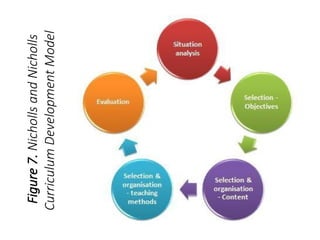
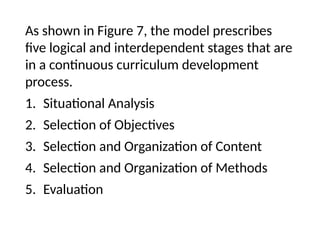
As shown in Figure 7, the model prescribes
five logical and interdependent stages that are
in a continuous curriculum development
process.
1. Situational Analysis
2. Selection of Objectives
3. Selection and Organization of Content
4. Selection and Organization of Methods
5. Evaluation
B. Wheeler's Curriculum
Development Model
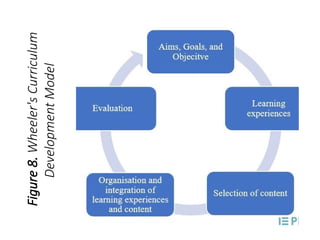
In his influential book, Curriculum Process,
Wheeler (1967) presented a cyclical process
in which each element of the curriculum is
related and interdependent. Although this
model is also rational in nature, each phase
is a logical development of the preceding
one.
Figure
8.
Wheeler's
Curriculum
Development
Model
C. The Contextual Filters Model of
Course Planning
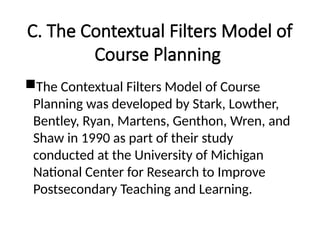
The Contextual Filters Model of Course
Planning was developed by Stark, Lowther,
Bentley, Ryan, Martens, Genthon, Wren, and
Shaw in 1990 as part of their study
conducted at the University of Michigan
National Center for Research to Improve
Postsecondary Teaching and Learning.
C. The Contextual Filters Model of
Course Planning
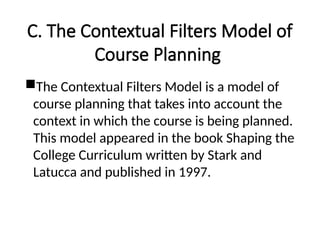
The Contextual Filters Model is a model of
course planning that takes into account the
context in which the course is being planned.
This model appeared in the book Shaping the
College Curriculum written by Stark and
Latucca and published in 1997.
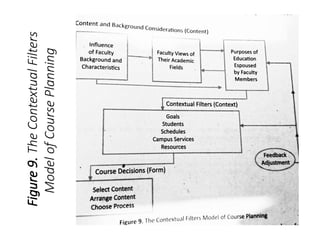
Content Influences encompass faculty
members' background and associated
disciplinary and educational beliefs.
Contextual Influences refer to the influences
outside of the instructors' immediate control
that cause adjustments in the course plans
such as student characteristics or
instructional resources.
Form includes the processes that are
followed when designing courses (Stark &
Latucca, 1997).
Figure
9.
The
Contextual
Filters
Model
of
Course
Planning

Cyclical Models of Curriculum Development.pptx

  • 1.
    Cyclical Models of Curriculum Development PRESENTEDBY: JUN-MAR PIOLOG & ARGIE ESTOPIA
  • 2.
    What is CurriculumDevelopment? Curriculum Development creates a plan for teaching and learning to ensure students receive a high-quality education.
  • 3.
    What is CurriculumModels? Designed to provide a basis for decisions regarding the selection, structuring and sequencing of the educational experiences.
  • 4.
    Cyclical Models ofCurriculum Development The cyclical models prescribe a cyclical or continuous process of curriculum development. Cyclical models usually start with situational analysis that serves as the basis for all succeeding process.
  • 5.
    A. Audrey Nichollsand Howard Nicholls Model for Curriculum Development An example of a cyclical model for curriculum development was developed by Nicholls and Nicholls (1978). The model emphasizes the cyclical nature of curriculum development.
  • 6.
  • 7.
    As shown inFigure 7, the model prescribes five logical and interdependent stages that are in a continuous curriculum development process. 1. Situational Analysis 2. Selection of Objectives 3. Selection and Organization of Content 4. Selection and Organization of Methods 5. Evaluation
  • 8.
    B. Wheeler's Curriculum DevelopmentModel In his influential book, Curriculum Process, Wheeler (1967) presented a cyclical process in which each element of the curriculum is related and interdependent. Although this model is also rational in nature, each phase is a logical development of the preceding one.
  • 9.
  • 10.
    C. The ContextualFilters Model of Course Planning The Contextual Filters Model of Course Planning was developed by Stark, Lowther, Bentley, Ryan, Martens, Genthon, Wren, and Shaw in 1990 as part of their study conducted at the University of Michigan National Center for Research to Improve Postsecondary Teaching and Learning.
  • 11.
    C. The ContextualFilters Model of Course Planning The Contextual Filters Model is a model of course planning that takes into account the context in which the course is being planned. This model appeared in the book Shaping the College Curriculum written by Stark and Latucca and published in 1997.
  • 12.
    Content Influences encompassfaculty members' background and associated disciplinary and educational beliefs. Contextual Influences refer to the influences outside of the instructors' immediate control that cause adjustments in the course plans such as student characteristics or instructional resources. Form includes the processes that are followed when designing courses (Stark & Latucca, 1997).
  • 13.