SUBJECT: TECHNIQUES OF EDUCATIONAL
ASSESSMENT
PRESENTATION TOPIC: SELECTED-RESPONSE ITEMS
PRESENTED BY: NADEEM AHMED KHAN
PRESENTED TO: DR. AROOSA SOHAIL
DEPARTMENT: EDUCATION
SEMESTER: M. PHIL (1ST SEMESTER)
DATE: DEC 23RD, 2022
SELECTED RESPONSE ITEMS
 Selected-response items ask students to select the correct answer
from a list of options included in the item
(Kansas State Department of Education)
 Selected-response items are those that are composed of
questions to which there is typically one best answer. They are
sometimes referred to objective assessments.
 These items measure the students’ ability to apply their knowledge
and skills.
Advantages of Selected-Response
Items
➢ They are efficient.
➢ Selected-response items can be used to assess a range of
student knowledge and skills.
➢ One can score them faster than other types of items.
➢ They are easy to analyze.
➢ They are relatively easy to construct and modify over time.
➢ They are quick to respond.
Disadvantages of Selected-Response
Items
 Selected-response items cannot directly measure higher-order
thinking in the same way that, for example, an essay prompt can.
 Students can guess the answers to selected-response items,
which makes the results less accurate.
 A long assessment that contains only selected-response items can
overwhelm and frustrate students.
 Multiple-choice questions favor students that are test-wise
 Multiple-choice questions reward guessing rather than knowing
Types of Selected-Response Items
▪ Binary Choice Items
▪ Multiple Choice Items
▪ Matching Items etc.
Binary Choice Items
▪ A Binary Question is answered by picking one of two opposite
choices.
▪ Such questions can be based on
❖ Fact/ Opinion
❖ True/ False
❖ Yes/ No
❖ Correct/ Incorrect
Binary Choice Items
Advantages
▪ It is fast and a student can answer
many questions in a short amount of
time.
▪ Can cover a lot of facts in a short
space
▪ "Easy” to construct
▪ Can assess distinguishing fact and
opinion
▪ Can assess identifying cause and
effect
Disadvantages
▪ A student has a 50/50 chance to get the
correct answer.
▪ Ambiguity may promote merely
“guessing.”
▪ Can usually only assess simple recall
of facts
▪ The “right” answer is often obvious
Instructions in writing Binary Type Items
 The statement must be unequally true or false.
 Make each item as significant as possible.
 Include only one concept in each statement.
 Rarely use negative statements, never use double negatives
 The written length of the statement should neither be too long nor too short.
 Don’t use new terminology on an exam that you haven’t used in class.
 Phrase items carefully to assess recall.
 Avoid ambiguous statement
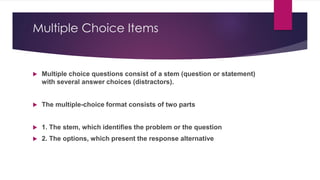
Multiple Choice Items
 Multiple choice questions consist of a stem (question or statement)
with several answer choices (distractors).
 The multiple-choice format consists of two parts
 1. The stem, which identifies the problem or the question
 2. The options, which present the response alternative
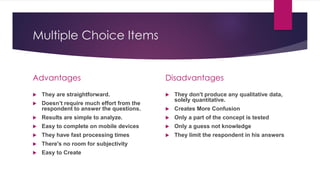
Multiple Choice Items
Advantages
 They are straightforward.
 Doesn’t require much effort from the
respondent to answer the questions.
 Results are simple to analyze.
 Easy to complete on mobile devices
 They have fast processing times
 There's no room for subjectivity
 Easy to Create
Disadvantages
 They don't produce any qualitative data,
solely quantitative.
 Creates More Confusion
 Only a part of the concept is tested
 Only a guess not knowledge
 They limit the respondent in his answers
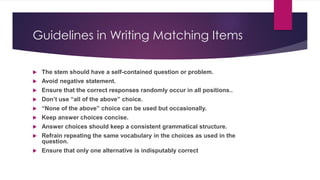
Guidelines in Writing Matching Items
 The stem should have a self-contained question or problem.
 Avoid negative statement.
 Ensure that the correct responses randomly occur in all positions..
 Don’t use “all of the above” choice.
 “None of the above” choice can be used but occasionally.
 Keep answer choices concise.
 Answer choices should keep a consistent grammatical structure.
 Refrain repeating the same vocabulary in the choices as used in the
question.
 Ensure that only one alternative is indisputably correct
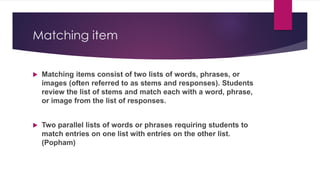
Matching item
 Matching items consist of two lists of words, phrases, or
images (often referred to as stems and responses). Students
review the list of stems and match each with a word, phrase,
or image from the list of responses.
 Two parallel lists of words or phrases requiring students to
match entries on one list with entries on the other list.
(Popham)
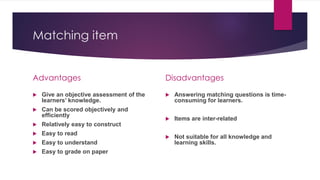
Matching item
Advantages
 Give an objective assessment of the
learners’ knowledge.
 Can be scored objectively and
efficiently
 Relatively easy to construct
 Easy to read
 Easy to understand
 Easy to grade on paper
Disadvantages
 Answering matching questions is time-
consuming for learners.
 Items are inter-related
 Not suitable for all knowledge and
learning skills.
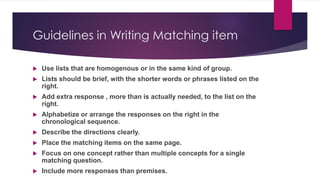
Guidelines in Writing Matching item
 Use lists that are homogenous or in the same kind of group.
 Lists should be brief, with the shorter words or phrases listed on the
right.
 Add extra response , more than is actually needed, to the list on the
right.
 Alphabetize or arrange the responses on the right in the
chronological sequence.
 Describe the directions clearly.
 Place the matching items on the same page.
 Focus on one concept rather than multiple concepts for a single
matching question.
 Include more responses than premises.
Selected Response Items.pdf

Selected Response Items.pdf

  • 1.
    SUBJECT: TECHNIQUES OFEDUCATIONAL ASSESSMENT PRESENTATION TOPIC: SELECTED-RESPONSE ITEMS PRESENTED BY: NADEEM AHMED KHAN PRESENTED TO: DR. AROOSA SOHAIL DEPARTMENT: EDUCATION SEMESTER: M. PHIL (1ST SEMESTER) DATE: DEC 23RD, 2022
  • 3.
    SELECTED RESPONSE ITEMS Selected-response items ask students to select the correct answer from a list of options included in the item (Kansas State Department of Education)  Selected-response items are those that are composed of questions to which there is typically one best answer. They are sometimes referred to objective assessments.  These items measure the students’ ability to apply their knowledge and skills.
  • 4.
    Advantages of Selected-Response Items ➢They are efficient. ➢ Selected-response items can be used to assess a range of student knowledge and skills. ➢ One can score them faster than other types of items. ➢ They are easy to analyze. ➢ They are relatively easy to construct and modify over time. ➢ They are quick to respond.
  • 5.
    Disadvantages of Selected-Response Items Selected-response items cannot directly measure higher-order thinking in the same way that, for example, an essay prompt can.  Students can guess the answers to selected-response items, which makes the results less accurate.  A long assessment that contains only selected-response items can overwhelm and frustrate students.  Multiple-choice questions favor students that are test-wise  Multiple-choice questions reward guessing rather than knowing
  • 6.
    Types of Selected-ResponseItems ▪ Binary Choice Items ▪ Multiple Choice Items ▪ Matching Items etc.
  • 7.
    Binary Choice Items ▪A Binary Question is answered by picking one of two opposite choices. ▪ Such questions can be based on ❖ Fact/ Opinion ❖ True/ False ❖ Yes/ No ❖ Correct/ Incorrect
  • 8.
    Binary Choice Items Advantages ▪It is fast and a student can answer many questions in a short amount of time. ▪ Can cover a lot of facts in a short space ▪ "Easy” to construct ▪ Can assess distinguishing fact and opinion ▪ Can assess identifying cause and effect Disadvantages ▪ A student has a 50/50 chance to get the correct answer. ▪ Ambiguity may promote merely “guessing.” ▪ Can usually only assess simple recall of facts ▪ The “right” answer is often obvious
  • 9.
    Instructions in writingBinary Type Items  The statement must be unequally true or false.  Make each item as significant as possible.  Include only one concept in each statement.  Rarely use negative statements, never use double negatives  The written length of the statement should neither be too long nor too short.  Don’t use new terminology on an exam that you haven’t used in class.  Phrase items carefully to assess recall.  Avoid ambiguous statement
  • 10.
    Multiple Choice Items Multiple choice questions consist of a stem (question or statement) with several answer choices (distractors).  The multiple-choice format consists of two parts  1. The stem, which identifies the problem or the question  2. The options, which present the response alternative
  • 11.
    Multiple Choice Items Advantages They are straightforward.  Doesn’t require much effort from the respondent to answer the questions.  Results are simple to analyze.  Easy to complete on mobile devices  They have fast processing times  There's no room for subjectivity  Easy to Create Disadvantages  They don't produce any qualitative data, solely quantitative.  Creates More Confusion  Only a part of the concept is tested  Only a guess not knowledge  They limit the respondent in his answers
  • 12.
    Guidelines in WritingMatching Items  The stem should have a self-contained question or problem.  Avoid negative statement.  Ensure that the correct responses randomly occur in all positions..  Don’t use “all of the above” choice.  “None of the above” choice can be used but occasionally.  Keep answer choices concise.  Answer choices should keep a consistent grammatical structure.  Refrain repeating the same vocabulary in the choices as used in the question.  Ensure that only one alternative is indisputably correct
  • 13.
    Matching item  Matchingitems consist of two lists of words, phrases, or images (often referred to as stems and responses). Students review the list of stems and match each with a word, phrase, or image from the list of responses.  Two parallel lists of words or phrases requiring students to match entries on one list with entries on the other list. (Popham)
  • 14.
    Matching item Advantages  Givean objective assessment of the learners’ knowledge.  Can be scored objectively and efficiently  Relatively easy to construct  Easy to read  Easy to understand  Easy to grade on paper Disadvantages  Answering matching questions is time- consuming for learners.  Items are inter-related  Not suitable for all knowledge and learning skills.
  • 15.
    Guidelines in WritingMatching item  Use lists that are homogenous or in the same kind of group.  Lists should be brief, with the shorter words or phrases listed on the right.  Add extra response , more than is actually needed, to the list on the right.  Alphabetize or arrange the responses on the right in the chronological sequence.  Describe the directions clearly.  Place the matching items on the same page.  Focus on one concept rather than multiple concepts for a single matching question.  Include more responses than premises.