Personality
What is personality? Personality-  the psychological qualities that bring continuity to an individual’s behavior in different situations at different times.
The “what” & the “why” of personality Most theories of personality try to explain how & why one’s personality forms & changes through the lifespan. Psychoanalytic , ( Radical Behavioristic ),  Humanistic  &  Cognitive The Trait Personality theory defines the components -traits, temperaments & types- of personality. Trait theorists do not ask the question of “why?”
The “what” & the “why” of personality Most theories of personality try to explain how & why one’s personality forms & changes through the lifespan. Psycho analytic  (now Psycho dynamic ) , ( Radical Behavioristic ),  Humanistic  &  Cognitive The Trait Personality theory defines the components -traits, temperaments & types- of personality. Trait theorists do not ask the question of “why?”
Psycho dynamic  Theory Contemporary Psycho dynamic  Theory is based on the psycho analytic  theories of Sigmund Freud. Psycho dynamic  personality theorists emphasize the effect of unconscious motives & past experiences on our current mental health.
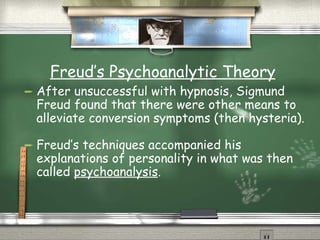
Freud’s Psychoanalytic Theory After unsuccessful with hypnosis, Sigmund Freud found that there were other means to alleviate conversion symptoms (then hysteria). Freud’s techniques accompanied his explanations of personality in what was then called  psychoanalysis .
Freud’s Psychoanalytic Theory Freud’s theory centered around the  unconscious . Repressed impulses, drives & conflicts which the conscious self is unaware Eros & Thanatos Eros - the  libido  fuels lust (& work & leisure activities). Thanatos - aggression & destruction against others
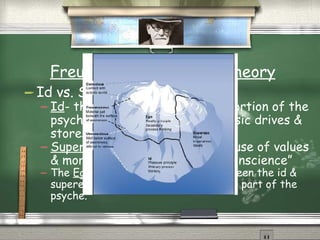
Freud’s Psychoanalytic Theory Id vs. Superego Id - the primitive, unconscious portion of the psyche that houses the most basic drives & stores repressed memories. Superego - the psyche’s storehouse of values & morals (from parents); “the conscience” The  Ego  moderates the conflict between the id & superego; it’s the conscious & rational part of the psyche.
Freud’s Psychoanalytic Theory Psychosexual Developmental Stages Oral Anal Phallic Latent Genital
Freud’s Psychoanalytic Theory Ego Defense Mechanisms (operate at the  pre conscious level) Repression Denial Reaction formation Displacement Regression Sublimation Projection Impetus for  projective testing-  Rorschach & TAT
Freud’s Psychoanalytic Theory Psychic Determinism Freud’s assumption that ALL mental & behavioral responses are caused by unconscious traumas, desires or conflicts. Freudian Slips… … when you say one thing but mean your mother.
Neo-Freudians’ Psychodynamic Theories All neo-Freudians  agreed  that the unconscious influenced behavior. All neo-Freudians  disagreed  about the specific motives for behavior.  (more focus conscious, lifelong influence & social effects) Neo-Freudians include: Carl Jung Karen Horney Alfred Adler Erik Erikson
Neo-Freudians’ Psychodynamic Theories Carl Jung  Personal vs. Collective Unconscious  Archetypes Personality types (I/E;S/iN; F/T) Karen Horney  M/F differences are derived from society Basic anxiety  causes mental disorder Dealing with basic anxiety: move  toward ,  against , or  away  from others Alfred Adler Compensation  for unconscious  inferiority Erik Erikson- social & lifelong development
Trait Theory Trait theory began with Hippocrates’ theory of the four humors (fluids) secreted from the body. Sanguine- cheerful Choleric- angry Melancholic- depressed Phlegmatic- cold, aloof
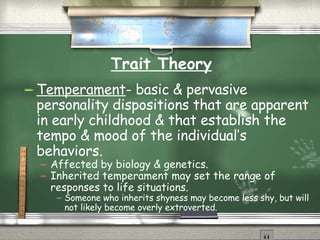
Trait Theory Temperament - basic & pervasive personality dispositions that are apparent in early childhood & that establish the tempo & mood of the individual’s behaviors. Affected by biology & genetics. Inherited temperament may set the range of responses to life situations. Someone who inherits shyness may become less shy, but will not likely become overly extroverted.
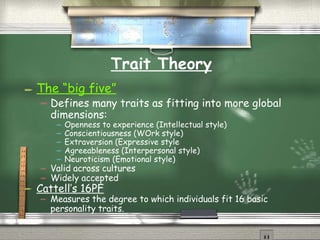
Trait Theory The “big five” Defines many traits as fitting into more global dimensions: Openness to experience (Intellectual style) Conscientiousness (WOrk style) Extraversion (Expressive style Agreeableness (Interpersonal style) Neuroticism (Emotional style) Valid across cultures Widely accepted Cattell’s 16PF Measures the degree to which individuals fit 16 basic personality traits.
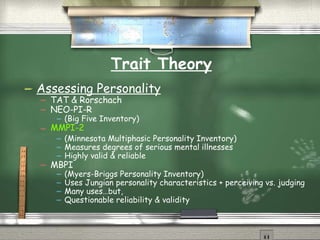
Trait Theory Assessing Personality TAT & Rorschach NEO-PI-R (Big Five Inventory) MMPI-2 (Minnesota Multiphasic Personality Inventory) Measures degrees of serious mental illnesses Highly valid & reliable MBPI (Myers-Briggs Personality Inventory) Uses Jungian personality characteristics + perceiving vs. judging Many uses…but,  Questionable reliability & validity
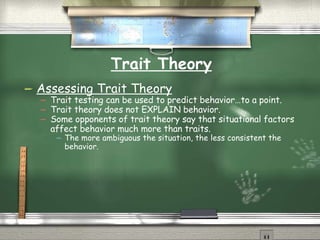
Trait Theory Assessing Trait Theory Trait testing can be used to predict behavior…to a point. Trait theory does not EXPLAIN behavior. Some opponents of trait theory say that situational factors affect behavior much more than traits.  The more ambiguous the situation, the less consistent the behavior.

#39&40 Personality

  • 1.
  • 2.
    What is personality?Personality- the psychological qualities that bring continuity to an individual’s behavior in different situations at different times.
  • 3.
    The “what” &the “why” of personality Most theories of personality try to explain how & why one’s personality forms & changes through the lifespan. Psychoanalytic , ( Radical Behavioristic ), Humanistic & Cognitive The Trait Personality theory defines the components -traits, temperaments & types- of personality. Trait theorists do not ask the question of “why?”
  • 4.
    The “what” &the “why” of personality Most theories of personality try to explain how & why one’s personality forms & changes through the lifespan. Psycho analytic (now Psycho dynamic ) , ( Radical Behavioristic ), Humanistic & Cognitive The Trait Personality theory defines the components -traits, temperaments & types- of personality. Trait theorists do not ask the question of “why?”
  • 5.
    Psycho dynamic Theory Contemporary Psycho dynamic Theory is based on the psycho analytic theories of Sigmund Freud. Psycho dynamic personality theorists emphasize the effect of unconscious motives & past experiences on our current mental health.
  • 6.
    Freud’s Psychoanalytic TheoryAfter unsuccessful with hypnosis, Sigmund Freud found that there were other means to alleviate conversion symptoms (then hysteria). Freud’s techniques accompanied his explanations of personality in what was then called psychoanalysis .
  • 7.
    Freud’s Psychoanalytic TheoryFreud’s theory centered around the unconscious . Repressed impulses, drives & conflicts which the conscious self is unaware Eros & Thanatos Eros - the libido fuels lust (& work & leisure activities). Thanatos - aggression & destruction against others
  • 8.
    Freud’s Psychoanalytic TheoryId vs. Superego Id - the primitive, unconscious portion of the psyche that houses the most basic drives & stores repressed memories. Superego - the psyche’s storehouse of values & morals (from parents); “the conscience” The Ego moderates the conflict between the id & superego; it’s the conscious & rational part of the psyche.
  • 9.
    Freud’s Psychoanalytic TheoryPsychosexual Developmental Stages Oral Anal Phallic Latent Genital
  • 10.
    Freud’s Psychoanalytic TheoryEgo Defense Mechanisms (operate at the pre conscious level) Repression Denial Reaction formation Displacement Regression Sublimation Projection Impetus for projective testing- Rorschach & TAT
  • 11.
    Freud’s Psychoanalytic TheoryPsychic Determinism Freud’s assumption that ALL mental & behavioral responses are caused by unconscious traumas, desires or conflicts. Freudian Slips… … when you say one thing but mean your mother.
  • 12.
    Neo-Freudians’ Psychodynamic TheoriesAll neo-Freudians agreed that the unconscious influenced behavior. All neo-Freudians disagreed about the specific motives for behavior. (more focus conscious, lifelong influence & social effects) Neo-Freudians include: Carl Jung Karen Horney Alfred Adler Erik Erikson
  • 13.
    Neo-Freudians’ Psychodynamic TheoriesCarl Jung Personal vs. Collective Unconscious Archetypes Personality types (I/E;S/iN; F/T) Karen Horney M/F differences are derived from society Basic anxiety causes mental disorder Dealing with basic anxiety: move toward , against , or away from others Alfred Adler Compensation for unconscious inferiority Erik Erikson- social & lifelong development
  • 14.
    Trait Theory Traittheory began with Hippocrates’ theory of the four humors (fluids) secreted from the body. Sanguine- cheerful Choleric- angry Melancholic- depressed Phlegmatic- cold, aloof
  • 15.
    Trait Theory Temperament- basic & pervasive personality dispositions that are apparent in early childhood & that establish the tempo & mood of the individual’s behaviors. Affected by biology & genetics. Inherited temperament may set the range of responses to life situations. Someone who inherits shyness may become less shy, but will not likely become overly extroverted.
  • 16.
    Trait Theory The“big five” Defines many traits as fitting into more global dimensions: Openness to experience (Intellectual style) Conscientiousness (WOrk style) Extraversion (Expressive style Agreeableness (Interpersonal style) Neuroticism (Emotional style) Valid across cultures Widely accepted Cattell’s 16PF Measures the degree to which individuals fit 16 basic personality traits.
  • 17.
    Trait Theory AssessingPersonality TAT & Rorschach NEO-PI-R (Big Five Inventory) MMPI-2 (Minnesota Multiphasic Personality Inventory) Measures degrees of serious mental illnesses Highly valid & reliable MBPI (Myers-Briggs Personality Inventory) Uses Jungian personality characteristics + perceiving vs. judging Many uses…but, Questionable reliability & validity
  • 18.
    Trait Theory AssessingTrait Theory Trait testing can be used to predict behavior…to a point. Trait theory does not EXPLAIN behavior. Some opponents of trait theory say that situational factors affect behavior much more than traits. The more ambiguous the situation, the less consistent the behavior.

Editor's Notes

  • #2 http://www.tflreport.com/jbpic/AdamSandlerOperaMan.jpg