Avian Systematics
• Systematics deals with evolutionary
relationships among organisms. Allied
with classification (or taxonomy).
• All birds are classified within the single
Class Aves
– 2 Subclasses
– 4 Infraclasses
Class Aves
• Subclass Sauriurae
– Infraclass Archaeornithes - Archaeopteryx
– Infraclass Enantiornithes - Opposite birds
• Subclass Ornithurae
– Infraclass Odontornithes - New World
toothed birds
– Infraclass Neornithes
• Superorder Paleognathae - ratites and
tinamous
• Superorder Neognathae - all other birds
• During the Mesozoic several extinct
lineages of birds shared the world with
early Neornithes.
The Ichthyornithiformes could fly and
bore teeth in the jaws; known forms
seem to have resembled gulls in their
lifestyle, if not their structure.
• The Hesperornithiformes were also
toothed, but most had small wings that
were useless for flight (although a few
hesperornithiforms that could probably fly
have been found as fossils). Flightless
hesperornithiforms seem to have swam
by powerful foot propulsion, somewhat
like modern cormorants
• The most complex fossil bird taxon is
the Enantiornithes. This group, which
first appeared in the Lower Cretaceous,
ranged from sparrow-sized birds to birds
with wingspans a meter across, and
included both toothed and toothless
forms. Our knowledge of the
Enantiornithes is still changing, and this
taxon may turn out to be paraphyletic
Avian Phylogeny based on Feduccia (1995)
Avian Systematics
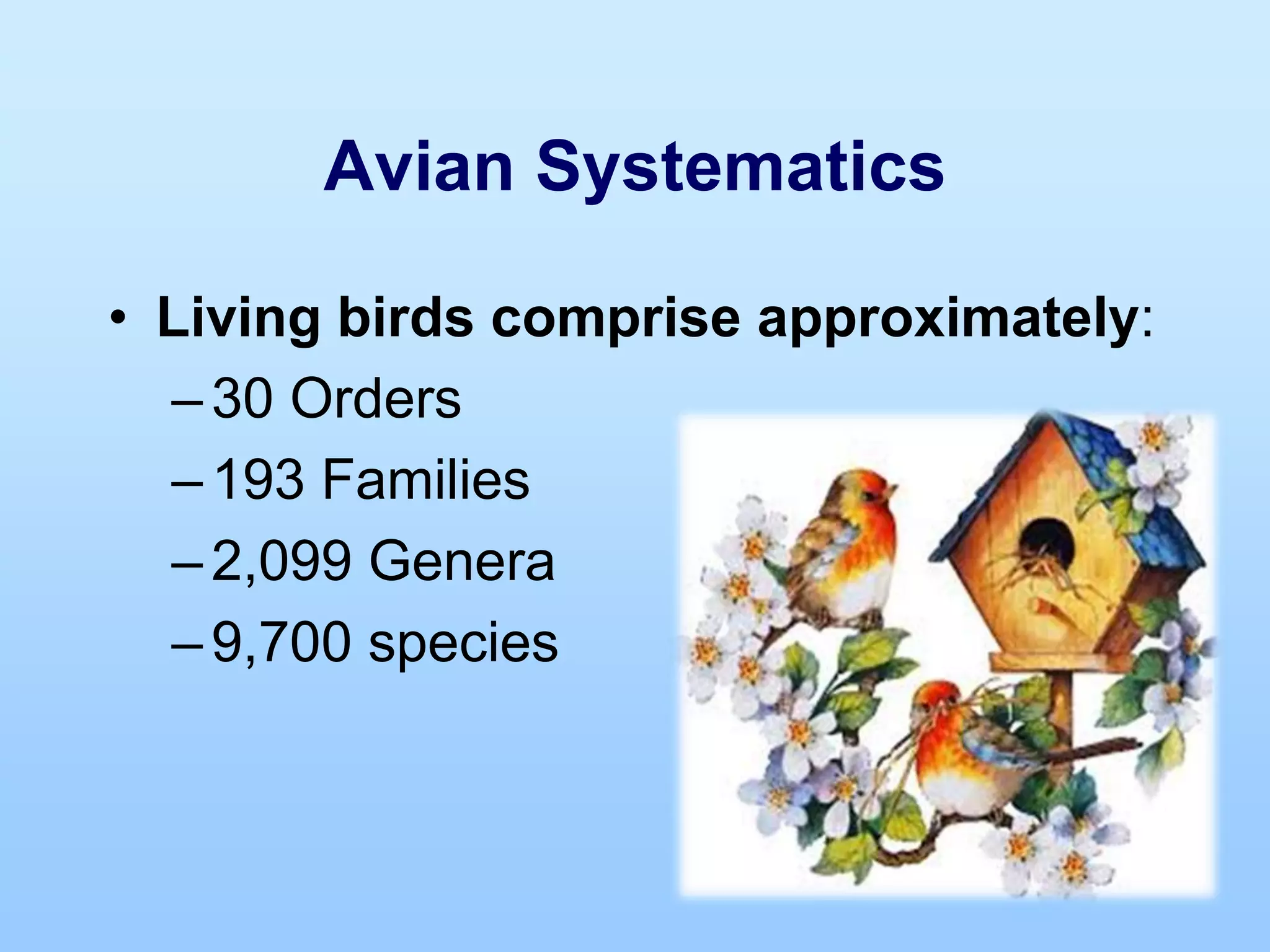
• Living birds comprise approximately:
–30 Orders
–193 Families
–2,099 Genera
–9,700 species
Avian Systematics
• Basic unit of classification = Species
– Biological Species Concept = a species is
a group of similar looking individuals that
are capable of interbreeding successfully
– Molecular Species Concept = a species is
a group of organisms that are diagnosably
different genetically from other groups of
organisms
Avian Systematics
• In practice, it can be difficult to delineate
species from subspecies (geographical
variants) by both definitions of species.
• 2 Schools of Thought on differentiating
species:
– Lumpers = tend to group similar forms into
a single species
– Splitters = tend to differentiate species
when only minor variation present
Avian Systematics
• The goal of systematics (and
classification) is to provide a correct
phylogeny (evolutionary family tree) for
organisms.
• Avian systematics deals with how the
phylogeny of modern birds is
established.
Bases for Classification
• Morphology = physical characteristics
– historical method by which phylogenies
derived
– still a common method, particularly for
fossil birds
• Biochemical Evidence = closely related
birds should have more similar genes
than more distantly related birds
• Supplementary Evidence
Morphology
• Physical characteristics used for
establishing phylogenies must be
shared derived characters, rather than
primitive characters.
• If two birds share a derived character,
we can hypothesize that they shared a
common ancestor with that same
derived character.
Morphology
• Cladistics = a method of using a number of
characters to establish a cladogram, which
presumably outlines the evolutionary
relationships among species based on these
characters.
• Caution: a cladogram is only as good as the
characters that are put into it, so careful
choice must be used in entering characters
into the model.
Morphology
• Morphological evidence alone is not sufficient
to derive correct phylogenies.
• One problem is convergent evolution = two
species which are not closely related may
look similar because they are adapted to
similar lifestyles or environments.
• Examples:
– Auks (N hemisphere) vs. Penguins (S
hemisphere)
– New World Warblers and Australian Thornbills
Penguins – southern Hemisphere Auks – northern Hemisphere
New World Warblers Australian Warblers/Thornbills
Biochemical Evidence
• Protein Electorphoresis = method of
separating proteins in an electric field
depending on their charge, which reflects
their amino acid sequence.
• Ideally, this should measure the genetic
distance between 2 birds, because the amino
acid sequence is dependent on the DNA
sequence.
• Not used much anymore.
Biochemical Evidence
• DNA/DNA Hybridization = also an attempt to
measure amount of genetic similarity. More
direct than using proteins.
– Fragments of single stranded DNA from 2 species
associated under specific conditions. Forms 2-
stranded hybrid complex.
– Hybrid complex then heated until dissociation.
– Higher numbers of shared base pairs lead to
increased thermal stability, so the more similar the
DNA, the higher the heat required for dissociation.
Biochemical Evidence
• Problems with DNA/DNA Hybridization
– Differences may reflect adaptive radiation (and
associated rapid DNA change) rather than distant
ancestry
– Natural selection acts on phenotype not on
genotype (convergence is also possible within
DNA)
– There is some argument over how accurately
thermal stability reflects actual DNA sequences.
• DNA/DNA hybridization not used much
anymore.
Biochemical Evidence
• DNA Sequencing = measures genetic
similarity of a portion of the genome (usually
certain specific genes) directly.
• Measures nucleotide sequences of certain
genes directly (often use mitochondrial DNA)
• Most direct measure of genetic similarity and
the common method for deriving phylogenies
currently.
• Usually will use several genes to verify
phylogeny.
Supplementary Evidence
• Behavior = related species should show
similar unique (derived) behaviors
– Example: New World Vultures historically
assigned to Falconiformes based on morphology.
Share unique habit of urinating on legs to increase
heat loss when hot with storks (Ciconiiformes).
DNA evidence supports relationship with storks.
• Biogeography = ranges of closely related
forms should be geographically closer than
more distantly related forms.
Supplementary Evidence
• Karyotypes = shapes and numbers of
chromosomes. Again, should be most similar
between closely related species.
• Ectoparasites = external parasites are often
specific for a particular species of bird.
Closely related birds should have similar
ectoparasites since they evolved along with
the birds.
• TAKE HOME = systematics is not a static
science, but is dynamic, changing as new
information comes to light.
Themes of avian systematics

Themes of avian systematics

  • 3.
    Avian Systematics • Systematicsdeals with evolutionary relationships among organisms. Allied with classification (or taxonomy). • All birds are classified within the single Class Aves – 2 Subclasses – 4 Infraclasses
  • 4.
    Class Aves • SubclassSauriurae – Infraclass Archaeornithes - Archaeopteryx – Infraclass Enantiornithes - Opposite birds • Subclass Ornithurae – Infraclass Odontornithes - New World toothed birds – Infraclass Neornithes • Superorder Paleognathae - ratites and tinamous • Superorder Neognathae - all other birds
  • 5.
    • During theMesozoic several extinct lineages of birds shared the world with early Neornithes. The Ichthyornithiformes could fly and bore teeth in the jaws; known forms seem to have resembled gulls in their lifestyle, if not their structure.
  • 6.
    • The Hesperornithiformeswere also toothed, but most had small wings that were useless for flight (although a few hesperornithiforms that could probably fly have been found as fossils). Flightless hesperornithiforms seem to have swam by powerful foot propulsion, somewhat like modern cormorants
  • 7.
    • The mostcomplex fossil bird taxon is the Enantiornithes. This group, which first appeared in the Lower Cretaceous, ranged from sparrow-sized birds to birds with wingspans a meter across, and included both toothed and toothless forms. Our knowledge of the Enantiornithes is still changing, and this taxon may turn out to be paraphyletic
  • 8.
    Avian Phylogeny basedon Feduccia (1995)
  • 9.
    Avian Systematics • Livingbirds comprise approximately: –30 Orders –193 Families –2,099 Genera –9,700 species
  • 10.
    Avian Systematics • Basicunit of classification = Species – Biological Species Concept = a species is a group of similar looking individuals that are capable of interbreeding successfully – Molecular Species Concept = a species is a group of organisms that are diagnosably different genetically from other groups of organisms
  • 11.
    Avian Systematics • Inpractice, it can be difficult to delineate species from subspecies (geographical variants) by both definitions of species. • 2 Schools of Thought on differentiating species: – Lumpers = tend to group similar forms into a single species – Splitters = tend to differentiate species when only minor variation present
  • 12.
    Avian Systematics • Thegoal of systematics (and classification) is to provide a correct phylogeny (evolutionary family tree) for organisms. • Avian systematics deals with how the phylogeny of modern birds is established.
  • 13.
    Bases for Classification •Morphology = physical characteristics – historical method by which phylogenies derived – still a common method, particularly for fossil birds • Biochemical Evidence = closely related birds should have more similar genes than more distantly related birds • Supplementary Evidence
  • 14.
    Morphology • Physical characteristicsused for establishing phylogenies must be shared derived characters, rather than primitive characters. • If two birds share a derived character, we can hypothesize that they shared a common ancestor with that same derived character.
  • 15.
    Morphology • Cladistics =a method of using a number of characters to establish a cladogram, which presumably outlines the evolutionary relationships among species based on these characters. • Caution: a cladogram is only as good as the characters that are put into it, so careful choice must be used in entering characters into the model.
  • 17.
    Morphology • Morphological evidencealone is not sufficient to derive correct phylogenies. • One problem is convergent evolution = two species which are not closely related may look similar because they are adapted to similar lifestyles or environments. • Examples: – Auks (N hemisphere) vs. Penguins (S hemisphere) – New World Warblers and Australian Thornbills
  • 18.
    Penguins – southernHemisphere Auks – northern Hemisphere
  • 19.
    New World WarblersAustralian Warblers/Thornbills
  • 20.
    Biochemical Evidence • ProteinElectorphoresis = method of separating proteins in an electric field depending on their charge, which reflects their amino acid sequence. • Ideally, this should measure the genetic distance between 2 birds, because the amino acid sequence is dependent on the DNA sequence. • Not used much anymore.
  • 21.
    Biochemical Evidence • DNA/DNAHybridization = also an attempt to measure amount of genetic similarity. More direct than using proteins. – Fragments of single stranded DNA from 2 species associated under specific conditions. Forms 2- stranded hybrid complex. – Hybrid complex then heated until dissociation. – Higher numbers of shared base pairs lead to increased thermal stability, so the more similar the DNA, the higher the heat required for dissociation.
  • 22.
    Biochemical Evidence • Problemswith DNA/DNA Hybridization – Differences may reflect adaptive radiation (and associated rapid DNA change) rather than distant ancestry – Natural selection acts on phenotype not on genotype (convergence is also possible within DNA) – There is some argument over how accurately thermal stability reflects actual DNA sequences. • DNA/DNA hybridization not used much anymore.
  • 23.
    Biochemical Evidence • DNASequencing = measures genetic similarity of a portion of the genome (usually certain specific genes) directly. • Measures nucleotide sequences of certain genes directly (often use mitochondrial DNA) • Most direct measure of genetic similarity and the common method for deriving phylogenies currently. • Usually will use several genes to verify phylogeny.
  • 24.
    Supplementary Evidence • Behavior= related species should show similar unique (derived) behaviors – Example: New World Vultures historically assigned to Falconiformes based on morphology. Share unique habit of urinating on legs to increase heat loss when hot with storks (Ciconiiformes). DNA evidence supports relationship with storks. • Biogeography = ranges of closely related forms should be geographically closer than more distantly related forms.
  • 25.
    Supplementary Evidence • Karyotypes= shapes and numbers of chromosomes. Again, should be most similar between closely related species. • Ectoparasites = external parasites are often specific for a particular species of bird. Closely related birds should have similar ectoparasites since they evolved along with the birds. • TAKE HOME = systematics is not a static science, but is dynamic, changing as new information comes to light.