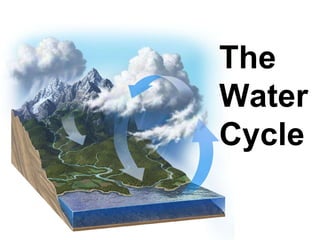
The Water Cycle
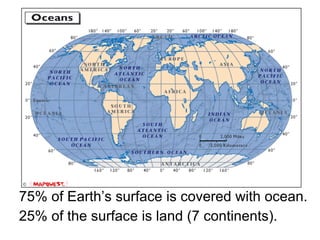
75% of Earth’s surface is covered with ocean. 25% of the surface is land (7 continents).
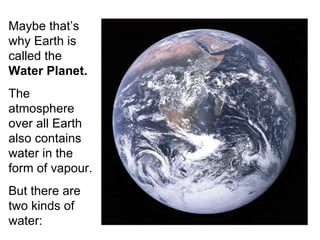
Maybe that’s why Earth is called the  Water Planet. The atmosphere over all Earth also contains water in the form of vapour. But there are two kinds of water:
Salt water   is in the oceans
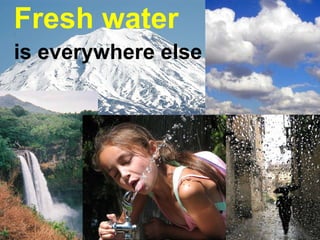
Fresh water   is everywhere else
Most  (97%)  of the water on Earth is salt water in the oceans. Salt water   in the oceans Earth’s water Fresh water 97% 3% Only about 3% of Earth’s water is fresh water.
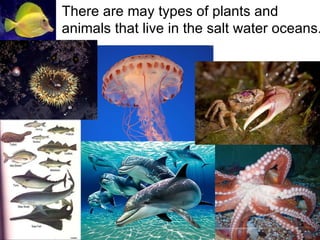
There are may types of plants and animals that live in the salt water oceans.
But all the plants and animals that don’t live in the ocean must have fresh (not salt) water to live and grow.
Salt water from the oceans becomes fresh water in a process we call the… Water  Cycle .   Salt water fresh water
The water cycle begins when energy from the sun heats ocean water.  This heat energy causes  evaporation.
evaporation  ee va poh ray shun   evaporated; evaporating   from Latin  evaporare,   steam, vapor  Spanish equivalent :  evaporación when liquid water becomes vapour
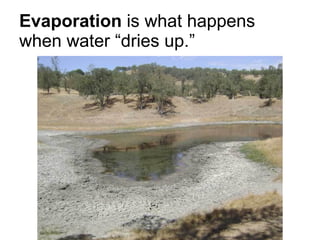
Evaporation  is what happens when water “dries up.”
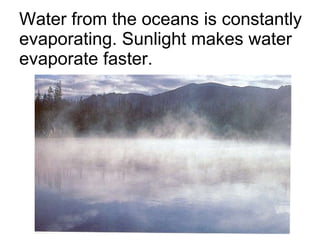
Water from the oceans is constantly evaporating. Sunlight makes water evaporate faster.
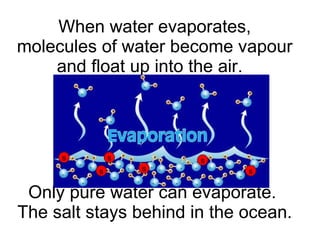
When water evaporates, molecules of water become vapour and float up into the air.  Only pure water can evaporate.  The salt stays behind in the ocean. s s s s s s
Some vapour gets into the air as it is released from plants. This is called  transpiration.
Water vapour is not visible in the atmosphere until it cools and  condenses  into clouds.
condensation  con den say shun   condensed; condensing   from Latin  condensare,   to thicken  Spanish equivalent :  condensación when vapour becomes liquid water
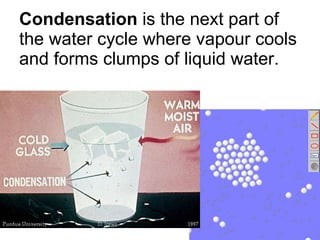
Condensation  is the next part of the water cycle where vapour cools and forms clumps of liquid water.
Warm air can hold a lot of vapour but when air cools the vapour condenses into bigger and bigger droplets.
Vapour condenses more and more as it gets cooler. Droplets get bigger and clouds get darker.
When the droplets get too heavy they fall to the ground as liquid or frozen water. This step in the water cycle is called  precipitation.
precipitation  pree sip ih  tay  shun precipitate; precipitating from Latin  praecipitare   ,   to fall  Spanish equivalent :  precipitación any water that falls from the sky  (rain, snow, sleet, hail)
 
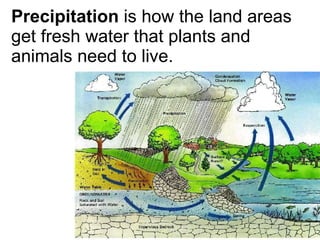
Precipitation  is how the land areas get fresh water that plants and animals need to live.
Some of the precipitation falls as snow. It may lay on the ground all winter then melt slowly to keep rivers running all summer.
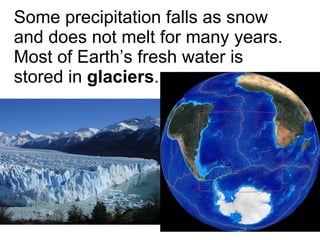
Some precipitation falls as snow and does not melt for many years.  Most of Earth’s fresh water is stored in  glaciers .
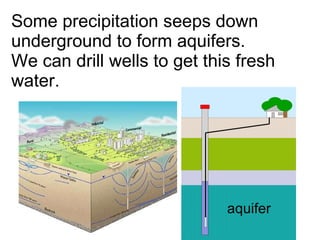
Some precipitation seeps down underground to form aquifers. We can drill wells to get this fresh water. aquifer
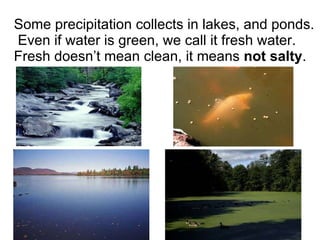
Some precipitation collects in lakes, and ponds.  Even if water is green, we call it fresh water. Fresh doesn’t mean clean, it means  not salty .
A lot of the precipitation runs off into streams and rivers where it flows back to the ocean. This is called  runoff.
runoff  Precipitation that doesn’t soak into the ground and “runs off” the land to get back to the oceans.
Eventually, all fresh water gets back to the ocean where the cycle of  evaporation ,  condensation ,  precipitation   and  runoff   can go on  and on to supply  fresh water to our planet.
 
A cycle is a wheel that is constantly turning Earth’s  water  is in a constant  cycle.   It evaporates from the ocean, travels through the air,  rains down on the land and then flows back to the ocean.
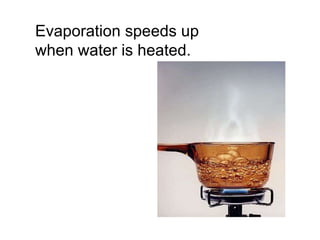
Evaporation speeds up when water is heated.
Earth’s atmosphere is warmer near the equator where the Sun’s ray are more direct. The north and south polar regions are colder. hot warm warm cold cold
This is why the areas around the equator where the world is hotter have more rain and humidity. equator equator
Some parts of the world seem to be very dry,  but even in the desert, there is water.  Every living plant and animal contains water and there is water vapour in the air.
For millions of years, some of the rain water that falls has been soaking deep underground. You can find water in these aquifers almost anyplace you drill.
Name 3 kinds of fresh water
Vapour  vay  pohr Water that is in the gas state. Water molecules that have been e vapor ated. Vapour is usually invisible but hot steam can be seen for a few seconds before it disappears.
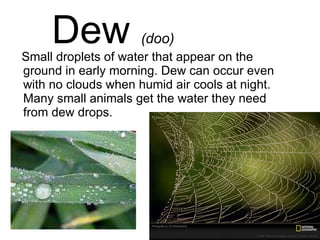
Dew  (doo) Small droplets of water that appear on the ground in early morning. Dew can occur even with no clouds when humid air cools at night.  Many small animals get the water they need from dew drops.
Convection current Air movements caused by uneven heating of the Earth and temperature differences.  Hot air rises, colder air sinks.  The result is wind.
Aquifer  ( ah  kwih fur) Big areas of underground water that can be found by drilling almost anyplace on Earth. This is also called the  water table.
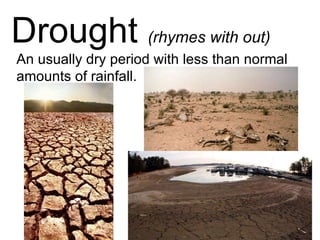
Drought  (rhymes with out) An usually dry period with less than normal amounts of rainfall.
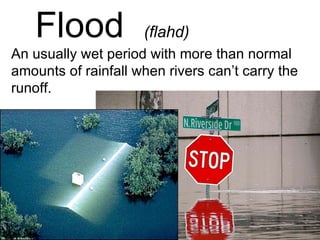
Flood  (flahd) An usually wet period with more than normal amounts of rainfall when rivers can’t carry the  runoff.
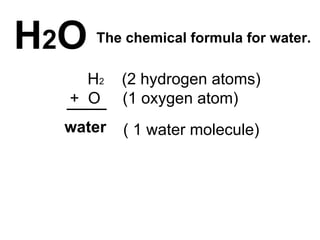
H 2 O H 2   (2 hydrogen atoms)  +  O  (1 oxygen atom) The chemical formula for water. water ( 1 water molecule)
Frozen H 2 O =  ice Liquid H 2 O =  water Gas H 2 O =  vapor

The water cycle

  • 1.
  • 2.
    75% of Earth’ssurface is covered with ocean. 25% of the surface is land (7 continents).
  • 3.
    Maybe that’s whyEarth is called the Water Planet. The atmosphere over all Earth also contains water in the form of vapour. But there are two kinds of water:
  • 4.
    Salt water is in the oceans
  • 5.
    Fresh water is everywhere else
  • 6.
    Most (97%) of the water on Earth is salt water in the oceans. Salt water in the oceans Earth’s water Fresh water 97% 3% Only about 3% of Earth’s water is fresh water.
  • 7.
    There are maytypes of plants and animals that live in the salt water oceans.
  • 8.
    But all theplants and animals that don’t live in the ocean must have fresh (not salt) water to live and grow.
  • 9.
    Salt water fromthe oceans becomes fresh water in a process we call the… Water Cycle . Salt water fresh water
  • 10.
    The water cyclebegins when energy from the sun heats ocean water. This heat energy causes evaporation.
  • 11.
    evaporation eeva poh ray shun evaporated; evaporating from Latin evaporare, steam, vapor Spanish equivalent : evaporación when liquid water becomes vapour
  • 12.
    Evaporation iswhat happens when water “dries up.”
  • 13.
    Water from theoceans is constantly evaporating. Sunlight makes water evaporate faster.
  • 14.
    When water evaporates,molecules of water become vapour and float up into the air. Only pure water can evaporate. The salt stays behind in the ocean. s s s s s s
  • 15.
    Some vapour getsinto the air as it is released from plants. This is called transpiration.
  • 16.
    Water vapour isnot visible in the atmosphere until it cools and condenses into clouds.
  • 17.
    condensation conden say shun condensed; condensing from Latin condensare, to thicken Spanish equivalent : condensación when vapour becomes liquid water
  • 18.
    Condensation isthe next part of the water cycle where vapour cools and forms clumps of liquid water.
  • 19.
    Warm air canhold a lot of vapour but when air cools the vapour condenses into bigger and bigger droplets.
  • 20.
    Vapour condenses moreand more as it gets cooler. Droplets get bigger and clouds get darker.
  • 21.
    When the dropletsget too heavy they fall to the ground as liquid or frozen water. This step in the water cycle is called precipitation.
  • 22.
    precipitation preesip ih tay shun precipitate; precipitating from Latin praecipitare , to fall Spanish equivalent : precipitación any water that falls from the sky (rain, snow, sleet, hail)
  • 23.
  • 24.
    Precipitation ishow the land areas get fresh water that plants and animals need to live.
  • 25.
    Some of theprecipitation falls as snow. It may lay on the ground all winter then melt slowly to keep rivers running all summer.
  • 26.
    Some precipitation fallsas snow and does not melt for many years. Most of Earth’s fresh water is stored in glaciers .
  • 27.
    Some precipitation seepsdown underground to form aquifers. We can drill wells to get this fresh water. aquifer
  • 28.
    Some precipitation collectsin lakes, and ponds. Even if water is green, we call it fresh water. Fresh doesn’t mean clean, it means not salty .
  • 29.
    A lot ofthe precipitation runs off into streams and rivers where it flows back to the ocean. This is called runoff.
  • 30.
    runoff Precipitationthat doesn’t soak into the ground and “runs off” the land to get back to the oceans.
  • 31.
    Eventually, all freshwater gets back to the ocean where the cycle of evaporation , condensation , precipitation and runoff can go on and on to supply fresh water to our planet.
  • 32.
  • 33.
    A cycle isa wheel that is constantly turning Earth’s water is in a constant cycle. It evaporates from the ocean, travels through the air, rains down on the land and then flows back to the ocean.
  • 34.
    Evaporation speeds upwhen water is heated.
  • 35.
    Earth’s atmosphere iswarmer near the equator where the Sun’s ray are more direct. The north and south polar regions are colder. hot warm warm cold cold
  • 36.
    This is whythe areas around the equator where the world is hotter have more rain and humidity. equator equator
  • 37.
    Some parts ofthe world seem to be very dry, but even in the desert, there is water. Every living plant and animal contains water and there is water vapour in the air.
  • 38.
    For millions ofyears, some of the rain water that falls has been soaking deep underground. You can find water in these aquifers almost anyplace you drill.
  • 39.
    Name 3 kindsof fresh water
  • 40.
    Vapour vay pohr Water that is in the gas state. Water molecules that have been e vapor ated. Vapour is usually invisible but hot steam can be seen for a few seconds before it disappears.
  • 41.
    Dew (doo)Small droplets of water that appear on the ground in early morning. Dew can occur even with no clouds when humid air cools at night. Many small animals get the water they need from dew drops.
  • 42.
    Convection current Airmovements caused by uneven heating of the Earth and temperature differences. Hot air rises, colder air sinks. The result is wind.
  • 43.
    Aquifer (ah kwih fur) Big areas of underground water that can be found by drilling almost anyplace on Earth. This is also called the water table.
  • 44.
    Drought (rhymeswith out) An usually dry period with less than normal amounts of rainfall.
  • 45.
    Flood (flahd)An usually wet period with more than normal amounts of rainfall when rivers can’t carry the runoff.
  • 46.
    H 2 OH 2 (2 hydrogen atoms) + O (1 oxygen atom) The chemical formula for water. water ( 1 water molecule)
  • 47.
    Frozen H 2O = ice Liquid H 2 O = water Gas H 2 O = vapor