Weather Phenomena
SOL 4.6SOL 4.6
Follows along with
Interactive Notebook
notes
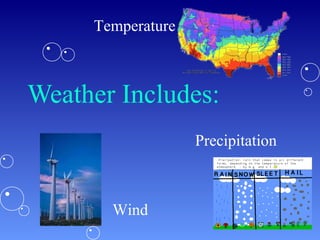
Weather Includes:
Temperature
Wind
Precipitation
Weather Instruments (Tools)
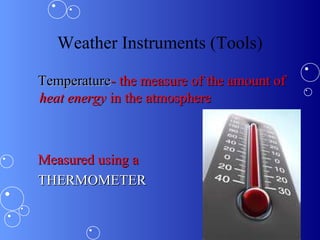
TemperatureTemperature- the measure of the amount of- the measure of the amount of
heat energyheat energy in the atmospherein the atmosphere
Measured using aMeasured using a
THERMOMETERTHERMOMETER
Additional Weather Instruments
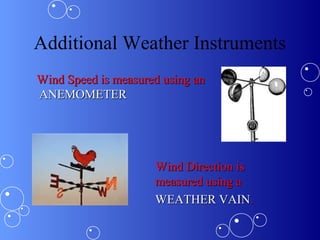
Wind Speed is measured using anWind Speed is measured using an
ANEMOMETERANEMOMETER
Wind Direction isWind Direction is
measured using ameasured using a
WEATHER VAINWEATHER VAIN..
Additional Weather Instruments
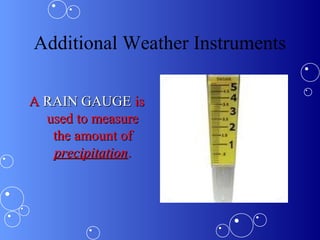
AA RAIN GAUGERAIN GAUGE isis
used to measureused to measure
the amount ofthe amount of
precipitationprecipitation..
Precipitation Includes:
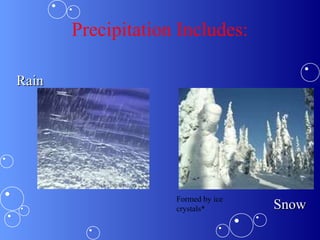
RainRain
SnowSnow
Formed by ice
crystals*
More types of Precipitation:
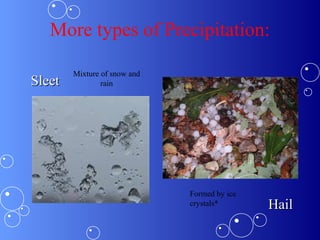
SleetSleet
HailHail
Formed by ice
crystals*
Mixture of snow and
rain
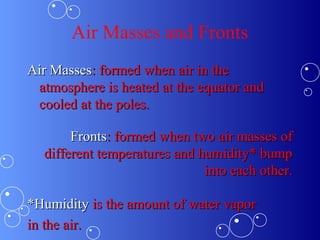
Air Masses and Fronts
Air MassesAir Masses: formed when air in the: formed when air in the
atmosphere is heated at the equator andatmosphere is heated at the equator and
cooled at the poles.cooled at the poles.
FrontsFronts: formed when two air masses of: formed when two air masses of
different temperatures and humidity* bumpdifferent temperatures and humidity* bump
into each other.into each other.
*Humidity*Humidity is the amount of water vaporis the amount of water vapor
in the air.in the air.
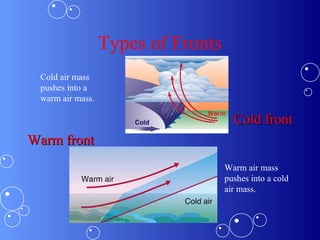
Types of Fronts
Cold frontCold front
Warm frontWarm front
Cold air mass
pushes into a
warm air mass.
Warm air mass
pushes into a cold
air mass.
Additional Weather Tools
Air pressureAir pressure is the result of the mass/weightis the result of the mass/weight
of the air and temperature pushing on itsof the air and temperature pushing on its
surroundings. (atmospheric pressure)surroundings. (atmospheric pressure)
Measured usingMeasured using
aa BAROMETERBAROMETER
Do weather forecasters use air
pressure to predict the weather?
High pressureHigh pressure areas are formed whenareas are formed when air isair is
cooled.cooled.
Low pressureLow pressure is formed whenis formed when air is warmedair is warmed..
Weather associated with low pressure areasWeather associated with low pressure areas
are: clouds, rain, and wind.are: clouds, rain, and wind.
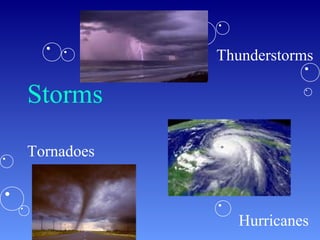
Storms
Thunderstorms
Tornadoes
Hurricanes
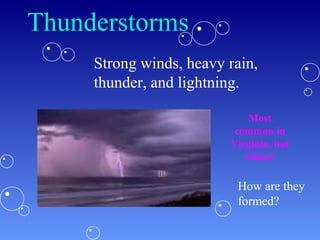
Thunderstorms
Strong winds, heavy rain,
thunder, and lightning.
Most
common in
Virginia, but
when?
How are they
formed?
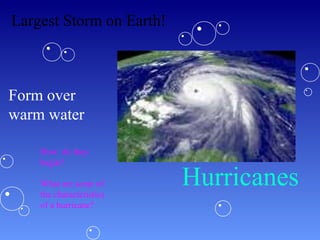
Hurricanes
Form over
warm water
Largest Storm on Earth!
How do they
begin?
What are some of
the characteristics
of a hurricane?
Tornados
Column of warm
air begins to spin
upward forming a
funnel cloud.
What types of wind
speed and what can
they do?
CLOUDS
Clouds are formed when warm airClouds are formed when warm air
carryingcarrying water vapor riseswater vapor rises from thefrom the
Earth and the water vaporEarth and the water vapor cools downcools down
andand connectconnect to each other.to each other.
Are all clouds the same?Are all clouds the same?
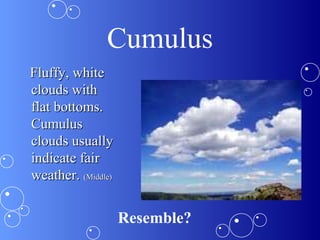
Cumulus
Fluffy, whiteFluffy, white
clouds withclouds with
flat bottoms.flat bottoms.
CumulusCumulus
clouds usuallyclouds usually
indicate fairindicate fair
weather.weather. (Middle)(Middle)
Resemble?
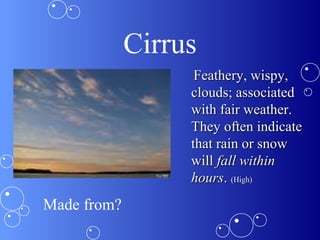
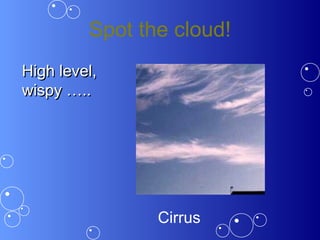
Cirrus
Feathery, wispy,Feathery, wispy,
clouds; associatedclouds; associated
with fair weather.with fair weather.
They often indicateThey often indicate
that rain or snowthat rain or snow
willwill fall withinfall within
hourshours.. (High)(High)
Made from?
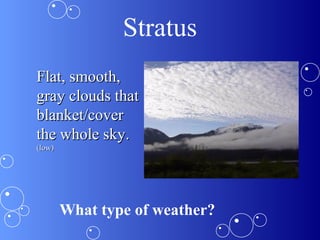
Stratus
Flat, smooth,Flat, smooth,
gray clouds thatgray clouds that
blanket/coverblanket/cover
the whole sky.the whole sky.
(low)(low)
What type of weather?
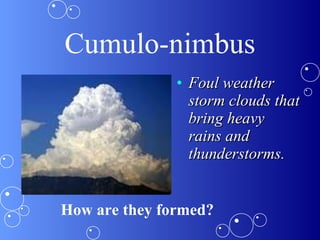
• Foul weatherFoul weather
storm clouds thatstorm clouds that
bring heavybring heavy
rains andrains and
thunderstorms.thunderstorms.
Cumulo-nimbus
How are they formed?
Spot the cloud!
Low and flat …..Low and flat …..
Stratus
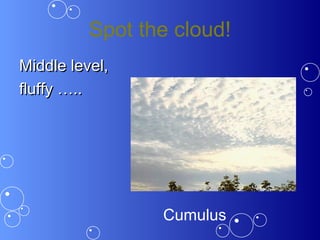
Spot the cloud!
Middle level,Middle level,
fluffy …..fluffy …..
Cumulus
Spot the cloud!
High level,High level,
wispy …..wispy …..
Cirrus
Spot the cloud!
Rain bearing,Rain bearing,
storm clouds …..storm clouds …..
Cumulo-Nimbus
Let’s Review 
It’s time to play the…It’s time to play the…
Cirrus CloudsCirrus Clouds Cold FrontCold Front Wind/WeatherWind/Weather
VaneVane
ThermometerThermometer HurricaneHurricane
High pressureHigh pressure SnowSnow Air MassesAir Masses CumulousCumulous
CloudsClouds
Low pressureLow pressure
PrecipitationPrecipitation BarometerBarometer SleetSleet Cumulo-nimbusCumulo-nimbus
CloudsClouds
HailHail
Rain GaugeRain Gauge Warm FrontWarm Front Air pressureAir pressure CloudsClouds ThunderstormThunderstorm
TornadoTornado AnemometerAnemometer Stratus CloudsStratus Clouds WeatherWeather MeteorologistsMeteorologists
The ABC’s of Weather
Draw a letter from the bag. Share a word or phraseDraw a letter from the bag. Share a word or phrase
that begins with the letter to summarize weather.that begins with the letter to summarize weather.
Tara Moore, Elementary Lead Science TeacherTara Moore, Elementary Lead Science Teacher
Suffolk Public SchoolsSuffolk Public Schools
October 2005October 2005
Some cloud slides adapted from John Harris, Radley College, UKSome cloud slides adapted from John Harris, Radley College, UK

Grade 4 - weather power point

  • 1.
    Weather Phenomena SOL 4.6SOL4.6 Follows along with Interactive Notebook notes
  • 2.
  • 3.
    Weather Instruments (Tools) TemperatureTemperature-the measure of the amount of- the measure of the amount of heat energyheat energy in the atmospherein the atmosphere Measured using aMeasured using a THERMOMETERTHERMOMETER
  • 4.
    Additional Weather Instruments WindSpeed is measured using anWind Speed is measured using an ANEMOMETERANEMOMETER Wind Direction isWind Direction is measured using ameasured using a WEATHER VAINWEATHER VAIN..
  • 5.
    Additional Weather Instruments AARAIN GAUGERAIN GAUGE isis used to measureused to measure the amount ofthe amount of precipitationprecipitation..
  • 6.
  • 7.
    More types ofPrecipitation: SleetSleet HailHail Formed by ice crystals* Mixture of snow and rain
  • 8.
    Air Masses andFronts Air MassesAir Masses: formed when air in the: formed when air in the atmosphere is heated at the equator andatmosphere is heated at the equator and cooled at the poles.cooled at the poles. FrontsFronts: formed when two air masses of: formed when two air masses of different temperatures and humidity* bumpdifferent temperatures and humidity* bump into each other.into each other. *Humidity*Humidity is the amount of water vaporis the amount of water vapor in the air.in the air.
  • 9.
    Types of Fronts ColdfrontCold front Warm frontWarm front Cold air mass pushes into a warm air mass. Warm air mass pushes into a cold air mass.
  • 10.
    Additional Weather Tools AirpressureAir pressure is the result of the mass/weightis the result of the mass/weight of the air and temperature pushing on itsof the air and temperature pushing on its surroundings. (atmospheric pressure)surroundings. (atmospheric pressure) Measured usingMeasured using aa BAROMETERBAROMETER
  • 11.
    Do weather forecastersuse air pressure to predict the weather? High pressureHigh pressure areas are formed whenareas are formed when air isair is cooled.cooled. Low pressureLow pressure is formed whenis formed when air is warmedair is warmed.. Weather associated with low pressure areasWeather associated with low pressure areas are: clouds, rain, and wind.are: clouds, rain, and wind.
  • 12.
  • 13.
    Thunderstorms Strong winds, heavyrain, thunder, and lightning. Most common in Virginia, but when? How are they formed?
  • 14.
    Hurricanes Form over warm water LargestStorm on Earth! How do they begin? What are some of the characteristics of a hurricane?
  • 15.
    Tornados Column of warm airbegins to spin upward forming a funnel cloud. What types of wind speed and what can they do?
  • 16.
    CLOUDS Clouds are formedwhen warm airClouds are formed when warm air carryingcarrying water vapor riseswater vapor rises from thefrom the Earth and the water vaporEarth and the water vapor cools downcools down andand connectconnect to each other.to each other. Are all clouds the same?Are all clouds the same?
  • 17.
    Cumulus Fluffy, whiteFluffy, white cloudswithclouds with flat bottoms.flat bottoms. CumulusCumulus clouds usuallyclouds usually indicate fairindicate fair weather.weather. (Middle)(Middle) Resemble?
  • 18.
    Cirrus Feathery, wispy,Feathery, wispy, clouds;associatedclouds; associated with fair weather.with fair weather. They often indicateThey often indicate that rain or snowthat rain or snow willwill fall withinfall within hourshours.. (High)(High) Made from?
  • 19.
    Stratus Flat, smooth,Flat, smooth, grayclouds thatgray clouds that blanket/coverblanket/cover the whole sky.the whole sky. (low)(low) What type of weather?
  • 20.
    • Foul weatherFoulweather storm clouds thatstorm clouds that bring heavybring heavy rains andrains and thunderstorms.thunderstorms. Cumulo-nimbus How are they formed?
  • 21.
    Spot the cloud! Lowand flat …..Low and flat ….. Stratus
  • 22.
    Spot the cloud! Middlelevel,Middle level, fluffy …..fluffy ….. Cumulus
  • 23.
    Spot the cloud! Highlevel,High level, wispy …..wispy ….. Cirrus
  • 24.
    Spot the cloud! Rainbearing,Rain bearing, storm clouds …..storm clouds ….. Cumulo-Nimbus
  • 25.
    Let’s Review  It’stime to play the…It’s time to play the…
  • 26.
    Cirrus CloudsCirrus CloudsCold FrontCold Front Wind/WeatherWind/Weather VaneVane ThermometerThermometer HurricaneHurricane High pressureHigh pressure SnowSnow Air MassesAir Masses CumulousCumulous CloudsClouds Low pressureLow pressure PrecipitationPrecipitation BarometerBarometer SleetSleet Cumulo-nimbusCumulo-nimbus CloudsClouds HailHail Rain GaugeRain Gauge Warm FrontWarm Front Air pressureAir pressure CloudsClouds ThunderstormThunderstorm TornadoTornado AnemometerAnemometer Stratus CloudsStratus Clouds WeatherWeather MeteorologistsMeteorologists
  • 27.
    The ABC’s ofWeather Draw a letter from the bag. Share a word or phraseDraw a letter from the bag. Share a word or phrase that begins with the letter to summarize weather.that begins with the letter to summarize weather. Tara Moore, Elementary Lead Science TeacherTara Moore, Elementary Lead Science Teacher Suffolk Public SchoolsSuffolk Public Schools October 2005October 2005 Some cloud slides adapted from John Harris, Radley College, UKSome cloud slides adapted from John Harris, Radley College, UK

Editor's Notes

  • #18 Cotton balls
  • #19 Tiny ice crystals instead of water vapor
  • #20 Light rain and drizzle
  • #21 Cumulus clouds joining together
  • #27 Teacher should use the essential knowledge from the 4th grade science curriculum framework to ask questions.