Janine V. Samelo, RCh
Regional fisheries laboratory, BFAR, Region 3
Ocean- Atmosphere Interaction
Effects of ocean on climate
Effects of ocean on climate change
Role of human activities on climate change
SIMPLIFIED SCHEMATIC VIEW OF THE COMPONENTS OF THE GLOBAL
CLIMATE SYSTEM AND THEIR INTERACTIONS
They regulate
the global
temperature
• Act as heat storage
• transportation of heat
around the globe
• evaporation
• freezing and thawing in
polar regions
• plays a major role in
• wind and precipitation
patterns.
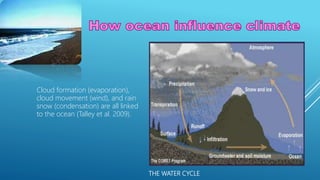
THE WATER CYCLE
Cloud formation (evaporation),
cloud movement (wind), and rain
snow (condensation) are all linked
to the ocean (Talley et al. 2009).
Help stabilize
atmospheric
conditions in land
regions
• These patterns heat places like
Europe and New Zealand and
cool places like southern
California and coastal Peru.
• The consistency of ocean
currents keeps these regions
from experiencing large
climatic and seasonal swings
that they might otherwise
experience.
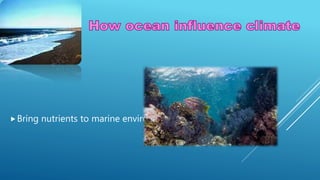
Bring nutrients to marine environments
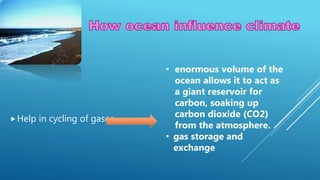
Help in cycling of gases
• enormous volume of the
ocean allows it to act as
a giant reservoir for
carbon, soaking up
carbon dioxide (CO2)
from the atmosphere.
• gas storage and
exchange
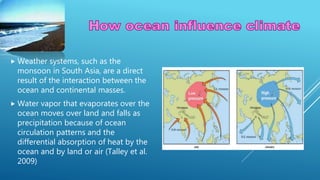
 Weather systems, such as the
monsoon in South Asia, are a direct
result of the interaction between the
ocean and continental masses.
 Water vapor that evaporates over the
ocean moves over land and falls as
precipitation because of ocean
circulation patterns and the
differential absorption of heat by the
ocean and by land or air (Talley et al.
2009)
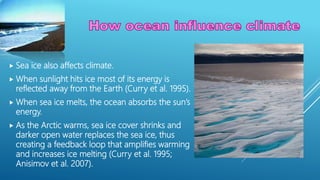
 Sea ice also affects climate.
 When sunlight hits ice most of its energy is
reflected away from the Earth (Curry et al. 1995).
 When sea ice melts, the ocean absorbs the sun’s
energy.
 As the Arctic warms, sea ice cover shrinks and
darker open water replaces the sea ice, thus
creating a feedback loop that amplifies warming
and increases ice melting (Curry et al. 1995;
Anisimov et al. 2007).
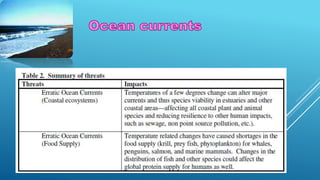
Located at the oceans surface and in deep water below 300m
It has interconnected current on both local and global scales
Circulation are powered by wind, tides Coriolis effect, sun
energy and water density differences
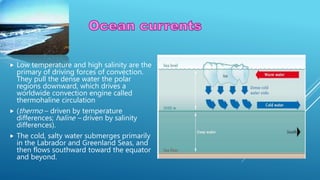
 Low temperature and high salinity are the
primary of driving forces of convection.
They pull the dense water the polar
regions downward, which drives a
worldwide convection engine called
thermohaline circulation
 (thermo – driven by temperature
differences; haline – driven by salinity
differences).
 The cold, salty water submerges primarily
in the Labrador and Greenland Seas, and
then flows southward toward the equator
and beyond.
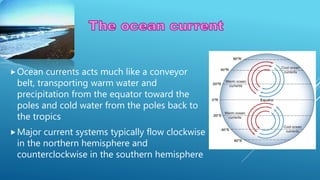
Ocean currents acts much like a conveyor
belt, transporting warm water and
precipitation from the equator toward the
poles and cold water from the poles back to
the tropics
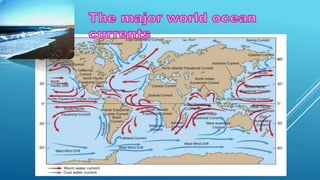
Major current systems typically flow clockwise
in the northern hemisphere and
counterclockwise in the southern hemisphere
The size, depth and location plays a key role in determining the
effects of current
Shorter horizontal currents called riptides exchange cooler,
deeper ocean water with warmer water on surface
Creates a dry conditions or storms
Those climates bordering cold currents tend to be drier as the cold
ocean water helps stabilize the air and do not favor cloud formation
and precipitation.
Air traveling over cold ocean currents lose energy to the water and
thus moderate the temperature of nearby coastal locations.
Air masses traveling over warm ocean currents promote instability
and precipitation.
In upwelling currents, vertical water movement and mixing brings
cold, nutrient rich water toward the surface while pushing warmer,
less dense water downward where it condenses and sinks
Creates an cycle
Prevailing winds, ocean surface currents and the associated mixing
influence the physical, chemical and biological characteristic of the
ocean as well as global climate
 Ocean warming has several consequences. A well-known example is sea-
level rise. As water warms, it expands, and the ocean surface rises.
 Currently, most of the excess heat in the ocean, and the associated thermal
expansion, is in a surface layer only a few hundred meters deep (Domingues
et al. 2008).
 Recent studies conclude that mean sea-level rise of 0.5m-0.8m over 1990
levels by 2100 is likely and that a rise of more than one meter in that time is
possible (Rahmstorf 2007; Pfeffer et al. 2008, Richardson et al. 2009).
 A change this significant causes storm surges and flooding to be more
dangerous and to occur more regularly (McMullen and Jabbour 2009).
 Extreme weather events are also affected by ocean warming.
 Heat is energy, so as hurricanes and typhoons form, warming sea
temperatures boost their destructive energy (Webster et al. 2005; Hoyos et al.
2006).
 marine and coastal
 ecosystems at risk.
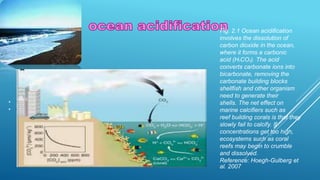
Fig. 2.1 Ocean acidification
involves the dissolution of
carbon dioxide in the ocean,
where it forms a carbonic
acid (H2CO3). The acid
converts carbonate ions into
bicarbonate, removing the
carbonate building blocks
shellfish and other organism
need to generate their
shells. The net effect on
marine calcifiers such as
reef building corals is that they
slowly fail to calcify. If
concentrations get too high,
ecosystems such as coral
reefs may begin to crumble
and dissolved.
Reference: Hoegh-Gulberg et
al. 2007
 marine and coastal
 ecosystems at risk.
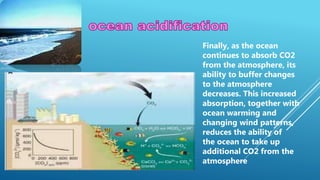
Finally, as the ocean
continues to absorb CO2
from the atmosphere, its
ability to buffer changes
to the atmosphere
decreases. This increased
absorption, together with
ocean warming and
changing wind patterns,
reduces the ability of
the ocean to take up
additional CO2 from the
atmosphere
 The climate can shift because of natural changes either within the climate
system
 Volcanic activity is an Earth-based event that is considered outside of the
climate system but that can have a pronounced effect on it.
 The very slow drift of continents, which moves land masses into different
climate zones over millions of years;
 The changing intensity of radiation emitted by the sun.
 The radiation energy of the sun fluctuates over time and changes temperatures
on Earth;
Changes in land use through activities such as deforestation, the
building of cities, the storage and use of water, and the use of
energy are all important factors locally
The urban heat island is an example of very local climate change. In
urban areas, the so-called concrete jungle of buildings and streets
stores up heat from the Sun during the day and slowly releases it at
night, making the nighttime warmer
Use of Appliances, lights, air conditioners, and furnaces all generate
heat.
 Carbon dioxide has increased from fossil fuel use in transportation, building heating
and cooling and the manufacture of cement and other goods.
 Methane has increased as a result of human activities related to agriculture, natural
gas distribution and landfills.
 Nitrous oxide is also emitted by human activities such as fertilizer use and fossil fuel
burning. Natural processes in soils and the oceans also release N2O.
 Halocarbon gas concentrations have increased primarily due to human activities.
Principal halocarbons include the chlorofluorocarbons (e.g., CFC-11 and CFC-12), which
were used extensively as refrigeration agents and in other industrial processes before
their presence in the atmosphere was found to cause stratospheric ozone depletion.
 Human use of aerosols, CFCs, pesticides, increase greenhouse gases
 Their presence therefore tends to affect the number and size of droplets in a
cloud and hence alters the reflection and absorption of solar radiation by the
cloud.
 Human activities that produce aerosols include biomass burning and the
operation of power plants.
 The latter inject sulfur dioxide into the atmosphere, a molecule that is oxidized
to form tiny droplets of sulfuric acid.
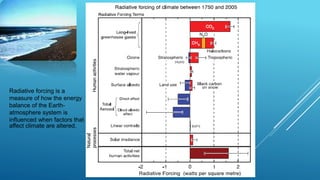
Radiative forcing is a
measure of how the energy
balance of the Earth-
atmosphere system is
influenced when factors that
affect climate are altered.
Ocean atmosphere interactions

Ocean atmosphere interactions

  • 1.
    Janine V. Samelo,RCh Regional fisheries laboratory, BFAR, Region 3
  • 2.
    Ocean- Atmosphere Interaction Effectsof ocean on climate Effects of ocean on climate change Role of human activities on climate change
  • 3.
    SIMPLIFIED SCHEMATIC VIEWOF THE COMPONENTS OF THE GLOBAL CLIMATE SYSTEM AND THEIR INTERACTIONS
  • 4.
    They regulate the global temperature •Act as heat storage • transportation of heat around the globe • evaporation • freezing and thawing in polar regions • plays a major role in • wind and precipitation patterns.
  • 5.
    THE WATER CYCLE Cloudformation (evaporation), cloud movement (wind), and rain snow (condensation) are all linked to the ocean (Talley et al. 2009).
  • 6.
    Help stabilize atmospheric conditions inland regions • These patterns heat places like Europe and New Zealand and cool places like southern California and coastal Peru. • The consistency of ocean currents keeps these regions from experiencing large climatic and seasonal swings that they might otherwise experience.
  • 7.
    Bring nutrients tomarine environments
  • 8.
    Help in cyclingof gases • enormous volume of the ocean allows it to act as a giant reservoir for carbon, soaking up carbon dioxide (CO2) from the atmosphere. • gas storage and exchange
  • 9.
     Weather systems,such as the monsoon in South Asia, are a direct result of the interaction between the ocean and continental masses.  Water vapor that evaporates over the ocean moves over land and falls as precipitation because of ocean circulation patterns and the differential absorption of heat by the ocean and by land or air (Talley et al. 2009)
  • 10.
     Sea icealso affects climate.  When sunlight hits ice most of its energy is reflected away from the Earth (Curry et al. 1995).  When sea ice melts, the ocean absorbs the sun’s energy.  As the Arctic warms, sea ice cover shrinks and darker open water replaces the sea ice, thus creating a feedback loop that amplifies warming and increases ice melting (Curry et al. 1995; Anisimov et al. 2007).
  • 11.
    Located at theoceans surface and in deep water below 300m It has interconnected current on both local and global scales Circulation are powered by wind, tides Coriolis effect, sun energy and water density differences
  • 12.
     Low temperatureand high salinity are the primary of driving forces of convection. They pull the dense water the polar regions downward, which drives a worldwide convection engine called thermohaline circulation  (thermo – driven by temperature differences; haline – driven by salinity differences).  The cold, salty water submerges primarily in the Labrador and Greenland Seas, and then flows southward toward the equator and beyond.
  • 13.
    Ocean currents actsmuch like a conveyor belt, transporting warm water and precipitation from the equator toward the poles and cold water from the poles back to the tropics Major current systems typically flow clockwise in the northern hemisphere and counterclockwise in the southern hemisphere
  • 14.
    The size, depthand location plays a key role in determining the effects of current Shorter horizontal currents called riptides exchange cooler, deeper ocean water with warmer water on surface Creates a dry conditions or storms
  • 16.
    Those climates borderingcold currents tend to be drier as the cold ocean water helps stabilize the air and do not favor cloud formation and precipitation. Air traveling over cold ocean currents lose energy to the water and thus moderate the temperature of nearby coastal locations. Air masses traveling over warm ocean currents promote instability and precipitation.
  • 17.
    In upwelling currents,vertical water movement and mixing brings cold, nutrient rich water toward the surface while pushing warmer, less dense water downward where it condenses and sinks Creates an cycle Prevailing winds, ocean surface currents and the associated mixing influence the physical, chemical and biological characteristic of the ocean as well as global climate
  • 18.
     Ocean warminghas several consequences. A well-known example is sea- level rise. As water warms, it expands, and the ocean surface rises.  Currently, most of the excess heat in the ocean, and the associated thermal expansion, is in a surface layer only a few hundred meters deep (Domingues et al. 2008).  Recent studies conclude that mean sea-level rise of 0.5m-0.8m over 1990 levels by 2100 is likely and that a rise of more than one meter in that time is possible (Rahmstorf 2007; Pfeffer et al. 2008, Richardson et al. 2009).
  • 19.
     A changethis significant causes storm surges and flooding to be more dangerous and to occur more regularly (McMullen and Jabbour 2009).  Extreme weather events are also affected by ocean warming.  Heat is energy, so as hurricanes and typhoons form, warming sea temperatures boost their destructive energy (Webster et al. 2005; Hoyos et al. 2006).
  • 21.
     marine andcoastal  ecosystems at risk. Fig. 2.1 Ocean acidification involves the dissolution of carbon dioxide in the ocean, where it forms a carbonic acid (H2CO3). The acid converts carbonate ions into bicarbonate, removing the carbonate building blocks shellfish and other organism need to generate their shells. The net effect on marine calcifiers such as reef building corals is that they slowly fail to calcify. If concentrations get too high, ecosystems such as coral reefs may begin to crumble and dissolved. Reference: Hoegh-Gulberg et al. 2007
  • 22.
     marine andcoastal  ecosystems at risk. Finally, as the ocean continues to absorb CO2 from the atmosphere, its ability to buffer changes to the atmosphere decreases. This increased absorption, together with ocean warming and changing wind patterns, reduces the ability of the ocean to take up additional CO2 from the atmosphere
  • 27.
     The climatecan shift because of natural changes either within the climate system  Volcanic activity is an Earth-based event that is considered outside of the climate system but that can have a pronounced effect on it.  The very slow drift of continents, which moves land masses into different climate zones over millions of years;  The changing intensity of radiation emitted by the sun.  The radiation energy of the sun fluctuates over time and changes temperatures on Earth;
  • 28.
    Changes in landuse through activities such as deforestation, the building of cities, the storage and use of water, and the use of energy are all important factors locally The urban heat island is an example of very local climate change. In urban areas, the so-called concrete jungle of buildings and streets stores up heat from the Sun during the day and slowly releases it at night, making the nighttime warmer Use of Appliances, lights, air conditioners, and furnaces all generate heat.
  • 29.
     Carbon dioxidehas increased from fossil fuel use in transportation, building heating and cooling and the manufacture of cement and other goods.  Methane has increased as a result of human activities related to agriculture, natural gas distribution and landfills.  Nitrous oxide is also emitted by human activities such as fertilizer use and fossil fuel burning. Natural processes in soils and the oceans also release N2O.  Halocarbon gas concentrations have increased primarily due to human activities. Principal halocarbons include the chlorofluorocarbons (e.g., CFC-11 and CFC-12), which were used extensively as refrigeration agents and in other industrial processes before their presence in the atmosphere was found to cause stratospheric ozone depletion.
  • 30.
     Human useof aerosols, CFCs, pesticides, increase greenhouse gases  Their presence therefore tends to affect the number and size of droplets in a cloud and hence alters the reflection and absorption of solar radiation by the cloud.  Human activities that produce aerosols include biomass burning and the operation of power plants.  The latter inject sulfur dioxide into the atmosphere, a molecule that is oxidized to form tiny droplets of sulfuric acid.
  • 32.
    Radiative forcing isa measure of how the energy balance of the Earth- atmosphere system is influenced when factors that affect climate are altered.

Editor's Notes

  • #4 Water is a central element of the climate system, and it appears in many forms: snow cover, land ice (including glaciers and the large ice sheets of Antarctica and Greenland), rivers, lakes, and surface and subsurface water. A change in any of the climate system components, whether it is initiated inside or outside of the system, causes the Earth’s climate to change.
  • #5 These patterns heat places like Europe and New Zealand and cool places like southern California and coastal Peru. The consistency of ocean currents keeps these regions from experiencing large climatic and seasonal swings that they might otherwise experience. Instabilities in the ocean currents caused by climate change could lead to major shifts in regional climate and weather patterns associated human migrations in the future.
  • #22 Additionally, experiments show that ocean acidification affects ocean physics by reducing sound absorption and allowing sound to travel much further (Hester et al. 2008). This reduced absorption causes ambient sound levels to rise significantly, harming marine life.
  • #30 Deforestation releases CO2 and reduces its uptake by plants. Carbon dioxide is also released in natural processes such as the decay of plant matter.
  • #33 Figure 2. Summary of the principal components of the radiative forcing of climate change. All these radiative forcings result from one or more factors that affect climate and are associated with human activities or natural processes as discussed in the text. The values represent the forcings in 2005 relative to the start of the industrial era (about 1750). Human activities cause significant changes in long-lived gases, ozone, water vapour, surface albedo, aerosols and contrails. The only increase in natural forcing of any significance between 1750 and 2005 occurred in solar irradiance. Positive forcings lead to warming of climate and negative forcings lead to a cooling. The thin black line attached to each coloured bar represents the range of uncertainty for the respective value. (Figure adapted from Figure 2.20 of this report.)