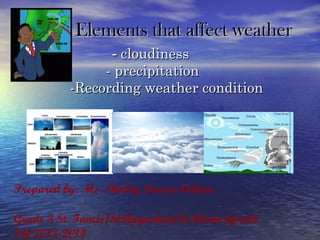
Elements that affect weather
- cloudiness
- precipitation
-Recording weather condition

Prepared by: Ms. Shirley Puaso-Valera
Grade 3 St. Fancis/St.Augustine/St.Maria Goretti
SY 2013-2014
Key Questions
A. How do factors affect the
weather?

B. Why do we need to know
the weather for the
day?
Objectives
A. Infer that weather changes from day to
day.
B. Identify the elements that affect the
weather.
C. Record in a chart the weather for the day/
week using symbols.
D. Analyze how the different elements
can affect the weather condition.
Look outside. Describe
the weather for the day
through the movements
of the clouds.
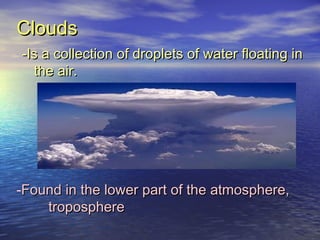
Clouds
-Is a collection of droplets of water floating in
the air.

-Found in the lower part of the atmosphere,
troposphere
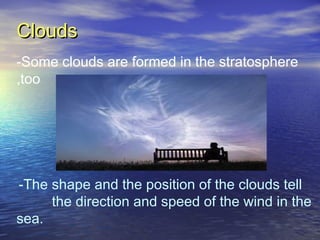
Clouds
-Some clouds are formed in the stratosphere
,too

-The shape and the position of the clouds tell
the direction and speed of the wind in the
sea.
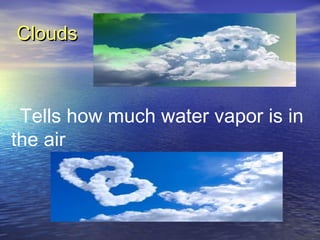
Clouds

- Tells

the air

how much water vapor is in
What are the kinds of clouds?

How clouds help in telling the
weather for the day?
Kinds of Clouds

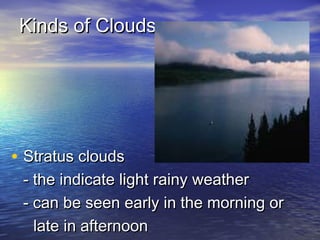
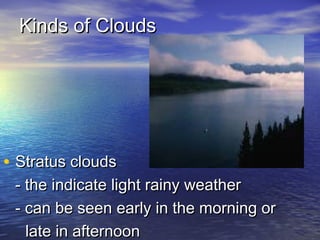
• Stratus clouds

- the indicate light rainy weather
- can be seen early in the morning or
late in afternoon
Kinds of Clouds

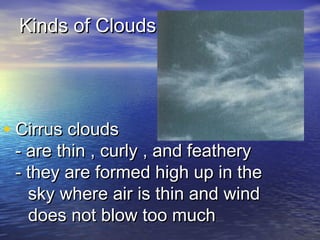
• Cirrus clouds

- are thin , curly , and feathery
- they are formed high up in the
sky where air is thin and wind
does not blow too much
Kinds of Clouds

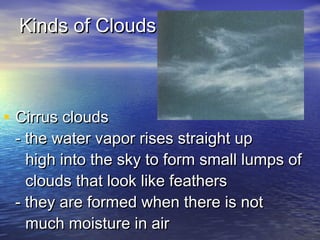
• Cirrus clouds

- the water vapor rises straight up
high into the sky to form small lumps of
clouds that look like feathers
- they are formed when there is not
much moisture in air
Kinds of Clouds
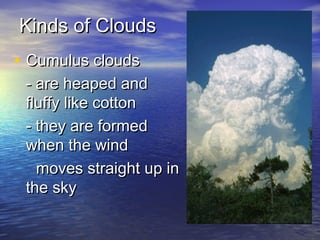
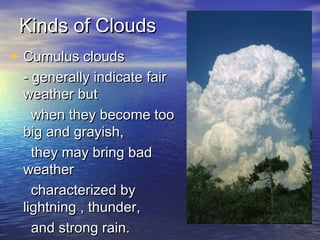
• Cumulus clouds

- are heaped and
fluffy like cotton
- they are formed
when the wind
moves straight up in
the sky
Kinds of Clouds
• Cumulus clouds

- generally indicate fair
weather but
when they become too
big and grayish,
they may bring bad
weather
characterized by
lightning , thunder,
and strong rain.
Kinds of Clouds

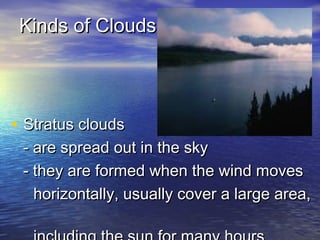
• Stratus clouds

- are spread out in the sky
- they are formed when the wind moves
horizontally, usually cover a large area,
Kinds of Clouds

• Stratus clouds

- the indicate light rainy weather
- can be seen early in the morning or
late in afternoon
Kinds of Clouds

• Stratus clouds

- it indicate light rainy weather
- can be seen early in the morning or
late in afternoon
Kinds of Clouds

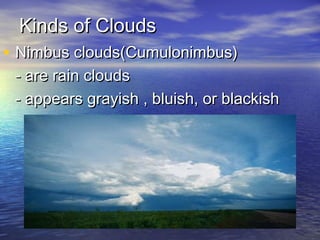
• Nimbus clouds(Cumulonimbus)

- are rain clouds
- appears grayish , bluish, or blackish
Kinds of Clouds

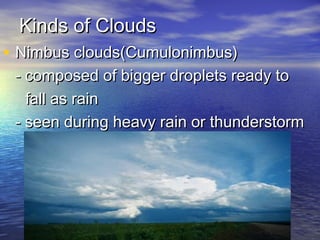
• Nimbus clouds(Cumulonimbus)

- composed of bigger droplets ready to
fall as rain
- seen during heavy rain or thunderstorm
Cloud in a jar activity:
• Observe

• Discussion on the result of the activity
Video clip viewing
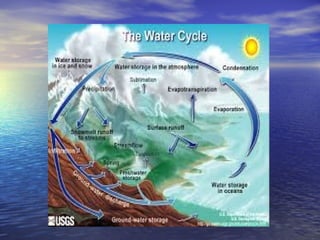
Water Cycle
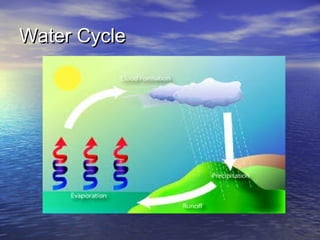
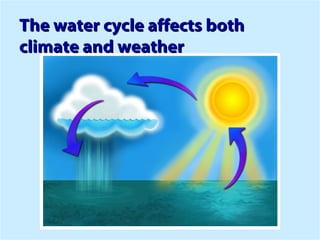
The water cycle affects both
climate and weather
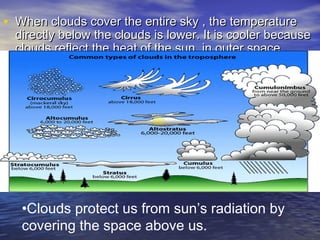
• When clouds cover the entire sky , the temperature

directly below the clouds is lower. It is cooler because
clouds reflect the heat of the sun in outer space

•Clouds protect us from sun’s radiation by
covering the space above us.
Precipitation
• Water that falls from the clouds
• Air temperature determines the form of

precipitation that falls
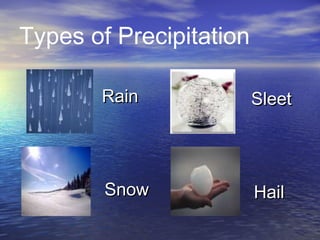
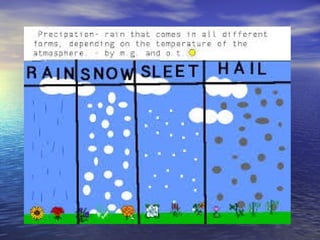
• 4 main types of Precipitation: Rain, Sleet,
Snow and Hail
Types of Precipitation
Rain

Sleet

Snow

Hail
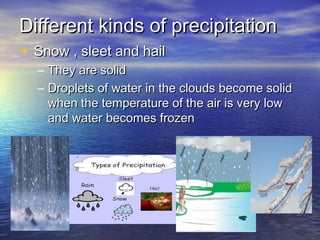
Different kinds of precipitation
• Snow , sleet and hail
–
–

They are solid
Droplets of water in the clouds become solid
when the temperature of the air is very low
and water becomes frozen
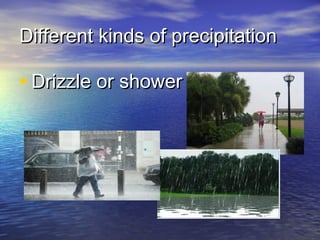
Different kinds of precipitation

• Drizzle or shower
Different kinds of precipitation
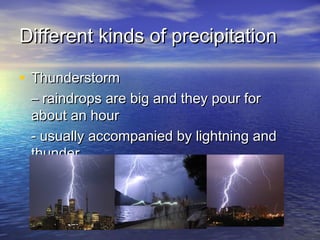
• Thunderstorm

– raindrops are big and they pour for
about an hour
- usually accompanied by lightning and
thunder
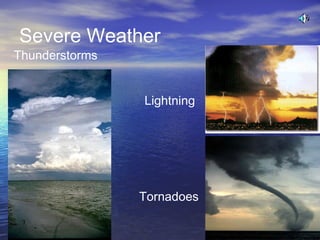
Severe Weather

Thunderstorms

Lightning

Tornadoes
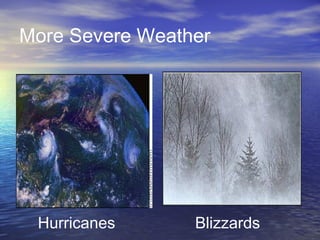
More Severe Weather

Hurricanes

Blizzards
• When rain fall heavily, the weather is
described as rainy.

In the Philippines, rainy weather is
accompanied by thunder and lightning.

•In Metro manila and other areas ,

heavy rains are usually followed by
floods.
Instruments used to measure
weather condition
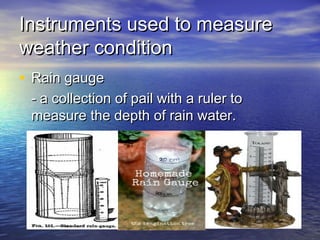
• Rain gauge

- a collection of pail with a ruler to
measure the depth of rain water.
Instruments used to measure
weather condition
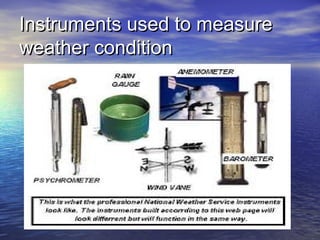
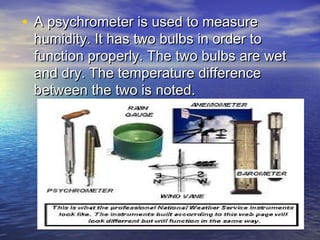
• A psychrometer is used to measure

humidity. It has two bulbs in order to
function properly. The two bulbs are wet
and dry. The temperature difference
between the two is noted.
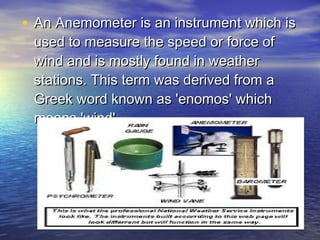
• An Anemometer is an instrument which is
used to measure the speed or force of
wind and is mostly found in weather
stations. This term was derived from a
Greek word known as 'enomos' which
means 'wind'.
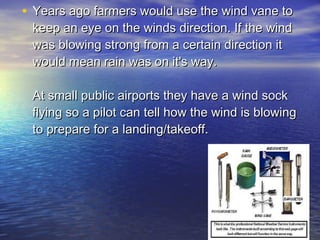
• Years ago farmers would use the wind vane to
keep an eye on the winds direction. If the wind
was blowing strong from a certain direction it
would mean rain was on it's way. 

At small public airports they have a wind sock
flying so a pilot can tell how the wind is blowing
to prepare for a landing/takeoff.
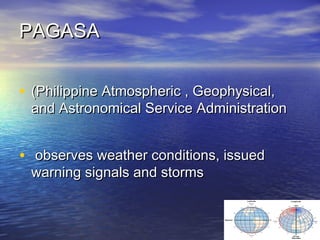
PAGASA
• (Philippine Atmospheric , Geophysical,

and Astronomical Service Administration

• observes weather conditions, issued
warning signals and storms
PAGASA
• Philippines is always visited by tropical

cyclones because it is in the typhoon belt.

• Tropical cyclones are weather

disturbances when it grows, it develops
into a typhoon or bagyo.
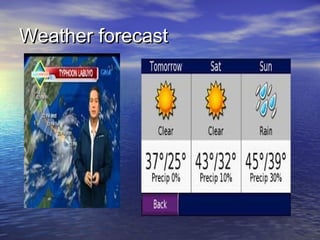
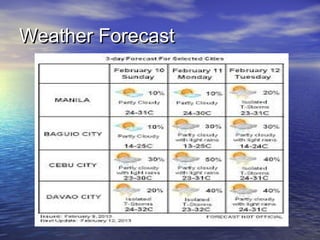
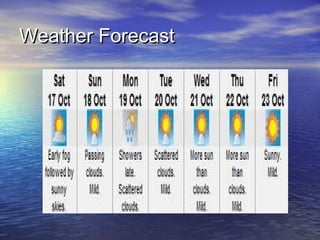
Weather forecast
Weather Forecast
Weather Forecast
Generalization
• Different factors affect and determine
weather conditions.

• Weather condition changes from time to
time , thus everybody should always be
ready.
Valuing
• Always be ready to

protect ourselves from
the different weather
conditions.
Evaluation
Answer page 325

A.Fill in the blanks with the correct

words to complete the sentences.
B.Match the weather instruments
to its use.
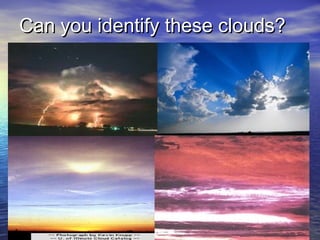
Can you identify these clouds?
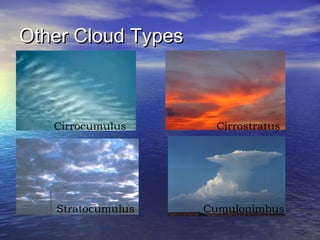
Other Cloud Types

Cirrocumulus

Stratocumulus

Cirrostratus

Cumulonimbus
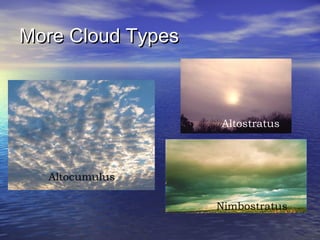
More Cloud Types

Altostratus

Altocumulus
Nimbostratus
• Earth’s tilt at an angle of 23.5 degrees to
the plane of its orbit around the Sun.

• Major components of Earth that influence

weather are: atmosphere, land forms, and
water.
About 70% of Earth’s surface is
•
covered by oceans.
THANK YOU
FOR LISTENING

Ppt elements that affect weather

  • 1.
    Elements that affectweather - cloudiness - precipitation -Recording weather condition Prepared by: Ms. Shirley Puaso-Valera Grade 3 St. Fancis/St.Augustine/St.Maria Goretti SY 2013-2014
  • 2.
    Key Questions A. Howdo factors affect the weather? B. Why do we need to know the weather for the day?
  • 3.
    Objectives A. Infer thatweather changes from day to day. B. Identify the elements that affect the weather. C. Record in a chart the weather for the day/ week using symbols. D. Analyze how the different elements can affect the weather condition.
  • 4.
    Look outside. Describe theweather for the day through the movements of the clouds.
  • 5.
    Clouds -Is a collectionof droplets of water floating in the air. -Found in the lower part of the atmosphere, troposphere
  • 6.
    Clouds -Some clouds areformed in the stratosphere ,too -The shape and the position of the clouds tell the direction and speed of the wind in the sea.
  • 7.
    Clouds - Tells the air howmuch water vapor is in
  • 8.
    What are thekinds of clouds? How clouds help in telling the weather for the day?
  • 9.
    Kinds of Clouds •Stratus clouds - the indicate light rainy weather - can be seen early in the morning or late in afternoon
  • 10.
    Kinds of Clouds •Cirrus clouds - are thin , curly , and feathery - they are formed high up in the sky where air is thin and wind does not blow too much
  • 11.
    Kinds of Clouds •Cirrus clouds - the water vapor rises straight up high into the sky to form small lumps of clouds that look like feathers - they are formed when there is not much moisture in air
  • 12.
    Kinds of Clouds •Cumulus clouds - are heaped and fluffy like cotton - they are formed when the wind moves straight up in the sky
  • 13.
    Kinds of Clouds •Cumulus clouds - generally indicate fair weather but when they become too big and grayish, they may bring bad weather characterized by lightning , thunder, and strong rain.
  • 14.
    Kinds of Clouds •Stratus clouds - are spread out in the sky - they are formed when the wind moves horizontally, usually cover a large area,
  • 15.
    Kinds of Clouds •Stratus clouds - the indicate light rainy weather - can be seen early in the morning or late in afternoon
  • 16.
    Kinds of Clouds •Stratus clouds - it indicate light rainy weather - can be seen early in the morning or late in afternoon
  • 17.
    Kinds of Clouds •Nimbus clouds(Cumulonimbus) - are rain clouds - appears grayish , bluish, or blackish
  • 18.
    Kinds of Clouds •Nimbus clouds(Cumulonimbus) - composed of bigger droplets ready to fall as rain - seen during heavy rain or thunderstorm
  • 19.
    Cloud in ajar activity: • Observe • Discussion on the result of the activity
  • 20.
  • 21.
  • 22.
    The water cycleaffects both climate and weather
  • 24.
    • When cloudscover the entire sky , the temperature directly below the clouds is lower. It is cooler because clouds reflect the heat of the sun in outer space •Clouds protect us from sun’s radiation by covering the space above us.
  • 25.
    Precipitation • Water thatfalls from the clouds • Air temperature determines the form of precipitation that falls • 4 main types of Precipitation: Rain, Sleet, Snow and Hail
  • 26.
  • 27.
    Different kinds ofprecipitation • Snow , sleet and hail – – They are solid Droplets of water in the clouds become solid when the temperature of the air is very low and water becomes frozen
  • 29.
    Different kinds ofprecipitation • Drizzle or shower
  • 30.
    Different kinds ofprecipitation • Thunderstorm – raindrops are big and they pour for about an hour - usually accompanied by lightning and thunder
  • 31.
  • 32.
  • 33.
    • When rainfall heavily, the weather is described as rainy. In the Philippines, rainy weather is accompanied by thunder and lightning. •In Metro manila and other areas , heavy rains are usually followed by floods.
  • 34.
    Instruments used tomeasure weather condition • Rain gauge - a collection of pail with a ruler to measure the depth of rain water.
  • 35.
    Instruments used tomeasure weather condition
  • 36.
    • A psychrometeris used to measure humidity. It has two bulbs in order to function properly. The two bulbs are wet and dry. The temperature difference between the two is noted.
  • 37.
    • An Anemometeris an instrument which is used to measure the speed or force of wind and is mostly found in weather stations. This term was derived from a Greek word known as 'enomos' which means 'wind'.
  • 38.
    • Years agofarmers would use the wind vane to keep an eye on the winds direction. If the wind was blowing strong from a certain direction it would mean rain was on it's way.  At small public airports they have a wind sock flying so a pilot can tell how the wind is blowing to prepare for a landing/takeoff.
  • 39.
    PAGASA • (Philippine Atmospheric, Geophysical, and Astronomical Service Administration • observes weather conditions, issued warning signals and storms
  • 40.
    PAGASA • Philippines isalways visited by tropical cyclones because it is in the typhoon belt. • Tropical cyclones are weather disturbances when it grows, it develops into a typhoon or bagyo.
  • 41.
  • 42.
  • 43.
  • 44.
    Generalization • Different factorsaffect and determine weather conditions. • Weather condition changes from time to time , thus everybody should always be ready.
  • 45.
    Valuing • Always beready to protect ourselves from the different weather conditions.
  • 46.
    Evaluation Answer page 325 A.Fillin the blanks with the correct words to complete the sentences. B.Match the weather instruments to its use.
  • 47.
    Can you identifythese clouds?
  • 48.
  • 49.
  • 50.
    • Earth’s tiltat an angle of 23.5 degrees to the plane of its orbit around the Sun. • Major components of Earth that influence weather are: atmosphere, land forms, and water. About 70% of Earth’s surface is • covered by oceans.
  • 51.

Editor's Notes

  • #23 The water cycle is powered from solar energy. The sun evaporates water from the entire Earth - 86% of the evaporation on Earth comes from the oceans. Evaporation cools the atmosphere and planets. The water cycle involves the evaporation, condensation and precipitation of water and all of these events shape the weather on a day to day basis. Evaporation and precipitation are ways in which water moves through the water cycle on any given day during a weather event. During certain times of year and certain seasons, it might rain often causing plants, soils, rivers, and lakes to absorb more water. During other times of year, hot, dry weather can lead to water evaporation causing plants and soil to dry out and streams and rivers to have lower elevations, but over the course of a year or several years, a balance occurs in the water cycle so the amount of water entering the system is equal to the amount exiting. This balance in the water cycle helps stabilize the climate. Climate is affected by the natural fluctuation of the balance of water entering and exiting the system on a global scale.