The
Water
Cycle
By : Ms. Venyde
What is the water cycle?
Did you know that there is no new water on Earth? It all gets
recycled and reused in a process that we call the water cycle.
The water cycle is a way that water moves all around the
Earth. It never stops and doesn't really have a beginning or
an end. It's like a big circle.
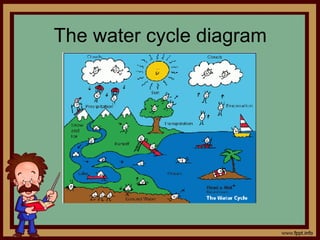
The water cycle diagram
Water cycle stages
In order to provide an explanation of water cycle, it can be
divided into four main stages. The four stages of this cycle
consist of evaporation, condensation, precipitation, and
collection. Let us understand each stage one by one.
1. Evaporation
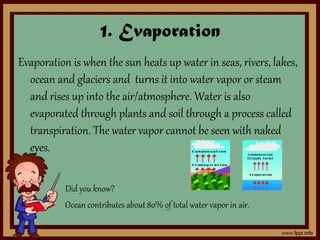
Evaporation is when the sun heats up water in seas, rivers, lakes,
ocean and glaciers and turns it into water vapor or steam
and rises up into the air/atmosphere. Water is also
evaporated through plants and soil through a process called
transpiration. The water vapor cannot be seen with naked
eyes.
Did you know?
Ocean contributes about 80% of total water vapor in air.
2. Condensation
As the water vapor rises higher into the air /atmosphere, it cools
and condenses. Condensation means that water changes
from a gas (water vapor or steam) to liquid (water droplets)
forming the clouds in the sky. Clouds contain million of tiny
droplets of water. My friends
and I form
clouds in the
sky.
3. Precipitation
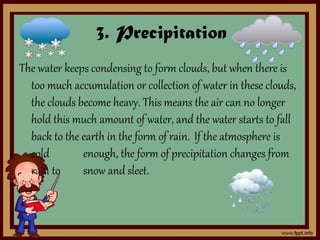
The water keeps condensing to form clouds, but when there is
too much accumulation or collection of water in these clouds,
the clouds become heavy. This means the air can no longer
hold this much amount of water, and the water starts to fall
back to the earth in the form of rain. If the atmosphere is
cold enough, the form of precipitation changes from
rain to snow and sleet.
4. Collection/ Water storage
In the last stage, rain or melted snow flows back into water
bodies like seas, rivers, lakes, and glacier. Rainwater is also
soaked up by the soil, through a process called infiltration.
Some of the water also runs off the surface or seeps in the
ground, which may later be seen as groundwater. Eventually
the water reaches the oceans, which are the largest water
bodies and the biggest source of water vapor.
Project Idea
Mini Water Cycle
Take a clear plastic container (a cake display container will work fine). On the base
of the container, spread some soil and spray some water on it to make it damp.
Then spread some moss over it. Now, take a small bowl and fill it halfway with
water and place it in the center, and scatter few pebbles around.
Now, you have created an Earth-like environment. Place the lid carefully to seal the
container, and leave the container in the Sun. Soon, you will observe a mini water
cycle.
The water from soil, moss, and the bowl will evaporate due to the Sun's heat,
condense on top of the container roof, and once the drops become large,
they will fall back down.
References
 http://www.buzzle.com/articles/water-cycle-
for-kids.html
http://www.ducksters.com/science/the_water_
cycle.php
 http://www.buzzle.com/articles/steps-of-the-
water-cycle.html
Thank you ^ ^

The water cycle for elementary

  • 1.
  • 2.
    What is thewater cycle? Did you know that there is no new water on Earth? It all gets recycled and reused in a process that we call the water cycle. The water cycle is a way that water moves all around the Earth. It never stops and doesn't really have a beginning or an end. It's like a big circle.
  • 3.
  • 4.
    Water cycle stages Inorder to provide an explanation of water cycle, it can be divided into four main stages. The four stages of this cycle consist of evaporation, condensation, precipitation, and collection. Let us understand each stage one by one.
  • 5.
    1. Evaporation Evaporation iswhen the sun heats up water in seas, rivers, lakes, ocean and glaciers and turns it into water vapor or steam and rises up into the air/atmosphere. Water is also evaporated through plants and soil through a process called transpiration. The water vapor cannot be seen with naked eyes. Did you know? Ocean contributes about 80% of total water vapor in air.
  • 6.
    2. Condensation As thewater vapor rises higher into the air /atmosphere, it cools and condenses. Condensation means that water changes from a gas (water vapor or steam) to liquid (water droplets) forming the clouds in the sky. Clouds contain million of tiny droplets of water. My friends and I form clouds in the sky.
  • 7.
    3. Precipitation The waterkeeps condensing to form clouds, but when there is too much accumulation or collection of water in these clouds, the clouds become heavy. This means the air can no longer hold this much amount of water, and the water starts to fall back to the earth in the form of rain. If the atmosphere is cold enough, the form of precipitation changes from rain to snow and sleet.
  • 8.
    4. Collection/ Waterstorage In the last stage, rain or melted snow flows back into water bodies like seas, rivers, lakes, and glacier. Rainwater is also soaked up by the soil, through a process called infiltration. Some of the water also runs off the surface or seeps in the ground, which may later be seen as groundwater. Eventually the water reaches the oceans, which are the largest water bodies and the biggest source of water vapor.
  • 9.
    Project Idea Mini WaterCycle Take a clear plastic container (a cake display container will work fine). On the base of the container, spread some soil and spray some water on it to make it damp. Then spread some moss over it. Now, take a small bowl and fill it halfway with water and place it in the center, and scatter few pebbles around. Now, you have created an Earth-like environment. Place the lid carefully to seal the container, and leave the container in the Sun. Soon, you will observe a mini water cycle. The water from soil, moss, and the bowl will evaporate due to the Sun's heat, condense on top of the container roof, and once the drops become large, they will fall back down.
  • 10.
  • 11.