The Water Cycle
A look into the water cycle
and its importance to the
natural world around us.
What is Water?
• Water is made out of
two parts:
– Hydrogen
– Oxygen
That is why water is called
H₂O
Waters States
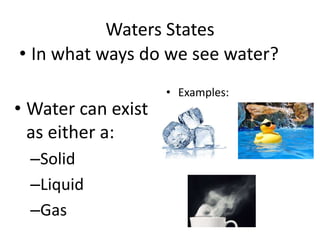
• Water can exist
as either a:
–Solid
–Liquid
–Gas
• Examples:
• In what ways do we see water?
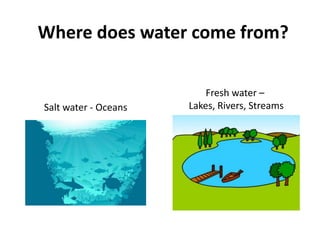
Where does water come from?
Salt water - Oceans
Fresh water –
Lakes, Rivers, Streams
How old is my water?
• How old do you think your water is?
– 1 day old
– 10 days old
– 100 days old
– Millions of years old
Your water is millions of years old!
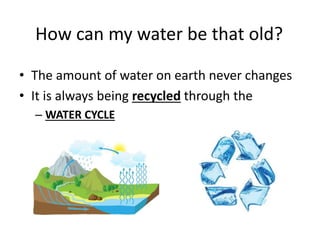
• It is the same water that the dinosaurs drank
• The same water knights on the battle field
drank
• The same water that your great great great
grandparents drank
How can my water be that old?
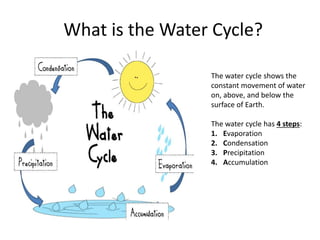
• The amount of water on earth never changes
• It is always being recycled through the
– WATER CYCLE
What is the Water Cycle?
The water cycle shows the
constant movement of water
on, above, and below the
surface of Earth.
The water cycle has 4 steps:
1. Evaporation
2. Condensation
3. Precipitation
4. Accumulation
Step 1
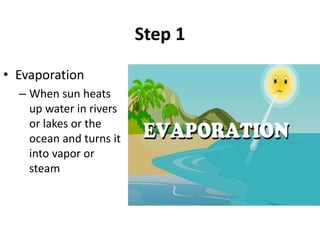
• Evaporation
– When sun heats
up water in rivers
or lakes or the
ocean and turns it
into vapor or
steam
Step 2
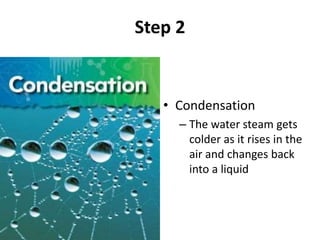
• Condensation
– The water steam gets
colder as it rises in the
air and changes back
into a liquid
Step 3
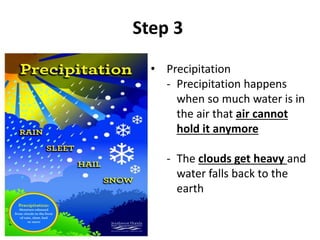
• Precipitation
- Precipitation happens
when so much water is in
the air that air cannot
hold it anymore
- The clouds get heavy and
water falls back to the
earth
Step 4
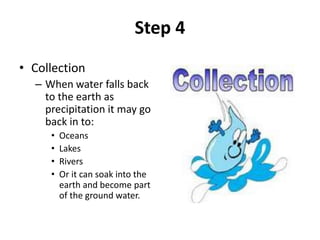
• Collection
– When water falls back
to the earth as
precipitation it may go
back in to:
• Oceans
• Lakes
• Rivers
• Or it can soak into the
earth and become part
of the ground water.
Then the water moves through the
cycle all over again!
What are the 4 steps ?
1. Evaporation
2. Condensation
3. Precipitation
4. Collection
The Magic School Bus: Wet All Over!
The Many Adventures of Drippy The
Raindrop
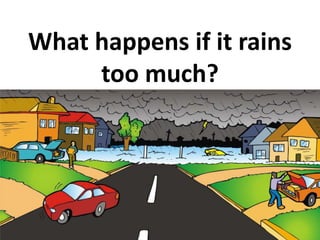
What happens if it rains
too much?
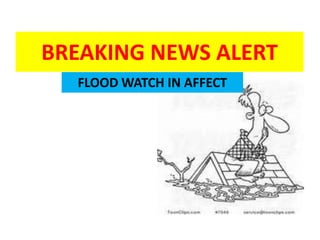
BREAKING NEWS ALERT
• London gets 73
millimeters of rain in
less than 24 hrs
• London is predicted to
get 50 more millimeters
in the next 48 hours
FLOOD WATCH IN AFFECT
What is a flood and how do they
happen?
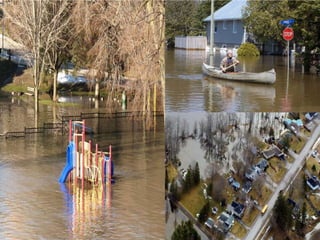
• Floods happen when areas that collect water
overflow
• Floods happen in low lying areas, as water
usually flows down hill
What happens if it doesn’t rain
at all?
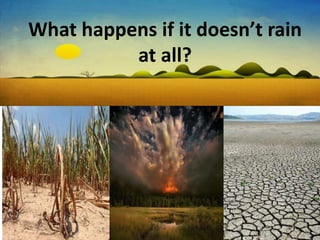
Droughts
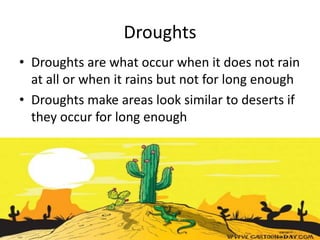
• Droughts are what occur when it does not rain
at all or when it rains but not for long enough
• Droughts make areas look similar to deserts if
they occur for long enough

The Water Cycle

  • 1.
    The Water Cycle Alook into the water cycle and its importance to the natural world around us.
  • 2.
    What is Water? •Water is made out of two parts: – Hydrogen – Oxygen That is why water is called H₂O
  • 3.
    Waters States • Watercan exist as either a: –Solid –Liquid –Gas • Examples: • In what ways do we see water?
  • 4.
    Where does watercome from? Salt water - Oceans Fresh water – Lakes, Rivers, Streams
  • 5.
    How old ismy water? • How old do you think your water is? – 1 day old – 10 days old – 100 days old – Millions of years old
  • 6.
    Your water ismillions of years old! • It is the same water that the dinosaurs drank • The same water knights on the battle field drank • The same water that your great great great grandparents drank
  • 7.
    How can mywater be that old? • The amount of water on earth never changes • It is always being recycled through the – WATER CYCLE
  • 8.
    What is theWater Cycle? The water cycle shows the constant movement of water on, above, and below the surface of Earth. The water cycle has 4 steps: 1. Evaporation 2. Condensation 3. Precipitation 4. Accumulation
  • 9.
    Step 1 • Evaporation –When sun heats up water in rivers or lakes or the ocean and turns it into vapor or steam
  • 10.
    Step 2 • Condensation –The water steam gets colder as it rises in the air and changes back into a liquid
  • 11.
    Step 3 • Precipitation -Precipitation happens when so much water is in the air that air cannot hold it anymore - The clouds get heavy and water falls back to the earth
  • 12.
    Step 4 • Collection –When water falls back to the earth as precipitation it may go back in to: • Oceans • Lakes • Rivers • Or it can soak into the earth and become part of the ground water.
  • 13.
    Then the watermoves through the cycle all over again! What are the 4 steps ? 1. Evaporation 2. Condensation 3. Precipitation 4. Collection
  • 14.
    The Magic SchoolBus: Wet All Over!
  • 15.
    The Many Adventuresof Drippy The Raindrop
  • 16.
    What happens ifit rains too much?
  • 17.
    BREAKING NEWS ALERT •London gets 73 millimeters of rain in less than 24 hrs • London is predicted to get 50 more millimeters in the next 48 hours FLOOD WATCH IN AFFECT
  • 18.
    What is aflood and how do they happen? • Floods happen when areas that collect water overflow • Floods happen in low lying areas, as water usually flows down hill
  • 20.
    What happens ifit doesn’t rain at all?
  • 21.
    Droughts • Droughts arewhat occur when it does not rain at all or when it rains but not for long enough • Droughts make areas look similar to deserts if they occur for long enough

Editor's Notes

  • #4 Ice: http://www.dest-europe.com/ice.png Water duck: http://3.bp.blogspot.com/-dlv1q98o1bI/TkS_8IFNUqI/AAAAAAAAEis/Auv-uMI9JiE/s1600/RubberDuckyPoolParty.jpg Water Vapor: http://media.treehugger.com/assets/images/2011/10/man-made-vapor.jpg
  • #5 Activity for class: Grab 10 glasses of water and 10 volunteers In 9 of the glasses fill the water up and add salt to them, mix it around (make sure there is enough so that the students can taste it) In 1 of the glasses fill it with regular tap water Ask the students to take a sip of the water in their glass (a sip not a drink-salty water will upset a stomach), ask them to than to explain the taste of their water. Ask those students that thought their water was salty to move to one side and those who thought their water tasted normal to stand on the other side. Ask the other students to count how many students water was “salty” and how many students water was “normal” . The number should be 9:1. Explain to the students that most of the water on earth is actually salt water, and that salt water is mainly found in oceans. If you have a map of the world it may be handy to show it at this point. Point out all of the oceans and how large they are. Explain to the students that there is not very much freshwater on earth, point to areas where freshwater is located, explain to them that freshwater is the only water we can use to drink and cook with. Using the same map point out some areas where freshwater is located such as the great lakes and glaciers and ice caps. Explain there is also underground freshwater called groundwater that is created when rain water soaks through the soil. Graphs: City of London,Water Engineering, 2015
  • #6 Image Source: https://wizardscape.files.wordpress.com/2009/06/water-drop-wt.jpg
  • #8 Water Recycle symbol: http://globedia.com/imagenes/noticias/2014/2/3/reciclaje-del-agua_1_1975829.jpg Water Cycle: http://visualcurriculums.org/wp-content/uploads/2013/10/03_WaterCycleVB_C.jpg
  • #9 Explain to the students that today they will be learning about the three states of water as well as the water cycle. They will learn about the 4 steps of the water cycle and the rate of state change that water goes through at various steps. Image source: http://i.ytimg.com/vi/k9l0s5zVibo/0.jpg
  • #10 Use example of kettle (plug in an let the students watch the steam come out of the top) explain to them that this is the same thing that the sun does to water. Once the water gets warm it evaporates. Image Source: http://i.ytimg.com/vi/k9l0s5zVibo/0.jpg
  • #11 Show students condensation by putting a hardcover book in the freezer for about an hour. Put the book overtop the boiling kettle of water from the previous experiment. Make sure you use oven mitts! Water droplets will form on the book, which is what causes condensation. Image Source: http://wayofwater.weebly.com/uploads/1/3/8/2/13820913/4089259_orig.jpg?0
  • #12 Continue the previous experiment long enough so that so much water will condense on the book that it won’t be able to hold it all . The water will begin dripping down from the book, creating precipitation. Image Source: http://www.srh.noaa.gov/images/jan/SWAW/winter_precip_type.PNG
  • #13 Image Source: http://i.ytimg.com/vi/k9l0s5zVibo/0.jpg
  • #14 Image Source: http://www.pd4pic.com/images800_/water-blue-recycle-recycling-arrows-rain-drop.png
  • #15 Image Source: http://www.questionsonislam.com/sites/default/files/rain-249872.jpg
  • #16 Image Source: http://images.clipartpanda.com/raindrop-clipart-toonvectors-42929-140.jpg
  • #17 Image Source: http://www.ready.gov/sites/default/files/ready_kids/images/disasters/ready-kids--disaster-floods-main.png
  • #18 Image source: http://3.bp.blogspot.com/_HtZBXJpv1yM/TOARhwCN-fI/AAAAAAAABCU/7-VE-sDfLi8/s1600/0511-1001-1604-4746_Black_and_White_Cartoon_of_a_Man_Stranded_on_His_Roof_During_a_Flood_clipart_image.jpg
  • #20 Playground Equipment Image Source: http://farm4.staticflickr.com/3014/3277614874_e52d9671e9_z.jpg?zz=1 Thames Overflowing Image Source: http://storage.lfpress.com/v1/dynamic_resize/sws_path/suns-prod-images/1297548598782_ORIGINAL.jpg?quality=80&size=650x&stmp=1397500257752 Canoe image source: http://blackburnnews.com/wp-content/uploads/2014/04/photo-17-620x400.jpg
  • #21 Crop Drought: http://static.theglobeandmail.ca/6e3/report-on-business/article4428121.ece/ALTERNATES/w620/drought-stalk.JPG Forest Fire: http://www.bing.com/images/search?q=forest+fire&view=detailv2&&id=955C6E52F0C3BD3B5A2156A505AC63651AFF9B82&selectedIndex=50&ccid=caVCfC6B&simid=608052359205292430&thid=JN.aMZHTTRrpLDD7B8GGo4kYA&ajaxhist=0 Dry soil: http://i.livescience.com/images/i/000/025/737/original/drought-weather.jpg?1332776088
  • #22 Image Source: http://www.cartoonaday.com/images/cartoons/2013/05/hot-desert-summer-598x302.jpg