Lesson:
We need water to perform several day
to day activities like cooking food,
washing clothes, cleaning utensils etc.
We can’t survive without water even a
single day
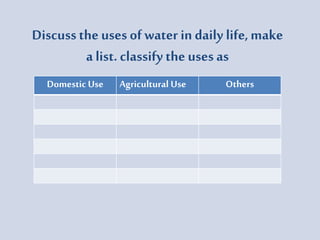
Discussthe uses ofwater in daily life,make
a list. classify the uses as
Domestic Use Agricultural Use Others
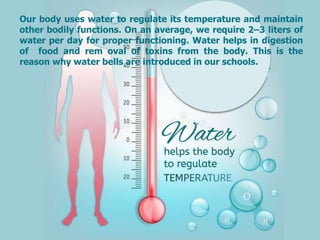
Our body uses water to regulate its temperature and maintain
other bodily functions. On an average, we require 2–3 liters of
water per day for proper functioning. Water helps in digestion
of food and rem oval of toxins from the body. This is the
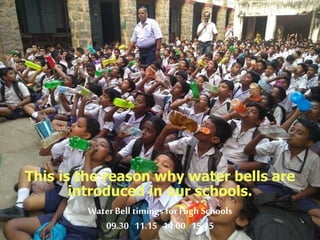
reason why water bells are introduced in our schools.
This is the reason why water bells are
introduced in our schools.
Water Bell timings for High Schools
09.30 11.15 14.00 15.15
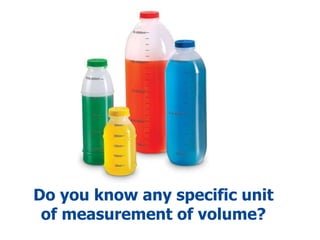
Do you know any specific unit
of measurement of volume?
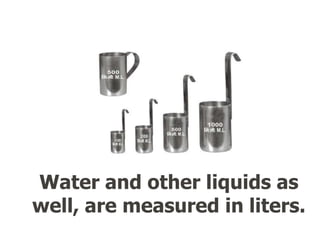
Water and other liquids as
well, are measured in liters.
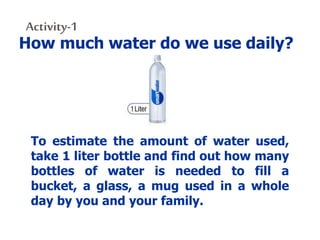
Activity-1
How much water do we use daily?
To estimate the amount of water used,
take 1 liter bottle and find out how many
bottles of water is needed to fill a
bucket, a glass, a mug used in a whole
day by you and your family.
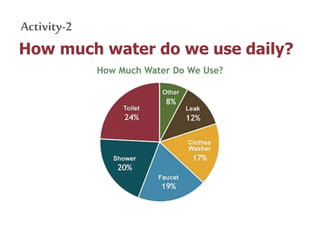
Activity-2
How much water do we use daily?
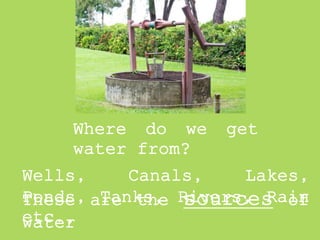
Where do we get
water from?
Wells, Canals, Lakes,
Ponds, Tanks, Rivers, Rain
etc.,
These are the sources of
water
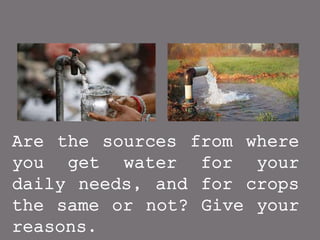
Are the sources from where
you get water for your
daily needs, and for crops
the same or not? Give your
reasons.
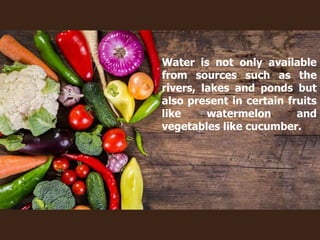
Water is not only available
from sources such as the
rivers, lakes and ponds but
also present in certain fruits
like watermelon and
vegetables like cucumber.
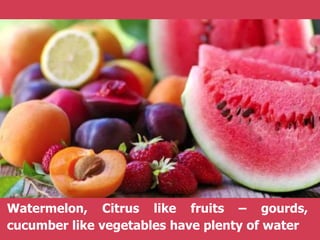
Watermelon, Citrus like fruits – gourds,
cucumber like vegetables have plenty of water
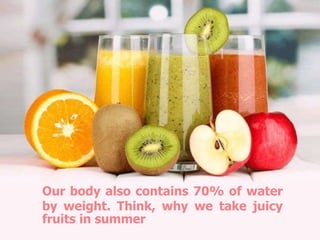
Our body also contains 70% of water
by weight. Think, why we take juicy
fruits in summer
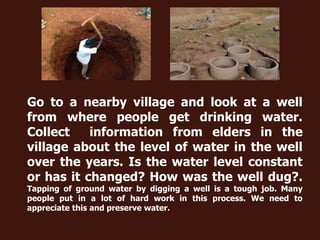
Go to a nearby village and look at a well
from where people get drinking water.
Collect information from elders in the
village about the level of water in the well
over the years. Is the water level constant
or has it changed? How was the well dug?.
Tapping of ground water by digging a well is a tough job. Many
people put in a lot of hard work in this process. We need to
appreciate this and preserve water.
Water conservation is our responsibility
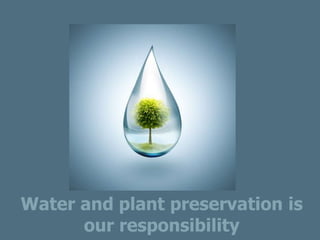
Water and plant preservation is
our responsibility
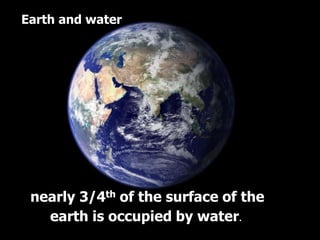
Earth and water
nearly 3/4th of the surface of the
earth is occupied by water.
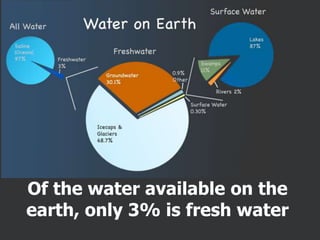
Of the water available on the
earth, only 3% is fresh water
Where do we get rain?
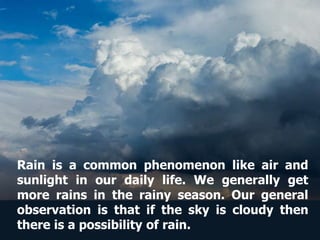
Rain is a common phenomenon like air and
sunlight in our daily life. We generally get
more rains in the rainy season. Our general
observation is that if the sky is cloudy then
there is a possibility of rain.
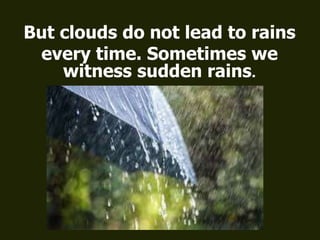
But clouds do not lead to rains
every time. Sometimes we
witness sudden rains.
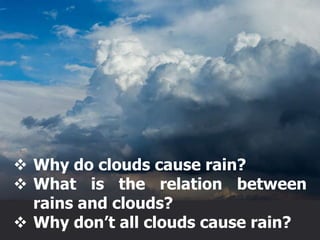
 Why do clouds cause rain?
 What is the relation between
rains and clouds?
 Why don’t all clouds cause rain?
Forms of Water
What are the forms
of water in nature?
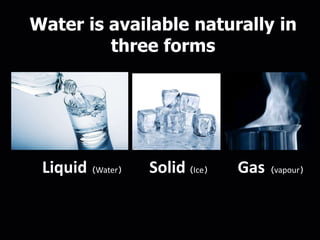
Water is available naturally in
three forms
Liquid (Water) Solid (Ice) Gas (vapour)
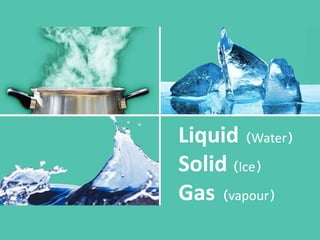
Liquid (Water)
Solid (Ice)
Gas (vapour)
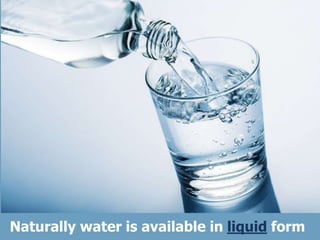
Naturally water is available in liquid form
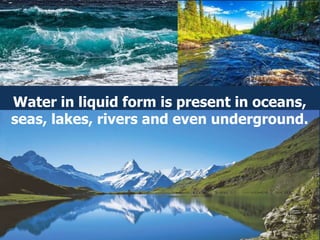
Water in liquid form is present in oceans,
seas, lakes, rivers and even underground.
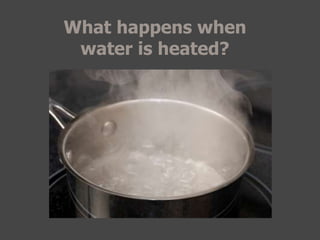
What happens when
water is heated?
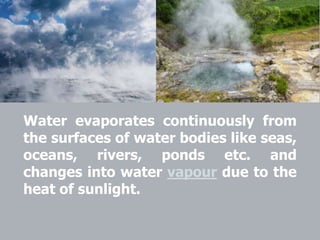
Water evaporates continuously from
the surfaces of water bodies like seas,
oceans, rivers, ponds etc. and
changes into water vapour due to the
heat of sunlight.
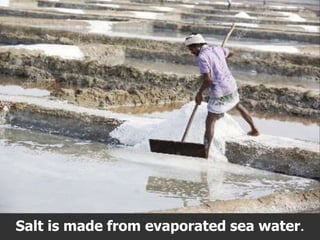
Salt is made from evaporated sea water.
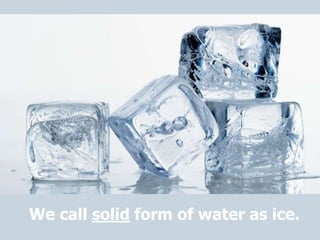
We call solid form of water as ice.
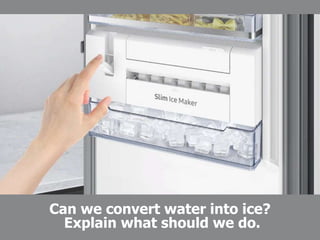
Can we convert water into ice?
Explain what should we do.
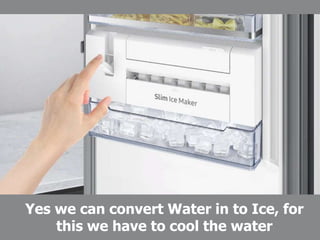
Yes we can convert Water in to Ice, for
this we have to cool the water
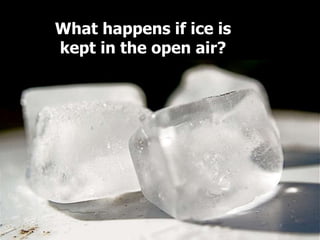
What happens if ice is
kept in the open air?
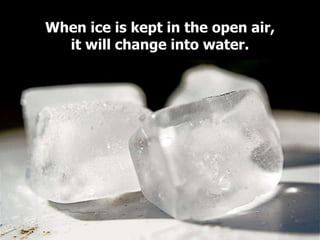
When ice is kept in the open air,
it will change into water.
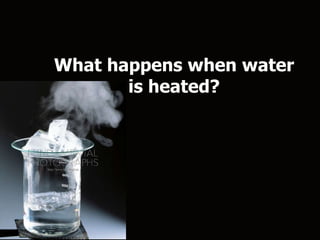
What happens when water
is heated?
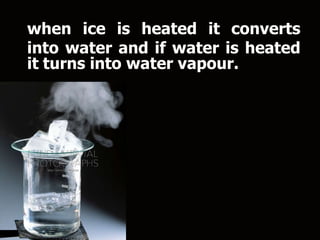
when ice is heated it converts
into water and if water is heated
it turns into water vapour.
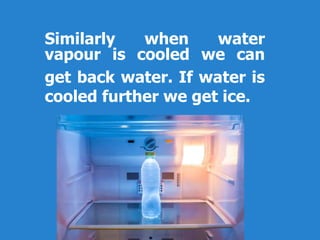
Similarly when water
vapour is cooled we can
get back water. If water is
cooled further we get ice.
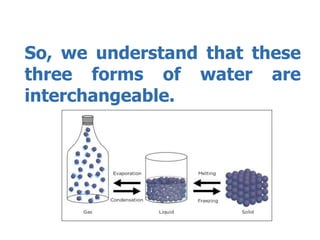
So, we understand that these
three forms of water are
interchangeable.
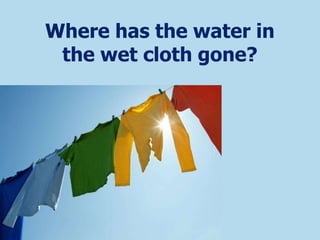
Where has the water in
the wet cloth gone?
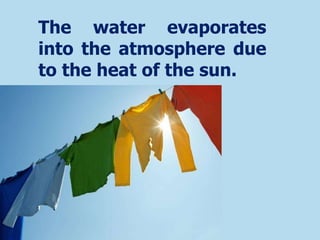
The water evaporates
into the atmosphere due
to the heat of the sun.
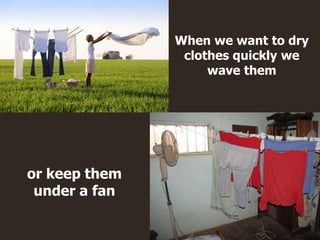
or keep them
under a fan
When we want to dry
clothes quickly we
wave them
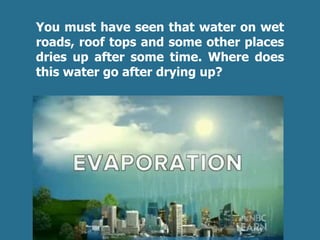
You must have seen that water on wet
roads, roof tops and some other places
dries up after some time. Where does
this water go after drying up?
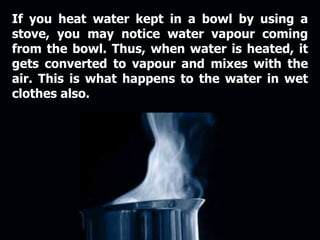
If you heat water kept in a bowl by using a
stove, you may notice water vapour coming
from the bowl. Thus, when water is heated, it
gets converted to vapour and mixes with the
air. This is what happens to the water in wet
clothes also.
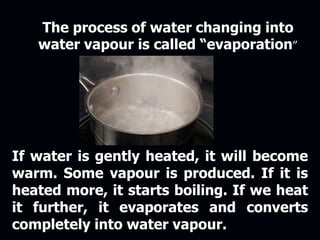
The process of water changing into
water vapour is called “evaporation”
If water is gently heated, it will become
warm. Some vapour is produced. If it is
heated more, it starts boiling. If we heat
it further, it evaporates and converts
completely into water vapour.
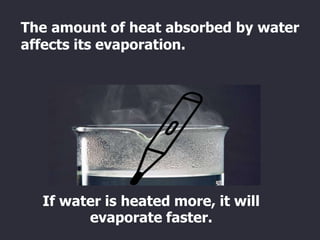
If water is heated more, it will
evaporate faster.
The amount of heat absorbed by water
affects its evaporation.
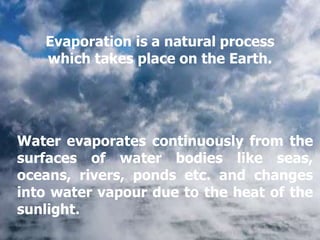
Water evaporates continuously from the
surfaces of water bodies like seas,
oceans, rivers, ponds etc. and changes
into water vapour due to the heat of the
sunlight.
Evaporation is a natural process
which takes place on the Earth.
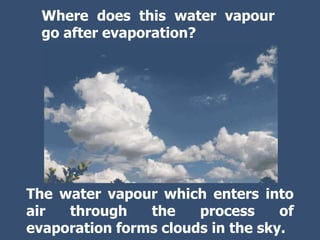
The water vapour which enters into
air through the process of
evaporation forms clouds in the sky.
Where does this water vapour
go after evaporation?
What is a cloud? How are clouds formed?
when water vapour reaches higher levels
it condenses due to contact with cool air
and forms small drops or water droplets.
These tiny droplets remain floating in the
air at higher levels of the atmosphere
and appear as clouds.
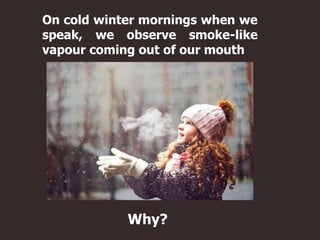
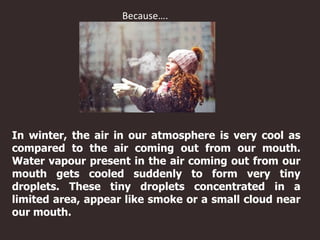
On cold winter mornings when we
speak, we observe smoke-like
vapour coming out of our mouth
Why?
In winter, the air in our atmosphere is very cool as
compared to the air coming out from our mouth.
Water vapour present in the air coming out from our
mouth gets cooled suddenly to form very tiny
droplets. These tiny droplets concentrated in a
limited area, appear like smoke or a small cloud near
our mouth.
Because….
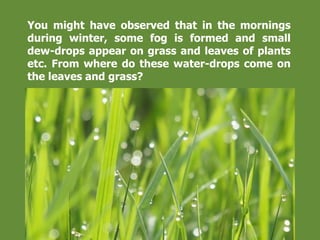
You might have observed that in the mornings
during winter, some fog is formed and small
dew-drops appear on grass and leaves of plants
etc. From where do these water-drops come on
the leaves and grass?
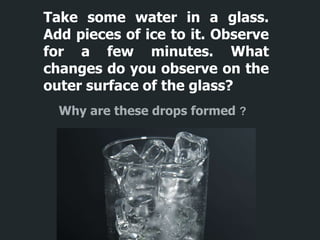
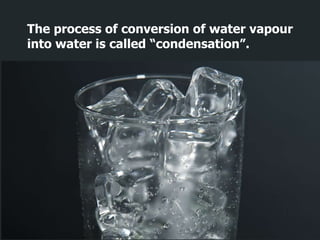
Take some water in a glass.
Add pieces of ice to it. Observe
for a few minutes. What
changes do you observe on the
outer surface of the glass?
Why are these drops formed ?
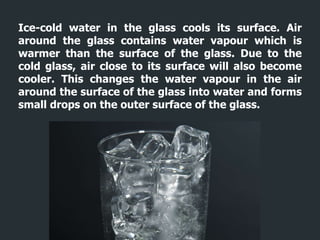
Ice-cold water in the glass cools its surface. Air
around the glass contains water vapour which is
warmer than the surface of the glass. Due to the
cold glass, air close to its surface will also become
cooler. This changes the water vapour in the air
around the surface of the glass into water and forms
small drops on the outer surface of the glass.
The process of conversion of water vapour
into water is called “condensation”.
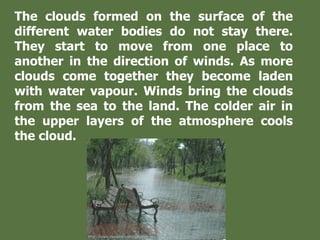
The clouds formed on the surface of the
different water bodies do not stay there.
They start to move from one place to
another in the direction of winds. As more
clouds come together they become laden
with water vapour. Winds bring the clouds
from the sea to the land. The colder air in
the upper layers of the atmosphere cools
the cloud.
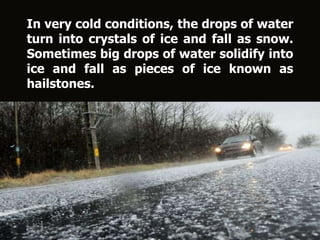
In very cold conditions, the drops of water
turn into crystals of ice and fall as snow.
Sometimes big drops of water solidify into
ice and fall as pieces of ice known as
hailstones.
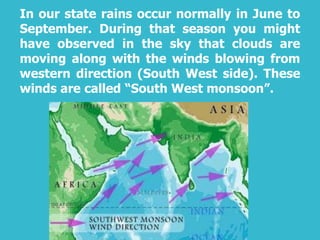
In our state rains occur normally in June to
September. During that season you might
have observed in the sky that clouds are
moving along with the winds blowing from
western direction (South West side). These
winds are called “South West monsoon”.
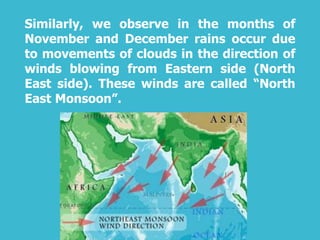
Similarly, we observe in the months of
November and December rains occur due
to movements of clouds in the direction of
winds blowing from Eastern side (North
East side). These winds are called “North
East Monsoon”.
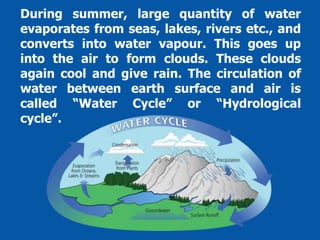
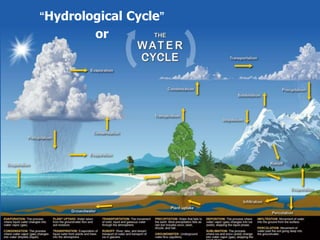
During summer, large quantity of water
evaporates from seas, lakes, rivers etc., and
converts into water vapour. This goes up
into the air to form clouds. These clouds
again cool and give rain. The circulation of
water between earth surface and air is
called “Water Cycle” or “Hydrological
cycle”.
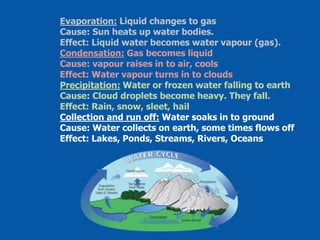
Evaporation: Liquid changes to gas
Cause: Sun heats up water bodies.
Effect: Liquid water becomes water vapour (gas).
Condensation: Gas becomes liquid
Cause: vapour raises in to air, cools
Effect: Water vapour turns in to clouds
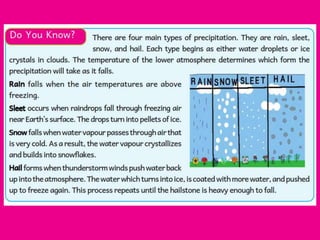
Precipitation: Water or frozen water falling to earth
Cause: Cloud droplets become heavy. They fall.
Effect: Rain, snow, sleet, hail
Collection and run off: Water soaks in to ground
Cause: Water collects on earth, some times flows off
Effect: Lakes, Ponds, Streams, Rivers, Oceans
“Hydrological Cycle”
or
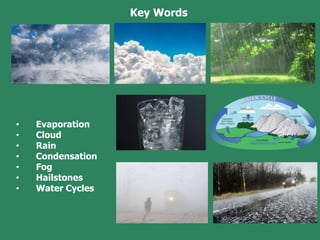
Key Words
• Evaporation
• Cloud
• Rain
• Condensation
• Fog
• Hailstones
• Water Cycles
What have we learnt?
♦ We need water for domestic, agriculture,
industrial purposes.
♦ We get water from sources like ponds,
lakes, rivers etc.
♦ Of the water available on the earth, only
3% is fresh water.
♦ We depend on rains for water.
♦ Water on the Earth can exist in three
forms: ice (solid form), water (liquid
form) and water vapour (gaseous form).
♦ The process of changing of water into
water vapour is called evaporation.
♦ Evaporation of water from the surface of
seas, lakes, ponds etc. is part of cloud
formation.
♦ Clouds are formed from tiny droplets of
water vapour.
♦ The process of conversion of water
vapour into water is called condensation.
♦ The cycle of evaporation and
condensation of water, present on
the Earth’s surface, causes rain.
♦ Rain, snow, sleet, or hail — any
kind of weather condition where
something’s falling from the sky is
called Precipitation.
♦ The conversion of water into water
vapour, water vapour to clouds and
clouds to rain is known as water
cycle.
♦ Long periods of less rainfall usually
causes droughts and famines.
♦ Floods are natural disasters that
affect human life.
♦ The amount of usable water on
earth is limited, so it needs to be
used carefully.
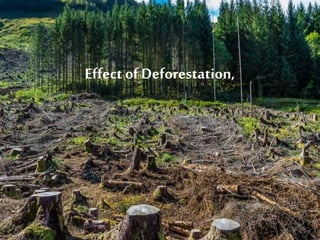
Effect ofDeforestation,
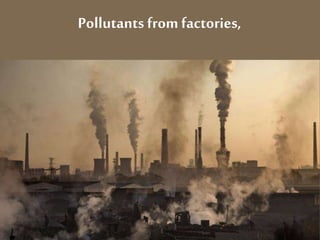
Pollutants from factories,
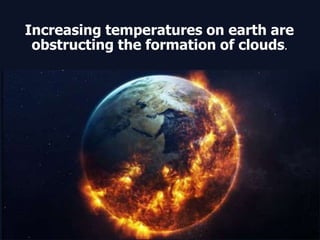
Increasing temperatures on earth are
obstructing the formation of clouds.
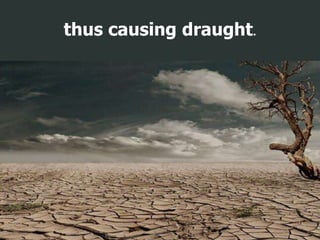
thus causing draught.
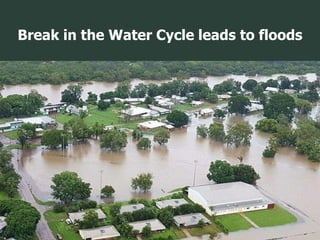
Break in the Water Cycle leads to floods
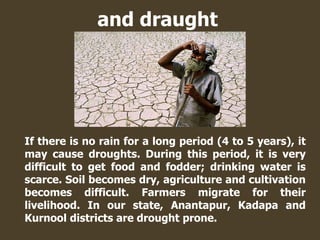
and draught
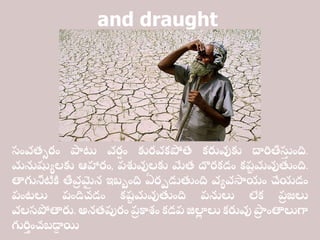
If there is no rain for a long period (4 to 5 years), it
may cause droughts. During this period, it is very
difficult to get food and fodder; drinking water is
scarce. Soil becomes dry, agriculture and cultivation
becomes difficult. Farmers migrate for their
livelihood. In our state, Anantapur, Kadapa and
Kurnool districts are drought prone.
and draught
సంవత్సరం పాటు వర
ష ం కురవకపోతే కరువుకు దారితీస్
త ంది.
మనుష్యులకు ఆహారం, పశువులకు మేత్ దొరకడం కష్
ట మవుతంది.
తాగునీటికి తీవ
ర మ
ై న ఇబ్బంది ఏరపడుతంది వువసాయం చేయడం
పంటలు పండిచడం కష్
ట మవుతంది పనులు లేక ప
ర జలు
వలసపోతారు. అనత్పురం ప
ర కాశం కడప జిల్ల
ా లు కరువు పా
ర ంతాలుగా
గురి
త ంచబ్డ్డ
ా యి
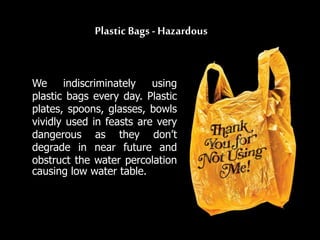
Plastic Bags - Hazardous
We indiscriminately using
plastic bags every day. Plastic
plates, spoons, glasses, bowls
vividly used in feasts are very
dangerous as they don’t
degrade in near future and
obstruct the water percolation
causing low water table.
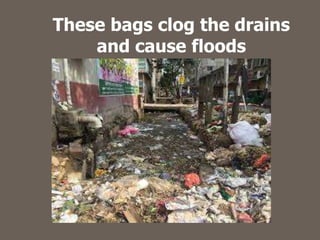
These bags clog the drains
and cause floods
The main reasons for water scarcity are
1. Population explosion
2. Uneven distribution of rainfall
3. Decline of ground water table
4. Pollution of water
5. Careless use of water.
Methods of water conservation
 Water management
 Rain water harvesting
 Water management
It consists of the following
factors:
a. Bringing awareness about the bad
effects of throwing wastes into the
water bodies
b. Recycling of water by separating
pollutants.
c. Minimizing the use of chemical
fertilizers in agriculture.
d. Controlling deforestation
e. Sprinkler Irrigation
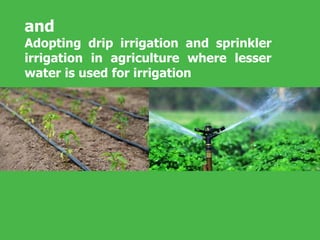
and
Adopting drip irrigation and sprinkler
irrigation in agriculture where lesser
water is used for irrigation
 Rain water harvest
a. Collecting water from where it
falls. (Roof water harvesting)
b. Collecting flowing rain water
(collecting rain water by
constructing ponds with bunds)
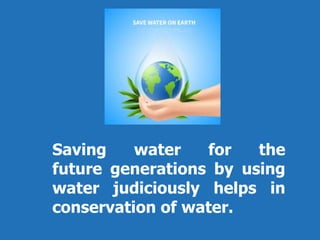
Saving water for the
future generations by using
water judiciously helps in
conservation of water.
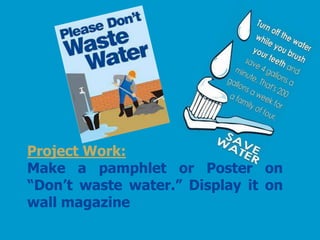
Project Work:
Make a pamphlet or Poster on
“Don’t waste water.” Display it on
wall magazine
Water .pptx

  • 1.
  • 2.
    We need waterto perform several day to day activities like cooking food, washing clothes, cleaning utensils etc. We can’t survive without water even a single day
  • 3.
    Discussthe uses ofwaterin daily life,make a list. classify the uses as Domestic Use Agricultural Use Others
  • 4.
    Our body useswater to regulate its temperature and maintain other bodily functions. On an average, we require 2–3 liters of water per day for proper functioning. Water helps in digestion of food and rem oval of toxins from the body. This is the reason why water bells are introduced in our schools.
  • 5.
    This is thereason why water bells are introduced in our schools. Water Bell timings for High Schools 09.30 11.15 14.00 15.15
  • 6.
    Do you knowany specific unit of measurement of volume?
  • 7.
    Water and otherliquids as well, are measured in liters.
  • 8.
    Activity-1 How much waterdo we use daily? To estimate the amount of water used, take 1 liter bottle and find out how many bottles of water is needed to fill a bucket, a glass, a mug used in a whole day by you and your family.
  • 9.
    Activity-2 How much waterdo we use daily?
  • 10.
    Where do weget water from? Wells, Canals, Lakes, Ponds, Tanks, Rivers, Rain etc., These are the sources of water
  • 11.
    Are the sourcesfrom where you get water for your daily needs, and for crops the same or not? Give your reasons.
  • 12.
    Water is notonly available from sources such as the rivers, lakes and ponds but also present in certain fruits like watermelon and vegetables like cucumber.
  • 13.
    Watermelon, Citrus likefruits – gourds, cucumber like vegetables have plenty of water
  • 14.
    Our body alsocontains 70% of water by weight. Think, why we take juicy fruits in summer
  • 15.
    Go to anearby village and look at a well from where people get drinking water. Collect information from elders in the village about the level of water in the well over the years. Is the water level constant or has it changed? How was the well dug?. Tapping of ground water by digging a well is a tough job. Many people put in a lot of hard work in this process. We need to appreciate this and preserve water.
  • 16.
    Water conservation isour responsibility
  • 17.
    Water and plantpreservation is our responsibility
  • 18.
    Earth and water nearly3/4th of the surface of the earth is occupied by water.
  • 19.
    Of the wateravailable on the earth, only 3% is fresh water
  • 20.
    Where do weget rain?
  • 21.
    Rain is acommon phenomenon like air and sunlight in our daily life. We generally get more rains in the rainy season. Our general observation is that if the sky is cloudy then there is a possibility of rain.
  • 22.
    But clouds donot lead to rains every time. Sometimes we witness sudden rains.
  • 23.
     Why doclouds cause rain?  What is the relation between rains and clouds?  Why don’t all clouds cause rain?
  • 24.
    Forms of Water Whatare the forms of water in nature?
  • 25.
    Water is availablenaturally in three forms Liquid (Water) Solid (Ice) Gas (vapour)
  • 26.
  • 27.
    Naturally water isavailable in liquid form
  • 28.
    Water in liquidform is present in oceans, seas, lakes, rivers and even underground.
  • 29.
  • 30.
    Water evaporates continuouslyfrom the surfaces of water bodies like seas, oceans, rivers, ponds etc. and changes into water vapour due to the heat of sunlight.
  • 31.
    Salt is madefrom evaporated sea water.
  • 32.
    We call solidform of water as ice.
  • 33.
    Can we convertwater into ice? Explain what should we do.
  • 34.
    Yes we canconvert Water in to Ice, for this we have to cool the water
  • 35.
    What happens ifice is kept in the open air?
  • 36.
    When ice iskept in the open air, it will change into water.
  • 37.
    What happens whenwater is heated?
  • 38.
    when ice isheated it converts into water and if water is heated it turns into water vapour.
  • 39.
    Similarly when water vapouris cooled we can get back water. If water is cooled further we get ice.
  • 40.
    So, we understandthat these three forms of water are interchangeable.
  • 41.
    Where has thewater in the wet cloth gone?
  • 42.
    The water evaporates intothe atmosphere due to the heat of the sun.
  • 43.
    or keep them undera fan When we want to dry clothes quickly we wave them
  • 44.
    You must haveseen that water on wet roads, roof tops and some other places dries up after some time. Where does this water go after drying up?
  • 45.
    If you heatwater kept in a bowl by using a stove, you may notice water vapour coming from the bowl. Thus, when water is heated, it gets converted to vapour and mixes with the air. This is what happens to the water in wet clothes also.
  • 46.
    The process ofwater changing into water vapour is called “evaporation” If water is gently heated, it will become warm. Some vapour is produced. If it is heated more, it starts boiling. If we heat it further, it evaporates and converts completely into water vapour.
  • 47.
    If water isheated more, it will evaporate faster. The amount of heat absorbed by water affects its evaporation.
  • 48.
    Water evaporates continuouslyfrom the surfaces of water bodies like seas, oceans, rivers, ponds etc. and changes into water vapour due to the heat of the sunlight. Evaporation is a natural process which takes place on the Earth.
  • 49.
    The water vapourwhich enters into air through the process of evaporation forms clouds in the sky. Where does this water vapour go after evaporation?
  • 50.
    What is acloud? How are clouds formed?
  • 51.
    when water vapourreaches higher levels it condenses due to contact with cool air and forms small drops or water droplets. These tiny droplets remain floating in the air at higher levels of the atmosphere and appear as clouds.
  • 52.
    On cold wintermornings when we speak, we observe smoke-like vapour coming out of our mouth Why?
  • 53.
    In winter, theair in our atmosphere is very cool as compared to the air coming out from our mouth. Water vapour present in the air coming out from our mouth gets cooled suddenly to form very tiny droplets. These tiny droplets concentrated in a limited area, appear like smoke or a small cloud near our mouth. Because….
  • 54.
    You might haveobserved that in the mornings during winter, some fog is formed and small dew-drops appear on grass and leaves of plants etc. From where do these water-drops come on the leaves and grass?
  • 55.
    Take some waterin a glass. Add pieces of ice to it. Observe for a few minutes. What changes do you observe on the outer surface of the glass? Why are these drops formed ?
  • 56.
    Ice-cold water inthe glass cools its surface. Air around the glass contains water vapour which is warmer than the surface of the glass. Due to the cold glass, air close to its surface will also become cooler. This changes the water vapour in the air around the surface of the glass into water and forms small drops on the outer surface of the glass.
  • 57.
    The process ofconversion of water vapour into water is called “condensation”.
  • 58.
    The clouds formedon the surface of the different water bodies do not stay there. They start to move from one place to another in the direction of winds. As more clouds come together they become laden with water vapour. Winds bring the clouds from the sea to the land. The colder air in the upper layers of the atmosphere cools the cloud.
  • 59.
    In very coldconditions, the drops of water turn into crystals of ice and fall as snow. Sometimes big drops of water solidify into ice and fall as pieces of ice known as hailstones.
  • 60.
    In our staterains occur normally in June to September. During that season you might have observed in the sky that clouds are moving along with the winds blowing from western direction (South West side). These winds are called “South West monsoon”.
  • 61.
    Similarly, we observein the months of November and December rains occur due to movements of clouds in the direction of winds blowing from Eastern side (North East side). These winds are called “North East Monsoon”.
  • 62.
    During summer, largequantity of water evaporates from seas, lakes, rivers etc., and converts into water vapour. This goes up into the air to form clouds. These clouds again cool and give rain. The circulation of water between earth surface and air is called “Water Cycle” or “Hydrological cycle”.
  • 63.
    Evaporation: Liquid changesto gas Cause: Sun heats up water bodies. Effect: Liquid water becomes water vapour (gas). Condensation: Gas becomes liquid Cause: vapour raises in to air, cools Effect: Water vapour turns in to clouds Precipitation: Water or frozen water falling to earth Cause: Cloud droplets become heavy. They fall. Effect: Rain, snow, sleet, hail Collection and run off: Water soaks in to ground Cause: Water collects on earth, some times flows off Effect: Lakes, Ponds, Streams, Rivers, Oceans
  • 64.
  • 66.
    Key Words • Evaporation •Cloud • Rain • Condensation • Fog • Hailstones • Water Cycles
  • 67.
    What have welearnt? ♦ We need water for domestic, agriculture, industrial purposes. ♦ We get water from sources like ponds, lakes, rivers etc. ♦ Of the water available on the earth, only 3% is fresh water. ♦ We depend on rains for water. ♦ Water on the Earth can exist in three forms: ice (solid form), water (liquid form) and water vapour (gaseous form).
  • 68.
    ♦ The processof changing of water into water vapour is called evaporation. ♦ Evaporation of water from the surface of seas, lakes, ponds etc. is part of cloud formation. ♦ Clouds are formed from tiny droplets of water vapour. ♦ The process of conversion of water vapour into water is called condensation.
  • 69.
    ♦ The cycleof evaporation and condensation of water, present on the Earth’s surface, causes rain. ♦ Rain, snow, sleet, or hail — any kind of weather condition where something’s falling from the sky is called Precipitation.
  • 70.
    ♦ The conversionof water into water vapour, water vapour to clouds and clouds to rain is known as water cycle. ♦ Long periods of less rainfall usually causes droughts and famines. ♦ Floods are natural disasters that affect human life. ♦ The amount of usable water on earth is limited, so it needs to be used carefully.
  • 71.
  • 72.
  • 73.
    Increasing temperatures onearth are obstructing the formation of clouds.
  • 74.
  • 75.
    Break in theWater Cycle leads to floods
  • 76.
    and draught If thereis no rain for a long period (4 to 5 years), it may cause droughts. During this period, it is very difficult to get food and fodder; drinking water is scarce. Soil becomes dry, agriculture and cultivation becomes difficult. Farmers migrate for their livelihood. In our state, Anantapur, Kadapa and Kurnool districts are drought prone.
  • 77.
    and draught సంవత్సరం పాటువర ష ం కురవకపోతే కరువుకు దారితీస్ త ంది. మనుష్యులకు ఆహారం, పశువులకు మేత్ దొరకడం కష్ ట మవుతంది. తాగునీటికి తీవ ర మ ై న ఇబ్బంది ఏరపడుతంది వువసాయం చేయడం పంటలు పండిచడం కష్ ట మవుతంది పనులు లేక ప ర జలు వలసపోతారు. అనత్పురం ప ర కాశం కడప జిల్ల ా లు కరువు పా ర ంతాలుగా గురి త ంచబ్డ్డ ా యి
  • 78.
    Plastic Bags -Hazardous We indiscriminately using plastic bags every day. Plastic plates, spoons, glasses, bowls vividly used in feasts are very dangerous as they don’t degrade in near future and obstruct the water percolation causing low water table.
  • 79.
    These bags clogthe drains and cause floods
  • 80.
    The main reasonsfor water scarcity are 1. Population explosion 2. Uneven distribution of rainfall 3. Decline of ground water table 4. Pollution of water 5. Careless use of water.
  • 81.
    Methods of waterconservation  Water management  Rain water harvesting
  • 82.
     Water management Itconsists of the following factors: a. Bringing awareness about the bad effects of throwing wastes into the water bodies b. Recycling of water by separating pollutants. c. Minimizing the use of chemical fertilizers in agriculture. d. Controlling deforestation e. Sprinkler Irrigation
  • 83.
    and Adopting drip irrigationand sprinkler irrigation in agriculture where lesser water is used for irrigation
  • 84.
     Rain waterharvest a. Collecting water from where it falls. (Roof water harvesting) b. Collecting flowing rain water (collecting rain water by constructing ponds with bunds)
  • 85.
    Saving water forthe future generations by using water judiciously helps in conservation of water.
  • 86.
    Project Work: Make apamphlet or Poster on “Don’t waste water.” Display it on wall magazine