WATER CYCLE
(Hydrological Cycle)
DEFINITION
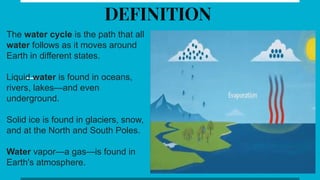
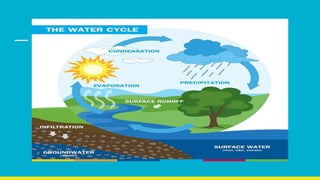
The water cycle is the path that all
water follows as it moves around
Earth in different states.
Liquid water is found in oceans,
rivers, lakes—and even
underground.
Solid ice is found in glaciers, snow,
and at the North and South Poles.
Water vapor—a gas—is found in
Earth's atmosphere.
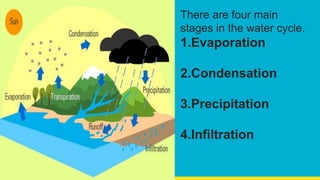
There are four main
stages in the water cycle.
1.Evaporation
2.Condensation
3.Precipitation
4.Infiltration
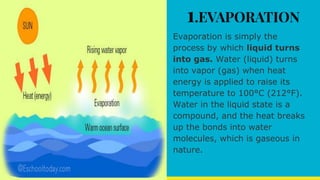
1.EVAPORATION
Evaporation is simply the
process by which liquid turns
into gas. Water (liquid) turns
into vapor (gas) when heat
energy is applied to raise its
temperature to 100°C (212°F).
Water in the liquid state is a
compound, and the heat breaks
up the bonds into water
molecules, which is gaseous in
nature.
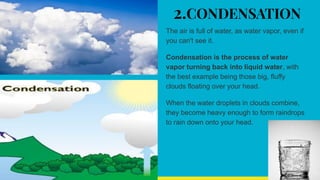
2.CONDENSATION
The air is full of water, as water vapor, even if
you can't see it.
Condensation is the process of water
vapor turning back into liquid water, with
the best example being those big, fluffy
clouds floating over your head.
When the water droplets in clouds combine,
they become heavy enough to form raindrops
to rain down onto your head.
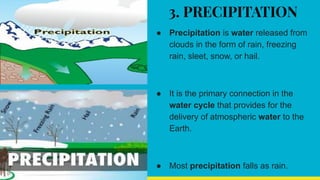
3. PRECIPITATION
● Precipitation is water released from
clouds in the form of rain, freezing
rain, sleet, snow, or hail.
● It is the primary connection in the
water cycle that provides for the
delivery of atmospheric water to the
Earth.
● Most precipitation falls as rain.
4.INFILTRATION
● Infiltration is the
process by which
precipitation or water
soaks into
subsurface soils and
moves into rocks
through cracks and
pore spaces.
ACTIVITY
Define WATER CYCLE.
List the steps of Hydrological cycle.
Describe the following terms.
● Evaporation
● Condensation
● Precipitation
● Infiltration
How water cycle helps in maintaining the balance of the Ecosystem?(work in pair
and share)
HOMEWORK
● Write a summary on the importance of water cycle in our
lives. (150-200 words)
Water cycle

Water cycle

  • 1.
  • 3.
    DEFINITION The water cycleis the path that all water follows as it moves around Earth in different states. Liquid water is found in oceans, rivers, lakes—and even underground. Solid ice is found in glaciers, snow, and at the North and South Poles. Water vapor—a gas—is found in Earth's atmosphere.
  • 4.
    There are fourmain stages in the water cycle. 1.Evaporation 2.Condensation 3.Precipitation 4.Infiltration
  • 5.
    1.EVAPORATION Evaporation is simplythe process by which liquid turns into gas. Water (liquid) turns into vapor (gas) when heat energy is applied to raise its temperature to 100°C (212°F). Water in the liquid state is a compound, and the heat breaks up the bonds into water molecules, which is gaseous in nature.
  • 6.
    2.CONDENSATION The air isfull of water, as water vapor, even if you can't see it. Condensation is the process of water vapor turning back into liquid water, with the best example being those big, fluffy clouds floating over your head. When the water droplets in clouds combine, they become heavy enough to form raindrops to rain down onto your head.
  • 7.
    3. PRECIPITATION ● Precipitationis water released from clouds in the form of rain, freezing rain, sleet, snow, or hail. ● It is the primary connection in the water cycle that provides for the delivery of atmospheric water to the Earth. ● Most precipitation falls as rain.
  • 8.
    4.INFILTRATION ● Infiltration isthe process by which precipitation or water soaks into subsurface soils and moves into rocks through cracks and pore spaces.
  • 10.
    ACTIVITY Define WATER CYCLE. Listthe steps of Hydrological cycle. Describe the following terms. ● Evaporation ● Condensation ● Precipitation ● Infiltration How water cycle helps in maintaining the balance of the Ecosystem?(work in pair and share)
  • 11.
    HOMEWORK ● Write asummary on the importance of water cycle in our lives. (150-200 words)