 Clipping means identifying portions of a scene that are
outside a specified region.
 For a 2D graphics the region defining what is to be
clipped is called the clip window.
 Types of clipping:
1. All-or-none clipping: If any part of object outside clip
window then the whole object is rejected.
2. Point clipping: Only keep the points that are inside clip
window.
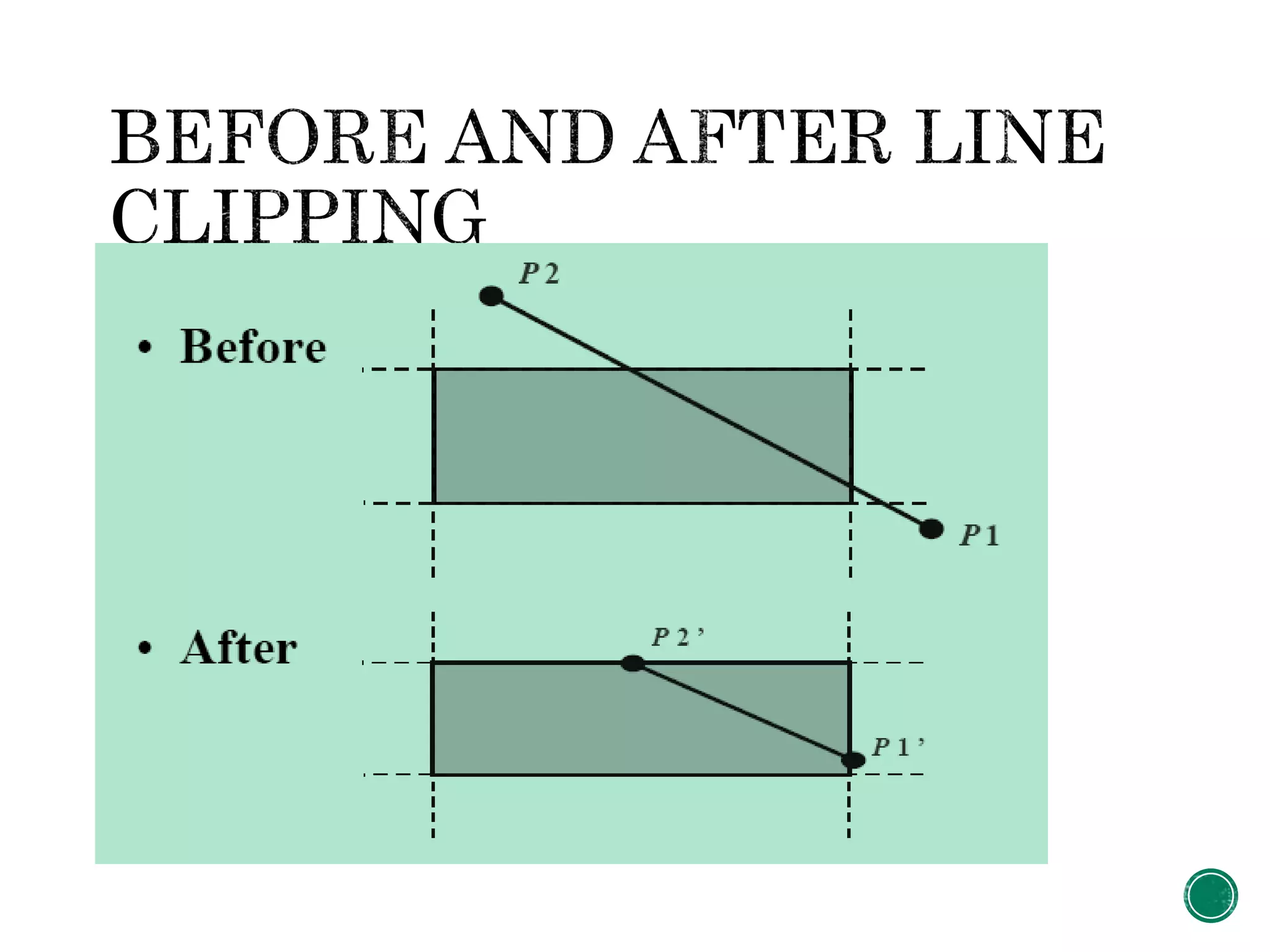
3. Line clipping: Only keep segment of line inside clip
window.
4. Polygon clipping: Only keep segment of polygon inside
clip window.
5. Text clipping.
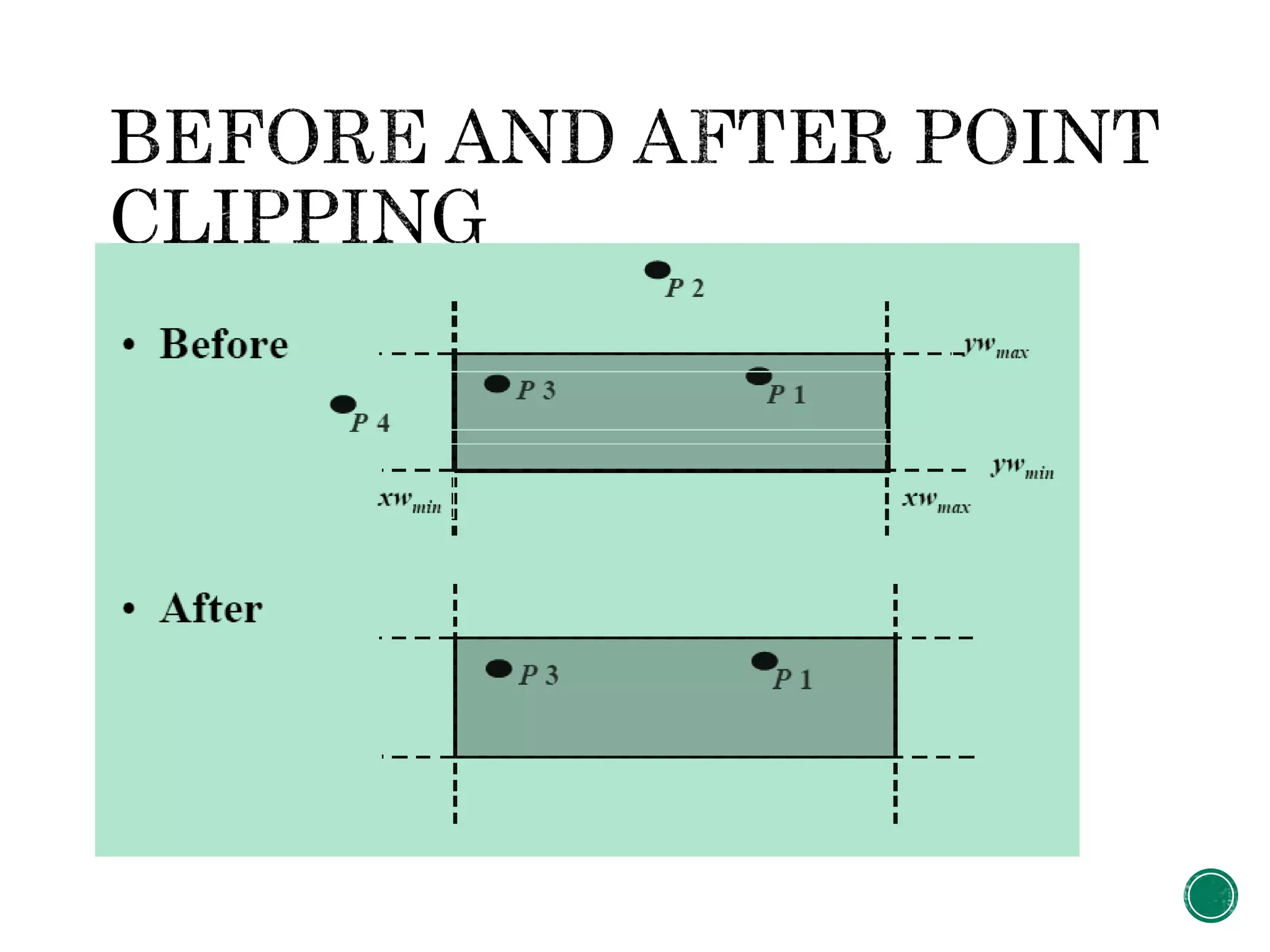
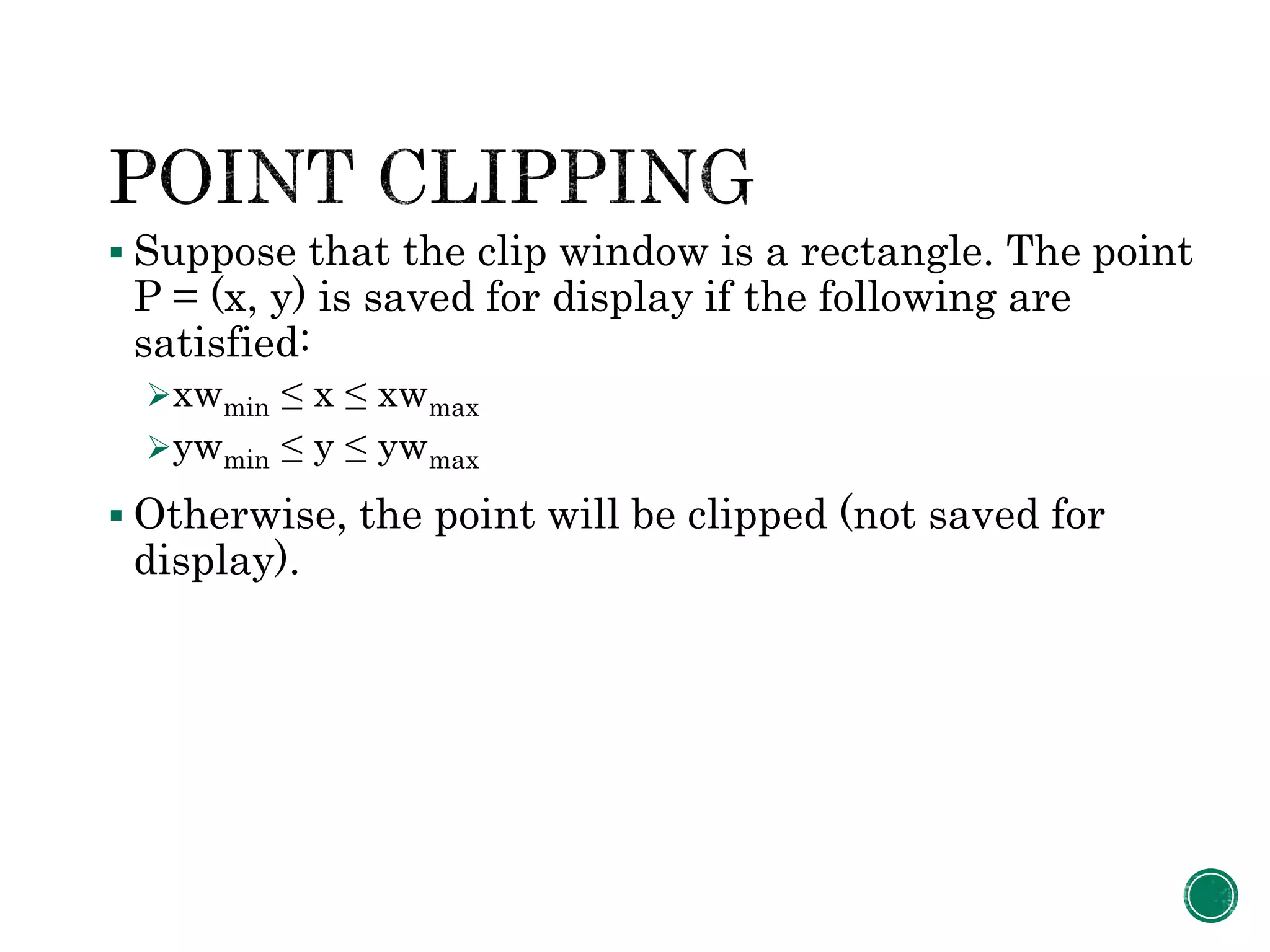
 Suppose that the clip window is a rectangle. The point
P = (x, y) is saved for display if the following are
satisfied:
xwmin ≤ x ≤ xwmax
ywmin ≤ y ≤ ywmax
 Otherwise, the point will be clipped (not saved for
display).
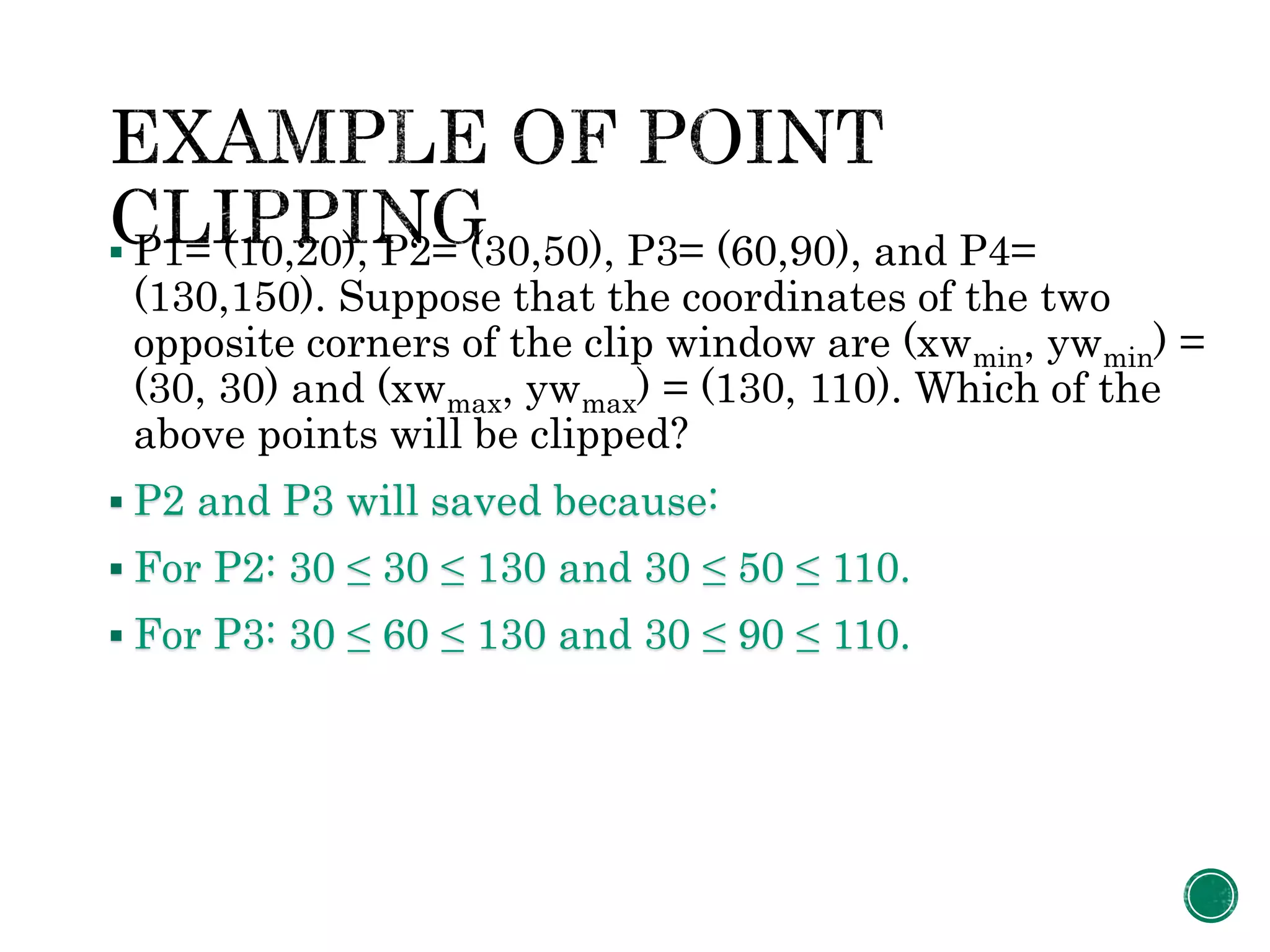
 P1= (10,20), P2= (30,50), P3= (60,90), and P4=
(130,150). Suppose that the coordinates of the two
opposite corners of the clip window are (xwmin, ywmin) =
(30, 30) and (xwmax, ywmax) = (130, 110). Which of the
above points will be clipped?
 P2 and P3 will saved because:
 For P2: 30 ≤ 30 ≤ 130 and 30 ≤ 50 ≤ 110.
 For P3: 30 ≤ 60 ≤ 130 and 30 ≤ 90 ≤ 110.
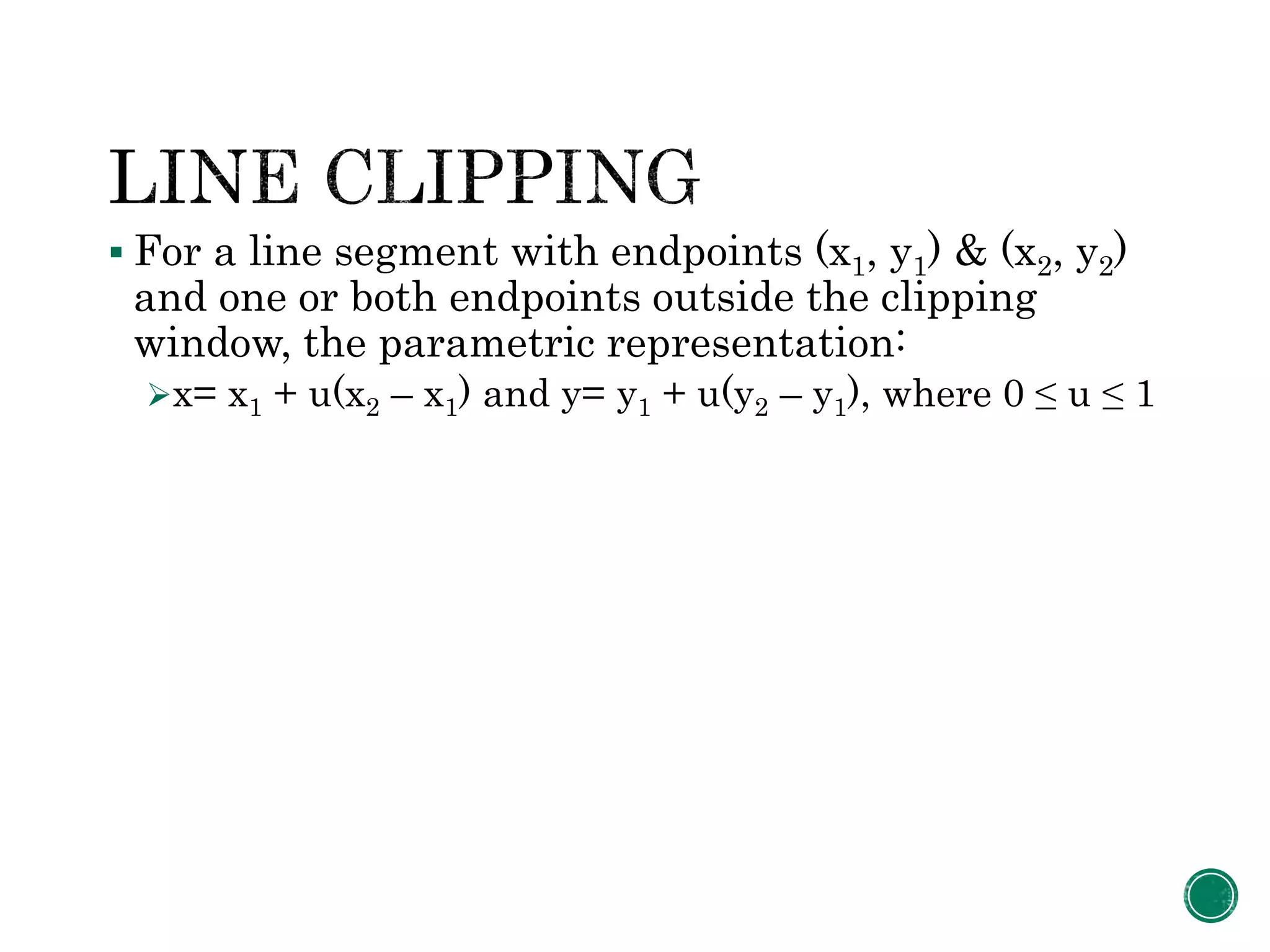
 For a line segment with endpoints (x1, y1) & (x2, y2)
and one or both endpoints outside the clipping
window, the parametric representation:
x= x1 + u(x2 – x1) and y= y1 + u(y2 – y1), where 0 ≤ u ≤ 1
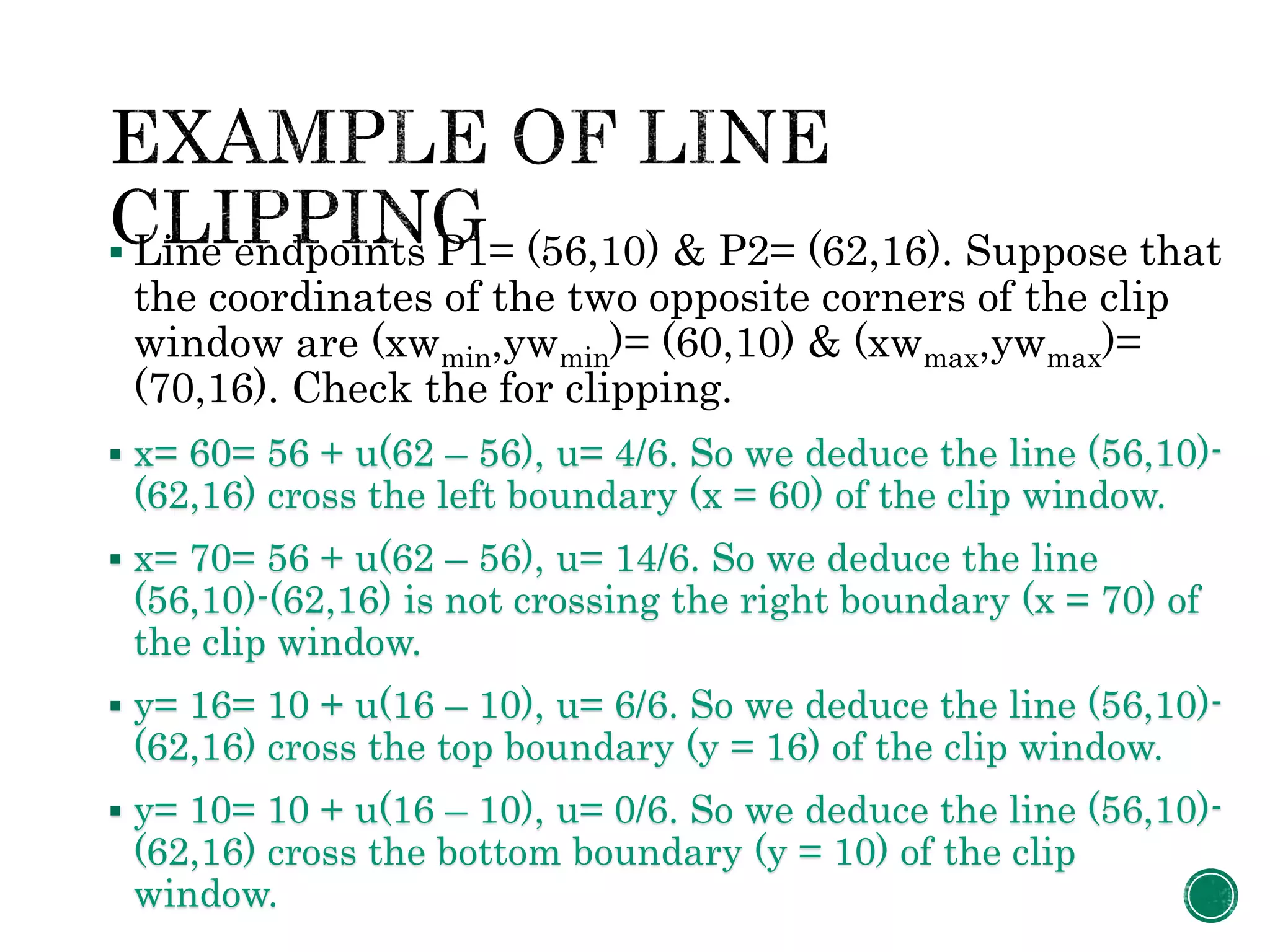
 Line endpoints P1= (56,10) & P2= (62,16). Suppose that
the coordinates of the two opposite corners of the clip
window are (xwmin,ywmin)= (60,10) & (xwmax,ywmax)=
(70,16). Check the for clipping.
 x= 60= 56 + u(62 – 56), u= 4/6. So we deduce the line (56,10)-
(62,16) cross the left boundary (x = 60) of the clip window.
 x= 70= 56 + u(62 – 56), u= 14/6. So we deduce the line
(56,10)-(62,16) is not crossing the right boundary (x = 70) of
the clip window.
 y= 16= 10 + u(16 – 10), u= 6/6. So we deduce the line (56,10)-
(62,16) cross the top boundary (y = 16) of the clip window.
 y= 10= 10 + u(16 – 10), u= 0/6. So we deduce the line (56,10)-
(62,16) cross the bottom boundary (y = 10) of the clip
window.
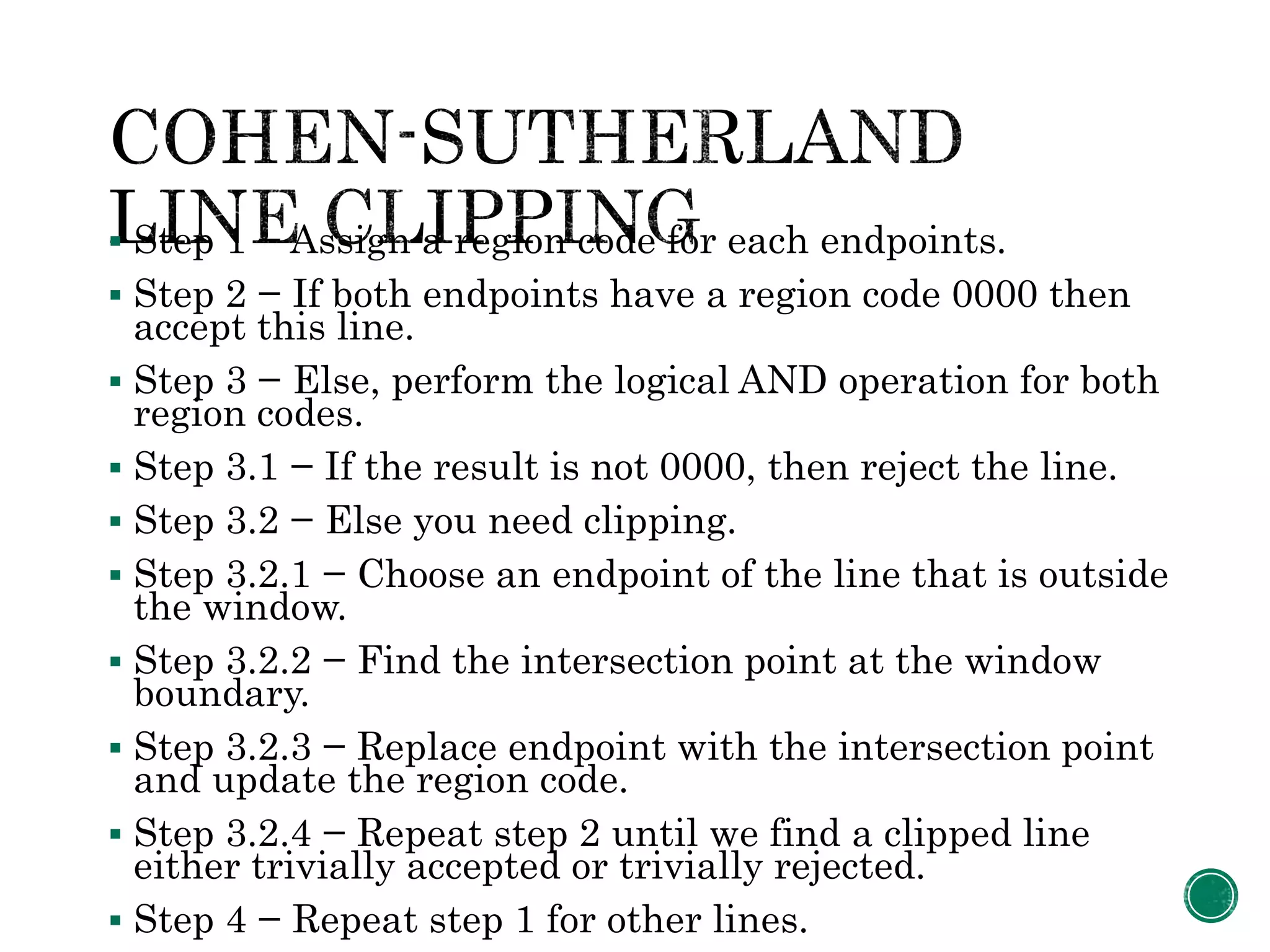
 Step 1 − Assign a region code for each endpoints.
 Step 2 − If both endpoints have a region code 0000 then
accept this line.
 Step 3 − Else, perform the logical AND operation for both
region codes.
 Step 3.1 − If the result is not 0000, then reject the line.
 Step 3.2 − Else you need clipping.
 Step 3.2.1 − Choose an endpoint of the line that is outside
the window.
 Step 3.2.2 − Find the intersection point at the window
boundary.
 Step 3.2.3 − Replace endpoint with the intersection point
and update the region code.
 Step 3.2.4 − Repeat step 2 until we find a clipped line
either trivially accepted or trivially rejected.
 Step 4 − Repeat step 1 for other lines.
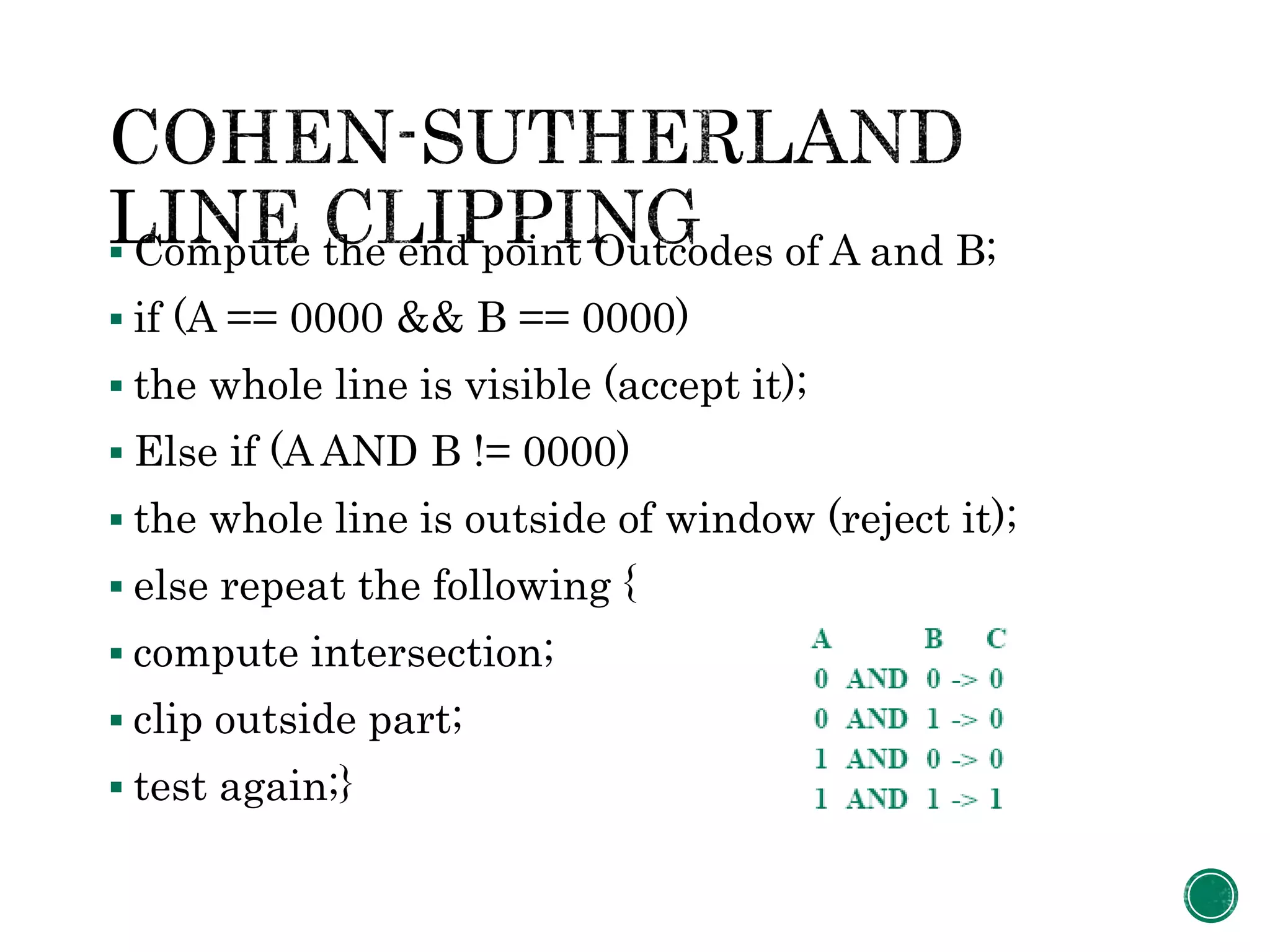
 Compute the end point Outcodes of A and B;
 if (A == 0000 && B == 0000)
 the whole line is visible (accept it);
 Else if (A AND B != 0000)
 the whole line is outside of window (reject it);
 else repeat the following {
 compute intersection;
 clip outside part;
 test again;}
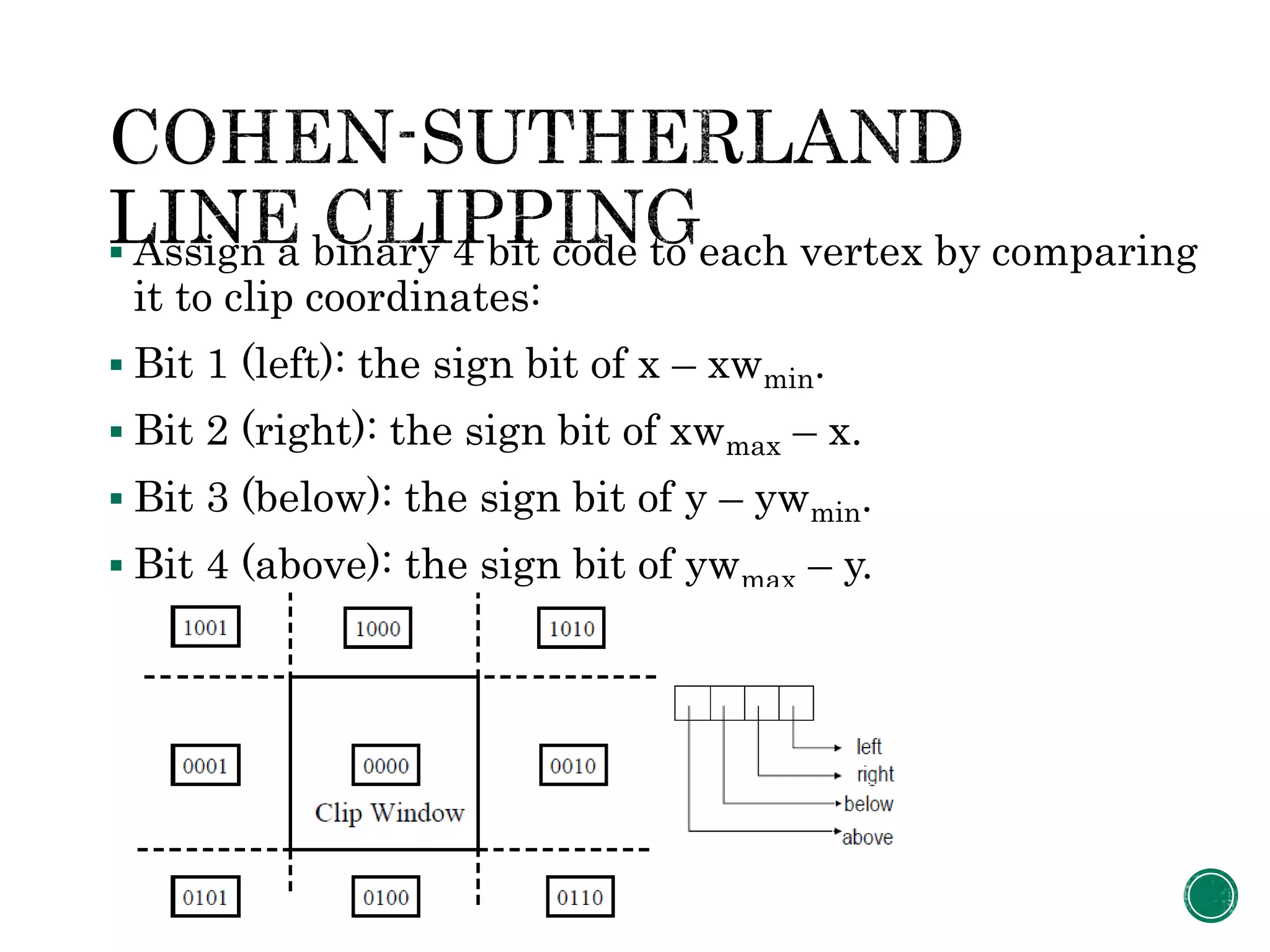
 Assign a binary 4 bit code to each vertex by comparing
it to clip coordinates:
 Bit 1 (left): the sign bit of x – xwmin.
 Bit 2 (right): the sign bit of xwmax – x.
 Bit 3 (below): the sign bit of y – ywmin.
 Bit 4 (above): the sign bit of ywmax – y.
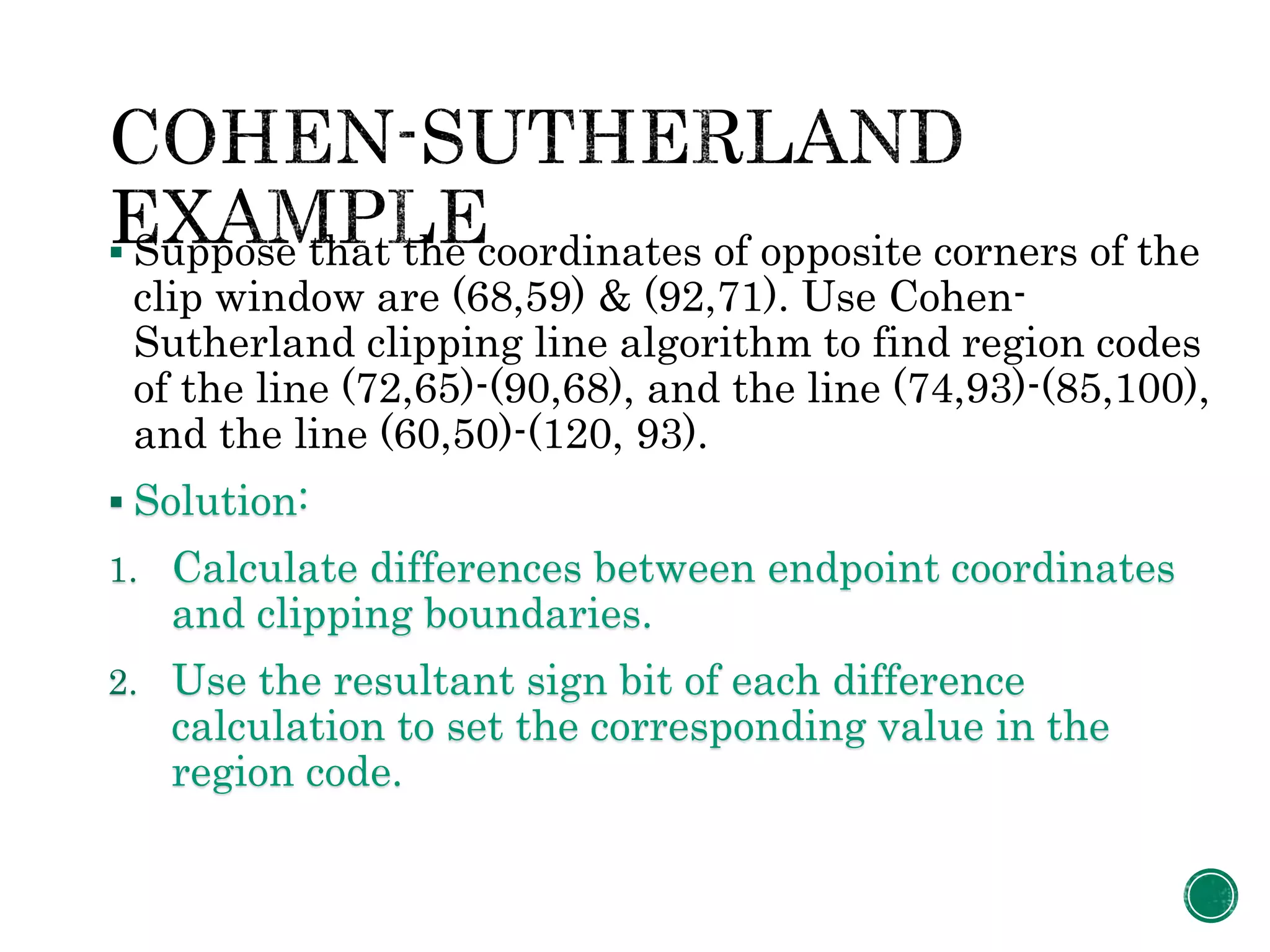
 Suppose that the coordinates of opposite corners of the
clip window are (68,59) & (92,71). Use Cohen-
Sutherland clipping line algorithm to find region codes
of the line (72,65)-(90,68), and the line (74,93)-(85,100),
and the line (60,50)-(120, 93).
 Solution:
1. Calculate differences between endpoint coordinates
and clipping boundaries.
2. Use the resultant sign bit of each difference
calculation to set the corresponding value in the
region code.
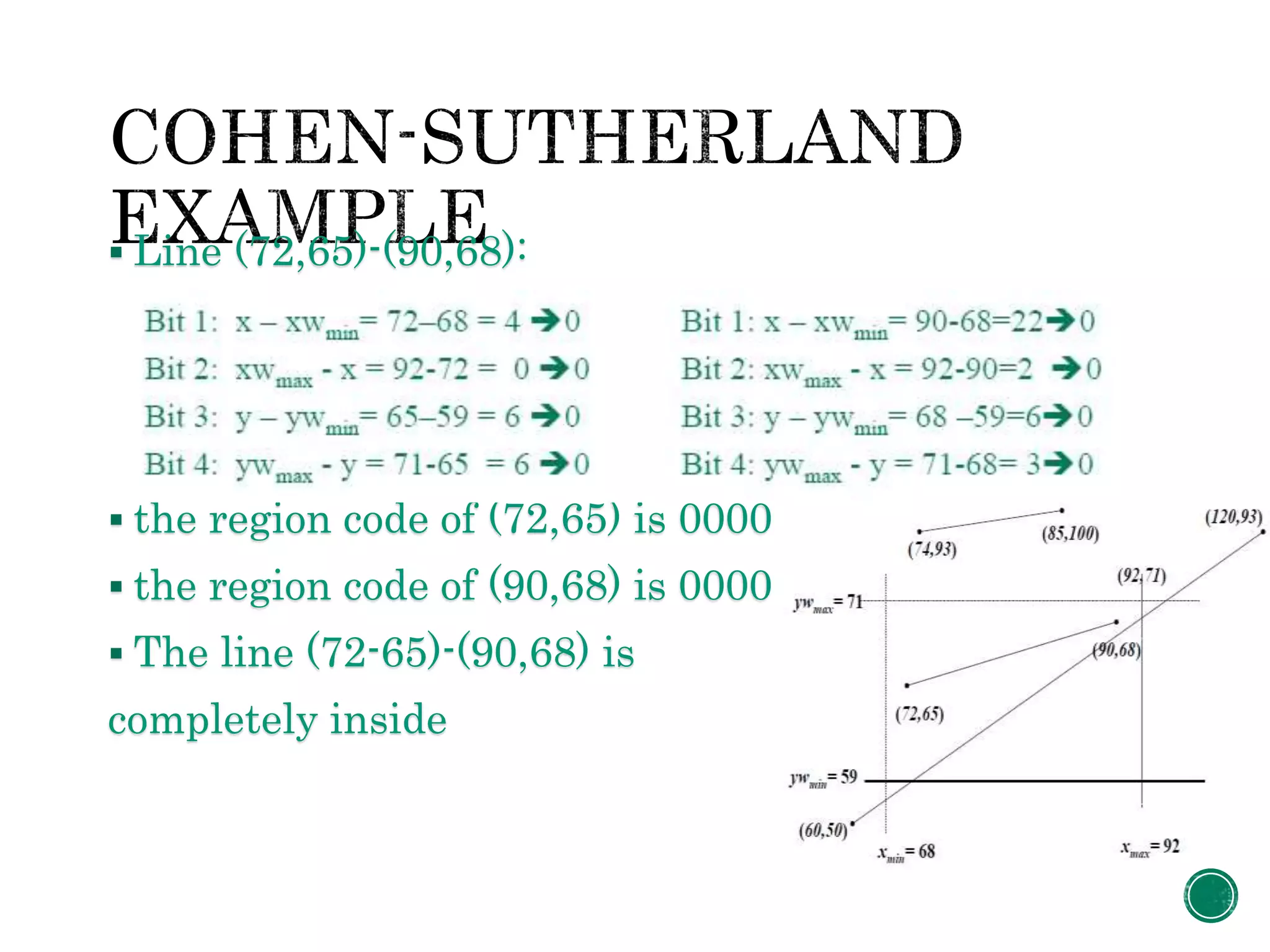
 Line (72,65)-(90,68):
 the region code of (72,65) is 0000
 the region code of (90,68) is 0000
 The line (72-65)-(90,68) is
completely inside
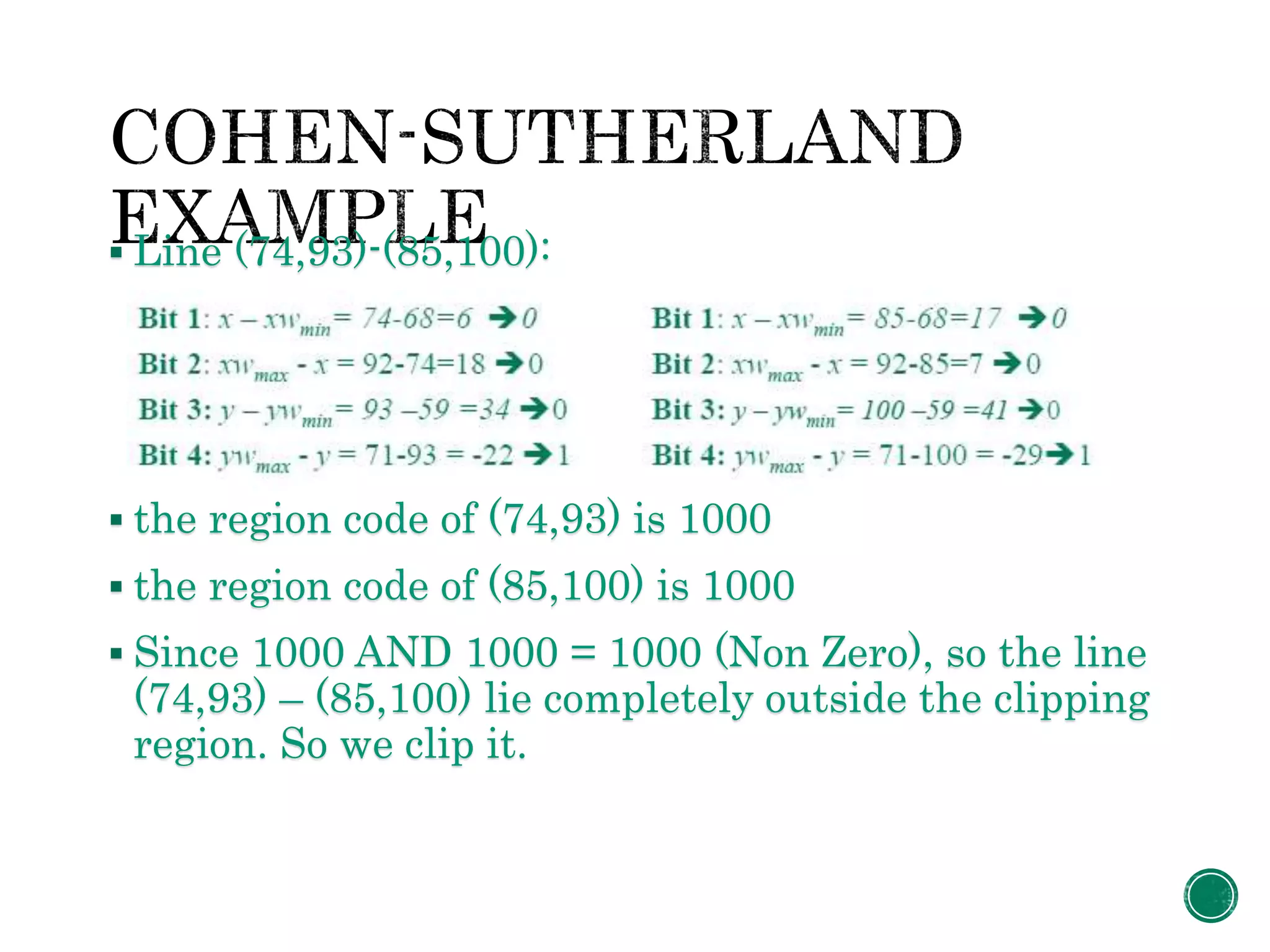
 Line (74,93)-(85,100):
 the region code of (74,93) is 1000
 the region code of (85,100) is 1000
 Since 1000 AND 1000 = 1000 (Non Zero), so the line
(74,93) – (85,100) lie completely outside the clipping
region. So we clip it.
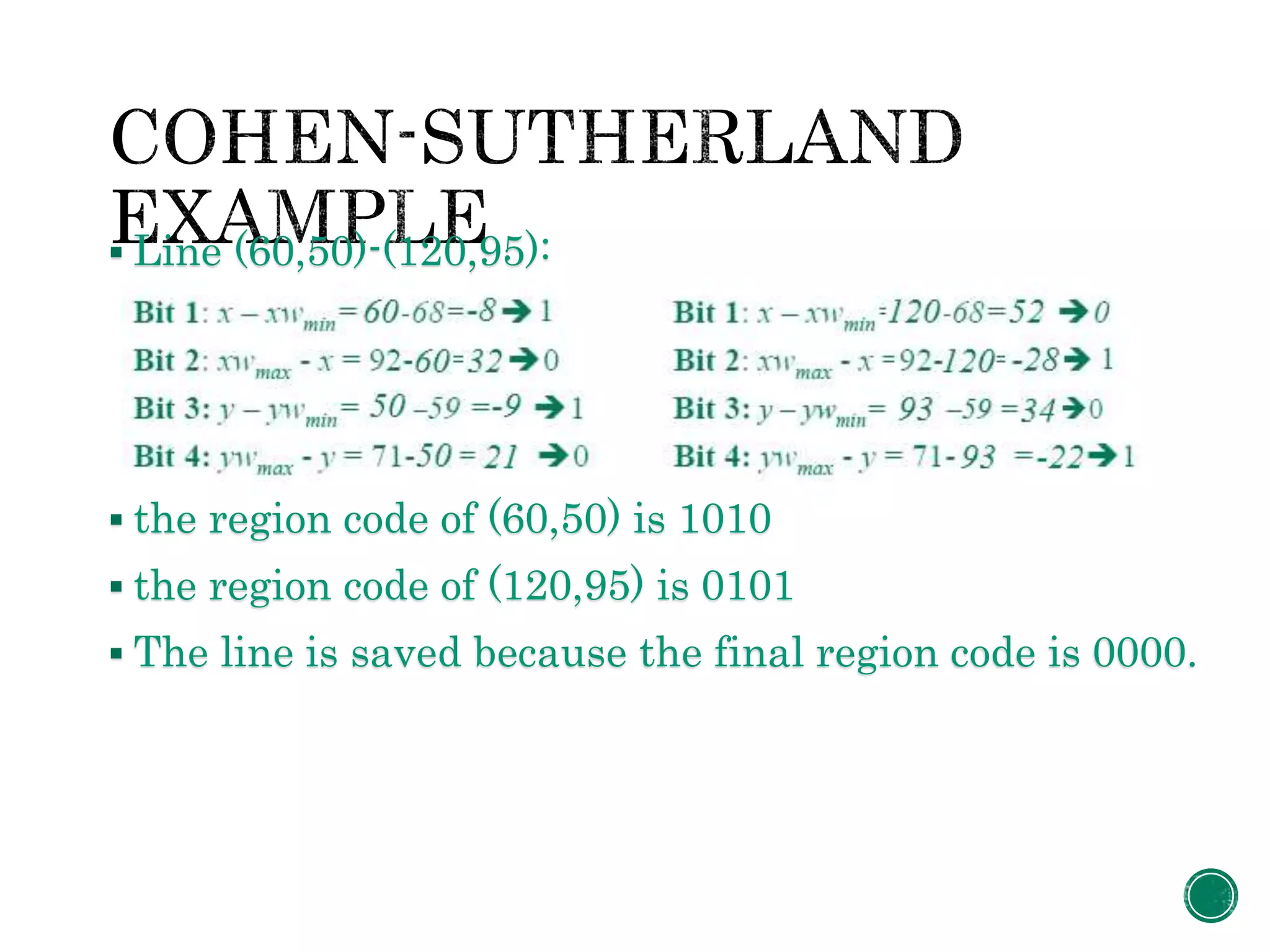
 Line (60,50)-(120,95):
 the region code of (60,50) is 1010
 the region code of (120,95) is 0101
 The line is saved because the final region code is 0000.
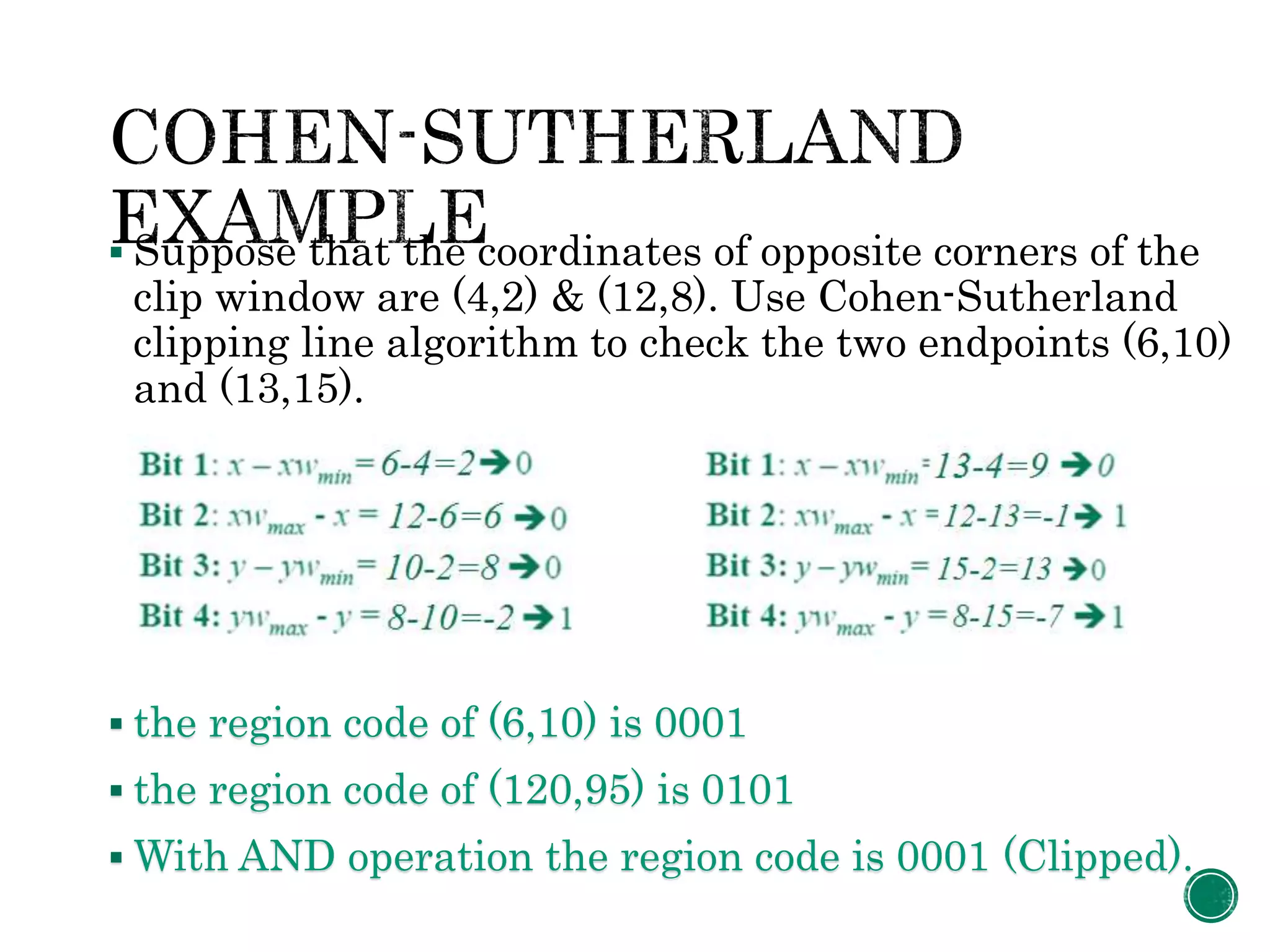
 Suppose that the coordinates of opposite corners of the
clip window are (4,2) & (12,8). Use Cohen-Sutherland
clipping line algorithm to check the two endpoints (6,10)
and (13,15).
 the region code of (6,10) is 0001
 the region code of (120,95) is 0101
 With AND operation the region code is 0001 (Clipped).

Computer Graphic - Clipping

  • 2.
     Clipping meansidentifying portions of a scene that are outside a specified region.  For a 2D graphics the region defining what is to be clipped is called the clip window.  Types of clipping: 1. All-or-none clipping: If any part of object outside clip window then the whole object is rejected. 2. Point clipping: Only keep the points that are inside clip window. 3. Line clipping: Only keep segment of line inside clip window. 4. Polygon clipping: Only keep segment of polygon inside clip window. 5. Text clipping.
  • 4.
     Suppose thatthe clip window is a rectangle. The point P = (x, y) is saved for display if the following are satisfied: xwmin ≤ x ≤ xwmax ywmin ≤ y ≤ ywmax  Otherwise, the point will be clipped (not saved for display).
  • 5.
     P1= (10,20),P2= (30,50), P3= (60,90), and P4= (130,150). Suppose that the coordinates of the two opposite corners of the clip window are (xwmin, ywmin) = (30, 30) and (xwmax, ywmax) = (130, 110). Which of the above points will be clipped?  P2 and P3 will saved because:  For P2: 30 ≤ 30 ≤ 130 and 30 ≤ 50 ≤ 110.  For P3: 30 ≤ 60 ≤ 130 and 30 ≤ 90 ≤ 110.
  • 7.
     For aline segment with endpoints (x1, y1) & (x2, y2) and one or both endpoints outside the clipping window, the parametric representation: x= x1 + u(x2 – x1) and y= y1 + u(y2 – y1), where 0 ≤ u ≤ 1
  • 8.
     Line endpointsP1= (56,10) & P2= (62,16). Suppose that the coordinates of the two opposite corners of the clip window are (xwmin,ywmin)= (60,10) & (xwmax,ywmax)= (70,16). Check the for clipping.  x= 60= 56 + u(62 – 56), u= 4/6. So we deduce the line (56,10)- (62,16) cross the left boundary (x = 60) of the clip window.  x= 70= 56 + u(62 – 56), u= 14/6. So we deduce the line (56,10)-(62,16) is not crossing the right boundary (x = 70) of the clip window.  y= 16= 10 + u(16 – 10), u= 6/6. So we deduce the line (56,10)- (62,16) cross the top boundary (y = 16) of the clip window.  y= 10= 10 + u(16 – 10), u= 0/6. So we deduce the line (56,10)- (62,16) cross the bottom boundary (y = 10) of the clip window.
  • 9.
     Step 1− Assign a region code for each endpoints.  Step 2 − If both endpoints have a region code 0000 then accept this line.  Step 3 − Else, perform the logical AND operation for both region codes.  Step 3.1 − If the result is not 0000, then reject the line.  Step 3.2 − Else you need clipping.  Step 3.2.1 − Choose an endpoint of the line that is outside the window.  Step 3.2.2 − Find the intersection point at the window boundary.  Step 3.2.3 − Replace endpoint with the intersection point and update the region code.  Step 3.2.4 − Repeat step 2 until we find a clipped line either trivially accepted or trivially rejected.  Step 4 − Repeat step 1 for other lines.
  • 10.
     Compute theend point Outcodes of A and B;  if (A == 0000 && B == 0000)  the whole line is visible (accept it);  Else if (A AND B != 0000)  the whole line is outside of window (reject it);  else repeat the following {  compute intersection;  clip outside part;  test again;}
  • 11.
     Assign abinary 4 bit code to each vertex by comparing it to clip coordinates:  Bit 1 (left): the sign bit of x – xwmin.  Bit 2 (right): the sign bit of xwmax – x.  Bit 3 (below): the sign bit of y – ywmin.  Bit 4 (above): the sign bit of ywmax – y.
  • 12.
     Suppose thatthe coordinates of opposite corners of the clip window are (68,59) & (92,71). Use Cohen- Sutherland clipping line algorithm to find region codes of the line (72,65)-(90,68), and the line (74,93)-(85,100), and the line (60,50)-(120, 93).  Solution: 1. Calculate differences between endpoint coordinates and clipping boundaries. 2. Use the resultant sign bit of each difference calculation to set the corresponding value in the region code.
  • 13.
     Line (72,65)-(90,68): the region code of (72,65) is 0000  the region code of (90,68) is 0000  The line (72-65)-(90,68) is completely inside
  • 14.
     Line (74,93)-(85,100): the region code of (74,93) is 1000  the region code of (85,100) is 1000  Since 1000 AND 1000 = 1000 (Non Zero), so the line (74,93) – (85,100) lie completely outside the clipping region. So we clip it.
  • 15.
     Line (60,50)-(120,95): the region code of (60,50) is 1010  the region code of (120,95) is 0101  The line is saved because the final region code is 0000.
  • 16.
     Suppose thatthe coordinates of opposite corners of the clip window are (4,2) & (12,8). Use Cohen-Sutherland clipping line algorithm to check the two endpoints (6,10) and (13,15).  the region code of (6,10) is 0001  the region code of (120,95) is 0101  With AND operation the region code is 0001 (Clipped).