Post-Optimal Analysis 
Linear optimization problem
Contents 
Introduction to Post-Optimal Analysis 
Changes Affection Feasibility 
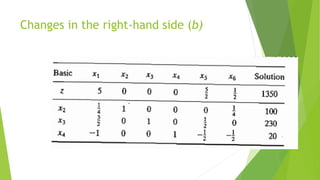
Changes in the right-hand side (b) 
Addition of a new constraint 
Changes Affecting Optimality 
Changes in the Objective Coefficients (c_j) 
Addition of new activity (x_j)
Post-Optimal Analysis 
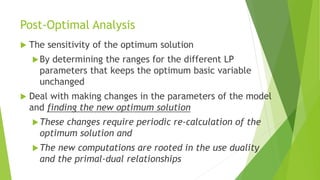
The sensitivity of the optimum solution 
By determining the ranges for the different LP parameters that keeps the optimum basic variable unchanged 
Deal with making changes in the parameters of the model and finding the new optimum solution 
These changes require periodic re-calculation of the optimum solution and 
The new computations are rooted in the use duality and the primal-dual relationships
Post-Optimal Analysis
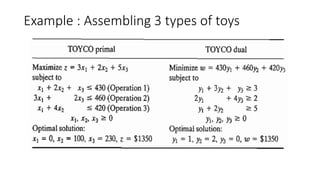
Example : Assembling 3 types of toys
Example : Assembling 3 types of toys 
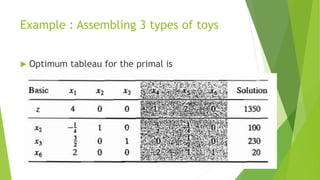
Optimum tableau for the primal is
Changes Affection Feasibility 
Two possibilities which can affect feasibility are 
Changes in the right-hand side (b) 
A new constraint is added
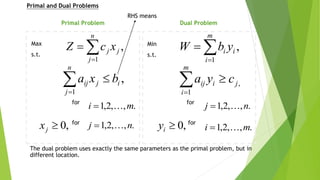
The dual problem uses exactly the same parameters as the primal problem, but in 
different location. 
Primal and Dual Problems 
Primal Problem Dual Problem 
Max 
s.t. 
Min 
s.t.  
 
n 
j 
j j Z c x 
1 
,  
 
m 
i 
i i W b y 
1 
, 
 
 
n 
j 
ij j i a x b 
1 
,  
 
m 
i 
ij i j a y c 
1 
, 
for for i 1,2,,m. j 1,2,,n. 
for 
i 1,2,,m. 
for  0, j 1,2,,n. j x  0, i y 
RHS means
Changes in the right-hand side (b)
Changes in the right-hand side (b) 
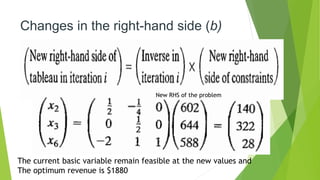
New RHS of the problem 
The current basic variable remain feasible at the new values and 
The optimum revenue is $1880
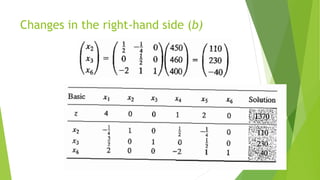
Changes in the right-hand side (b)
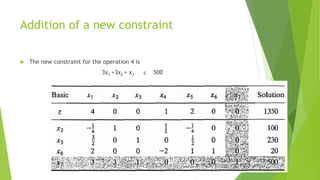
Addition of a new constraint 
The new constraint for the operation 4 is 
3x1 +3x2 + x3≤ 500
Addition of a new constraint
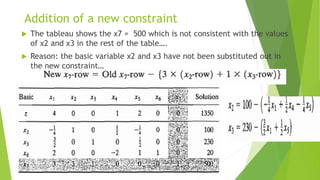
Addition of a new constraint 
The tableau shows the x7 = 500 which is not consistent with the values of x2 and x3 in the rest of the table…. 
Reason: the basic variable x2 and x3 have not been substituted out in the new constraint…
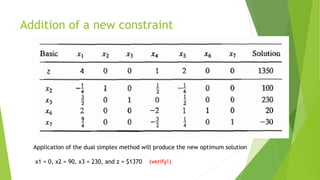
Addition of a new constraint 
Application of the dual simplex method will produce the new optimum solution 
x1 = 0, x2 = 90, x3 = 230, and z = $1370 (verify!)
Changes Affecting Optimality 
The changes in the Objective Coefficients 
The addition of a new economic activity (variable)
Changes in the Objective Coefficients
Changes in the Objective Coefficients 
Affect only the optimality of the solution and require recomputing the z-row coefficients (reduced costs):- 
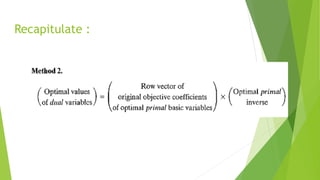
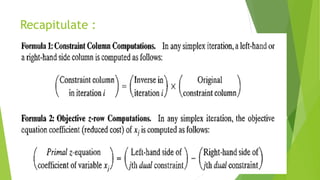
1)Compute the dual values using the Method 2 
2)Substitute the new dual values in Formula 2, to determine the new reduced costs (z-row coefficients).
Recapitulate :
Recapitulate :
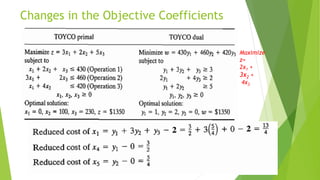
Changes in the Objective Coefficients 
Maximize z = 2x1+ 3x2+ 4x3is the new objective function then,
Changes in the Objective Coefficients 
Maximize z= 
2x1+ 
3x2+ 
4x3
Changes in the Objective Coefficients 
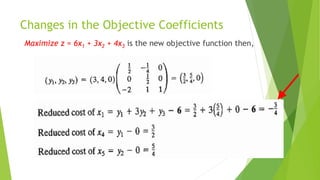
Maximize z = 6x1+ 3x2+ 4x3is the new objective function then,
Changes in the Objective Coefficients 
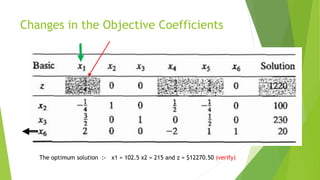
The optimum solution :-x1 = 102.5 x2 = 215 and z = $12270.50 (verify)
Addition of new activity
Addition of new activity 
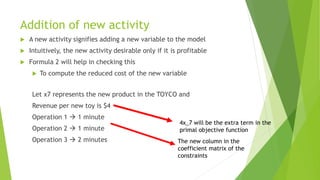
A new activity signifies adding a new variable to the model 
Intuitively, the new activity desirable only if it is profitable 
Formula 2 will help in checking this 
To compute the reduced cost of the new variable 
Let x7 represents the new product in the TOYCO and 
Revenue per new toy is $4 
Operation 1 1 minute 
Operation 2 1 minute 
Operation 3 2 minutes 
The new column in the coefficient matrix of the constraints 
4x_7 will be the extra term in the primal objective function
Addition of new activity 
Given that (y_1, y_2, y_3) = (1,2,0) are the optimal dual variable, 
Reduce cost of x7 is
Addition of new activity 
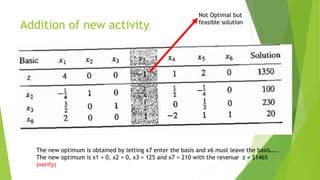
Not Optimal but feasible solution 
The new optimum is obtained by letting x7 enter the basis and x6 must leave the basis….. 
The new optimum is x1 = 0, x2 = 0, x3 = 125 and x7 = 210 with the revenue z = $1465 (verify)
Thanks for your attention

Post-optimal analysis of LPP

  • 1.
    Post-Optimal Analysis Linearoptimization problem
  • 2.
    Contents Introduction toPost-Optimal Analysis Changes Affection Feasibility Changes in the right-hand side (b) Addition of a new constraint Changes Affecting Optimality Changes in the Objective Coefficients (c_j) Addition of new activity (x_j)
  • 3.
    Post-Optimal Analysis Thesensitivity of the optimum solution By determining the ranges for the different LP parameters that keeps the optimum basic variable unchanged Deal with making changes in the parameters of the model and finding the new optimum solution These changes require periodic re-calculation of the optimum solution and The new computations are rooted in the use duality and the primal-dual relationships
  • 4.
  • 5.
    Example : Assembling3 types of toys
  • 6.
    Example : Assembling3 types of toys Optimum tableau for the primal is
  • 7.
    Changes Affection Feasibility Two possibilities which can affect feasibility are Changes in the right-hand side (b) A new constraint is added
  • 8.
    The dual problemuses exactly the same parameters as the primal problem, but in different location. Primal and Dual Problems Primal Problem Dual Problem Max s.t. Min s.t.   n j j j Z c x 1 ,   m i i i W b y 1 ,   n j ij j i a x b 1 ,   m i ij i j a y c 1 , for for i 1,2,,m. j 1,2,,n. for i 1,2,,m. for  0, j 1,2,,n. j x  0, i y RHS means
  • 9.
    Changes in theright-hand side (b)
  • 10.
    Changes in theright-hand side (b) New RHS of the problem The current basic variable remain feasible at the new values and The optimum revenue is $1880
  • 11.
    Changes in theright-hand side (b)
  • 12.
    Changes in theright-hand side (b)
  • 13.
    Addition of anew constraint The new constraint for the operation 4 is 3x1 +3x2 + x3≤ 500
  • 14.
    Addition of anew constraint
  • 15.
    Addition of anew constraint
  • 16.
    Addition of anew constraint The tableau shows the x7 = 500 which is not consistent with the values of x2 and x3 in the rest of the table…. Reason: the basic variable x2 and x3 have not been substituted out in the new constraint…
  • 17.
    Addition of anew constraint Application of the dual simplex method will produce the new optimum solution x1 = 0, x2 = 90, x3 = 230, and z = $1370 (verify!)
  • 18.
    Changes Affecting Optimality The changes in the Objective Coefficients The addition of a new economic activity (variable)
  • 19.
    Changes in theObjective Coefficients
  • 20.
    Changes in theObjective Coefficients Affect only the optimality of the solution and require recomputing the z-row coefficients (reduced costs):- 1)Compute the dual values using the Method 2 2)Substitute the new dual values in Formula 2, to determine the new reduced costs (z-row coefficients).
  • 21.
  • 22.
  • 23.
    Changes in theObjective Coefficients Maximize z = 2x1+ 3x2+ 4x3is the new objective function then,
  • 24.
    Changes in theObjective Coefficients Maximize z= 2x1+ 3x2+ 4x3
  • 25.
    Changes in theObjective Coefficients Maximize z = 6x1+ 3x2+ 4x3is the new objective function then,
  • 26.
    Changes in theObjective Coefficients The optimum solution :-x1 = 102.5 x2 = 215 and z = $12270.50 (verify)
  • 27.
  • 28.
    Addition of newactivity A new activity signifies adding a new variable to the model Intuitively, the new activity desirable only if it is profitable Formula 2 will help in checking this To compute the reduced cost of the new variable Let x7 represents the new product in the TOYCO and Revenue per new toy is $4 Operation 1 1 minute Operation 2 1 minute Operation 3 2 minutes The new column in the coefficient matrix of the constraints 4x_7 will be the extra term in the primal objective function
  • 29.
    Addition of newactivity Given that (y_1, y_2, y_3) = (1,2,0) are the optimal dual variable, Reduce cost of x7 is
  • 30.
    Addition of newactivity Not Optimal but feasible solution The new optimum is obtained by letting x7 enter the basis and x6 must leave the basis….. The new optimum is x1 = 0, x2 = 0, x3 = 125 and x7 = 210 with the revenue z = $1465 (verify)
  • 31.
    Thanks for yourattention