And Beyond
The Scientific Method
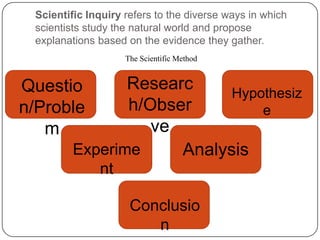
Scientific Inquiry refers to the diverse ways in which
scientists study the natural world and propose
explanations based on the evidence they gather.
Questio
n/Proble
m
Researc
h/Obser
ve
Hypothesiz
e
Experime
nt
Analysis
Conclusio
n
The Scientific Method
Question/
Problem
Does adding aspirin to the water help keep
flowers fresh?
Research/
Observe
Some people have said that adding aspirin to
water can help keep the flowers fresh. When
you buy cut flowers, there is usually a packet of
powder to add to the water to help keep the
flowers fresh.
Hypothesis
If I add aspirin to the water, then the
flowers will stay fresh longer (colorful and
upright).
Experiment
First, identify the variables (a variable is
any factor that can affect the result of an
experiment.)
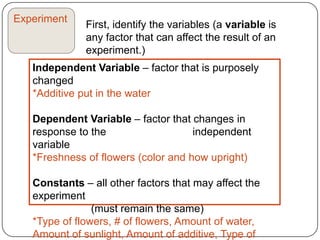
Independent Variable – factor that is purposely
changed
*Additive put in the water
Dependent Variable – factor that changes in
response to the independent
variable
*Freshness of flowers (color and how upright)
Constants – all other factors that may affect the
experiment
(must remain the same)
*Type of flowers, # of flowers, Amount of water,
Amount of sunlight, Amount of additive, Type of
Experiment Second, identify the materials (be specific
including amounts and types)
Third, develop a step-by-step procedure
(again be specific) and complete the steps.
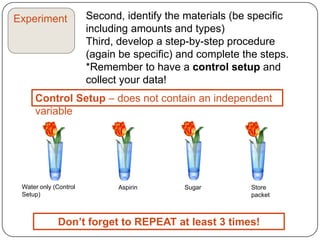
*Remember to have a control setup and
collect your data!
Control Setup – does not contain an independent
variable
Water only (Control
Setup)
Aspirin Sugar Store
packet
Don’t forget to REPEAT at least 3 times!
Analysis
Consolidate data and construct tables &
graphs. Data from the various trials should
be similar.
Conclusion Examine data objectively to see if they
support the hypothesis. Consider whether
enough data was collected and if there
was any bias.
Bias – influence that favors for or against an
outcome
And beyond…
Sometimes it’s not possible or desirable to design a controlled
experiment to investigate a question.
Other Types of Investigations
• Observational research
• Surveys
• Literature-Based

The scientific method gr 6

  • 1.
  • 2.
    Scientific Inquiry refersto the diverse ways in which scientists study the natural world and propose explanations based on the evidence they gather. Questio n/Proble m Researc h/Obser ve Hypothesiz e Experime nt Analysis Conclusio n The Scientific Method
  • 3.
    Question/ Problem Does adding aspirinto the water help keep flowers fresh? Research/ Observe Some people have said that adding aspirin to water can help keep the flowers fresh. When you buy cut flowers, there is usually a packet of powder to add to the water to help keep the flowers fresh. Hypothesis If I add aspirin to the water, then the flowers will stay fresh longer (colorful and upright).
  • 4.
    Experiment First, identify thevariables (a variable is any factor that can affect the result of an experiment.) Independent Variable – factor that is purposely changed *Additive put in the water Dependent Variable – factor that changes in response to the independent variable *Freshness of flowers (color and how upright) Constants – all other factors that may affect the experiment (must remain the same) *Type of flowers, # of flowers, Amount of water, Amount of sunlight, Amount of additive, Type of
  • 5.
    Experiment Second, identifythe materials (be specific including amounts and types) Third, develop a step-by-step procedure (again be specific) and complete the steps. *Remember to have a control setup and collect your data! Control Setup – does not contain an independent variable Water only (Control Setup) Aspirin Sugar Store packet Don’t forget to REPEAT at least 3 times!
  • 6.
    Analysis Consolidate data andconstruct tables & graphs. Data from the various trials should be similar. Conclusion Examine data objectively to see if they support the hypothesis. Consider whether enough data was collected and if there was any bias. Bias – influence that favors for or against an outcome
  • 7.
    And beyond… Sometimes it’snot possible or desirable to design a controlled experiment to investigate a question. Other Types of Investigations • Observational research • Surveys • Literature-Based