Page 1© Amy Brown Science
Page 2
What is Science?
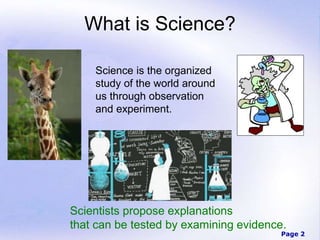
Science is the organized
study of the world around
us through observation
and experiment.
Scientists propose explanations
that can be tested by examining evidence.
Page 3
How is Science Done?
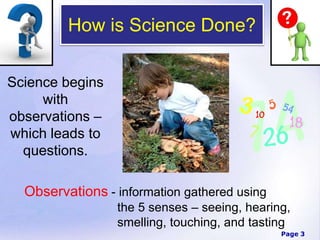
Science begins
with
observations –
which leads to
questions.
Observations - information gathered using
the 5 senses – seeing, hearing,
smelling, touching, and tasting
Page 4
Scientific Methods
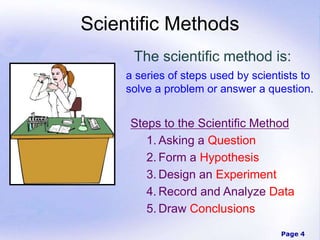
The scientific method is:
a series of steps used by scientists to
solve a problem or answer a question.
Steps to the Scientific Method
1. Asking a Question
2. Form a Hypothesis
3. Design an Experiment
4. Record and Analyze Data
5. Draw Conclusions
Page 5
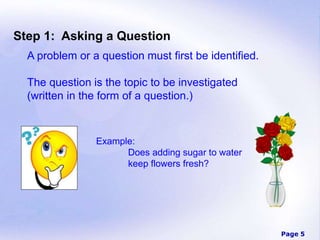
Step 1: Asking a Question
A problem or a question must first be identified.
The question is the topic to be investigated
(written in the form of a question.)
Example:
Does adding sugar to water
keep flowers fresh?
Page 6
A hypothesis is a prediction
or possible answer to the
question.
A hypothesis must be
stated in a way that is
“testable”.
Step 2: Forming a Hypothesis
*testable – means there must be measurable data
Example
If sugar is added to the water in a vase,
then the flowers will stay fresh longer.
Page 7
Step 3: Designing an Experiment
The factors in an experiment that can
be changed are called variables.
In controlled experiments scientists
change only one variable at a time.
All other variables are kept constant or “controlled”.
Describe in detail what you plan to do to
test your hypothesis.
Identify Variables
Page 8
Independent and Dependent Variables
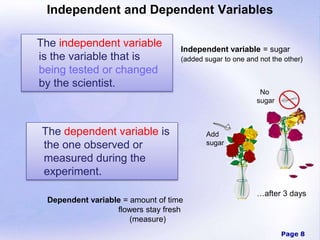
The independent variable
is the variable that is
being tested or changed
by the scientist.
The dependent variable is
the one observed or
measured during the
experiment.
No
sugar
Add
sugar
Independent variable = sugar
(added sugar to one and not the other)
Dependent variable = amount of time
flowers stay fresh
(measure)
…after 3 days
Page 9
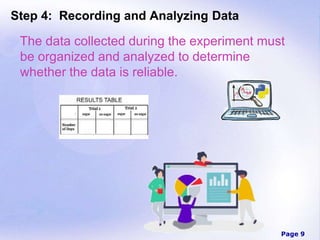
Step 4: Recording and Analyzing Data
The data collected during the experiment must
be organized and analyzed to determine
whether the data is reliable.
Page 10
Step 5: Drawing Conclusions
The data from the experiment is used as evidence to
determine if the hypothesis is correct or incorrect.
*Experiments must be
repeated over and over
before a valid conclusion
can be reached.

Scientific method power point slideshare

  • 1.
    Page 1© AmyBrown Science
  • 2.
    Page 2 What isScience? Science is the organized study of the world around us through observation and experiment. Scientists propose explanations that can be tested by examining evidence.
  • 3.
    Page 3 How isScience Done? Science begins with observations – which leads to questions. Observations - information gathered using the 5 senses – seeing, hearing, smelling, touching, and tasting
  • 4.
    Page 4 Scientific Methods Thescientific method is: a series of steps used by scientists to solve a problem or answer a question. Steps to the Scientific Method 1. Asking a Question 2. Form a Hypothesis 3. Design an Experiment 4. Record and Analyze Data 5. Draw Conclusions
  • 5.
    Page 5 Step 1:Asking a Question A problem or a question must first be identified. The question is the topic to be investigated (written in the form of a question.) Example: Does adding sugar to water keep flowers fresh?
  • 6.
    Page 6 A hypothesisis a prediction or possible answer to the question. A hypothesis must be stated in a way that is “testable”. Step 2: Forming a Hypothesis *testable – means there must be measurable data Example If sugar is added to the water in a vase, then the flowers will stay fresh longer.
  • 7.
    Page 7 Step 3:Designing an Experiment The factors in an experiment that can be changed are called variables. In controlled experiments scientists change only one variable at a time. All other variables are kept constant or “controlled”. Describe in detail what you plan to do to test your hypothesis. Identify Variables
  • 8.
    Page 8 Independent andDependent Variables The independent variable is the variable that is being tested or changed by the scientist. The dependent variable is the one observed or measured during the experiment. No sugar Add sugar Independent variable = sugar (added sugar to one and not the other) Dependent variable = amount of time flowers stay fresh (measure) …after 3 days
  • 9.
    Page 9 Step 4:Recording and Analyzing Data The data collected during the experiment must be organized and analyzed to determine whether the data is reliable.
  • 10.
    Page 10 Step 5:Drawing Conclusions The data from the experiment is used as evidence to determine if the hypothesis is correct or incorrect. *Experiments must be repeated over and over before a valid conclusion can be reached.