Scientific Problem Solving
Scientific Method
The world is full of problems!
Scientific Method
A set of procedures a scientist would follow in
solving a problem!
Scientific Method
1. Define the Problem
Scientific Method
2. Collect Data on the Problem
What is Data?
Information from which conclusions can be made.
Scientific Method
3. Draw a Hypothesis
Scientific Method
What is a Hypothesis
An Educated Guess!
Scientific Method
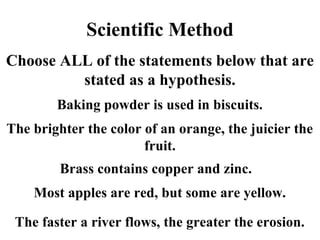
Choose ALL of the statements below that are
stated as a hypothesis.
Baking powder is used in biscuits.
The brighter the color of an orange, the juicier the
fruit.
Brass contains copper and zinc.
Most apples are red, but some are yellow.
The faster a river flows, the greater the erosion.
Scientific Method
Some chickens lay an egg every day. Other chickens
produce few eggs. A study is planned to examine factors
that might affect the number of eggs produced by
chickens.
Which of the following is NOT a suitable hypothesis for
the study?
Scientific Method
If chickens receive more hours of light, then they will
produce more eggs.
If more eggs are produced by chickens, then they lose
more weight.
If the cage for chickens is larger, then they will produce
more eggs.
If there is more protein in the feed, then more eggs are
produced.
Scientific Method
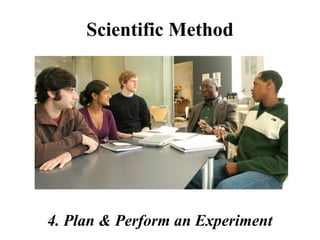
4. Plan & Perform an Experiment
Scientific Method
For an Experiment to be VALID, it needs
A Control Group
A Test Group
Scientific Method
Students in a science class placed ice cubes in a cup. They
were studying variables that affected how long it takes the
ice to melt.
Scientific Method
Select the variable that would most likely NOT affect the
time it takes the ice to melt.
Size of cup
Number of students
Size of ice cube
Temperature of the room
Scientific Method
Example
A student pours 100 mL of hot water carefully into one
beaker and pours 100 mL of cold water into another
beaker. He drops a lump of sugar into each beaker and
times how long it will take each sugar cube to dissolve. Will
this experiment show the effect water temperature has on
the rate at which sugar dissolves?
To be VALID, there can only be 1 VARIABLE!
Scientific Method
A student pours 100 mL of hot water carefully into one
beaker and pours 100 mL of cold water into another
beaker. He drops a lump of sugar into each beaker and
times how long it will take each sugar cube to dissolve. Will
this experiment show the effect water temperature has on
the rate at which sugar dissolves?
Scientific Method
Example
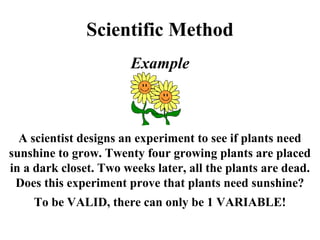
A scientist designs an experiment to see if plants need
sunshine to grow. Twenty four growing plants are placed
in a dark closet. Two weeks later, all the plants are dead.
Does this experiment prove that plants need sunshine?
To be VALID, there can only be 1 VARIABLE!
Scientific Method
There are 2 types of Variables?
Dependent Variable
Independent Variable
Scientific Method
Dependent Variable
What you measure in an experiment.
What is being affected during an experiment.
Scientific Method
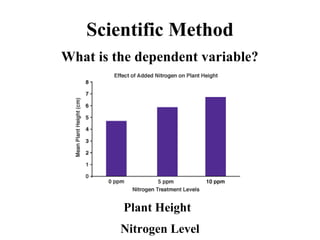
A group of identical plants are grown with different
nitrogen levels.
Scientific Method
What is the dependent variable?
Plant Height
Nitrogen Level
Scientific Method
Independent Variable
This is what is changed to test a hypothesis.
What is causing the affect during an experiment.
Scientific Method
A group of identical plants are grown with different
colors of light.
Scientific Method
What is the Independent Variable?
Color of Light
Plant Height
Scientific Method
What is the Independent Variable in this experiment?
Scientific Method
Independent Variable = Soil Type
Scientific Method
5. Collect & Record Your Observations
Measurements
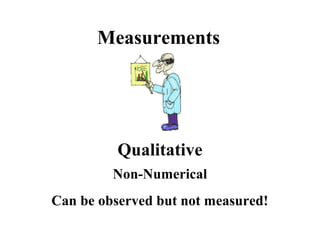
Qualitative
Non-Numerical
Can be observed but not measured!
Measurements
Quanitative
Numerical
Can be observed and measured!
Qualitative or Quantitative?
Mass
Size
pH
Color
Salt deposits form.
Accuracy & Precision
Accuracy refers to the closeness of measurements to the
correct or accepted value of the quantity measured.
Accuracy & Precision
Precision refers to the closeness of a set of measurements of
the same quantity made in the same way.
Accurate &/or Precise?
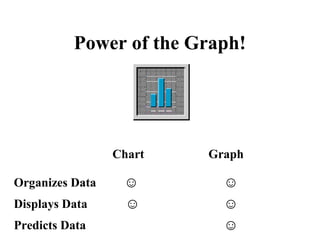
Power of the Graph!
Chart Graph
Organizes Data ☺ ☺
Displays Data ☺ ☺
Predicts Data ☺
Scientific Method
6. Draw a Conclusion
Scientific Theory
Represents a hypotheses, or a group of related
hypotheses, which has been confirmed through
repeated experimental tests.
Scientific Method
A student decides to set up an experiment to see if cats
preferred skim milk or 2%milk. She put out a cup of milk
and a cup of 2%milk. Both milks were served at the same
temperature. She then measured which type and how
much milk her 5 kittens drank over the course of a day.
The student discovered that the cats liked the 2% more
than the skim milk.
What is wrong with the above experiment?
Scientific Method
7. Communicate Your Findings
Scientific Method

Scientific Method