The cell theory states that:
1. The cell is the basic unit of life.
2. All living things are made up of one or more cells.
3. All cells come from other cells through the process of reproduction.
THE CELL THEORYIS COMPOSED OF
3 PARTS.
1. The cell is the basic unit of life.
2. All living things are made up of 1 or more cells.
3. All cells come from other cells.
3.
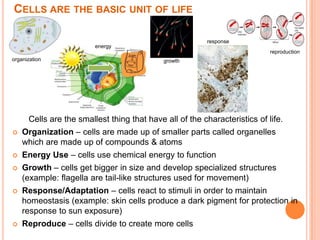
CELLS ARE THEBASIC UNIT OF LIFE
Cells are the smallest thing that have all of the characteristics of life.
Organization – cells are made up of smaller parts called organelles
which are made up of compounds & atoms
Energy Use – cells use chemical energy to function
Growth – cells get bigger in size and develop specialized structures
(example: flagella are tail-like structures used for movement)
Response/Adaptation – cells react to stimuli in order to maintain
homeostasis (example: skin cells produce a dark pigment for protection in
response to sun exposure)
Reproduce – cells divide to create more cells
organization
energy
growth
response
reproduction
4.
ALL LIVING THINGSARE COMPOSED OF ONE OR
MORE CELLS
Unicellular – organisms that are only 1 cell (examples:
bacteria, protists, and some fungus)
Multicellular – organisms made up of 2 or more cells
(plants, animals, and most fungus)
bacteria protist
plant animal fungus
Public Domain (CC0)
5.
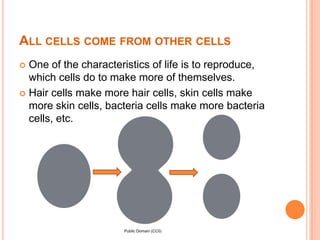
ALL CELLS COMEFROM OTHER CELLS
One of the characteristics of life is to reproduce,
which cells do to make more of themselves.
Hair cells make more hair cells, skin cells make
more skin cells, bacteria cells make more bacteria
cells, etc.
Public Domain (CC0)