Matching Content to Delivery
ISD
E-Learning
SM page 29
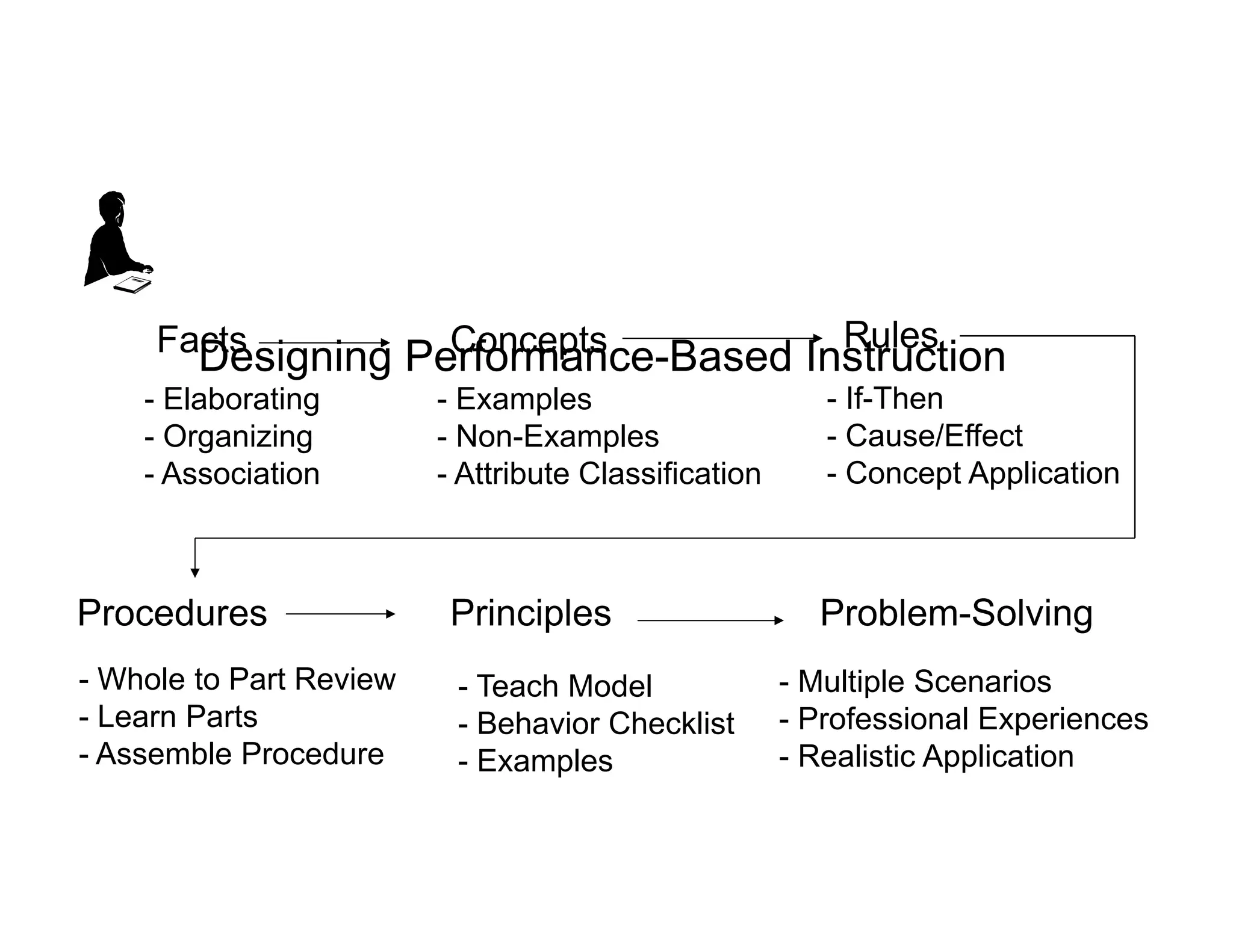
Designing Performance-Based InstructionFacts Concepts Rules
- Elaborating
- Organizing
- Association
- Examples
- Non-Examples
- Attribute Classification
- If-Then
- Cause/Effect
- Concept Application
Procedures Principles Problem-Solving
- Whole to Part Review
- Learn Parts
- Assemble Procedure
- Teach Model
- Behavior Checklist
- Examples
- Multiple Scenarios
- Professional Experiences
- Realistic Application
Facts
 Designing for Facts
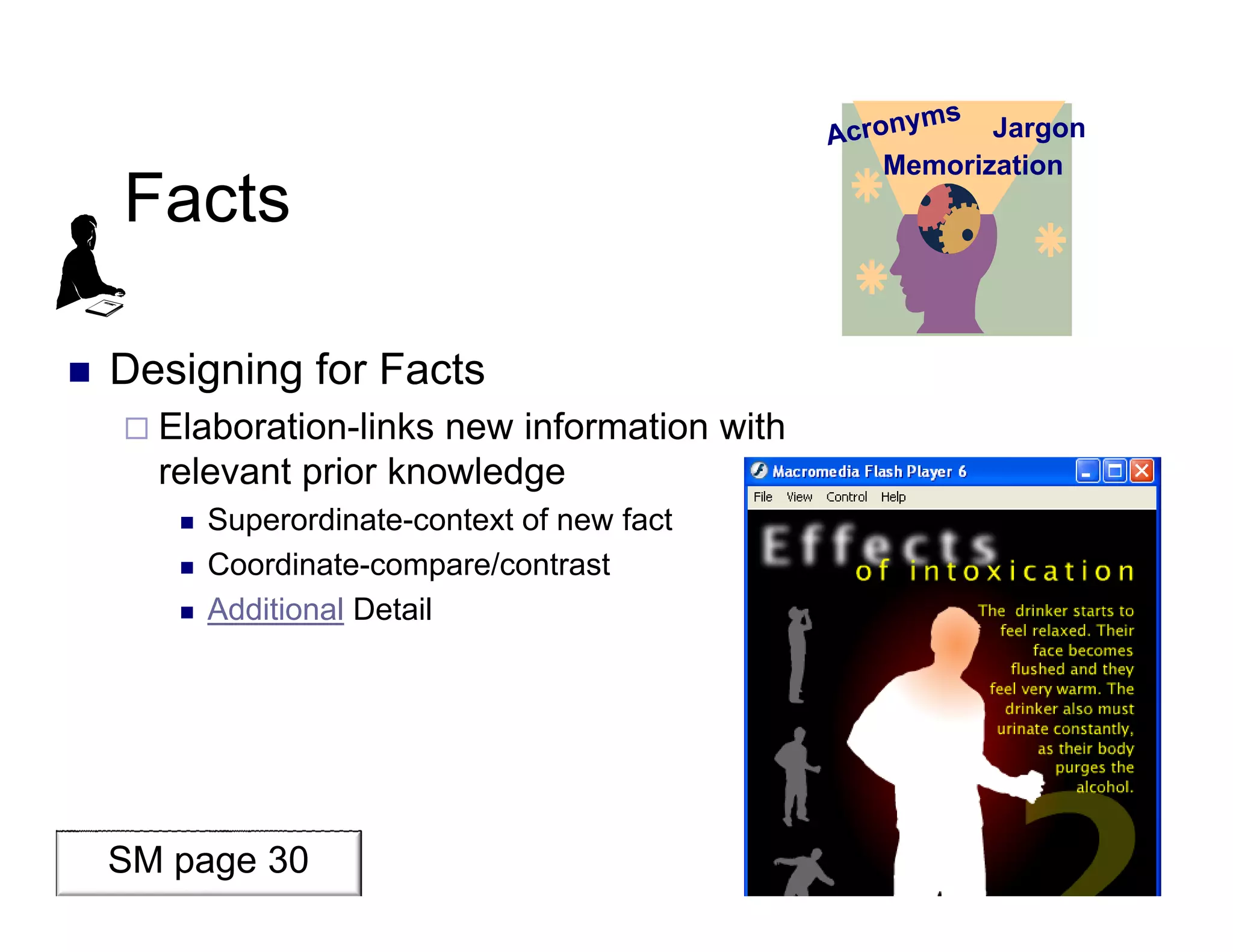
 Elaboration-links new information with
relevant prior knowledge
 Superordinate-context of new fact
 Coordinate-compare/contrast
 Additional Detail
Jargon
Memorization
SM page 30
Facts
 Designing for Facts
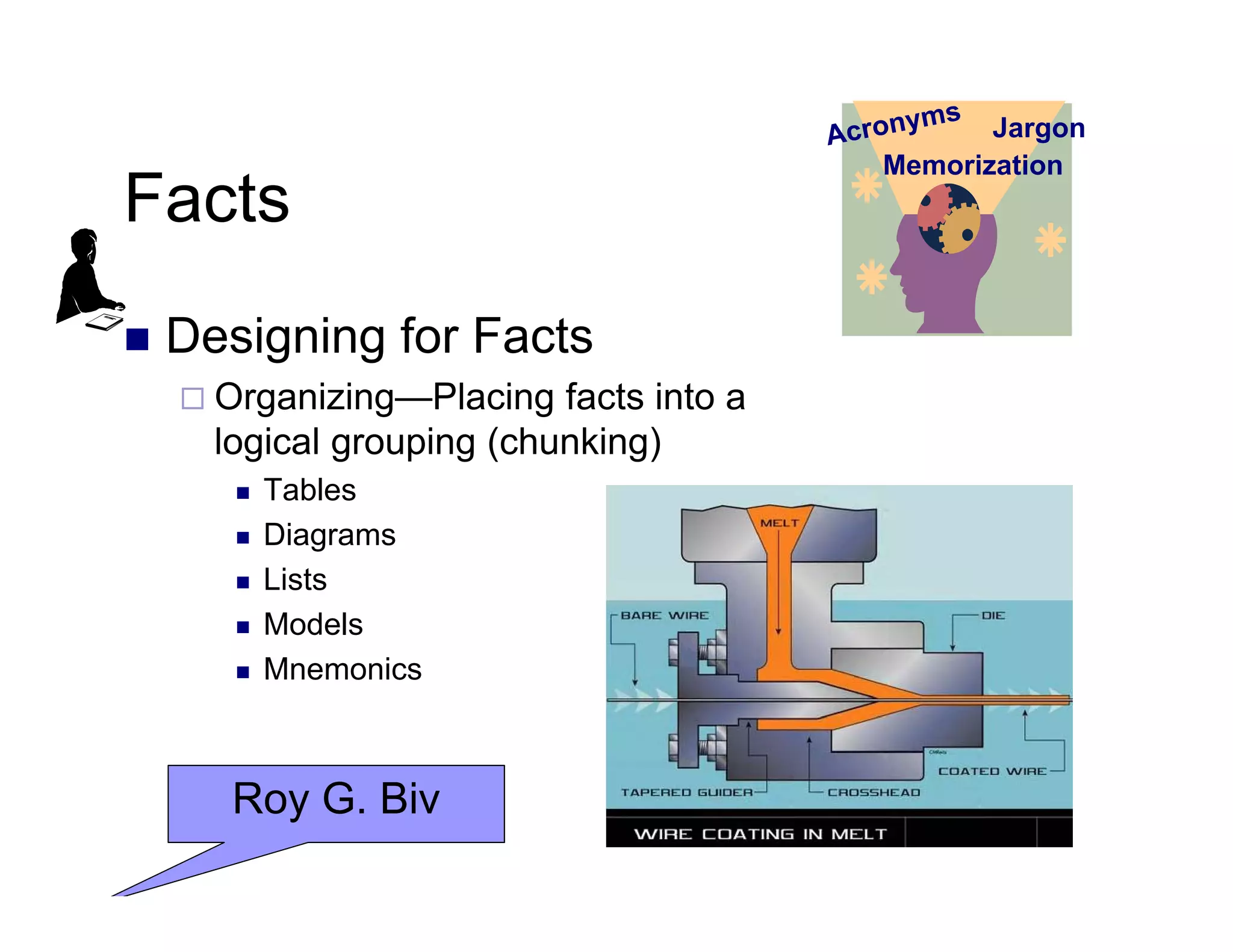
 Organizing—Placing facts into a
logical grouping (chunking)
 Tables
 Diagrams
 Lists
 Models
 Mnemonics
Jargon
Memorization
Roy G. Biv
Facts
 Designing for Facts
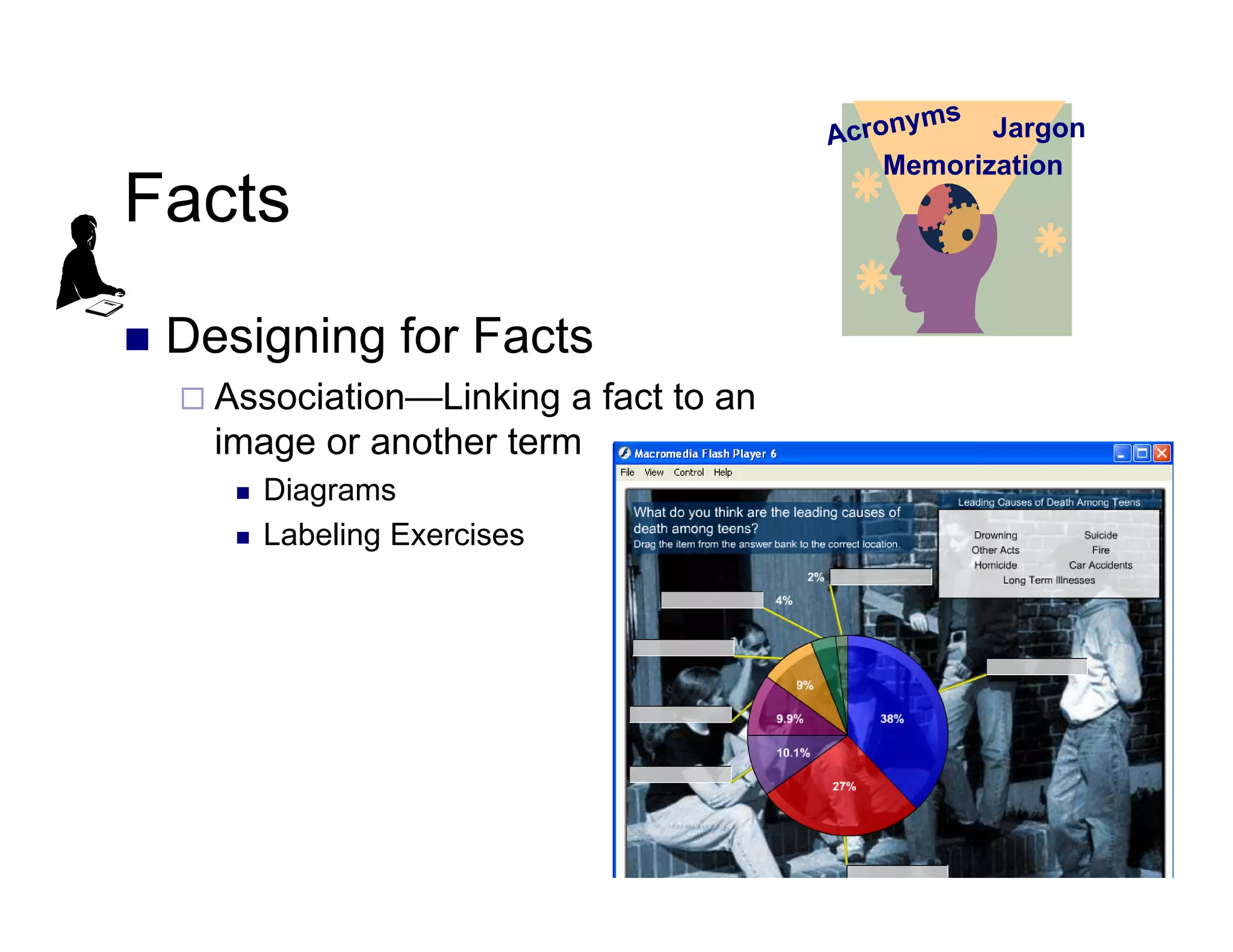
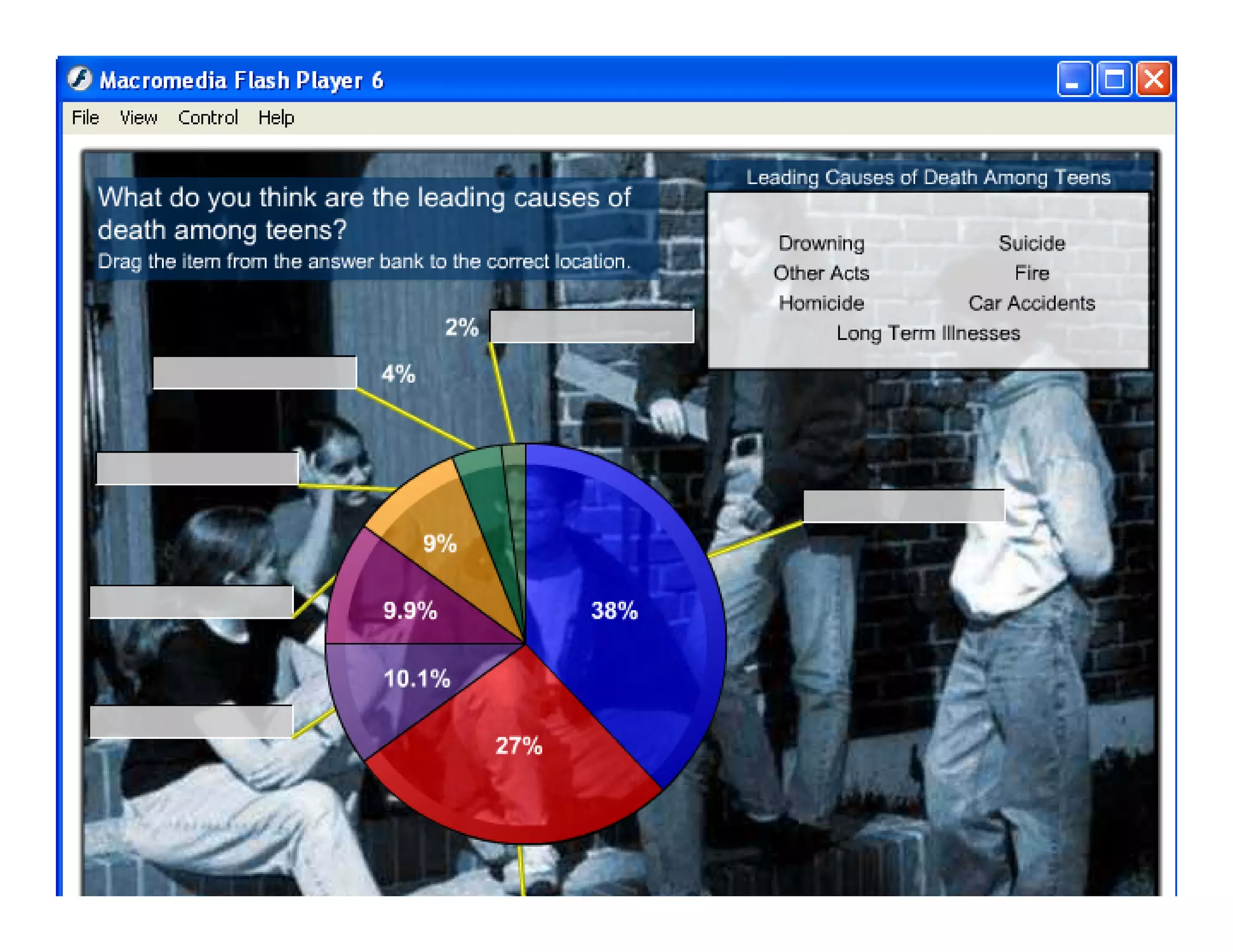
 Association—Linking a fact to an
image or another term
 Diagrams
 Labeling Exercises
Jargon
Memorization
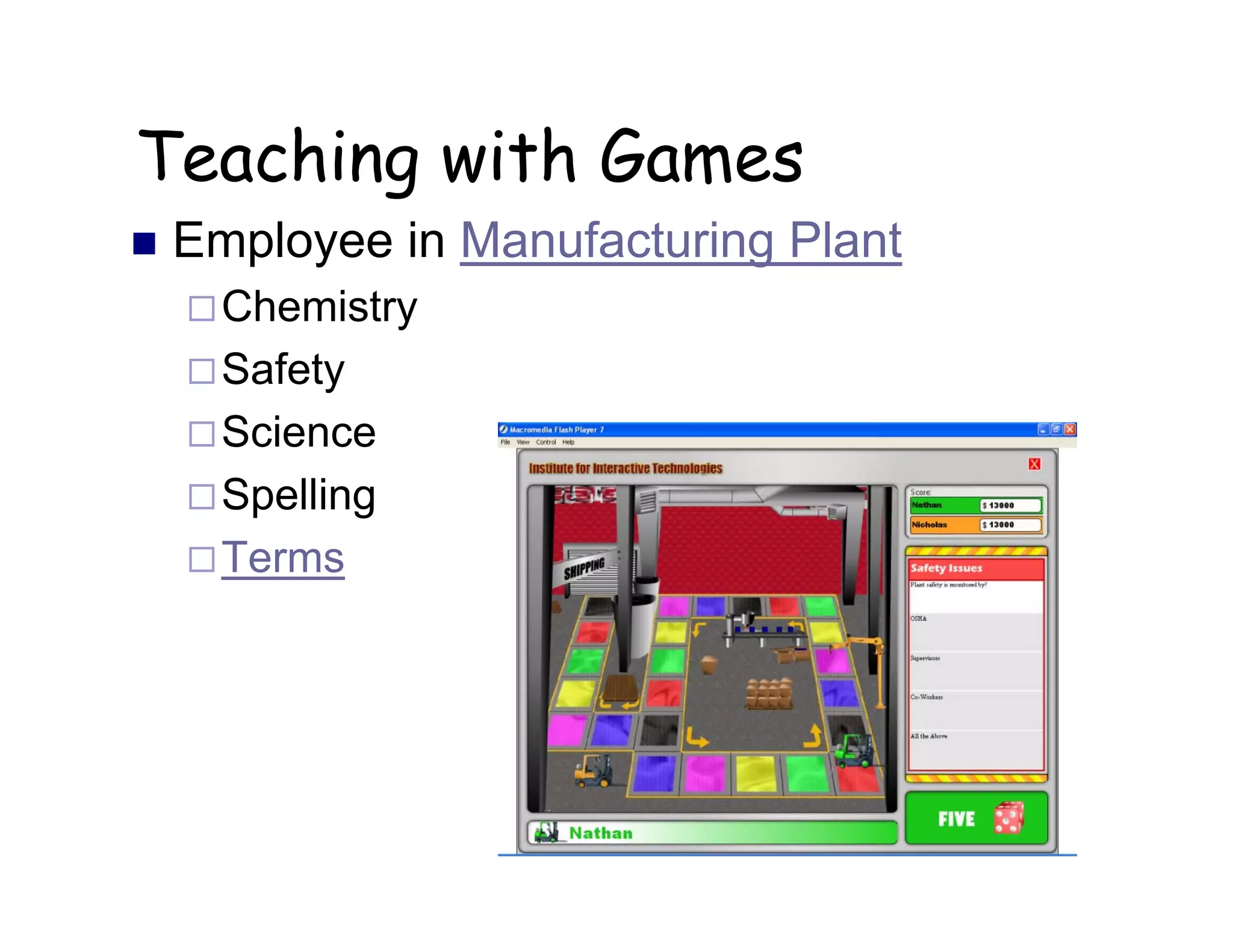
Teaching with Games
 Employee in Manufacturing Plant
Chemistry
Safety
Science
Spelling
Terms
http://www.kaplaneduneering.com/kappnotes/index.php/2007/05/accidental-learning-and-power-of/
Researchers have found that the
human brain has a natural affinity
for narrative construction.
Yep, people tend to remember facts
more accurately if they encounter
them in a story rather than in a list.
And they rate legal arguments as
more convincing when built into
narrative tales rather than on legal
precedent.
Fact Exercise
SM page 31
Concepts
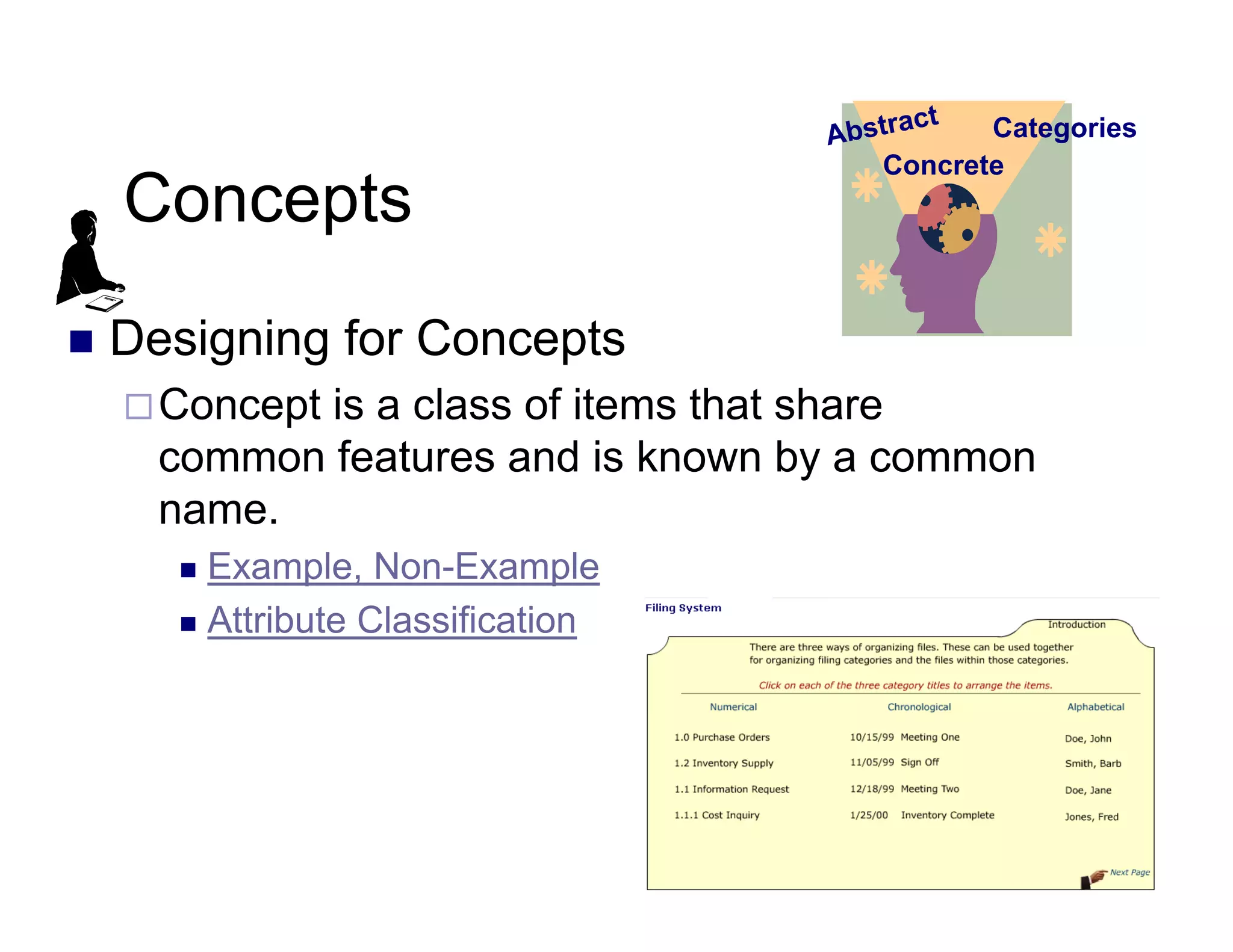
 Designing for Concepts
Concept is a class of items that share
common features and is known by a common
name.
 Example, Non-Example
 Attribute Classification
Categories
Concrete
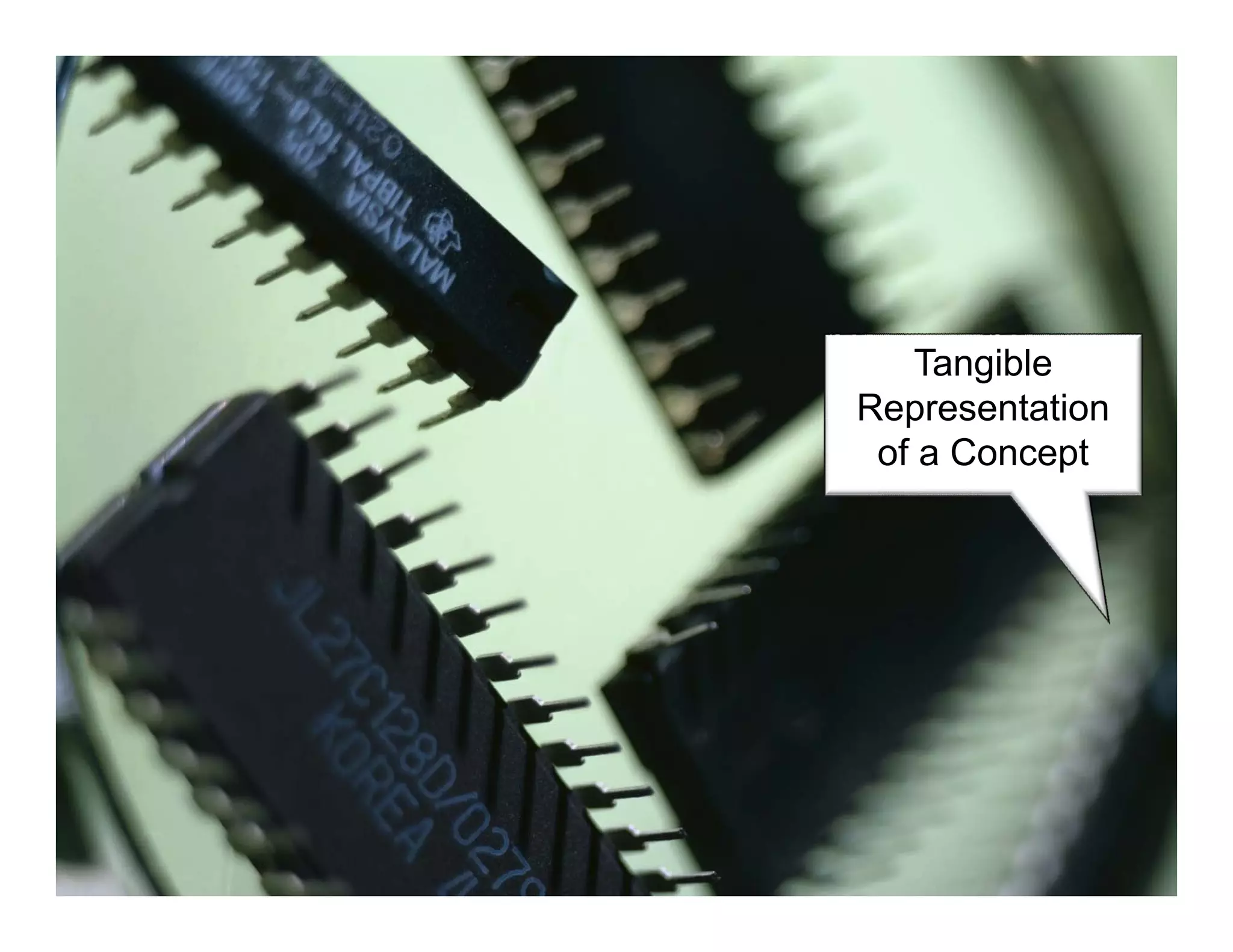
Tangible
Representation
of a Concept
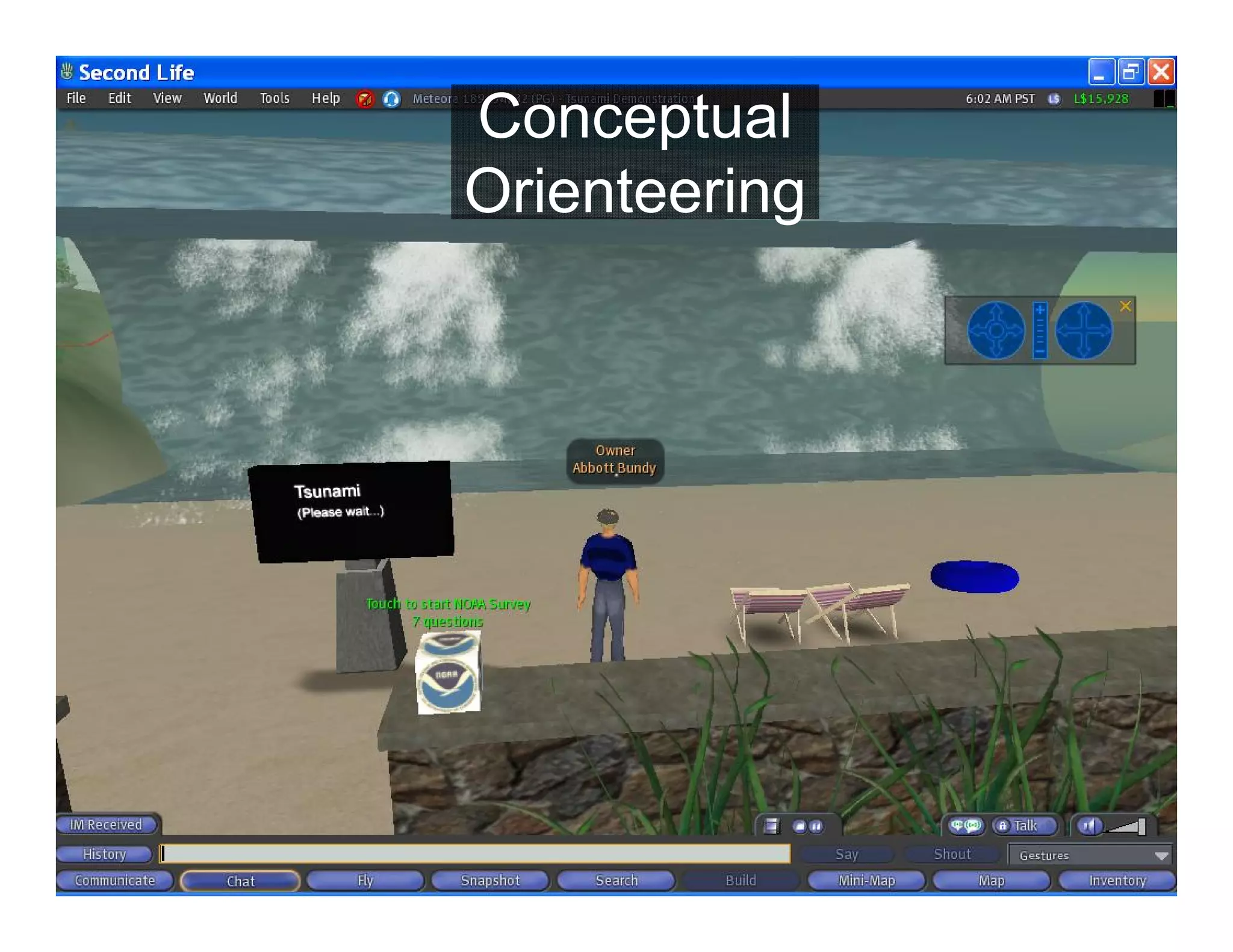
Conceptual
Orienteering
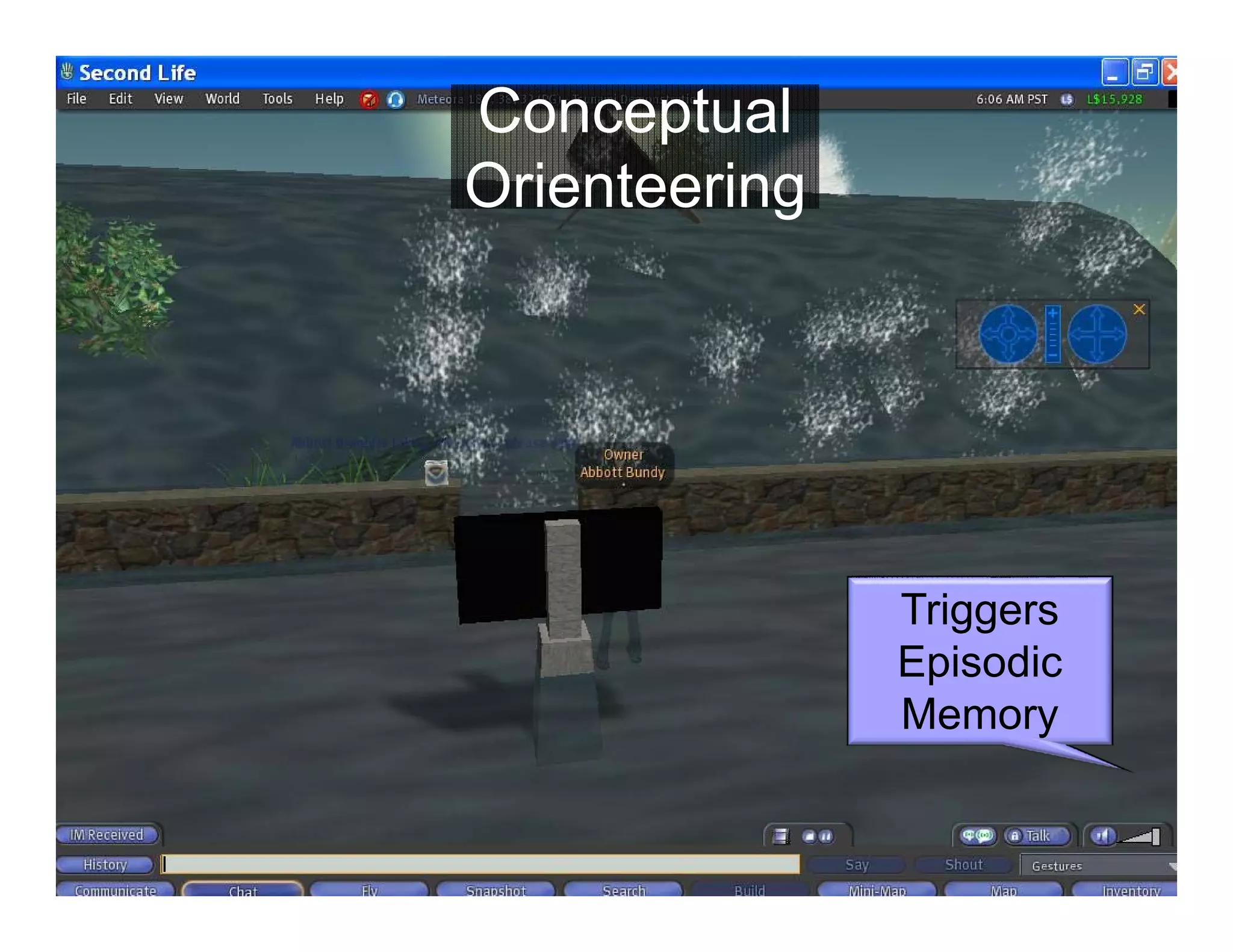
Conceptual
Orienteering
Triggers
Episodic
Memory
Concept Exercise
SM page 34
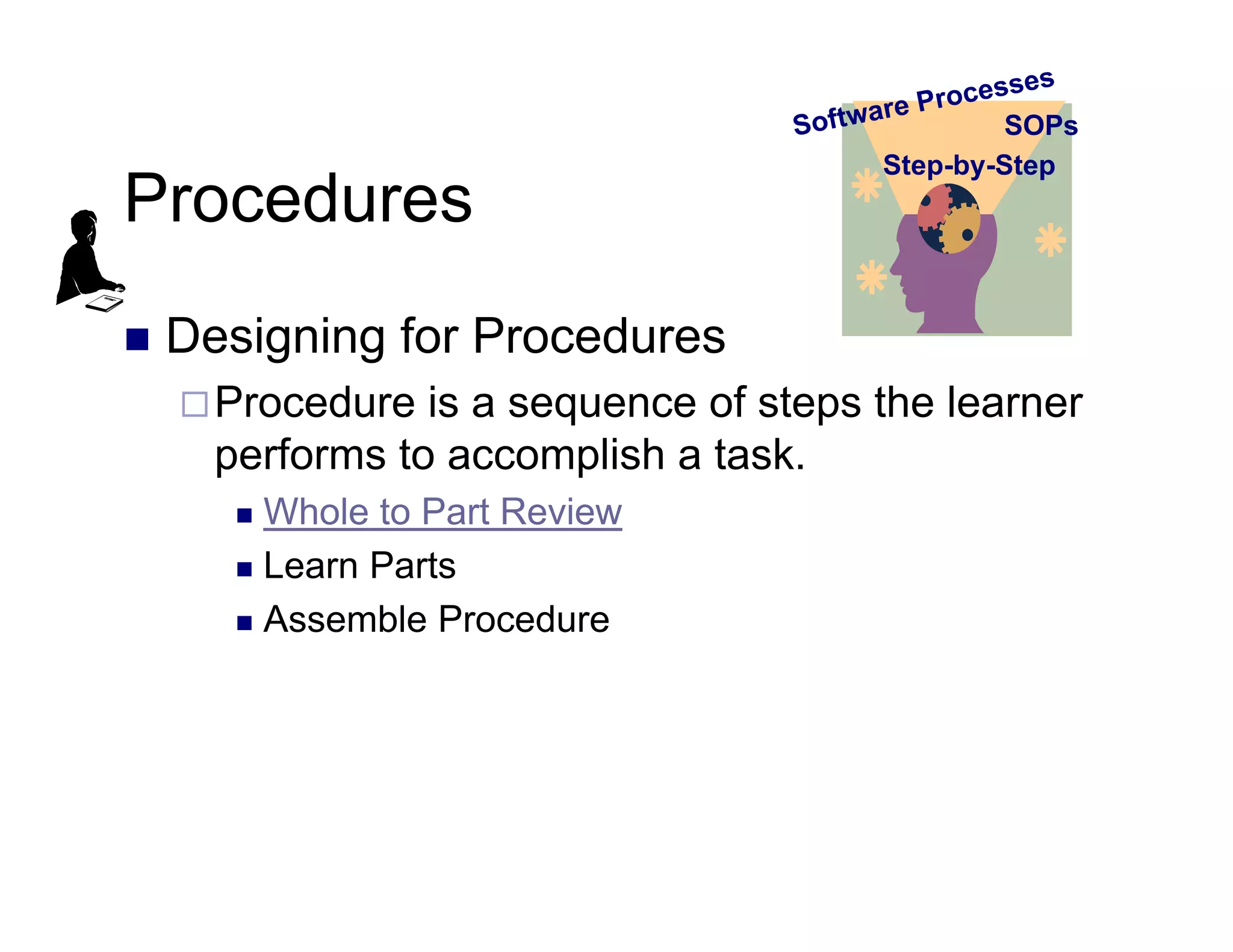
Procedures
 Designing for Procedures
Procedure is a sequence of steps the learner
performs to accomplish a task.
 Whole to Part Review
 Learn Parts
 Assemble Procedure
SOPs
Step-by-Step
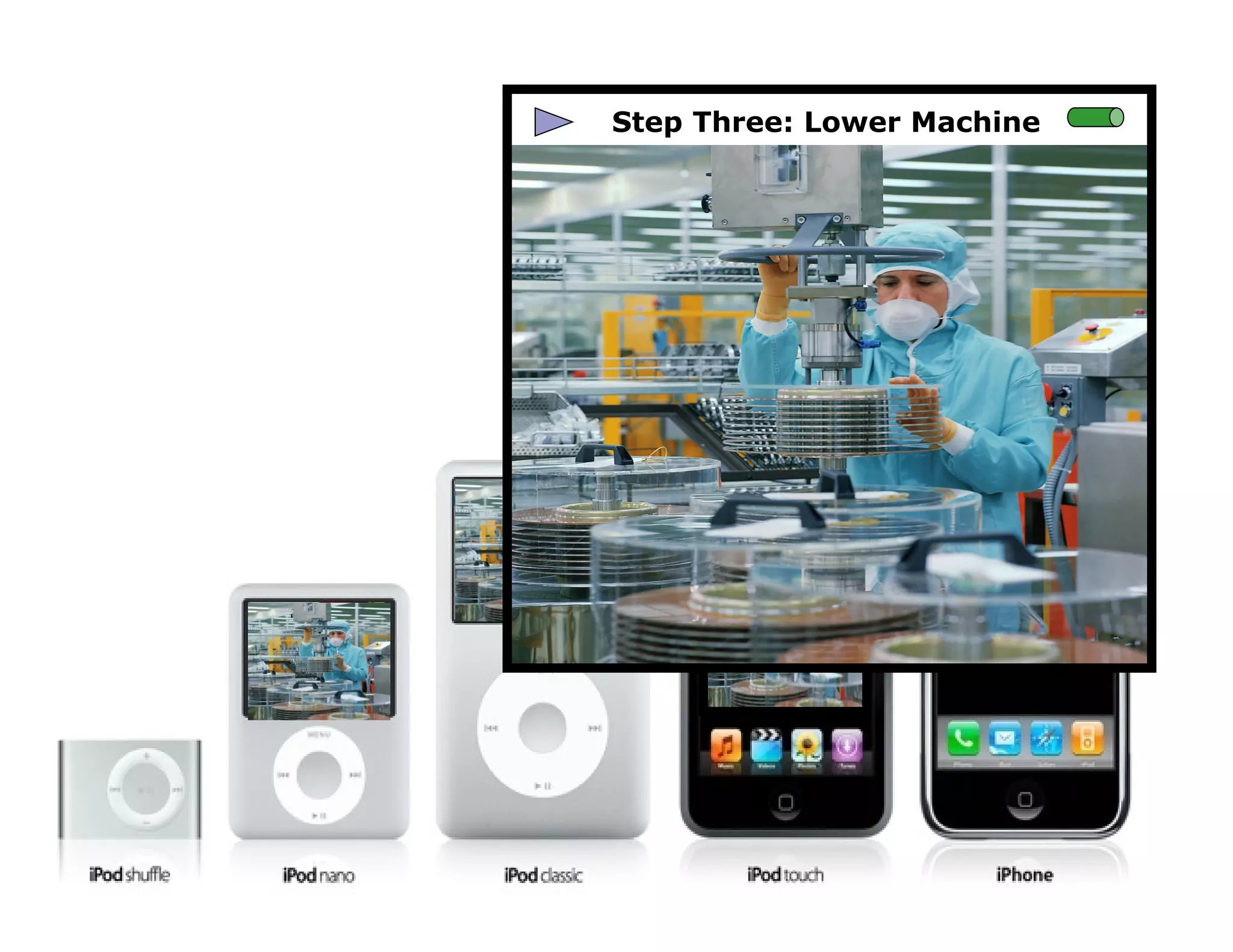
Step Three: Lower Machine
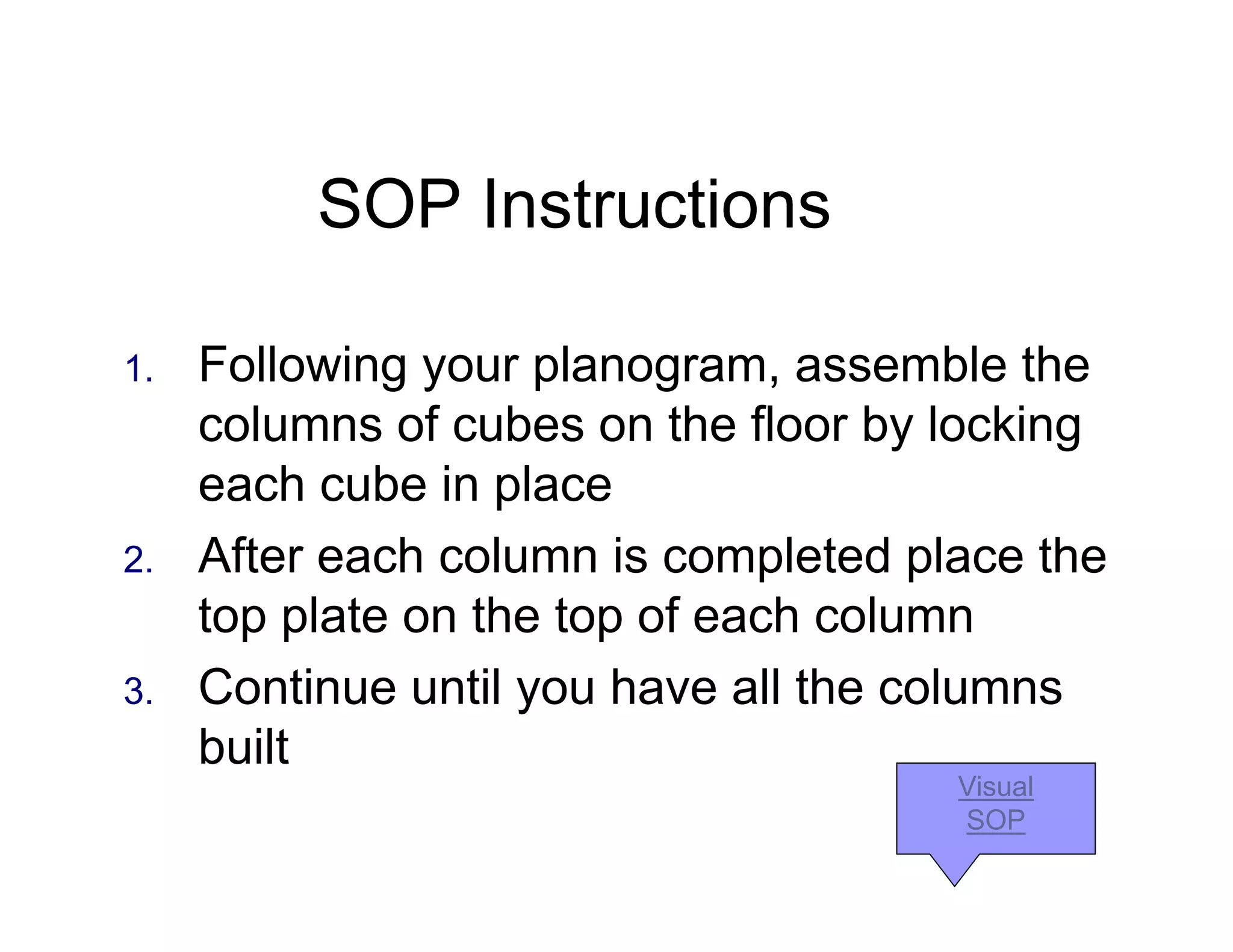
SOP Instructions
1. Following your planogram, assemble the
columns of cubes on the floor by locking
each cube in place
2. After each column is completed place the
top plate on the top of each column
3. Continue until you have all the columns
built
Visual
SOP
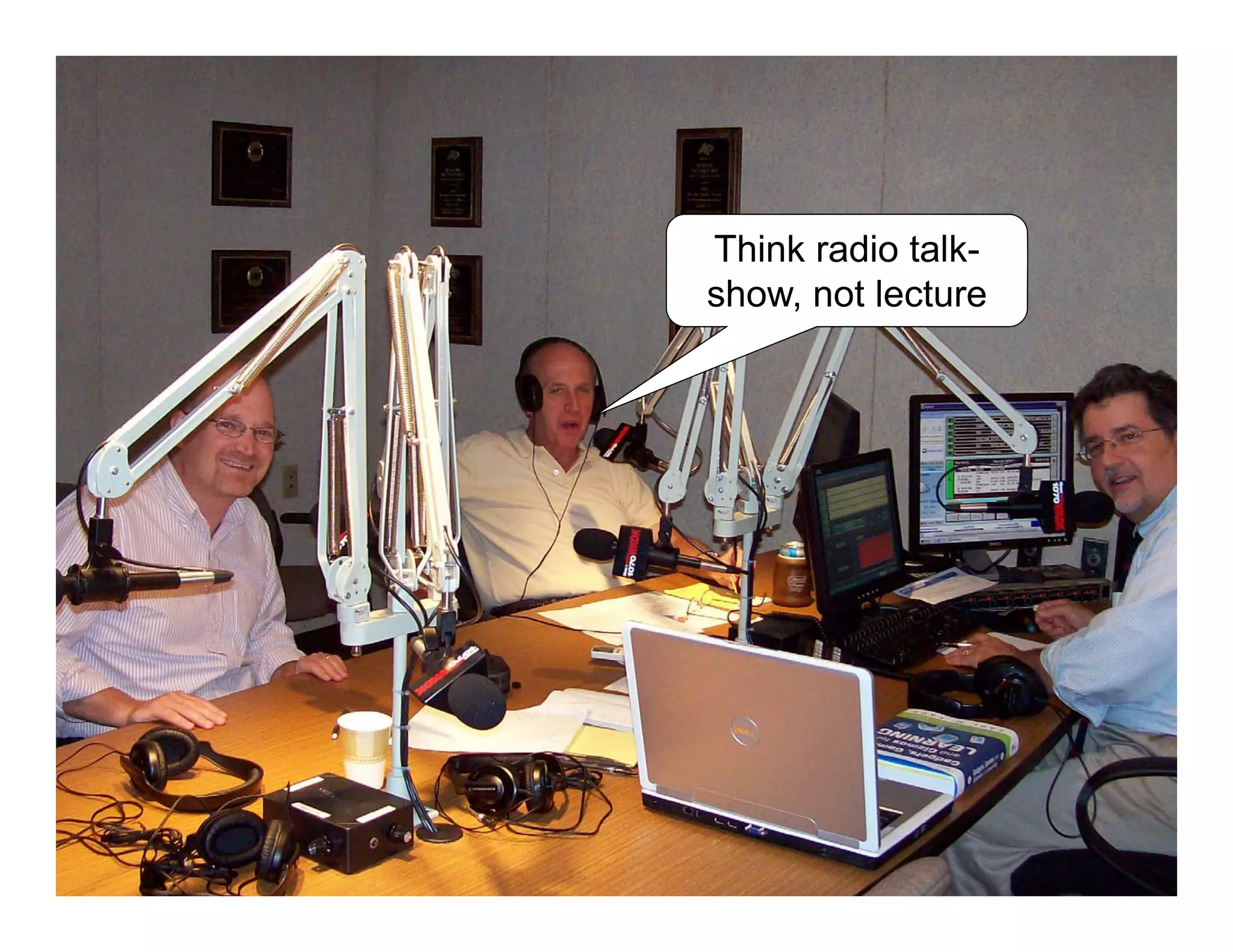
Think radio talk-
show, not lecture
www.gadgetsgamesandgizmos.com © Karl M. Kapp 2007
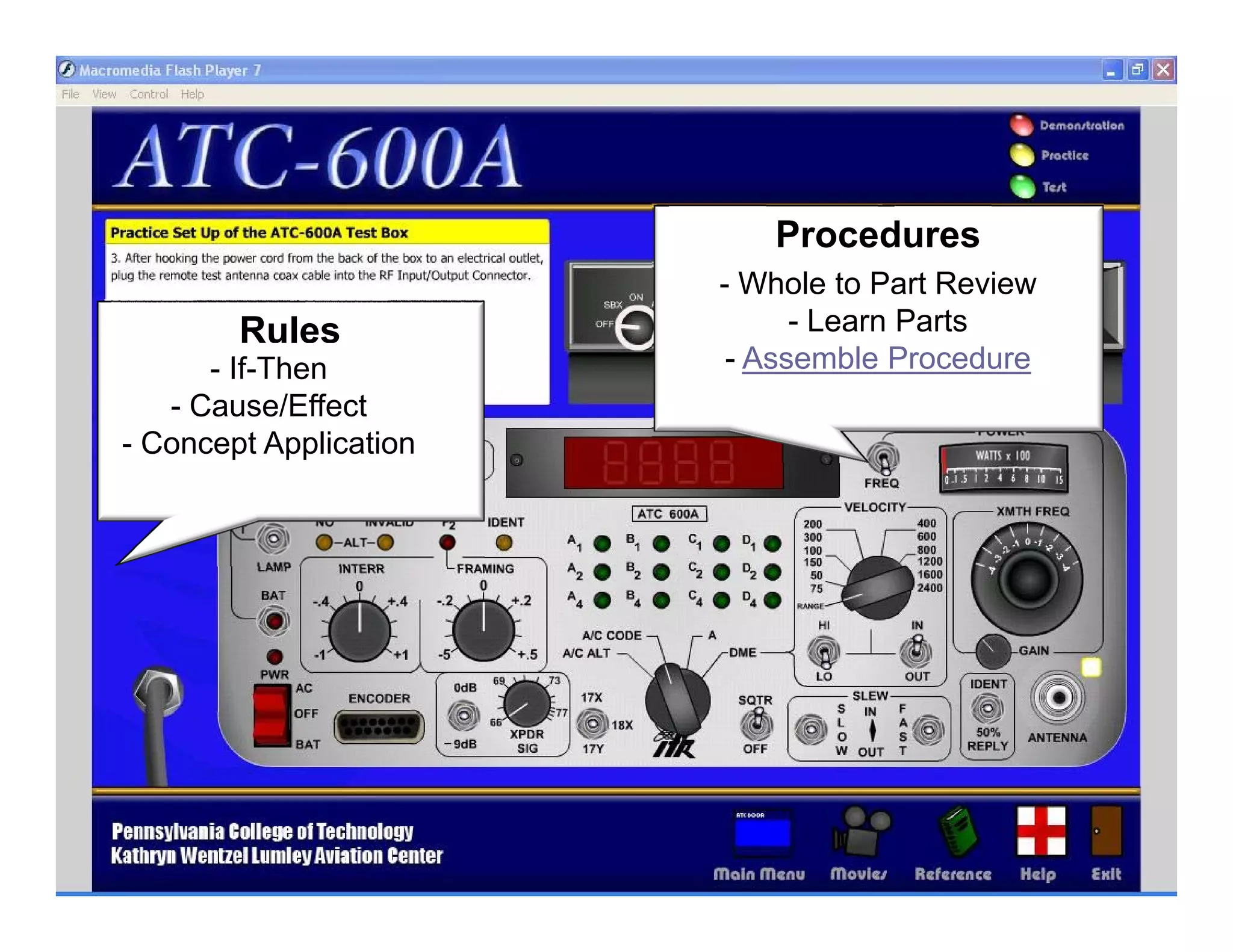
Rules
- If-Then
- Cause/Effect
- Concept Application
Procedures
- Whole to Part Review
- Learn Parts
- Assemble Procedure
Create Youtube
Moments.
Procedure Exercise
SM page 36
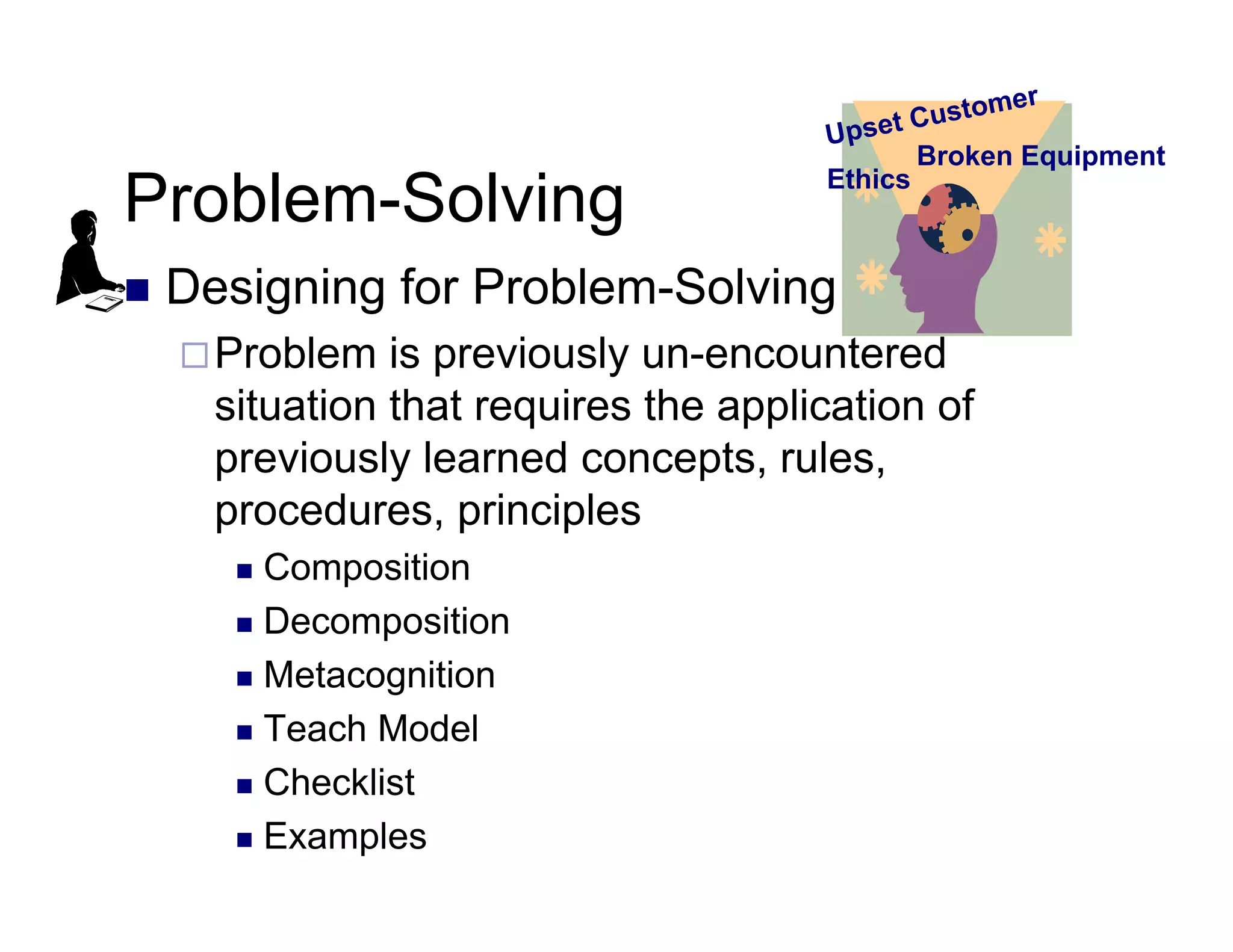
Problem-Solving
 Designing for Problem-Solving
Problem is previously un-encountered
situation that requires the application of
previously learned concepts, rules,
procedures, principles
 Composition
 Decomposition
 Metacognition
 Teach Model
 Checklist
 Examples
Ethics
Broken Equipment
Consider using
the “En Media
Res” technique
Problem-Based Learning
www.gadgetsgamesandgizmos.com
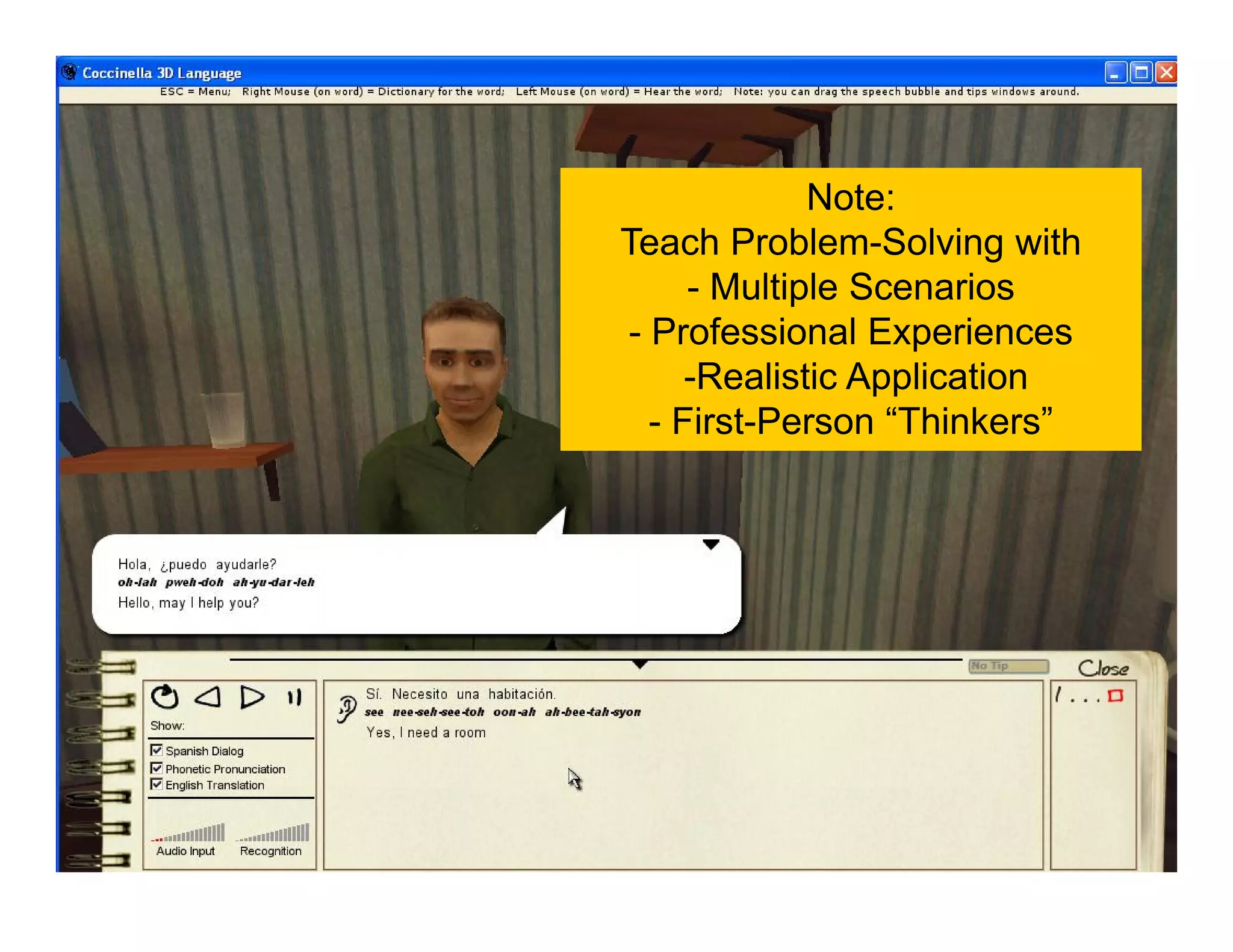
Note:
Teach Problem-Solving with
- Multiple Scenarios
- Professional Experiences
-Realistic Application
- First-Person “Thinkers”
Note:
Teach Problem-Solving with
- Multiple Scenarios
- Professional Experiences
-Realistic Application
- First-Person “Thinkers”
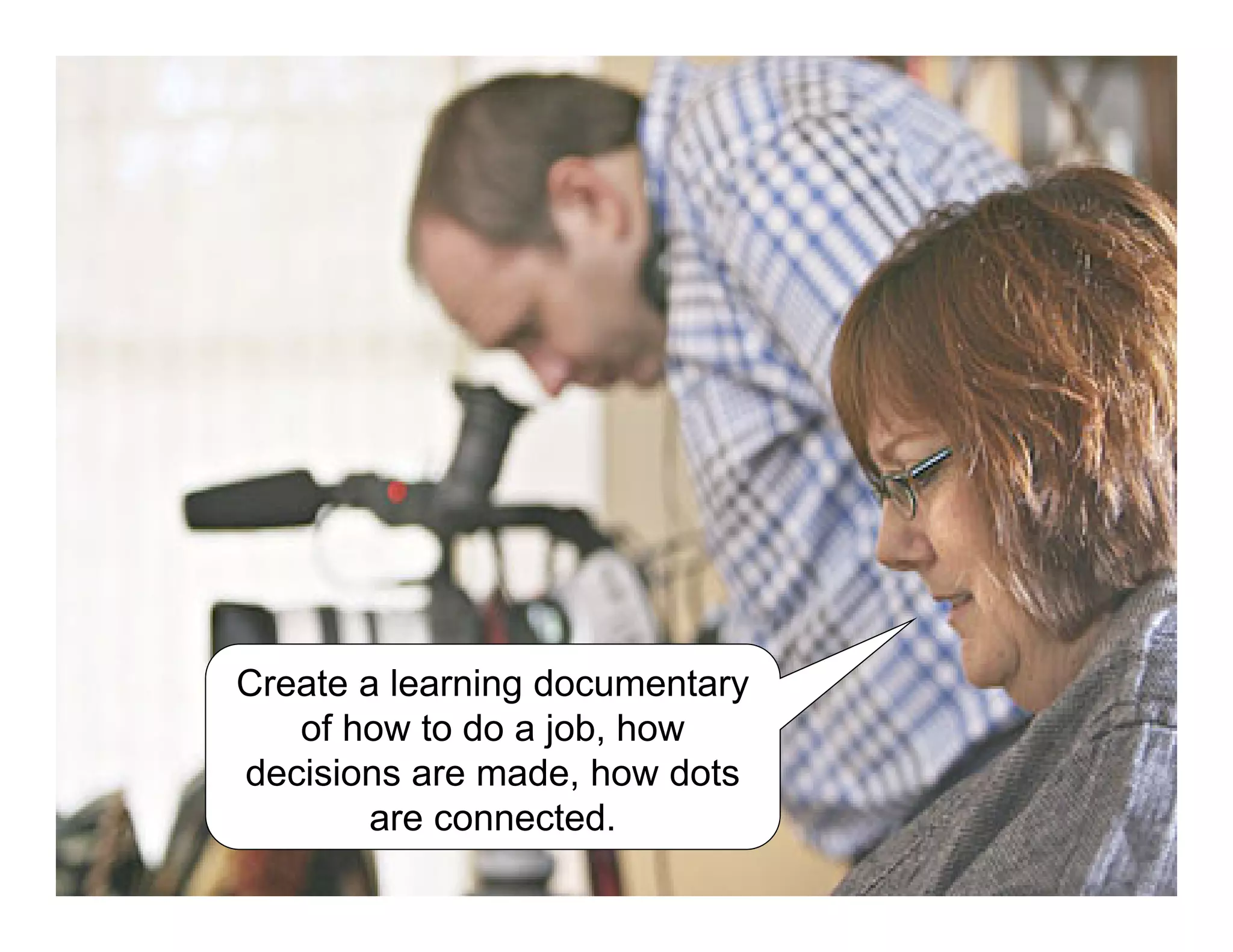
Create a learning documentary
of how to do a job, how
decisions are made, how dots
are connected.
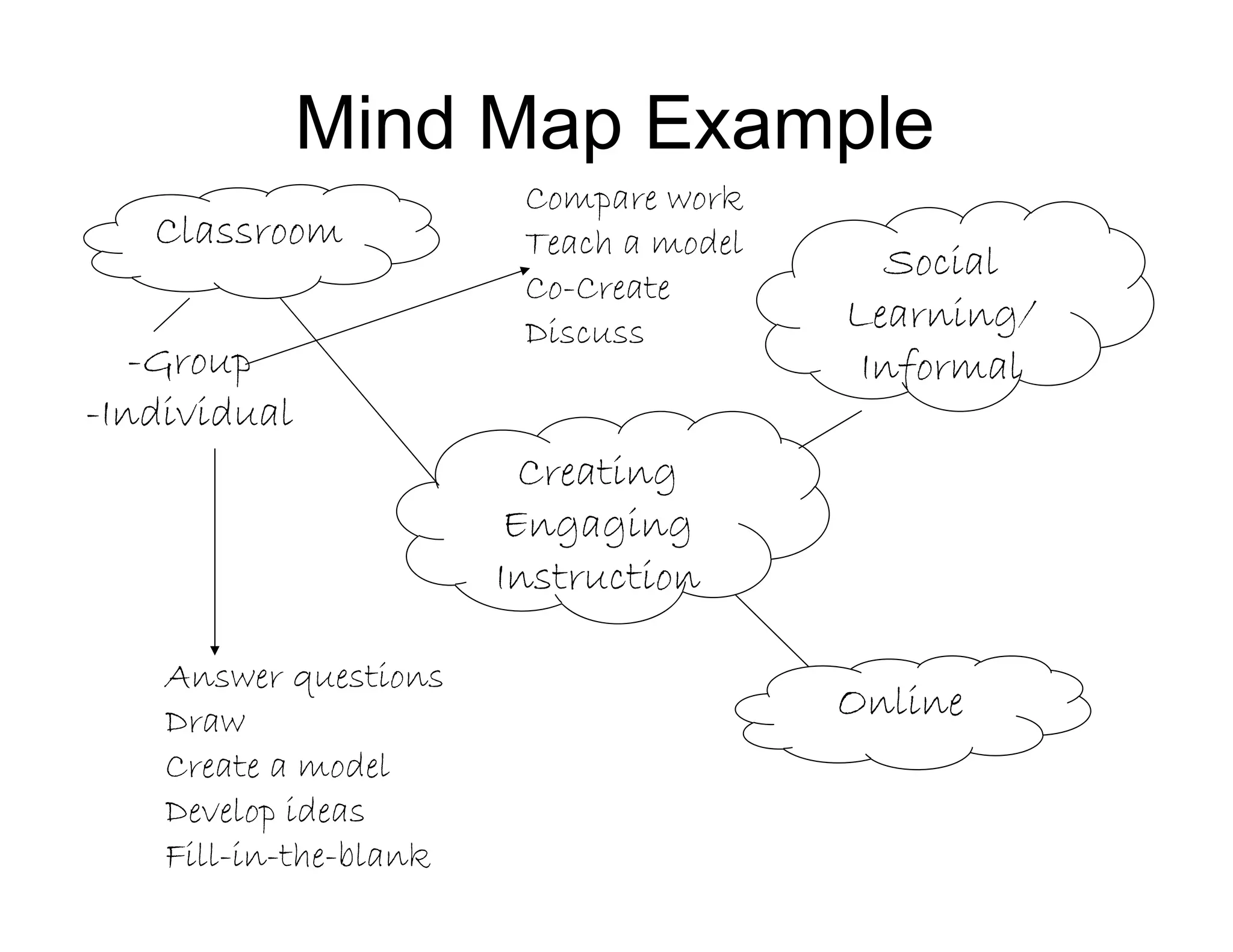
Creating
Engaging
Instruction
Classroom
-Group
-Individual
Compare work
Teach a model
Co-Create
Discuss
Answer questions
Draw
Create a model
Develop ideas
Fill-in-the-blank
Online
Mind Map Example
Social
Learning/
Informal
Problem Solving Exercise
SM page 39
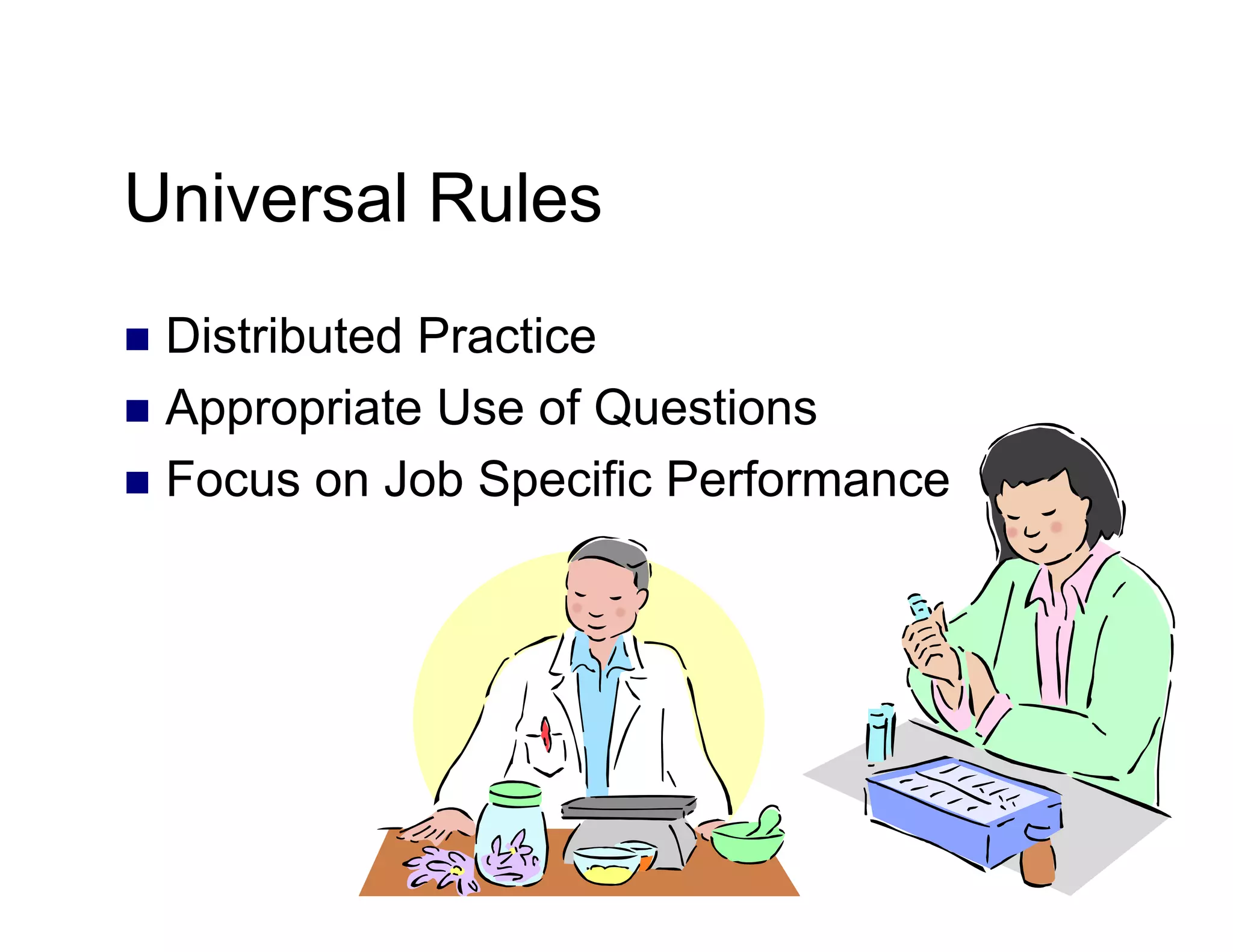
Universal Rules
 Distributed Practice
 Appropriate Use of Questions
 Focus on Job Specific Performance
Say Dadda
What are you thinking?
What are your choices?
Where else does this apply?
What are the underlying concepts?
What mistakes need to be avoided?
Metacognition
10 Things We Know about Games
for Learning From Research
SM page 42
10. Games Can Influence
People to Behave in a Pro-
social Manner.
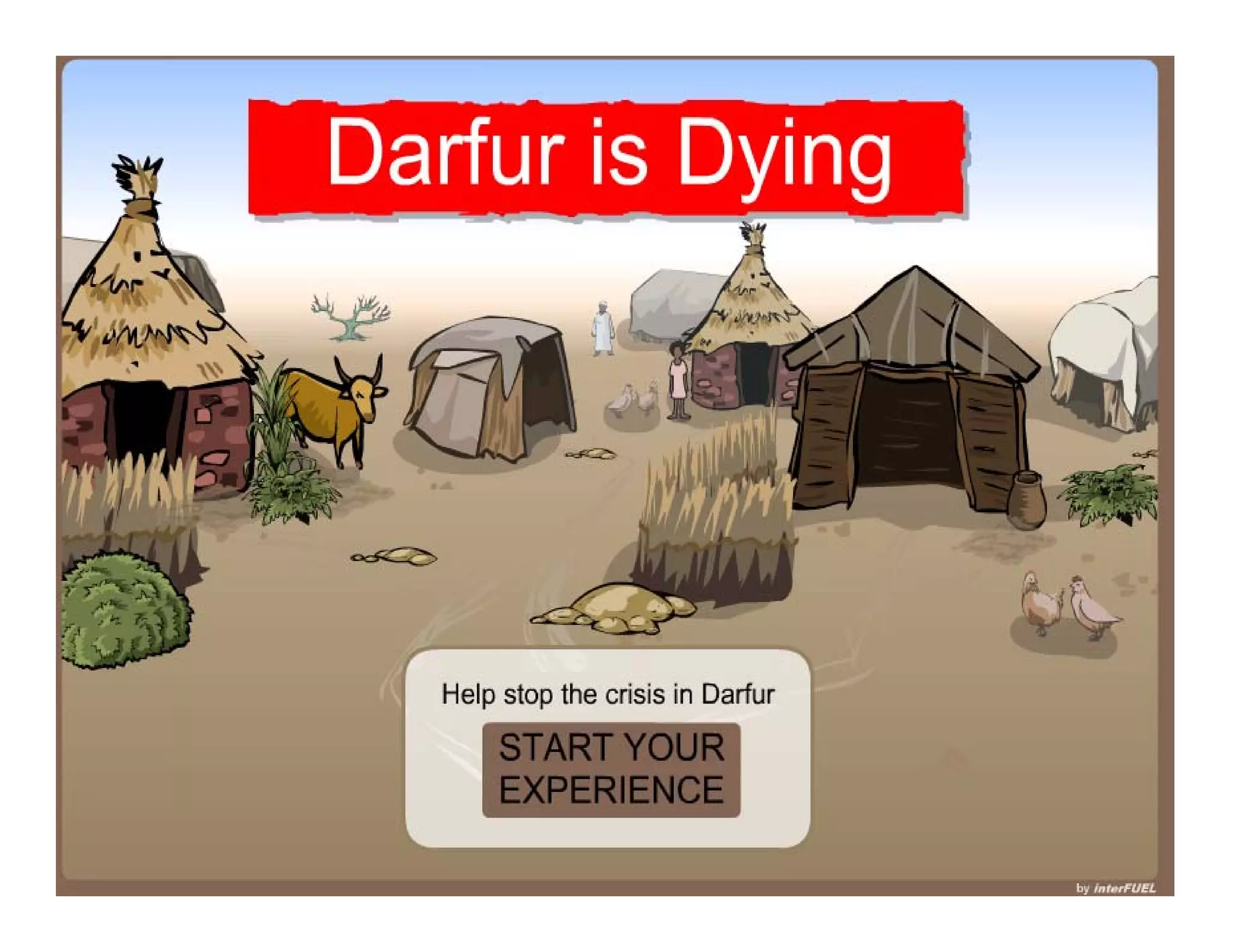
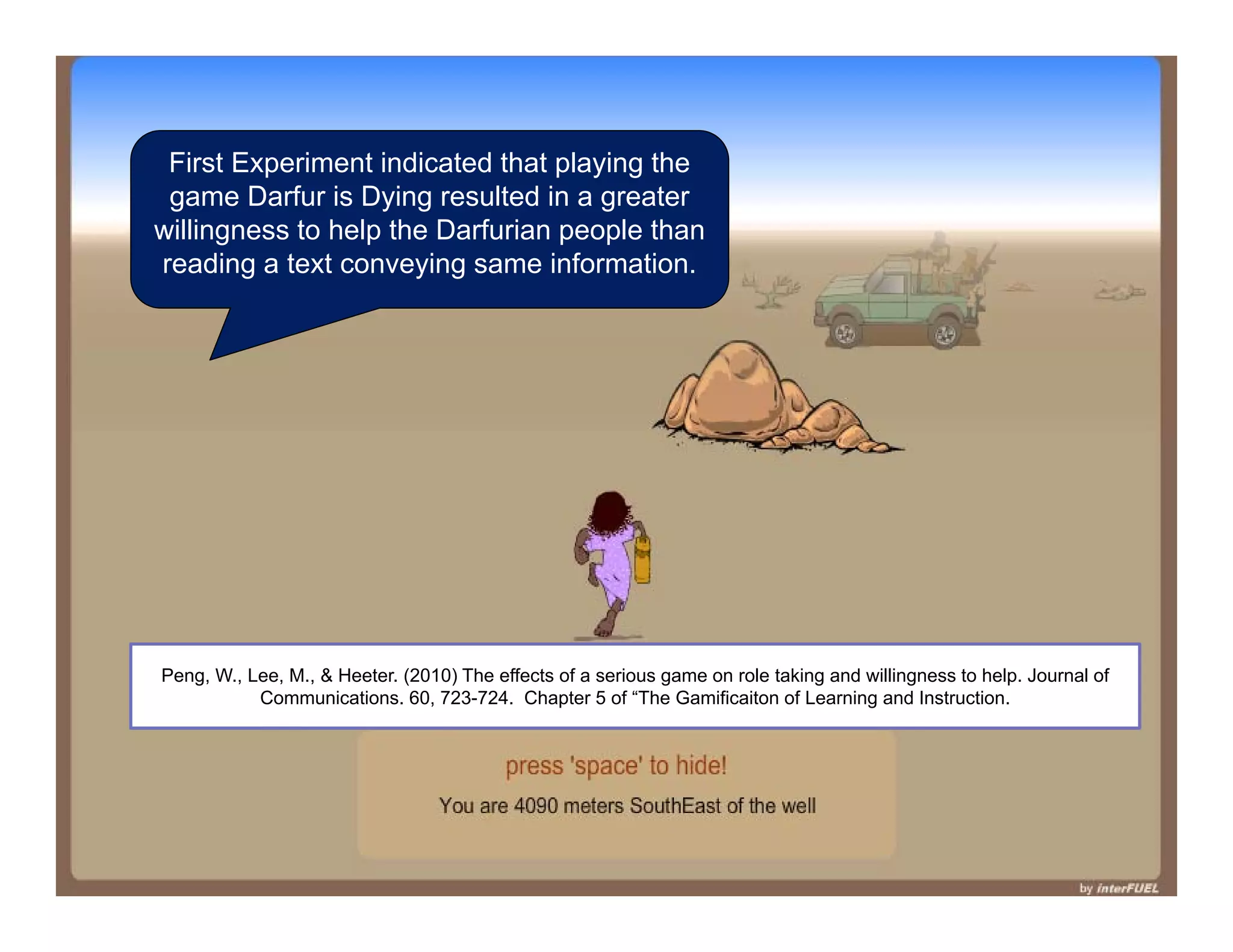
First Experiment indicated that playing the
game Darfur is Dying resulted in a greater
willingness to help the Darfurian people than
reading a text conveying same information.
Peng, W., Lee, M., & Heeter. (2010) The effects of a serious game on role taking and willingness to help. Journal of
Communications. 60, 723-724. Chapter 5 of “The Gamificaiton of Learning and Instruction.
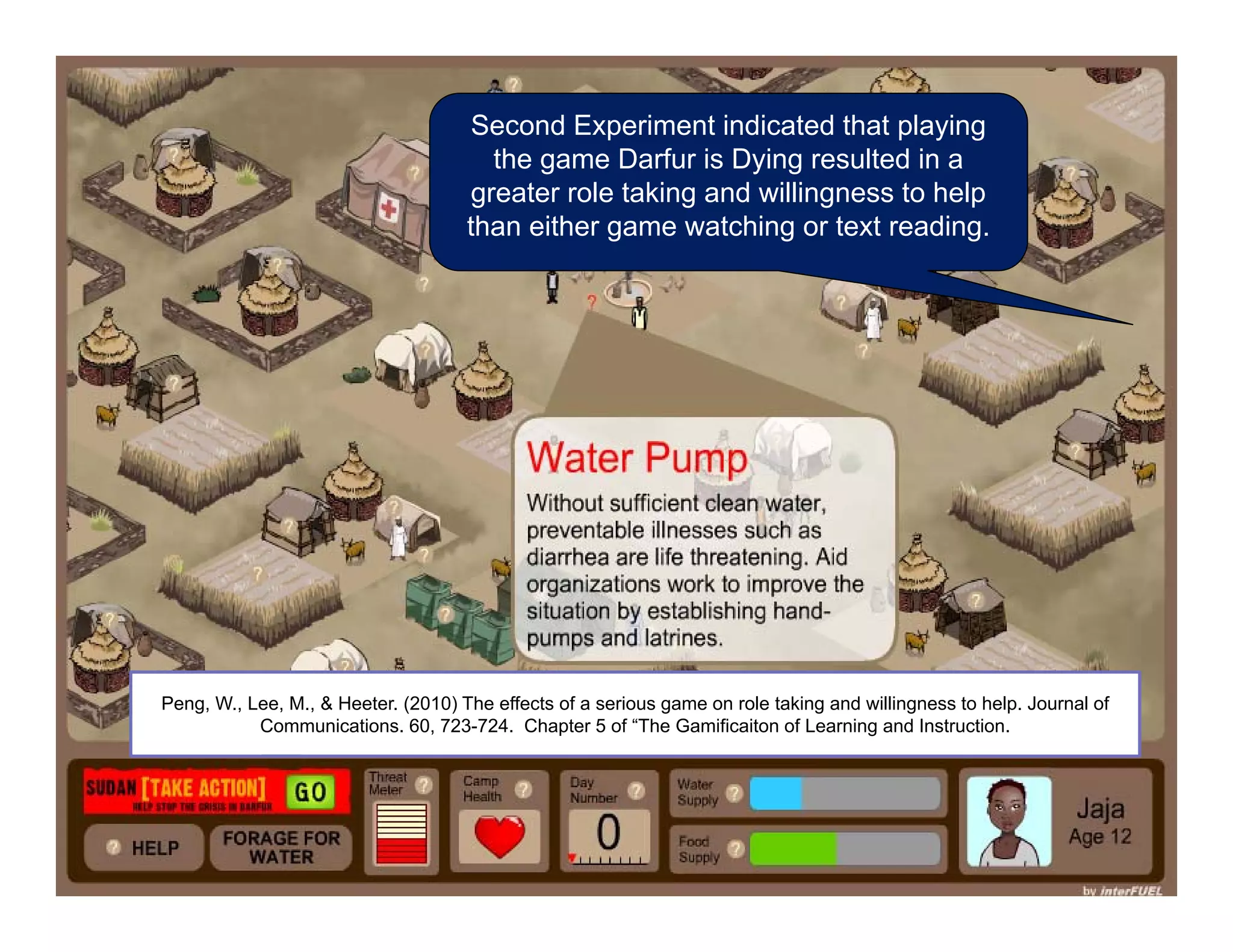
Second Experiment indicated that playing
the game Darfur is Dying resulted in a
greater role taking and willingness to help
than either game watching or text reading.
Peng, W., Lee, M., & Heeter. (2010) The effects of a serious game on role taking and willingness to help. Journal of
Communications. 60, 723-724. Chapter 5 of “The Gamificaiton of Learning and Instruction.
Rosenberg, R.S. Baughman, S.L., Bailenson, J.N. (2013) Virtual Superheroes: 
Using Superpowers in Virtual Reality to Encourage Prosocial Behavior. PLOS One., 8(1), 1‐9.
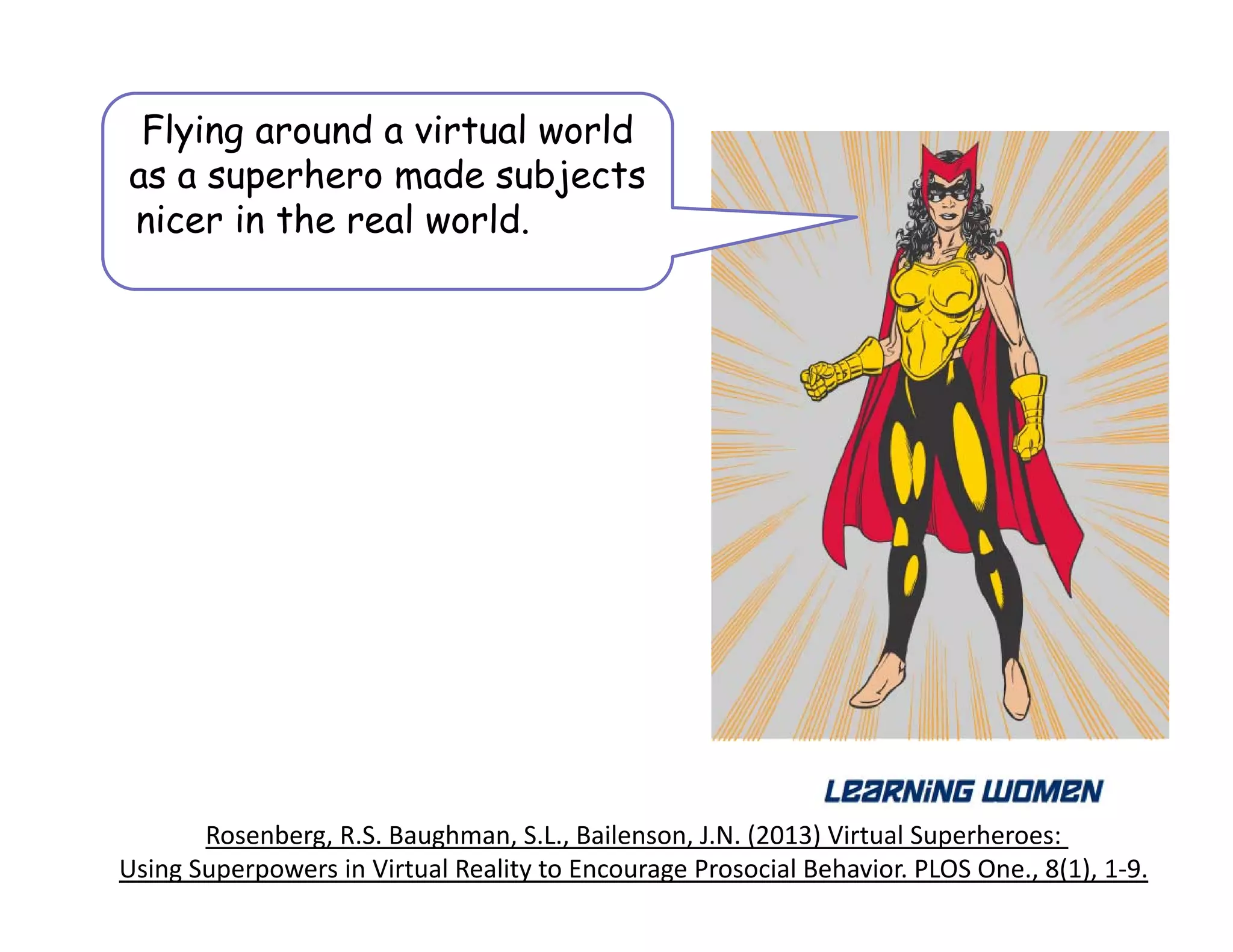
Flying around a virtual world
as a superhero made subjects
nicer in the real world. physical
world
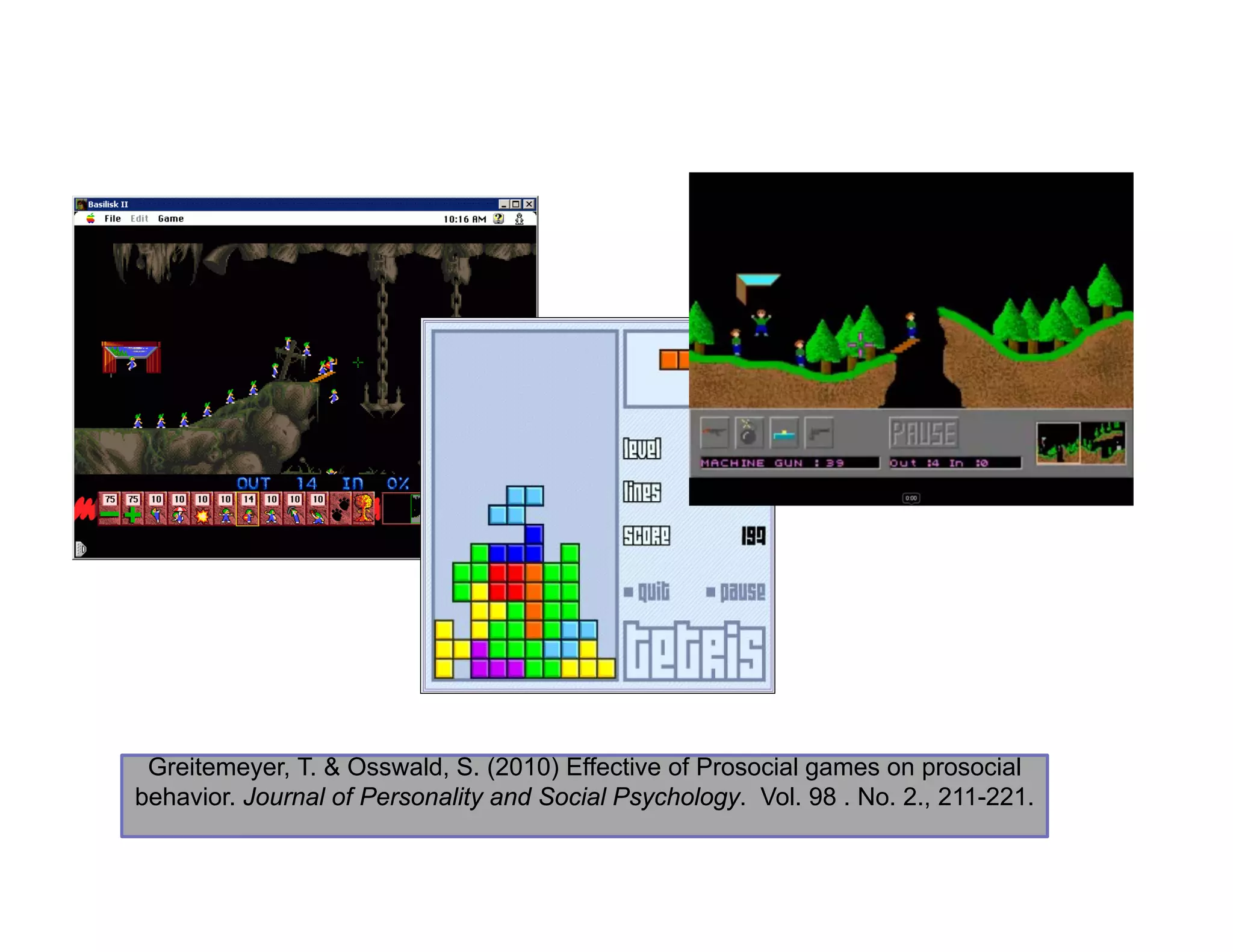
Greitemeyer, T. & Osswald, S. (2010) Effective of Prosocial games on prosocial
behavior. Journal of Personality and Social Psychology. Vol. 98 . No. 2., 211-221.
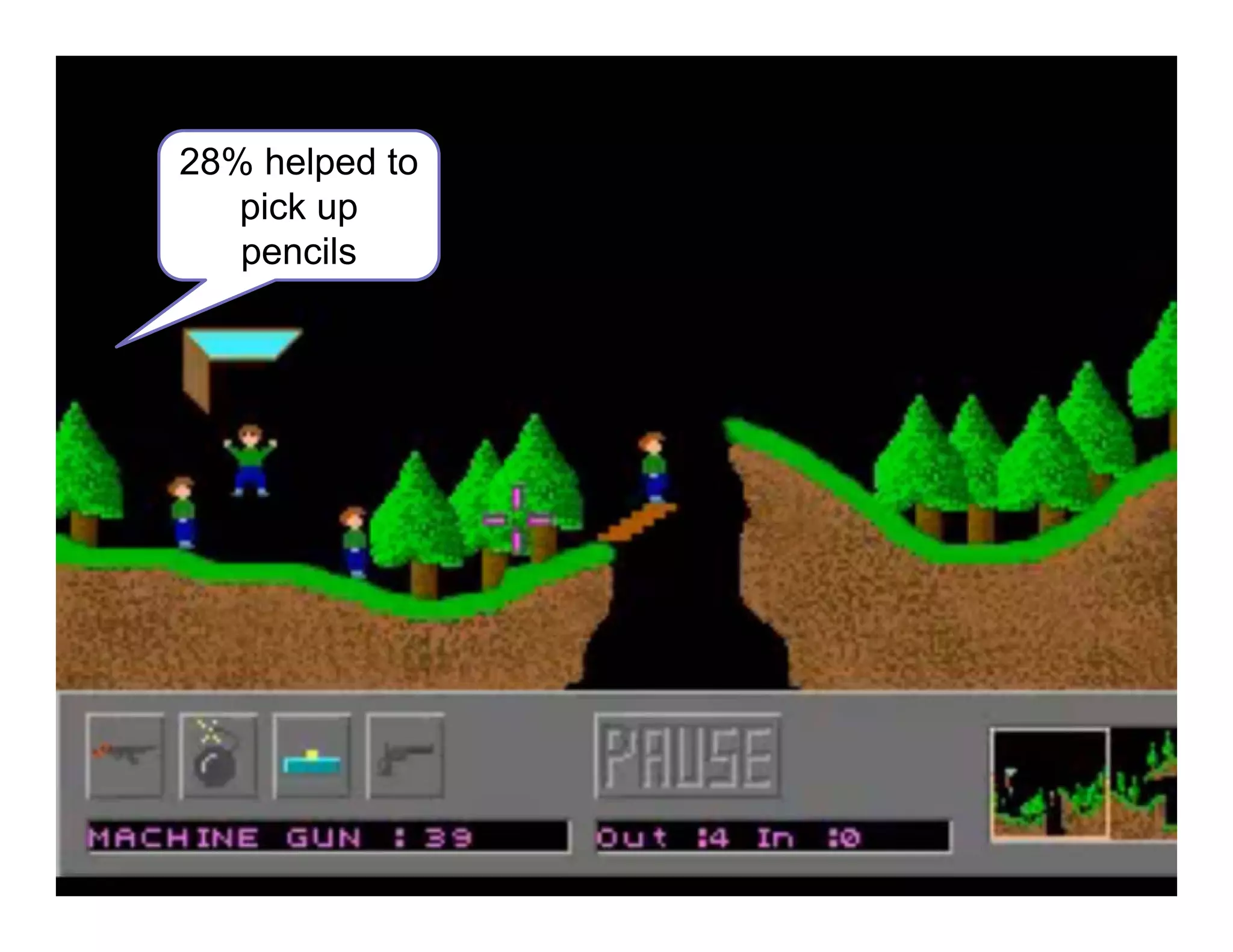
28% helped to
pick up
pencils
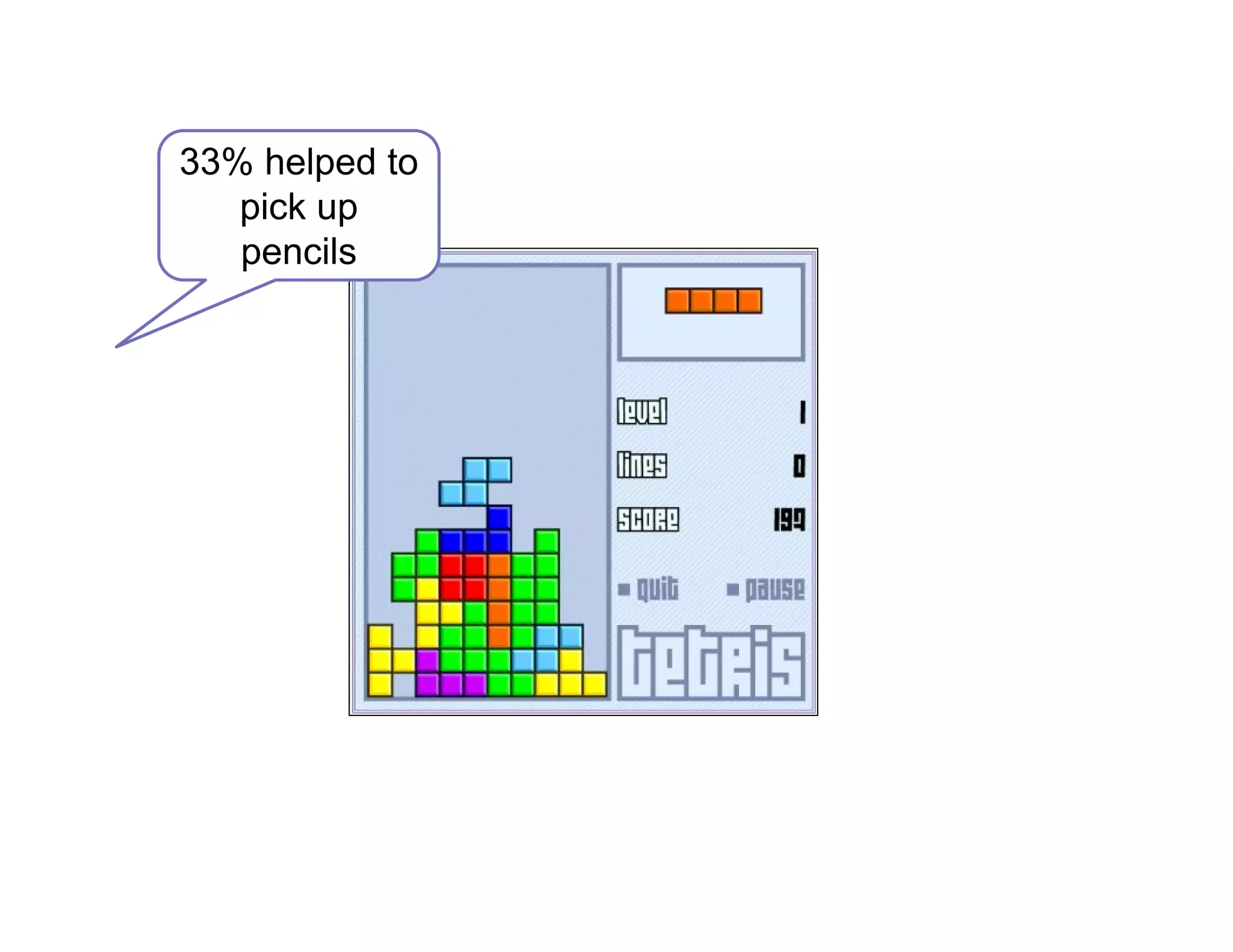
33% helped to
pick up
pencils
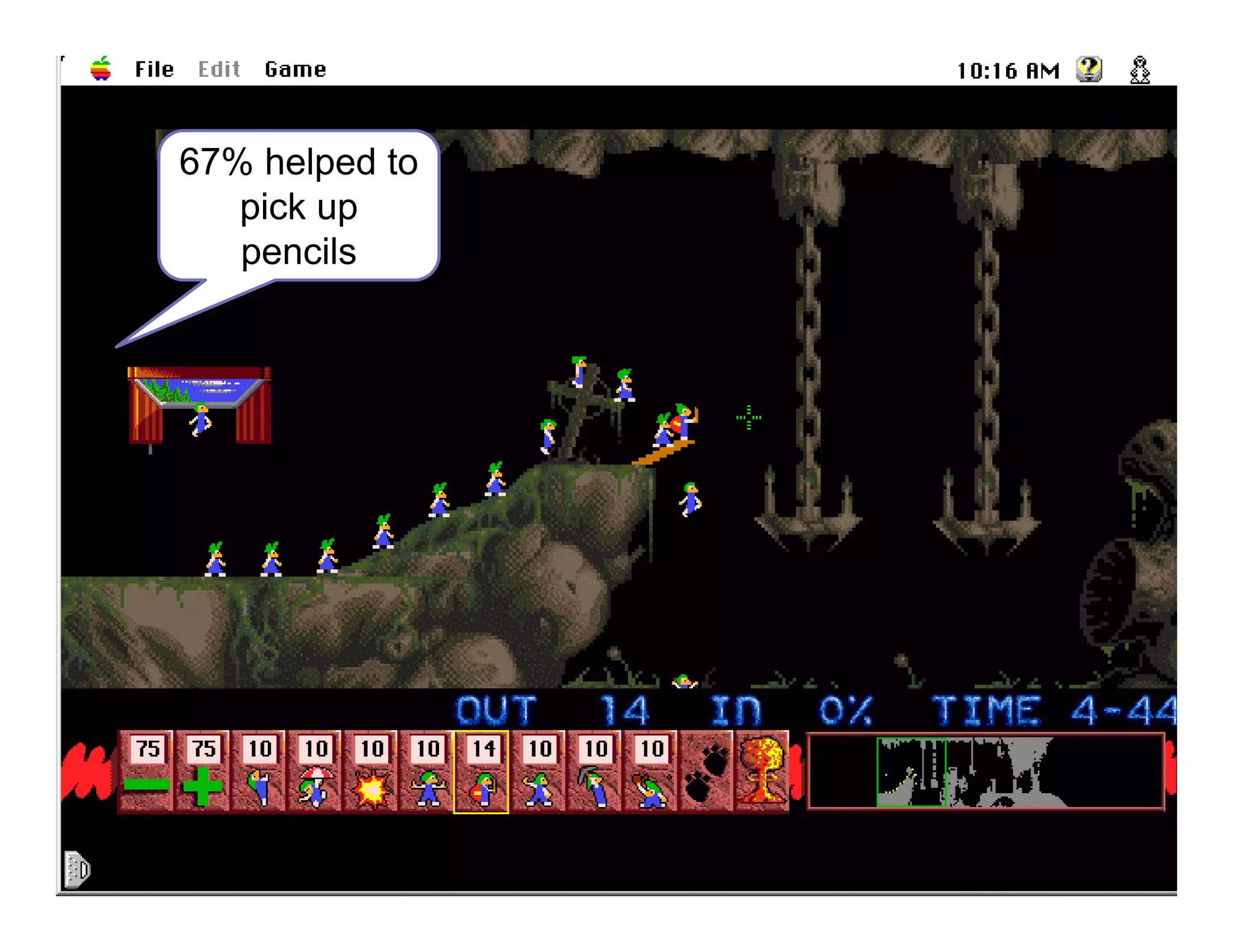
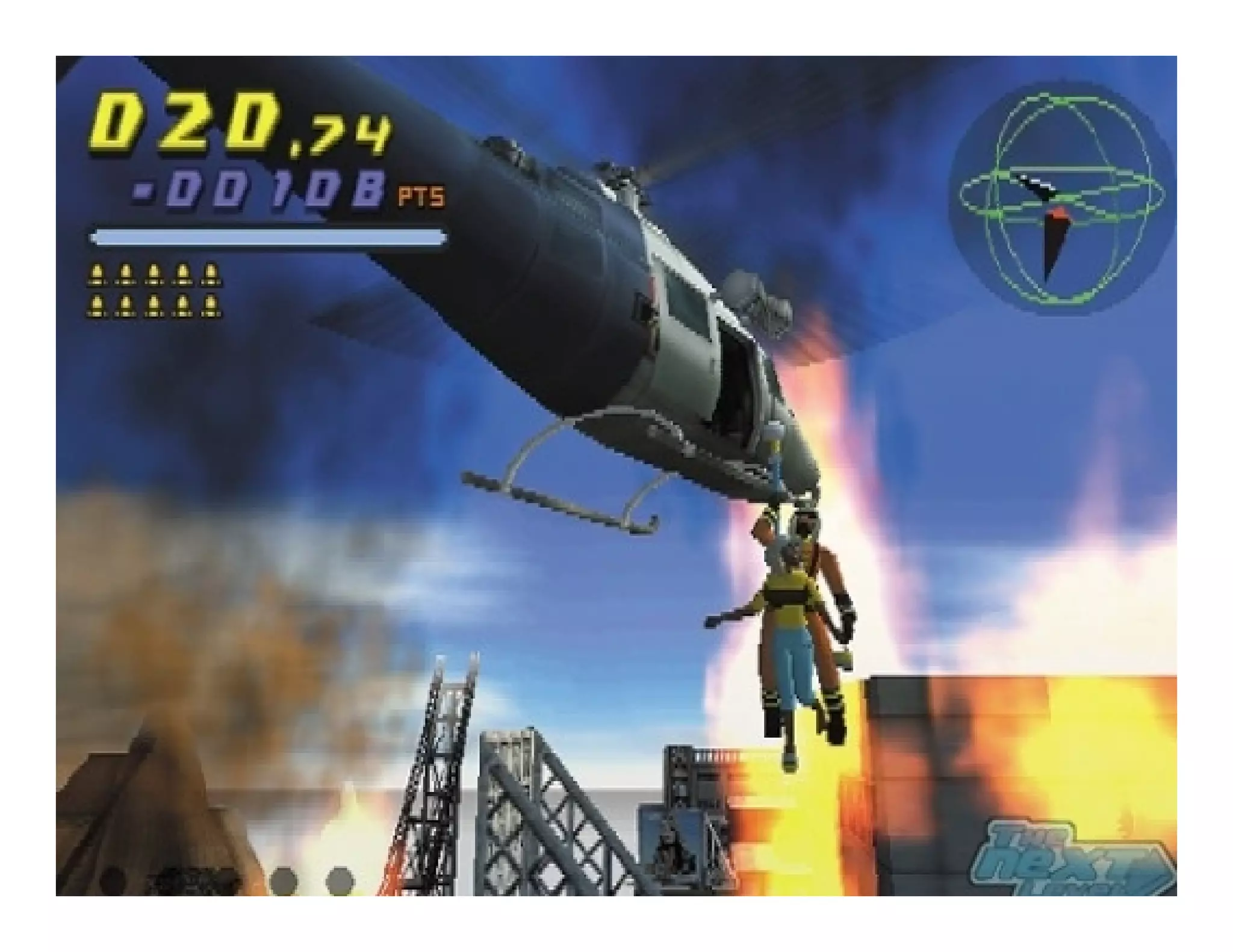
67% helped to
pick up
pencils
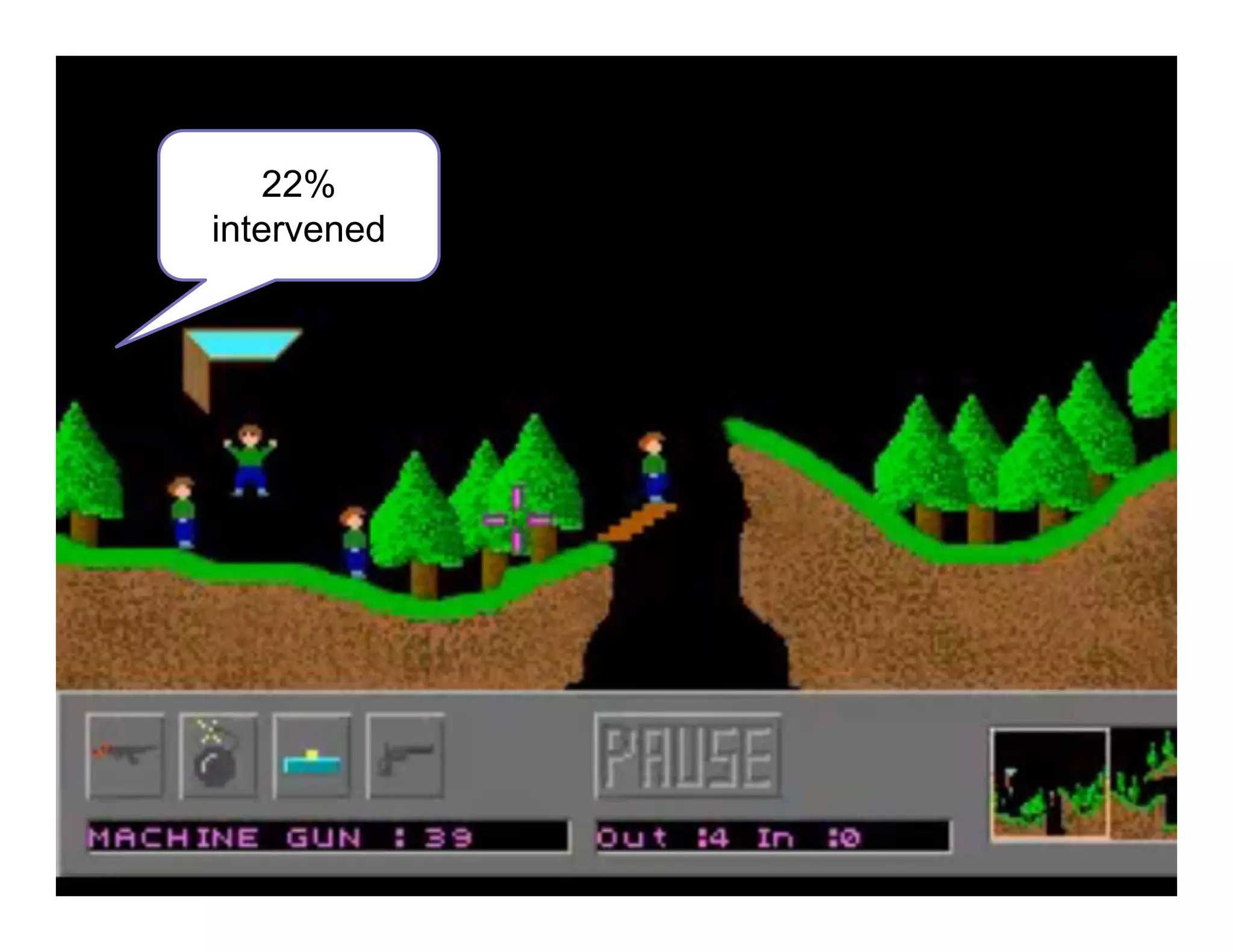
22%
intervened
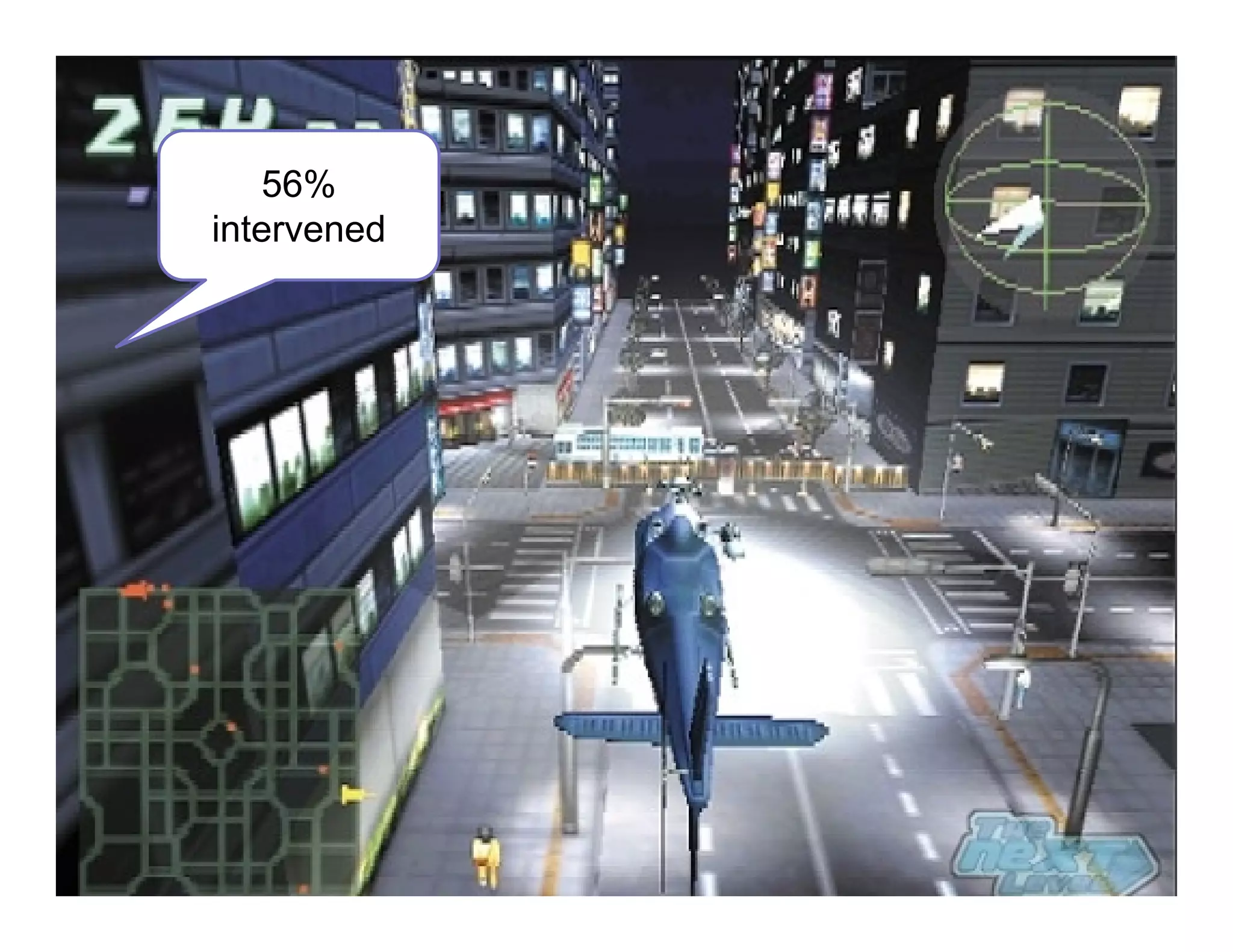
56%
intervened
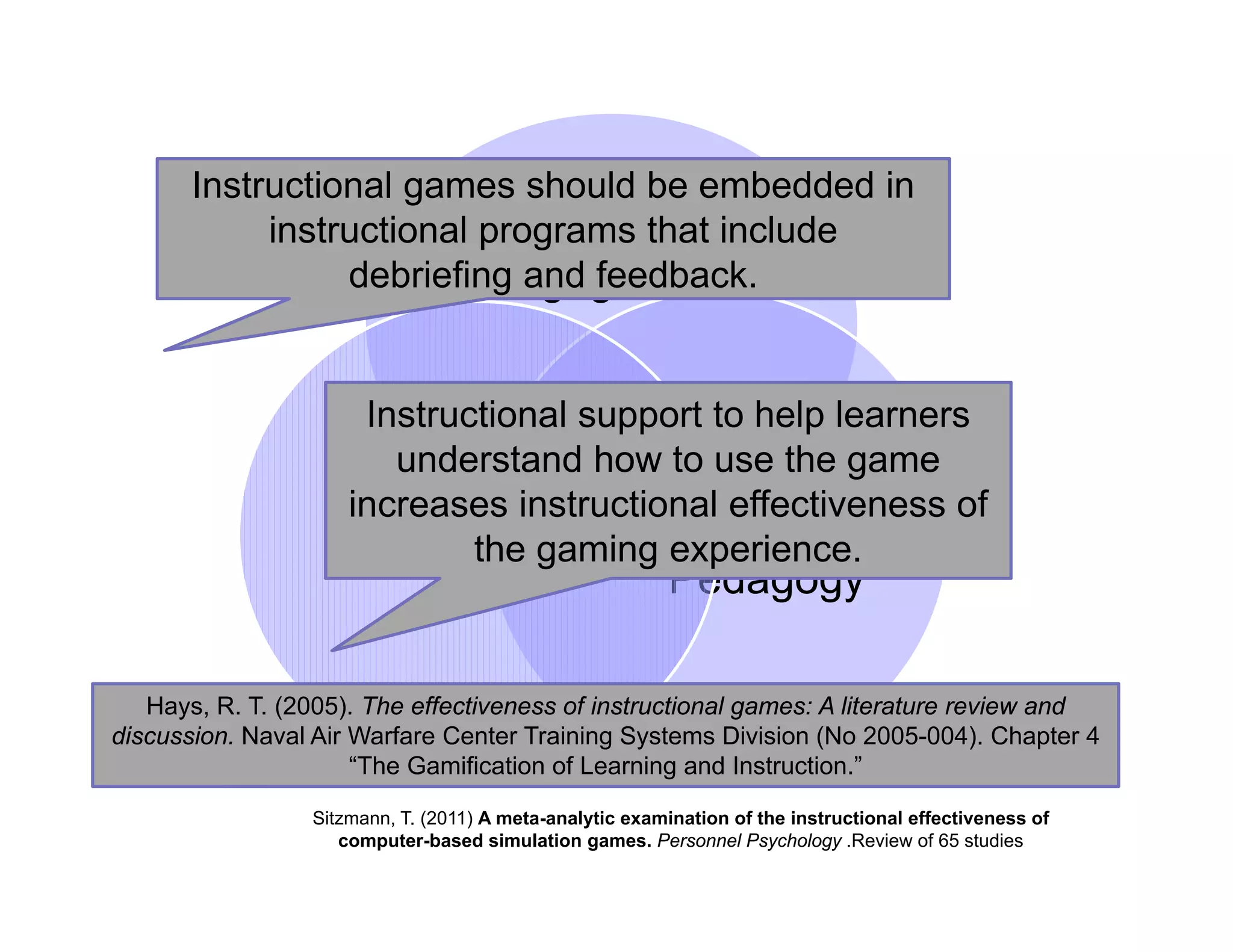
9. Games Must be Embedded
into the Curriculum to be
Effective for Learning.
Engagement
Pedagogy
Game
Educational
Simulation
Instructional games should be embedded in
instructional programs that include
debriefing and feedback.
Instructional support to help learners
understand how to use the game
increases instructional effectiveness of
the gaming experience.
Hays, R. T. (2005). The effectiveness of instructional games: A literature review and
discussion. Naval Air Warfare Center Training Systems Division (No 2005-004). Chapter 4
“The Gamification of Learning and Instruction.”
Sitzmann, T. (2011) A meta-analytic examination of the instructional effectiveness of
computer-based simulation games. Personnel Psychology .Review of 65 studies
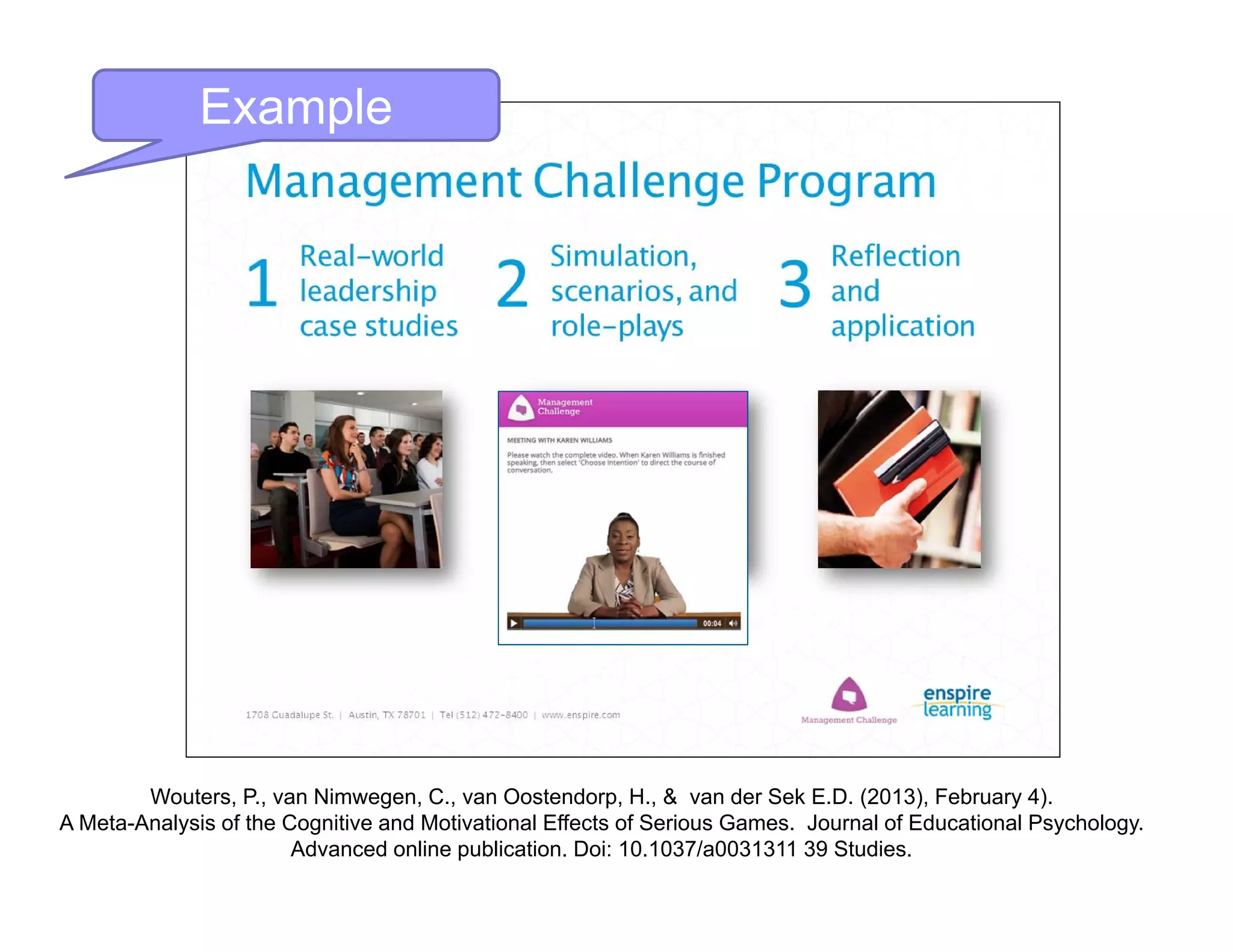
Example
Wouters, P., van Nimwegen, C., van Oostendorp, H., & van der Sek E.D. (2013), February 4).
A Meta-Analysis of the Cognitive and Motivational Effects of Serious Games. Journal of Educational Psychology.
Advanced online publication. Doi: 10.1037/a0031311 39 Studies.
8. Games are more effective
than traditional instruction
when multiple sessions are
involved.
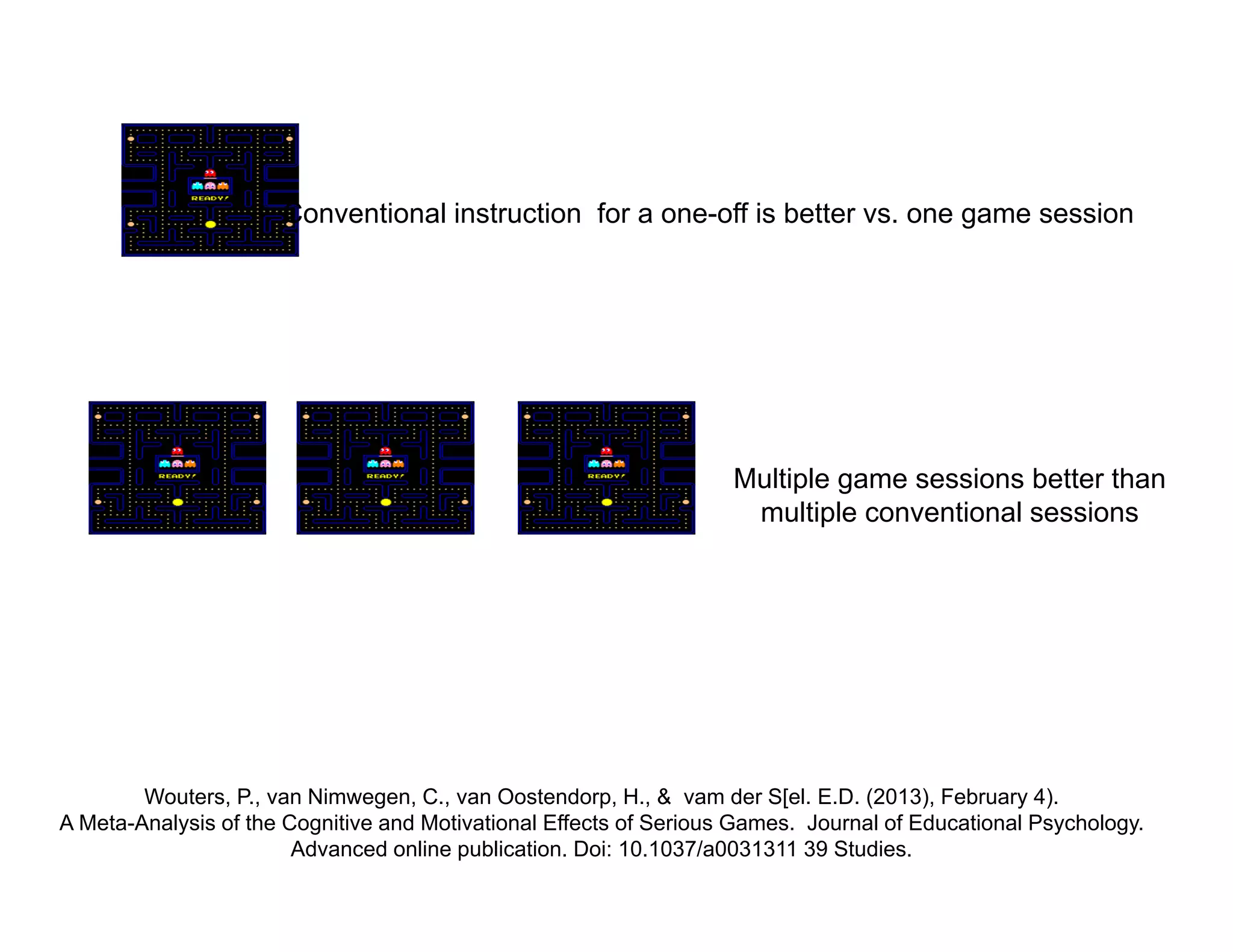
Conventional instruction for a one-off is better vs. one game session
Multiple game sessions better than
multiple conventional sessions
Wouters, P., van Nimwegen, C., van Oostendorp, H., & vam der S[el. E.D. (2013), February 4).
A Meta-Analysis of the Cognitive and Motivational Effects of Serious Games. Journal of Educational Psychology.
Advanced online publication. Doi: 10.1037/a0031311 39 Studies.
7. Games are more effective
than traditional instruction
when players work in groups.
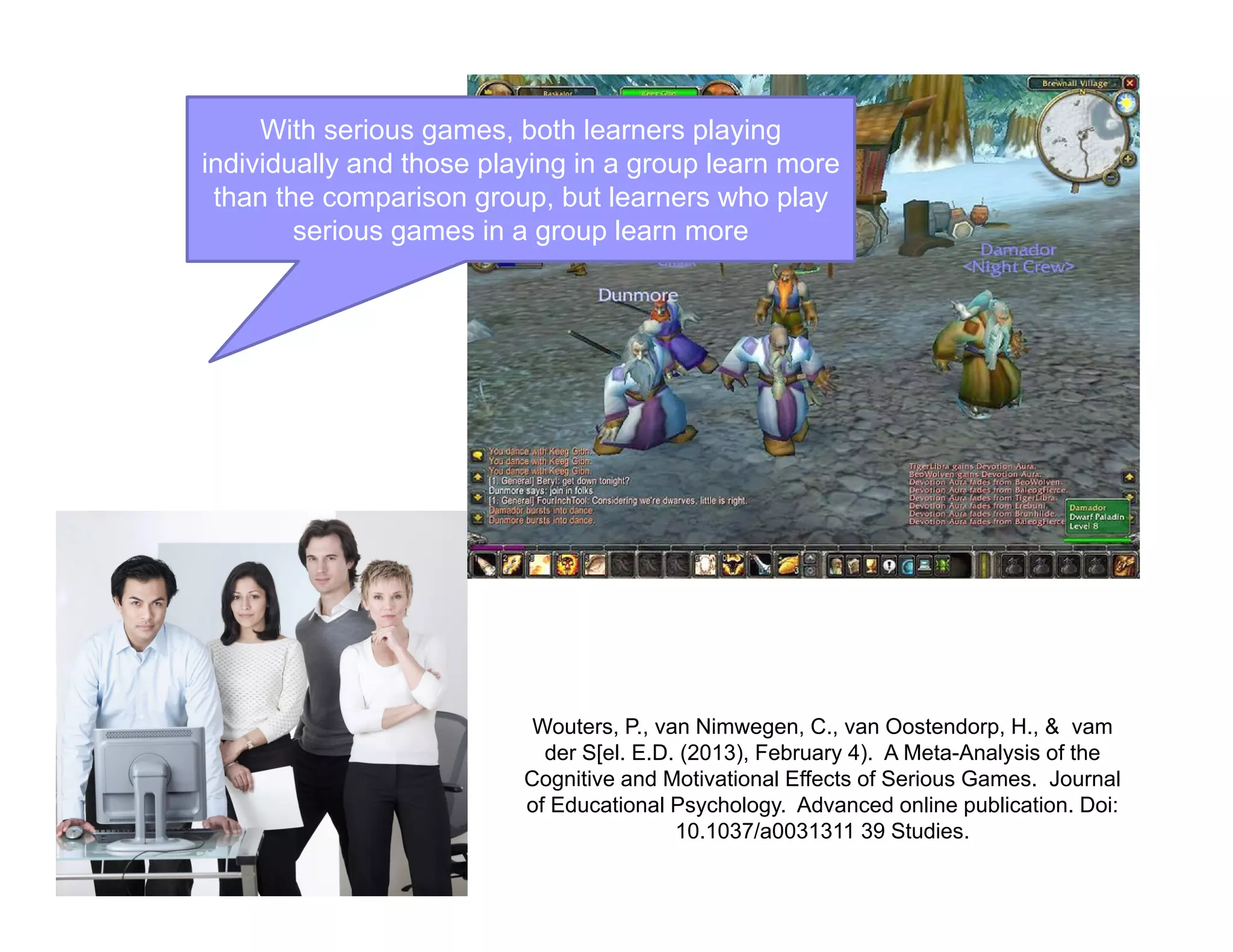
With serious games, both learners playing
individually and those playing in a group learn more
than the comparison group, but learners who play
serious games in a group learn more
Wouters, P., van Nimwegen, C., van Oostendorp, H., & vam
der S[el. E.D. (2013), February 4). A Meta-Analysis of the
Cognitive and Motivational Effects of Serious Games. Journal
of Educational Psychology. Advanced online publication. Doi:
10.1037/a0031311 39 Studies.
6. Instruction with serious
games yields higher learning
gains than conventional
instruction.
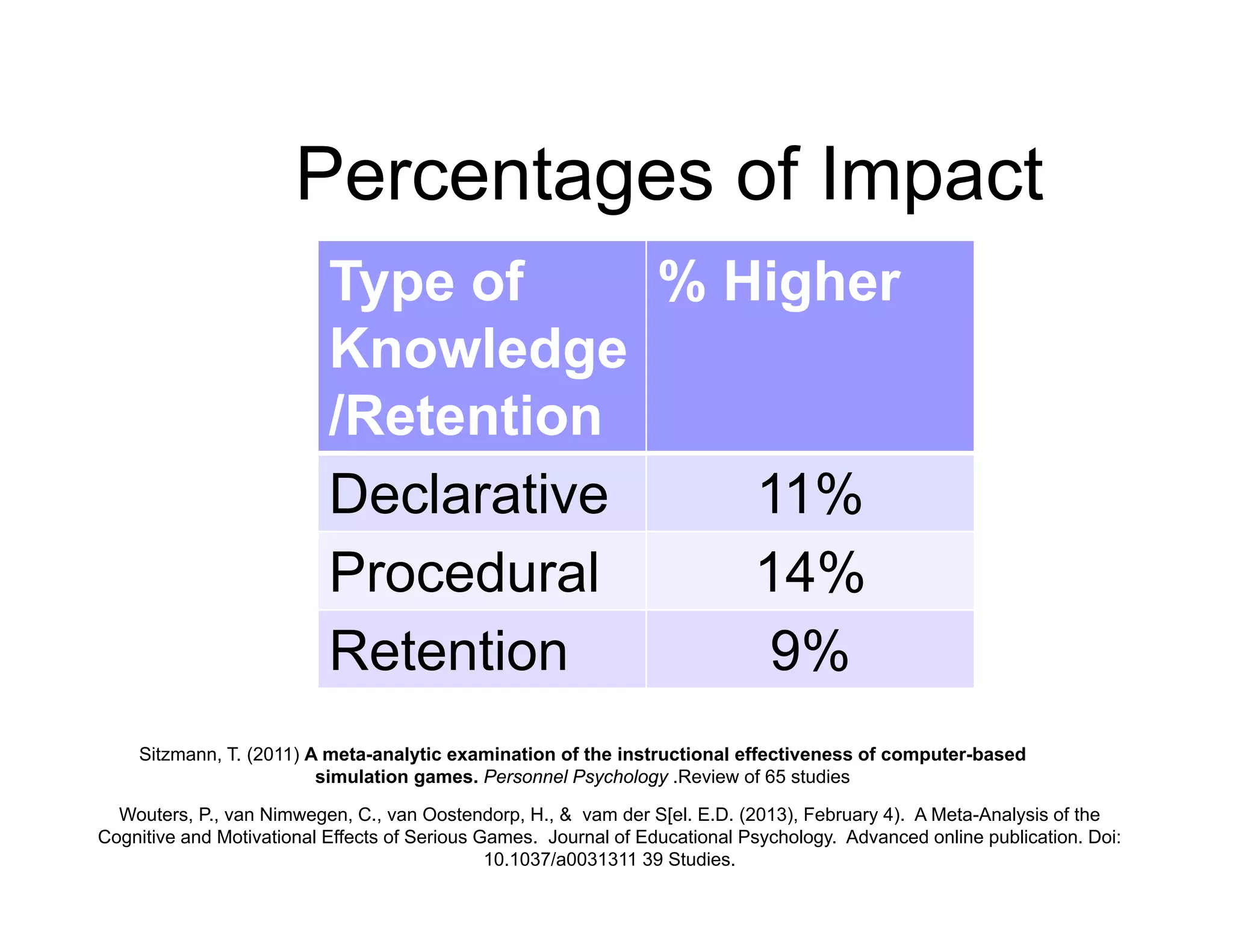
Type of
Knowledge
/Retention
% Higher
Declarative 11%
Procedural 14%
Retention 9%
Percentages of Impact
Sitzmann, T. (2011) A meta-analytic examination of the instructional effectiveness of computer-based
simulation games. Personnel Psychology .Review of 65 studies
Wouters, P., van Nimwegen, C., van Oostendorp, H., & vam der S[el. E.D. (2013), February 4). A Meta-Analysis of the
Cognitive and Motivational Effects of Serious Games. Journal of Educational Psychology. Advanced online publication. Doi:
10.1037/a0031311 39 Studies.
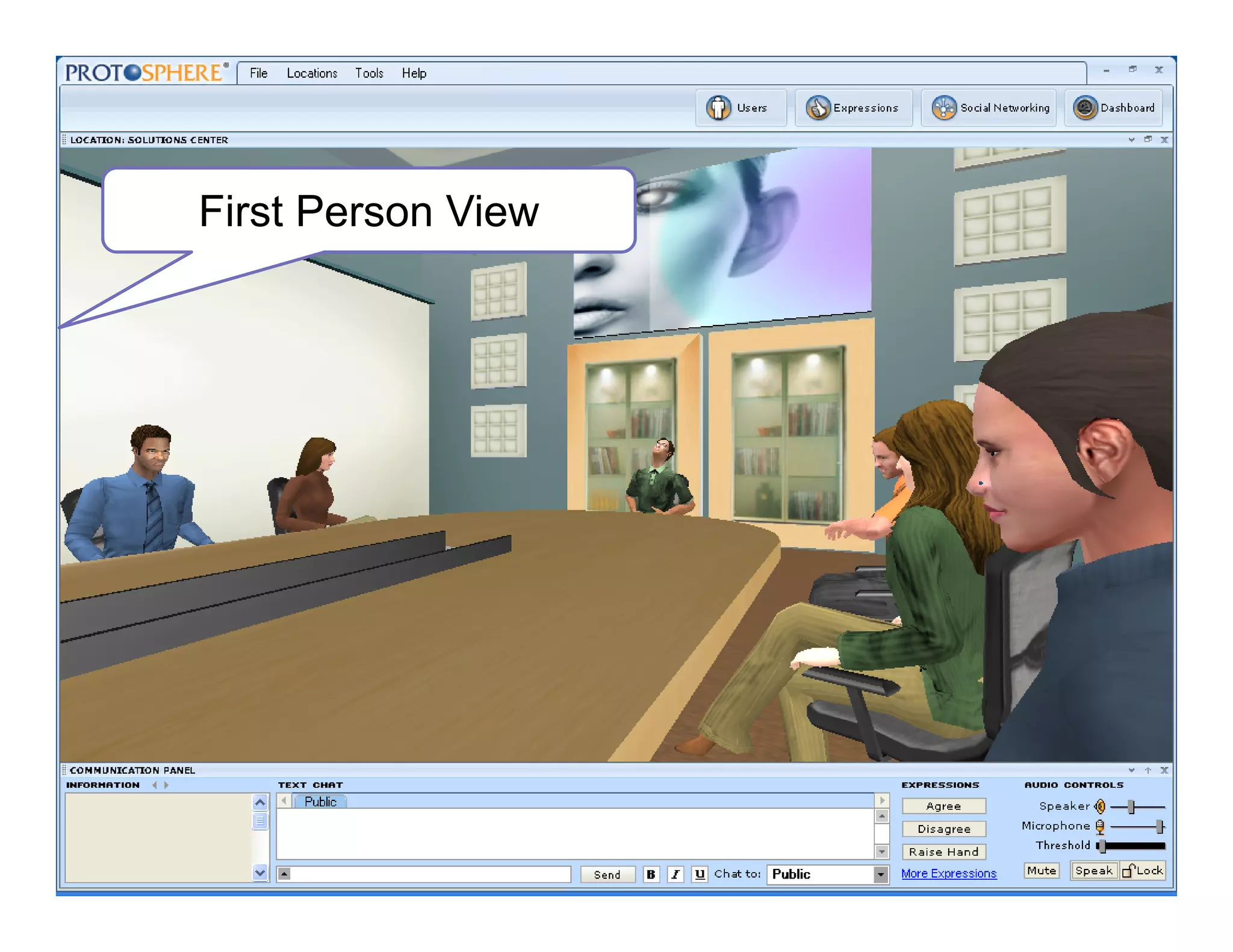
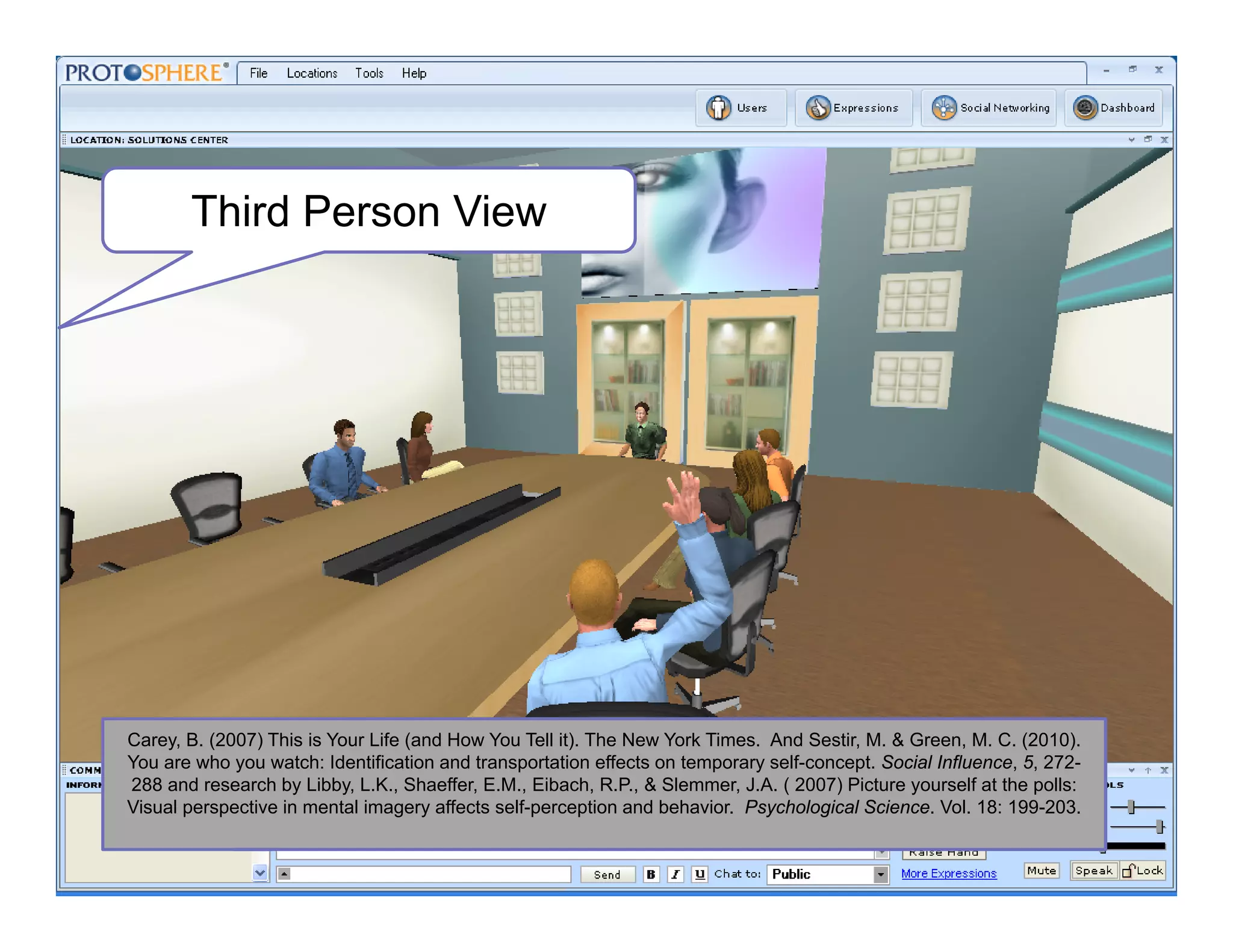
5. Third person view in a
game is better for changing a
person’s behavior than first
person.
First Person View
Third Person View
Carey, B. (2007) This is Your Life (and How You Tell it). The New York Times. And Sestir, M. & Green, M. C. (2010).
You are who you watch: Identification and transportation effects on temporary self-concept. Social Influence, 5, 272-
288 and research by Libby, L.K., Shaeffer, E.M., Eibach, R.P., & Slemmer, J.A. ( 2007) Picture yourself at the polls:
Visual perspective in mental imagery affects self-perception and behavior. Psychological Science. Vol. 18: 199-203.
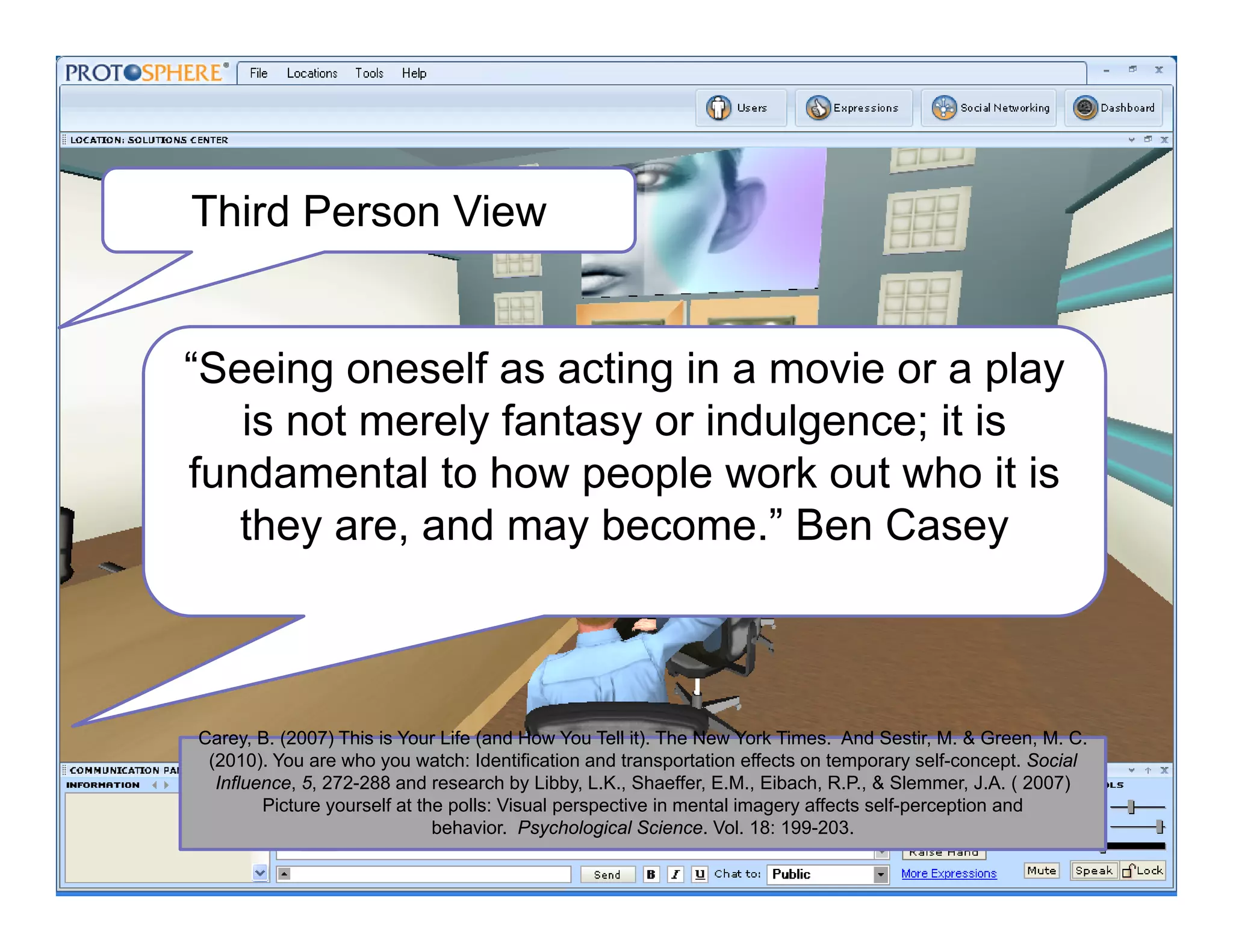
Third Person View
Carey B (2007) This is Your Life (and How You Tell it) The New York Times And Sestir M & Green M CCarey, B. (2007) This is Your Life (and How You Tell it). The New York Times. And Sestir, M. & Green, M. C.
(2010). You are who you watch: Identification and transportation effects on temporary self-concept. Social
Influence, 5, 272-288 and research by Libby, L.K., Shaeffer, E.M., Eibach, R.P., & Slemmer, J.A. ( 2007)
Picture yourself at the polls: Visual perspective in mental imagery affects self-perception and
behavior. Psychological Science. Vol. 18: 199-203.
“Seeing oneself as acting in a movie or a play
is not merely fantasy or indulgence; it is
fundamental to how people work out who it is
they are, and may become.” Ben Casey
5. While playing a game,
learners will voluntarily do
harder problems and more
work.
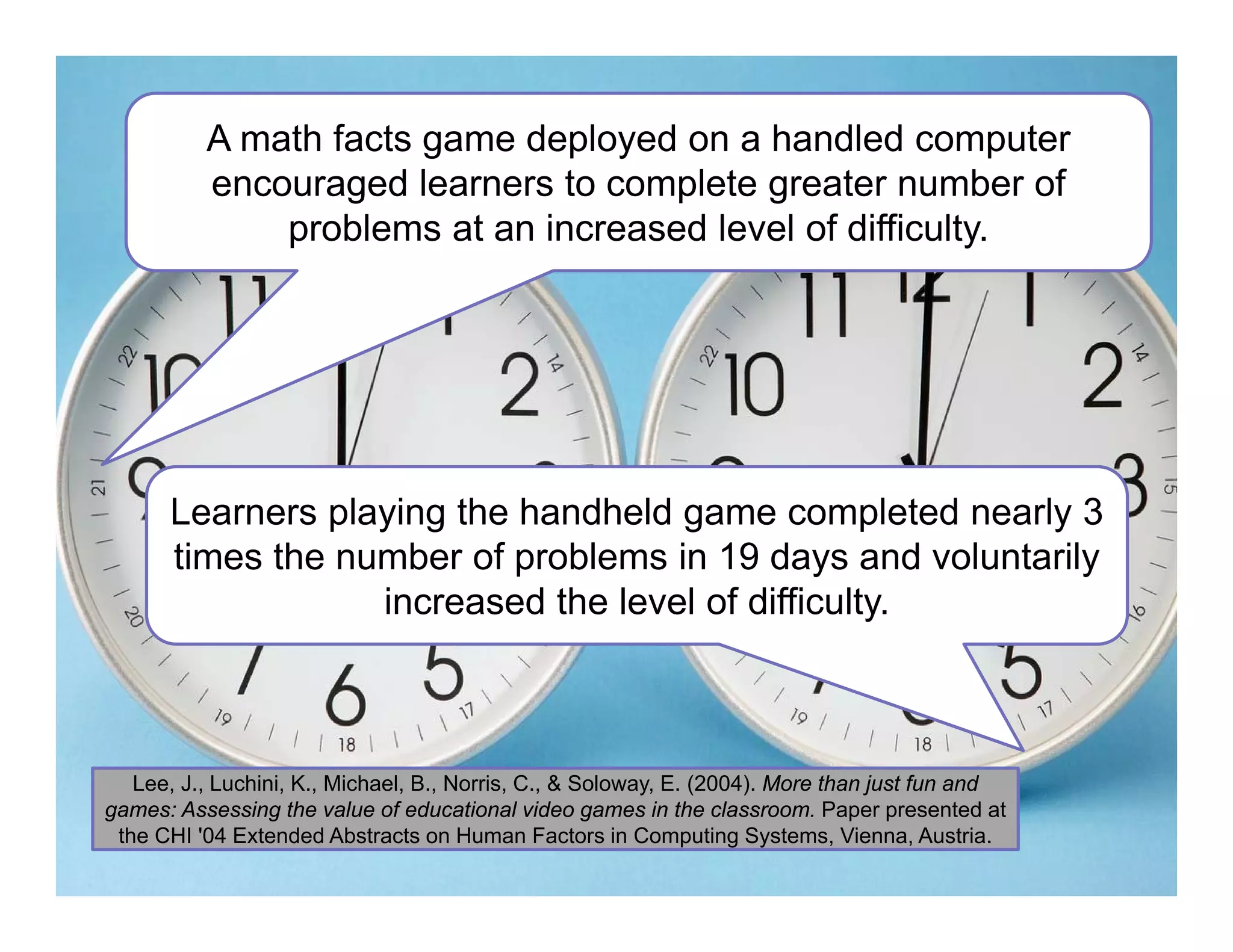
A math facts game deployed on a handled computer
encouraged learners to complete greater number of
problems at an increased level of difficulty.
Learners playing the handheld game completed nearly 3
times the number of problems in 19 days and voluntarily
increased the level of difficulty.
Lee, J., Luchini, K., Michael, B., Norris, C., & Soloway, E. (2004). More than just fun and
games: Assessing the value of educational video games in the classroom. Paper presented at
the CHI '04 Extended Abstracts on Human Factors in Computing Systems, Vienna, Austria.
4. An experience as an avatar
can change a person's real life
perceptions.
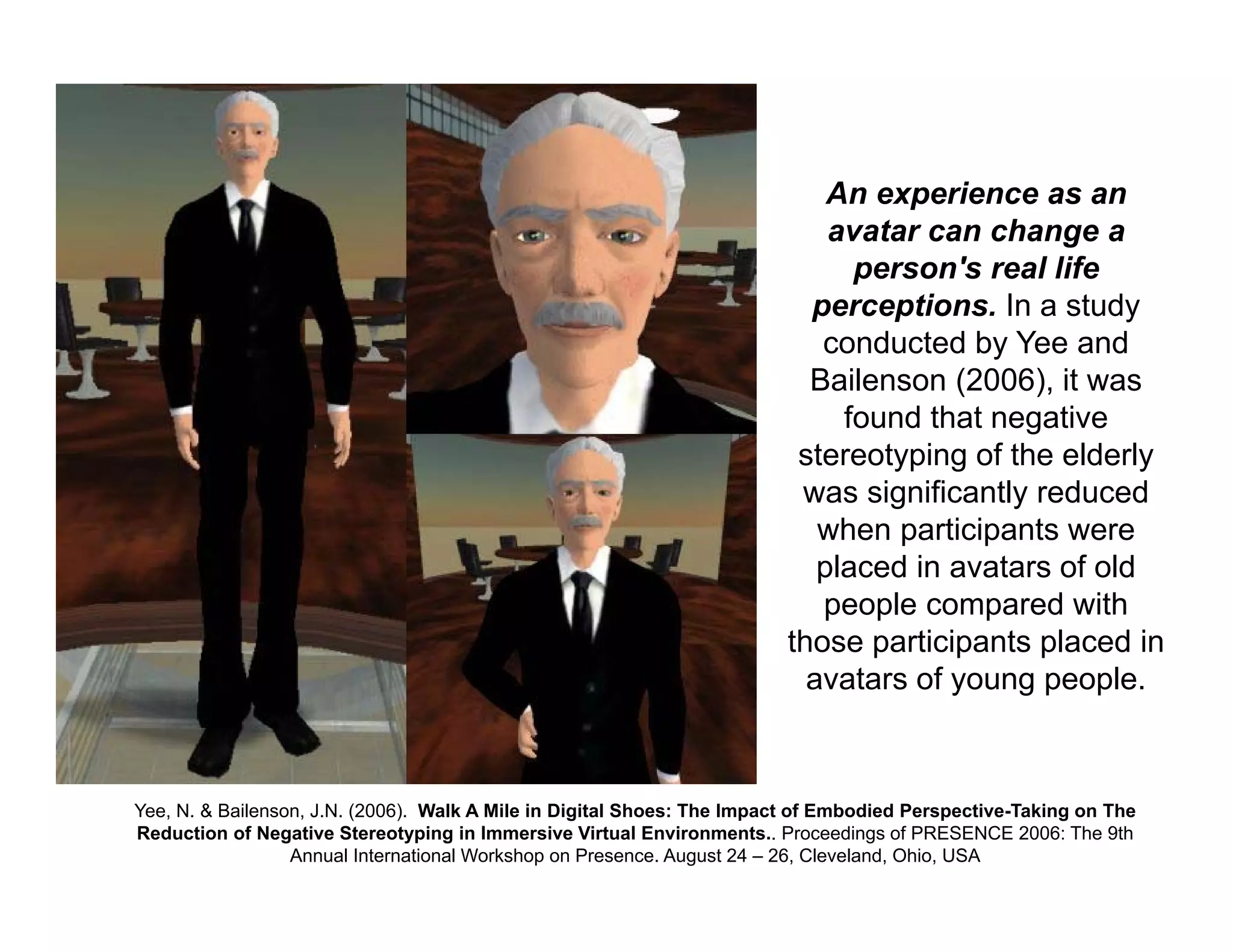
An experience as an
avatar can change a
person's real life
perceptions. In a study
conducted by Yee and
Bailenson (2006), it was
found that negative
stereotyping of the elderly
was significantly reduced
when participants were
placed in avatars of old
people compared with
those participants placed in
avatars of young people.
Yee, N. & Bailenson, J.N. (2006). Walk A Mile in Digital Shoes: The Impact of Embodied Perspective-Taking on The
Reduction of Negative Stereotyping in Immersive Virtual Environments.. Proceedings of PRESENCE 2006: The 9th
Annual International Workshop on Presence. August 24 – 26, Cleveland, Ohio, USA
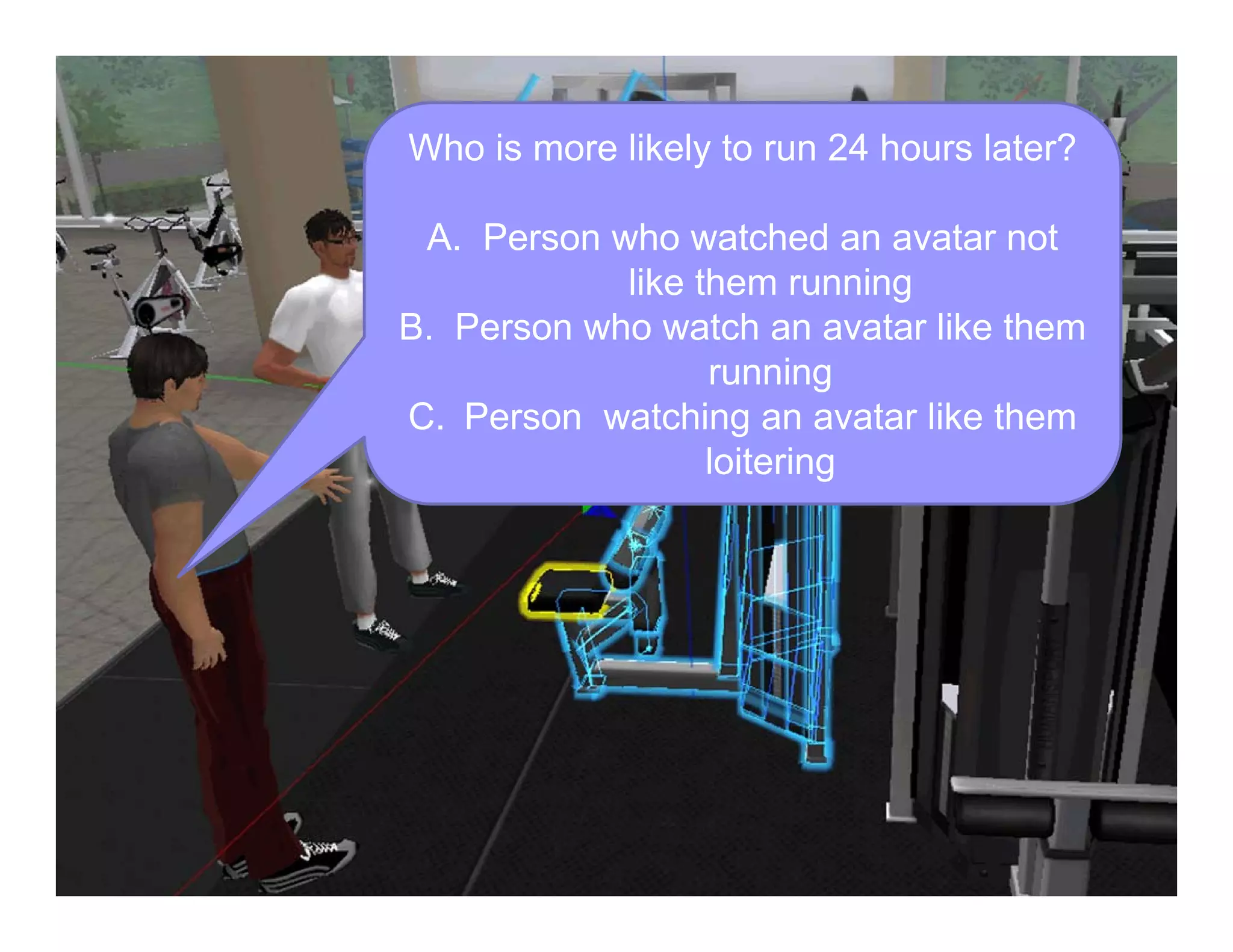
Who is more likely to run 24 hours later?
A. Person who watched an avatar not
like them running
B. Person who watch an avatar like them
running
C. Person watching an avatar like them
loitering
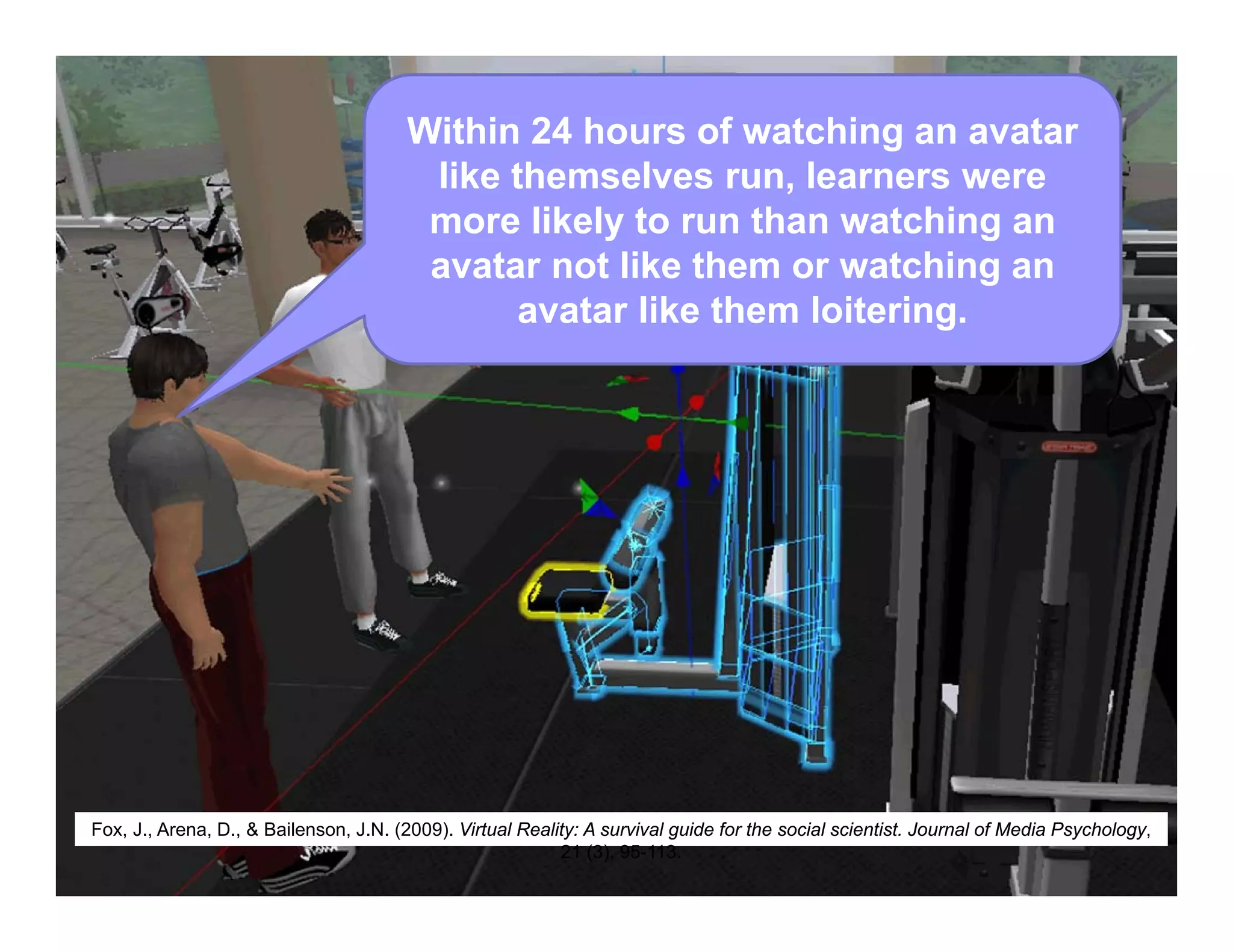
Within 24 hours of watching an avatar
like themselves run, learners were
more likely to run than watching an
avatar not like them or watching an
avatar like them loitering.
Fox, J., Arena, D., & Bailenson, J.N. (2009). Virtual Reality: A survival guide for the social scientist. Journal of Media Psychology,
21 (3), 95-113.
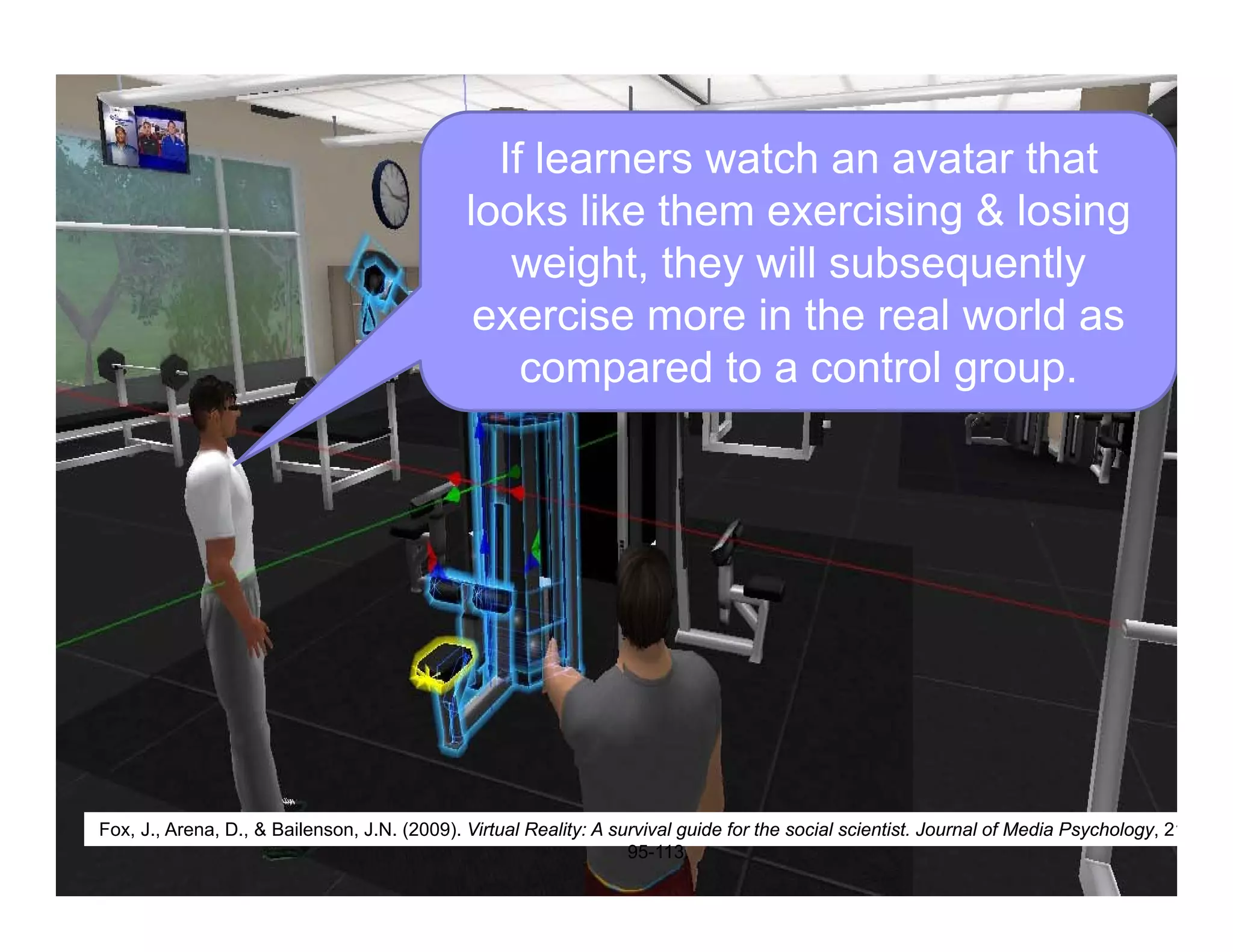
If learners watch an avatar that
looks like them exercising & losing
weight, they will subsequently
exercise more in the real world as
compared to a control group.
Fox, J., Arena, D., & Bailenson, J.N. (2009). Virtual Reality: A survival guide for the social scientist. Journal of Media Psychology, 21
95-113.
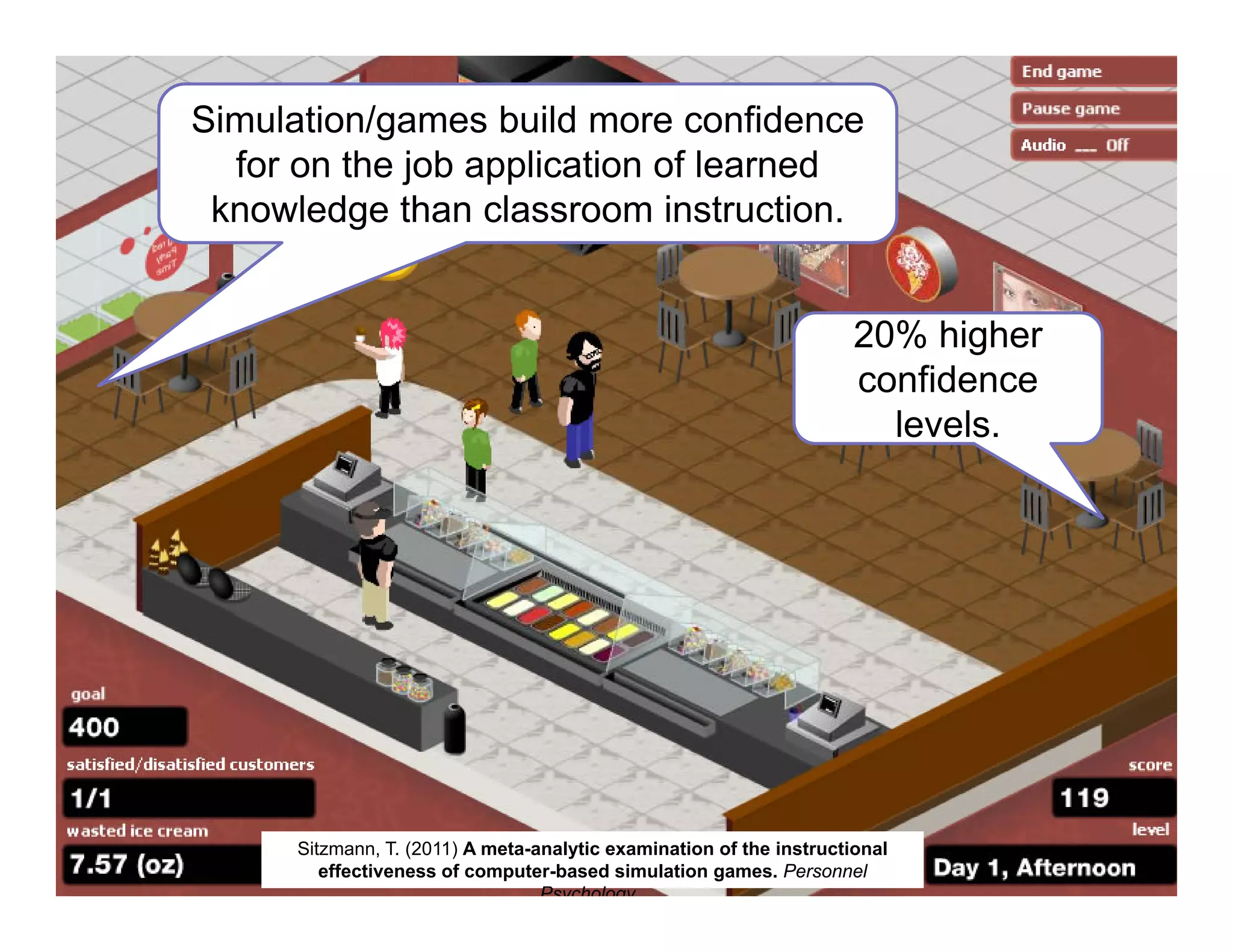
3. Simulation/games build more
confidence for on the job
application of learned knowledge
than classroom instruction.
Sitzmann, T. (2011) A meta-analytic examination of the instructional
effectiveness of computer-based simulation games. Personnel
Psychology
levels.
20% higher
confidence
levels.
Simulation/games build more confidence
for on the job application of learned
knowledge than classroom instruction.
2. Games don’t have to be
considered “entertaining” to be
instructional.
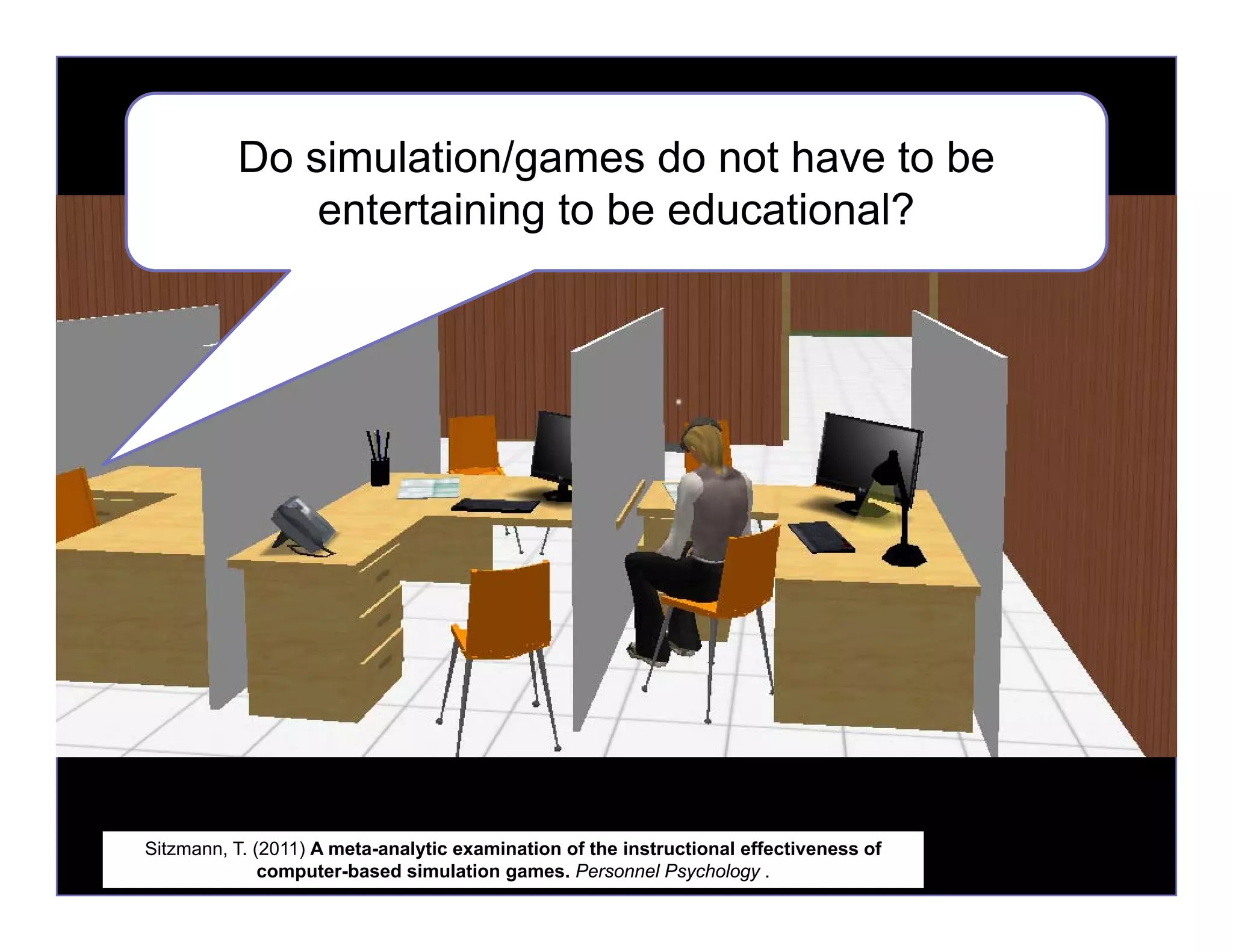
Do simulation/games do not have to be
entertaining to be educational?
Sitzmann, T. (2011) A meta-analytic examination of the instructional effectiveness of
computer-based simulation games. Personnel Psychology .
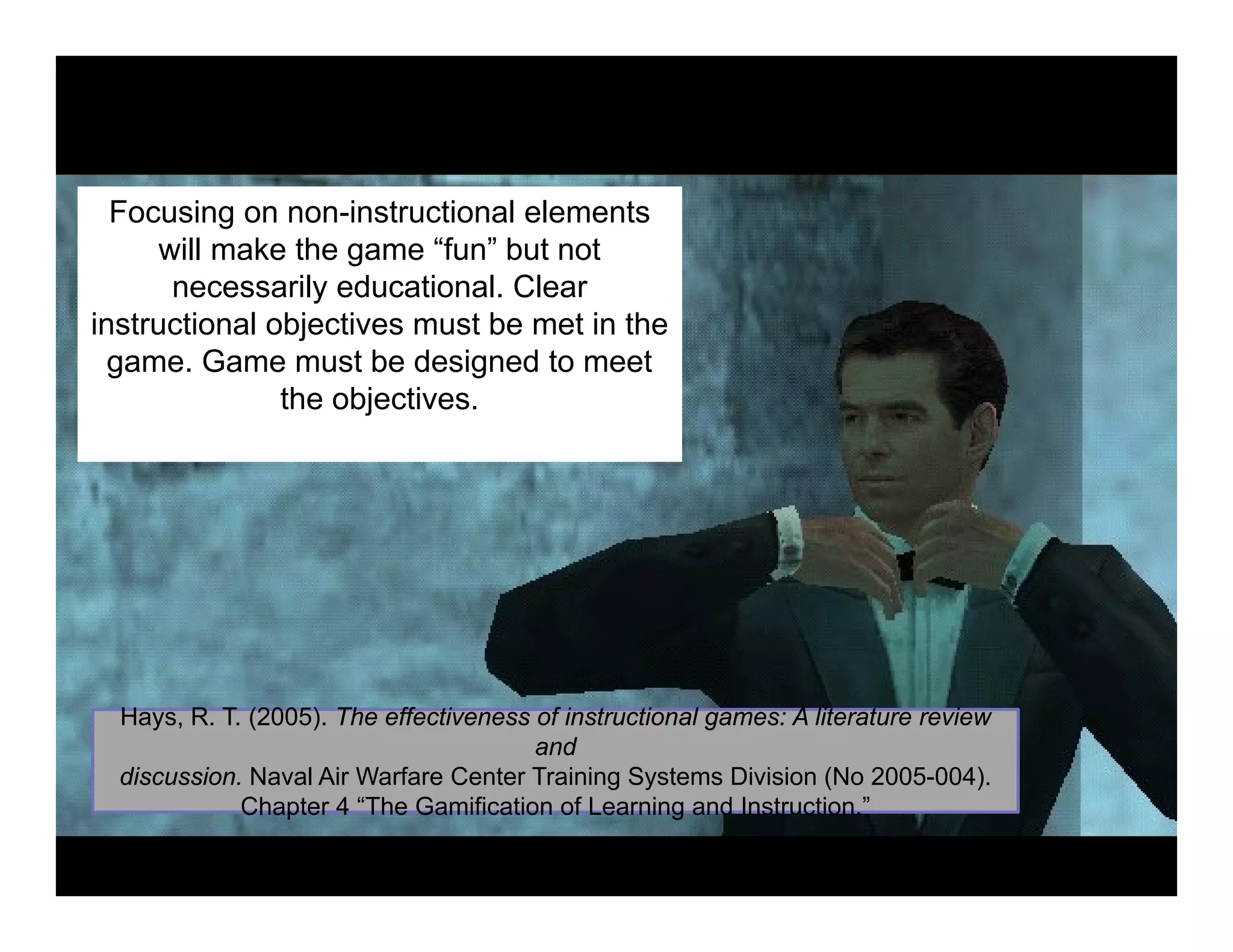
1. An instructional game will only
be effective if it is designed to meet
specific instructional objectives and
was designed as it was intended.
Focusing on non-instructional elements
will make the game “fun” but not
necessarily educational. Clear
instructional objectives must be met in the
game. Game must be designed to meet
the objectives.
H R T (2005) Th ff ti f i t ti l A lit t i
Chapter 4 The Gamification of Learning and Instruction.
Hays, R. T. (2005). The effectiveness of instructional games: A literature review
and
discussion. Naval Air Warfare Center Training Systems Division (No 2005-004).
Chapter 4 “The Gamification of Learning and Instruction.”
1) An instructional game will only be effective if it is designed to meet
specific instructional objectives and was designed as it was intended.
2) Games don’t have to be considered “entertaining” to be instructional.
3) Simulation/games build more confidence for on the job application of
learned knowledge than classroom instruction
4) An experience as an avatar can change a person's real life perceptions.
5) While playing a game, learners will voluntarily do harder problems and
work.
6) Instruction with serious games yields higher learning gains than
conventional instruction.
7) Games are more effective than traditional instruction when players work in
groups.
8) Games are more effective than traditional instruction when multiple
sessions are involved.
9) Games Must be Embedded into the Curriculum to be Effective for
Learning.
10) Games can influence people to behave in a pro-social manner.
Take-Aways
Action Planning
SM page 43
Action Planning 
• Create an outline for making your instruction 
more engaging based on the content covered 
in the workshop. 
Summary and Questions
• Any final questions? 
• Additional questions, follow 
– Kapp Notes (Blog)
– @kkapp (Twitter)
– Facebook

Innovative Learning Techniques: Games, Social Learning and Interactive Stories Part II

  • 1.
    Matching Content toDelivery ISD E-Learning SM page 29
  • 2.
    Designing Performance-Based InstructionFactsConcepts Rules - Elaborating - Organizing - Association - Examples - Non-Examples - Attribute Classification - If-Then - Cause/Effect - Concept Application Procedures Principles Problem-Solving - Whole to Part Review - Learn Parts - Assemble Procedure - Teach Model - Behavior Checklist - Examples - Multiple Scenarios - Professional Experiences - Realistic Application
  • 3.
    Facts  Designing forFacts  Elaboration-links new information with relevant prior knowledge  Superordinate-context of new fact  Coordinate-compare/contrast  Additional Detail Jargon Memorization SM page 30
  • 4.
    Facts  Designing forFacts  Organizing—Placing facts into a logical grouping (chunking)  Tables  Diagrams  Lists  Models  Mnemonics Jargon Memorization Roy G. Biv
  • 5.
    Facts  Designing forFacts  Association—Linking a fact to an image or another term  Diagrams  Labeling Exercises Jargon Memorization
  • 7.
    Teaching with Games Employee in Manufacturing Plant Chemistry Safety Science Spelling Terms
  • 8.
    http://www.kaplaneduneering.com/kappnotes/index.php/2007/05/accidental-learning-and-power-of/ Researchers have foundthat the human brain has a natural affinity for narrative construction. Yep, people tend to remember facts more accurately if they encounter them in a story rather than in a list. And they rate legal arguments as more convincing when built into narrative tales rather than on legal precedent.
  • 9.
  • 10.
    Concepts  Designing forConcepts Concept is a class of items that share common features and is known by a common name.  Example, Non-Example  Attribute Classification Categories Concrete
  • 11.
  • 12.
  • 13.
  • 15.
  • 16.
    Procedures  Designing forProcedures Procedure is a sequence of steps the learner performs to accomplish a task.  Whole to Part Review  Learn Parts  Assemble Procedure SOPs Step-by-Step
  • 18.
  • 19.
    SOP Instructions 1. Followingyour planogram, assemble the columns of cubes on the floor by locking each cube in place 2. After each column is completed place the top plate on the top of each column 3. Continue until you have all the columns built Visual SOP
  • 20.
  • 21.
    www.gadgetsgamesandgizmos.com © KarlM. Kapp 2007 Rules - If-Then - Cause/Effect - Concept Application Procedures - Whole to Part Review - Learn Parts - Assemble Procedure
  • 22.
  • 23.
  • 24.
    Problem-Solving  Designing forProblem-Solving Problem is previously un-encountered situation that requires the application of previously learned concepts, rules, procedures, principles  Composition  Decomposition  Metacognition  Teach Model  Checklist  Examples Ethics Broken Equipment
  • 25.
    Consider using the “EnMedia Res” technique
  • 26.
  • 27.
    www.gadgetsgamesandgizmos.com Note: Teach Problem-Solving with -Multiple Scenarios - Professional Experiences -Realistic Application - First-Person “Thinkers” Note: Teach Problem-Solving with - Multiple Scenarios - Professional Experiences -Realistic Application - First-Person “Thinkers”
  • 28.
    Create a learningdocumentary of how to do a job, how decisions are made, how dots are connected.
  • 29.
    Creating Engaging Instruction Classroom -Group -Individual Compare work Teach amodel Co-Create Discuss Answer questions Draw Create a model Develop ideas Fill-in-the-blank Online Mind Map Example Social Learning/ Informal
  • 30.
  • 31.
    Universal Rules  DistributedPractice  Appropriate Use of Questions  Focus on Job Specific Performance
  • 32.
  • 34.
    What are youthinking? What are your choices? Where else does this apply? What are the underlying concepts? What mistakes need to be avoided? Metacognition
  • 35.
    10 Things WeKnow about Games for Learning From Research SM page 42
  • 36.
    10. Games CanInfluence People to Behave in a Pro- social Manner.
  • 39.
    First Experiment indicatedthat playing the game Darfur is Dying resulted in a greater willingness to help the Darfurian people than reading a text conveying same information. Peng, W., Lee, M., & Heeter. (2010) The effects of a serious game on role taking and willingness to help. Journal of Communications. 60, 723-724. Chapter 5 of “The Gamificaiton of Learning and Instruction.
  • 40.
    Second Experiment indicatedthat playing the game Darfur is Dying resulted in a greater role taking and willingness to help than either game watching or text reading. Peng, W., Lee, M., & Heeter. (2010) The effects of a serious game on role taking and willingness to help. Journal of Communications. 60, 723-724. Chapter 5 of “The Gamificaiton of Learning and Instruction.
  • 41.
  • 42.
    Greitemeyer, T. &Osswald, S. (2010) Effective of Prosocial games on prosocial behavior. Journal of Personality and Social Psychology. Vol. 98 . No. 2., 211-221.
  • 43.
  • 44.
  • 45.
  • 47.
  • 48.
  • 49.
    9. Games Mustbe Embedded into the Curriculum to be Effective for Learning.
  • 50.
    Engagement Pedagogy Game Educational Simulation Instructional games shouldbe embedded in instructional programs that include debriefing and feedback. Instructional support to help learners understand how to use the game increases instructional effectiveness of the gaming experience. Hays, R. T. (2005). The effectiveness of instructional games: A literature review and discussion. Naval Air Warfare Center Training Systems Division (No 2005-004). Chapter 4 “The Gamification of Learning and Instruction.” Sitzmann, T. (2011) A meta-analytic examination of the instructional effectiveness of computer-based simulation games. Personnel Psychology .Review of 65 studies
  • 51.
    Example Wouters, P., vanNimwegen, C., van Oostendorp, H., & van der Sek E.D. (2013), February 4). A Meta-Analysis of the Cognitive and Motivational Effects of Serious Games. Journal of Educational Psychology. Advanced online publication. Doi: 10.1037/a0031311 39 Studies.
  • 52.
    8. Games aremore effective than traditional instruction when multiple sessions are involved.
  • 53.
    Conventional instruction fora one-off is better vs. one game session Multiple game sessions better than multiple conventional sessions Wouters, P., van Nimwegen, C., van Oostendorp, H., & vam der S[el. E.D. (2013), February 4). A Meta-Analysis of the Cognitive and Motivational Effects of Serious Games. Journal of Educational Psychology. Advanced online publication. Doi: 10.1037/a0031311 39 Studies.
  • 54.
    7. Games aremore effective than traditional instruction when players work in groups.
  • 55.
    With serious games,both learners playing individually and those playing in a group learn more than the comparison group, but learners who play serious games in a group learn more Wouters, P., van Nimwegen, C., van Oostendorp, H., & vam der S[el. E.D. (2013), February 4). A Meta-Analysis of the Cognitive and Motivational Effects of Serious Games. Journal of Educational Psychology. Advanced online publication. Doi: 10.1037/a0031311 39 Studies.
  • 56.
    6. Instruction withserious games yields higher learning gains than conventional instruction.
  • 57.
    Type of Knowledge /Retention % Higher Declarative11% Procedural 14% Retention 9% Percentages of Impact Sitzmann, T. (2011) A meta-analytic examination of the instructional effectiveness of computer-based simulation games. Personnel Psychology .Review of 65 studies Wouters, P., van Nimwegen, C., van Oostendorp, H., & vam der S[el. E.D. (2013), February 4). A Meta-Analysis of the Cognitive and Motivational Effects of Serious Games. Journal of Educational Psychology. Advanced online publication. Doi: 10.1037/a0031311 39 Studies.
  • 58.
    5. Third personview in a game is better for changing a person’s behavior than first person.
  • 59.
  • 60.
    Third Person View Carey,B. (2007) This is Your Life (and How You Tell it). The New York Times. And Sestir, M. & Green, M. C. (2010). You are who you watch: Identification and transportation effects on temporary self-concept. Social Influence, 5, 272- 288 and research by Libby, L.K., Shaeffer, E.M., Eibach, R.P., & Slemmer, J.A. ( 2007) Picture yourself at the polls: Visual perspective in mental imagery affects self-perception and behavior. Psychological Science. Vol. 18: 199-203.
  • 61.
    Third Person View CareyB (2007) This is Your Life (and How You Tell it) The New York Times And Sestir M & Green M CCarey, B. (2007) This is Your Life (and How You Tell it). The New York Times. And Sestir, M. & Green, M. C. (2010). You are who you watch: Identification and transportation effects on temporary self-concept. Social Influence, 5, 272-288 and research by Libby, L.K., Shaeffer, E.M., Eibach, R.P., & Slemmer, J.A. ( 2007) Picture yourself at the polls: Visual perspective in mental imagery affects self-perception and behavior. Psychological Science. Vol. 18: 199-203. “Seeing oneself as acting in a movie or a play is not merely fantasy or indulgence; it is fundamental to how people work out who it is they are, and may become.” Ben Casey
  • 62.
    5. While playinga game, learners will voluntarily do harder problems and more work.
  • 63.
    A math factsgame deployed on a handled computer encouraged learners to complete greater number of problems at an increased level of difficulty. Learners playing the handheld game completed nearly 3 times the number of problems in 19 days and voluntarily increased the level of difficulty. Lee, J., Luchini, K., Michael, B., Norris, C., & Soloway, E. (2004). More than just fun and games: Assessing the value of educational video games in the classroom. Paper presented at the CHI '04 Extended Abstracts on Human Factors in Computing Systems, Vienna, Austria.
  • 64.
    4. An experienceas an avatar can change a person's real life perceptions.
  • 65.
    An experience asan avatar can change a person's real life perceptions. In a study conducted by Yee and Bailenson (2006), it was found that negative stereotyping of the elderly was significantly reduced when participants were placed in avatars of old people compared with those participants placed in avatars of young people. Yee, N. & Bailenson, J.N. (2006). Walk A Mile in Digital Shoes: The Impact of Embodied Perspective-Taking on The Reduction of Negative Stereotyping in Immersive Virtual Environments.. Proceedings of PRESENCE 2006: The 9th Annual International Workshop on Presence. August 24 – 26, Cleveland, Ohio, USA
  • 66.
    Who is morelikely to run 24 hours later? A. Person who watched an avatar not like them running B. Person who watch an avatar like them running C. Person watching an avatar like them loitering
  • 67.
    Within 24 hoursof watching an avatar like themselves run, learners were more likely to run than watching an avatar not like them or watching an avatar like them loitering. Fox, J., Arena, D., & Bailenson, J.N. (2009). Virtual Reality: A survival guide for the social scientist. Journal of Media Psychology, 21 (3), 95-113.
  • 68.
    If learners watchan avatar that looks like them exercising & losing weight, they will subsequently exercise more in the real world as compared to a control group. Fox, J., Arena, D., & Bailenson, J.N. (2009). Virtual Reality: A survival guide for the social scientist. Journal of Media Psychology, 21 95-113.
  • 69.
    3. Simulation/games buildmore confidence for on the job application of learned knowledge than classroom instruction.
  • 70.
    Sitzmann, T. (2011)A meta-analytic examination of the instructional effectiveness of computer-based simulation games. Personnel Psychology levels. 20% higher confidence levels. Simulation/games build more confidence for on the job application of learned knowledge than classroom instruction.
  • 71.
    2. Games don’thave to be considered “entertaining” to be instructional.
  • 72.
    Do simulation/games donot have to be entertaining to be educational? Sitzmann, T. (2011) A meta-analytic examination of the instructional effectiveness of computer-based simulation games. Personnel Psychology .
  • 73.
    1. An instructionalgame will only be effective if it is designed to meet specific instructional objectives and was designed as it was intended.
  • 74.
    Focusing on non-instructionalelements will make the game “fun” but not necessarily educational. Clear instructional objectives must be met in the game. Game must be designed to meet the objectives. H R T (2005) Th ff ti f i t ti l A lit t i Chapter 4 The Gamification of Learning and Instruction. Hays, R. T. (2005). The effectiveness of instructional games: A literature review and discussion. Naval Air Warfare Center Training Systems Division (No 2005-004). Chapter 4 “The Gamification of Learning and Instruction.”
  • 75.
    1) An instructionalgame will only be effective if it is designed to meet specific instructional objectives and was designed as it was intended. 2) Games don’t have to be considered “entertaining” to be instructional. 3) Simulation/games build more confidence for on the job application of learned knowledge than classroom instruction 4) An experience as an avatar can change a person's real life perceptions. 5) While playing a game, learners will voluntarily do harder problems and work. 6) Instruction with serious games yields higher learning gains than conventional instruction. 7) Games are more effective than traditional instruction when players work in groups. 8) Games are more effective than traditional instruction when multiple sessions are involved. 9) Games Must be Embedded into the Curriculum to be Effective for Learning. 10) Games can influence people to behave in a pro-social manner. Take-Aways
  • 76.
  • 77.
  • 78.