Keygan Sands
 Measures tectonic movement*
 90% earthquakes occur
underwater*
 Motions may be <1mm or >1m*
 Uses:
 Calculating quake energy*
 Predicting quakes*
 Studying structure of mantle and
crust*
*Ocean Instruments
Collins 2004
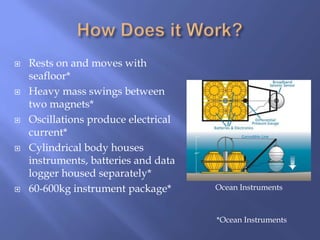
 Rests on and moves with
seafloor*
 Heavy mass swings between
two magnets*
 Oscillations produce electrical
current*
 Cylindrical body houses
instruments, batteries and data
logger housed separately*
 60-600kg instrument package*
*Ocean Instruments
Ocean Instruments
 Developed in 1970s by institutions (WHOI, SIO,
University of Texas)*
 Inefficient: high power, limited storage capacity,
inexact clocks*
 Formation of National OBS Instrumentation Pool in
1999 by NSF with first major long-term deployment in
2004*
 Modern OBSs are lower power, higher precision clocks,
sensitive to finer motions*
 Divided into short and long period OBSs*
*Collins 2004
 Short-period OBS (WHOI D2 and L-CHEAPO):
 High-frequency motions*
 Small quakes*
 Studies outer layers of crust*
 60 day to 6 month deployment period**
 Long-period OBS (WHOI and Scripps long-
deployment):
 Broader range of motions*
 10/sec to 1/min data collection*
 Mid-sized quakes, distant activities*
 >12 month deployment period**
*Ocean Instruments
**OBSIP, National Science Foundation
OBSIP, NSF
 Good:
 Stable clocks
 Easily recovered data
 Connectable to surface
observatories
 Easily deployed (requires
winch)
 Bad:
 Imprecise installation
 Short-period have short
battery lives
 High data Ocean Instruments
Ocean Instruments
 “Structure of the East Pacific Rise from an Ocean
Bottom Seismometer Survey” –Orcutt and
Kennett, 1976
 Physical structure of sea floor studied
 Determined that oceanic crust structure can change
rapidly depending on age (velocity of earthquake
waves through medium)
 “Earthquake distribution in the subduction zone
off eastern Hokkaido, Japan, deduced from ocean-
bottom seismographic and land observations” –
Iwasaki et. al, 1991
 Observations of microearthquakes on continental
slope of Japan
 Determined that several tectonic blocks exist in the
subduction zone along Kuril Trench (differences in
seismicities between locations)
 “A Sea-Floor Spreading Event
Captured by Seismometers” –Tolstoy
et. al, 2006
 Monitoring of East Pacific Rise during
ridge eruption and precursor activity
 Developed a profile of major spreading
event
 Eruptions can be used to forecast
spreading
 “Tracking fin whales in the northeast
Pacific Ocean with a seafloor seismic
network” –Wilcock, 2012
 Use of OBSs to passively monitor whale
locations
 Microearthquakes: 10Hz, whale calls:
20Hz
Life of Sea
Collins, John (2004). “Listening Closely to „See‟ Into the Earth.” Oceanus.
<http://www.whoi.edu/oceanus/viewArticle.do?id=2509&archives=true>
Iwasaki, T., Hirata, N., Kanazawa, T. Urabe, T., Motoya, Y., and Shimamura, H. (1991).
Earthquake distribution in the subduction zone off eastern Hokkaido, Japan, deduced
from ocean-bottom seismographic and land observations. Geophys. J. Int. 105, 693-711.
“Life of Fin Whale.” Life of Sea. <http://life-sea.blogspot.com/2011/07/life-of-fin-whale.html>
“Ocean Bottom Seismograph Instrument Pool.” NSF. <http://www.obsip.org/index.php/>
“Ocean-Bottom Seismometer.” Ocean Instruments. <http://www.whoi.edu/instruments/vi
ewInstrument.do?id=10347>
Orcutt, J. A. and Kennett, L. N. (1976). Structure of the East Pacific Rise from an Ocean Bottom
Seismometer Survey. Geophys. J. R. asir. Society 45, 305-320.
Tolstoy, M., Cowen, J. P., Baker, E. T., Fornari, D. J., Rubin, K. H., Shank, T. M., Waldhauser, F.,
Bohnenstiehl, D. R., Forsyth, D. W., Holmes, R. C., Love, B., Perfit, M. R., Weekly, R.
T., Soule, S. A., and Glazer, B. (2006). A Sea-Floor Spreading Event Captured by
Seismometers. Science 314, 1920-1922.
Wilcock, W. S. D. (2012). Tracking fin whales in the northeast Pacific Ocean with a seafloor
seismic network. Acoustical Society of America 132, 2408-2419.

The Ocean Bottom Seismometer

  • 1.
  • 2.
     Measures tectonicmovement*  90% earthquakes occur underwater*  Motions may be <1mm or >1m*  Uses:  Calculating quake energy*  Predicting quakes*  Studying structure of mantle and crust* *Ocean Instruments Collins 2004
  • 3.
     Rests onand moves with seafloor*  Heavy mass swings between two magnets*  Oscillations produce electrical current*  Cylindrical body houses instruments, batteries and data logger housed separately*  60-600kg instrument package* *Ocean Instruments Ocean Instruments
  • 4.
     Developed in1970s by institutions (WHOI, SIO, University of Texas)*  Inefficient: high power, limited storage capacity, inexact clocks*  Formation of National OBS Instrumentation Pool in 1999 by NSF with first major long-term deployment in 2004*  Modern OBSs are lower power, higher precision clocks, sensitive to finer motions*  Divided into short and long period OBSs* *Collins 2004
  • 5.
     Short-period OBS(WHOI D2 and L-CHEAPO):  High-frequency motions*  Small quakes*  Studies outer layers of crust*  60 day to 6 month deployment period**  Long-period OBS (WHOI and Scripps long- deployment):  Broader range of motions*  10/sec to 1/min data collection*  Mid-sized quakes, distant activities*  >12 month deployment period** *Ocean Instruments **OBSIP, National Science Foundation OBSIP, NSF
  • 6.
     Good:  Stableclocks  Easily recovered data  Connectable to surface observatories  Easily deployed (requires winch)  Bad:  Imprecise installation  Short-period have short battery lives  High data Ocean Instruments Ocean Instruments
  • 7.
     “Structure ofthe East Pacific Rise from an Ocean Bottom Seismometer Survey” –Orcutt and Kennett, 1976  Physical structure of sea floor studied  Determined that oceanic crust structure can change rapidly depending on age (velocity of earthquake waves through medium)  “Earthquake distribution in the subduction zone off eastern Hokkaido, Japan, deduced from ocean- bottom seismographic and land observations” – Iwasaki et. al, 1991  Observations of microearthquakes on continental slope of Japan  Determined that several tectonic blocks exist in the subduction zone along Kuril Trench (differences in seismicities between locations)
  • 8.
     “A Sea-FloorSpreading Event Captured by Seismometers” –Tolstoy et. al, 2006  Monitoring of East Pacific Rise during ridge eruption and precursor activity  Developed a profile of major spreading event  Eruptions can be used to forecast spreading  “Tracking fin whales in the northeast Pacific Ocean with a seafloor seismic network” –Wilcock, 2012  Use of OBSs to passively monitor whale locations  Microearthquakes: 10Hz, whale calls: 20Hz Life of Sea
  • 9.
    Collins, John (2004).“Listening Closely to „See‟ Into the Earth.” Oceanus. <http://www.whoi.edu/oceanus/viewArticle.do?id=2509&archives=true> Iwasaki, T., Hirata, N., Kanazawa, T. Urabe, T., Motoya, Y., and Shimamura, H. (1991). Earthquake distribution in the subduction zone off eastern Hokkaido, Japan, deduced from ocean-bottom seismographic and land observations. Geophys. J. Int. 105, 693-711. “Life of Fin Whale.” Life of Sea. <http://life-sea.blogspot.com/2011/07/life-of-fin-whale.html> “Ocean Bottom Seismograph Instrument Pool.” NSF. <http://www.obsip.org/index.php/> “Ocean-Bottom Seismometer.” Ocean Instruments. <http://www.whoi.edu/instruments/vi ewInstrument.do?id=10347> Orcutt, J. A. and Kennett, L. N. (1976). Structure of the East Pacific Rise from an Ocean Bottom Seismometer Survey. Geophys. J. R. asir. Society 45, 305-320. Tolstoy, M., Cowen, J. P., Baker, E. T., Fornari, D. J., Rubin, K. H., Shank, T. M., Waldhauser, F., Bohnenstiehl, D. R., Forsyth, D. W., Holmes, R. C., Love, B., Perfit, M. R., Weekly, R. T., Soule, S. A., and Glazer, B. (2006). A Sea-Floor Spreading Event Captured by Seismometers. Science 314, 1920-1922. Wilcock, W. S. D. (2012). Tracking fin whales in the northeast Pacific Ocean with a seafloor seismic network. Acoustical Society of America 132, 2408-2419.