• Measurement of seismic-wave travel time is one of the most common geophysical
method.
• The main objective of this method is to map the structures of subsurface formations
in order to infer the existence of possible petroleum traps.
• In addition, the method can be used to identify lithology (rock type), fluid content
(oil, gas, or water), and fine structures (fractures).
• In this method, seismic energy is generated artificially at the near surface and the
generated waves travel in the subsurface and get reflected and refracted off layer
boundaries.
• Seismic exploration is divided into refraction and reflection surveys, depending on
whether the predominant portion of the seismic waves travel is horizontal or
vertical.
• Refraction seismic surveys are used in engineering geophysics and petroleum
exploration.
• Seismic reflection surveys, on the other hand is widely used in petroleum
exploration; e.g. to detect boundaries between different kinds of rocks, this detection
assists in the mapping of geological structures.
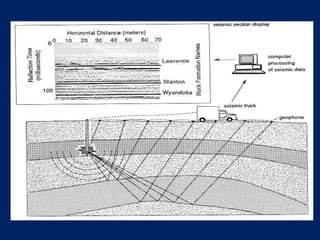
• The reflected waves are recorded at the surface and the travel times and amplitudes
analyzed to map the subsurface.
• Almost all of petroleum exploration is done using the seismic method.
• Seismic energy is detected on land by using devices called geophones, which react to
on-site ground motions.
Compared to other exploration methods, the seismic method gives, by far, the best
subsurface structural and lithological image.
SEISMIC METHOD
SEISMIC METHOD
SEISMIC SURVEY
• OBJECTIVES
• PREPARATION
• PLANNING & DESIGNING
• PARAMETER SELECTION
• DATA ACQUISITION
OBJECTIVES
REGIONAL EXPLORATORY INVESTIGATIONS
• Delineation of structural and stratigraphic anomalies
FIELD DEVELOPMENT
• To mark suitable locations for field development and for reservoir
studies
PROSPECT DELINEATION
• To mark the depth of prospective horizon and trap
closures
PREPARATION
AVAILABLE BUDGET & TIME
AVAILABLE DATA
Geological Data
Geophysical Data
Other Information
GEOLOGICAL DATA
Surface maps
Cross sections
Contour maps
Isopachs
Formation depths/thickness
Lithologies
Well history
Wire Line Logs
MAPS
WELL DATA
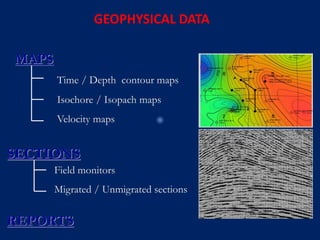
GEOPHYSICAL DATA
Time / Depth contour maps
Isochore / Isopach maps
Velocity maps
MAPS
SECTIONS
Field monitors
Migrated / Unmigrated sections
REPORTS
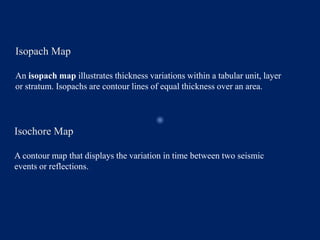
Isochore Map
A contour map that displays the variation in time between two seismic
events or reflections.
Isopach Map
An isopach map illustrates thickness variations within a tabular unit, layer
or stratum. Isopachs are contour lines of equal thickness over an area.
OTHER DATA
• Topographic Maps
• Arial Photographs
• Cultural Information
KEY INFORMATION
• Depth of Target Horizon
• Dip of the Target Horizon
• Arial Extension of Target
• Accessibility in the Area
• Noise Type in the Area
• Thickness of the Weathered Layer
• Structural Settings of the Area
• Terrain
• Climate
PLANNING & DESIGNING
1. ACQUISITION PARAMETERS
2. BID INVITATION
a. Minimum Offset b. Maximum Offset
c. Source Interval
e. No. of Channels
d. Receiver Interval
g. Source
PARAMETER SELECTION
• SPREAD TYPE
• RECEIVER LAYOUT
• SOURCE TYPE
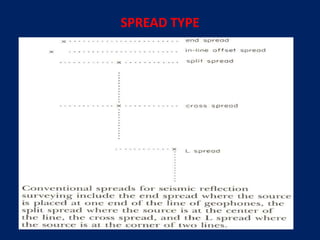
SPREAD TYPE
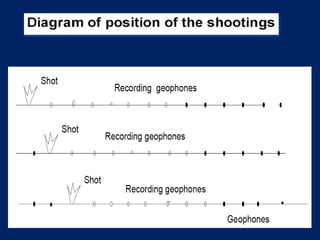
The shot or the vibration point can be situated:
• At the extremity of the active geophones (End shot)
• At the center of the geophones. (Split spread shot)
• At a certain distance (offset) of first geophone
The last geometry allows to have a long distance of offset,
The second is more adapted if the reflectors are tilted.
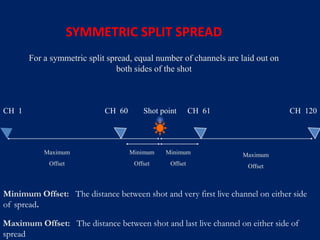
SYMMETRIC SPLIT SPREAD
Maximum
Offset
Minimum
Offset
Minimum
Offset
Maximum
Offset
Shot pointCH 1 CH 61CH 60 CH 120
For a symmetric split spread, equal number of channels are laid out on
both sides of the shot
Minimum Offset: The distance between shot and very first live channel on either side
of spread.
Maximum Offset: The distance between shot and last live channel on either side of
spread
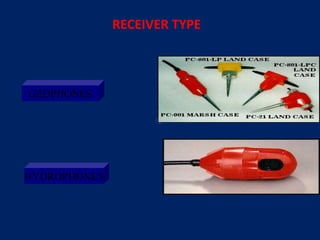
RECEIVER TYPE
GEOPHONES
HYDROPHONES
SEISMIC DETECTORS
• Land detectors (Geophone):
It is a device is used to detect the seismic vibrations.
A geophone is a transducer which transform mechanical energy (seismic vibrations) into
electrical energy.
It consists of a moving coil and a stationary magnet. The movement of the coil due to
vibration creates electromagnetic flux proportional to the magnitude of vibration.
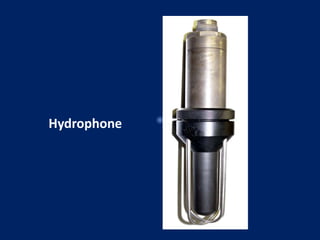
• Marine detectors (Hydrophone):
It is a device used to detect the pressure waves.
A hydrophone is a transducer which convert a sound signal into an electrical signal, since
sound is a pressure wave.
Most hydrophones are based on a piezoelectric transducer that generates electricity when
subjected to a pressure change.
Hydrophone
RECEIVER LAYOUT
Linear Array
Weighted Array
Parallel array
G1 G2 G2
3
G2
4
G1 G12
G24G13
G1 G10 G11 G12
G13 G14 G15 G24
Weight drop
Dynamite
SOURCE TYPE
Vibroseis
Hammer
LAND SURVEY
MARINE SURVEY
Air Gun
SEISMIC SOURCES
• Land Sources:
• A‐Impulsive sources: which are divided to Explosive sources such as Dynamite
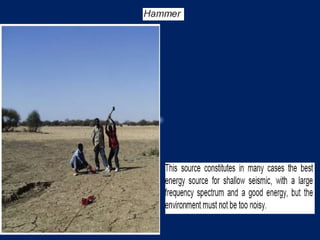
(common in Petroleum exploration), and Non Explosive such as Weight drop &
Hammers (common in shallow seismic investigation).
• B‐Non impulsive sources: the main common is Vibroseis which is a designed
vehicle lift its weight on large plate in contact with ground surface in sweeps.
• Up Sweep: Frequency begins low & increase with time.
• Down Sweep: Frequency begins high & decrease with time.
• Marine sources:
• Air gun: the common in offshore survey (first produced in 1960). This gun
releases highly compressed air into water. It uses a compressed air at 2000‐
5000PSI to produce an explosive blast of air. Several air guns with different sizes
are fired to enhance their initial pulses & reduce their bubble effects.
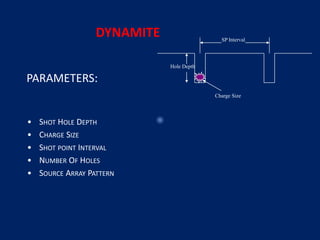
DYNAMITE
• SHOT HOLE DEPTH
• CHARGE SIZE
• SHOT POINT INTERVAL
• NUMBER OF HOLES
• SOURCE ARRAY PATTERN
SP Interval
Hole Depth
Charge Size
PARAMETERS:
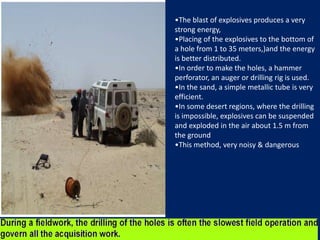
•The blast of explosives produces a very
strong energy,
•Placing of the explosives to the bottom of
a hole from 1 to 35 meters,)and the energy
is better distributed.
•In order to make the holes, a hammer
perforator, an auger or drilling rig is used.
•In the sand, a simple metallic tube is very
efficient.
•In some desert regions, where the drilling
is impossible, explosives can be suspended
and exploded in the air about 1.5 m from
the ground
•This method, very noisy & dangerous
VIBROSEIS
SOURCE POINT
Due to different types of sources the source
point is referred as:
• Shot Point (SP) for Dynamite Sources
• Vibroseis Point (VP) for Vibroseis Sources
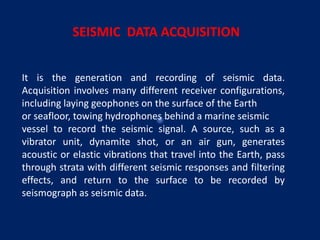
It is the generation and recording of seismic data.
Acquisition involves many different receiver configurations,
including laying geophones on the surface of the Earth
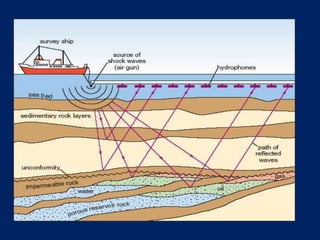
or seafloor, towing hydrophones behind a marine seismic
vessel to record the seismic signal. A source, such as a
vibrator unit, dynamite shot, or an air gun, generates
acoustic or elastic vibrations that travel into the Earth, pass
through strata with different seismic responses and filtering
effects, and return to the surface to be recorded by
seismograph as seismic data.
SEISMIC DATA ACQUISITION
INSTRUMENT FOR SEISMIC SURVEYING
1. Geophone/Hydrophone
2. Energy Source
3. Seismic Crew
4. Seismic Cables
5. Recorder/Seismograph
REFLECTION FROM A HORIZONTAL
REFLECTOR
Offset
CMP
Surface
Reflector
Source Detector
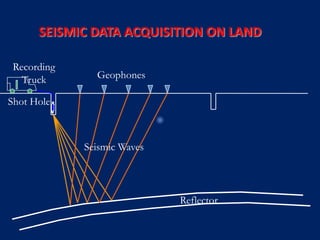
SEISMIC DATA ACQUISITION ON LAND
Shot Hole
Geophones
Recording
Truck
Seismic Waves
Reflector
SEISMIC DATA ACQUISITION IN MARINE
Hydrophones
Seismic ship
Seismic Waves
Shot
Reflector
Streamer
Sea surface
• Survey Crew
• Drilling Crew
• Loading Crew
• Layout Crew
• Recording Crew
• Shooting Crew
• LVL Crew
• Safety Crew (HSE)
SEISMIC CREWS
Trimble Man Pack - 4700 GPS
• GPS used by the Survey Crew
for locating the Source & Receiver
Points of the Seismic lines, carried
on their shoulders
External Batteries and Receiver
• Its is connected with two external
batteries and a receiver which receives
the signal from the satellite.
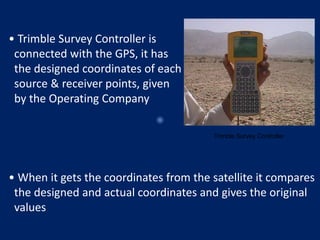
• Trimble Survey Controller is
connected with the GPS, it has
the designed coordinates of each
source & receiver points, given
by the Operating Company
Trimble Survey Controller
• When it gets the coordinates from the satellite it compares
the designed and actual coordinates and gives the original
values
Shot Points Receiver Points
• After locating the points, the crew mark the places of
source and receiver points finally marking a seismic line
Source Points with red paint Receiver Points with white paint
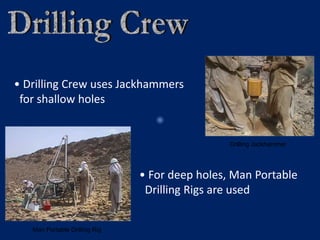
Drilling Jackhammer
• Drilling Crew uses Jackhammers
for shallow holes
Man Portable Drilling Rig
• For deep holes, Man Portable
Drilling Rigs are used
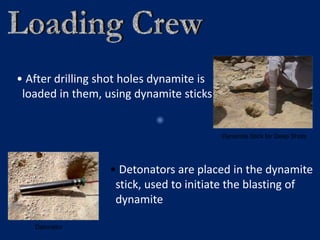
Dynamite Stick for Deep Shots
• After drilling shot holes dynamite is
loaded in them, using dynamite sticks
Detonator
• Detonators are placed in the dynamite
stick, used to initiate the blasting of
dynamite
• Lowering of Charge in a Drilled Hole
with detonator in them
• Hole is loaded and filled with Sand
• Loading is done and place is marked
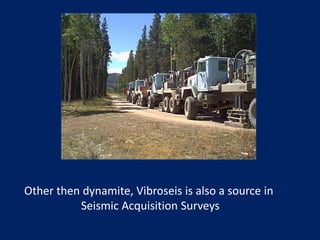
Other then dynamite, Vibroseis is also a source in
Seismic Acquisition Surveys
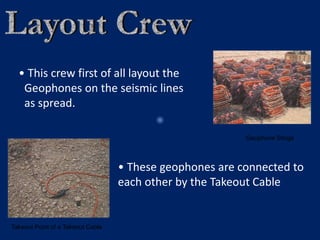
Geophone Stings
Takeout Point of a Takeout Cable
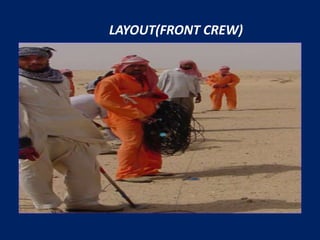
• This crew first of all layout the
Geophones on the seismic lines
as spread.
• These geophones are connected to
each other by the Takeout Cable
CABLE & GEOPHONE
Link cableGeophone string
LAYOUT(FRONT CREW)
CABLE LAYOUT
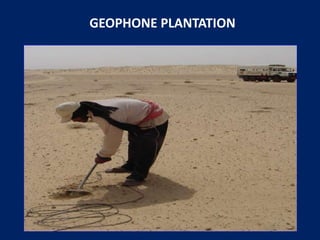
GEOPHONE PLANTATION
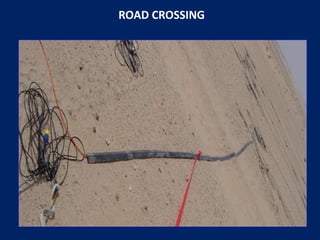
ROAD CROSSING
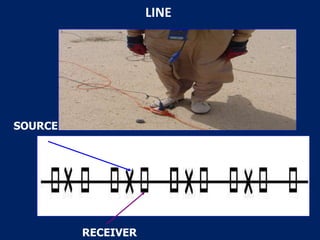
LINE
SOURCE
RECEIVER
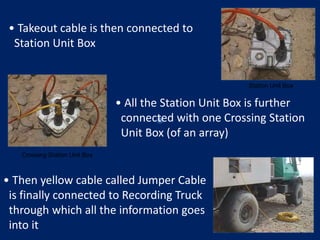
Station Unit Box
• Takeout cable is then connected to
Station Unit Box
Crossing Station Unit Box
• All the Station Unit Box is further
connected with one Crossing Station
Unit Box (of an array)
• Then yellow cable called Jumper Cable
is finally connected to Recording Truck
through which all the information goes
into it
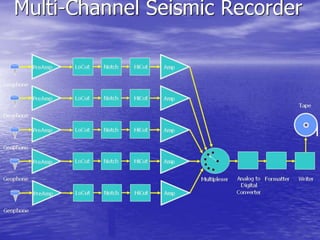
RECORDER
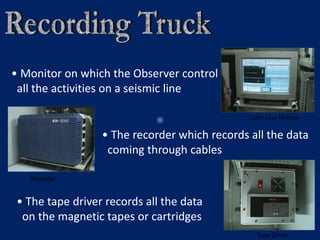
RECORDING
Color Line Monitor
Recorder
Tape Driver
• Monitor on which the Observer control
all the activities on a seismic line
• The recorder which records all the data
coming through cables
• The tape driver records all the data
on the magnetic tapes or cartridges
Camera
Seismic Source Synchronizer
• The thermal plotter used to make a hard
copy of the recorded data
• Device which synchronizes the blaster.
Before shooting, recorder presses ARM
button to charge the detonators, at the
same time the blaster operator presses
the ARM button in the blaster
• Then recorder presses GO button to
blast the dynamite
Blaster
• Bag carried by the shooting crew is called
The Blaster, it works in coordination with
the Seismic Source Synchronizer
• “Blast view” on seismic
line
Portable recording system
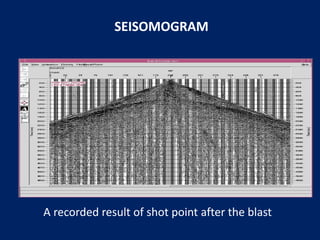
SEISOMOGRAPH
A recorded result of shot point after the blast
SEISOMOGRAM
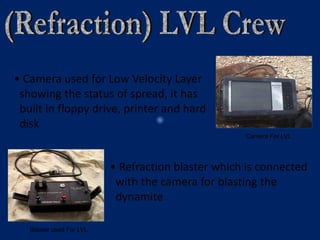
Camera For LVL
Blaster used For LVL
• Camera used for Low Velocity Layer
showing the status of spread, it has
built in floppy drive, printer and hard
disk
• Refraction blaster which is connected
with the camera for blasting the
dynamite
LVL Spread
• A view of a spread for the Refraction
Survey
• Recorded result of an Low
Velocity Layer shot
• Safety Caps
• Foot Wears
• Coveralls
• Loose Clothing
• Water Bottles
• Fire Extinguishers, Fire Alarms, Smoke Alarms
• Sign Boards
• The job of this crew is to provide the following things
to all the crews
• After all the shots are recorded every thing is wounded
• The data is send to the Operator Company
• The place is restored by the Green Team and inspected by
the Client Company
• Then Operator Company sends data to DGPC
Seismograph:
It is the instrument that measure motions of the
ground, including those of seismic waves
generated by earthquakes, nuclear explosions, and
other seismic sources.
Seismogram:
It is a graph output by a seismograph. It is a record of
the ground motion at a measuring station as a function
of time.
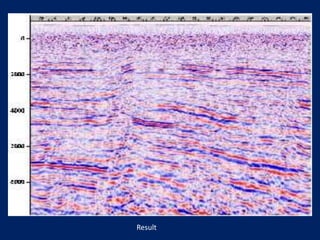
Two‐dimensional survey (2‐D):
Seismic data or a group of seismic lines acquired individually such that there typically
are significant gaps (commonly 1 km or more) between adjacent lines. A 2D survey
typically contains numerous lines acquired orthogonally to the strike of geological
structures (such as faults and folds) with a minimum of lines acquired parallel to
geological structures to allow line‐to‐line tying of the seismic data and interpretation
and mapping of structures.
The seismic data recorded by 2‐D survey is seismic line.
Three‐dimensional survey (3‐D):
The acquisition of seismic data as closely spaced receiver and shot lines such that
there typically are no significant gaps in the subsurface coverage.
The seismic data recorded by 3‐D survey is seismic cube.
LAND SURVEY
The 2-D method, which can be used to map structures along widely spaced
traverses.
Geometry
2‐D SURVEY
Result
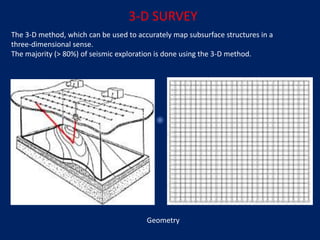
The 3-D method, which can be used to accurately map subsurface structures in a
three-dimensional sense.
The majority (> 80%) of seismic exploration is done using the 3-D method.
Geometry
3‐D SURVEY
Result
Seismic cube
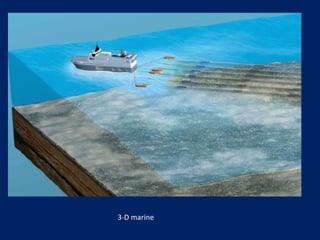
2‐D and 3‐D survey in marine differ from land survey by:
‐The seismic source is Air gun & not dynamite or Vibroseis
‐The seismic detector is Hydrophone & not a geophone
‐The sources and detectors are always at depth below the sea level & the depth
of the cable is controlled by Streamer‐Birds
‐The receivers are connected together by streamer.
MARINE SURVEY
2‐D marine
3‐D marine
Tail buoy:
A floating device used in marine seismic acquisition to identify the
end of streamer. It allows the seismic acquisition crew to monitor
location and direction of streamers.
Streamer Bird:
A device connected with the streamer to control the depth of
streamer.
Streamer Bird
REFRACTION SURVEY
Advantages
– Amplitude of refractor are large.
– Best for exploration of shallow structures.
– Easy to process and interpret.
Disadvantages
– Exploration for deeper structures is difficult because of large XCrit distance,
– Blind to low velocity layers.
SEISMIC REFLECTION SURVEY
Advantages
– Geophone spread needed is relatively shorter.
– Not blind to low velocity layers. Since acoustic impedance exist for
every layer.
– Convenient for deeper exploration.
Disadvantages
– Difficulty in recognizing reflected waves.
– Small amplitude.
– Obscured by overlapping refracted and surface waves.
SEISMIC NOISE
Noise is the undesired information contained on
a seismic record which one does not wish to use
and these are to be filtered. There are two types
of seismic noises encountered in seismic survey
are;
(1) Coherent Noise.
(2) Incoherent Noise or Random Noise.
(1)COHERENT NOISE
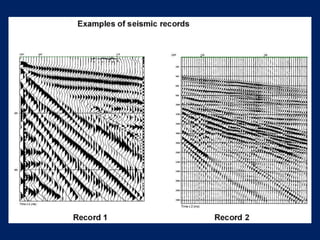
• It displays some regular patterns on seismogram.
• It is seismic energy which aligns from trace to trace or record to
record on seismic record .
• Often, it is very similar to the signal and usually more difficult to
overcome than the incoherent/random noise.
• By examining the patterns of coherent noise, we can
devise field procedures to reduce it.
It has various sources as discussed below
Ground Rolls
Direct arrivals
Refracted events
Multiples reflections
Diffraction events
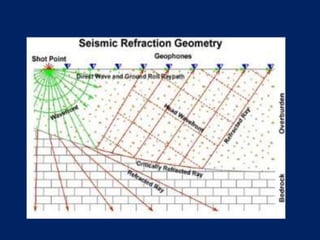
• Head waves are always the first events seen on a record.
• They are linear and often very visible and strong.
• Sometimes they can disappear with large offset.
• Many geophysicists try to remove head wave using
•surgical mute,
•FK filtering
•adapted NMO stretch mute value,
• but in some case, uppermost reflection and refraction can be very
close and difficult to distinguish.
Direct and Refracted waves
Refracted Waves
In Seismic reflection survey the refracted events
comes as first arrival.
Ground Roll
Ground rolls are Rayleigh waves which appear as
second arrival on seismic section.
• Surface waves (Rayleigh, Love) primarily Rayleigh are
– low velocity,
– low frequency signal,
– With relatively higher amplitude seen below shots.
They override the useful reflections.
• They can be reduced using
– frequency filtering.
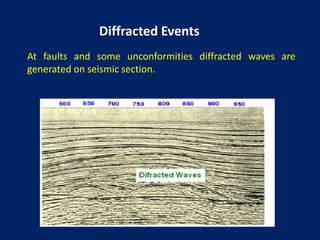
Diffracted Events
At faults and some unconformities diffracted waves are
generated on seismic section.
• The seismic reflection takes an interest essentially to the P
compression waves, in the setting of seismic studies for the geo-
technical; the recording of the S waves can to prove out to be
useful for the shearing modules calculation.
• In knowing the velocity of the P waves and S, it is possible of
calculating the Poisson’s ratio:
S Waves
(2)INCOHERENT NOISE OR RANDOM NOISE
It is the seismic energy that does not align up from
trace to trace or record to record on seismic record. It
displays no systematic pattern.
This noise is uncorrectable.
We can overcome random noises by recording more
than one traces from the same location.
It has various sources such as given below.
i. Wind Noise
ii. Water Flow Noise
iii. Small Movement With in the Earth
iv. Local Noise
v. Bad Geophone Noise
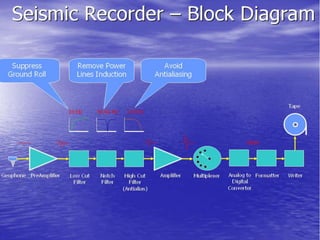
FILTERING
A process or algorithm using a set of limits used to eliminate unwanted portions of
seismic data, commonly on the basis of frequency or amplitude, to enhance the signal-
to-noise ratio of the data.
The common use of digital filter in data processing is to filter out unwanted frequencies.
Types of filters:
• Band-Pass filter:
A filter used to pass a defined band of frequencies.
Any high or low frequencies outside this range will be attenuated.
• Low-Cut filter (High pass):
A filter that pass only the high frequencies and eliminate the low frequencies.
• High-Cut filter (Low-Pass):
A filter that pass only the low frequencies and eliminate the high frequencies.
• Notch filter:
It is used to filter out narrow band of frequencies within frequency range of
data
The most common use of this filter is to attenuate noises caused by power
lines.

New introduction to seismic method

  • 1.
    • Measurement ofseismic-wave travel time is one of the most common geophysical method. • The main objective of this method is to map the structures of subsurface formations in order to infer the existence of possible petroleum traps. • In addition, the method can be used to identify lithology (rock type), fluid content (oil, gas, or water), and fine structures (fractures). • In this method, seismic energy is generated artificially at the near surface and the generated waves travel in the subsurface and get reflected and refracted off layer boundaries. • Seismic exploration is divided into refraction and reflection surveys, depending on whether the predominant portion of the seismic waves travel is horizontal or vertical. • Refraction seismic surveys are used in engineering geophysics and petroleum exploration. • Seismic reflection surveys, on the other hand is widely used in petroleum exploration; e.g. to detect boundaries between different kinds of rocks, this detection assists in the mapping of geological structures. • The reflected waves are recorded at the surface and the travel times and amplitudes analyzed to map the subsurface. • Almost all of petroleum exploration is done using the seismic method. • Seismic energy is detected on land by using devices called geophones, which react to on-site ground motions. Compared to other exploration methods, the seismic method gives, by far, the best subsurface structural and lithological image. SEISMIC METHOD
  • 2.
  • 3.
    SEISMIC SURVEY • OBJECTIVES •PREPARATION • PLANNING & DESIGNING • PARAMETER SELECTION • DATA ACQUISITION
  • 4.
    OBJECTIVES REGIONAL EXPLORATORY INVESTIGATIONS •Delineation of structural and stratigraphic anomalies FIELD DEVELOPMENT • To mark suitable locations for field development and for reservoir studies PROSPECT DELINEATION • To mark the depth of prospective horizon and trap closures
  • 5.
    PREPARATION AVAILABLE BUDGET &TIME AVAILABLE DATA Geological Data Geophysical Data Other Information
  • 6.
    GEOLOGICAL DATA Surface maps Crosssections Contour maps Isopachs Formation depths/thickness Lithologies Well history Wire Line Logs MAPS WELL DATA
  • 7.
    GEOPHYSICAL DATA Time /Depth contour maps Isochore / Isopach maps Velocity maps MAPS SECTIONS Field monitors Migrated / Unmigrated sections REPORTS
  • 8.
    Isochore Map A contourmap that displays the variation in time between two seismic events or reflections. Isopach Map An isopach map illustrates thickness variations within a tabular unit, layer or stratum. Isopachs are contour lines of equal thickness over an area.
  • 9.
    OTHER DATA • TopographicMaps • Arial Photographs • Cultural Information
  • 10.
    KEY INFORMATION • Depthof Target Horizon • Dip of the Target Horizon • Arial Extension of Target • Accessibility in the Area • Noise Type in the Area • Thickness of the Weathered Layer • Structural Settings of the Area • Terrain • Climate
  • 11.
    PLANNING & DESIGNING 1.ACQUISITION PARAMETERS 2. BID INVITATION a. Minimum Offset b. Maximum Offset c. Source Interval e. No. of Channels d. Receiver Interval g. Source
  • 12.
    PARAMETER SELECTION • SPREADTYPE • RECEIVER LAYOUT • SOURCE TYPE
  • 13.
  • 14.
    The shot orthe vibration point can be situated: • At the extremity of the active geophones (End shot) • At the center of the geophones. (Split spread shot) • At a certain distance (offset) of first geophone The last geometry allows to have a long distance of offset, The second is more adapted if the reflectors are tilted.
  • 16.
    SYMMETRIC SPLIT SPREAD Maximum Offset Minimum Offset Minimum Offset Maximum Offset ShotpointCH 1 CH 61CH 60 CH 120 For a symmetric split spread, equal number of channels are laid out on both sides of the shot Minimum Offset: The distance between shot and very first live channel on either side of spread. Maximum Offset: The distance between shot and last live channel on either side of spread
  • 17.
  • 18.
    SEISMIC DETECTORS • Landdetectors (Geophone): It is a device is used to detect the seismic vibrations. A geophone is a transducer which transform mechanical energy (seismic vibrations) into electrical energy. It consists of a moving coil and a stationary magnet. The movement of the coil due to vibration creates electromagnetic flux proportional to the magnitude of vibration. • Marine detectors (Hydrophone): It is a device used to detect the pressure waves. A hydrophone is a transducer which convert a sound signal into an electrical signal, since sound is a pressure wave. Most hydrophones are based on a piezoelectric transducer that generates electricity when subjected to a pressure change.
  • 20.
  • 21.
    RECEIVER LAYOUT Linear Array WeightedArray Parallel array G1 G2 G2 3 G2 4 G1 G12 G24G13 G1 G10 G11 G12 G13 G14 G15 G24
  • 23.
  • 24.
  • 25.
    SEISMIC SOURCES • LandSources: • A‐Impulsive sources: which are divided to Explosive sources such as Dynamite (common in Petroleum exploration), and Non Explosive such as Weight drop & Hammers (common in shallow seismic investigation). • B‐Non impulsive sources: the main common is Vibroseis which is a designed vehicle lift its weight on large plate in contact with ground surface in sweeps. • Up Sweep: Frequency begins low & increase with time. • Down Sweep: Frequency begins high & decrease with time. • Marine sources: • Air gun: the common in offshore survey (first produced in 1960). This gun releases highly compressed air into water. It uses a compressed air at 2000‐ 5000PSI to produce an explosive blast of air. Several air guns with different sizes are fired to enhance their initial pulses & reduce their bubble effects.
  • 26.
    DYNAMITE • SHOT HOLEDEPTH • CHARGE SIZE • SHOT POINT INTERVAL • NUMBER OF HOLES • SOURCE ARRAY PATTERN SP Interval Hole Depth Charge Size PARAMETERS:
  • 27.
    •The blast ofexplosives produces a very strong energy, •Placing of the explosives to the bottom of a hole from 1 to 35 meters,)and the energy is better distributed. •In order to make the holes, a hammer perforator, an auger or drilling rig is used. •In the sand, a simple metallic tube is very efficient. •In some desert regions, where the drilling is impossible, explosives can be suspended and exploded in the air about 1.5 m from the ground •This method, very noisy & dangerous
  • 28.
  • 33.
    SOURCE POINT Due todifferent types of sources the source point is referred as: • Shot Point (SP) for Dynamite Sources • Vibroseis Point (VP) for Vibroseis Sources
  • 34.
    It is thegeneration and recording of seismic data. Acquisition involves many different receiver configurations, including laying geophones on the surface of the Earth or seafloor, towing hydrophones behind a marine seismic vessel to record the seismic signal. A source, such as a vibrator unit, dynamite shot, or an air gun, generates acoustic or elastic vibrations that travel into the Earth, pass through strata with different seismic responses and filtering effects, and return to the surface to be recorded by seismograph as seismic data. SEISMIC DATA ACQUISITION
  • 35.
    INSTRUMENT FOR SEISMICSURVEYING 1. Geophone/Hydrophone 2. Energy Source 3. Seismic Crew 4. Seismic Cables 5. Recorder/Seismograph
  • 38.
    REFLECTION FROM AHORIZONTAL REFLECTOR Offset CMP Surface Reflector Source Detector
  • 39.
    SEISMIC DATA ACQUISITIONON LAND Shot Hole Geophones Recording Truck Seismic Waves Reflector
  • 40.
    SEISMIC DATA ACQUISITIONIN MARINE Hydrophones Seismic ship Seismic Waves Shot Reflector Streamer Sea surface
  • 41.
    • Survey Crew •Drilling Crew • Loading Crew • Layout Crew • Recording Crew • Shooting Crew • LVL Crew • Safety Crew (HSE) SEISMIC CREWS
  • 42.
    Trimble Man Pack- 4700 GPS • GPS used by the Survey Crew for locating the Source & Receiver Points of the Seismic lines, carried on their shoulders External Batteries and Receiver • Its is connected with two external batteries and a receiver which receives the signal from the satellite.
  • 43.
    • Trimble SurveyController is connected with the GPS, it has the designed coordinates of each source & receiver points, given by the Operating Company Trimble Survey Controller • When it gets the coordinates from the satellite it compares the designed and actual coordinates and gives the original values
  • 44.
    Shot Points ReceiverPoints • After locating the points, the crew mark the places of source and receiver points finally marking a seismic line Source Points with red paint Receiver Points with white paint
  • 45.
    Drilling Jackhammer • DrillingCrew uses Jackhammers for shallow holes Man Portable Drilling Rig • For deep holes, Man Portable Drilling Rigs are used
  • 46.
    Dynamite Stick forDeep Shots • After drilling shot holes dynamite is loaded in them, using dynamite sticks Detonator • Detonators are placed in the dynamite stick, used to initiate the blasting of dynamite
  • 47.
    • Lowering ofCharge in a Drilled Hole with detonator in them • Hole is loaded and filled with Sand • Loading is done and place is marked
  • 48.
    Other then dynamite,Vibroseis is also a source in Seismic Acquisition Surveys
  • 49.
    Geophone Stings Takeout Pointof a Takeout Cable • This crew first of all layout the Geophones on the seismic lines as spread. • These geophones are connected to each other by the Takeout Cable
  • 50.
    CABLE & GEOPHONE LinkcableGeophone string
  • 51.
  • 52.
  • 53.
  • 54.
  • 55.
  • 56.
    Station Unit Box •Takeout cable is then connected to Station Unit Box Crossing Station Unit Box • All the Station Unit Box is further connected with one Crossing Station Unit Box (of an array) • Then yellow cable called Jumper Cable is finally connected to Recording Truck through which all the information goes into it
  • 57.
  • 58.
    Color Line Monitor Recorder TapeDriver • Monitor on which the Observer control all the activities on a seismic line • The recorder which records all the data coming through cables • The tape driver records all the data on the magnetic tapes or cartridges
  • 59.
    Camera Seismic Source Synchronizer •The thermal plotter used to make a hard copy of the recorded data • Device which synchronizes the blaster. Before shooting, recorder presses ARM button to charge the detonators, at the same time the blaster operator presses the ARM button in the blaster • Then recorder presses GO button to blast the dynamite
  • 60.
    Blaster • Bag carriedby the shooting crew is called The Blaster, it works in coordination with the Seismic Source Synchronizer • “Blast view” on seismic line
  • 61.
  • 65.
    A recorded resultof shot point after the blast SEISOMOGRAM
  • 69.
    Camera For LVL Blasterused For LVL • Camera used for Low Velocity Layer showing the status of spread, it has built in floppy drive, printer and hard disk • Refraction blaster which is connected with the camera for blasting the dynamite
  • 70.
    LVL Spread • Aview of a spread for the Refraction Survey • Recorded result of an Low Velocity Layer shot
  • 71.
    • Safety Caps •Foot Wears • Coveralls • Loose Clothing • Water Bottles • Fire Extinguishers, Fire Alarms, Smoke Alarms • Sign Boards • The job of this crew is to provide the following things to all the crews
  • 72.
    • After allthe shots are recorded every thing is wounded • The data is send to the Operator Company • The place is restored by the Green Team and inspected by the Client Company • Then Operator Company sends data to DGPC
  • 73.
    Seismograph: It is theinstrument that measure motions of the ground, including those of seismic waves generated by earthquakes, nuclear explosions, and other seismic sources. Seismogram: It is a graph output by a seismograph. It is a record of the ground motion at a measuring station as a function of time.
  • 74.
    Two‐dimensional survey (2‐D): Seismicdata or a group of seismic lines acquired individually such that there typically are significant gaps (commonly 1 km or more) between adjacent lines. A 2D survey typically contains numerous lines acquired orthogonally to the strike of geological structures (such as faults and folds) with a minimum of lines acquired parallel to geological structures to allow line‐to‐line tying of the seismic data and interpretation and mapping of structures. The seismic data recorded by 2‐D survey is seismic line. Three‐dimensional survey (3‐D): The acquisition of seismic data as closely spaced receiver and shot lines such that there typically are no significant gaps in the subsurface coverage. The seismic data recorded by 3‐D survey is seismic cube. LAND SURVEY
  • 75.
    The 2-D method,which can be used to map structures along widely spaced traverses. Geometry 2‐D SURVEY
  • 76.
  • 77.
    The 3-D method,which can be used to accurately map subsurface structures in a three-dimensional sense. The majority (> 80%) of seismic exploration is done using the 3-D method. Geometry 3‐D SURVEY
  • 78.
  • 79.
  • 80.
    2‐D and 3‐Dsurvey in marine differ from land survey by: ‐The seismic source is Air gun & not dynamite or Vibroseis ‐The seismic detector is Hydrophone & not a geophone ‐The sources and detectors are always at depth below the sea level & the depth of the cable is controlled by Streamer‐Birds ‐The receivers are connected together by streamer. MARINE SURVEY
  • 81.
  • 82.
  • 83.
    Tail buoy: A floatingdevice used in marine seismic acquisition to identify the end of streamer. It allows the seismic acquisition crew to monitor location and direction of streamers. Streamer Bird: A device connected with the streamer to control the depth of streamer.
  • 84.
  • 86.
    REFRACTION SURVEY Advantages – Amplitudeof refractor are large. – Best for exploration of shallow structures. – Easy to process and interpret. Disadvantages – Exploration for deeper structures is difficult because of large XCrit distance, – Blind to low velocity layers.
  • 87.
    SEISMIC REFLECTION SURVEY Advantages –Geophone spread needed is relatively shorter. – Not blind to low velocity layers. Since acoustic impedance exist for every layer. – Convenient for deeper exploration. Disadvantages – Difficulty in recognizing reflected waves. – Small amplitude. – Obscured by overlapping refracted and surface waves.
  • 89.
    SEISMIC NOISE Noise isthe undesired information contained on a seismic record which one does not wish to use and these are to be filtered. There are two types of seismic noises encountered in seismic survey are; (1) Coherent Noise. (2) Incoherent Noise or Random Noise.
  • 90.
    (1)COHERENT NOISE • Itdisplays some regular patterns on seismogram. • It is seismic energy which aligns from trace to trace or record to record on seismic record . • Often, it is very similar to the signal and usually more difficult to overcome than the incoherent/random noise. • By examining the patterns of coherent noise, we can devise field procedures to reduce it.
  • 91.
    It has varioussources as discussed below Ground Rolls Direct arrivals Refracted events Multiples reflections Diffraction events
  • 93.
    • Head wavesare always the first events seen on a record. • They are linear and often very visible and strong. • Sometimes they can disappear with large offset. • Many geophysicists try to remove head wave using •surgical mute, •FK filtering •adapted NMO stretch mute value, • but in some case, uppermost reflection and refraction can be very close and difficult to distinguish. Direct and Refracted waves
  • 94.
    Refracted Waves In Seismicreflection survey the refracted events comes as first arrival.
  • 95.
    Ground Roll Ground rollsare Rayleigh waves which appear as second arrival on seismic section.
  • 96.
    • Surface waves(Rayleigh, Love) primarily Rayleigh are – low velocity, – low frequency signal, – With relatively higher amplitude seen below shots. They override the useful reflections. • They can be reduced using – frequency filtering.
  • 97.
    Diffracted Events At faultsand some unconformities diffracted waves are generated on seismic section.
  • 100.
    • The seismicreflection takes an interest essentially to the P compression waves, in the setting of seismic studies for the geo- technical; the recording of the S waves can to prove out to be useful for the shearing modules calculation. • In knowing the velocity of the P waves and S, it is possible of calculating the Poisson’s ratio: S Waves
  • 101.
    (2)INCOHERENT NOISE ORRANDOM NOISE It is the seismic energy that does not align up from trace to trace or record to record on seismic record. It displays no systematic pattern. This noise is uncorrectable. We can overcome random noises by recording more than one traces from the same location. It has various sources such as given below. i. Wind Noise ii. Water Flow Noise iii. Small Movement With in the Earth iv. Local Noise v. Bad Geophone Noise
  • 102.
    FILTERING A process oralgorithm using a set of limits used to eliminate unwanted portions of seismic data, commonly on the basis of frequency or amplitude, to enhance the signal- to-noise ratio of the data. The common use of digital filter in data processing is to filter out unwanted frequencies. Types of filters: • Band-Pass filter: A filter used to pass a defined band of frequencies. Any high or low frequencies outside this range will be attenuated. • Low-Cut filter (High pass): A filter that pass only the high frequencies and eliminate the low frequencies. • High-Cut filter (Low-Pass): A filter that pass only the low frequencies and eliminate the high frequencies. • Notch filter: It is used to filter out narrow band of frequencies within frequency range of data The most common use of this filter is to attenuate noises caused by power lines.