Texture
Texture of edimentary rocks is of mainly two types, based on what they are made of and
how they form. Clastic sedimentary rocks are composed of pieces of rock, minerals, or
fossils that are mechanical transported, formed by weathering, erosion and transportation
process viz., Sandstone, conglomerate etc. Whereas, non clastic or chemical sedimentary
rocks form by precipitation or the growth of new minerals in water.
Grain Size
The grain size, shape and roundness of the sediments are the principal components of
texture of sediments and sedimentary rocks. Essentially the texture is the micro geometry
of the rock OR the features and arrangements of the grains in the sediment, especially the
grain size.
The terms such as coarse grained, angular or imbricated describe the textural attributes.
Texture has grain-to-grain relations. It is best studied in thin section or by analysis of
small portion of unconsolidated material.
The study of grain size of clastic/detrital sediment is of considerable importance to
sedimentologists for that it helps to understand the paleoenvironment, provenance or
source, sediment transport direction, depositional environment etc. In normal terrigenous
water-deposited materials, grain size is the measure of the proximity of the source area
and distance of transport i.e., coarser deposits usually have not moved so far. The size;
and uniformity of size or sorting are measures of the competence and efficiency of the
transporting agent. Sorting refers to the distribution of grain sizes in a rock. If all of the
grains are of same size, the rock is "well sorted". If there is a mixture of grain sizes, such
as sand and clay, or gravel and sand, the rock is "poorly sorted".
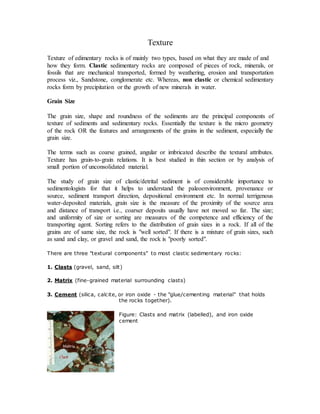
There are three "textural components" to most clastic sedimentary rocks:
1. Clasts (gravel, sand, silt)
2. Matrix (fine-grained material surrounding clasts)
3. Cement (silica, calcite, or iron oxide - the "glue/cementing material" that holds
the rocks together).
Figure: Clasts and matrix (labelled), and iron oxide
cement
The size of sediment particles can be measured by visual estimation or by use of a set of
sieves. The sediment particles larger than several centimeters are usually determined by
direct measurement with vernier calipers or meter sticks. Particles up to about 0.062mm
are analysed by mechanical screening (sieving); and silts & clays finer than 0.062mm are
analysed by pipette or hydrometer. Sands can also be measured by petrographic
microscope or by electronic devices.
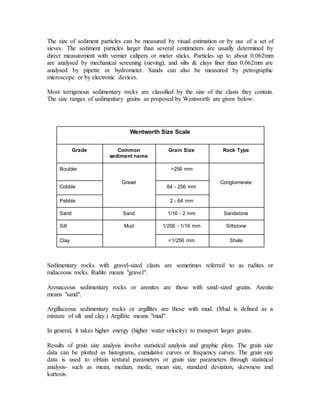
Most terrigenous sedimentary rocks are classified by the size of the clasts they contain.
The size ranges of sedimentary grains as proposed by Wentworth are given below:
Sedimentary rocks with gravel-sized clasts are sometimes referred to as rudites or
rudaceous rocks. Rudite means "gravel".
Arenaceous sedimentary rocks or arenites are those with sand-sized grains. Arenite
means "sand".
Argillaceous sedimentary rocks or argillites are those with mud. (Mud is defined as a
mixture of silt and clay.) Argillite means "mud".
In general, it takes higher energy (higher water velocity) to transport larger grains.
Results of grain size analysis involve statistical analysis and graphic plots. The grain size
data can be plotted as histograms, cumulative curves or frequency curves. The grain size
data is used to obtain textural parameters or grain size parameters through statistical
analysis- such as mean, median, mode, mean size, standard deviation, skewness and
kurtosis.
Wentworth Size Scale
Grade Common
sediment name
Grain Size Rock Type
Boulder
Gravel
>256 mm
Conglomerate
Cobble 64 - 256 mm
Pebble 2 - 64 mm
Sand Sand 1/16 - 2 mm Sandstone
Silt Mud 1/256 - 1/16 mm Siltstone
Clay <1/256 mm Shale
1
N
Roundness and Form or Shape
Roundness and shape of clastic materials are two separate parameters, which are used in
determining the texture of the sediments.
Roundness:
Roundness is the degree of angularity of grains, or it is
rounding of the edges and corners of a clastic grain.
According to Wadell, roundness is defined as the ratio of the
average radius of curvature of the edges and corners of a grain
to the curvature of the maximum inscribed sphere. The
roundness of the sphere is 1. The measurements on spheres
(grains) being difficult, two dimensional projections of grains
(by the help of Camera Lucida projections) are generally used.
It is expressed as –
Roundness = ( ∑ ri /N) / R
Where ri are the radii of the corners of the particles, N = the total number of corners
measured, and R is the radius of the largest possible inscribed circle.
Shape:
Shape is expressed as the ratio between the three measurable diameters of an irregular
grain: length, breadth and width.
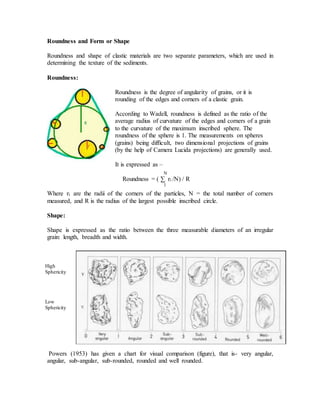
Powers (1953) has given a chart for visual comparison (figure), that is- very angular,
angular, sub-angular, sub-rounded, rounded and well rounded.
Low
Sphericity
High
Sphericity
Form
Form refers to attributes involving the three dimensional morphology: i.e., the variation
in proportion of the three axes which define the geometric shape:
Zing diagrams - plot the ratio of the axes (short: intermediate) vs. (intermediate to long).
The shape terms given in the picture are most commonly used to describe pebble to
boulder size particles. Often a visual estimate, rather than actual measurements are used.

Sediment texture

  • 1.
    Texture Texture of edimentaryrocks is of mainly two types, based on what they are made of and how they form. Clastic sedimentary rocks are composed of pieces of rock, minerals, or fossils that are mechanical transported, formed by weathering, erosion and transportation process viz., Sandstone, conglomerate etc. Whereas, non clastic or chemical sedimentary rocks form by precipitation or the growth of new minerals in water. Grain Size The grain size, shape and roundness of the sediments are the principal components of texture of sediments and sedimentary rocks. Essentially the texture is the micro geometry of the rock OR the features and arrangements of the grains in the sediment, especially the grain size. The terms such as coarse grained, angular or imbricated describe the textural attributes. Texture has grain-to-grain relations. It is best studied in thin section or by analysis of small portion of unconsolidated material. The study of grain size of clastic/detrital sediment is of considerable importance to sedimentologists for that it helps to understand the paleoenvironment, provenance or source, sediment transport direction, depositional environment etc. In normal terrigenous water-deposited materials, grain size is the measure of the proximity of the source area and distance of transport i.e., coarser deposits usually have not moved so far. The size; and uniformity of size or sorting are measures of the competence and efficiency of the transporting agent. Sorting refers to the distribution of grain sizes in a rock. If all of the grains are of same size, the rock is "well sorted". If there is a mixture of grain sizes, such as sand and clay, or gravel and sand, the rock is "poorly sorted". There are three "textural components" to most clastic sedimentary rocks: 1. Clasts (gravel, sand, silt) 2. Matrix (fine-grained material surrounding clasts) 3. Cement (silica, calcite, or iron oxide - the "glue/cementing material" that holds the rocks together). Figure: Clasts and matrix (labelled), and iron oxide cement
  • 2.
    The size ofsediment particles can be measured by visual estimation or by use of a set of sieves. The sediment particles larger than several centimeters are usually determined by direct measurement with vernier calipers or meter sticks. Particles up to about 0.062mm are analysed by mechanical screening (sieving); and silts & clays finer than 0.062mm are analysed by pipette or hydrometer. Sands can also be measured by petrographic microscope or by electronic devices. Most terrigenous sedimentary rocks are classified by the size of the clasts they contain. The size ranges of sedimentary grains as proposed by Wentworth are given below: Sedimentary rocks with gravel-sized clasts are sometimes referred to as rudites or rudaceous rocks. Rudite means "gravel". Arenaceous sedimentary rocks or arenites are those with sand-sized grains. Arenite means "sand". Argillaceous sedimentary rocks or argillites are those with mud. (Mud is defined as a mixture of silt and clay.) Argillite means "mud". In general, it takes higher energy (higher water velocity) to transport larger grains. Results of grain size analysis involve statistical analysis and graphic plots. The grain size data can be plotted as histograms, cumulative curves or frequency curves. The grain size data is used to obtain textural parameters or grain size parameters through statistical analysis- such as mean, median, mode, mean size, standard deviation, skewness and kurtosis. Wentworth Size Scale Grade Common sediment name Grain Size Rock Type Boulder Gravel >256 mm Conglomerate Cobble 64 - 256 mm Pebble 2 - 64 mm Sand Sand 1/16 - 2 mm Sandstone Silt Mud 1/256 - 1/16 mm Siltstone Clay <1/256 mm Shale
  • 3.
    1 N Roundness and Formor Shape Roundness and shape of clastic materials are two separate parameters, which are used in determining the texture of the sediments. Roundness: Roundness is the degree of angularity of grains, or it is rounding of the edges and corners of a clastic grain. According to Wadell, roundness is defined as the ratio of the average radius of curvature of the edges and corners of a grain to the curvature of the maximum inscribed sphere. The roundness of the sphere is 1. The measurements on spheres (grains) being difficult, two dimensional projections of grains (by the help of Camera Lucida projections) are generally used. It is expressed as – Roundness = ( ∑ ri /N) / R Where ri are the radii of the corners of the particles, N = the total number of corners measured, and R is the radius of the largest possible inscribed circle. Shape: Shape is expressed as the ratio between the three measurable diameters of an irregular grain: length, breadth and width. Powers (1953) has given a chart for visual comparison (figure), that is- very angular, angular, sub-angular, sub-rounded, rounded and well rounded. Low Sphericity High Sphericity
  • 4.
    Form Form refers toattributes involving the three dimensional morphology: i.e., the variation in proportion of the three axes which define the geometric shape: Zing diagrams - plot the ratio of the axes (short: intermediate) vs. (intermediate to long). The shape terms given in the picture are most commonly used to describe pebble to boulder size particles. Often a visual estimate, rather than actual measurements are used.