Potential earthquake zone of indian ocean
By :- Chavda hitesh harshadbhai
Roll.no:-04
Department of marine science
Msc Marine Science , Part-2
Goa university
contents
Understanding submarine earthquake
Understanding Tsunami
Triple junction in Indian Ocean
Concept of Aulacogen
Seismic waves in ocean
Ocean bottom seismometer
Sensors :-Geophone ,hydrophone
Measurement of earthquake
Case Study
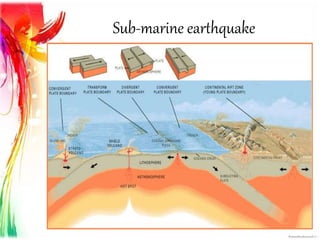
Sub-marine earthquake
Underwater earthquake occur at the bottom of ocean
Leading to cause tsunami
 plate tectonics helps to explain the cause of submarine earthquakes
I. Convergent plate boundary
 older, and denser plate moves below the lighter plate.
 Ex:-Great Sumatran fault
II. Transform plate boundary
 two plates will slide past each other
 Ex:-Owen fracture zone
III. Divergent plate boundary
 two plates are moving away from each other
 Ex:-Carlsberg ridge,90E ridge
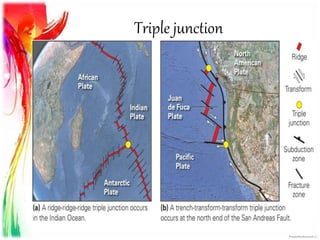
Triple junction
*A point where the boundaries of three tectonic plates meet.
*Three boundaries will be one of 3 types - a ridge (R), trench (T)
or transform fault (F)
*The Rodrigues Triple Junction is a R-R-R triple junction in the
southern Indian Ocean, where the African, the Indo-Australian and
the Antarctic Plates meet.
*Potential zones for earthquake
Aulacogen:-An aulacogen is a failed arm of a triple junction.
-Cause massive earthquakes
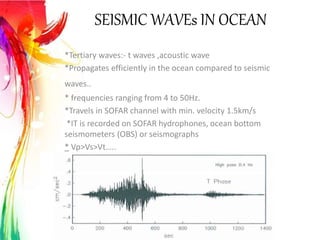
SEISMIC WAVEs IN OCEAN
*Tertiary waves:- t waves ,acoustic wave
*Propagates efficiently in the ocean compared to seismic
waves..
* frequencies ranging from 4 to 50Hz.
*Travels in SOFAR channel with min. velocity 1.5km/s
*IT is recorded on SOFAR hydrophones, ocean bottom
seismometers (OBS) or seismographs
* Vp>Vs>Vt…..
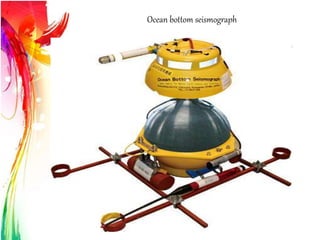
Ocean bottom seismograph
Ocean bottom seismometer- Records earth motion under ocean &
lake
*Works on principal of inertia & Acoustic sounding
*Consists of two sensors 1.Geophone 2.Hydrophone
Types:-
1. Short-period OBSs:- long frequency,
2. Long-period OBSs:- short frequency
Working principle
Different sensors
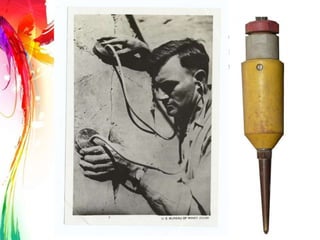
Geophone:-Converts ground movement (velocity)
into voltage,z which converted in to digital signals
*Response of geophone is proportional to ground
velocity,
*geophones are used in reflection seismology to record the energy
waves reflected by the subsurface geology.
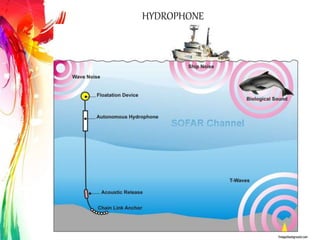
HYDROPHONE
*Microphone designed to be used underwater for recording
or listening to underwater sound.
*Based on a piezoelectric transducer
*Convert a sound signal into an electrical signal since sound
is a pressure wave.
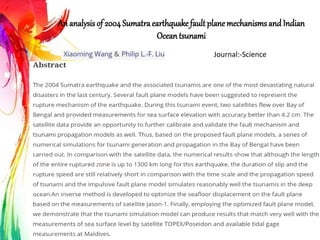
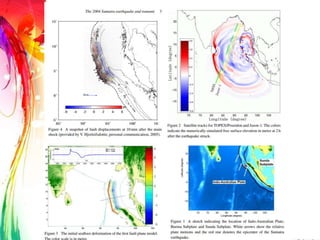
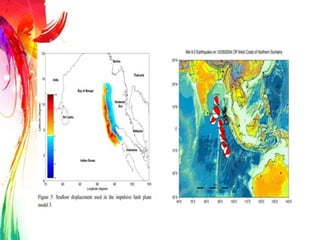
An analysis of 2004Sumatra earthquake fault plane mechanisms and Indian
Ocean tsunami
Journal:-Science
QUICK REVIEW
Dec 26, 2004: Magnitude 9.3 (moment mag)
• Undersea (depth 30 km)
• Epicentre of the W coast of Sumatra
• Tsunami followed, killing 230,000 in 14 countries
• Caused by subduction: A 1600 km faultline slipped ~15 m along
the subduction zone with the India plate slides under the Burma
plate (over several mins)
• Reverse faulting • The 2nd largest earthquake ever recorded on
a seismograph
• 24-30 m waves reaching the coasts • Total E of Tsunami = 5
megatons of TNT • More than twice the total explosive energy
used during all of WWII • Greatest strength waves was in the E-
W direction • Distance is NEVER a guarantee of safety, Somalia
was hit harder than Bangladesh • No warning systems were in
place • The tsunami in deep water is only recognizable by
expensive little sensors
• Coral reefs would have helped, they would have acted as a
barrier
reference
1. Ammon, C.J. et al. (2005). “Rupture Process of the 2004
Sumatra-Andaman Earthquake”. Science 308, 1133–1139.
2. 2. Borrero, J.C. (2005). “Field Data and Satellite Imagery of
Tsunami Effects in Banda Aceh”. Science 308, 1596.
3. 3. Harada, K. et al. (2005). http://www.drs.dpri.kyoto-u.ac.
jp/sumatra/thailand/phuket_survey_e.html#result.
4. 4. Ji, C. (2005). http://www.gps.caltech.edu/∼jichen/
Earthquake/2004/aceh/aceh.html.
5. 5. Lay, T. et al. (2005). “The Great Sumatra-Andaman
Earthquake of 24 December 2004”. Science 308, 1127–
1133.
6. 6. Liu, P.L.-F., Cho,Y.-S.,Yoon, S.-B. and Seo, S.-N. (1994).
“Numerical Simulations of the 1960 Chilean Tsunami
Propagation and Inundation at Hilo Hawaii”. In: El-Sabh,
M.I. (ed.), Recent Development in Tsunami Research.
Kluwer Academic Publishers, Dordrecht.
7. https://dosits.org/people-and-sound/examine-the-
earth/earthquakes/
Thank you

Future scientists

  • 1.
    Potential earthquake zoneof indian ocean By :- Chavda hitesh harshadbhai Roll.no:-04 Department of marine science Msc Marine Science , Part-2 Goa university
  • 2.
    contents Understanding submarine earthquake UnderstandingTsunami Triple junction in Indian Ocean Concept of Aulacogen Seismic waves in ocean Ocean bottom seismometer Sensors :-Geophone ,hydrophone Measurement of earthquake Case Study
  • 3.
    Sub-marine earthquake Underwater earthquakeoccur at the bottom of ocean Leading to cause tsunami  plate tectonics helps to explain the cause of submarine earthquakes I. Convergent plate boundary  older, and denser plate moves below the lighter plate.  Ex:-Great Sumatran fault II. Transform plate boundary  two plates will slide past each other  Ex:-Owen fracture zone III. Divergent plate boundary  two plates are moving away from each other  Ex:-Carlsberg ridge,90E ridge
  • 4.
    Triple junction *A pointwhere the boundaries of three tectonic plates meet. *Three boundaries will be one of 3 types - a ridge (R), trench (T) or transform fault (F) *The Rodrigues Triple Junction is a R-R-R triple junction in the southern Indian Ocean, where the African, the Indo-Australian and the Antarctic Plates meet. *Potential zones for earthquake Aulacogen:-An aulacogen is a failed arm of a triple junction. -Cause massive earthquakes
  • 5.
    SEISMIC WAVEs INOCEAN *Tertiary waves:- t waves ,acoustic wave *Propagates efficiently in the ocean compared to seismic waves.. * frequencies ranging from 4 to 50Hz. *Travels in SOFAR channel with min. velocity 1.5km/s *IT is recorded on SOFAR hydrophones, ocean bottom seismometers (OBS) or seismographs * Vp>Vs>Vt…..
  • 6.
    Ocean bottom seismograph Oceanbottom seismometer- Records earth motion under ocean & lake *Works on principal of inertia & Acoustic sounding *Consists of two sensors 1.Geophone 2.Hydrophone Types:- 1. Short-period OBSs:- long frequency, 2. Long-period OBSs:- short frequency Working principle
  • 7.
    Different sensors Geophone:-Converts groundmovement (velocity) into voltage,z which converted in to digital signals *Response of geophone is proportional to ground velocity, *geophones are used in reflection seismology to record the energy waves reflected by the subsurface geology.
  • 8.
    HYDROPHONE *Microphone designed tobe used underwater for recording or listening to underwater sound. *Based on a piezoelectric transducer *Convert a sound signal into an electrical signal since sound is a pressure wave.
  • 9.
    An analysis of2004Sumatra earthquake fault plane mechanisms and Indian Ocean tsunami Journal:-Science
  • 12.
    QUICK REVIEW Dec 26,2004: Magnitude 9.3 (moment mag) • Undersea (depth 30 km) • Epicentre of the W coast of Sumatra • Tsunami followed, killing 230,000 in 14 countries • Caused by subduction: A 1600 km faultline slipped ~15 m along the subduction zone with the India plate slides under the Burma plate (over several mins) • Reverse faulting • The 2nd largest earthquake ever recorded on a seismograph • 24-30 m waves reaching the coasts • Total E of Tsunami = 5 megatons of TNT • More than twice the total explosive energy used during all of WWII • Greatest strength waves was in the E- W direction • Distance is NEVER a guarantee of safety, Somalia was hit harder than Bangladesh • No warning systems were in place • The tsunami in deep water is only recognizable by expensive little sensors • Coral reefs would have helped, they would have acted as a barrier
  • 13.
    reference 1. Ammon, C.J.et al. (2005). “Rupture Process of the 2004 Sumatra-Andaman Earthquake”. Science 308, 1133–1139. 2. 2. Borrero, J.C. (2005). “Field Data and Satellite Imagery of Tsunami Effects in Banda Aceh”. Science 308, 1596. 3. 3. Harada, K. et al. (2005). http://www.drs.dpri.kyoto-u.ac. jp/sumatra/thailand/phuket_survey_e.html#result. 4. 4. Ji, C. (2005). http://www.gps.caltech.edu/∼jichen/ Earthquake/2004/aceh/aceh.html. 5. 5. Lay, T. et al. (2005). “The Great Sumatra-Andaman Earthquake of 24 December 2004”. Science 308, 1127– 1133. 6. 6. Liu, P.L.-F., Cho,Y.-S.,Yoon, S.-B. and Seo, S.-N. (1994). “Numerical Simulations of the 1960 Chilean Tsunami Propagation and Inundation at Hilo Hawaii”. In: El-Sabh, M.I. (ed.), Recent Development in Tsunami Research. Kluwer Academic Publishers, Dordrecht. 7. https://dosits.org/people-and-sound/examine-the- earth/earthquakes/
  • 14.