BASTAR CRATON
Presented by :-
MAYANK MAHAWAR
M.Sc 2nd sem
BASTAR CRATON
BASTAR CRATON
BASTAR CRATON
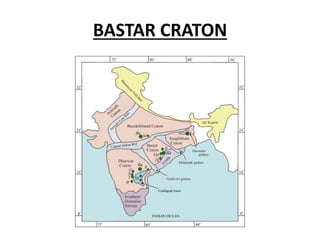
• Bastar craton covers an area of 1,30,000
square km.
• It is bounded by the Godavari Graben in the
south.
• Mahanadi graben in the north-east.
• CITZ (central Indian tectonic zone) forming
part of the Satpura mobile belt in the north.
• Eastern Ghats mobile belt in the east and
Daccan trap cover in the west.
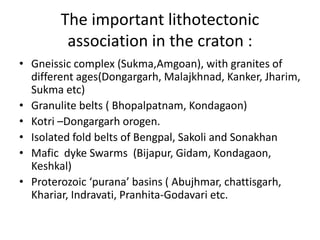
The important lithotectonic
association in the craton :
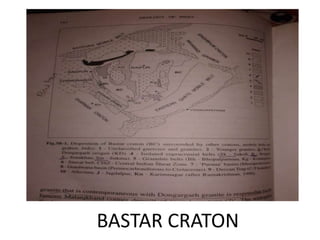
• Gneissic complex (Sukma,Amgoan), with granites of
different ages(Dongargarh, Malajkhnad, Kanker, Jharim,
Sukma etc)
• Granulite belts ( Bhopalpatnam, Kondagaon)
• Kotri –Dongargarh orogen.
• Isolated fold belts of Bengpal, Sakoli and Sonakhan
• Mafic dyke Swarms (Bijapur, Gidam, Kondagaon,
Keshkal)
• Proterozoic ‘purana’ basins ( Abujhmar, chattisgarh,
Khariar, Indravati, Pranhita-Godavari etc.
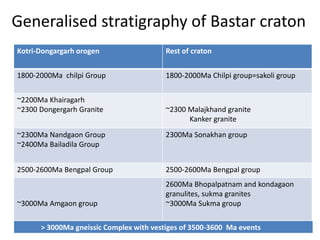
Generalised stratigraphy of Bastar craton
Kotri-Dongargarh orogen Rest of craton
1800-2000Ma chilpi Group 1800-2000Ma Chilpi group=sakoli group
~2200Ma Khairagarh
~2300 Dongergarh Granite ~2300 Malajkhand granite
Kanker granite
~2300Ma Nandgaon Group
~2400Ma Bailadila Group
2300Ma Sonakhan group
2500-2600Ma Bengpal Group 2500-2600Ma Bengpal group
~3000Ma Amgaon group
2600Ma Bhopalpatnam and kondagaon
granulites, sukma granites
~3000Ma Sukma group
> 3000Ma gneissic Complex with vestiges of 3500-3600 Ma events
DESCRIPTION OF STRATIGRAPHY
DIVISIONS
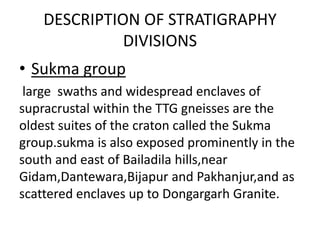
• Sukma group
large swaths and widespread enclaves of
supracrustal within the TTG gneisses are the
oldest suites of the craton called the Sukma
group.sukma is also exposed prominently in the
south and east of Bailadila hills,near
Gidam,Dantewara,Bijapur and Pakhanjur,and as
scattered enclaves up to Dongargarh Granite.
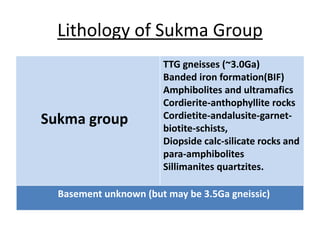
Lithology of Sukma Group
Sukma group
TTG gneisses (~3.0Ga)
Banded iron formation(BIF)
Amphibolites and ultramafics
Cordierite-anthophyllite rocks
Cordietite-andalusite-garnet-
biotite-schists,
Diopside calc-silicate rocks and
para-amphibolites
Sillimanites quartzites.
Basement unknown (but may be 3.5Ga gneissic)
STRUCTURE AND METAMORPHISM:
• Structure in sukma group are complex, as the
rock are scattered. Major folds are found in
Kondgaon,bijapur.
• Metamorphism is of low-pressure type.
• AGE : Rb-Sr isochron ages of 2500-2600 Ma
3500-3600Ma determined by U-Pb and
SHRIMP zircon. The age of sukma group is rekoned
at ~3000 Ma.
AMGAON GROUP
• Amgaon Group occurs in a ~100 km wide belt to
the south of sakoli belt around Gadchiroli, where
sukma type lithologies occure within migmatites
and grade into granulites in the NW extensions of
Bhopalpatnam granulite belt.
• The amgaon enclaves consist of quartzite, calc
silicate rocks, marbles, chromoferous ulteramafic
and subordinate BIF.
• Amgoan group of enclaves is marked by
intermediate-pressure metamorphism.
• AGE : The age of amgaon group is uncertain..
GRANULITE BELTS
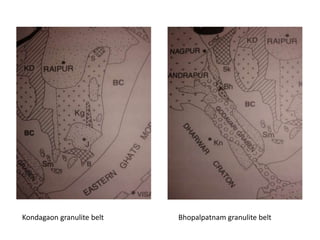
• Bhopalpatnam granulite belt(Bh):
• Bh is about 300km long and 30-40km wide,
and trend NW-SE to the north of godavari
graben,corresponding to the Karimnagar granulite belt of
dharwar craton in the south.
• Kondagaon granulite belt(Kg):
• Kn granulite belt is a 70 km long, NS
trending belt occuring to the north of Indravati basin. It
appears to be an uplifted horst like structure.
• The Kg granulite belt indicates ages arround
2600Ma.
•
Kondagaon granulite belt Bhopalpatnam granulite belt
BENGPAL GROUP
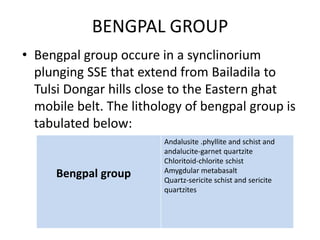
• Bengpal group occure in a synclinorium
plunging SSE that extend from Bailadila to
Tulsi Dongar hills close to the Eastern ghat
mobile belt. The lithology of bengpal group is
tabulated below:
Bengpal group
Andalusite .phyllite and schist and
andalucite-garnet quartzite
Chloritoid-chlorite schist
Amygdular metabasalt
Quartz-sericite schist and sericite
quartzites
STRUCTURE OF BENGPAL GROUP
• Bengpal group invovled in complex isoclinal to
reclined folding. Bengpal belt appears to form
a regional synclinorium plunging towards
southeast.
• AGE:
• Most of the dates are Rb-Sr isochrones of
~2500-2600Ma
KOTRI DONGARGARH OROGEN
• BAILADILA GROUP-
• Bailadila Hills, representing the type area for
BaildilaGroup, form the southernmost part of
the Kotri- Dongargarh orogen..
• The iron ore deposite extend from the north
of Bailadila to Rowghat and Dalli-Rajhara that
contribute iron ores to the Bhilai Steel Plant .
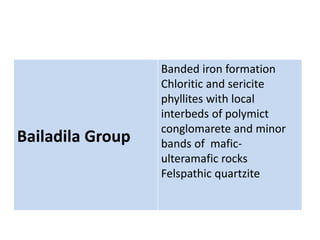
Bailadila Group
Banded iron formation
Chloritic and sericite
phyllites with local
interbeds of polymict
conglomarete and minor
bands of mafic-
ulteramafic rocks
Felspathic quartzite
NANDGAON GROUP
• Bailadila Group is uncomformably overlain by a
sequence of bimodal felsic to mafic volcanics
belonging to Nandgaon Group that is well
exposed between Dongargah Granite and
Chattisgarh basin.
• Nandgaon group is not extensively deformed ,
but N-S trending fold and fault are fairly common.
The Rhyolites of Nandgaon group yield Rb-Sr
whole rock isochron ages of ~2300 Ma.
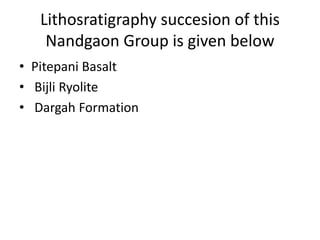
Lithosratigraphy succesion of this
Nandgaon Group is given below
• Pitepani Basalt
• Bijli Ryolite
• Dargah Formation
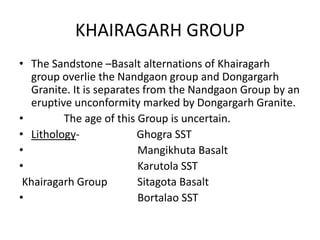
KHAIRAGARH GROUP
• The Sandstone –Basalt alternations of Khairagarh
group overlie the Nandgaon group and Dongargarh
Granite. It is separates from the Nandgaon Group by an
eruptive unconformity marked by Dongargarh Granite.
• The age of this Group is uncertain.
• Lithology- Ghogra SST
• Mangikhuta Basalt
• Karutola SST
Khairagarh Group Sitagota Basalt
• Bortalao SST
CHILPI GROUP
• The predominently low Grade metasediments
of chilpi group are well exposed in the type
area of chilpi ghatsection on the Chilpi-
Bilaspur road. The main rock unit of the group
are chloritic and sricite phyllites and banded
cherts.
• The age of chilpi group is not known with
certainty, it may be >1800 Ma old, by
comparision with Sakoli and Khairagarh Group
SAKOLI GROUP
• Sakoli Group covering an area of 3500 square km
, is a triangular belt, which occurs at the three
major tectonic trend lines viz. The satpura mobile
belt, kotri-dongargarh belt, and parallel to tha
Goadavari graben
• The triangular outcrop pattern of sakoli and
sauser belt was described in earlier litrature as
Bhandara tringular.
• The rock assemlage of the belt is metapelites
with subordinate felsic to mafic bimodal
volcanics.
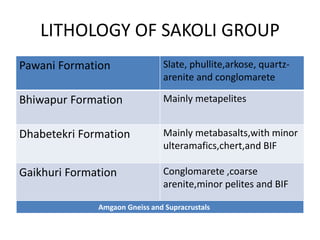
LITHOLOGY OF SAKOLI GROUP
Pawani Formation Slate, phullite,arkose, quartz-
arenite and conglomarete
Bhiwapur Formation Mainly metapelites
Dhabetekri Formation Mainly metabasalts,with minor
ulteramafics,chert,and BIF
Gaikhuri Formation Conglomarete ,coarse
arenite,minor pelites and BIF
Amgaon Gneiss and Supracrustals
SONAKHAN GROUP
• The Isolated ,NW-Trending Sonakhan belt
covering an area of 1000 square km. since the
Sonakhan belt is predominently a volcanic belt,
• It has been termed as schist belt or greenstone
belt.
• LITHOLOGY-
• Arjuni Formation
• Unconformity
• Baghmara Formation/Bilari
REFERENCE
• M.Ramakrishnan and R.Vaidyanadhan.
• Internet
Thank you…

Bastar craton

  • 1.
    BASTAR CRATON Presented by:- MAYANK MAHAWAR M.Sc 2nd sem
  • 2.
  • 3.
  • 4.
    BASTAR CRATON • Bastarcraton covers an area of 1,30,000 square km. • It is bounded by the Godavari Graben in the south. • Mahanadi graben in the north-east. • CITZ (central Indian tectonic zone) forming part of the Satpura mobile belt in the north. • Eastern Ghats mobile belt in the east and Daccan trap cover in the west.
  • 5.
    The important lithotectonic associationin the craton : • Gneissic complex (Sukma,Amgoan), with granites of different ages(Dongargarh, Malajkhnad, Kanker, Jharim, Sukma etc) • Granulite belts ( Bhopalpatnam, Kondagaon) • Kotri –Dongargarh orogen. • Isolated fold belts of Bengpal, Sakoli and Sonakhan • Mafic dyke Swarms (Bijapur, Gidam, Kondagaon, Keshkal) • Proterozoic ‘purana’ basins ( Abujhmar, chattisgarh, Khariar, Indravati, Pranhita-Godavari etc.
  • 6.
    Generalised stratigraphy ofBastar craton Kotri-Dongargarh orogen Rest of craton 1800-2000Ma chilpi Group 1800-2000Ma Chilpi group=sakoli group ~2200Ma Khairagarh ~2300 Dongergarh Granite ~2300 Malajkhand granite Kanker granite ~2300Ma Nandgaon Group ~2400Ma Bailadila Group 2300Ma Sonakhan group 2500-2600Ma Bengpal Group 2500-2600Ma Bengpal group ~3000Ma Amgaon group 2600Ma Bhopalpatnam and kondagaon granulites, sukma granites ~3000Ma Sukma group > 3000Ma gneissic Complex with vestiges of 3500-3600 Ma events
  • 7.
    DESCRIPTION OF STRATIGRAPHY DIVISIONS •Sukma group large swaths and widespread enclaves of supracrustal within the TTG gneisses are the oldest suites of the craton called the Sukma group.sukma is also exposed prominently in the south and east of Bailadila hills,near Gidam,Dantewara,Bijapur and Pakhanjur,and as scattered enclaves up to Dongargarh Granite.
  • 8.
    Lithology of SukmaGroup Sukma group TTG gneisses (~3.0Ga) Banded iron formation(BIF) Amphibolites and ultramafics Cordierite-anthophyllite rocks Cordietite-andalusite-garnet- biotite-schists, Diopside calc-silicate rocks and para-amphibolites Sillimanites quartzites. Basement unknown (but may be 3.5Ga gneissic)
  • 9.
    STRUCTURE AND METAMORPHISM: •Structure in sukma group are complex, as the rock are scattered. Major folds are found in Kondgaon,bijapur. • Metamorphism is of low-pressure type. • AGE : Rb-Sr isochron ages of 2500-2600 Ma 3500-3600Ma determined by U-Pb and SHRIMP zircon. The age of sukma group is rekoned at ~3000 Ma.
  • 10.
    AMGAON GROUP • AmgaonGroup occurs in a ~100 km wide belt to the south of sakoli belt around Gadchiroli, where sukma type lithologies occure within migmatites and grade into granulites in the NW extensions of Bhopalpatnam granulite belt. • The amgaon enclaves consist of quartzite, calc silicate rocks, marbles, chromoferous ulteramafic and subordinate BIF. • Amgoan group of enclaves is marked by intermediate-pressure metamorphism. • AGE : The age of amgaon group is uncertain..
  • 11.
    GRANULITE BELTS • Bhopalpatnamgranulite belt(Bh): • Bh is about 300km long and 30-40km wide, and trend NW-SE to the north of godavari graben,corresponding to the Karimnagar granulite belt of dharwar craton in the south. • Kondagaon granulite belt(Kg): • Kn granulite belt is a 70 km long, NS trending belt occuring to the north of Indravati basin. It appears to be an uplifted horst like structure. • The Kg granulite belt indicates ages arround 2600Ma. •
  • 12.
    Kondagaon granulite beltBhopalpatnam granulite belt
  • 13.
    BENGPAL GROUP • Bengpalgroup occure in a synclinorium plunging SSE that extend from Bailadila to Tulsi Dongar hills close to the Eastern ghat mobile belt. The lithology of bengpal group is tabulated below: Bengpal group Andalusite .phyllite and schist and andalucite-garnet quartzite Chloritoid-chlorite schist Amygdular metabasalt Quartz-sericite schist and sericite quartzites
  • 14.
    STRUCTURE OF BENGPALGROUP • Bengpal group invovled in complex isoclinal to reclined folding. Bengpal belt appears to form a regional synclinorium plunging towards southeast. • AGE: • Most of the dates are Rb-Sr isochrones of ~2500-2600Ma
  • 15.
    KOTRI DONGARGARH OROGEN •BAILADILA GROUP- • Bailadila Hills, representing the type area for BaildilaGroup, form the southernmost part of the Kotri- Dongargarh orogen.. • The iron ore deposite extend from the north of Bailadila to Rowghat and Dalli-Rajhara that contribute iron ores to the Bhilai Steel Plant .
  • 16.
    Bailadila Group Banded ironformation Chloritic and sericite phyllites with local interbeds of polymict conglomarete and minor bands of mafic- ulteramafic rocks Felspathic quartzite
  • 17.
    NANDGAON GROUP • BailadilaGroup is uncomformably overlain by a sequence of bimodal felsic to mafic volcanics belonging to Nandgaon Group that is well exposed between Dongargah Granite and Chattisgarh basin. • Nandgaon group is not extensively deformed , but N-S trending fold and fault are fairly common. The Rhyolites of Nandgaon group yield Rb-Sr whole rock isochron ages of ~2300 Ma.
  • 18.
    Lithosratigraphy succesion ofthis Nandgaon Group is given below • Pitepani Basalt • Bijli Ryolite • Dargah Formation
  • 19.
    KHAIRAGARH GROUP • TheSandstone –Basalt alternations of Khairagarh group overlie the Nandgaon group and Dongargarh Granite. It is separates from the Nandgaon Group by an eruptive unconformity marked by Dongargarh Granite. • The age of this Group is uncertain. • Lithology- Ghogra SST • Mangikhuta Basalt • Karutola SST Khairagarh Group Sitagota Basalt • Bortalao SST
  • 20.
    CHILPI GROUP • Thepredominently low Grade metasediments of chilpi group are well exposed in the type area of chilpi ghatsection on the Chilpi- Bilaspur road. The main rock unit of the group are chloritic and sricite phyllites and banded cherts. • The age of chilpi group is not known with certainty, it may be >1800 Ma old, by comparision with Sakoli and Khairagarh Group
  • 21.
    SAKOLI GROUP • SakoliGroup covering an area of 3500 square km , is a triangular belt, which occurs at the three major tectonic trend lines viz. The satpura mobile belt, kotri-dongargarh belt, and parallel to tha Goadavari graben • The triangular outcrop pattern of sakoli and sauser belt was described in earlier litrature as Bhandara tringular. • The rock assemlage of the belt is metapelites with subordinate felsic to mafic bimodal volcanics.
  • 22.
    LITHOLOGY OF SAKOLIGROUP Pawani Formation Slate, phullite,arkose, quartz- arenite and conglomarete Bhiwapur Formation Mainly metapelites Dhabetekri Formation Mainly metabasalts,with minor ulteramafics,chert,and BIF Gaikhuri Formation Conglomarete ,coarse arenite,minor pelites and BIF Amgaon Gneiss and Supracrustals
  • 23.
    SONAKHAN GROUP • TheIsolated ,NW-Trending Sonakhan belt covering an area of 1000 square km. since the Sonakhan belt is predominently a volcanic belt, • It has been termed as schist belt or greenstone belt. • LITHOLOGY- • Arjuni Formation • Unconformity • Baghmara Formation/Bilari
  • 24.
    REFERENCE • M.Ramakrishnan andR.Vaidyanadhan. • Internet
  • 25.