Classification
of
Clastic Sedimentary
Rock
*formed from broken rock fragments weathered
and eroded by river, glacier, wind and sea
waves. These clastic sediments are found
deposited on floodplains, beaches, in desert
and on the sea floors.
CLASTIC ROCKS
Clastic rockssolidify
• Clastic rocks are classified on the basis of
the grain size: conglomerate, sandstone,
shale etc.
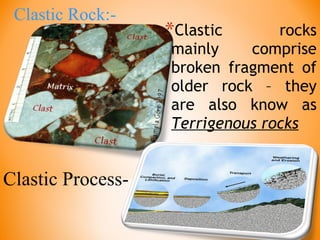
*Clastic rocks
mainly comprise
broken fragment of
older rock – they
are also know as
Terrigenous rocks
Clastic Rock:-
Clastic Process-
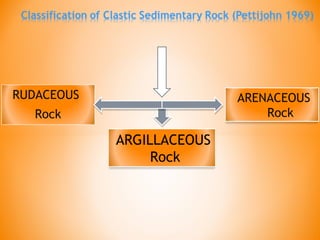
RUDACEOUS
Rock
ARENACEOUS
Rock
ARGILLACEOUS
Rock
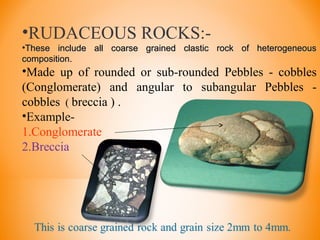
•RUDACEOUS ROCKS:-
•These include all coarse grained clastic rock of heterogeneousThese include all coarse grained clastic rock of heterogeneous
composition.composition.
•Made up of rounded or sub-rounded Pebbles - cobbles
(Conglomerate) and angular to subangular Pebbles -
cobbles ( breccia ) .
•Example-
1.Conglomerate
2.Breccia
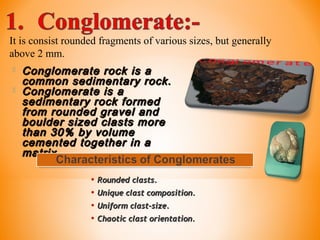
It is consist rounded fragments of various sizes, but generally
above 2 mm.
 Conglomerate rock is aConglomerate rock is a
common sedimentary rock.common sedimentary rock.
 Conglomerate is aConglomerate is a
sedimentary rock formedsedimentary rock formed
from rounded gravel andfrom rounded gravel and
boulder sized clasts moreboulder sized clasts more
than 30% by volumethan 30% by volume
cemented together in acemented together in a
matrix.matrix.
• Rounded clasts.Rounded clasts.
• Unique clast composition.Unique clast composition.
• Uniform clast-size.Uniform clast-size.
• Chaotic clast orientation.Chaotic clast orientation.
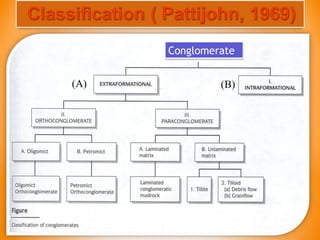
ConglomerateConglomerate
(A) (B)
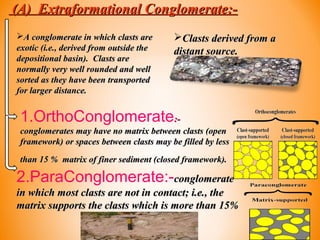
(A) Extraformational Conglomerate:-(A) Extraformational Conglomerate:-
Clasts derived from aClasts derived from a
distant source.distant source.
A conglomerate in which clasts areA conglomerate in which clasts are
exotic (i.e., derived from outside theexotic (i.e., derived from outside the
depositional basin). Clasts aredepositional basin). Clasts are
normally very well rounded and wellnormally very well rounded and well
sorted as they have been transportedsorted as they have been transported
for larger distance.for larger distance.
1.OrthoConglomerate:-:-
conglomerates may have no matrix between clasts (openconglomerates may have no matrix between clasts (open
framework) or spaces between clasts may be filled by lessframework) or spaces between clasts may be filled by less
than 15 % matrix of finer sediment (closed framework).than 15 % matrix of finer sediment (closed framework).
2.ParaConglomerate:-conglomerateconglomerate
in which most clasts are not in contact; i.e., thein which most clasts are not in contact; i.e., the
matrix supports the clasts which is more than 15%matrix supports the clasts which is more than 15%
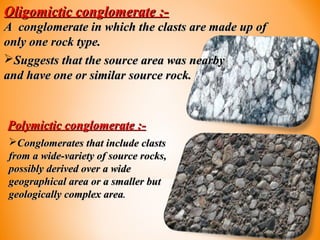
Oligomictic conglomerate :-Oligomictic conglomerate :-
A conglomerate in which the clasts are made up ofA conglomerate in which the clasts are made up of
only one rock type.only one rock type.
Suggests that the source area was nearbySuggests that the source area was nearby
and have one or similar source rock.and have one or similar source rock.
Polymictic conglomerate :-Polymictic conglomerate :-
Conglomerates that include clastsConglomerates that include clasts
from a wide-variety of source rocks,from a wide-variety of source rocks,
possibly derived over a widepossibly derived over a wide
geographical area or a smaller butgeographical area or a smaller but
geologically complex areageologically complex area..
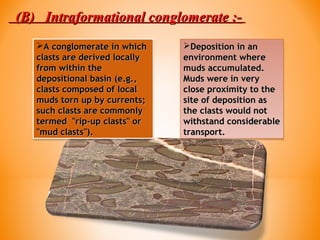
(B) Intraformational conglomerate :-(B) Intraformational conglomerate :-
A conglomerate in whichA conglomerate in which
clasts are derived locallyclasts are derived locally
from within thefrom within the
depositional basin (e.g.,depositional basin (e.g.,
clasts composed of localclasts composed of local
muds torn up by currents;muds torn up by currents;
such clasts are commonlysuch clasts are commonly
termed "rip-up clasts" ortermed "rip-up clasts" or
"mud clasts")."mud clasts").
A conglomerate in whichA conglomerate in which
clasts are derived locallyclasts are derived locally
from within thefrom within the
depositional basin (e.g.,depositional basin (e.g.,
clasts composed of localclasts composed of local
muds torn up by currents;muds torn up by currents;
such clasts are commonlysuch clasts are commonly
termed "rip-up clasts" ortermed "rip-up clasts" or
"mud clasts")."mud clasts").
Deposition in anDeposition in an
environment whereenvironment where
muds accumulated.muds accumulated.
Muds were in veryMuds were in very
close proximity to theclose proximity to the
site of deposition assite of deposition as
the clasts would notthe clasts would not
withstand considerablewithstand considerable
transport.transport.
Deposition in anDeposition in an
environment whereenvironment where
muds accumulated.muds accumulated.
Muds were in veryMuds were in very
close proximity to theclose proximity to the
site of deposition assite of deposition as
the clasts would notthe clasts would not
withstand considerablewithstand considerable
transport.transport.
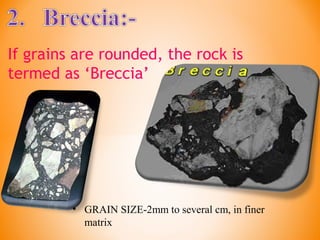
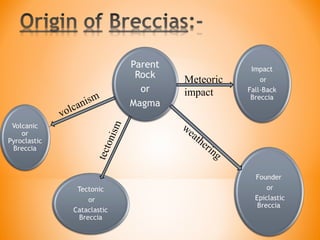
If grains are rounded, the rock is
termed as ‘Breccia’
• GRAIN SIZE-2mm to several cm, in finer
matrix
volcanismtectonism
weathering
Meteoric
impact
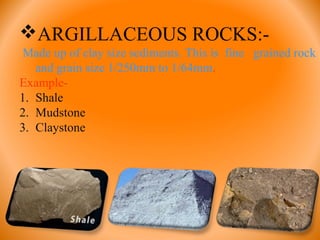
ARGILLACEOUS ROCKS:-
Made up of clay size sediments. This is fine grained rock
and grain size 1/250mm to 1/64mm.
Example-
1. Shale
2. Mudstone
3. Claystone
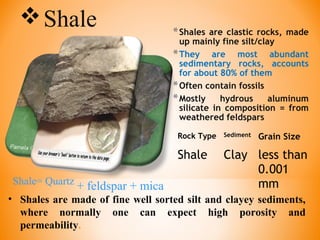
*Shales are clastic rocks, made
up mainly fine silt/clay
*They are most abundant
sedimentary rocks, accounts
for about 80% of them
*Often contain fossils
*Mostly hydrous aluminum
silicate in composition = from
weathered feldspars
• Shales are made of fine well sorted silt and clayey sediments,
where normally one can expect high porosity and
permeability.
Shale= Quartz
+ feldspar + mica
Rock Type Sediment Grain Size
Shale Clay less than
0.001
mm
Shale
Three type on the basis of their Origin-
1.Residual Shales
2.Transported Shales
3.Hybrid Shales
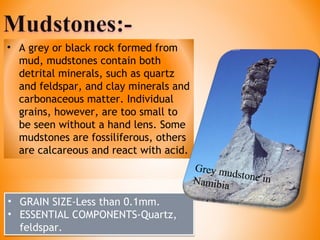
• A grey or black rock formed from
mud, mudstones contain both
detrital minerals, such as quartz
and feldspar, and clay minerals and
carbonaceous matter. Individual
grains, however, are too small to
be seen without a hand lens. Some
mudstones are fossiliferous, others
are calcareous and react with acid.
• GRAIN SIZE-Less than 0.1mm.
• ESSENTIAL COMPONENTS-Quartz,
feldspar.
• GRAIN SIZE-Less than 0.1mm.
• ESSENTIAL COMPONENTS-Quartz,
feldspar.
Grey mudstone inNamibia
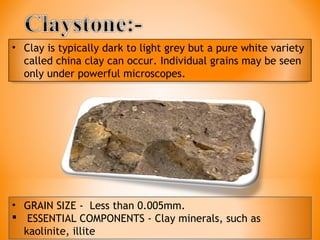
• Clay is typically dark to light grey but a pure white variety
called china clay can occur. Individual grains may be seen
only under powerful microscopes.
• GRAIN SIZE - Less than 0.005mm.
 ESSENTIAL COMPONENTS - Clay minerals, such as
kaolinite, illite
•ARENACEOUS ROCKS:-
• Made up of mainly sand e.g. Sandstone. These rocks
are either accumulated by wind action or deposited
under water action or marine to non marine. This rock is
medium grained and grain size is 1/16mm to 2mm.
•Example-
1.Sandstone
2.Silt stone
3.Arkose
4.Greywacke
5.Grit
This rock other name is Terrigenous.
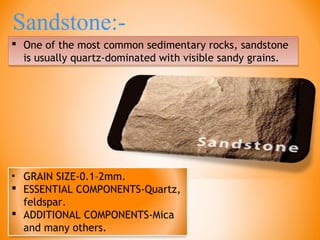
Sandstone:-
 One of the most common sedimentary rocks, sandstone
is usually quartz-dominated with visible sandy grains.
 One of the most common sedimentary rocks, sandstone
is usually quartz-dominated with visible sandy grains.
• GRAIN SIZE-0.1–2mm.
 ESSENTIAL COMPONENTS-Quartz,
feldspar.
 ADDITIONAL COMPONENTS-Mica
and many others.
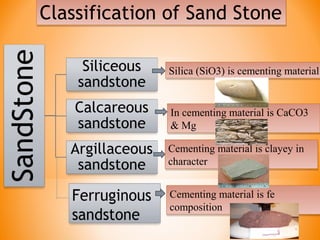
Classification of Sand StoneClassification of Sand Stone
Silica (SiO3) is cementing materialSilica (SiO3) is cementing material
In cementing material is CaCO3
& Mg
In cementing material is CaCO3
& Mg
Cementing material is clayey in
character
Cementing material is clayey in
character
Cementing material is fe
composition
Cementing material is fe
composition
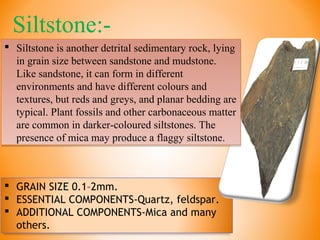
Siltstone:-
 GRAIN SIZE 0.1–2mm.
 ESSENTIAL COMPONENTS-Quartz, feldspar.
 ADDITIONAL COMPONENTS-Mica and many
others.
 Siltstone is another detrital sedimentary rock, lying
in grain size between sandstone and mudstone.
Like sandstone, it can form in different
environments and have different colours and
textures, but reds and greys, and planar bedding are
typical. Plant fossils and other carbonaceous matter
are common in darker-coloured siltstones. The
presence of mica may produce a flaggy siltstone.
 Siltstone is another detrital sedimentary rock, lying
in grain size between sandstone and mudstone.
Like sandstone, it can form in different
environments and have different colours and
textures, but reds and greys, and planar bedding are
typical. Plant fossils and other carbonaceous matter
are common in darker-coloured siltstones. The
presence of mica may produce a flaggy siltstone.
A pink sandstone, the colour of which is due to an abundance of
feldspar, especially pink alkali feldspars.Arkose forms by the fast
deposition of sand weathered from granites and gneisses
GRAIN SIZE= 0.1–2mm.
ESSENTIAL COMPONENTS- Feldspar, quartz.
A pink sandstone, the colour of which is due to an abundance of
feldspar, especially pink alkali feldspars.Arkose forms by the fast
deposition of sand weathered from granites and gneisses
GRAIN SIZE= 0.1–2mm.
ESSENTIAL COMPONENTS- Feldspar, quartz.
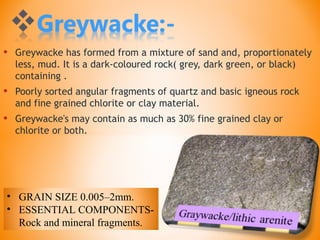
• Greywacke has formed from a mixture of sand and, proportionately
less, mud. It is a dark-coloured rock( grey, dark green, or black)
containing .
• Poorly sorted angular fragments of quartz and basic igneous rock
and fine grained chlorite or clay material.
• Greywacke's may contain as much as 30% fine grained clay or
chlorite or both.
• GRAIN SIZE 0.005–2mm.
• ESSENTIAL COMPONENTS-
Rock and mineral fragments.
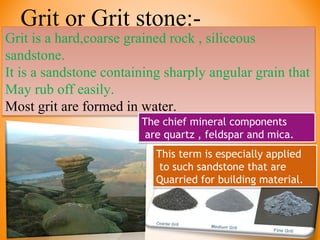
Grit or Grit stone:-
Grit is a hard,coarse grained rock , siliceous
sandstone.
It is a sandstone containing sharply angular grain that
May rub off easily.
Most grit are formed in water.
Grit is a hard,coarse grained rock , siliceous
sandstone.
It is a sandstone containing sharply angular grain that
May rub off easily.
Most grit are formed in water.
The chief mineral components
are quartz , feldspar and mica.
The chief mineral components
are quartz , feldspar and mica.
This term is especially applied
to such sandstone that are
Quarried for building material.
This term is especially applied
to such sandstone that are
Quarried for building material.
Vishnu clastic rock ppt

Vishnu clastic rock ppt

  • 1.
  • 2.
    *formed from brokenrock fragments weathered and eroded by river, glacier, wind and sea waves. These clastic sediments are found deposited on floodplains, beaches, in desert and on the sea floors. CLASTIC ROCKS Clastic rockssolidify • Clastic rocks are classified on the basis of the grain size: conglomerate, sandstone, shale etc.
  • 3.
    *Clastic rocks mainly comprise brokenfragment of older rock – they are also know as Terrigenous rocks Clastic Rock:- Clastic Process-
  • 4.
  • 5.
    •RUDACEOUS ROCKS:- •These includeall coarse grained clastic rock of heterogeneousThese include all coarse grained clastic rock of heterogeneous composition.composition. •Made up of rounded or sub-rounded Pebbles - cobbles (Conglomerate) and angular to subangular Pebbles - cobbles ( breccia ) . •Example- 1.Conglomerate 2.Breccia
  • 6.
    It is consistrounded fragments of various sizes, but generally above 2 mm.  Conglomerate rock is aConglomerate rock is a common sedimentary rock.common sedimentary rock.  Conglomerate is aConglomerate is a sedimentary rock formedsedimentary rock formed from rounded gravel andfrom rounded gravel and boulder sized clasts moreboulder sized clasts more than 30% by volumethan 30% by volume cemented together in acemented together in a matrix.matrix. • Rounded clasts.Rounded clasts. • Unique clast composition.Unique clast composition. • Uniform clast-size.Uniform clast-size. • Chaotic clast orientation.Chaotic clast orientation.
  • 7.
  • 8.
    (A) Extraformational Conglomerate:-(A)Extraformational Conglomerate:- Clasts derived from aClasts derived from a distant source.distant source. A conglomerate in which clasts areA conglomerate in which clasts are exotic (i.e., derived from outside theexotic (i.e., derived from outside the depositional basin). Clasts aredepositional basin). Clasts are normally very well rounded and wellnormally very well rounded and well sorted as they have been transportedsorted as they have been transported for larger distance.for larger distance. 1.OrthoConglomerate:-:- conglomerates may have no matrix between clasts (openconglomerates may have no matrix between clasts (open framework) or spaces between clasts may be filled by lessframework) or spaces between clasts may be filled by less than 15 % matrix of finer sediment (closed framework).than 15 % matrix of finer sediment (closed framework). 2.ParaConglomerate:-conglomerateconglomerate in which most clasts are not in contact; i.e., thein which most clasts are not in contact; i.e., the matrix supports the clasts which is more than 15%matrix supports the clasts which is more than 15%
  • 9.
    Oligomictic conglomerate :-Oligomicticconglomerate :- A conglomerate in which the clasts are made up ofA conglomerate in which the clasts are made up of only one rock type.only one rock type. Suggests that the source area was nearbySuggests that the source area was nearby and have one or similar source rock.and have one or similar source rock. Polymictic conglomerate :-Polymictic conglomerate :- Conglomerates that include clastsConglomerates that include clasts from a wide-variety of source rocks,from a wide-variety of source rocks, possibly derived over a widepossibly derived over a wide geographical area or a smaller butgeographical area or a smaller but geologically complex areageologically complex area..
  • 10.
    (B) Intraformational conglomerate:-(B) Intraformational conglomerate :- A conglomerate in whichA conglomerate in which clasts are derived locallyclasts are derived locally from within thefrom within the depositional basin (e.g.,depositional basin (e.g., clasts composed of localclasts composed of local muds torn up by currents;muds torn up by currents; such clasts are commonlysuch clasts are commonly termed "rip-up clasts" ortermed "rip-up clasts" or "mud clasts")."mud clasts"). A conglomerate in whichA conglomerate in which clasts are derived locallyclasts are derived locally from within thefrom within the depositional basin (e.g.,depositional basin (e.g., clasts composed of localclasts composed of local muds torn up by currents;muds torn up by currents; such clasts are commonlysuch clasts are commonly termed "rip-up clasts" ortermed "rip-up clasts" or "mud clasts")."mud clasts"). Deposition in anDeposition in an environment whereenvironment where muds accumulated.muds accumulated. Muds were in veryMuds were in very close proximity to theclose proximity to the site of deposition assite of deposition as the clasts would notthe clasts would not withstand considerablewithstand considerable transport.transport. Deposition in anDeposition in an environment whereenvironment where muds accumulated.muds accumulated. Muds were in veryMuds were in very close proximity to theclose proximity to the site of deposition assite of deposition as the clasts would notthe clasts would not withstand considerablewithstand considerable transport.transport.
  • 11.
    If grains arerounded, the rock is termed as ‘Breccia’ • GRAIN SIZE-2mm to several cm, in finer matrix
  • 12.
  • 13.
    ARGILLACEOUS ROCKS:- Made upof clay size sediments. This is fine grained rock and grain size 1/250mm to 1/64mm. Example- 1. Shale 2. Mudstone 3. Claystone
  • 14.
    *Shales are clasticrocks, made up mainly fine silt/clay *They are most abundant sedimentary rocks, accounts for about 80% of them *Often contain fossils *Mostly hydrous aluminum silicate in composition = from weathered feldspars • Shales are made of fine well sorted silt and clayey sediments, where normally one can expect high porosity and permeability. Shale= Quartz + feldspar + mica Rock Type Sediment Grain Size Shale Clay less than 0.001 mm Shale
  • 15.
    Three type onthe basis of their Origin- 1.Residual Shales 2.Transported Shales 3.Hybrid Shales
  • 16.
    • A greyor black rock formed from mud, mudstones contain both detrital minerals, such as quartz and feldspar, and clay minerals and carbonaceous matter. Individual grains, however, are too small to be seen without a hand lens. Some mudstones are fossiliferous, others are calcareous and react with acid. • GRAIN SIZE-Less than 0.1mm. • ESSENTIAL COMPONENTS-Quartz, feldspar. • GRAIN SIZE-Less than 0.1mm. • ESSENTIAL COMPONENTS-Quartz, feldspar. Grey mudstone inNamibia
  • 17.
    • Clay istypically dark to light grey but a pure white variety called china clay can occur. Individual grains may be seen only under powerful microscopes. • GRAIN SIZE - Less than 0.005mm.  ESSENTIAL COMPONENTS - Clay minerals, such as kaolinite, illite
  • 18.
    •ARENACEOUS ROCKS:- • Madeup of mainly sand e.g. Sandstone. These rocks are either accumulated by wind action or deposited under water action or marine to non marine. This rock is medium grained and grain size is 1/16mm to 2mm. •Example- 1.Sandstone 2.Silt stone 3.Arkose 4.Greywacke 5.Grit This rock other name is Terrigenous.
  • 19.
    Sandstone:-  One ofthe most common sedimentary rocks, sandstone is usually quartz-dominated with visible sandy grains.  One of the most common sedimentary rocks, sandstone is usually quartz-dominated with visible sandy grains. • GRAIN SIZE-0.1–2mm.  ESSENTIAL COMPONENTS-Quartz, feldspar.  ADDITIONAL COMPONENTS-Mica and many others.
  • 20.
    Classification of SandStoneClassification of Sand Stone Silica (SiO3) is cementing materialSilica (SiO3) is cementing material In cementing material is CaCO3 & Mg In cementing material is CaCO3 & Mg Cementing material is clayey in character Cementing material is clayey in character Cementing material is fe composition Cementing material is fe composition
  • 21.
    Siltstone:-  GRAIN SIZE0.1–2mm.  ESSENTIAL COMPONENTS-Quartz, feldspar.  ADDITIONAL COMPONENTS-Mica and many others.  Siltstone is another detrital sedimentary rock, lying in grain size between sandstone and mudstone. Like sandstone, it can form in different environments and have different colours and textures, but reds and greys, and planar bedding are typical. Plant fossils and other carbonaceous matter are common in darker-coloured siltstones. The presence of mica may produce a flaggy siltstone.  Siltstone is another detrital sedimentary rock, lying in grain size between sandstone and mudstone. Like sandstone, it can form in different environments and have different colours and textures, but reds and greys, and planar bedding are typical. Plant fossils and other carbonaceous matter are common in darker-coloured siltstones. The presence of mica may produce a flaggy siltstone.
  • 22.
    A pink sandstone,the colour of which is due to an abundance of feldspar, especially pink alkali feldspars.Arkose forms by the fast deposition of sand weathered from granites and gneisses GRAIN SIZE= 0.1–2mm. ESSENTIAL COMPONENTS- Feldspar, quartz. A pink sandstone, the colour of which is due to an abundance of feldspar, especially pink alkali feldspars.Arkose forms by the fast deposition of sand weathered from granites and gneisses GRAIN SIZE= 0.1–2mm. ESSENTIAL COMPONENTS- Feldspar, quartz.
  • 23.
    • Greywacke hasformed from a mixture of sand and, proportionately less, mud. It is a dark-coloured rock( grey, dark green, or black) containing . • Poorly sorted angular fragments of quartz and basic igneous rock and fine grained chlorite or clay material. • Greywacke's may contain as much as 30% fine grained clay or chlorite or both. • GRAIN SIZE 0.005–2mm. • ESSENTIAL COMPONENTS- Rock and mineral fragments.
  • 24.
    Grit or Gritstone:- Grit is a hard,coarse grained rock , siliceous sandstone. It is a sandstone containing sharply angular grain that May rub off easily. Most grit are formed in water. Grit is a hard,coarse grained rock , siliceous sandstone. It is a sandstone containing sharply angular grain that May rub off easily. Most grit are formed in water. The chief mineral components are quartz , feldspar and mica. The chief mineral components are quartz , feldspar and mica. This term is especially applied to such sandstone that are Quarried for building material. This term is especially applied to such sandstone that are Quarried for building material.

Editor's Notes

  • #18 Clay is typically dark to light grey but a pure white variety called china clay can occur. Individual grains may be seen only under powerful microscopes.