Labor and delivery
DEFINITION
•Labor is a physiologic process during which the
products of conception (i.e., the fetus, membranes,
umbilical cord, and placenta) are expelled outside of
the uterus
•i.e. culmination of pregnancy
•Effacement and dilatation of the uterine cervix is a
result of rhythmic uterine contractions of sufficient
frequency, intensity, and duration.
•The onset of labor is defined as regular, painful
uterine contractions that becomes more
frequent and stronger resulting in progressive
cervical effacement and dilatation.
•Cervical dilatation in the absence of uterine
contraction suggests cervical insufficiency,
whereas uterine contraction without cervical
change does not meet the definition of labor.
Effacement and dilatation of the cervix
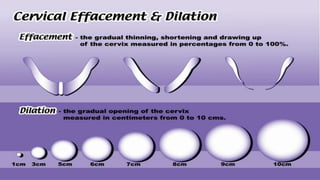
•Cervical dilation is the opening of the cervix
during childbirth or in other conditions like
miscarriages/abortion.
•Effacement is the thinning and shortening of the
cervix that occurs during labor
Dilatation progress
•Latent phase: 0-3 centimeters
•Active Labor: 4-7 centimeters
•Transition: 8-10 centimeters
•Complete: 10 centimeters.
Delivery of the infant takes place shortly after
this stage is reached
Effacement
Effacement and dilatation
Stages of Labor
Obstetrician have divided labor into 3 stages that
delineate milestones in a continuous process.
•First stage (Dilatation stage)
•Second stage (Descent and delivery of the baby)
•Third stage (Delivery of placenta and membranes)
First stage of labor
•The first stage begins with regular uterine
contractions and ends with complete
cervical dilatation at 10 cm.
Divided into:
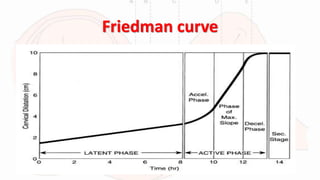
•Latent phase( 0-3cm dilatation)
•Active phase (4-10cm dilatation)
•The latent phase begins with mild, irregular
uterine contractions that soften and shorten the
cervix. The contractions become progressively
more rhythmic and stronger.
•This is followed by the active phase of labor, which
usually begins at about 3-4 cm of cervical dilation
and is characterized by rapid cervical dilation and
descent of the presenting fetal part.
Friedman curve
Second stage
•The second stage begins with complete cervical
dilatation and ends with the delivery of the fetus.
•Stage of descent and delivery of the baby.
•Normally takes 2hrs.
•If it takes longer then 2hrs is should be considered
prolonged.
Prolonged second stage
Risk factors associated with a prolonged second
stage include
•nulliparity,
•increasing maternal weight and/or weight gain,
•use of regional anesthesia,
•fetal occiput in a posterior or transverse
position, and
•increased birth weight
Third stage of labor
•The third stage of labor is defined by the time period
between the delivery of the fetus and the delivery of
the placenta and fetal membranes.
•Although delivery of the placenta often requires less
than 10 minutes, the duration of the third stage of
labor may last as long as 30 minutes.
Management of third stage
Aims at;
• Shortening of the third stage
• Minimize blood loss
Expectant/passive management of the third stage
of labor involves spontaneous delivery of the
placenta
Active management
• Involves :
•prophylactic administration of oxytocin or other
uterotonics (prostaglandins or ergot alkaloids),
•early cord clamping/cutting, and
•controlled cord traction of the umbilical cord.
A systematic review of the literature
reveals that that active management
shortens the duration of the third stage
and is superior to expectant
management with respect to blood
loss/risk of postpartum hemorrhage
Duration of third stage
•The third stage of labor is considered
prolonged after 30 minutes, and active
intervention, such as manual extraction
of the placenta, is commonly considered
Mechanism of normal Labor
• The ability of the fetus to successfully negotiate the
pelvis during labor involves changes in position of its
head during its passage in labor.
• The mechanisms of labor, also known as the cardinal
movements, are described in relation to a vertex
presentation, as is the case in 95% of all pregnancies
Criteria for normal labor.
• Spontaneous in its onset and at term
• With vertex presentation
• Without prolongation
• Natural termination with minimum aids
• Without having complications affecting the health of the
mother and/or the baby.
-Any deviation from these criteria is an abnormal labor.
1. Engagement
• The widest diameter of the presenting part (with a
well-flexed head, where the largest transverse
diameter of the fetal occiput is the biparietal diameter)
enters the maternal pelvis to a level below the plane
of the pelvic inlet.
• On the pelvic examination, the presenting part is at 0
station, or at the level of the maternal ischial spines
2. Descent
The downward passage of the
presenting part through the pelvis. This
occurs intermittently with contractions.
The rate is greatest during the second
stage of labor.
3. Flexion
As the fetal vertex descents, it encounters resistance
from the bony pelvis or the soft tissues of the pelvic
floor, resulting in passive flexion of the fetal occiput.
The chin is brought into contact with the fetal thorax,
and the presenting diameter changes from
occipitofrontal (11.0 cm) to suboccipitobregmatic (9.5
cm) for optimal passage through the pelvis
Internal rotation
• As the head descends, the presenting part, usually in
the transverse position, is rotated about 45° to
anteroposterior (AP) position under the symphysis.
• Internal rotation brings the AP diameter of the head in
line with the AP diameter of the pelvic outlet.
Extension
With further descent and full flexion of the head, the
base of the occiput comes in contact with the inferior
margin of the pubic symphysis. Upward resistance from
the pelvic floor and the downward forces from the
uterine contractions cause the occiput to extend and
rotate around the symphysis. This is followed by the
delivery of the fetus' head.
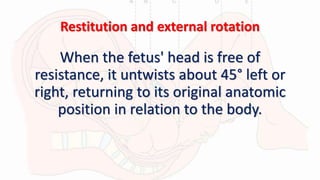
Restitution and external rotation
When the fetus' head is free of
resistance, it untwists about 45° left or
right, returning to its original anatomic
position in relation to the body.
Expulsion
After the fetus' head is delivered, further
descent brings the anterior shoulder to the
level of the pubic symphysis. The anterior
shoulder is then rotated under the
symphysis, followed by the posterior
shoulder and the rest of the fetus.
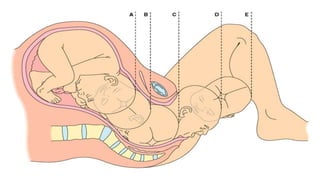
Mechanisms of labor.
Engagement and descent
flexion
Internal rotation
extension
Deliv..ant shoulder

Labour and delivery

  • 1.
  • 2.
    DEFINITION •Labor is aphysiologic process during which the products of conception (i.e., the fetus, membranes, umbilical cord, and placenta) are expelled outside of the uterus •i.e. culmination of pregnancy •Effacement and dilatation of the uterine cervix is a result of rhythmic uterine contractions of sufficient frequency, intensity, and duration.
  • 3.
    •The onset oflabor is defined as regular, painful uterine contractions that becomes more frequent and stronger resulting in progressive cervical effacement and dilatation. •Cervical dilatation in the absence of uterine contraction suggests cervical insufficiency, whereas uterine contraction without cervical change does not meet the definition of labor.
  • 4.
    Effacement and dilatationof the cervix •Cervical dilation is the opening of the cervix during childbirth or in other conditions like miscarriages/abortion. •Effacement is the thinning and shortening of the cervix that occurs during labor
  • 5.
    Dilatation progress •Latent phase:0-3 centimeters •Active Labor: 4-7 centimeters •Transition: 8-10 centimeters •Complete: 10 centimeters. Delivery of the infant takes place shortly after this stage is reached
  • 6.
  • 7.
  • 8.
    Stages of Labor Obstetricianhave divided labor into 3 stages that delineate milestones in a continuous process. •First stage (Dilatation stage) •Second stage (Descent and delivery of the baby) •Third stage (Delivery of placenta and membranes)
  • 9.
    First stage oflabor •The first stage begins with regular uterine contractions and ends with complete cervical dilatation at 10 cm. Divided into: •Latent phase( 0-3cm dilatation) •Active phase (4-10cm dilatation)
  • 10.
    •The latent phasebegins with mild, irregular uterine contractions that soften and shorten the cervix. The contractions become progressively more rhythmic and stronger. •This is followed by the active phase of labor, which usually begins at about 3-4 cm of cervical dilation and is characterized by rapid cervical dilation and descent of the presenting fetal part.
  • 11.
  • 12.
    Second stage •The secondstage begins with complete cervical dilatation and ends with the delivery of the fetus. •Stage of descent and delivery of the baby. •Normally takes 2hrs. •If it takes longer then 2hrs is should be considered prolonged.
  • 13.
    Prolonged second stage Riskfactors associated with a prolonged second stage include •nulliparity, •increasing maternal weight and/or weight gain, •use of regional anesthesia, •fetal occiput in a posterior or transverse position, and •increased birth weight
  • 14.
    Third stage oflabor •The third stage of labor is defined by the time period between the delivery of the fetus and the delivery of the placenta and fetal membranes. •Although delivery of the placenta often requires less than 10 minutes, the duration of the third stage of labor may last as long as 30 minutes.
  • 15.
    Management of thirdstage Aims at; • Shortening of the third stage • Minimize blood loss Expectant/passive management of the third stage of labor involves spontaneous delivery of the placenta
  • 16.
    Active management • Involves: •prophylactic administration of oxytocin or other uterotonics (prostaglandins or ergot alkaloids), •early cord clamping/cutting, and •controlled cord traction of the umbilical cord.
  • 17.
    A systematic reviewof the literature reveals that that active management shortens the duration of the third stage and is superior to expectant management with respect to blood loss/risk of postpartum hemorrhage
  • 18.
    Duration of thirdstage •The third stage of labor is considered prolonged after 30 minutes, and active intervention, such as manual extraction of the placenta, is commonly considered
  • 19.
    Mechanism of normalLabor • The ability of the fetus to successfully negotiate the pelvis during labor involves changes in position of its head during its passage in labor. • The mechanisms of labor, also known as the cardinal movements, are described in relation to a vertex presentation, as is the case in 95% of all pregnancies
  • 20.
    Criteria for normallabor. • Spontaneous in its onset and at term • With vertex presentation • Without prolongation • Natural termination with minimum aids • Without having complications affecting the health of the mother and/or the baby. -Any deviation from these criteria is an abnormal labor.
  • 21.
    1. Engagement • Thewidest diameter of the presenting part (with a well-flexed head, where the largest transverse diameter of the fetal occiput is the biparietal diameter) enters the maternal pelvis to a level below the plane of the pelvic inlet. • On the pelvic examination, the presenting part is at 0 station, or at the level of the maternal ischial spines
  • 22.
    2. Descent The downwardpassage of the presenting part through the pelvis. This occurs intermittently with contractions. The rate is greatest during the second stage of labor.
  • 23.
    3. Flexion As thefetal vertex descents, it encounters resistance from the bony pelvis or the soft tissues of the pelvic floor, resulting in passive flexion of the fetal occiput. The chin is brought into contact with the fetal thorax, and the presenting diameter changes from occipitofrontal (11.0 cm) to suboccipitobregmatic (9.5 cm) for optimal passage through the pelvis
  • 24.
    Internal rotation • Asthe head descends, the presenting part, usually in the transverse position, is rotated about 45° to anteroposterior (AP) position under the symphysis. • Internal rotation brings the AP diameter of the head in line with the AP diameter of the pelvic outlet.
  • 25.
    Extension With further descentand full flexion of the head, the base of the occiput comes in contact with the inferior margin of the pubic symphysis. Upward resistance from the pelvic floor and the downward forces from the uterine contractions cause the occiput to extend and rotate around the symphysis. This is followed by the delivery of the fetus' head.
  • 26.
    Restitution and externalrotation When the fetus' head is free of resistance, it untwists about 45° left or right, returning to its original anatomic position in relation to the body.
  • 27.
    Expulsion After the fetus'head is delivered, further descent brings the anterior shoulder to the level of the pubic symphysis. The anterior shoulder is then rotated under the symphysis, followed by the posterior shoulder and the rest of the fetus.
  • 28.
  • 29.
  • 30.
  • 31.
  • 32.
  • 33.