NORMAL LABOUR
&
MECHANISM OF LABOR
PROFESSOR DR. IRAM CHAUDHRY
FCPS(OBS&GYNAE), MHPE
OUTLINE
• Definition of Labor
• Mechanism of Labor
• Stages of Labor
• Management of Normal
Labor
Labour
• It is a physiological process by which the
fetus, placenta and membrane are expelled
out through the birth canal after twenty four
week of pregnancy
• Parturition isthe process of givingbirth
Normal labour
• Normal labour is physiological process by
which the fetus ,placenta and membrane are
expelled through the birth canal after full
term pregnancy (37-42 weeks ofgestation)
• Labour is called normal when it fulfills
the following criteria :
 Spontaneous onset at term
 With vertex presentation
 Without prolongation
 Natural termination with minimal
aids
Clinical course of labour
Onset of labour: not definitely known
Mechanical factors:
- uterine distension
Hormonal factors:
1. Maternal :
o progesterone withdrawal
o oxytocin stimulation
o prostaglandins
o serotonin
2. fetal:
o fetal cortisol
o fetal membranes
3. Neuronal:
o sympathetic- alpha receptor stimulation
1- Regular Uterine Contractions
2- Show
3- Leaking
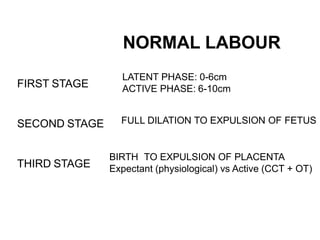
NORMAL LABOUR
FIRST STAGE
SECOND STAGE
THIRD STAGE
LATENT PHASE: 0-6cm
ACTIVE PHASE: 6-10cm
FULL DILATION TO EXPULSION OF FETUS
BIRTH TO EXPULSION OF PLACENTA
Expectant (physiological) vs Active (CCT + OT)
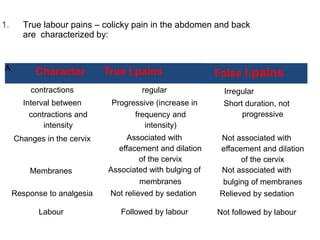
1. True labour pains – colicky pain in the abdomen and back
are characterized by:
A Character True l.pains False l.pains
Irregular
Short duration, not
progressive
contractions
Interval between
contractions and
intensity
Changes in the cervix
Membranes
Response to analgesia
Labour
regular
Progressive (increase in
frequency and
intensity)
Associated with
effacement and dilation
of the cervix
Associated with bulging of
membranes
Not relieved by sedation
Followed by labour
Not associated with
effacement and dilation
of the cervix
Not associated with
bulging of membranes
Relieved by sedation
Not followed by labour
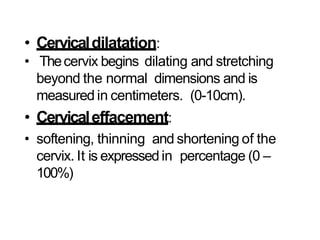
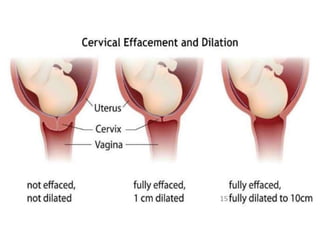
• Cervicaldilatation:
• Thecervix begins dilating and stretching
beyond the normal dimensions and is
measured in centimeters. (0-10cm).
• Cervicaleffacement:
• softening, thinning and shortening of the
cervix. It is expressedin percentage (0 –
100%)
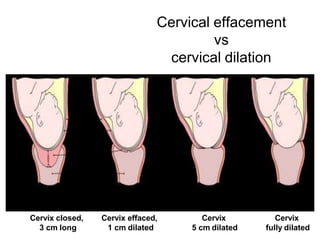
Cervical effacement
vs
cervical dilation
Cervix closed,
3 cm long
Cervix effaced,
1 cm dilated
Cervix
5 cm dilated
Cervix
fully dilated
Factors affecting Labor (5 P’s)
In every labor; there are five essential factors affect the
process. 5 P’s:
1. Passenger: the fetus
2. Passageway: the pelvis and birth canal
3. Powers: the uterine contractions
physical
4. Position: maternal postures and
positions
5. Psyche: the response of the mother
7
1.Passenger (The Fetus):
The fetus relationship to the passageway is the major
factor in the birthing process. The relationship includes:
• Fetal skull and size
• Number of fetuses
• Position of feus
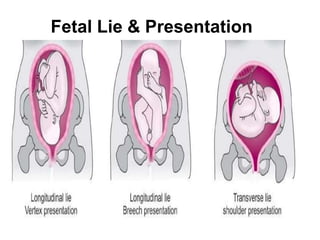
– Fetal lie: relationship of fetal spine to maternal spine;
longitudinal (vertical) or transverse (horizontal)
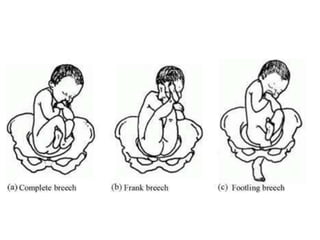
– Fetal presentation: part of fetus that enters pelvis first
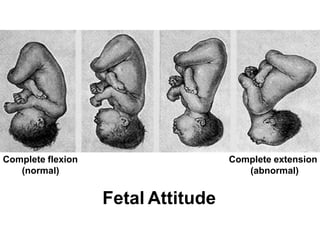
– Fetal attitude: relationship of fetal body parts to each other;
flexion (normal) or extension (abnormal)
– Fetal position: fetal direction in the pelvis
– Fetal station: position of the baby's head relative to the lower
bone of pelvis called the ischial spines 8
Fetal Lie & Presentation
Fetal Attitude 10
Complete extension
(abnormal)
Complete flexion
(normal)
Fetal Position
11
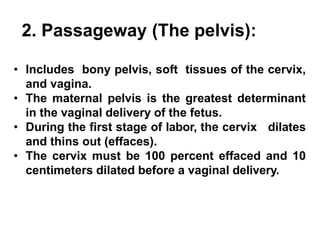
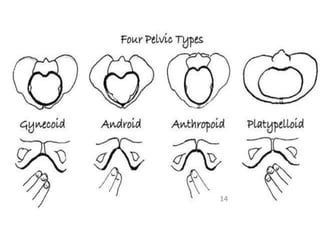
2. Passageway (The pelvis):
• Includes bony pelvis, soft tissues of the cervix,
and vagina.
• The maternal pelvis is the greatest determinant
in the vaginal delivery of the fetus.
• During the first stage of labor, the cervix dilates
and thins out (effaces).
• The cervix must be 100 percent effaced and 10
centimeters dilated before a vaginal delivery.
Fetal Station 12
14
ST
AGESOFLABOUR:
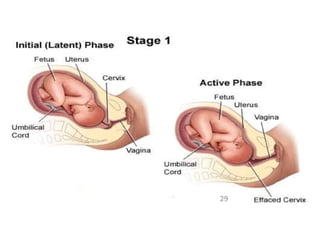
First stage:
stageof cervical effacement and dilatation
Definition:
refers to the period from the onset of true
uterine contractions to full dilation of cervix,
when it measures 10cm.
15
29
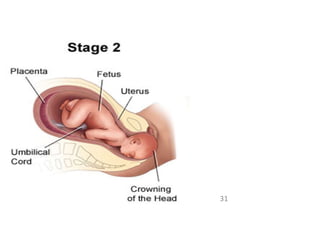
Secondstage of labour:
stage of delivery of the fetus.
Definition:
the second stage refers to the period from complete
cervical dilatation to the birth of thefetus.
Duration:
primigravida =2h
multigravida =1h
However the duration of second stage is
controversial
31
Third stage of labour:
The stage of expulsion of placenta and
membranes.
Duration:
upto30minutes,averagetimeis10 minutes
33
34
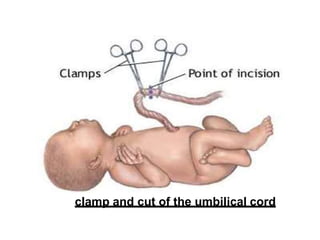
clamp and cut of the umbilical cord
Stageof
labour
Definition Duration
StageI latent
phase
(affacment)
•Beginsfrom the onset of regularcontractions.
•Endswith acceleration of cervicaldilatation
•Prepares cervix for dilatation.
<20hours in PG
<14hours MG
Stage1 active
phase
(dilatation)
•Beginswith acceleration of cervicaldilatation.
•Endsat 10 cmdilatation
•Rapid cervical dilatation
<2/hours in PG
<1.5/ hrs inMG
Stage2
(descent)
•Beginsfrom 10cmdilatation
•Endswith delivery of thebaby
•Descent of the fetus
<2hours in PG
<1hours in MG
Add 1 hour inepi
Stage3
(expulsion)
•Beginswith delivery of thebaby.
•Endswith delivery of theplacenta
•Delivery of the placenta
<30min.
Mechanism of Labor
19
In the normal labor; there are series of changes in position
and attitude of the fetus to accommodate himself to the
pelvic to pass easily through the birth canal:
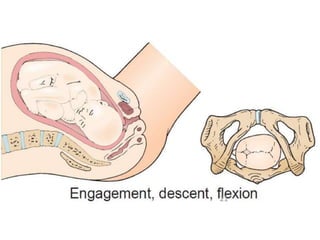
1. Engagement
2. Descent
3. Flexion
4. Internal rotation
5. Extension
6. External rotation
7. Expulsion
1. Engagement
20
of the fetal head passes
The greatest diameter
through the pelvic inlet.
2. Descent
Movement of the fetus through the birth canal
during the first and second stages of labor
3. Flexion
The chin of the fetus moves toward the fetal chest
which reduce the fetal head diameter from nearly 12
to 9.5 cm.
21
4. Internal rotation
The rotation of the fetal head until the longest
diameter of the fetal head match the longest
diameter of the maternal pelvic.
22
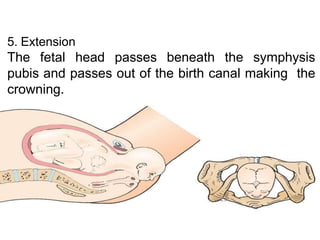
5. Extension
The fetal head passes beneath the symphysis
pubis and passes out of the birth canal making the
crowning.
23
6. External rotation (Restitution)
After the head has delivered, the shoulders
rotate internally to fit the pelvis.
24
7. Expulsion
The shoulders and remainder of the body are
delivered
25
During antenatal period, the women should be
classified as high or low risk pregnancy.
The medical or surgical problems should be corrected
(anaemia, hypertension, urinary tract infection),
Vaccination
Investigations
(HIV, HCV, Hbs Ag, blood grouping).
Advise her to attend atenatal classes and hospital
delivery.
Thank you

NORMAL LABOUR& Mechanism.pptx

  • 1.
    NORMAL LABOUR & MECHANISM OFLABOR PROFESSOR DR. IRAM CHAUDHRY FCPS(OBS&GYNAE), MHPE
  • 2.
    OUTLINE • Definition ofLabor • Mechanism of Labor • Stages of Labor • Management of Normal Labor
  • 3.
    Labour • It isa physiological process by which the fetus, placenta and membrane are expelled out through the birth canal after twenty four week of pregnancy • Parturition isthe process of givingbirth
  • 4.
    Normal labour • Normallabour is physiological process by which the fetus ,placenta and membrane are expelled through the birth canal after full term pregnancy (37-42 weeks ofgestation)
  • 5.
    • Labour iscalled normal when it fulfills the following criteria :  Spontaneous onset at term  With vertex presentation  Without prolongation  Natural termination with minimal aids
  • 6.
    Clinical course oflabour Onset of labour: not definitely known Mechanical factors: - uterine distension Hormonal factors: 1. Maternal : o progesterone withdrawal o oxytocin stimulation o prostaglandins o serotonin 2. fetal: o fetal cortisol o fetal membranes 3. Neuronal: o sympathetic- alpha receptor stimulation
  • 7.
    1- Regular UterineContractions 2- Show 3- Leaking
  • 8.
    NORMAL LABOUR FIRST STAGE SECONDSTAGE THIRD STAGE LATENT PHASE: 0-6cm ACTIVE PHASE: 6-10cm FULL DILATION TO EXPULSION OF FETUS BIRTH TO EXPULSION OF PLACENTA Expectant (physiological) vs Active (CCT + OT)
  • 9.
    1. True labourpains – colicky pain in the abdomen and back are characterized by: A Character True l.pains False l.pains Irregular Short duration, not progressive contractions Interval between contractions and intensity Changes in the cervix Membranes Response to analgesia Labour regular Progressive (increase in frequency and intensity) Associated with effacement and dilation of the cervix Associated with bulging of membranes Not relieved by sedation Followed by labour Not associated with effacement and dilation of the cervix Not associated with bulging of membranes Relieved by sedation Not followed by labour
  • 10.
    • Cervicaldilatation: • Thecervixbegins dilating and stretching beyond the normal dimensions and is measured in centimeters. (0-10cm). • Cervicaleffacement: • softening, thinning and shortening of the cervix. It is expressedin percentage (0 – 100%)
  • 11.
    Cervical effacement vs cervical dilation Cervixclosed, 3 cm long Cervix effaced, 1 cm dilated Cervix 5 cm dilated Cervix fully dilated
  • 12.
    Factors affecting Labor(5 P’s) In every labor; there are five essential factors affect the process. 5 P’s: 1. Passenger: the fetus 2. Passageway: the pelvis and birth canal 3. Powers: the uterine contractions physical 4. Position: maternal postures and positions 5. Psyche: the response of the mother 7
  • 13.
    1.Passenger (The Fetus): Thefetus relationship to the passageway is the major factor in the birthing process. The relationship includes: • Fetal skull and size • Number of fetuses • Position of feus – Fetal lie: relationship of fetal spine to maternal spine; longitudinal (vertical) or transverse (horizontal) – Fetal presentation: part of fetus that enters pelvis first – Fetal attitude: relationship of fetal body parts to each other; flexion (normal) or extension (abnormal) – Fetal position: fetal direction in the pelvis – Fetal station: position of the baby's head relative to the lower bone of pelvis called the ischial spines 8
  • 14.
    Fetal Lie &Presentation
  • 17.
    Fetal Attitude 10 Completeextension (abnormal) Complete flexion (normal)
  • 18.
  • 19.
    2. Passageway (Thepelvis): • Includes bony pelvis, soft tissues of the cervix, and vagina. • The maternal pelvis is the greatest determinant in the vaginal delivery of the fetus. • During the first stage of labor, the cervix dilates and thins out (effaces). • The cervix must be 100 percent effaced and 10 centimeters dilated before a vaginal delivery.
  • 20.
  • 21.
  • 22.
    ST AGESOFLABOUR: First stage: stageof cervicaleffacement and dilatation Definition: refers to the period from the onset of true uterine contractions to full dilation of cervix, when it measures 10cm.
  • 23.
  • 24.
  • 25.
    Secondstage of labour: stageof delivery of the fetus. Definition: the second stage refers to the period from complete cervical dilatation to the birth of thefetus. Duration: primigravida =2h multigravida =1h However the duration of second stage is controversial
  • 26.
  • 27.
    Third stage oflabour: The stage of expulsion of placenta and membranes. Duration: upto30minutes,averagetimeis10 minutes
  • 28.
  • 29.
    34 clamp and cutof the umbilical cord
  • 30.
    Stageof labour Definition Duration StageI latent phase (affacment) •Beginsfromthe onset of regularcontractions. •Endswith acceleration of cervicaldilatation •Prepares cervix for dilatation. <20hours in PG <14hours MG Stage1 active phase (dilatation) •Beginswith acceleration of cervicaldilatation. •Endsat 10 cmdilatation •Rapid cervical dilatation <2/hours in PG <1.5/ hrs inMG Stage2 (descent) •Beginsfrom 10cmdilatation •Endswith delivery of thebaby •Descent of the fetus <2hours in PG <1hours in MG Add 1 hour inepi Stage3 (expulsion) •Beginswith delivery of thebaby. •Endswith delivery of theplacenta •Delivery of the placenta <30min.
  • 31.
    Mechanism of Labor 19 Inthe normal labor; there are series of changes in position and attitude of the fetus to accommodate himself to the pelvic to pass easily through the birth canal: 1. Engagement 2. Descent 3. Flexion 4. Internal rotation 5. Extension 6. External rotation 7. Expulsion
  • 32.
    1. Engagement 20 of thefetal head passes The greatest diameter through the pelvic inlet. 2. Descent Movement of the fetus through the birth canal during the first and second stages of labor 3. Flexion The chin of the fetus moves toward the fetal chest which reduce the fetal head diameter from nearly 12 to 9.5 cm.
  • 33.
  • 34.
    4. Internal rotation Therotation of the fetal head until the longest diameter of the fetal head match the longest diameter of the maternal pelvic. 22
  • 35.
    5. Extension The fetalhead passes beneath the symphysis pubis and passes out of the birth canal making the crowning. 23
  • 36.
    6. External rotation(Restitution) After the head has delivered, the shoulders rotate internally to fit the pelvis. 24
  • 37.
    7. Expulsion The shouldersand remainder of the body are delivered 25
  • 38.
    During antenatal period,the women should be classified as high or low risk pregnancy. The medical or surgical problems should be corrected (anaemia, hypertension, urinary tract infection), Vaccination Investigations (HIV, HCV, Hbs Ag, blood grouping). Advise her to attend atenatal classes and hospital delivery.
  • 39.