Dr. Charles M. Ware, D.H.Ed., CHES
 Doctorate in Health Sociology and Education
 Masters in Exercise Science and Sport Management
 Bachelors in Physical Education
 Licensed Psychologist
 Certified Health Education Specialist
 Certified Health Coach
 Certified Personal Fitness Trainer
 By the end of this training, you
will be able to:
◦ Describe adult learner characteristics.
◦ Distinguish what factors contribute to
maximum retention in adult learners.
◦ Be able to select the most effective
training methods for all adult learners.
The term “pedagogy” was derived
from the Greek words “paid”
(meaning “child”) and “agogus”
(meaning “leading”). Thus, it is
defined as the art and science of
teaching children.
The term “Andragogy” was coined by researchers of
adult learning in order to contrast their beliefs about
learning to the pedagogical model. Malcolm Knowles
first introduced the concept in the US in 1968. The
concept of andragogy implies self-directedness and
an active student role, as well as solution-centered
activities. It was derived from the Greek word “aner”
(with the stem andr-) meaning “man, not boy.”
 Children
◦ Rely on others to decide what is
important to be learned.
 Adults
◦ Decide for themselves what is
important to be learned.
 Children
◦ Accept the information being
presented at face value.
 Adults
◦ Need to validate the information
based on beliefs and experience.
 Children
◦ Expect what they are learning to be
useful in their long-term future.
 Adults
◦ Expect what they are learning to be
immediately useful.
 Children
◦ Have little or no experience upon
which to draw so are relatively “clean
slates”.
 Adults
◦ Have much experience upon to draw
and may have fixed viewpoints.
 Children
◦ Have little ability to serve as a
knowledgeable resource to teacher
or fellow classmates.
 Adults
◦ Have significant ability to serve a
knowledgeable resource to trainer
and fellow learners.
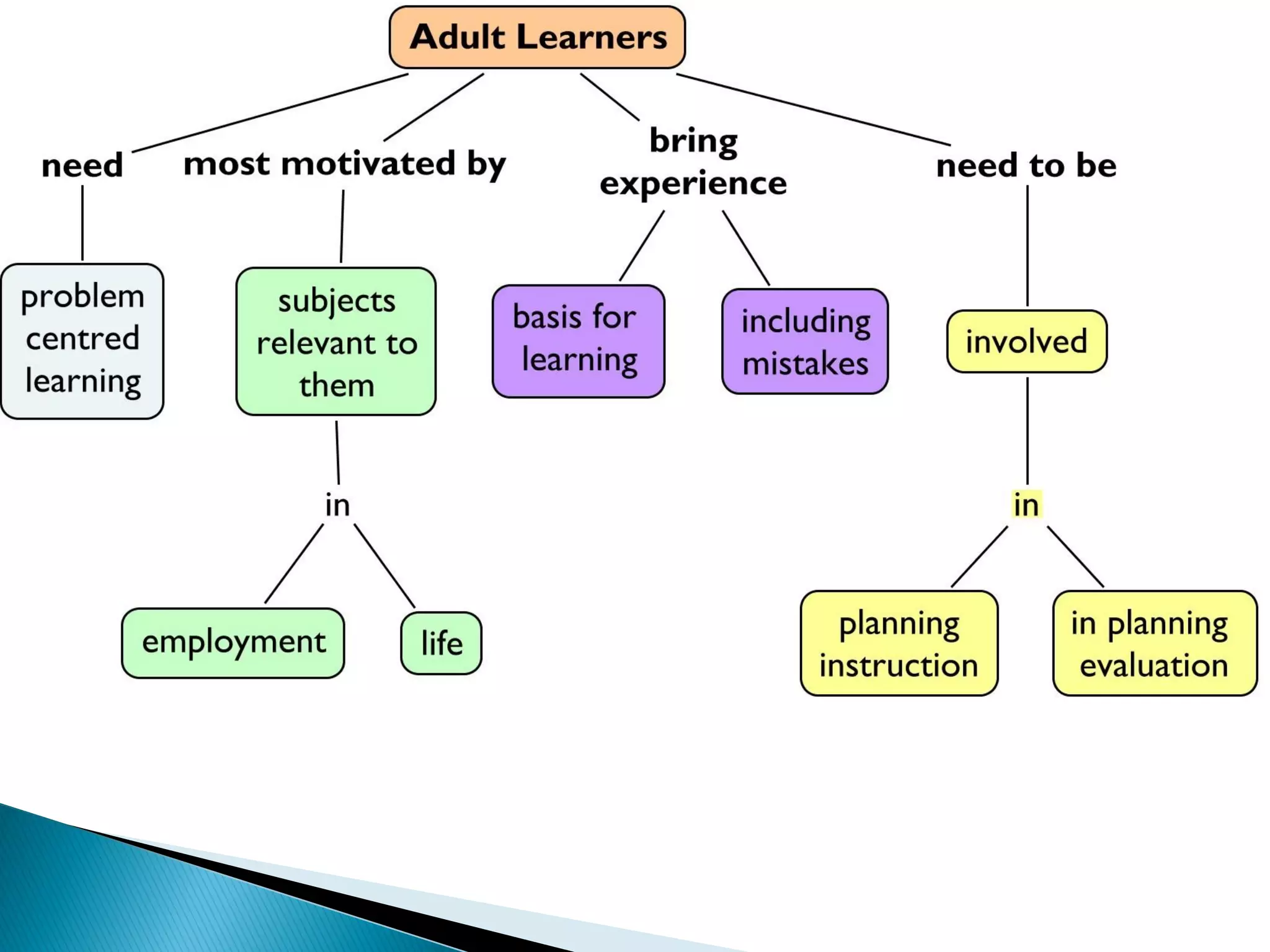
 Self-Concept
◦ Adults expect and enjoy independence.
◦ They like control or like to take control.
◦ Learning is a process of sharing with
the teacher and one another.
◦ Teacher has the responsibility to
encourage and nurture the process of
self-direction.
 Need to Know
◦ Adult learners need to know why
they need to learn something before
undertaking it.
 Experience
◦ Have many experiences; therefore,
teacher must draw on adult-learner
experiences.
◦ Trade-off. Anyone in class also could
share.
◦ In some areas, students may have more
experience than the instructor.
◦ Elicits 2-and 3-way communication;
instructor to student and student to
student.
 Readiness to Learn
◦ Adults normally come to class
motivated and ready to learn because
they have chosen the training.
◦ Adults learn in order to cope with
real-life tasks.
◦ Adults do not group by age or sex
but by experience.
 Time Perspective
◦ Pragmatic-want application today.
◦ Can barely tolerate studying anything
that cannot be applied to a task they
expect to perform.
 Orientation to Learning
◦ Adults and teachers need to be
problem or task centered.
◦ Learning is a process of increasing
competence to achieve full potential
in life. Not acquiring subject matter
content.
 Focus on “real-world” problems.
 Emphasize how the learning can be
applied.
 Relate the learning to the learner’s
goals.
 Relate the material to the learners past
experiences.
 Allow debate and challenge of ideas.
 Listen to and respect the opinion of
learners.
 Encourage learners to be resources to
you and to each other.
 Treat learners like adult, and adults
like learners.
 Give learners creative control.
 Presentation/Lecture
◦ Advantages
 Keeps group together and on the same point
 Time control is easier
 Useful for large group size (20 or more]
◦ Drawbacks
 Can be dull if used to long without learner participation
 Difficult to gauge if people are learning
 Retention is limited.
 Structured Exercise/Role Play
◦ Advantages
 Aids retention.
 Allows practice of new skills in a controlled environment.
 Learners are actively involved.
◦ Drawbacks
 Required preparation time.
 May be difficult to tailor to all learners’ situations.
 Needs sufficient class time for exercise completion but
more importantly feedback.
 Individual Reading Assignments and
Exercises
◦ Advantages
 Saves time as learners can read faster than teacher can
talk.
 Material can be retained for later use.
 Insures consistency of information.
◦ Drawbacks
 Can be boring if used too long without interruption.
 Learners read at different paces.
 Difficult to gauge if people are learning.
 Facilitated Group Discussion
◦ Advantages
 Keep learners interested and involved.
 Learner resources can be discovered and shared.
 Learning can be observed.
◦ Drawbacks
 Learning points can be confusing or lost.
 A few learners may dominate the discussion.
 Time control is more difficult.
 Case Study
◦ Advantages
 Required active learner involvement.
 Can stimulate performance required after training.
 Learning can be observed.
◦ Drawbacks
 Information must be precise and kept up-to-date.
 Needs sufficient class time for learners to complete the
cases.
 Learners can become too interested in case content.
 Demonstration
◦ Advantages
 Aids in understanding and retention.
 Stimulates learners interest.
 Can give learners a model to follow.
◦ Drawbacks
 Must be accurate and relevant to learners.
 Written examples can require lengthy preparation.
 Trainer demonstrations may be difficult for all
learners to see well.
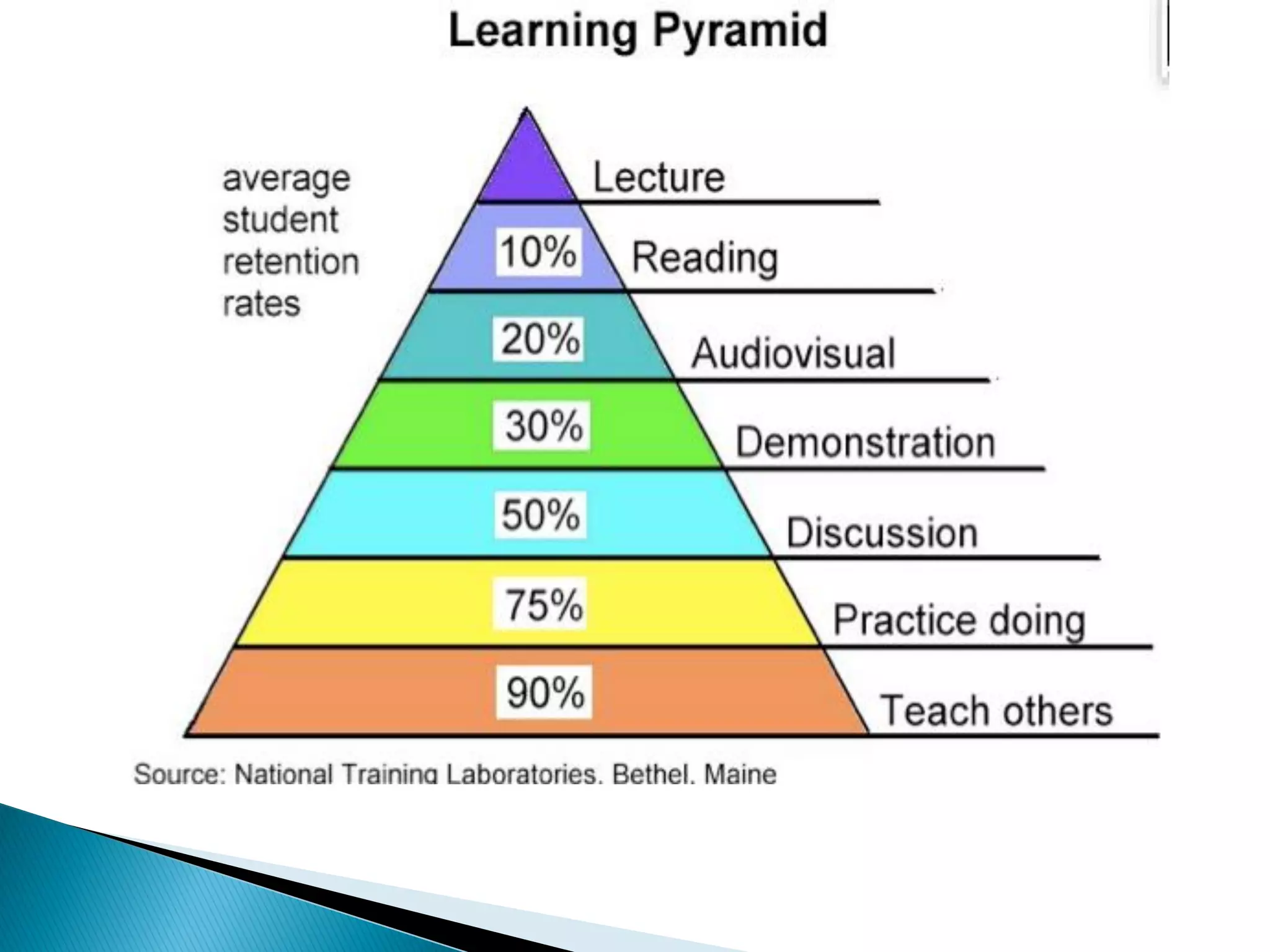
Adults retain _____ of what they hear:
a) 30%
b) 10%
c) 40%
d) None of the above
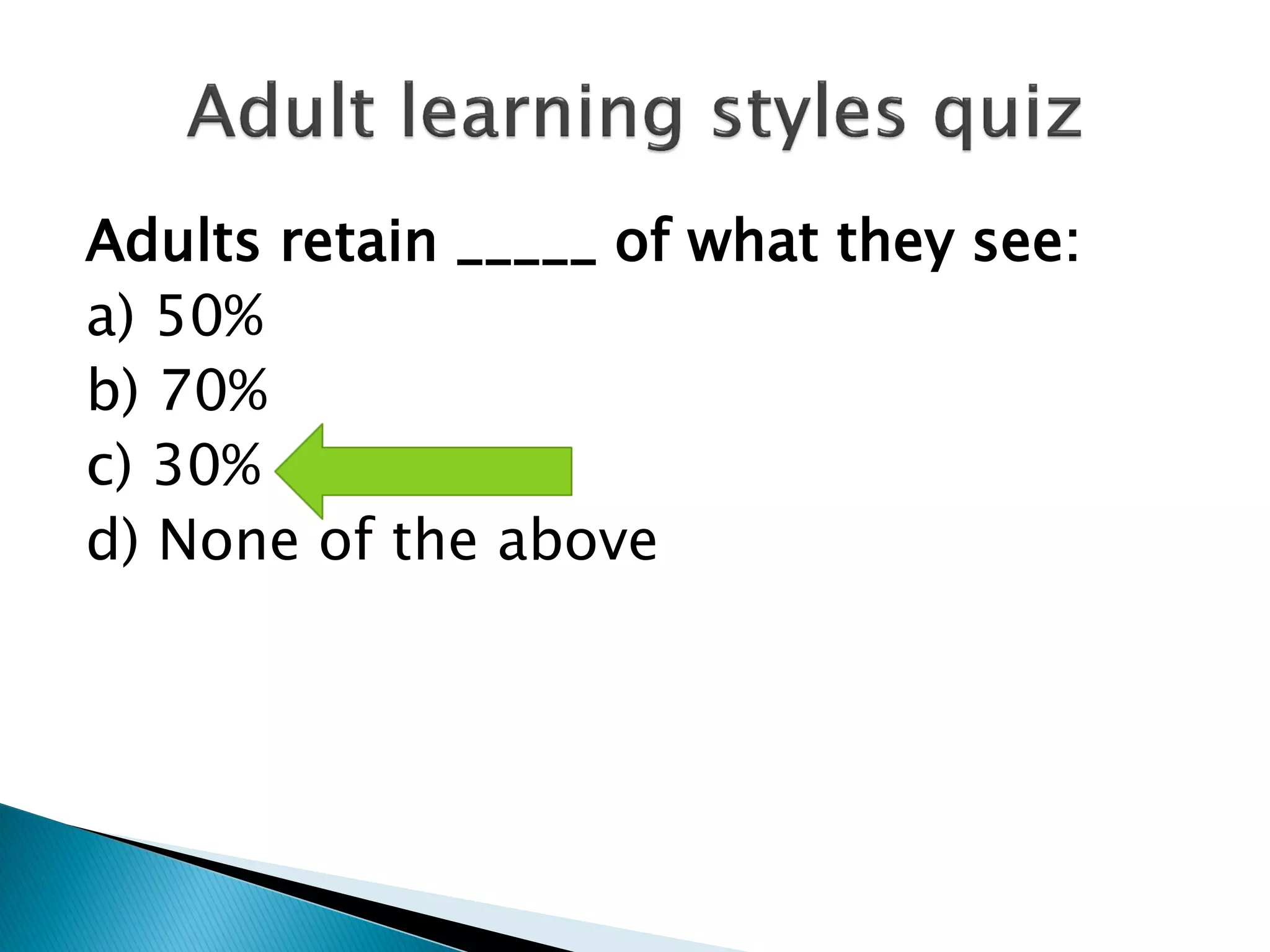
Adults retain _____ of what they see:
a) 50%
b) 70%
c) 30%
d) None of the above
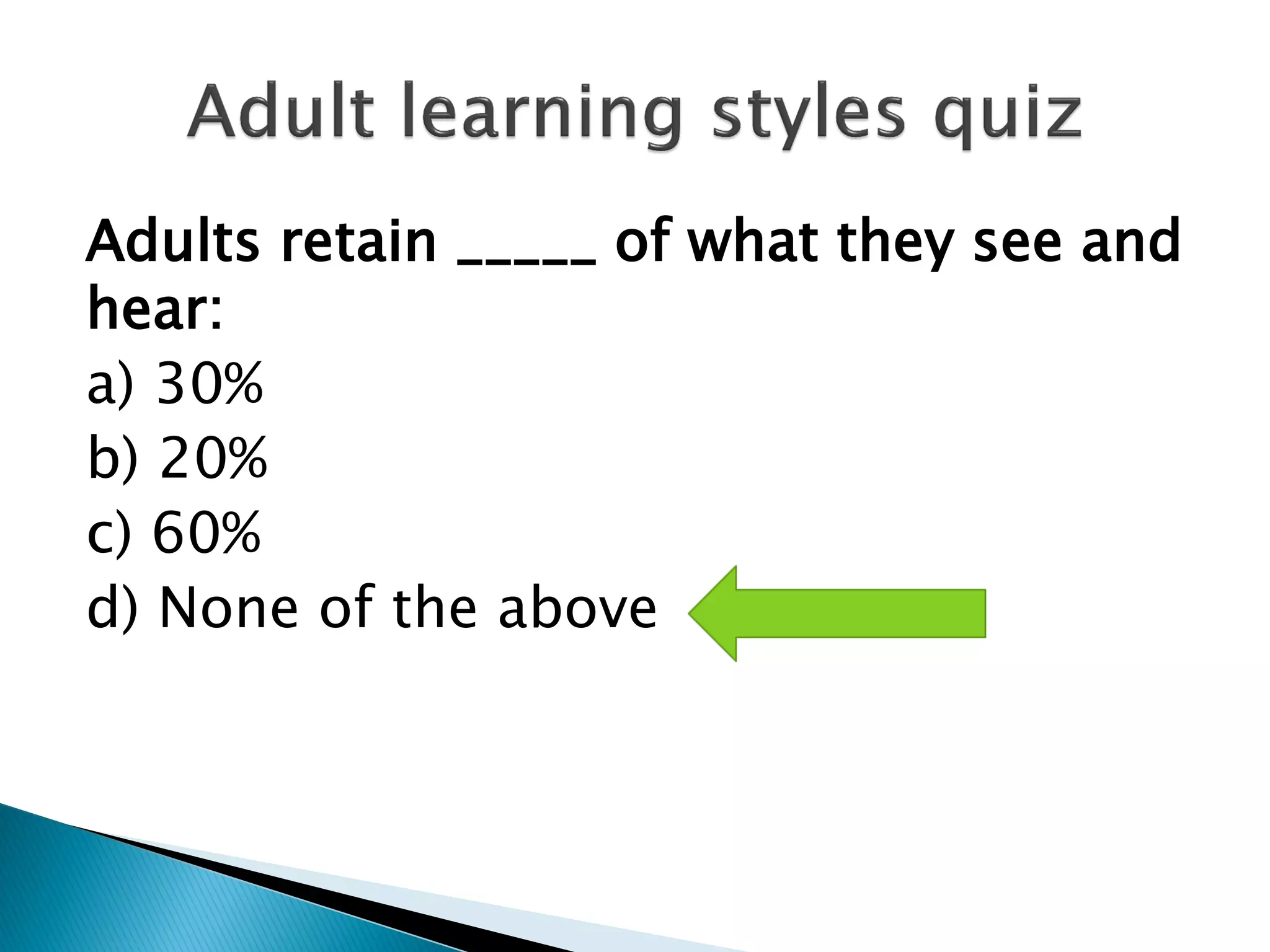
Adults retain _____ of what they see and
hear:
a) 30%
b) 20%
c) 60%
d) None of the above
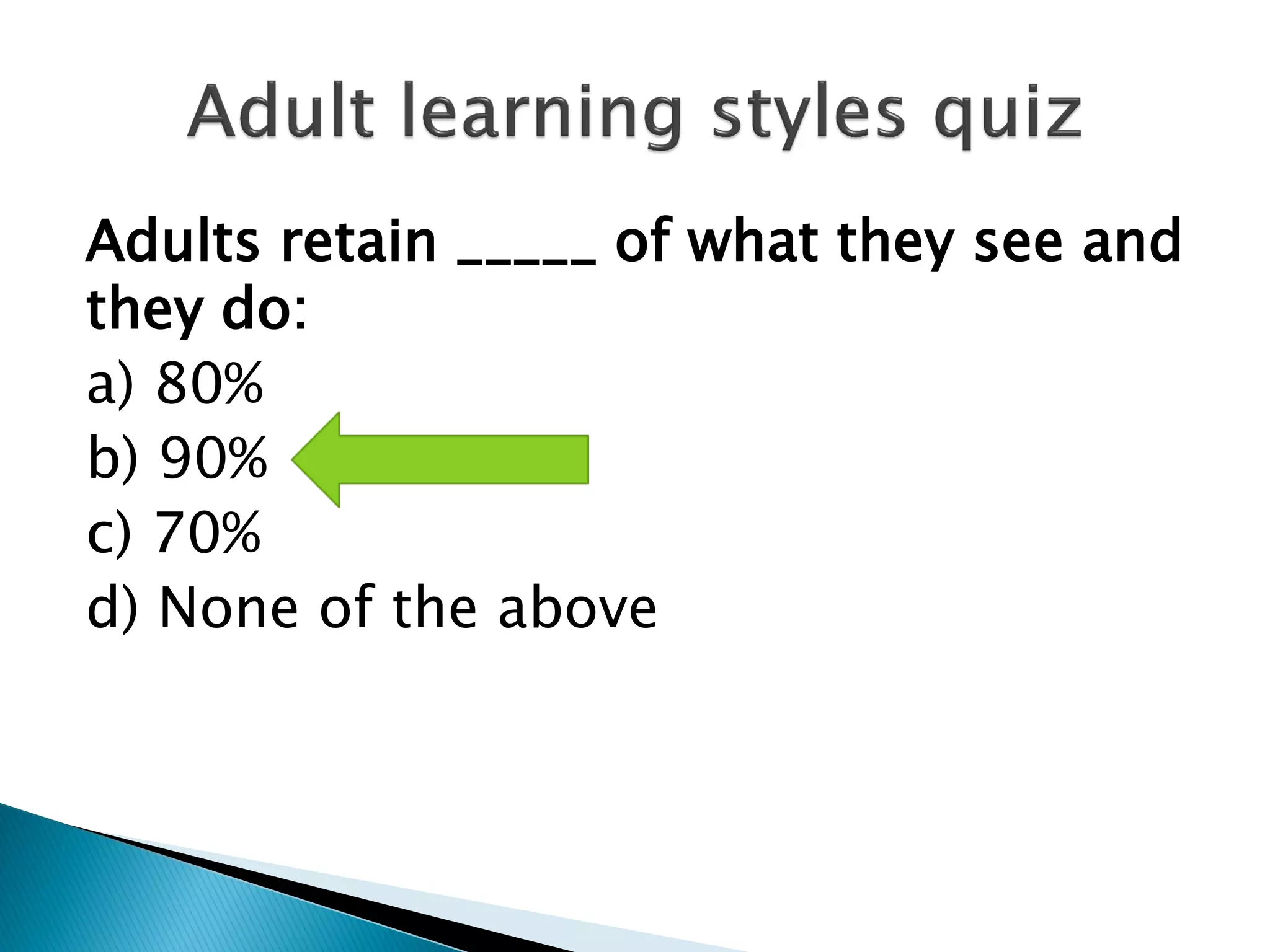
Adults retain _____ of what they see and
they do:
a) 80%
b) 90%
c) 70%
d) None of the above
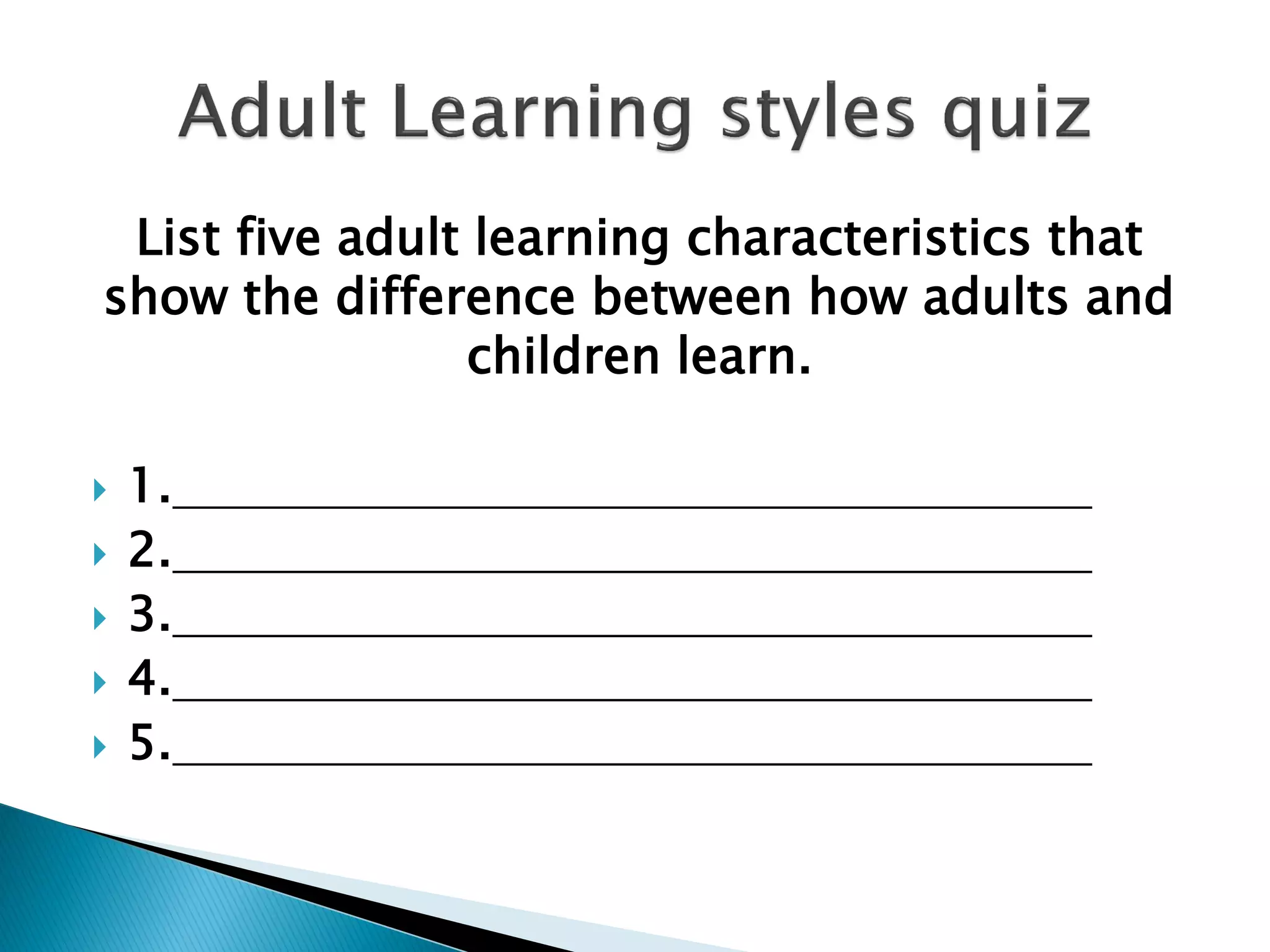
List five adult learning characteristics that
show the difference between how adults and
children learn.
 1.
 2.
 3.
 4.
 5.
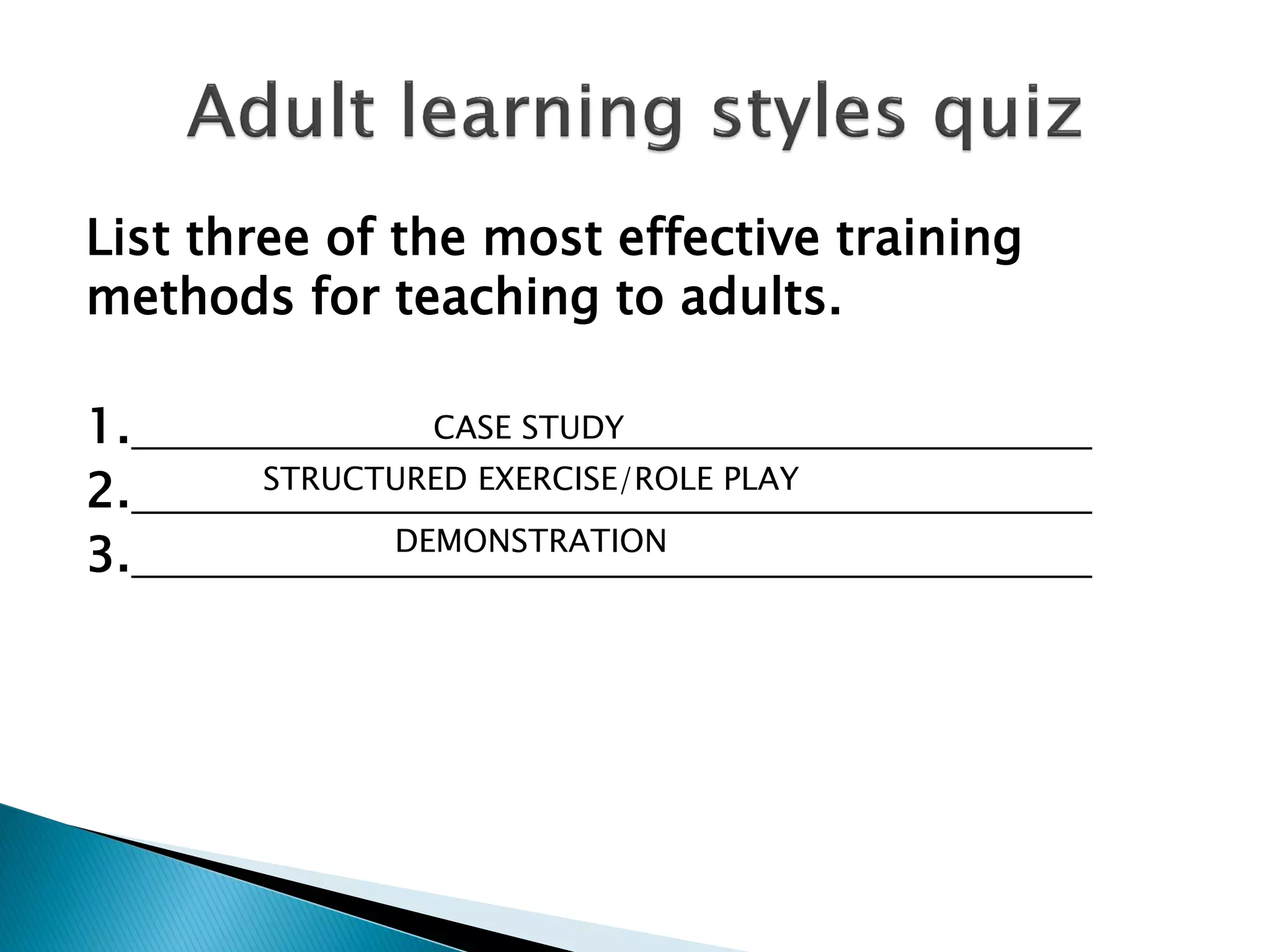
List three of the most effective training
methods for teaching to adults.
1.
2.
3.
CASE STUDY
STRUCTURED EXERCISE/ROLE PLAY
DEMONSTRATION
Adult Learning Styles and Training Methods

Adult Learning Styles and Training Methods

  • 1.
    Dr. Charles M.Ware, D.H.Ed., CHES
  • 2.
     Doctorate inHealth Sociology and Education  Masters in Exercise Science and Sport Management  Bachelors in Physical Education  Licensed Psychologist  Certified Health Education Specialist  Certified Health Coach  Certified Personal Fitness Trainer
  • 3.
     By theend of this training, you will be able to: ◦ Describe adult learner characteristics. ◦ Distinguish what factors contribute to maximum retention in adult learners. ◦ Be able to select the most effective training methods for all adult learners.
  • 8.
    The term “pedagogy”was derived from the Greek words “paid” (meaning “child”) and “agogus” (meaning “leading”). Thus, it is defined as the art and science of teaching children.
  • 9.
    The term “Andragogy”was coined by researchers of adult learning in order to contrast their beliefs about learning to the pedagogical model. Malcolm Knowles first introduced the concept in the US in 1968. The concept of andragogy implies self-directedness and an active student role, as well as solution-centered activities. It was derived from the Greek word “aner” (with the stem andr-) meaning “man, not boy.”
  • 12.
     Children ◦ Relyon others to decide what is important to be learned.  Adults ◦ Decide for themselves what is important to be learned.
  • 13.
     Children ◦ Acceptthe information being presented at face value.  Adults ◦ Need to validate the information based on beliefs and experience.
  • 14.
     Children ◦ Expectwhat they are learning to be useful in their long-term future.  Adults ◦ Expect what they are learning to be immediately useful.
  • 15.
     Children ◦ Havelittle or no experience upon which to draw so are relatively “clean slates”.  Adults ◦ Have much experience upon to draw and may have fixed viewpoints.
  • 16.
     Children ◦ Havelittle ability to serve as a knowledgeable resource to teacher or fellow classmates.  Adults ◦ Have significant ability to serve a knowledgeable resource to trainer and fellow learners.
  • 19.
     Self-Concept ◦ Adultsexpect and enjoy independence. ◦ They like control or like to take control. ◦ Learning is a process of sharing with the teacher and one another. ◦ Teacher has the responsibility to encourage and nurture the process of self-direction.
  • 20.
     Need toKnow ◦ Adult learners need to know why they need to learn something before undertaking it.
  • 21.
     Experience ◦ Havemany experiences; therefore, teacher must draw on adult-learner experiences. ◦ Trade-off. Anyone in class also could share. ◦ In some areas, students may have more experience than the instructor. ◦ Elicits 2-and 3-way communication; instructor to student and student to student.
  • 22.
     Readiness toLearn ◦ Adults normally come to class motivated and ready to learn because they have chosen the training. ◦ Adults learn in order to cope with real-life tasks. ◦ Adults do not group by age or sex but by experience.
  • 23.
     Time Perspective ◦Pragmatic-want application today. ◦ Can barely tolerate studying anything that cannot be applied to a task they expect to perform.
  • 24.
     Orientation toLearning ◦ Adults and teachers need to be problem or task centered. ◦ Learning is a process of increasing competence to achieve full potential in life. Not acquiring subject matter content.
  • 25.
     Focus on“real-world” problems.  Emphasize how the learning can be applied.  Relate the learning to the learner’s goals.  Relate the material to the learners past experiences.  Allow debate and challenge of ideas.
  • 26.
     Listen toand respect the opinion of learners.  Encourage learners to be resources to you and to each other.  Treat learners like adult, and adults like learners.  Give learners creative control.
  • 28.
     Presentation/Lecture ◦ Advantages Keeps group together and on the same point  Time control is easier  Useful for large group size (20 or more] ◦ Drawbacks  Can be dull if used to long without learner participation  Difficult to gauge if people are learning  Retention is limited.
  • 29.
     Structured Exercise/RolePlay ◦ Advantages  Aids retention.  Allows practice of new skills in a controlled environment.  Learners are actively involved. ◦ Drawbacks  Required preparation time.  May be difficult to tailor to all learners’ situations.  Needs sufficient class time for exercise completion but more importantly feedback.
  • 30.
     Individual ReadingAssignments and Exercises ◦ Advantages  Saves time as learners can read faster than teacher can talk.  Material can be retained for later use.  Insures consistency of information. ◦ Drawbacks  Can be boring if used too long without interruption.  Learners read at different paces.  Difficult to gauge if people are learning.
  • 31.
     Facilitated GroupDiscussion ◦ Advantages  Keep learners interested and involved.  Learner resources can be discovered and shared.  Learning can be observed. ◦ Drawbacks  Learning points can be confusing or lost.  A few learners may dominate the discussion.  Time control is more difficult.
  • 32.
     Case Study ◦Advantages  Required active learner involvement.  Can stimulate performance required after training.  Learning can be observed. ◦ Drawbacks  Information must be precise and kept up-to-date.  Needs sufficient class time for learners to complete the cases.  Learners can become too interested in case content.
  • 33.
     Demonstration ◦ Advantages Aids in understanding and retention.  Stimulates learners interest.  Can give learners a model to follow. ◦ Drawbacks  Must be accurate and relevant to learners.  Written examples can require lengthy preparation.  Trainer demonstrations may be difficult for all learners to see well.
  • 34.
    Adults retain _____of what they hear: a) 30% b) 10% c) 40% d) None of the above
  • 35.
    Adults retain _____of what they see: a) 50% b) 70% c) 30% d) None of the above
  • 36.
    Adults retain _____of what they see and hear: a) 30% b) 20% c) 60% d) None of the above
  • 37.
    Adults retain _____of what they see and they do: a) 80% b) 90% c) 70% d) None of the above
  • 38.
    List five adultlearning characteristics that show the difference between how adults and children learn.  1.  2.  3.  4.  5.
  • 39.
    List three ofthe most effective training methods for teaching to adults. 1. 2. 3. CASE STUDY STRUCTURED EXERCISE/ROLE PLAY DEMONSTRATION