NEURON AND IT’S STRUCTURAL &
FUNCTIONAL TYPES
BY: Syed Irshad Murtaza
Technologist
Neurophysiology Dept
AKUH Karachi
Date: 05/06-08-2015
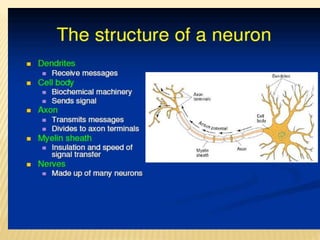
NEURONS
 The nervous system consists of vast number
of cells called neurons.
 The are the functional unit of the nervous
system.
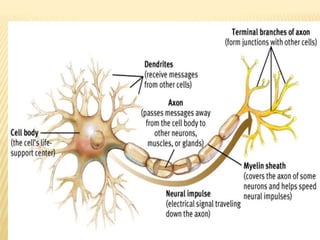
 Each neuron consists of cell body(soma),
axon and dendrites.
 Neurons are commonly referred to as nerve
cells. Bundles of axons bound together and
are called nerves.
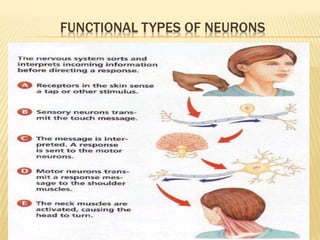
FUNCTIONAL TYPES OF NEURONS
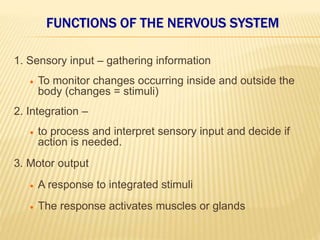
FUNCTIONS OF THE NERVOUS SYSTEM
1. Sensory input – gathering information
 To monitor changes occurring inside and outside the
body (changes = stimuli)
2. Integration –
 to process and interpret sensory input and decide if
action is needed.
3. Motor output
 A response to integrated stimuli
 The response activates muscles or glands
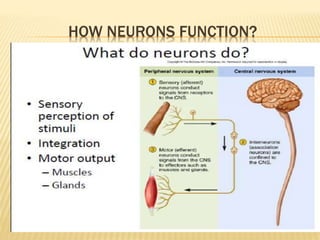
HOW NEURONS FUNCTION?
STRUCTURAL TYPES OF NEURON
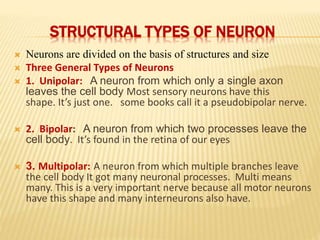
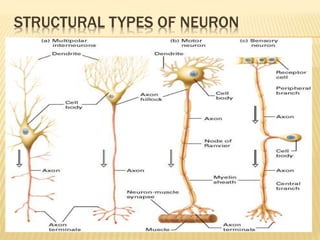
 Neurons are divided on the basis of structures and size
 Three General Types of Neurons
 1. Unipolar: A neuron from which only a single axon
leaves the cell body Most sensory neurons have this
shape. It’s just one. some books call it a pseudobipolar nerve.
 2. Bipolar: A neuron from which two processes leave the
cell body. It’s found in the retina of our eyes
 3. Multipolar: A neuron from which multiple branches leave
the cell body It got many neuronal processes. Multi means
many. This is a very important nerve because all motor neurons
have this shape and many interneurons also have.
STRUCTURAL TYPES OF NEURON
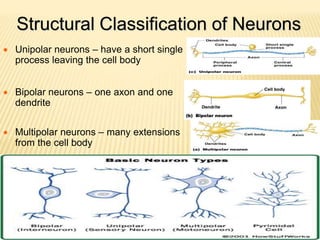
Structural Classification of Neurons
 Multipolar neurons – many extensions
from the cell body
 Bipolar neurons – one axon and one
dendrite
 Unipolar neurons – have a short single
process leaving the cell body
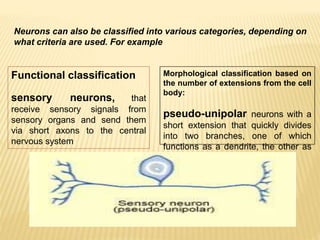
Neurons can also be classified into various categories, depending on
what criteria are used. For example
Functional classification
sensory neurons, that
receive sensory signals from
sensory organs and send them
via short axons to the central
nervous system
Morphological classification based on
the number of extensions from the cell
body:
pseudo-unipolar neurons with a
short extension that quickly divides
into two branches, one of which
functions as a dendrite, the other as
an axon…..
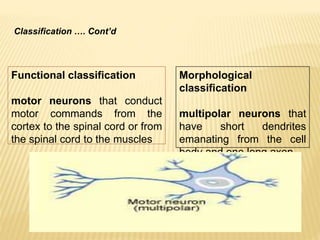
Functional classification
motor neurons that conduct
motor commands from the
cortex to the spinal cord or from
the spinal cord to the muscles
Morphological
classification
multipolar neurons that
have short dendrites
emanating from the cell
body and one long axon
Classification …. Cont’d
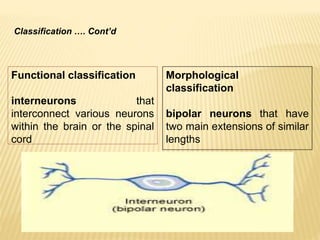
Functional classification
interneurons that
interconnect various neurons
within the brain or the spinal
cord
Morphological
classification
bipolar neurons that have
two main extensions of similar
lengths
Classification …. Cont’d
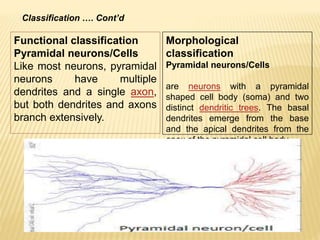
Functional classification
Pyramidal neurons/Cells
Like most neurons, pyramidal
neurons have multiple
dendrites and a single axon,
but both dendrites and axons
branch extensively.
Morphological
classification
Pyramidal neurons/Cells
are neurons with a pyramidal
shaped cell body (soma) and two
distinct dendritic trees. The basal
dendrites emerge from the base
and the apical dendrites from the
apex of the pyramidal cell body.
Classification …. Cont’d
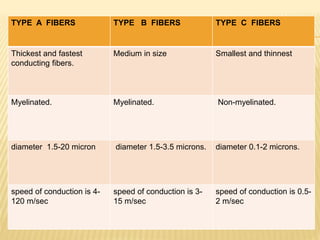
TYPES OF NERVE FIBERS
The individual nerve fibers have different
diameters related to different functions. Each
nerve fiber arises from soma of the neuron
through a long extended process called the
axon.
Not all signals move at the same conduction
velocities. This is due to the type of fiber that is
conducting the signal. Most fibers fall under one
of the three different fiber types: A fibers, B
fibers, and C fibers. These classifications are
based on their diameters, and other
physiological characteristics
Note: Larger the diameter of the neuron faster the
speed of the action potential.
TYPE A FIBERS TYPE B FIBERS TYPE C FIBERS
Thickest and fastest
conducting fibers.
Medium in size Smallest and thinnest
Myelinated. Myelinated. Non-myelinated.
diameter 1.5-20 micron diameter 1.5-3.5 microns. diameter 0.1-2 microns.
speed of conduction is 4-
120 m/sec
speed of conduction is 3-
15 m/sec
speed of conduction is 0.5-
2 m/sec
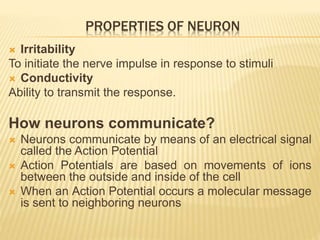
PROPERTIES OF NEURON
 Irritability
To initiate the nerve impulse in response to stimuli
 Conductivity
Ability to transmit the response.
How neurons communicate?
 Neurons communicate by means of an electrical signal
called the Action Potential
 Action Potentials are based on movements of ions
between the outside and inside of the cell
 When an Action Potential occurs a molecular message
is sent to neighboring neurons
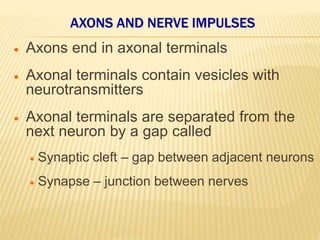
AXONS AND NERVE IMPULSES
 Axons end in axonal terminals
 Axonal terminals contain vesicles with
neurotransmitters
 Axonal terminals are separated from the
next neuron by a gap called
 Synaptic cleft – gap between adjacent neurons
 Synapse – junction between nerves
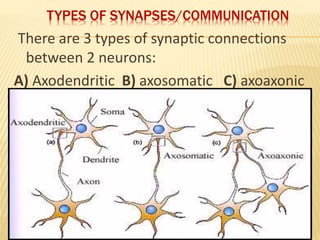
TYPES OF SYNAPSES/COMMUNICATION
There are 3 types of synaptic connections
between 2 neurons:
A) Axodendritic B) axosomatic C) axoaxonic
 All or None Principle :
 All or None Principle A law stating that once the
membrane depolarized to a threshold value, action
potentials occur maximally or not at all.
Throughout depolarisation, the Na+ continues to rush
inside until the action potential reaches its peak and the
sodium gates close.
If the depolarisation is not great enough to reach
threshold, then an action potential and hence an impulse
are not produced.
ACTION POTENTIAL
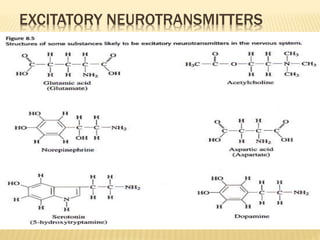
EXCITATORY NEUROTRANSMITTERS
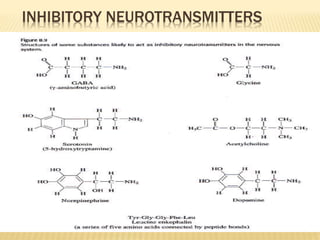
INHIBITORY NEUROTRANSMITTERS
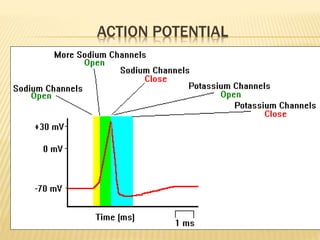
ACTION POTENTIAL
PHASES OF ACTION POTENTIAL
 “An action potential (also known as a nerve impulse or a
spike potential) is a self-regenerating wave of
electrochemical activity (in response to stimuli) that allows
excitable cells (such as nerve cells) to carry a signal over a
distance.”
 Stages of Action potential :
 Resting stage
i. In it the neuron is polarised due to different concentration
of ion across membrane.
ii. Inside –ve membrane.
iii. Outside +ve membrane
iv. Na+ and K+ Channels are close
v. Na+ major extracellular cation
vi. K+ major intracellualr cation
vii. Membrane is at rest.
viii. This is resting membrane potential =-70mV.
 Depolarization
i. Threshold stimulus (about -60 to -55mV)
ii. Excite the Na-channels.
iii. Na+ Channels Open
iv. Influx of Na+ Starts
v. Na+ ions Rush in
vi. Inside became more +ve membrane
vii. Outside -ve membrane
viii. Membrane potential rises from -70mV to +40mV
ix. Action Potential or nerve impulse is then generated.
PHASES OF ACTION POTENTIAL
 Repolarization
i. Na+ Channels Close.
ii. At the same time K+ Channels Open.
iii. Efflux of K+ Starts.
iv. Inside again became –ve membrane
v. And Outside +ve membrane.
vi. Membrane potential fall to -80mV (called Undershoot)
vii. Then Na-K-Pumps Work actively using ATP, to retain the
Equilibrium.
viii. Sending 3 Na+ out and 2 K+ in to the cell. And restore the
membrane potential of -70mV.
PHASES OF ACTION POTENTIAL
 Hyperpolarization
 This is the Refractory period in which a second stimulus will not
produce a second action potential (no matter how strong that
stimulus is)
 In which neuron returns to resting potential
 In it Na+ is expel outside the membrane while K+ inside the
membrane.
 RELATIVE - Refractory period :
 RELATIVE - Refractory period, Another action potential can be
produced, but only if the stimulus is greater than the threshold
stimulus
ACTION POTENTIAL
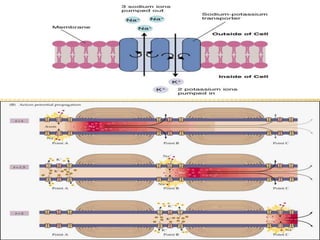
 Propagation of Action potential Through Myelinated Neurons :
 Insulatroy properties of the myelin sheath prevent the movement of
the ions
 Exchange of ions takes place only in gaps called Nodes of Ranvier.
 When depolarization occurs one node it moves across along myelin
sheath to the next nodes.
 This movement called Saltatory conduction.
 Propagation of Action potential Through Un-myelinated Neurons :
 Propagation of Action potential Through Un-Myelinated Neurons
through each and every part of the membrane. That’s why it is
called Continuous conduction with slow speed.
 In unmyelinated fibres, the entire axon membrane is exposed and
impulse conduction is slower.
ACTION POTENTIAL
Neuron & its structural & functional type by Murtaza Syed

Neuron & its structural & functional type by Murtaza Syed

  • 1.
    NEURON AND IT’SSTRUCTURAL & FUNCTIONAL TYPES BY: Syed Irshad Murtaza Technologist Neurophysiology Dept AKUH Karachi Date: 05/06-08-2015
  • 2.
    NEURONS  The nervoussystem consists of vast number of cells called neurons.  The are the functional unit of the nervous system.  Each neuron consists of cell body(soma), axon and dendrites.  Neurons are commonly referred to as nerve cells. Bundles of axons bound together and are called nerves.
  • 5.
  • 6.
    FUNCTIONS OF THENERVOUS SYSTEM 1. Sensory input – gathering information  To monitor changes occurring inside and outside the body (changes = stimuli) 2. Integration –  to process and interpret sensory input and decide if action is needed. 3. Motor output  A response to integrated stimuli  The response activates muscles or glands
  • 7.
  • 8.
    STRUCTURAL TYPES OFNEURON  Neurons are divided on the basis of structures and size  Three General Types of Neurons  1. Unipolar: A neuron from which only a single axon leaves the cell body Most sensory neurons have this shape. It’s just one. some books call it a pseudobipolar nerve.  2. Bipolar: A neuron from which two processes leave the cell body. It’s found in the retina of our eyes  3. Multipolar: A neuron from which multiple branches leave the cell body It got many neuronal processes. Multi means many. This is a very important nerve because all motor neurons have this shape and many interneurons also have.
  • 9.
  • 10.
    Structural Classification ofNeurons  Multipolar neurons – many extensions from the cell body  Bipolar neurons – one axon and one dendrite  Unipolar neurons – have a short single process leaving the cell body
  • 11.
    Neurons can alsobe classified into various categories, depending on what criteria are used. For example Functional classification sensory neurons, that receive sensory signals from sensory organs and send them via short axons to the central nervous system Morphological classification based on the number of extensions from the cell body: pseudo-unipolar neurons with a short extension that quickly divides into two branches, one of which functions as a dendrite, the other as an axon…..
  • 12.
    Functional classification motor neuronsthat conduct motor commands from the cortex to the spinal cord or from the spinal cord to the muscles Morphological classification multipolar neurons that have short dendrites emanating from the cell body and one long axon Classification …. Cont’d
  • 13.
    Functional classification interneurons that interconnectvarious neurons within the brain or the spinal cord Morphological classification bipolar neurons that have two main extensions of similar lengths Classification …. Cont’d
  • 14.
    Functional classification Pyramidal neurons/Cells Likemost neurons, pyramidal neurons have multiple dendrites and a single axon, but both dendrites and axons branch extensively. Morphological classification Pyramidal neurons/Cells are neurons with a pyramidal shaped cell body (soma) and two distinct dendritic trees. The basal dendrites emerge from the base and the apical dendrites from the apex of the pyramidal cell body. Classification …. Cont’d
  • 15.
    TYPES OF NERVEFIBERS The individual nerve fibers have different diameters related to different functions. Each nerve fiber arises from soma of the neuron through a long extended process called the axon. Not all signals move at the same conduction velocities. This is due to the type of fiber that is conducting the signal. Most fibers fall under one of the three different fiber types: A fibers, B fibers, and C fibers. These classifications are based on their diameters, and other physiological characteristics Note: Larger the diameter of the neuron faster the speed of the action potential.
  • 16.
    TYPE A FIBERSTYPE B FIBERS TYPE C FIBERS Thickest and fastest conducting fibers. Medium in size Smallest and thinnest Myelinated. Myelinated. Non-myelinated. diameter 1.5-20 micron diameter 1.5-3.5 microns. diameter 0.1-2 microns. speed of conduction is 4- 120 m/sec speed of conduction is 3- 15 m/sec speed of conduction is 0.5- 2 m/sec
  • 17.
    PROPERTIES OF NEURON Irritability To initiate the nerve impulse in response to stimuli  Conductivity Ability to transmit the response. How neurons communicate?  Neurons communicate by means of an electrical signal called the Action Potential  Action Potentials are based on movements of ions between the outside and inside of the cell  When an Action Potential occurs a molecular message is sent to neighboring neurons
  • 18.
    AXONS AND NERVEIMPULSES  Axons end in axonal terminals  Axonal terminals contain vesicles with neurotransmitters  Axonal terminals are separated from the next neuron by a gap called  Synaptic cleft – gap between adjacent neurons  Synapse – junction between nerves
  • 20.
    TYPES OF SYNAPSES/COMMUNICATION Thereare 3 types of synaptic connections between 2 neurons: A) Axodendritic B) axosomatic C) axoaxonic
  • 21.
     All orNone Principle :  All or None Principle A law stating that once the membrane depolarized to a threshold value, action potentials occur maximally or not at all. Throughout depolarisation, the Na+ continues to rush inside until the action potential reaches its peak and the sodium gates close. If the depolarisation is not great enough to reach threshold, then an action potential and hence an impulse are not produced. ACTION POTENTIAL
  • 22.
  • 23.
  • 24.
  • 25.
    PHASES OF ACTIONPOTENTIAL  “An action potential (also known as a nerve impulse or a spike potential) is a self-regenerating wave of electrochemical activity (in response to stimuli) that allows excitable cells (such as nerve cells) to carry a signal over a distance.”  Stages of Action potential :  Resting stage i. In it the neuron is polarised due to different concentration of ion across membrane. ii. Inside –ve membrane. iii. Outside +ve membrane iv. Na+ and K+ Channels are close v. Na+ major extracellular cation vi. K+ major intracellualr cation vii. Membrane is at rest. viii. This is resting membrane potential =-70mV.
  • 26.
     Depolarization i. Thresholdstimulus (about -60 to -55mV) ii. Excite the Na-channels. iii. Na+ Channels Open iv. Influx of Na+ Starts v. Na+ ions Rush in vi. Inside became more +ve membrane vii. Outside -ve membrane viii. Membrane potential rises from -70mV to +40mV ix. Action Potential or nerve impulse is then generated. PHASES OF ACTION POTENTIAL
  • 27.
     Repolarization i. Na+Channels Close. ii. At the same time K+ Channels Open. iii. Efflux of K+ Starts. iv. Inside again became –ve membrane v. And Outside +ve membrane. vi. Membrane potential fall to -80mV (called Undershoot) vii. Then Na-K-Pumps Work actively using ATP, to retain the Equilibrium. viii. Sending 3 Na+ out and 2 K+ in to the cell. And restore the membrane potential of -70mV. PHASES OF ACTION POTENTIAL
  • 28.
     Hyperpolarization  Thisis the Refractory period in which a second stimulus will not produce a second action potential (no matter how strong that stimulus is)  In which neuron returns to resting potential  In it Na+ is expel outside the membrane while K+ inside the membrane.  RELATIVE - Refractory period :  RELATIVE - Refractory period, Another action potential can be produced, but only if the stimulus is greater than the threshold stimulus ACTION POTENTIAL
  • 29.
     Propagation ofAction potential Through Myelinated Neurons :  Insulatroy properties of the myelin sheath prevent the movement of the ions  Exchange of ions takes place only in gaps called Nodes of Ranvier.  When depolarization occurs one node it moves across along myelin sheath to the next nodes.  This movement called Saltatory conduction.  Propagation of Action potential Through Un-myelinated Neurons :  Propagation of Action potential Through Un-Myelinated Neurons through each and every part of the membrane. That’s why it is called Continuous conduction with slow speed.  In unmyelinated fibres, the entire axon membrane is exposed and impulse conduction is slower. ACTION POTENTIAL