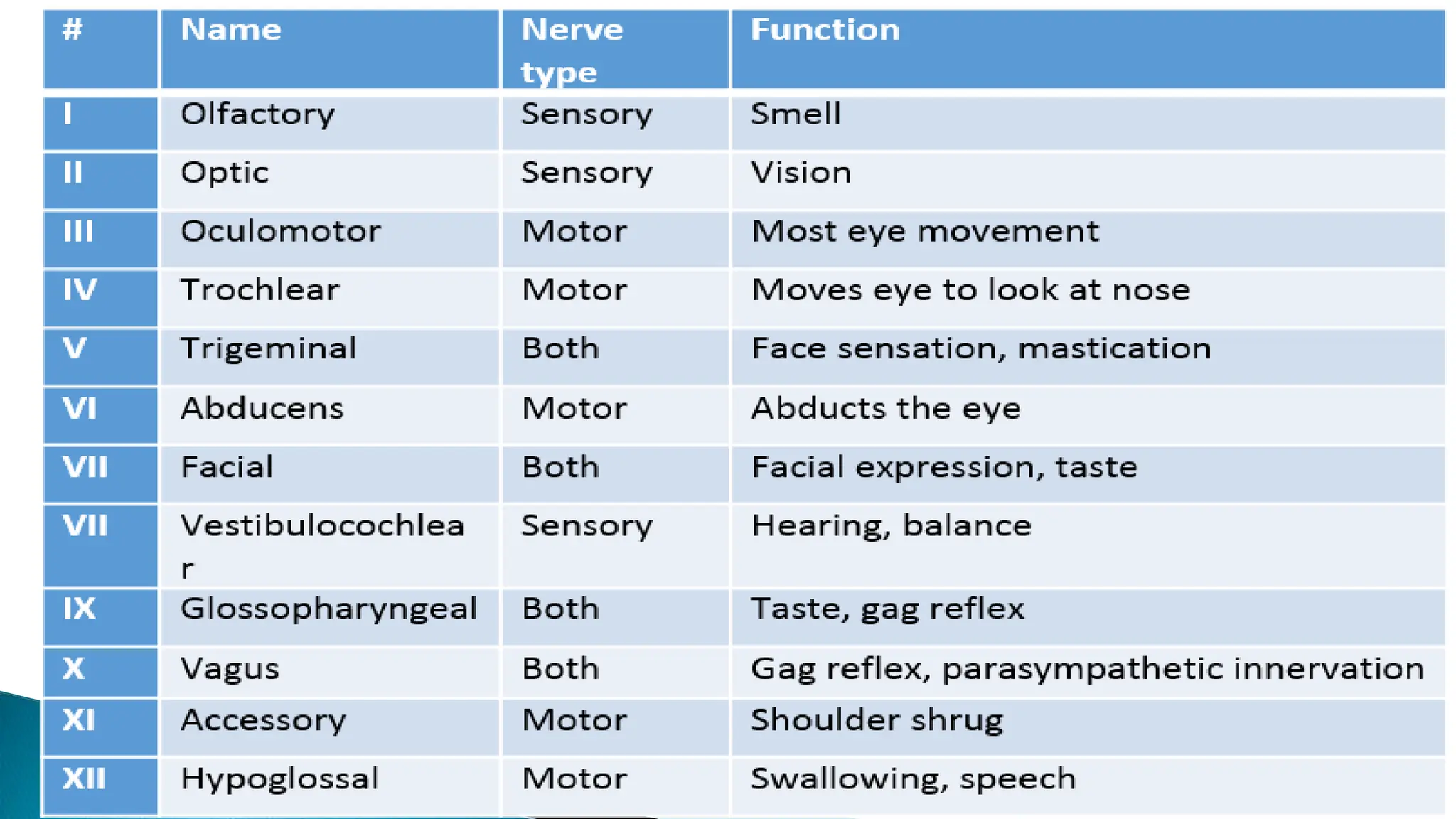
Ms.N.S.Kamble
 The human nervous system is a complex of interconnected systems in which larger
systems are comprised of smaller subsystems each of which have specific structures
with specific functions.
 The nervous system is very important in helping to maintain the homeostasis
(balance) of the human body.
 A series of sensory receptors work with the nervous system to provide information
about changes in both the internal and external environments.
 Four Primary Functions Of Nervous System
1. Sensing the world -Vision, Hearing, Smell, Taste, Touch
2. Transmitting information
3. Processing information
4. Producing a response
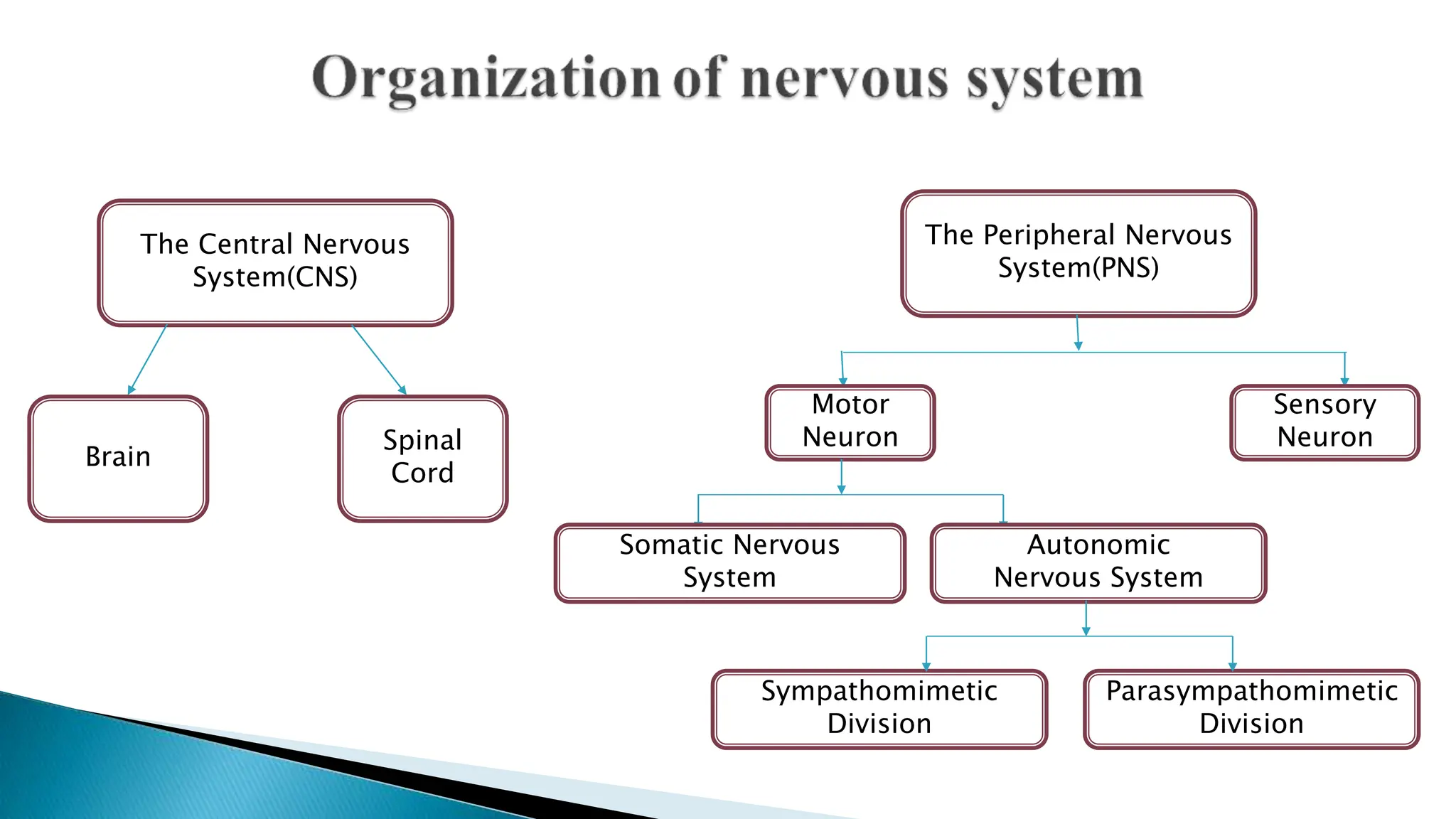
The Central Nervous
System(CNS)
The Peripheral Nervous
System(PNS)
Brain
Spinal
Cord
Motor
Neuron
Sensory
Neuron
Somatic Nervous
System
Autonomic
Nervous System
Sympathomimetic
Division
Parasympathomimetic
Division
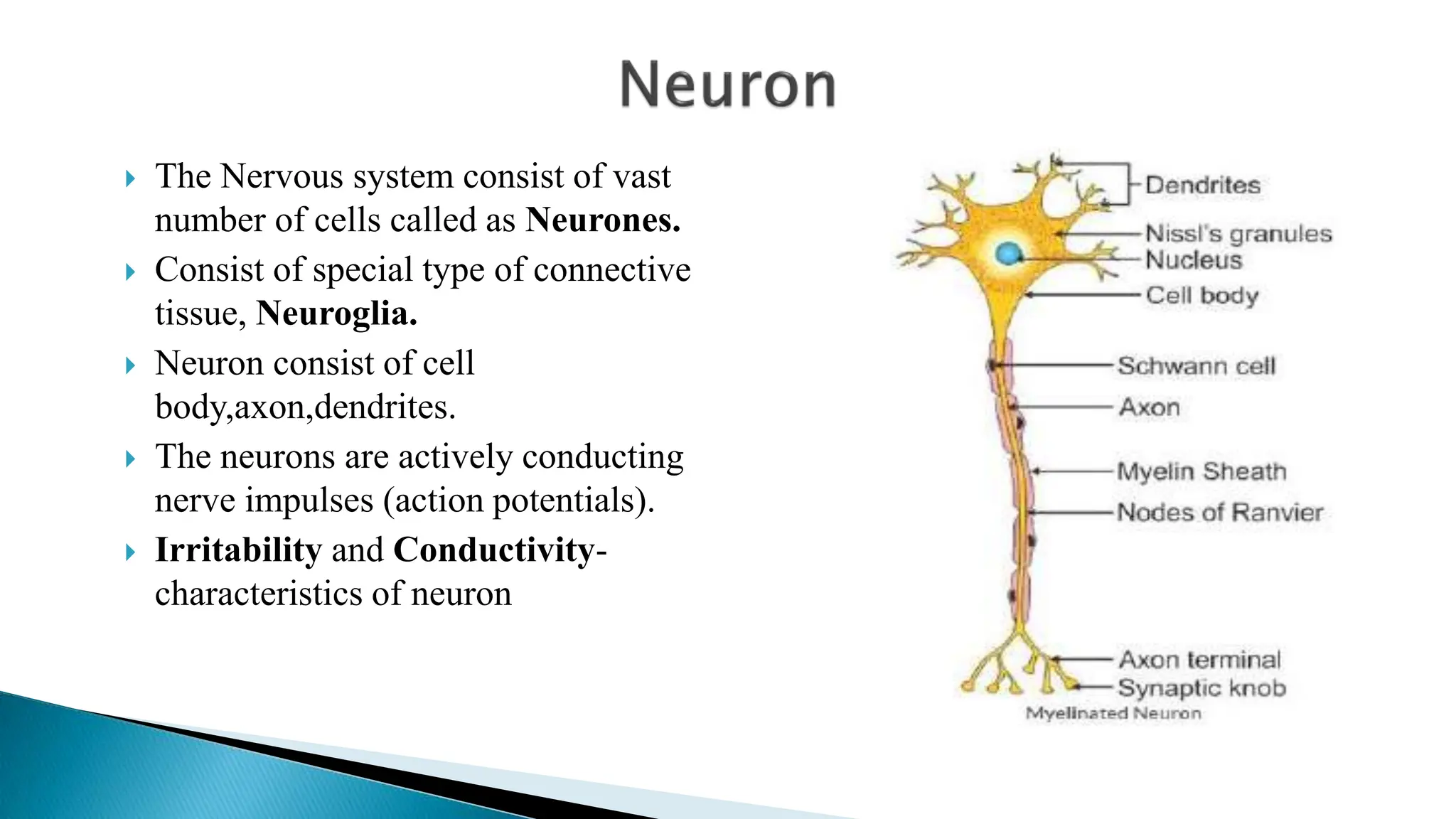
 The Nervous system consist of vast
number of cells called as Neurones.
 Consist of special type of connective
tissue, Neuroglia.
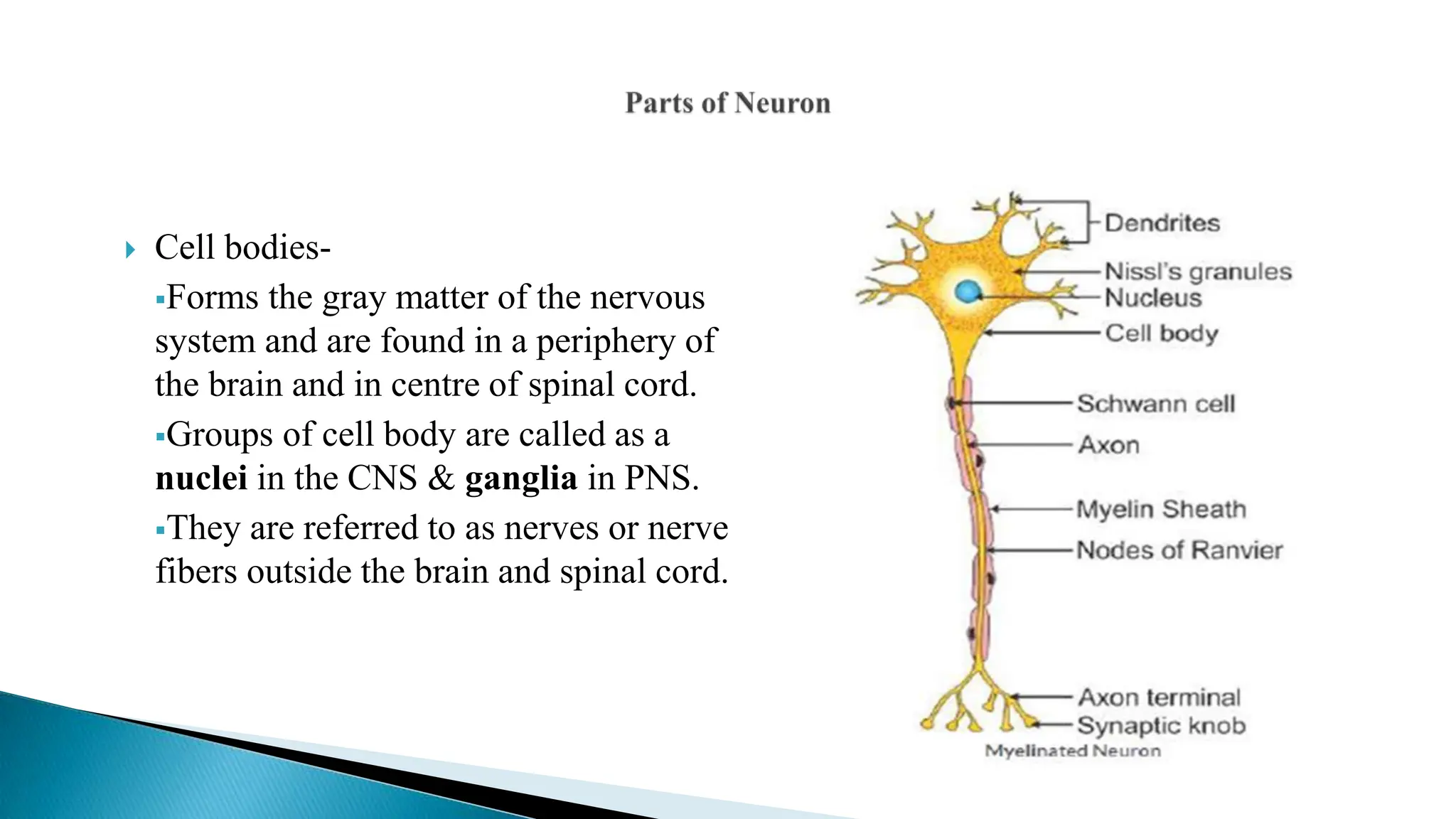
 Neuron consist of cell
body,axon,dendrites.
 The neurons are actively conducting
nerve impulses (action potentials).
 Irritability and Conductivity-
characteristics of neuron
 Cell bodies-
Forms the gray matter of the nervous
system and are found in a periphery of
the brain and in centre of spinal cord.
Groups of cell body are called as a
nuclei in the CNS & ganglia in PNS.
They are referred to as nerves or nerve
fibers outside the brain and spinal cord.
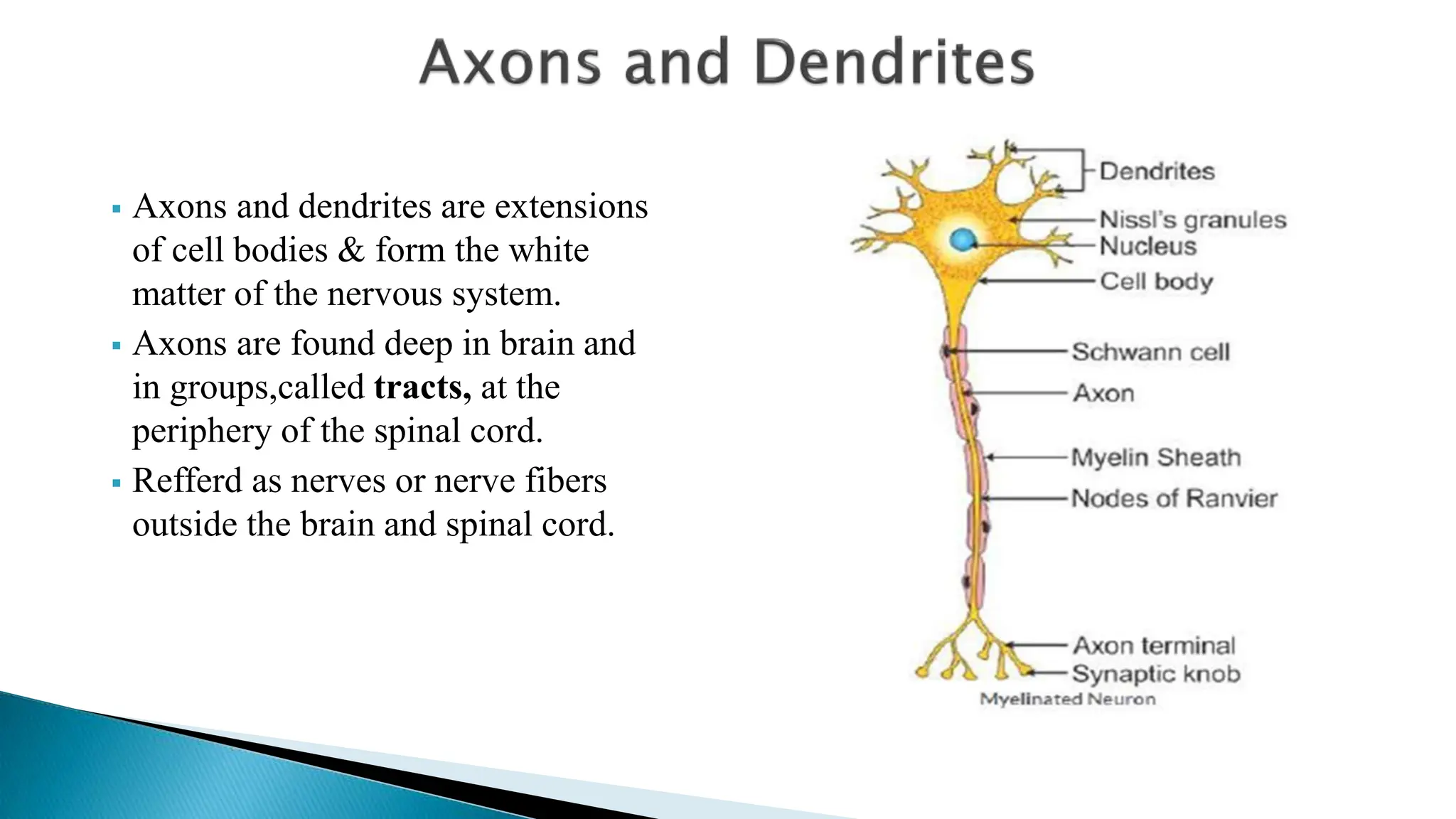
 Axons and dendrites are extensions
of cell bodies & form the white
matter of the nervous system.
 Axons are found deep in brain and
in groups,called tracts, at the
periphery of the spinal cord.
 Refferd as nerves or nerve fibers
outside the brain and spinal cord.
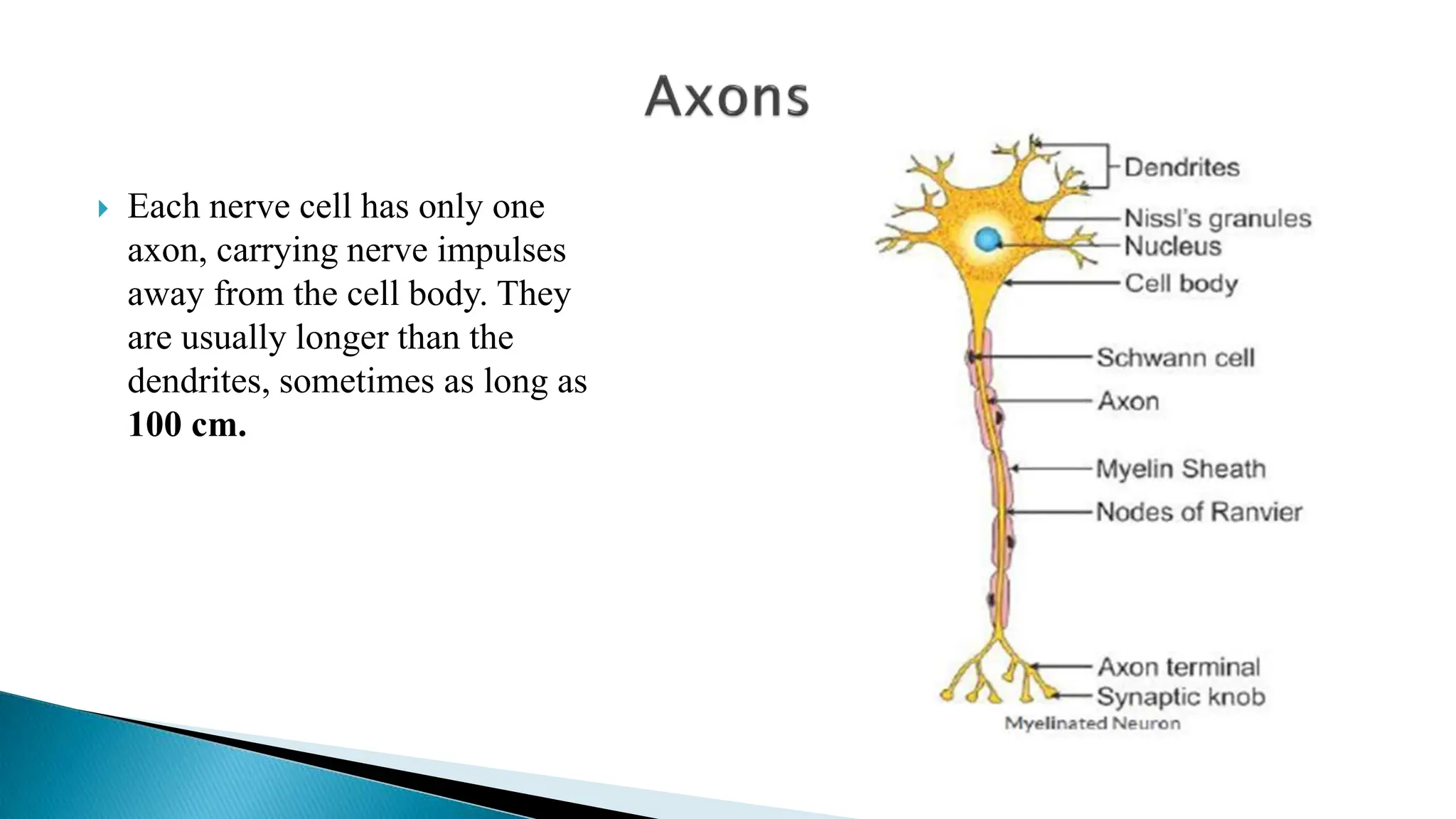
 Each nerve cell has only one
axon, carrying nerve impulses
away from the cell body. They
are usually longer than the
dendrites, sometimes as long as
100 cm.
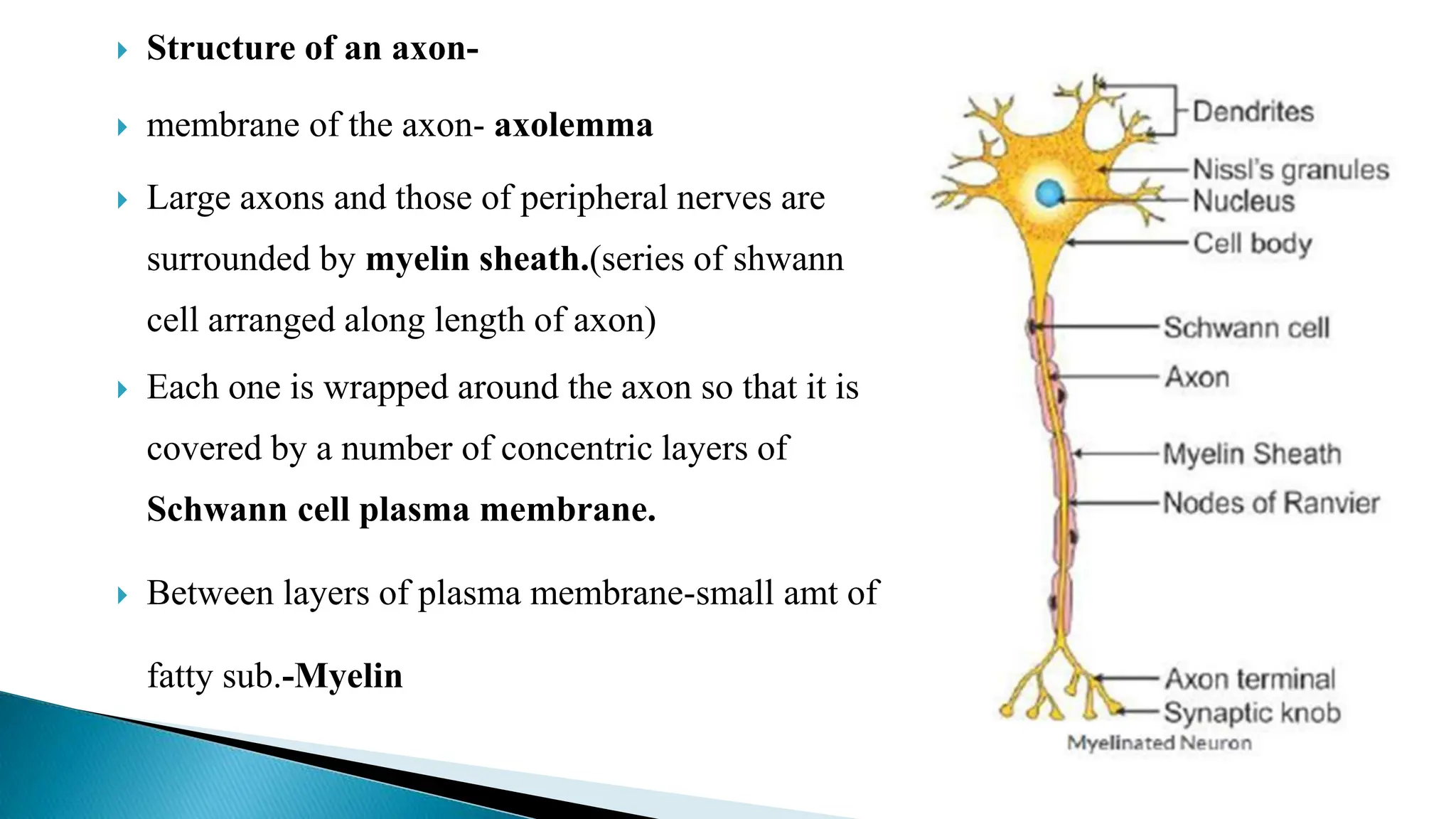
 Structure of an axon-
 membrane of the axon- axolemma
 Large axons and those of peripheral nerves are
surrounded by myelin sheath.(series of shwann
cell arranged along length of axon)
 Each one is wrapped around the axon so that it is
covered by a number of concentric layers of
Schwann cell plasma membrane.
 Between layers of plasma membrane-small amt of
fatty sub.-Myelin
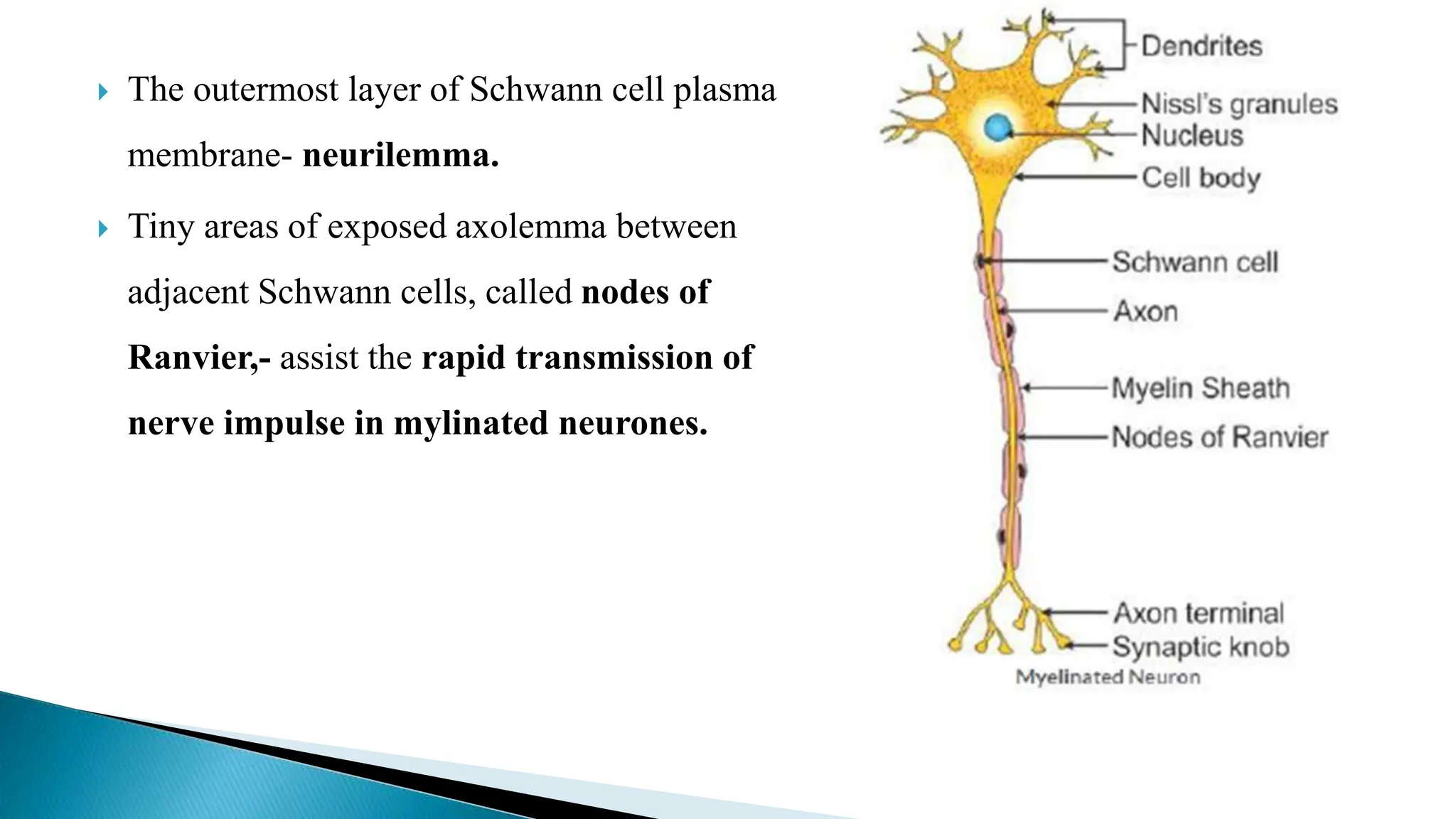
 The outermost layer of Schwann cell plasma
membrane- neurilemma.
 Tiny areas of exposed axolemma between
adjacent Schwann cells, called nodes of
Ranvier,- assist the rapid transmission of
nerve impulse in mylinated neurones.
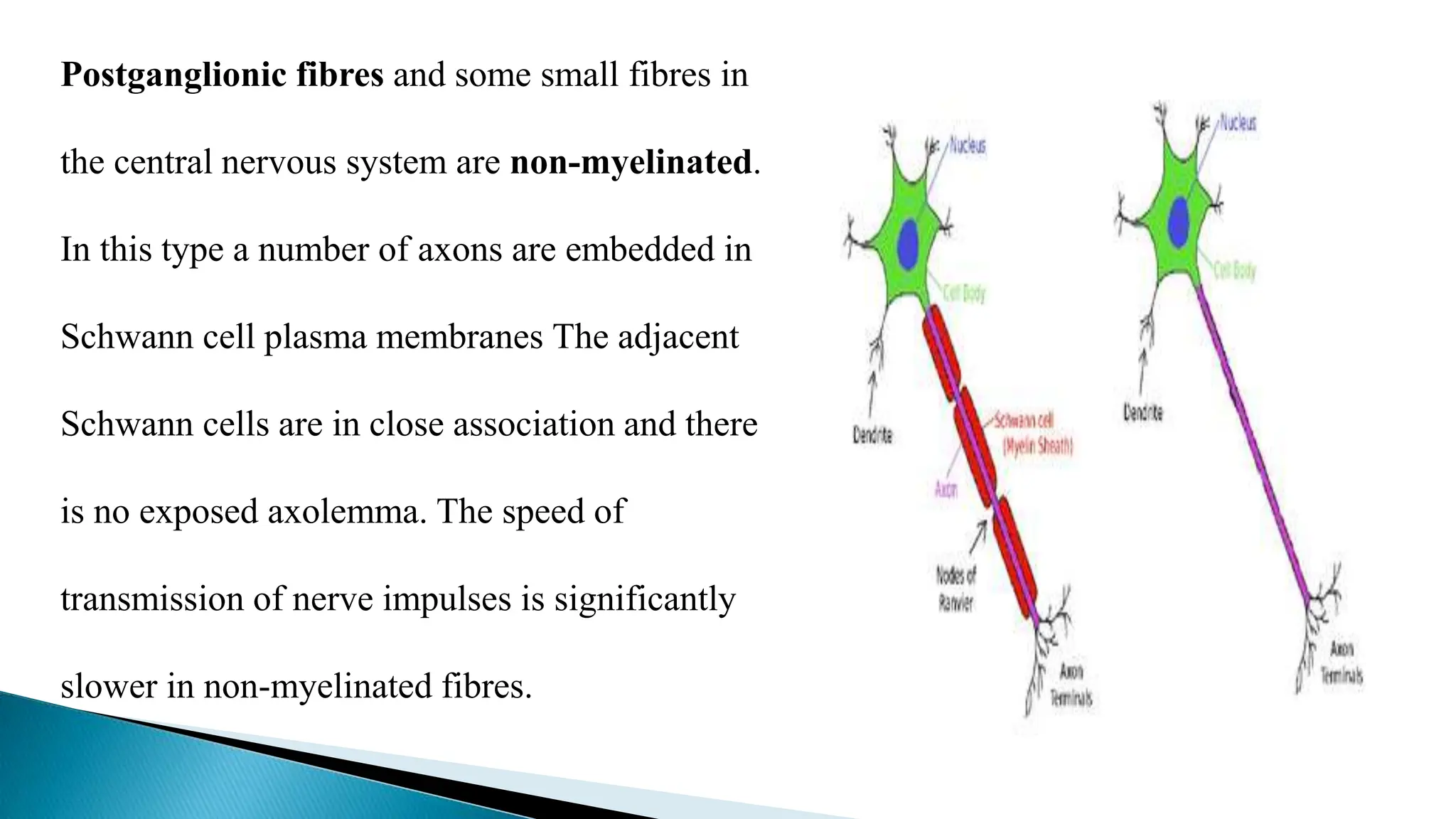
Postganglionic fibres and some small fibres in
the central nervous system are non-myelinated.
In this type a number of axons are embedded in
Schwann cell plasma membranes The adjacent
Schwann cells are in close association and there
is no exposed axolemma. The speed of
transmission of nerve impulses is significantly
slower in non-myelinated fibres.
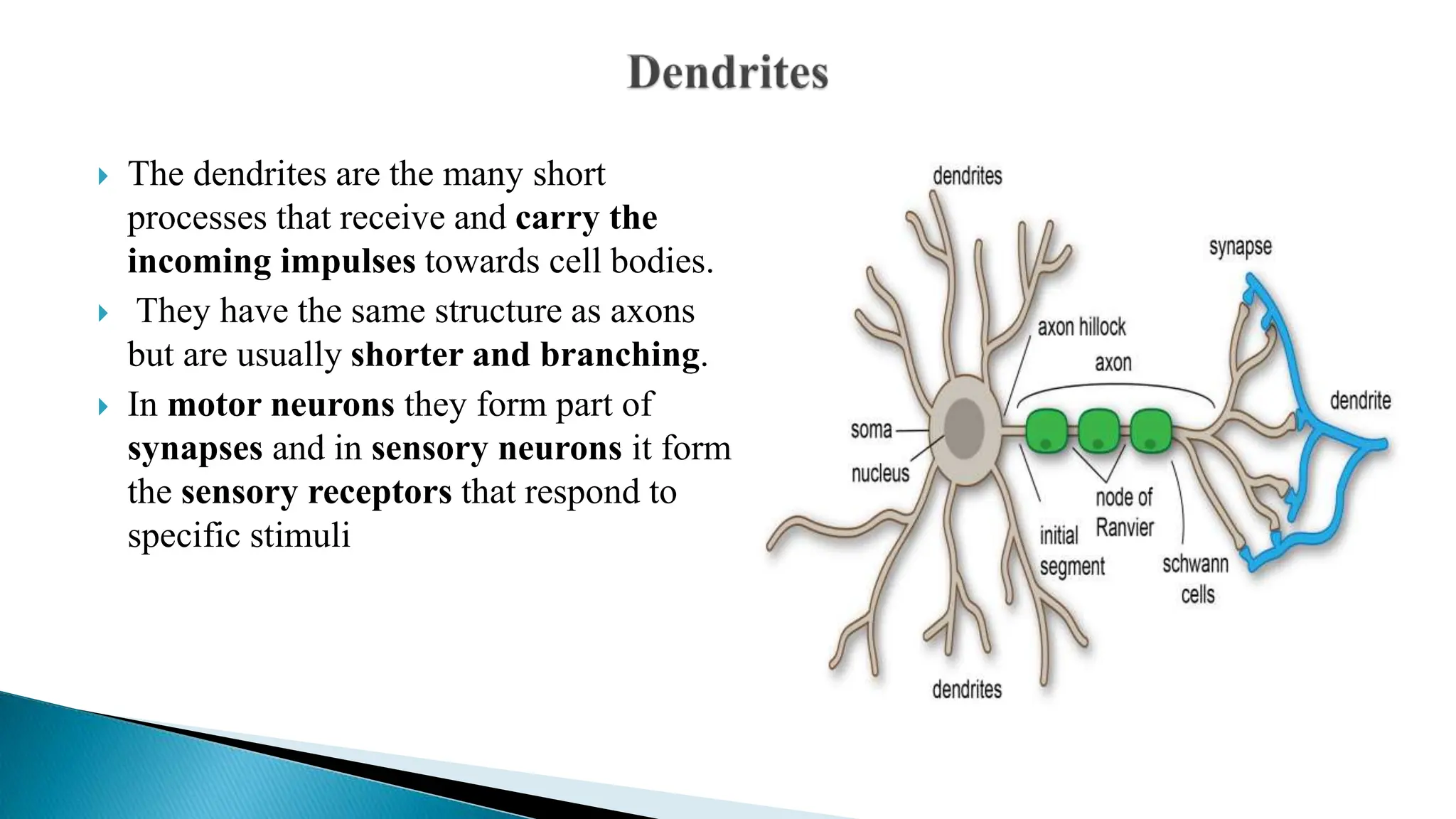
 The dendrites are the many short
processes that receive and carry the
incoming impulses towards cell bodies.
 They have the same structure as axons
but are usually shorter and branching.
 In motor neurons they form part of
synapses and in sensory neurons it form
the sensory receptors that respond to
specific stimuli
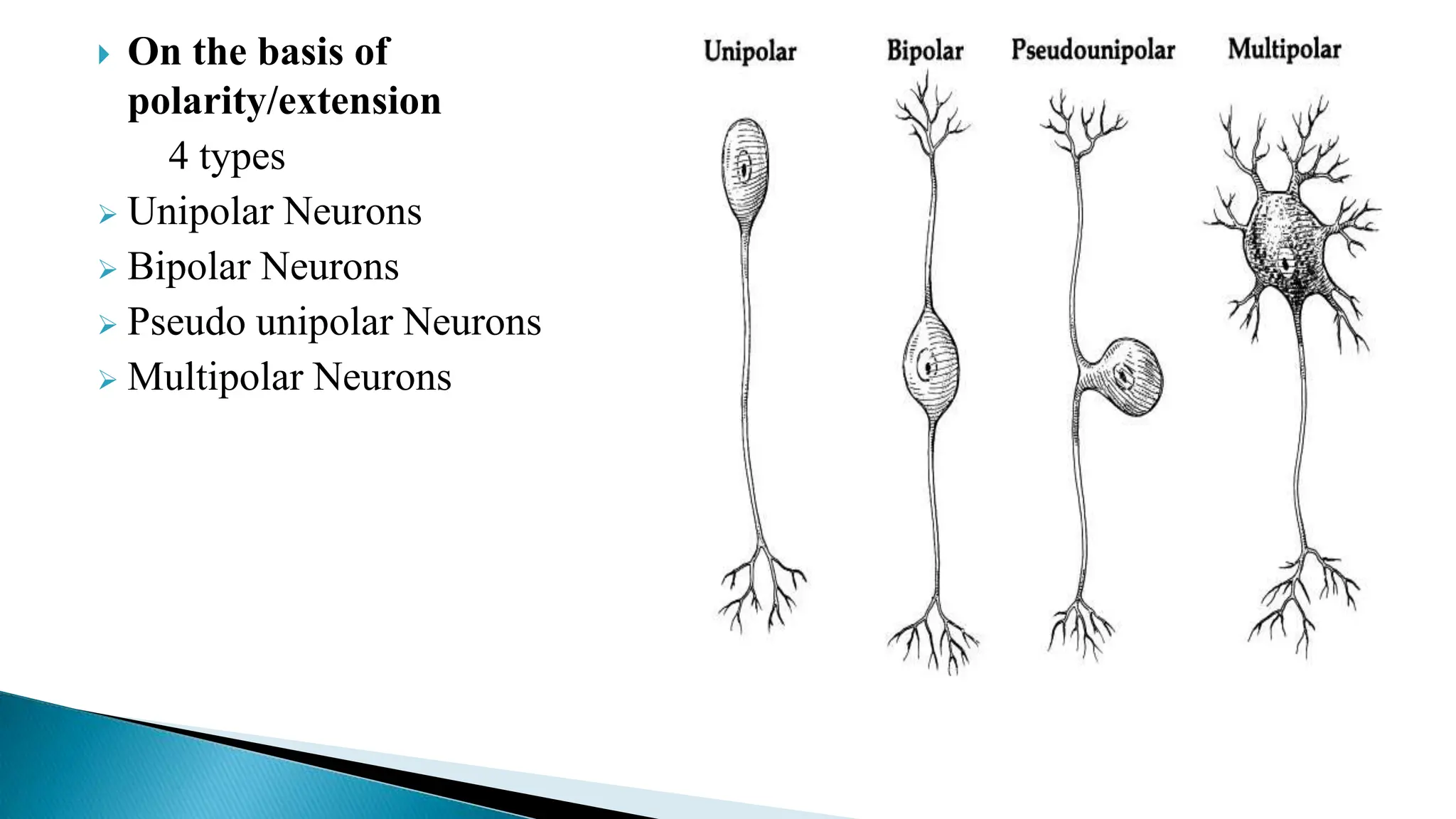
 On the basis of polarity/extension
 On the basis of function
 On the basis of myelin sheath
 On the basis of
polarity/extension
4 types
 Unipolar Neurons
 Bipolar Neurons
 Pseudo unipolar Neurons
 Multipolar Neurons
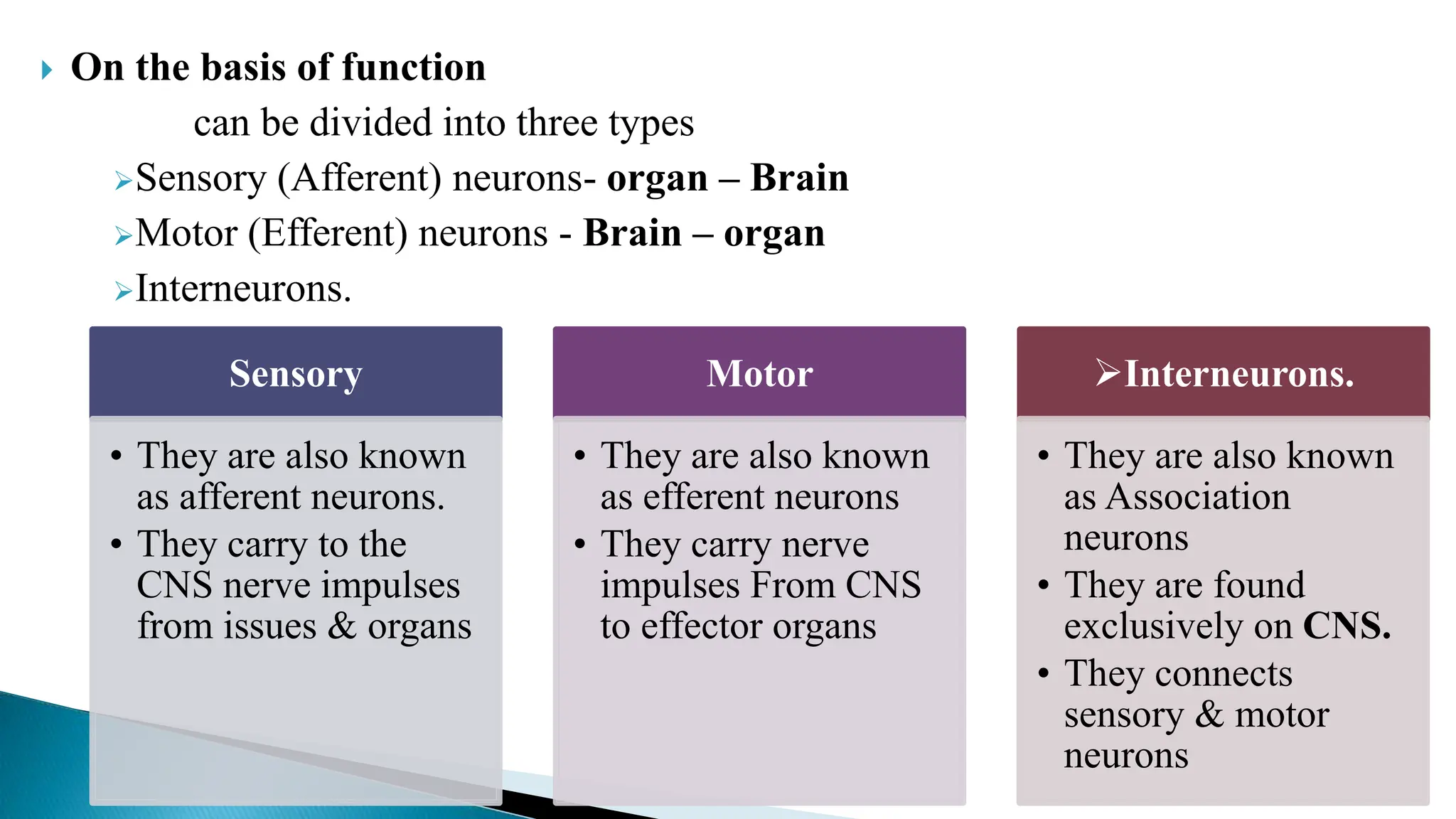
 On the basis of function
can be divided into three types
Sensory (Afferent) neurons- organ – Brain
Motor (Efferent) neurons - Brain – organ
Interneurons.
Sensory
• They are also known
as afferent neurons.
• They carry to the
CNS nerve impulses
from issues & organs
Motor
• They are also known
as efferent neurons
• They carry nerve
impulses From CNS
to effector organs
Interneurons.
• They are also known
as Association
neurons
• They are found
exclusively on CNS.
• They connects
sensory & motor
neurons
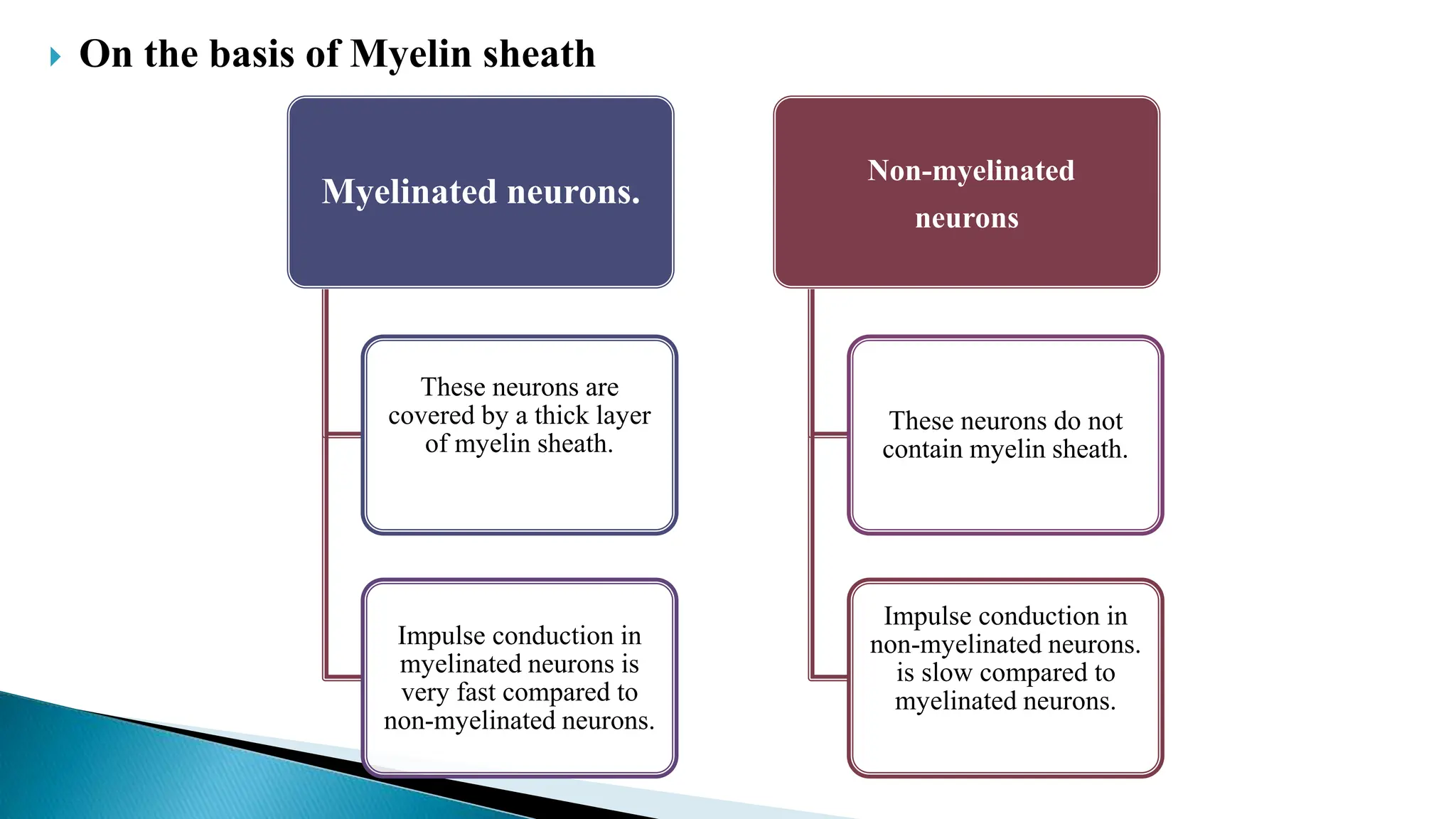
 On the basis of Myelin sheath
Myelinated neurons.
These neurons are
covered by a thick layer
of myelin sheath.
Impulse conduction in
myelinated neurons is
very fast compared to
non-myelinated neurons.
Non-myelinated
neurons
These neurons do not
contain myelin sheath.
Impulse conduction in
non-myelinated neurons.
is slow compared to
myelinated neurons.
 They are also known as Non-neuronal or glial cells.
 These are the supporting cells of neurons but do not generate or conduct
nerve impulses.
 Unlike neurons, these cells have cell division property.
 Functions of neuroglia-
 They provide nutrition to neuron.
 They Protect neurons from Pathogens.
 They Provide structural & functional support to neurons.
 They form myelin sheath.
 They also maintains Homeostasis.
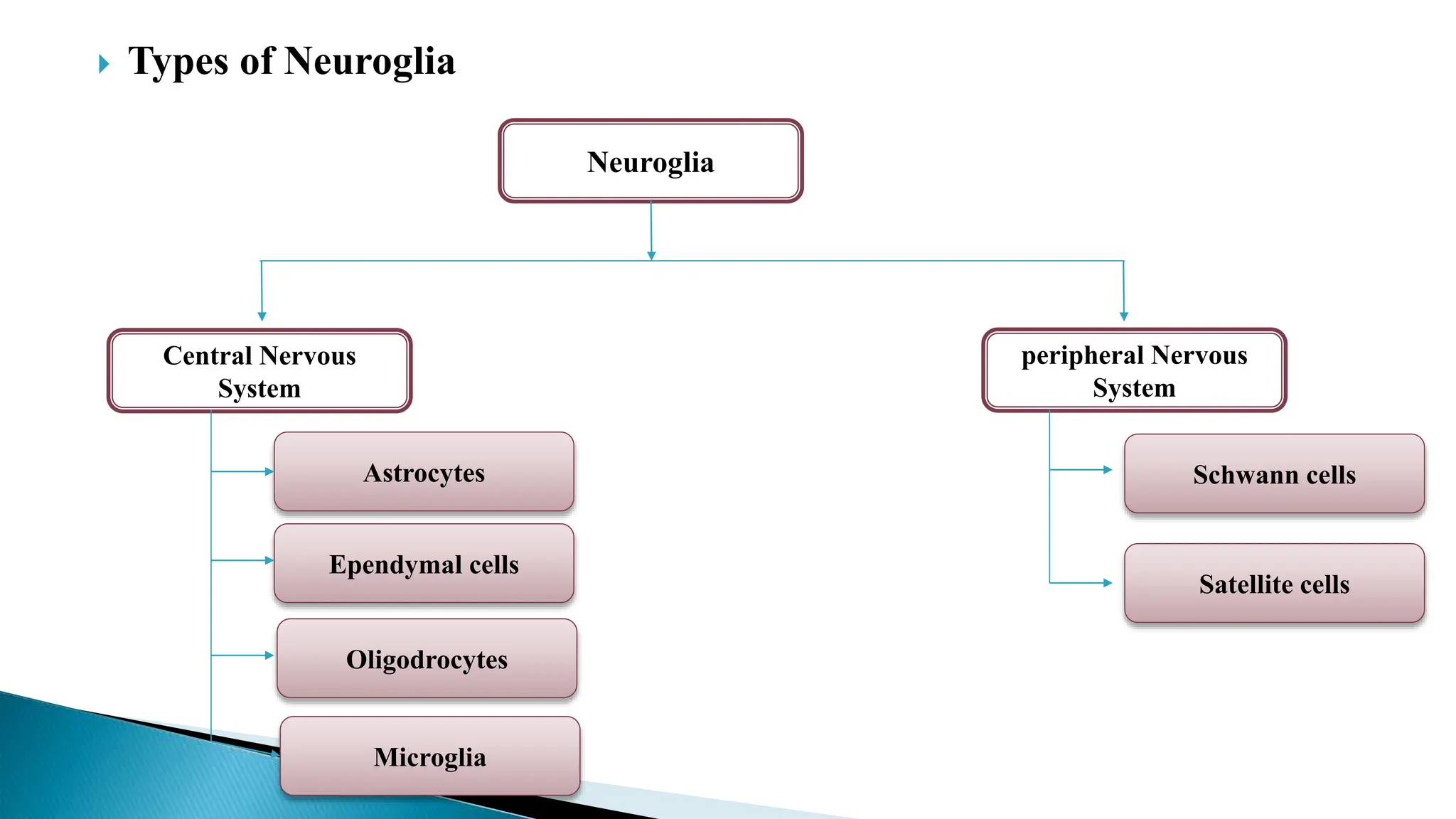
 Types of Neuroglia
Neuroglia
peripheral Nervous
System
Oligodrocytes
Ependymal cells
Astrocytes
Central Nervous
System
Schwann cells
Microglia
Satellite cells
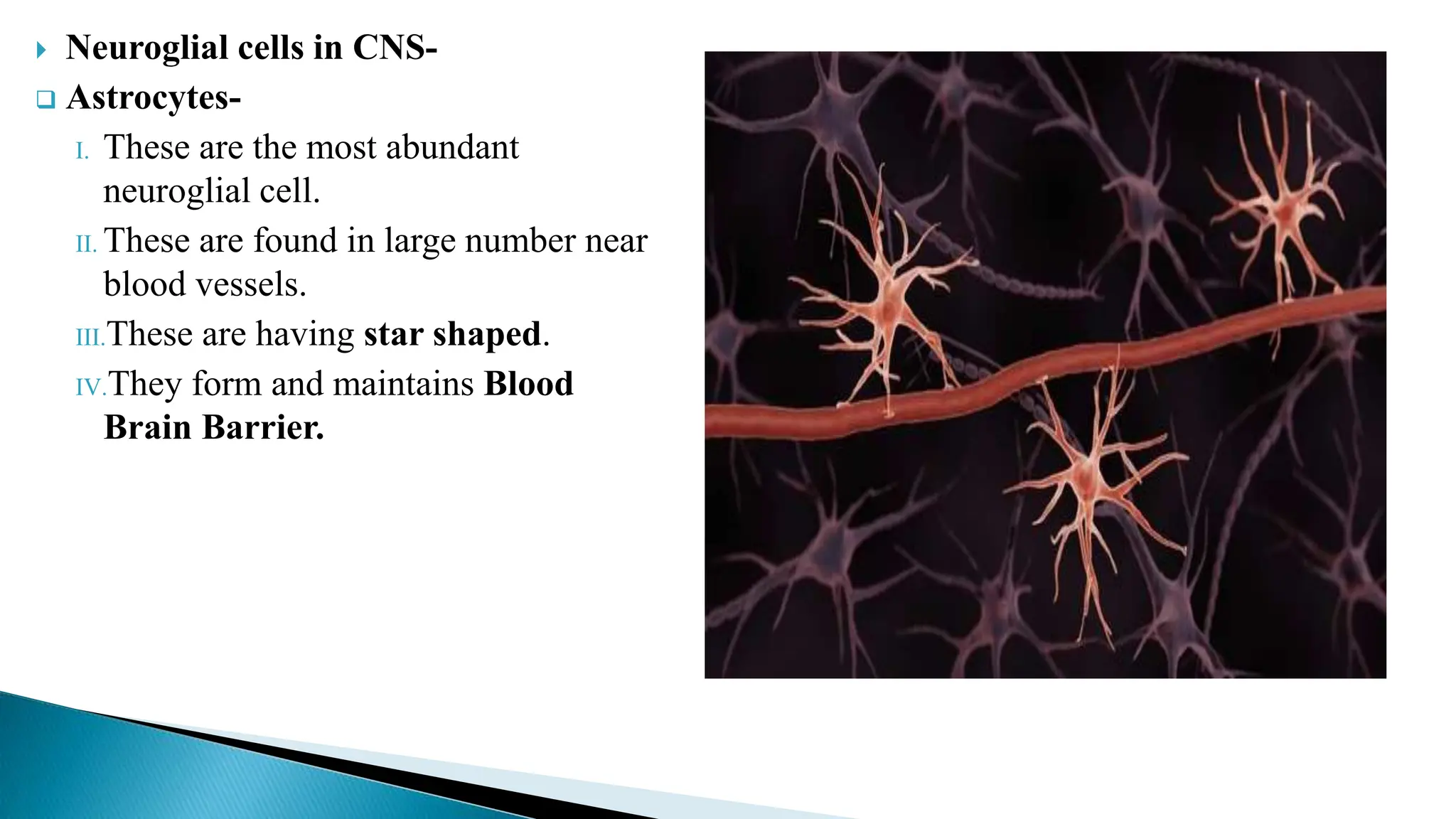
 Neuroglial cells in CNS-
 Astrocytes-
I. These are the most abundant
neuroglial cell.
II. These are found in large number near
blood vessels.
III.These are having star shaped.
IV.They form and maintains Blood
Brain Barrier.
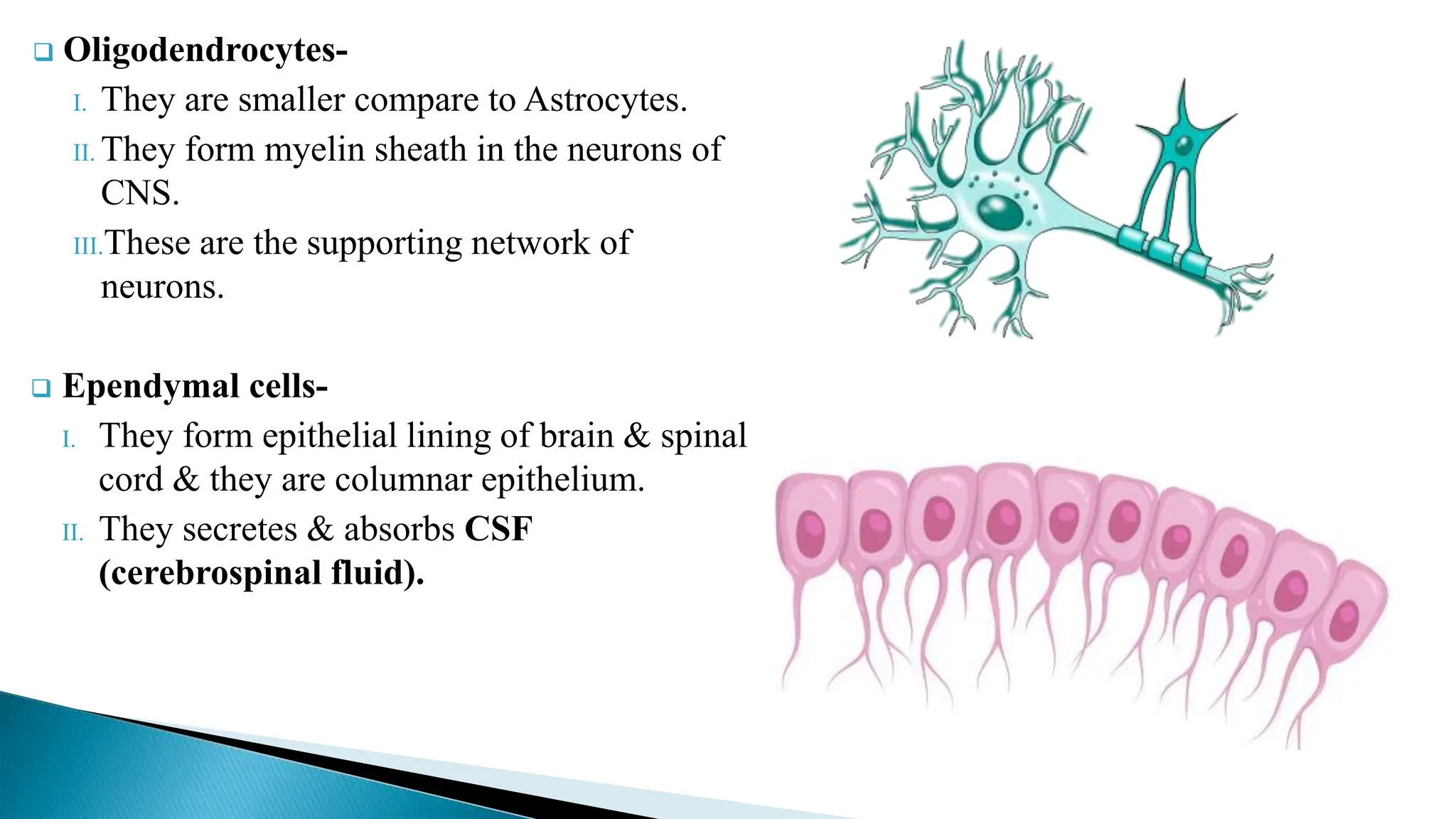
 Oligodendrocytes-
I. They are smaller compare to Astrocytes.
II. They form myelin sheath in the neurons of
CNS.
III.These are the supporting network of
neurons.
 Ependymal cells-
I. They form epithelial lining of brain & spinal
cord & they are columnar epithelium.
II. They secretes & absorbs CSF
(cerebrospinal fluid).
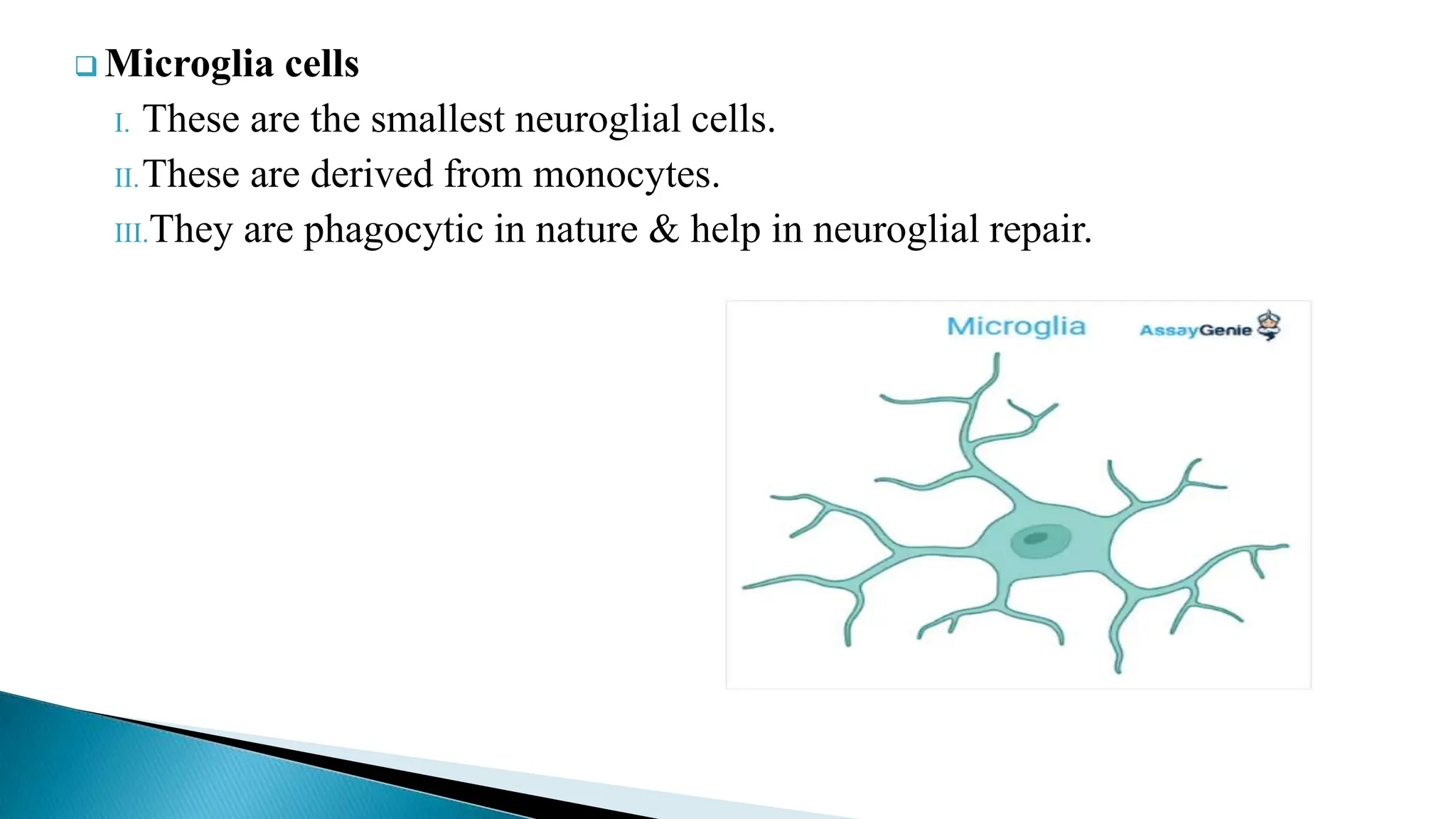
 Microglia cells
I. These are the smallest neuroglial cells.
II.These are derived from monocytes.
III.They are phagocytic in nature & help in neuroglial repair.
 Neuroglial cells in PNS-
 Shawann cells-
I. These are the major glial cells in PNS.
II.They form myelin sheath in the neurons of PNS.
III.They are also known as neurilemma cells.
 Satellite cells-
I. These are form extracellular space of nervous system
II.They provide physical support to neurons.
 Neurons / Nerve Fibres contains some special Properties as follows-
I. Conductivity
II. Excitability
III.Refractory Period
IV.Unfatigability
V. All or none law
VI.Accomodation
 Conductivity-It is the ability of nerve fiber to conduct nerve impulses
(electrical impulses) along its length from one part to another
 Excitability-It is the ability of neurons / nerve fibers to respond to various
stimuli & convert them into nerve impulse.
 Refractive Period-when the nerve fiber is once excited, it will not respond
to any other stimulus for a selective time period and this time period is
known as Refractive Period.
 Unfatigability-It is the ability of nerve Fibers to get Fatigued even if they
receives continuous stimuli.
 All or None law-It is one of the most important property of nerve Fibers,
nerve fibers gets excited only at a particular threshold strength. Either they
will give maximum response or they give no response.
 Accomodation-If the continuous stimuli is applied to the nerve Fibers then
it will decrease the excitability of nerve fibers
 Neuron is a type of cell found in our nervous System which is able to generate, carry
& transmit nerve impulse. Electrophysiology Study of electrical properties of neuron
In electrophysiology we basically study about
I. How nerve impulse generated.
II. How Stimulus changed membrane ion concentration.
III.How stimulus converted into nerve impulse
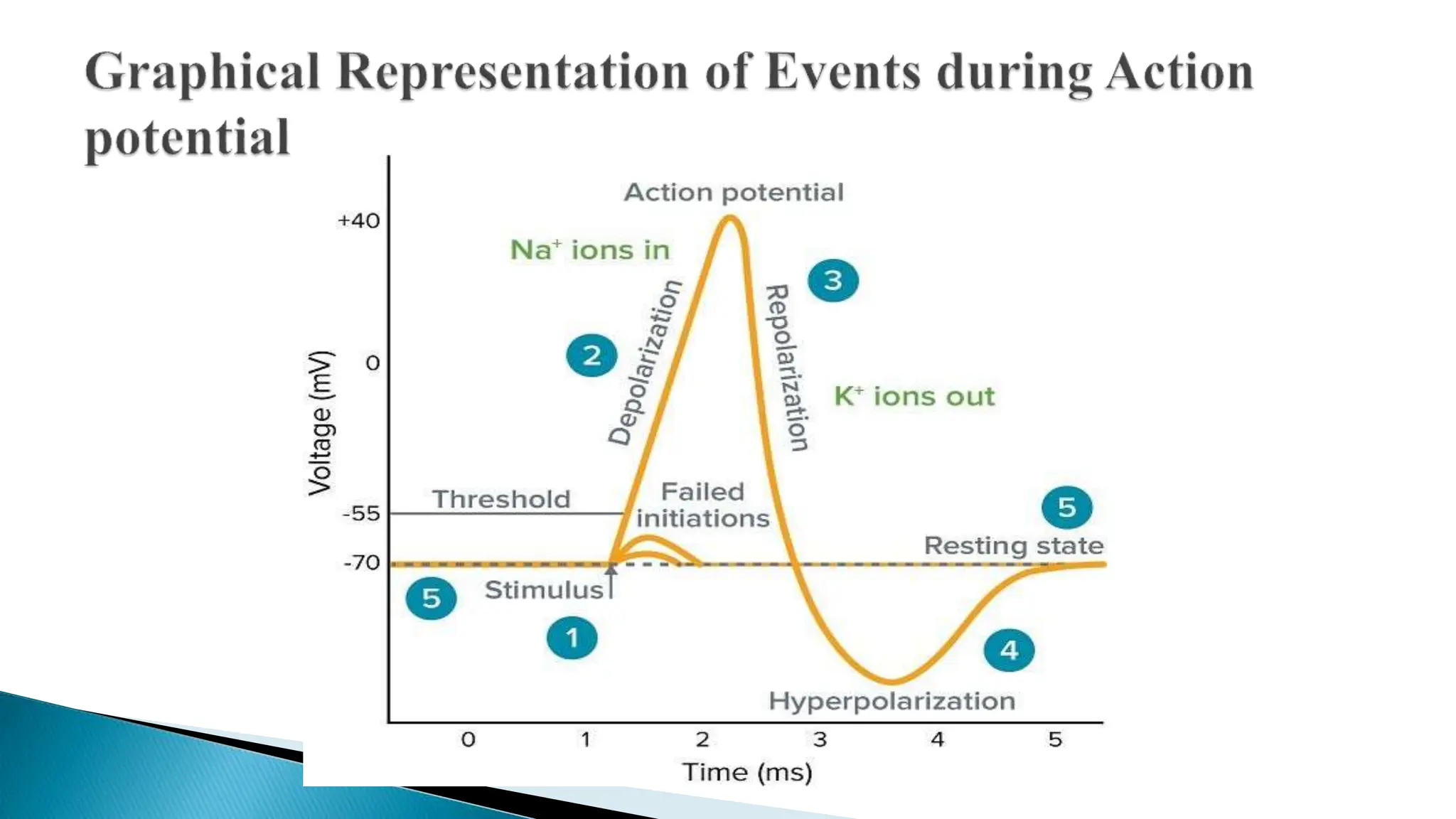
 An action potential is the Potential difference generate across membrane of neuron
due to disbalance of Positive & negative change which ultimately give rise to
generation of nerve impulse.
 Events during generation of Action Potential.
Polarization
Depolarization
Repolarization
Hyperpolarization.
 Polarization-
 known as Resting stage
 No stimulus comes so that no action potential generate
 At resting Stage - Inside Membrane- negative(-)& High k+
Outside Membrane-Positive (+)& High Na+
 Resting membrane potential-(-70mv)
 Depolarization
I. When stimulus comes it deactivates Na+ k+ Pump.
II. Now Na+ ions Continuously ↑ inside cell membrane via leakage channels &
ultimately inside of membrane becomes positively charged & this stage is called
depolarization (voltage gate Na+ also opens)
III.Membrane potential rises to +30 mv.
 Repolarization
I. Now when wave of depolarization passed from one part of membrane to another,
voltage gated Na+ channel again gets closed and now voltage gated k+ channels
opens.
II. Now k+ ions continuously passing out from the cell & ultimately the inside of
membrane again becomes negatively charged & this stage is called Repolarization.
III.ATPase Pump again activates.
 Hyperpolarization-
I. Although membrane again becomes repolarized but StiII k+ Channels (voltage
gated) still remains opened.
II. Now due to this k+ ions continues passing outside of membrane & membrane
potential becomes -90 mv which causes hyperpolarization.
III.when potential reaches -90mv k+ channels also get closes & finally membrane
reaches to resting stage
 A Synapse is a junction between two neurons where transmission of nerve
impulses takes place.
 Synapse allow communication between two neurons & other cells through the use
of neurotransmitters.
 Generally this junction is formed between axon terminal of one neuron and the
dendrite of another neuron.
 Neurotransmitters transmits Signals from presynaptic neuron to postsynaptic
neuron.
 Classification of Synapse
Basically two types of synapse
I. Chemical Synapse
II. Electrical Synapse.
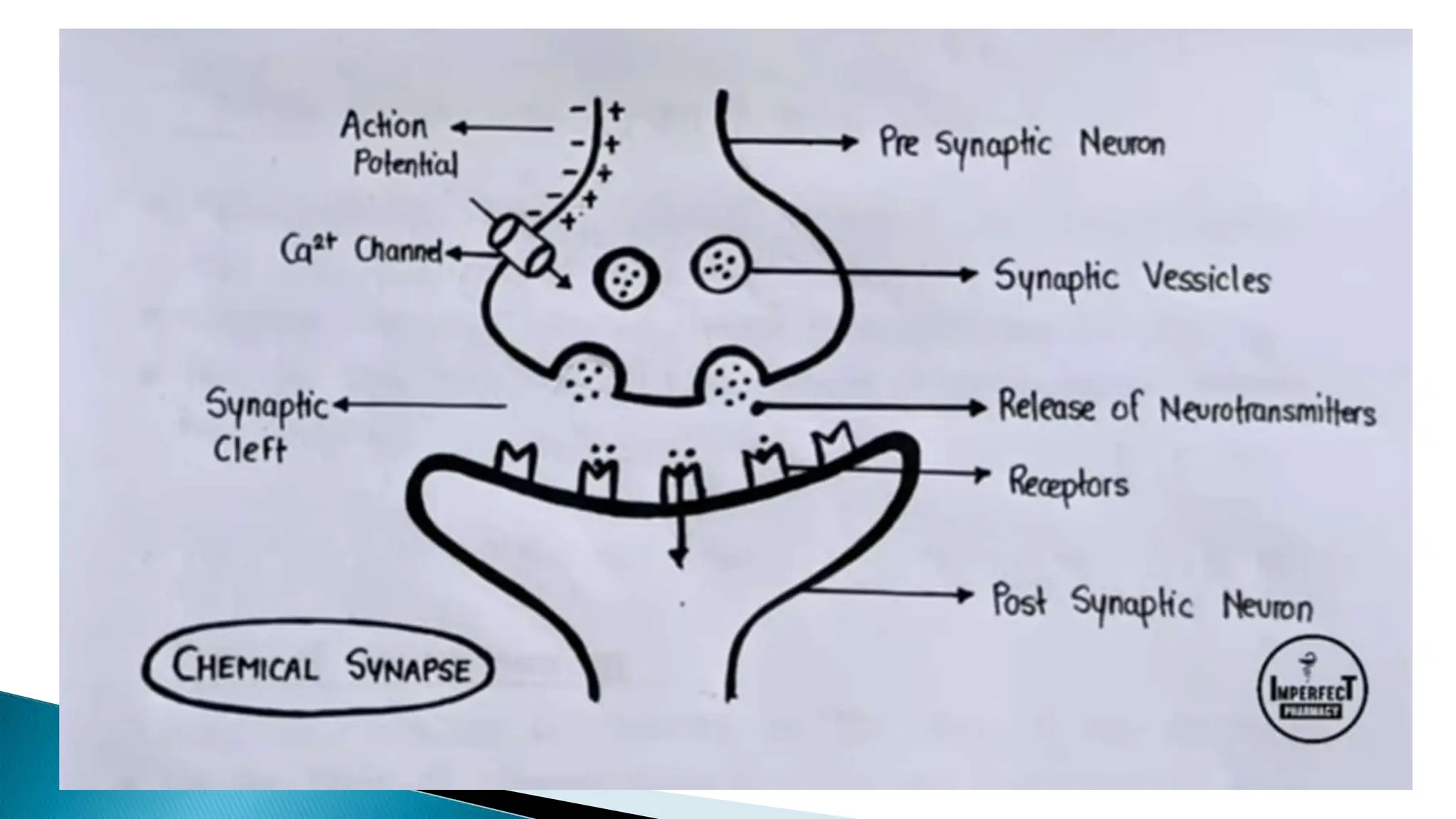
 Chemical Synapse
I. A chemical synapse is a junction between two neurons through which signals are
transmitted by the release of chemical neurotransmitters
II. In the chemical Synapse there is no continuity between two neurons because of
presence of space, called Synaptic cleft.
III. Neurotransmitters release from vesicles due to generation of action potential.
IV. Almost every synapse in human body is a type of chemical synapse.
 Electrical Synapse
I. Electrical synapse is a type of synapse in which there is a direct connection
between presynaptic & Post synaptic neuron through gap junction.
II. In electrical Synapse transmission occurs very rapidly.
III. They are very Fewer in number compare to chemical synapse
 Neurotransmitters
I. Neurotransmitters are the chemical messenger that transmit Signals from one
neuron to another across a synapse.
II. Neurotransmitters are generally Packed in Synaptic vesicles.
III. They are very important for rapid transfer of nerve impulse between two neurons.
 Types Of Neurotransmitters
On the basis of chemical nature
On the basis of function.
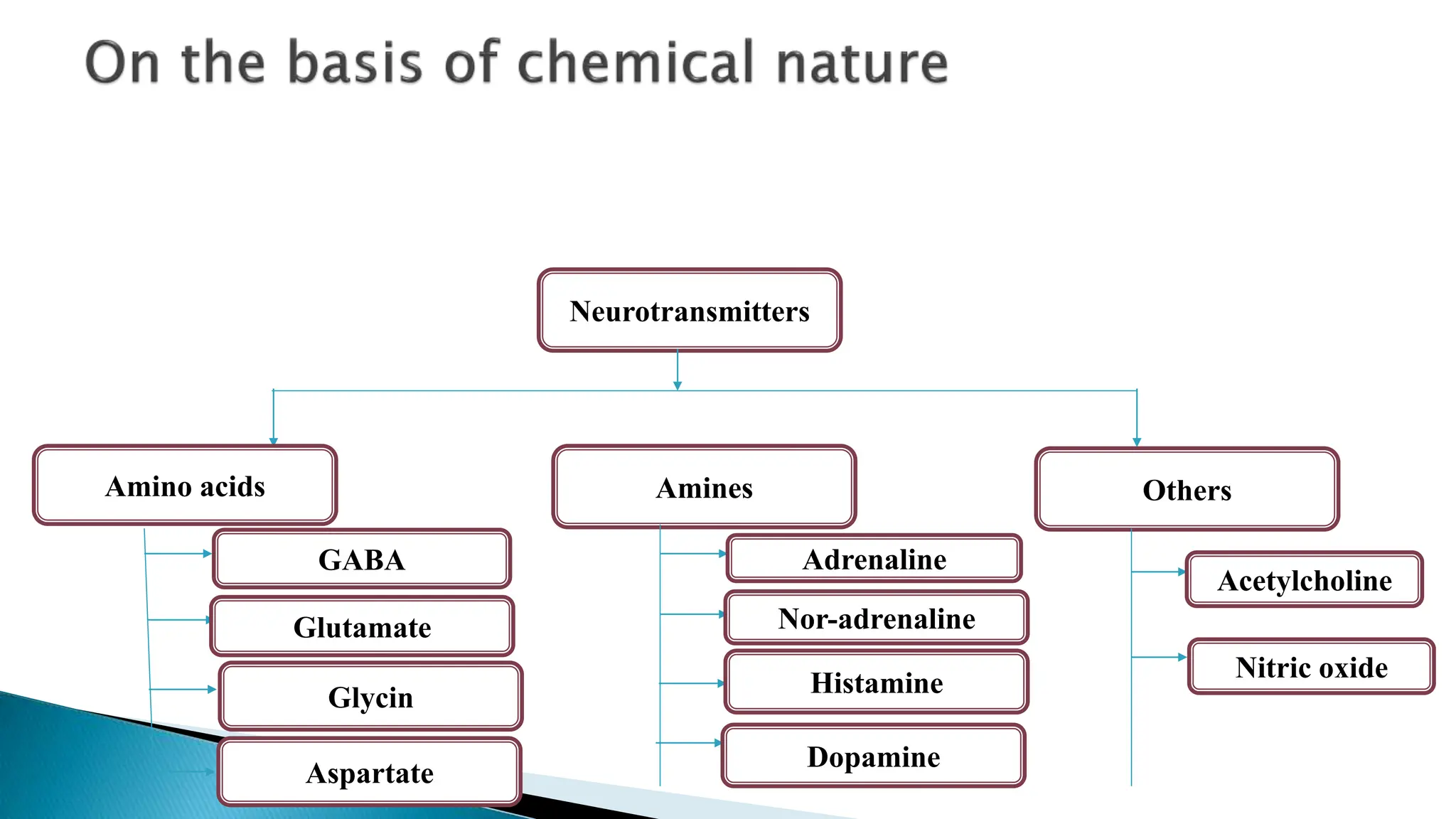
Neurotransmitters
Amino acids Amines Others
Nitric oxide
Acetylcholine
Adrenaline
Dopamine
Histamine
Nor-adrenaline
GABA
Glutamate
Glycin
Aspartate
I. Excitatory Neurotransmitters
II. Inhibitory Neurotransmitters
III.Both
 Excitatory Neurotransmitters
These neurotransmitters act by stimulating the target neurons
They increase the influx of sodium ions inside the cell cause depolarization.
Examples Ach, Adrenaline, Serotonin etc..
 Inhibitory Neurotransmitters
These neurotransmitters act by inhibiting the target neurons
They increases the outflux of potassium ions outside the cell & cause
repolarization
e.g. GABA, Glycine, serotonin.
 Both (Excitatory & Inhibitory)
Neurotransmitters which contains both excitatory & inhibitory properties are classified
in this group
eg. Ach, Dopamine
 The CNS is mainly consist of Brain & Spinal cord.
 Both Brain & Spinal cord is protected by cranial cavity and vertebral column
respectively.
 The CNS is major controlling, regulatory & communicating System in our body
Meninges-
 Although Brain & spinal cord is protected by cranial bones and vertebral column but
since they are very sensitive and important organ of our body, hence they are Called
Further Protected by three layers of covering Meninges.
 Meninges provide both protection & nourishment to brain & spinal cord.
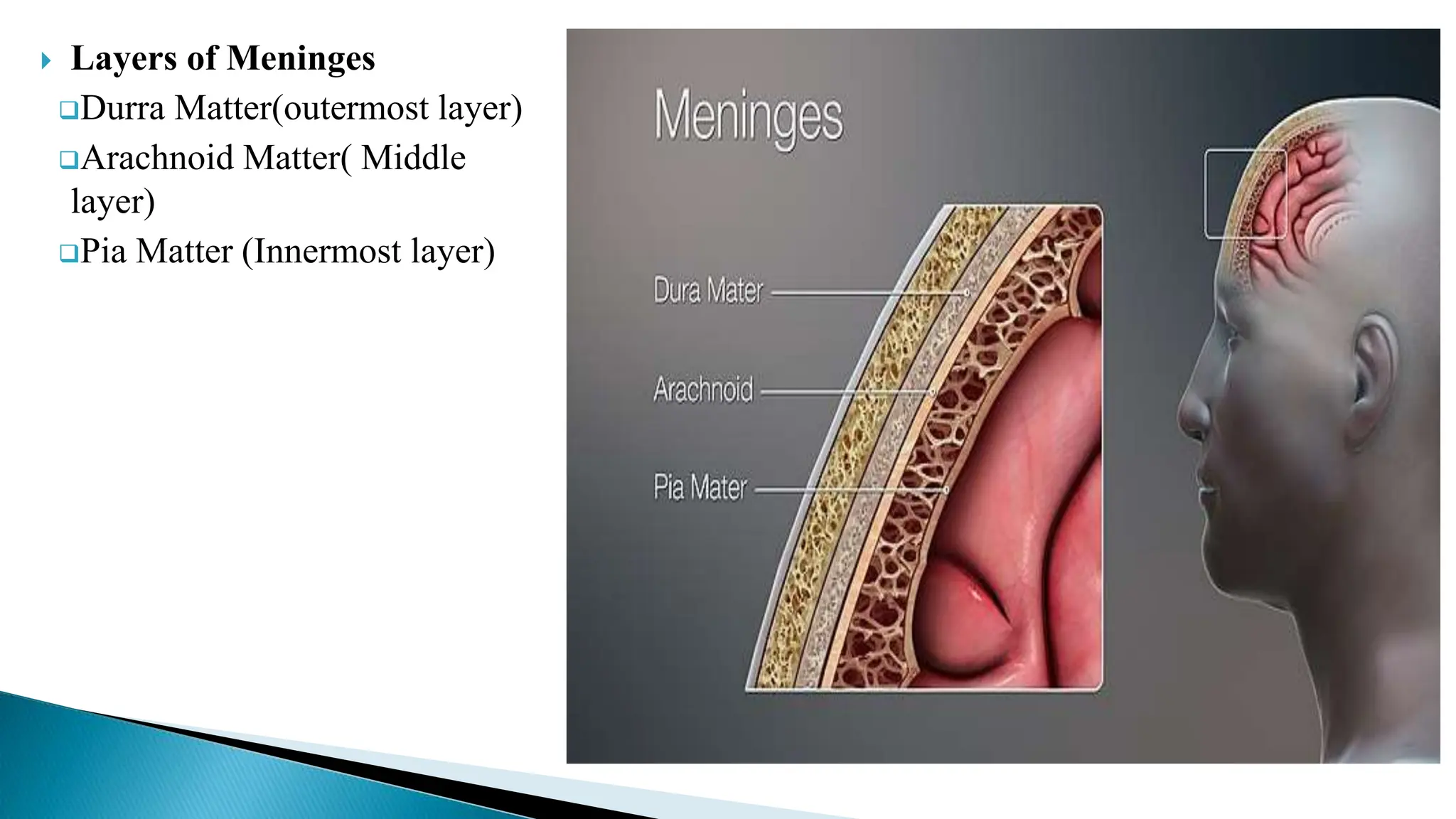
 Layers of Meninges
Durra Matter(outermost layer)
Arachnoid Matter( Middle
layer)
Pia Matter (Innermost layer)
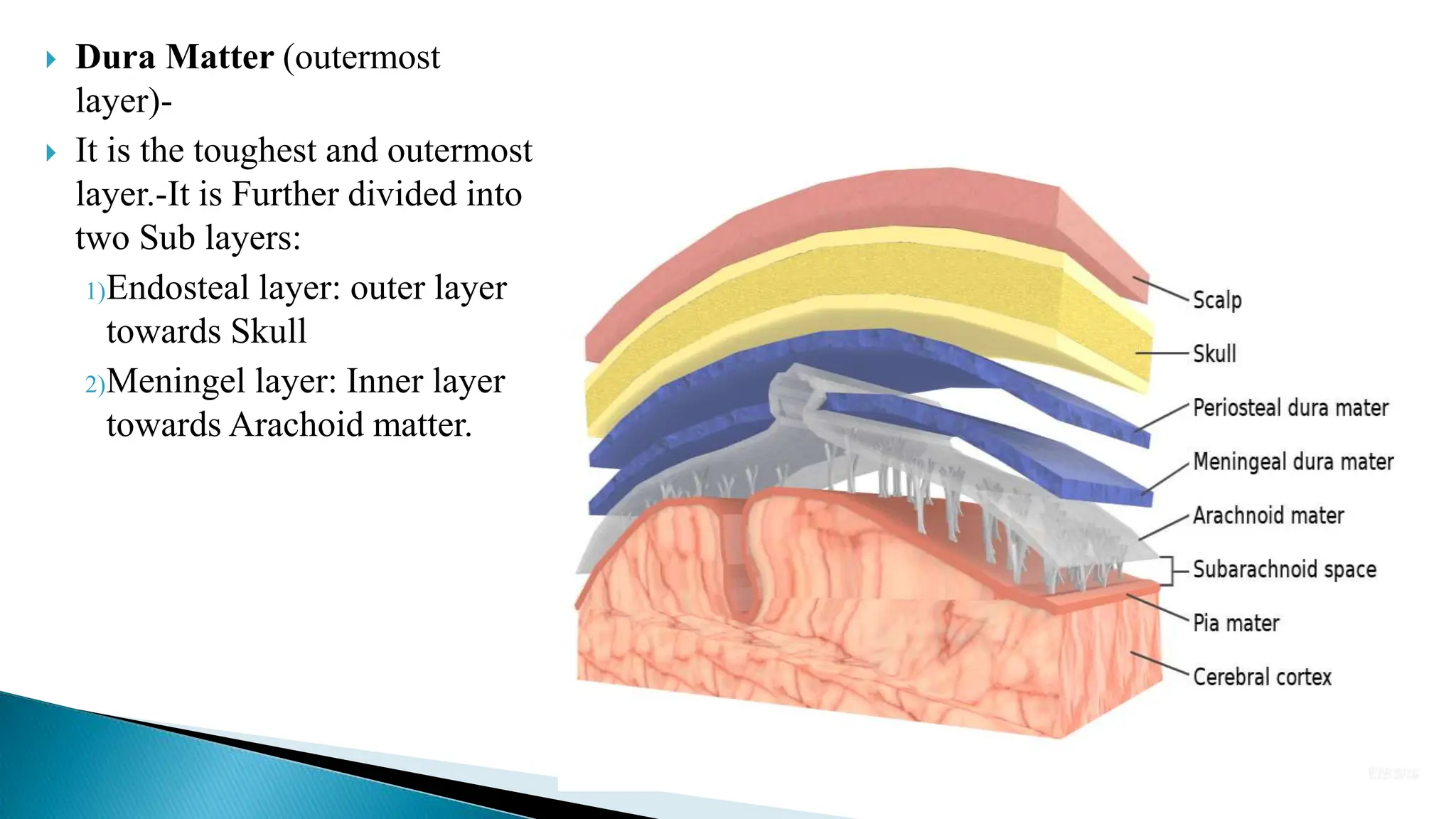
 Dura Matter (outermost
layer)-
 It is the toughest and outermost
layer.-It is Further divided into
two Sub layers:
1)Endosteal layer: outer layer
towards Skull
2)Meningel layer: Inner layer
towards Arachoid matter.
 Arachnoid Matter-
 It is the middle Fibrous layer.
 It is separated from dura matter by subdural space.
 It is separated from pia matter by subarachnoid space.
 Arachnoid matter & pia matter are collectively known
Leptomeninges.
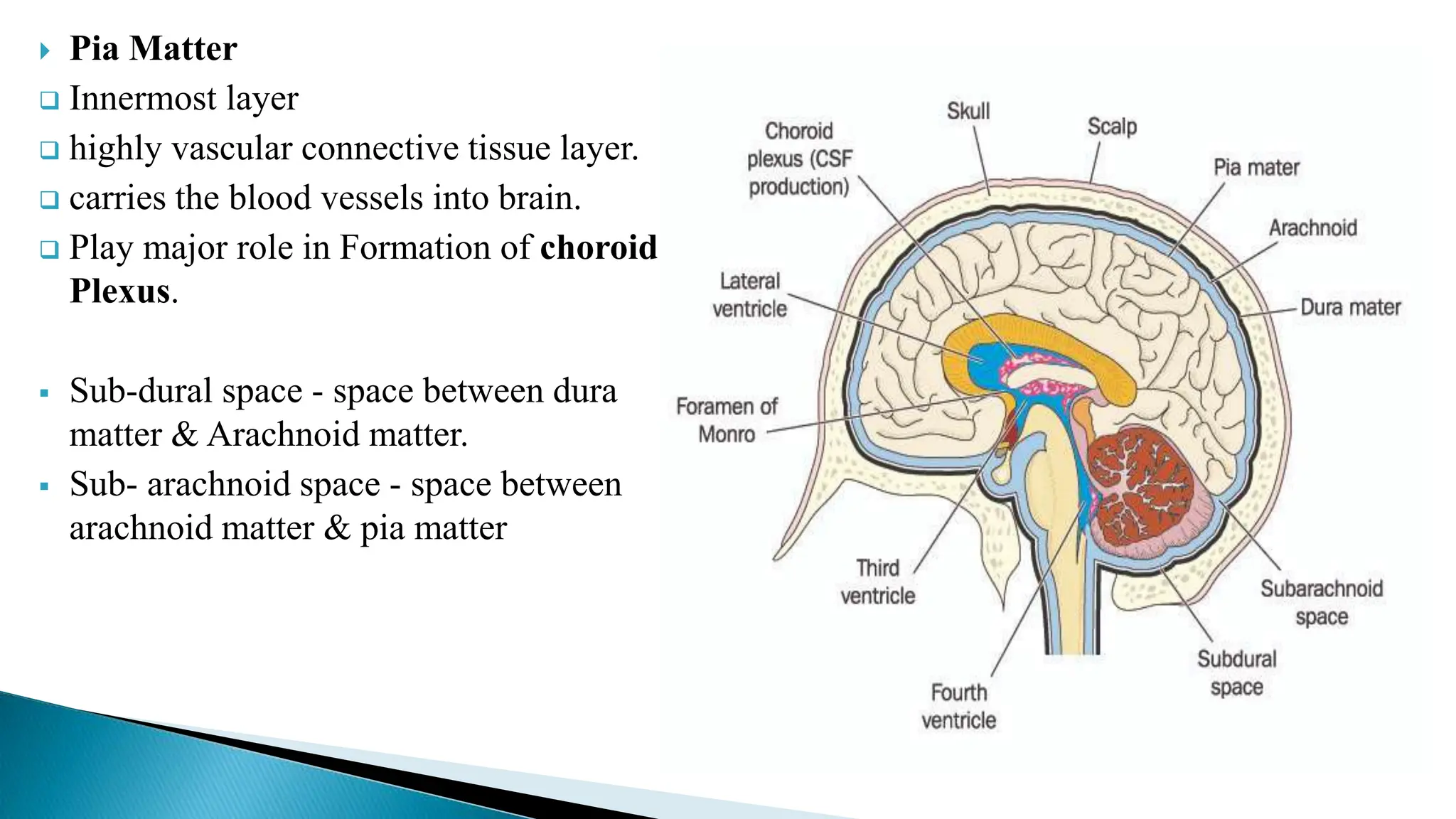
 Pia Matter
 Innermost layer
 highly vascular connective tissue layer.
 carries the blood vessels into brain.
 Play major role in Formation of choroid
Plexus.
 Sub-dural space - space between dura
matter & Arachnoid matter.
 Sub- arachnoid space - space between
arachnoid matter & pia matter
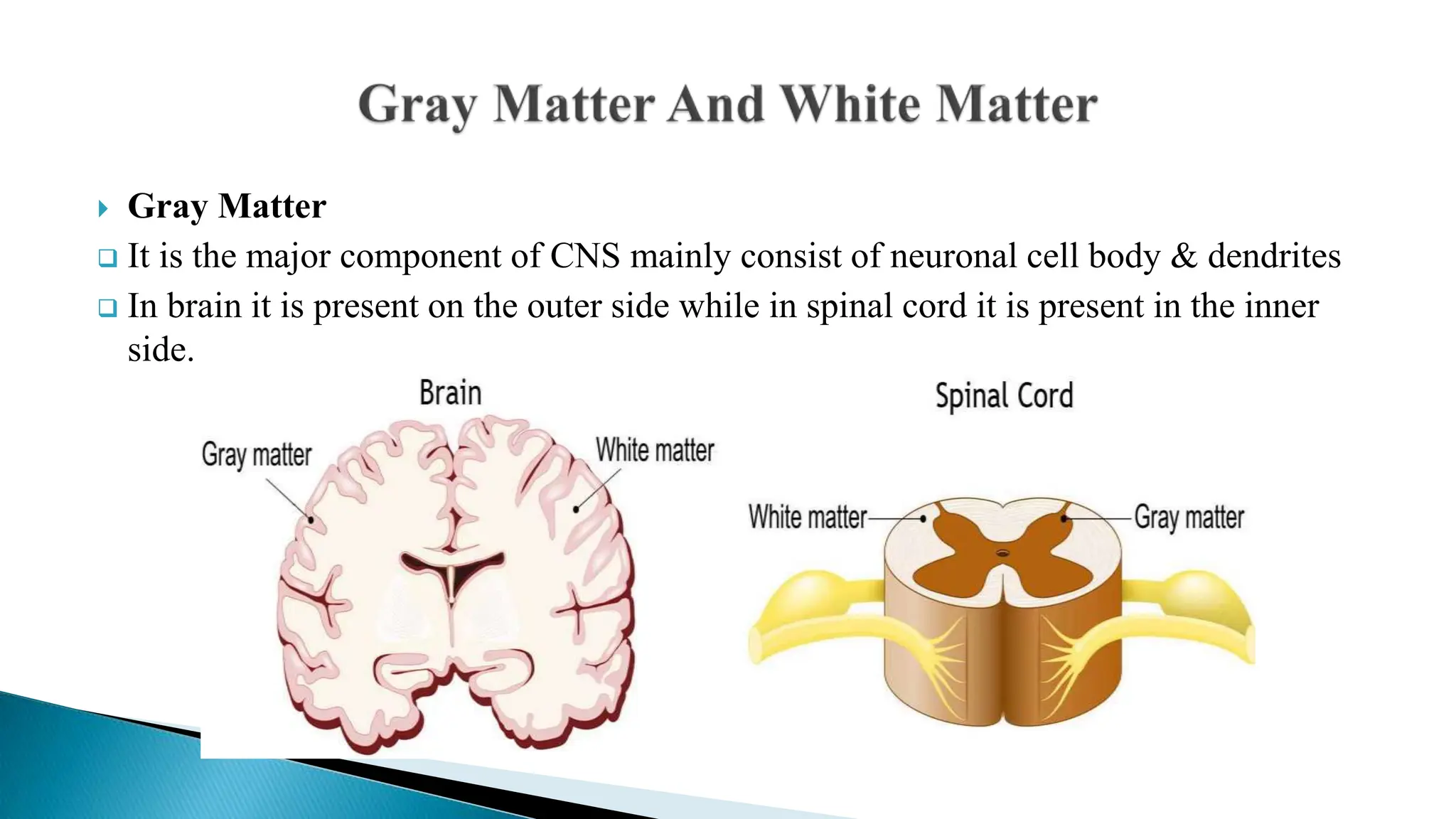
 Gray Matter
 It is the major component of CNS mainly consist of neuronal cell body & dendrites
 In brain it is present on the outer side while in spinal cord it is present in the inner
side.
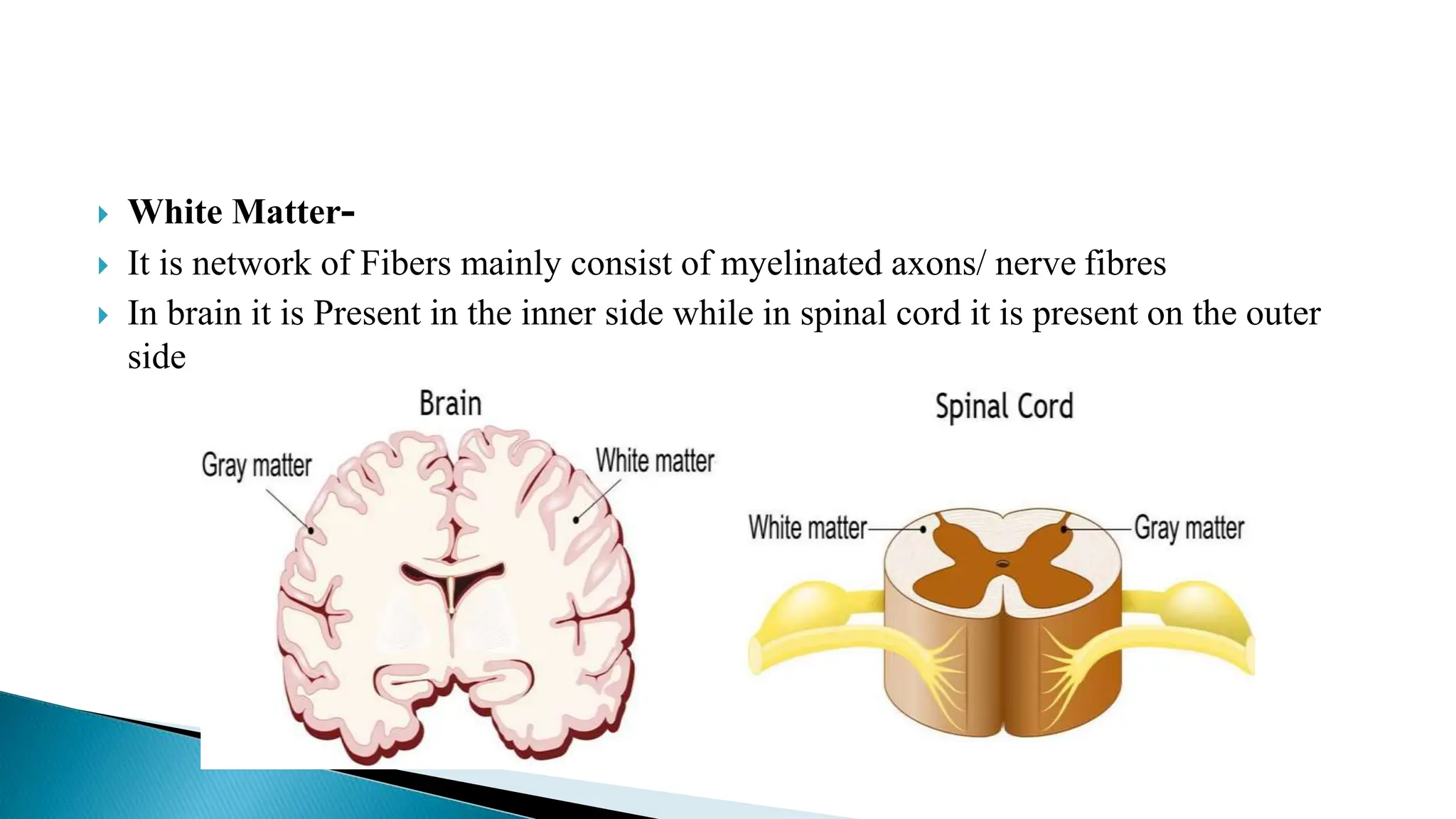
 White Matter-
 It is network of Fibers mainly consist of myelinated axons/ nerve fibres
 In brain it is Present in the inner side while in spinal cord it is present on the outer
side
 Brain is one of the largest organ in the body which coordinates most of the body
activities.
 It is the control center of the body.
 The adult human brain weighs on average about 1.4-1.5 kg. In males the average
weight is about 1370 g while in females it is about 1200 grams.
 It is made up of about 100 billion neurons.
 It is one of the most complex living structure in this universe.
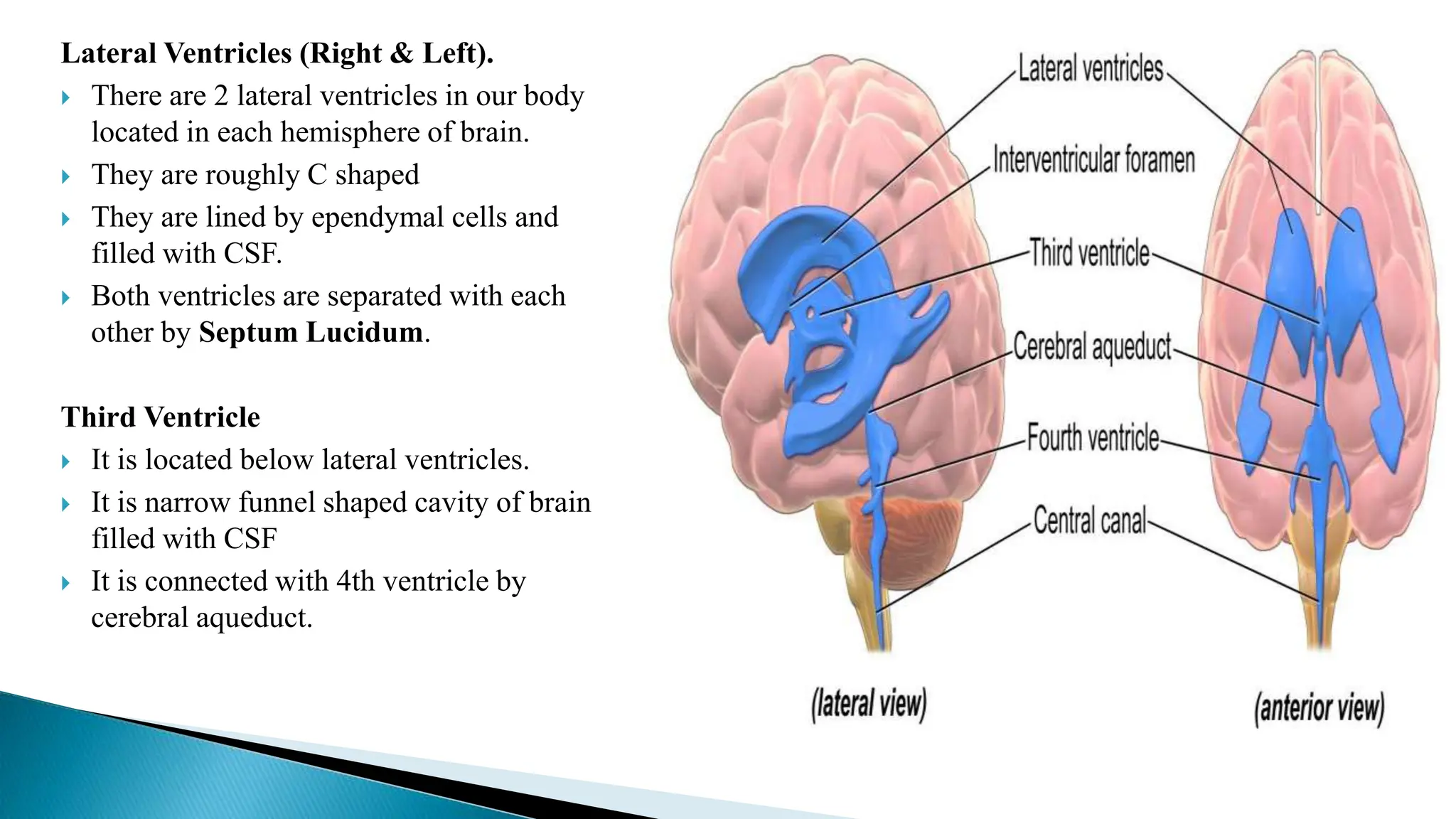
Lateral Ventricles (Right & Left).
 There are 2 lateral ventricles in our body
located in each hemisphere of brain.
 They are roughly C shaped
 They are lined by ependymal cells and
filled with CSF.
 Both ventricles are separated with each
other by Septum Lucidum.
Third Ventricle
 It is located below lateral ventricles.
 It is narrow funnel shaped cavity of brain
filled with CSF
 It is connected with 4th ventricle by
cerebral aqueduct.
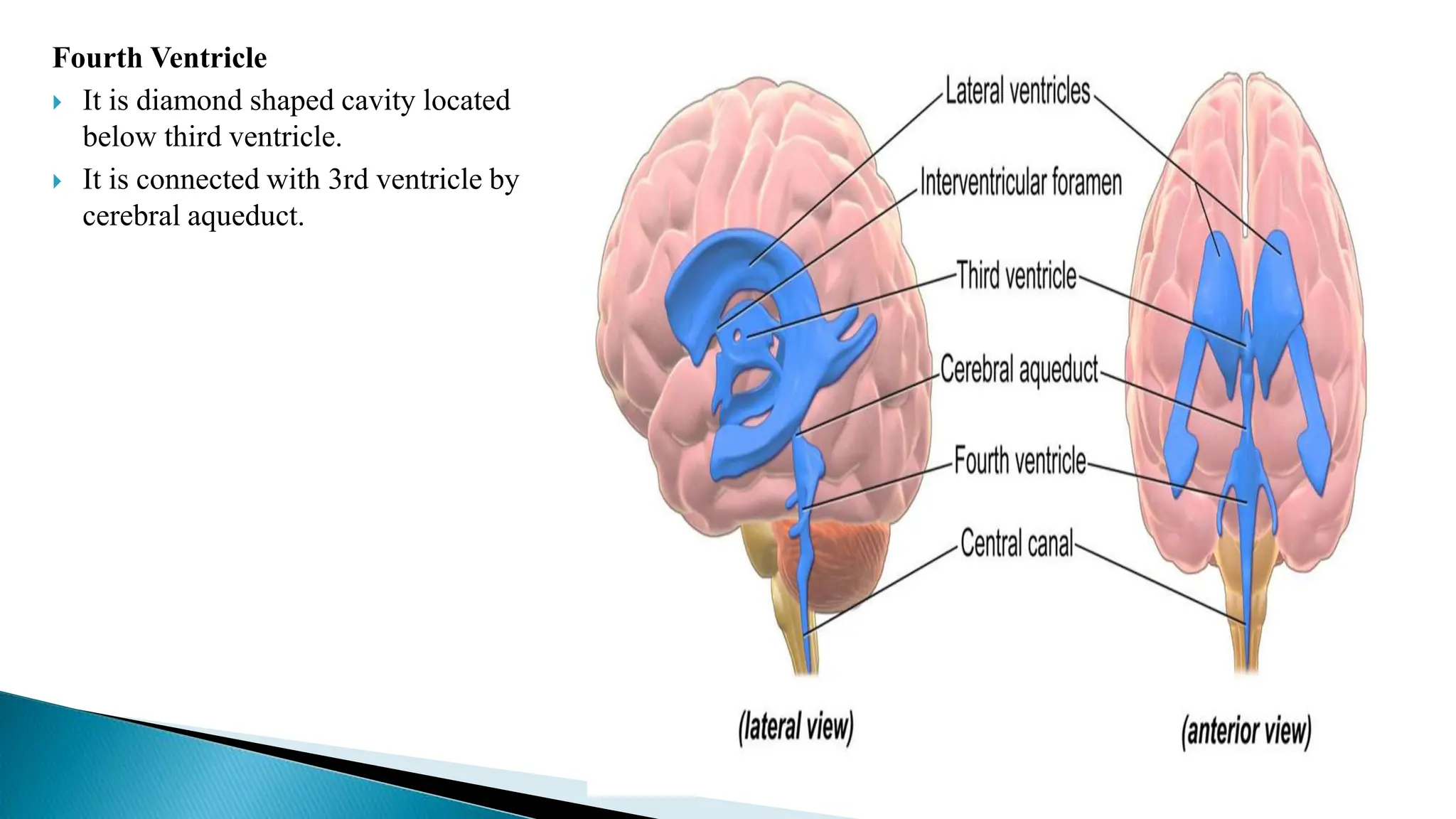
Fourth Ventricle
 It is diamond shaped cavity located
below third ventricle.
 It is connected with 3rd ventricle by
cerebral aqueduct.
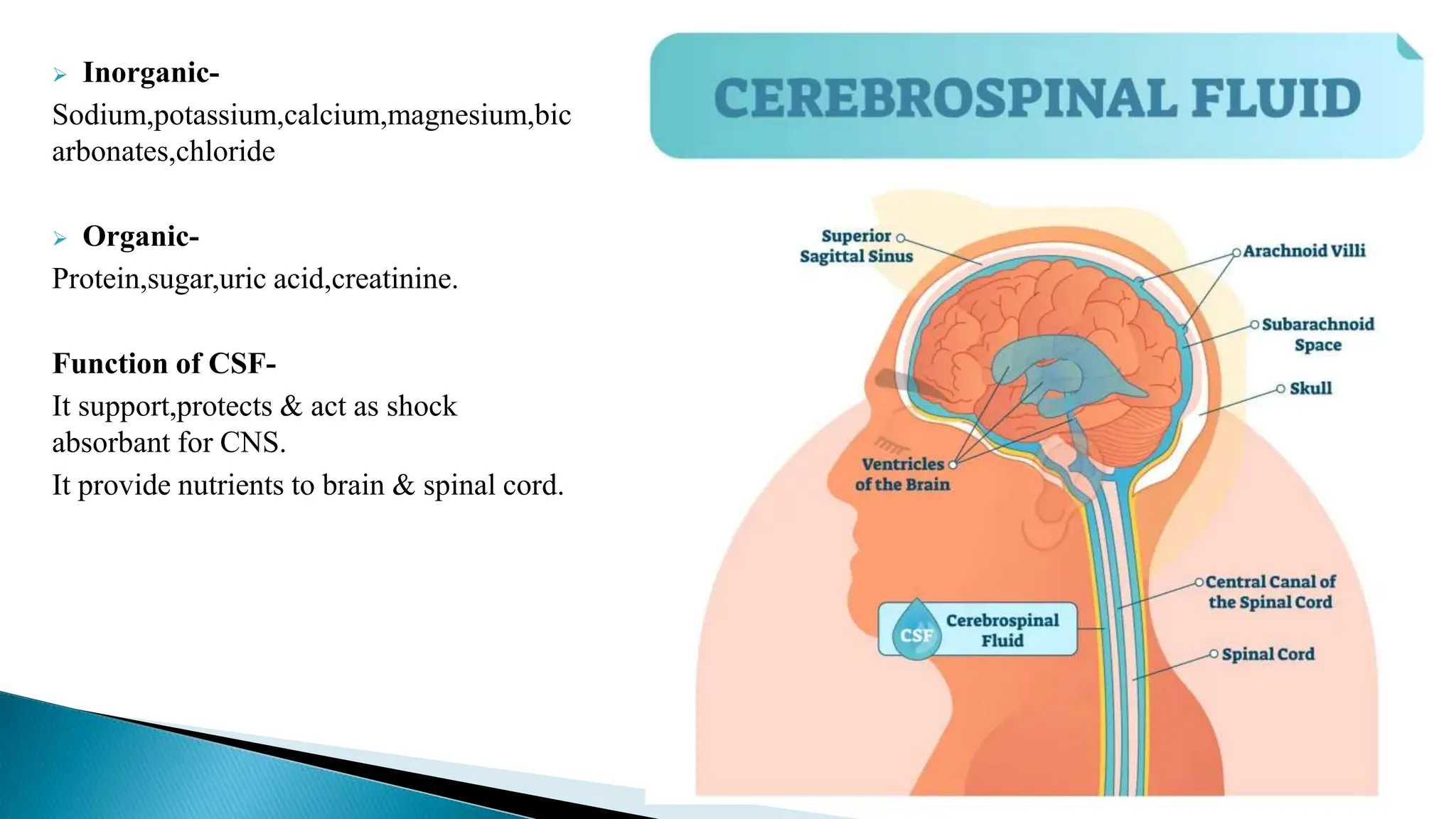
 CSF is a clear, colourless & transparent fluid found in the ventricles, sub arachnoid space and central
canal of spinal cord.
 It is mainly formed by choroid plexus of lateral ventricles.
 Choroid Plexus :Choroid Plexus is a network of blood vessels lined by ependymal cells that produces
CSF.
 The volume of CSF is approx 100-150 ml.
 It is secret at a rate of 0.5 ml/min or 500-700 ml/day
 Its pH is slightly alkaline 7.3
Composition of CSF
It is composed of :
99%. Water
1%. Salid Substances
 Inorganic-
Sodium,potassium,calcium,magnesium,bic
arbonates,chloride
 Organic-
Protein,sugar,uric acid,creatinine.
Function of CSF-
It support,protects & act as shock
absorbant for CNS.
It provide nutrients to brain & spinal cord.
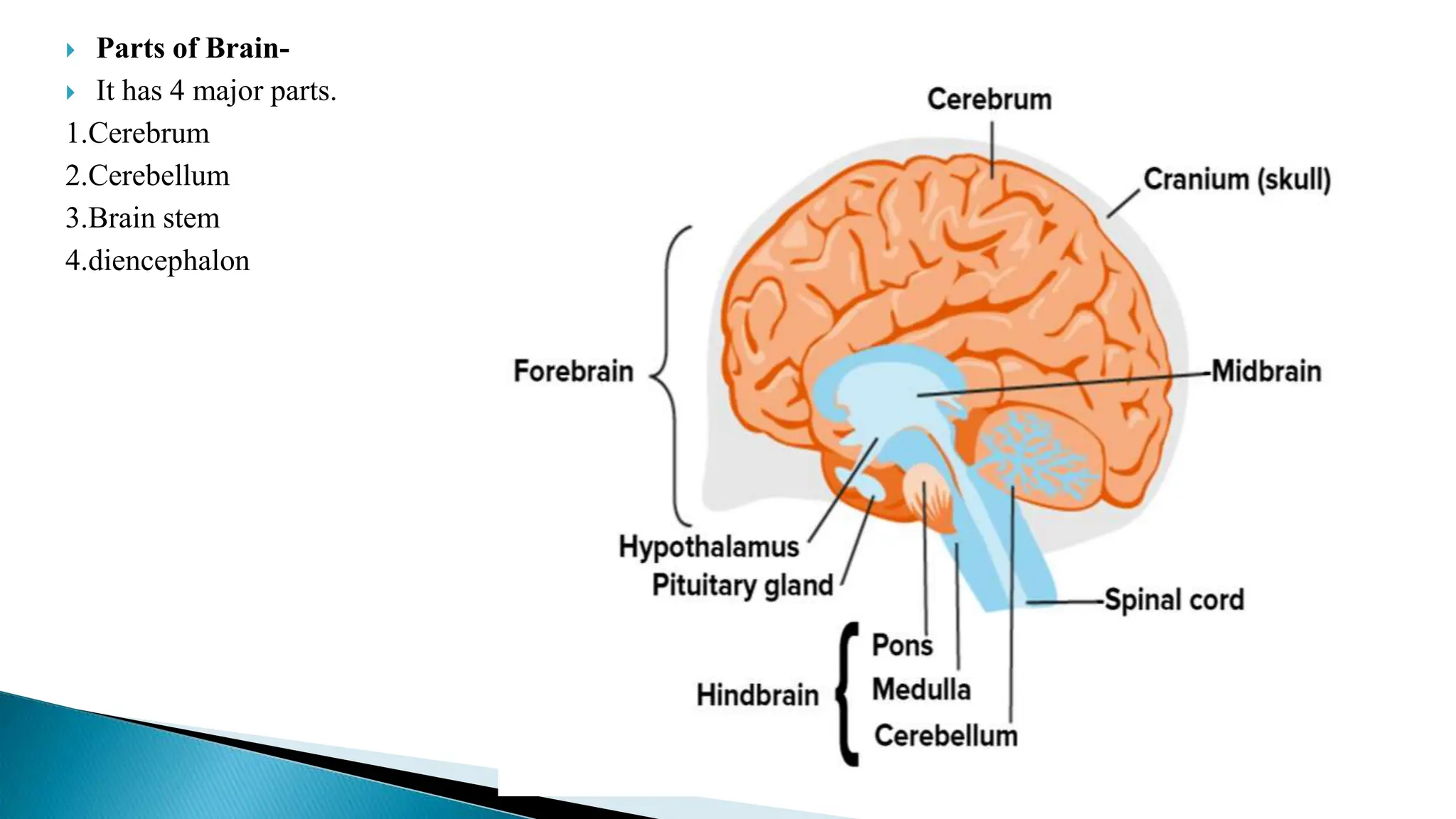
 Parts of Brain-
 It has 4 major parts.
1.Cerebrum
2.Cerebellum
3.Brain stem
4.diencephalon
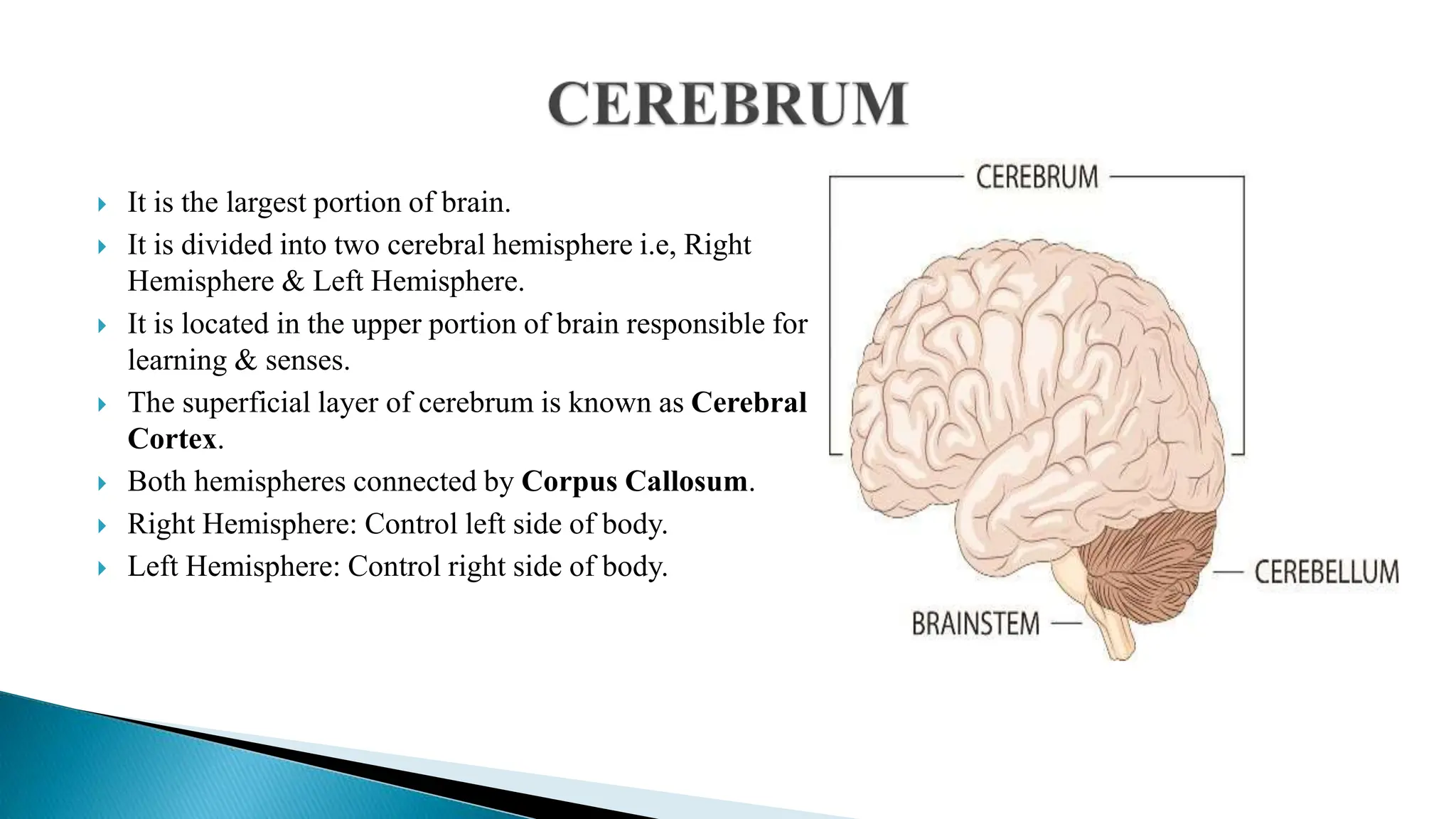
 It is the largest portion of brain.
 It is divided into two cerebral hemisphere i.e, Right
Hemisphere & Left Hemisphere.
 It is located in the upper portion of brain responsible for
learning & senses.
 The superficial layer of cerebrum is known as Cerebral
Cortex.
 Both hemispheres connected by Corpus Callosum.
 Right Hemisphere: Control left side of body.
 Left Hemisphere: Control right side of body.
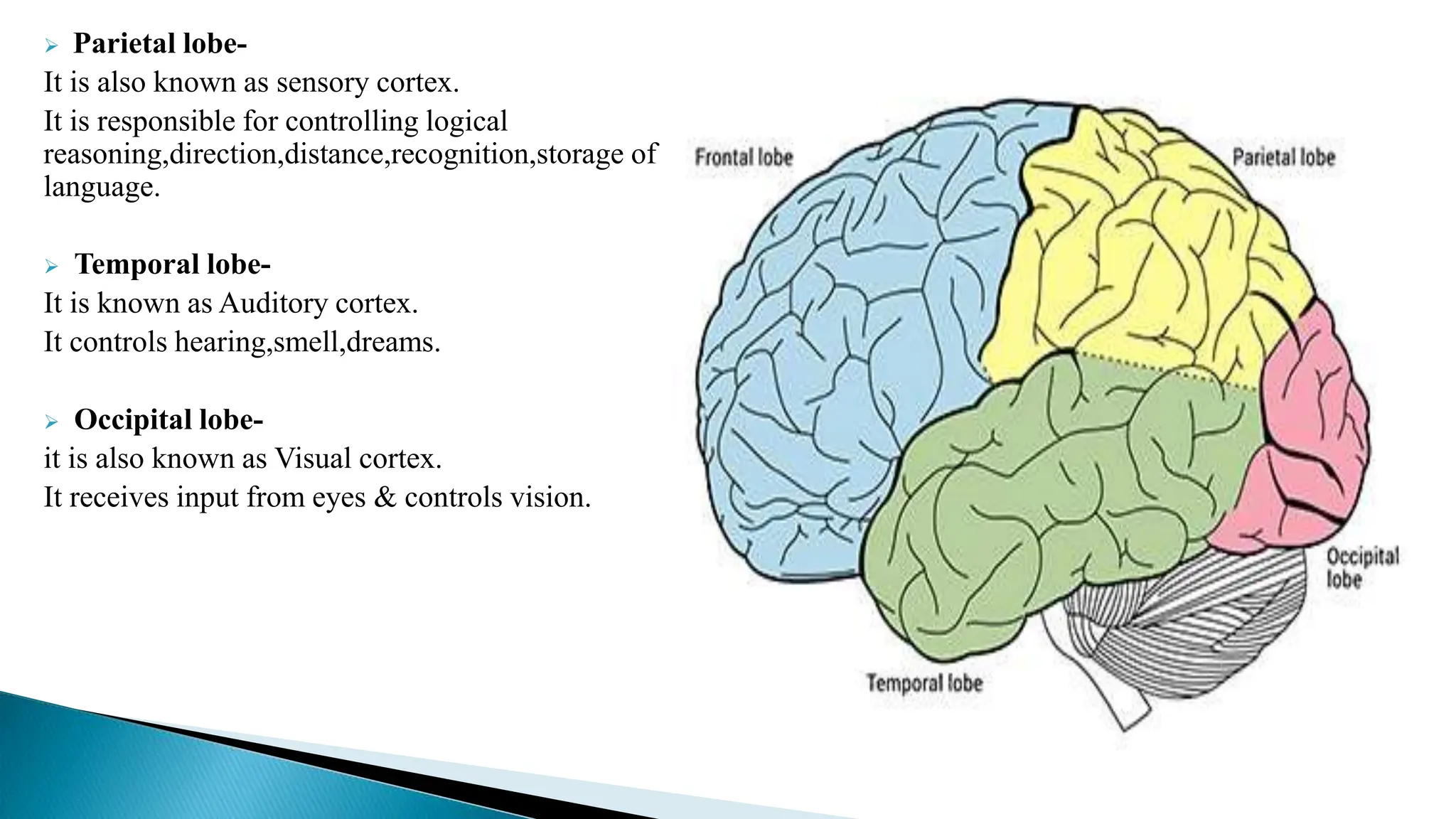
LOBES OF CEREBRUM
 The cerebrum of brain is divided into 4 major lobes
 Frontal Lobe
 Parietal Lobe
 Temporal Lobe
 Occipital Lobe
Frontal Lobe
 It is also known as Motor Cortex.
 It controls, motor functions like personality, movement, planning,decision
making,creativity,concentration,thoughts.
 Parietal lobe-
It is also known as sensory cortex.
It is responsible for controlling logical
reasoning,direction,distance,recognition,storage of
language.
 Temporal lobe-
It is known as Auditory cortex.
It controls hearing,smell,dreams.
 Occipital lobe-
it is also known as Visual cortex.
It receives input from eyes & controls vision.
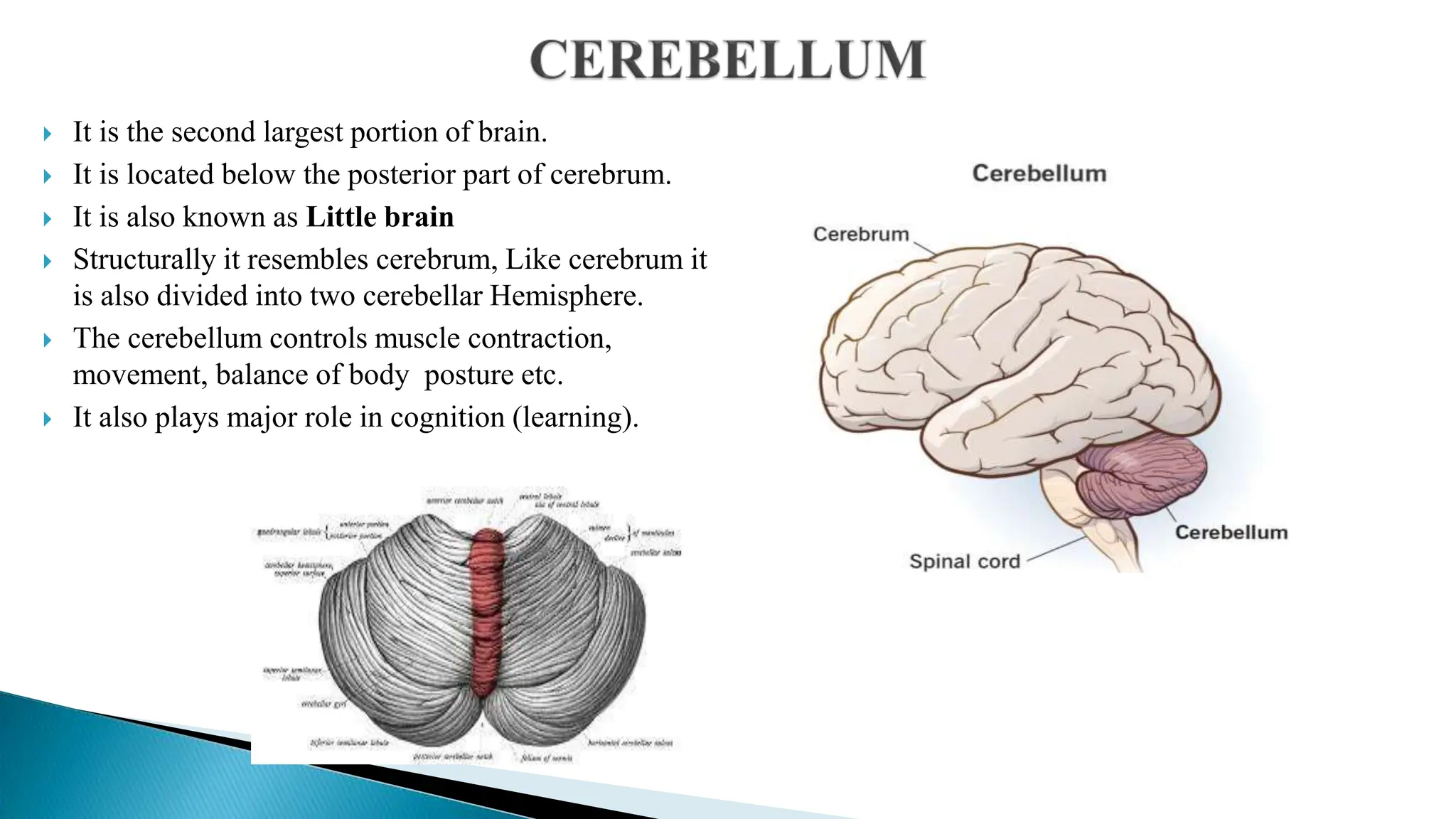
 It is the second largest portion of brain.
 It is located below the posterior part of cerebrum.
 It is also known as Little brain
 Structurally it resembles cerebrum, Like cerebrum it
is also divided into two cerebellar Hemisphere.
 The cerebellum controls muscle contraction,
movement, balance of body posture etc.
 It also plays major role in cognition (learning).
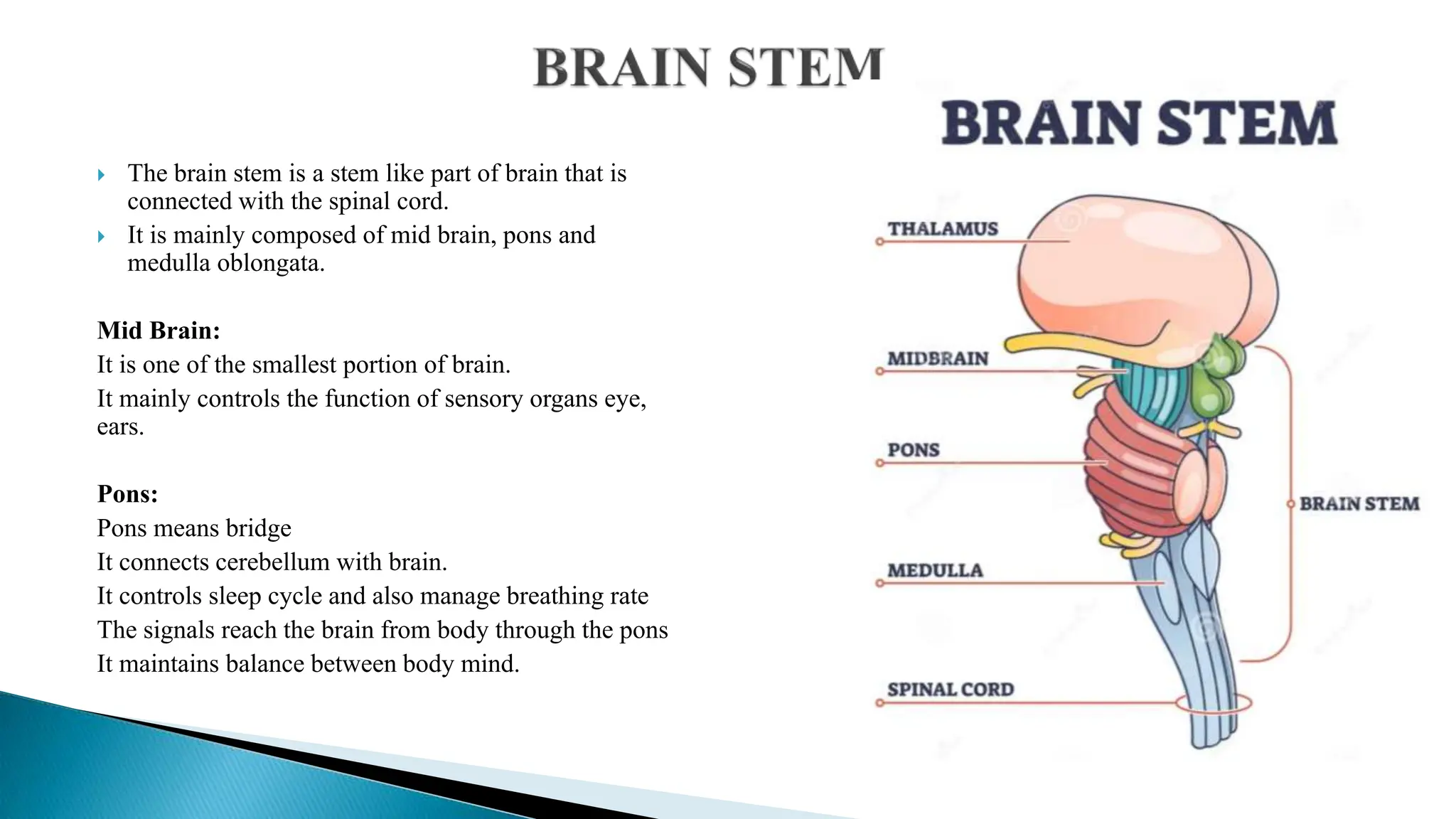
 The brain stem is a stem like part of brain that is
connected with the spinal cord.
 It is mainly composed of mid brain, pons and
medulla oblongata.
Mid Brain:
It is one of the smallest portion of brain.
It mainly controls the function of sensory organs eye,
ears.
Pons:
Pons means bridge
It connects cerebellum with brain.
It controls sleep cycle and also manage breathing rate
The signals reach the brain from body through the pons
It maintains balance between body mind.
 Medulla Oblongata:
 It is lowermost part of brain.
 It is directly connected with spinal cord.
 It mainly controls involuntary actions of body like respiration, Blood Circulation, Heart rate,vomiting.
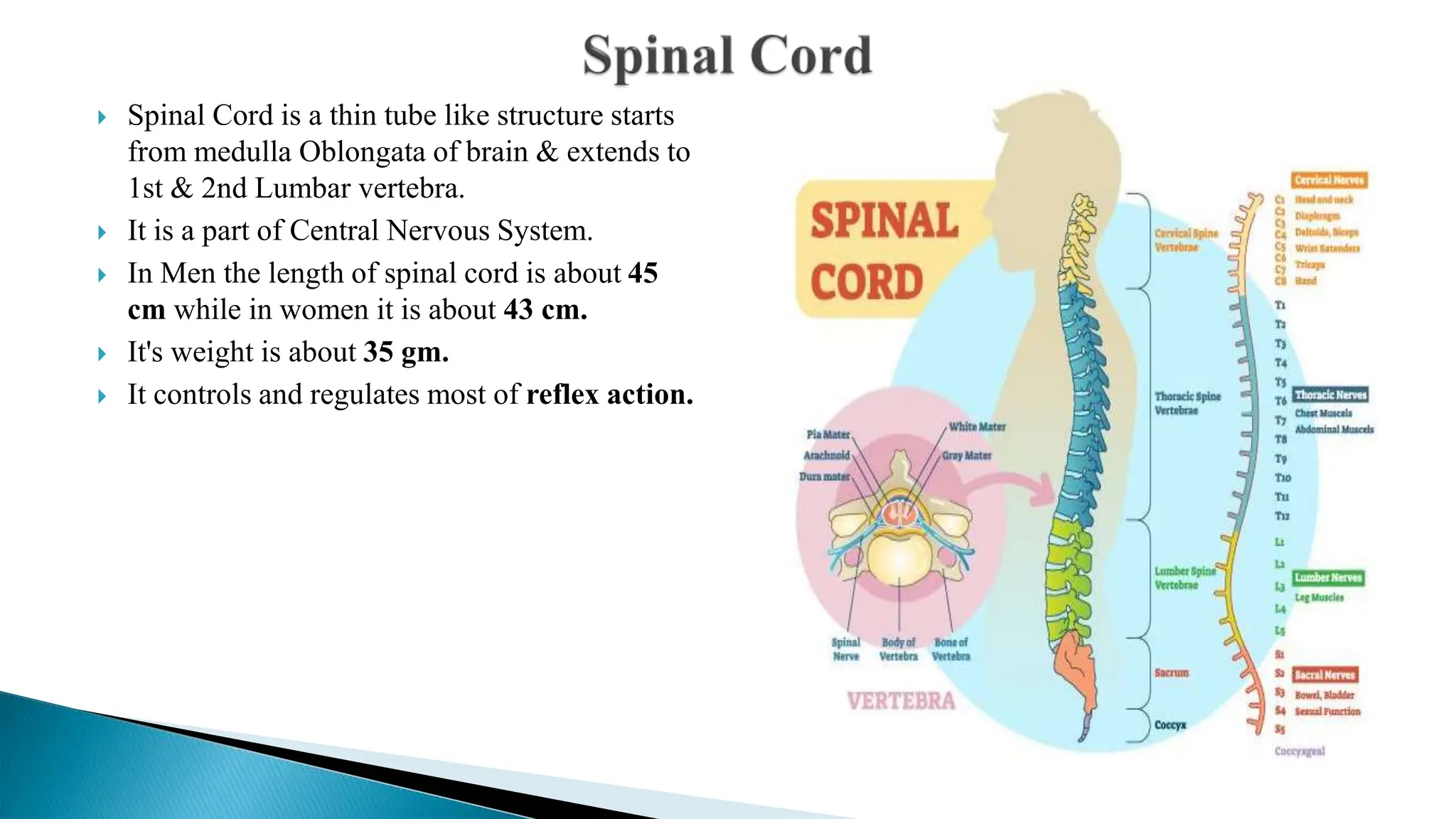
 Spinal Cord is a thin tube like structure starts
from medulla Oblongata of brain & extends to
1st & 2nd Lumbar vertebra.
 It is a part of Central Nervous System.
 In Men the length of spinal cord is about 45
cm while in women it is about 43 cm.
 It's weight is about 35 gm.
 It controls and regulates most of reflex action.
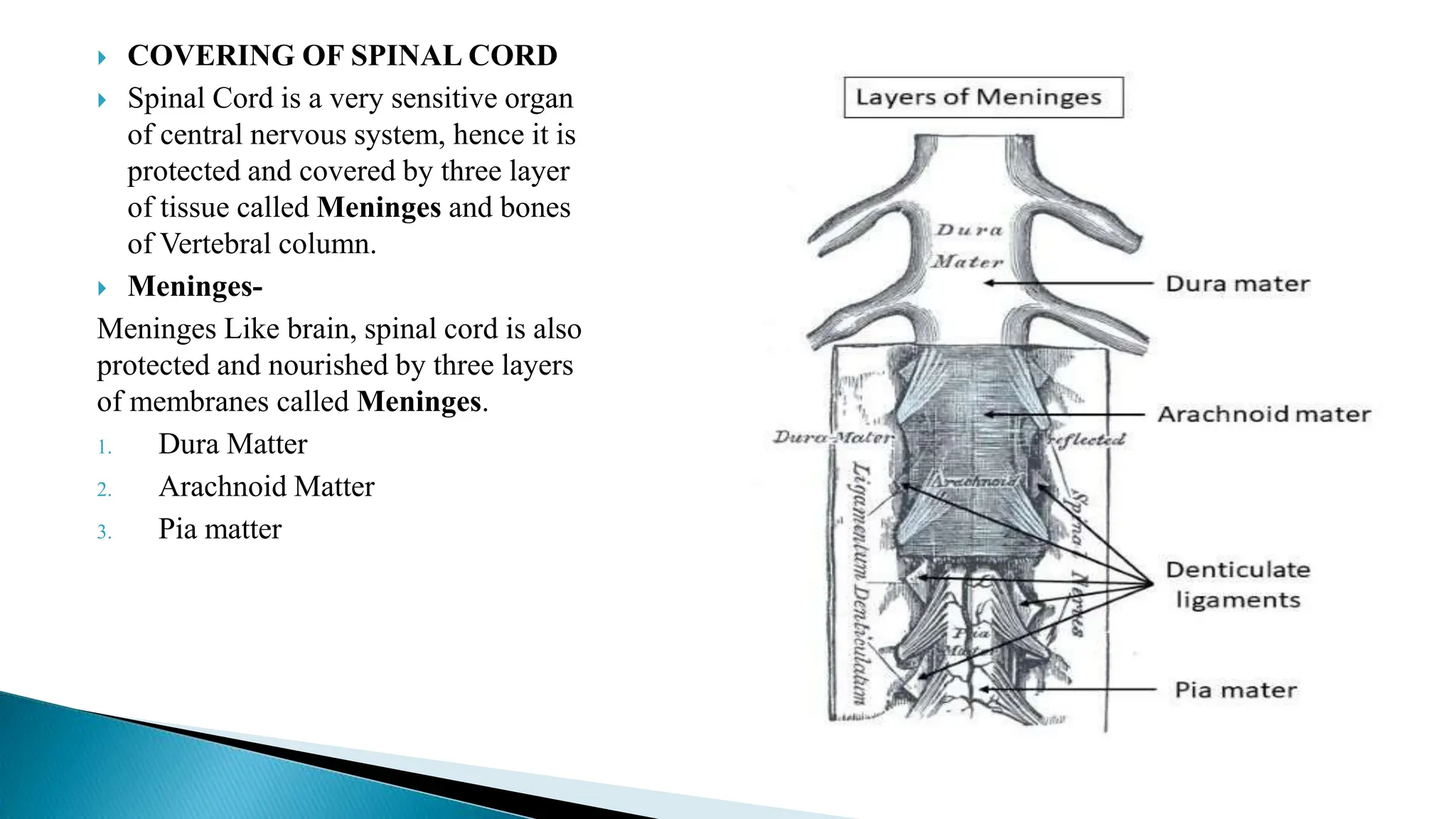
 COVERING OF SPINAL CORD
 Spinal Cord is a very sensitive organ
of central nervous system, hence it is
protected and covered by three layer
of tissue called Meninges and bones
of Vertebral column.
 Meninges-
Meninges Like brain, spinal cord is also
protected and nourished by three layers
of membranes called Meninges.
1. Dura Matter
2. Arachnoid Matter
3. Pia matter
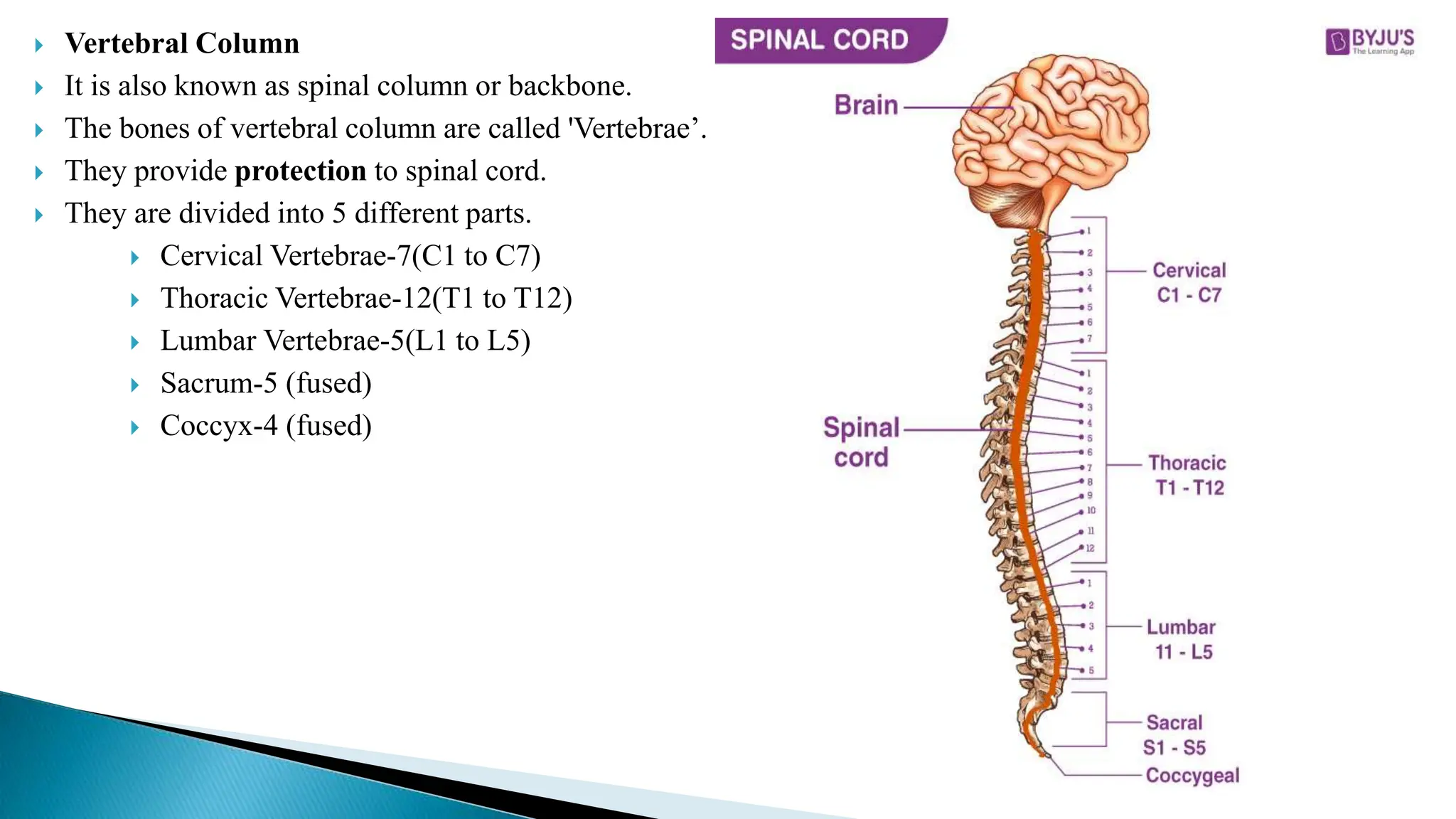
 Vertebral Column
 It is also known as spinal column or backbone.
 The bones of vertebral column are called 'Vertebrae’.
 They provide protection to spinal cord.
 They are divided into 5 different parts.
 Cervical Vertebrae-7(C1 to C7)
 Thoracic Vertebrae-12(T1 to T12)
 Lumbar Vertebrae-5(L1 to L5)
 Sacrum-5 (fused)
 Coccyx-4 (fused)
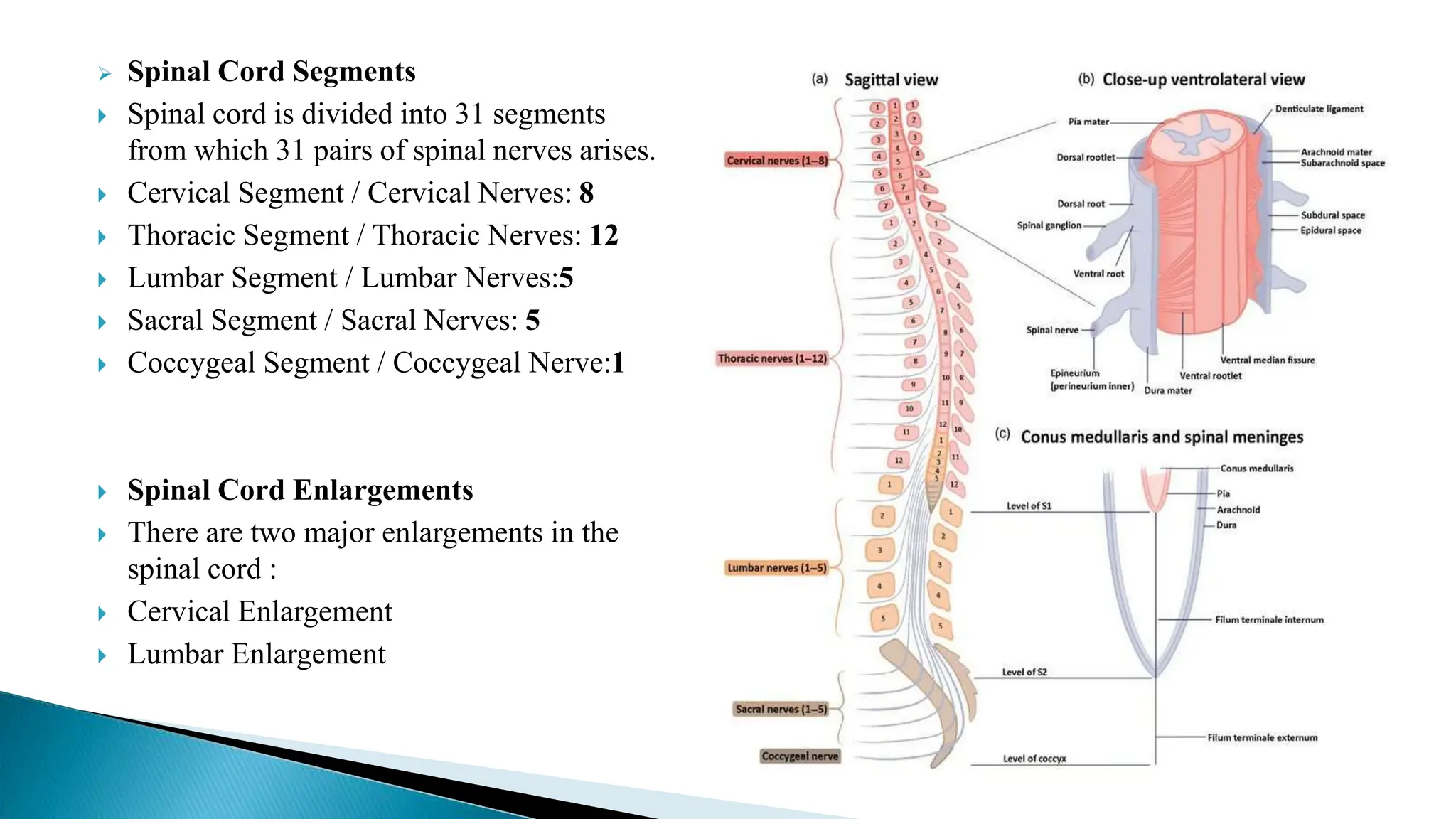
 Spinal Cord Segments
 Spinal cord is divided into 31 segments
from which 31 pairs of spinal nerves arises.
 Cervical Segment / Cervical Nerves: 8
 Thoracic Segment / Thoracic Nerves: 12
 Lumbar Segment / Lumbar Nerves:5
 Sacral Segment / Sacral Nerves: 5
 Coccygeal Segment / Coccygeal Nerve:1
 Spinal Cord Enlargements
 There are two major enlargements in the
spinal cord :
 Cervical Enlargement
 Lumbar Enlargement
 Cervical Enlargement-It is the superior
enlargement extends from 4th cervical vertebrae to
the 1st thoracic vertebrae [C3-T2].
 Lumbar Enlargement-It is the inferior
enlargement extends from 9th to 12th thoracic
vertebrae [T9-T12]
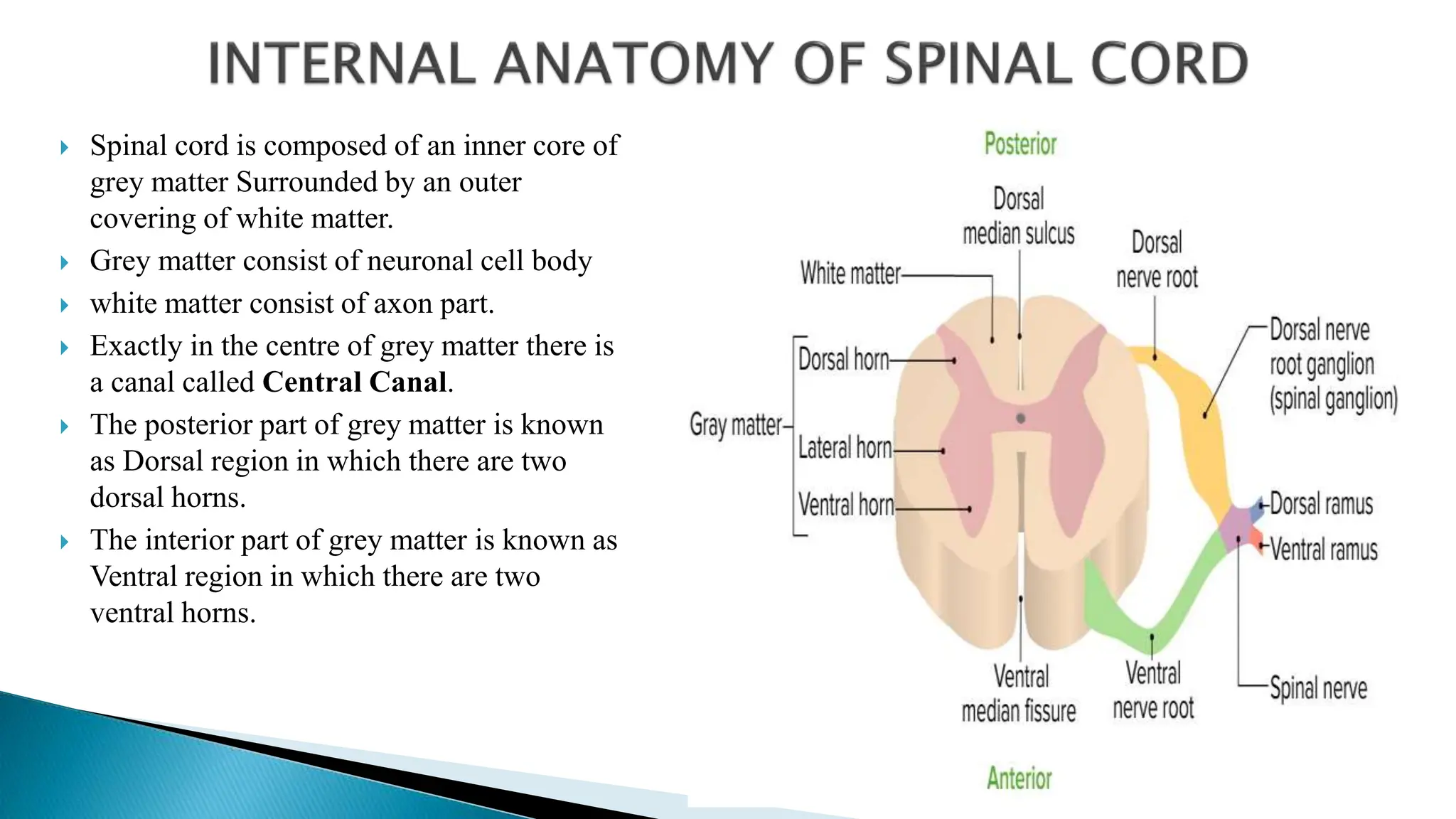
 Spinal cord is composed of an inner core of
grey matter Surrounded by an outer
covering of white matter.
 Grey matter consist of neuronal cell body
 white matter consist of axon part.
 Exactly in the centre of grey matter there is
a canal called Central Canal.
 The posterior part of grey matter is known
as Dorsal region in which there are two
dorsal horns.
 The interior part of grey matter is known as
Ventral region in which there are two
ventral horns.
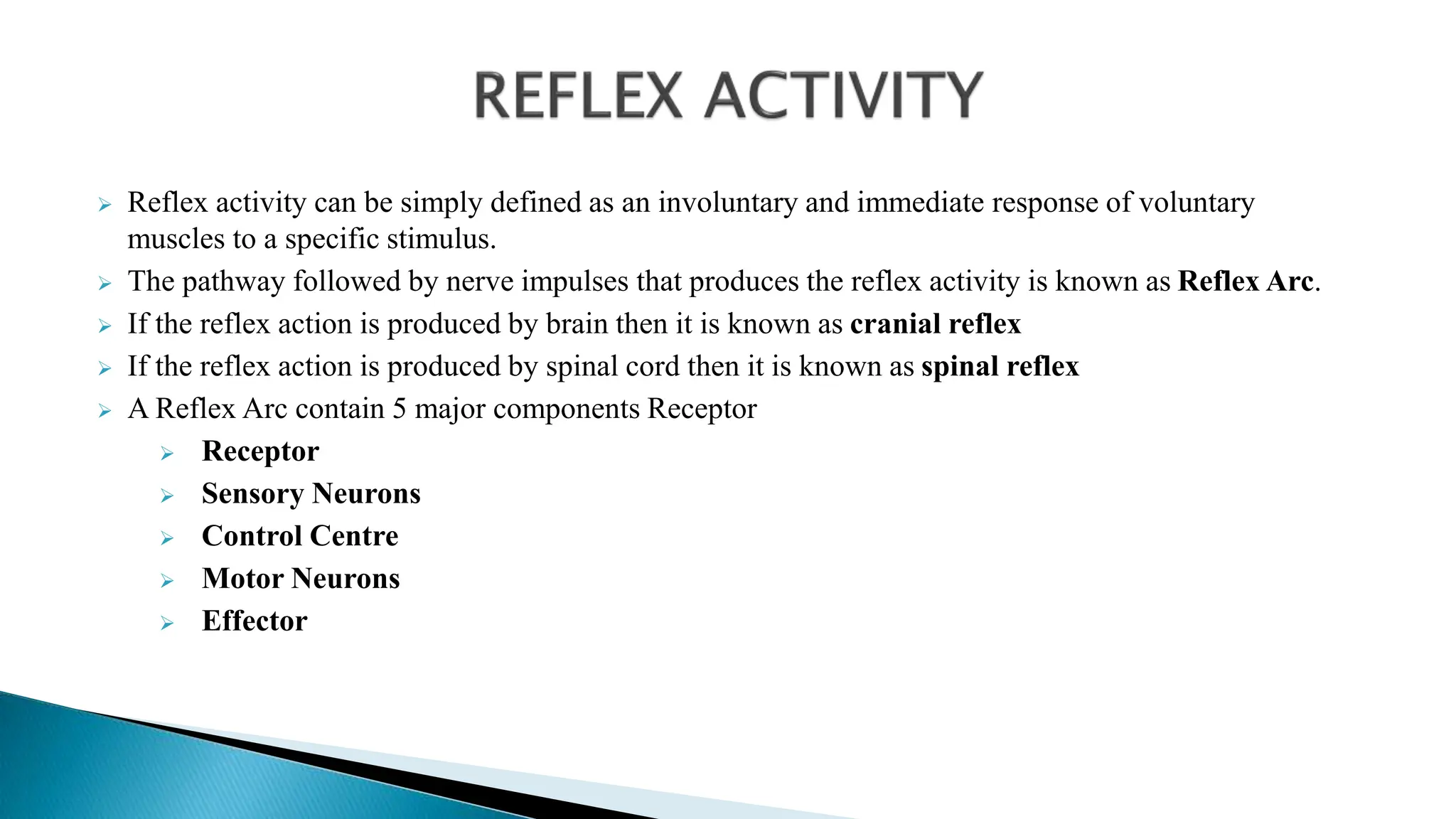
 Reflex activity can be simply defined as an involuntary and immediate response of voluntary
muscles to a specific stimulus.
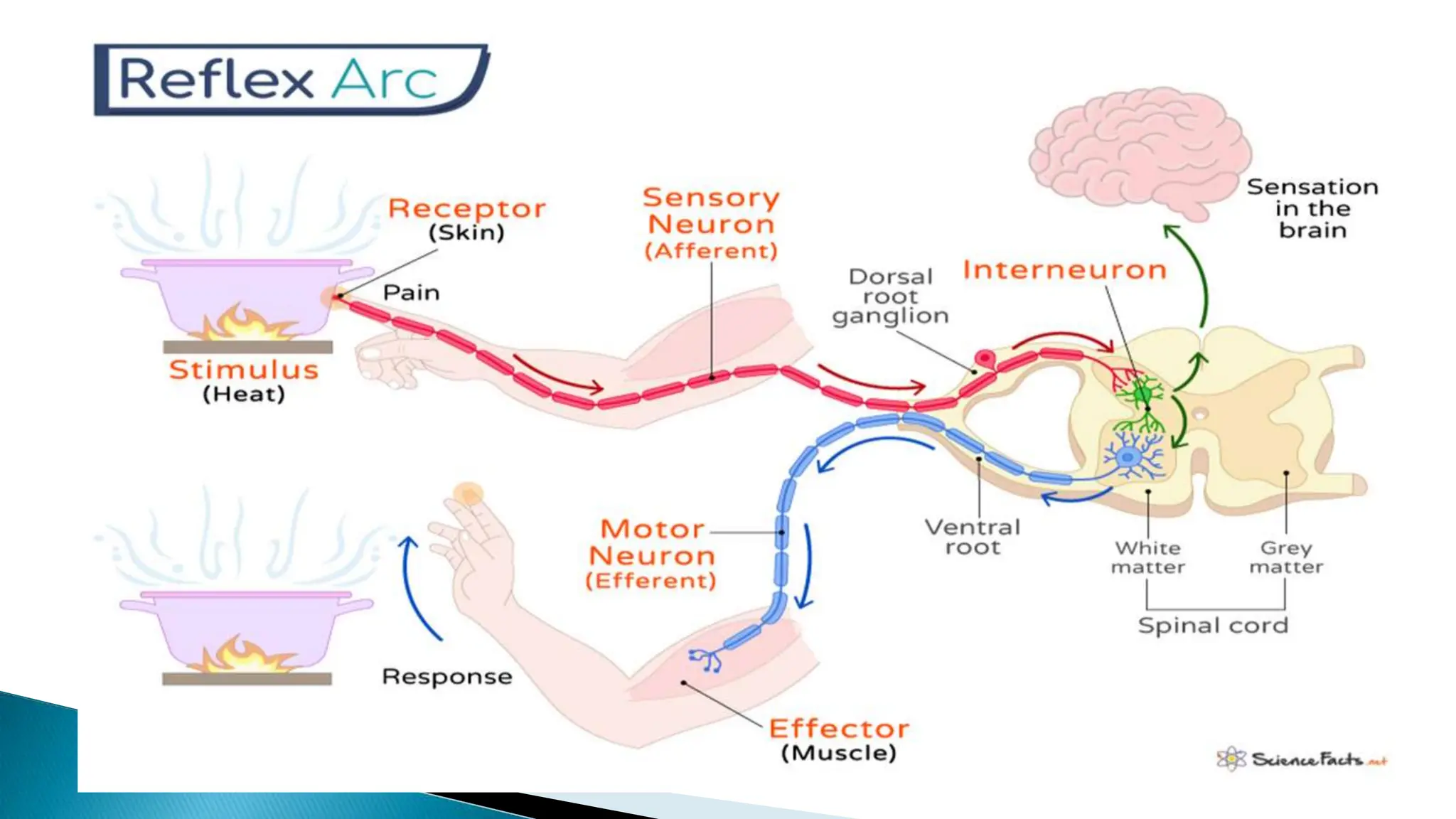
 The pathway followed by nerve impulses that produces the reflex activity is known as Reflex Arc.
 If the reflex action is produced by brain then it is known as cranial reflex
 If the reflex action is produced by spinal cord then it is known as spinal reflex
 A Reflex Arc contain 5 major components Receptor
 Receptor
 Sensory Neurons
 Control Centre
 Motor Neurons
 Effector
Thank you!

Unit 1 Nervous System.pptx by Nutan Kamble

  • 1.
  • 2.
     The humannervous system is a complex of interconnected systems in which larger systems are comprised of smaller subsystems each of which have specific structures with specific functions.  The nervous system is very important in helping to maintain the homeostasis (balance) of the human body.  A series of sensory receptors work with the nervous system to provide information about changes in both the internal and external environments.  Four Primary Functions Of Nervous System 1. Sensing the world -Vision, Hearing, Smell, Taste, Touch 2. Transmitting information 3. Processing information 4. Producing a response
  • 3.
    The Central Nervous System(CNS) ThePeripheral Nervous System(PNS) Brain Spinal Cord Motor Neuron Sensory Neuron Somatic Nervous System Autonomic Nervous System Sympathomimetic Division Parasympathomimetic Division
  • 4.
     The Nervoussystem consist of vast number of cells called as Neurones.  Consist of special type of connective tissue, Neuroglia.  Neuron consist of cell body,axon,dendrites.  The neurons are actively conducting nerve impulses (action potentials).  Irritability and Conductivity- characteristics of neuron
  • 5.
     Cell bodies- Formsthe gray matter of the nervous system and are found in a periphery of the brain and in centre of spinal cord. Groups of cell body are called as a nuclei in the CNS & ganglia in PNS. They are referred to as nerves or nerve fibers outside the brain and spinal cord.
  • 6.
     Axons anddendrites are extensions of cell bodies & form the white matter of the nervous system.  Axons are found deep in brain and in groups,called tracts, at the periphery of the spinal cord.  Refferd as nerves or nerve fibers outside the brain and spinal cord.
  • 7.
     Each nervecell has only one axon, carrying nerve impulses away from the cell body. They are usually longer than the dendrites, sometimes as long as 100 cm.
  • 8.
     Structure ofan axon-  membrane of the axon- axolemma  Large axons and those of peripheral nerves are surrounded by myelin sheath.(series of shwann cell arranged along length of axon)  Each one is wrapped around the axon so that it is covered by a number of concentric layers of Schwann cell plasma membrane.  Between layers of plasma membrane-small amt of fatty sub.-Myelin
  • 9.
     The outermostlayer of Schwann cell plasma membrane- neurilemma.  Tiny areas of exposed axolemma between adjacent Schwann cells, called nodes of Ranvier,- assist the rapid transmission of nerve impulse in mylinated neurones.
  • 10.
    Postganglionic fibres andsome small fibres in the central nervous system are non-myelinated. In this type a number of axons are embedded in Schwann cell plasma membranes The adjacent Schwann cells are in close association and there is no exposed axolemma. The speed of transmission of nerve impulses is significantly slower in non-myelinated fibres.
  • 11.
     The dendritesare the many short processes that receive and carry the incoming impulses towards cell bodies.  They have the same structure as axons but are usually shorter and branching.  In motor neurons they form part of synapses and in sensory neurons it form the sensory receptors that respond to specific stimuli
  • 12.
     On thebasis of polarity/extension  On the basis of function  On the basis of myelin sheath
  • 13.
     On thebasis of polarity/extension 4 types  Unipolar Neurons  Bipolar Neurons  Pseudo unipolar Neurons  Multipolar Neurons
  • 14.
     On thebasis of function can be divided into three types Sensory (Afferent) neurons- organ – Brain Motor (Efferent) neurons - Brain – organ Interneurons. Sensory • They are also known as afferent neurons. • They carry to the CNS nerve impulses from issues & organs Motor • They are also known as efferent neurons • They carry nerve impulses From CNS to effector organs Interneurons. • They are also known as Association neurons • They are found exclusively on CNS. • They connects sensory & motor neurons
  • 15.
     On thebasis of Myelin sheath Myelinated neurons. These neurons are covered by a thick layer of myelin sheath. Impulse conduction in myelinated neurons is very fast compared to non-myelinated neurons. Non-myelinated neurons These neurons do not contain myelin sheath. Impulse conduction in non-myelinated neurons. is slow compared to myelinated neurons.
  • 16.
     They arealso known as Non-neuronal or glial cells.  These are the supporting cells of neurons but do not generate or conduct nerve impulses.  Unlike neurons, these cells have cell division property.  Functions of neuroglia-  They provide nutrition to neuron.  They Protect neurons from Pathogens.  They Provide structural & functional support to neurons.  They form myelin sheath.  They also maintains Homeostasis.
  • 17.
     Types ofNeuroglia Neuroglia peripheral Nervous System Oligodrocytes Ependymal cells Astrocytes Central Nervous System Schwann cells Microglia Satellite cells
  • 18.
     Neuroglial cellsin CNS-  Astrocytes- I. These are the most abundant neuroglial cell. II. These are found in large number near blood vessels. III.These are having star shaped. IV.They form and maintains Blood Brain Barrier.
  • 19.
     Oligodendrocytes- I. Theyare smaller compare to Astrocytes. II. They form myelin sheath in the neurons of CNS. III.These are the supporting network of neurons.  Ependymal cells- I. They form epithelial lining of brain & spinal cord & they are columnar epithelium. II. They secretes & absorbs CSF (cerebrospinal fluid).
  • 20.
     Microglia cells I.These are the smallest neuroglial cells. II.These are derived from monocytes. III.They are phagocytic in nature & help in neuroglial repair.
  • 21.
     Neuroglial cellsin PNS-  Shawann cells- I. These are the major glial cells in PNS. II.They form myelin sheath in the neurons of PNS. III.They are also known as neurilemma cells.  Satellite cells- I. These are form extracellular space of nervous system II.They provide physical support to neurons.
  • 22.
     Neurons /Nerve Fibres contains some special Properties as follows- I. Conductivity II. Excitability III.Refractory Period IV.Unfatigability V. All or none law VI.Accomodation
  • 23.
     Conductivity-It isthe ability of nerve fiber to conduct nerve impulses (electrical impulses) along its length from one part to another  Excitability-It is the ability of neurons / nerve fibers to respond to various stimuli & convert them into nerve impulse.  Refractive Period-when the nerve fiber is once excited, it will not respond to any other stimulus for a selective time period and this time period is known as Refractive Period.
  • 24.
     Unfatigability-It isthe ability of nerve Fibers to get Fatigued even if they receives continuous stimuli.  All or None law-It is one of the most important property of nerve Fibers, nerve fibers gets excited only at a particular threshold strength. Either they will give maximum response or they give no response.  Accomodation-If the continuous stimuli is applied to the nerve Fibers then it will decrease the excitability of nerve fibers
  • 25.
     Neuron isa type of cell found in our nervous System which is able to generate, carry & transmit nerve impulse. Electrophysiology Study of electrical properties of neuron In electrophysiology we basically study about I. How nerve impulse generated. II. How Stimulus changed membrane ion concentration. III.How stimulus converted into nerve impulse
  • 26.
     An actionpotential is the Potential difference generate across membrane of neuron due to disbalance of Positive & negative change which ultimately give rise to generation of nerve impulse.  Events during generation of Action Potential. Polarization Depolarization Repolarization Hyperpolarization.
  • 27.
     Polarization-  knownas Resting stage  No stimulus comes so that no action potential generate  At resting Stage - Inside Membrane- negative(-)& High k+ Outside Membrane-Positive (+)& High Na+  Resting membrane potential-(-70mv)
  • 28.
     Depolarization I. Whenstimulus comes it deactivates Na+ k+ Pump. II. Now Na+ ions Continuously ↑ inside cell membrane via leakage channels & ultimately inside of membrane becomes positively charged & this stage is called depolarization (voltage gate Na+ also opens) III.Membrane potential rises to +30 mv.
  • 29.
     Repolarization I. Nowwhen wave of depolarization passed from one part of membrane to another, voltage gated Na+ channel again gets closed and now voltage gated k+ channels opens. II. Now k+ ions continuously passing out from the cell & ultimately the inside of membrane again becomes negatively charged & this stage is called Repolarization. III.ATPase Pump again activates.
  • 30.
     Hyperpolarization- I. Althoughmembrane again becomes repolarized but StiII k+ Channels (voltage gated) still remains opened. II. Now due to this k+ ions continues passing outside of membrane & membrane potential becomes -90 mv which causes hyperpolarization. III.when potential reaches -90mv k+ channels also get closes & finally membrane reaches to resting stage
  • 32.
     A Synapseis a junction between two neurons where transmission of nerve impulses takes place.  Synapse allow communication between two neurons & other cells through the use of neurotransmitters.  Generally this junction is formed between axon terminal of one neuron and the dendrite of another neuron.  Neurotransmitters transmits Signals from presynaptic neuron to postsynaptic neuron.
  • 34.
     Classification ofSynapse Basically two types of synapse I. Chemical Synapse II. Electrical Synapse.
  • 35.
     Chemical Synapse I.A chemical synapse is a junction between two neurons through which signals are transmitted by the release of chemical neurotransmitters II. In the chemical Synapse there is no continuity between two neurons because of presence of space, called Synaptic cleft. III. Neurotransmitters release from vesicles due to generation of action potential. IV. Almost every synapse in human body is a type of chemical synapse.
  • 36.
     Electrical Synapse I.Electrical synapse is a type of synapse in which there is a direct connection between presynaptic & Post synaptic neuron through gap junction. II. In electrical Synapse transmission occurs very rapidly. III. They are very Fewer in number compare to chemical synapse
  • 37.
     Neurotransmitters I. Neurotransmittersare the chemical messenger that transmit Signals from one neuron to another across a synapse. II. Neurotransmitters are generally Packed in Synaptic vesicles. III. They are very important for rapid transfer of nerve impulse between two neurons.
  • 38.
     Types OfNeurotransmitters On the basis of chemical nature On the basis of function.
  • 39.
    Neurotransmitters Amino acids AminesOthers Nitric oxide Acetylcholine Adrenaline Dopamine Histamine Nor-adrenaline GABA Glutamate Glycin Aspartate
  • 40.
    I. Excitatory Neurotransmitters II.Inhibitory Neurotransmitters III.Both
  • 41.
     Excitatory Neurotransmitters Theseneurotransmitters act by stimulating the target neurons They increase the influx of sodium ions inside the cell cause depolarization. Examples Ach, Adrenaline, Serotonin etc..  Inhibitory Neurotransmitters These neurotransmitters act by inhibiting the target neurons They increases the outflux of potassium ions outside the cell & cause repolarization e.g. GABA, Glycine, serotonin.
  • 42.
     Both (Excitatory& Inhibitory) Neurotransmitters which contains both excitatory & inhibitory properties are classified in this group eg. Ach, Dopamine
  • 43.
     The CNSis mainly consist of Brain & Spinal cord.  Both Brain & Spinal cord is protected by cranial cavity and vertebral column respectively.  The CNS is major controlling, regulatory & communicating System in our body
  • 44.
    Meninges-  Although Brain& spinal cord is protected by cranial bones and vertebral column but since they are very sensitive and important organ of our body, hence they are Called Further Protected by three layers of covering Meninges.  Meninges provide both protection & nourishment to brain & spinal cord.
  • 45.
     Layers ofMeninges Durra Matter(outermost layer) Arachnoid Matter( Middle layer) Pia Matter (Innermost layer)
  • 46.
     Dura Matter(outermost layer)-  It is the toughest and outermost layer.-It is Further divided into two Sub layers: 1)Endosteal layer: outer layer towards Skull 2)Meningel layer: Inner layer towards Arachoid matter.
  • 47.
     Arachnoid Matter- It is the middle Fibrous layer.  It is separated from dura matter by subdural space.  It is separated from pia matter by subarachnoid space.  Arachnoid matter & pia matter are collectively known Leptomeninges.
  • 48.
     Pia Matter Innermost layer  highly vascular connective tissue layer.  carries the blood vessels into brain.  Play major role in Formation of choroid Plexus.  Sub-dural space - space between dura matter & Arachnoid matter.  Sub- arachnoid space - space between arachnoid matter & pia matter
  • 49.
     Gray Matter It is the major component of CNS mainly consist of neuronal cell body & dendrites  In brain it is present on the outer side while in spinal cord it is present in the inner side.
  • 50.
     White Matter- It is network of Fibers mainly consist of myelinated axons/ nerve fibres  In brain it is Present in the inner side while in spinal cord it is present on the outer side
  • 51.
     Brain isone of the largest organ in the body which coordinates most of the body activities.  It is the control center of the body.  The adult human brain weighs on average about 1.4-1.5 kg. In males the average weight is about 1370 g while in females it is about 1200 grams.  It is made up of about 100 billion neurons.  It is one of the most complex living structure in this universe.
  • 52.
    Lateral Ventricles (Right& Left).  There are 2 lateral ventricles in our body located in each hemisphere of brain.  They are roughly C shaped  They are lined by ependymal cells and filled with CSF.  Both ventricles are separated with each other by Septum Lucidum. Third Ventricle  It is located below lateral ventricles.  It is narrow funnel shaped cavity of brain filled with CSF  It is connected with 4th ventricle by cerebral aqueduct.
  • 53.
    Fourth Ventricle  Itis diamond shaped cavity located below third ventricle.  It is connected with 3rd ventricle by cerebral aqueduct.
  • 54.
     CSF isa clear, colourless & transparent fluid found in the ventricles, sub arachnoid space and central canal of spinal cord.  It is mainly formed by choroid plexus of lateral ventricles.  Choroid Plexus :Choroid Plexus is a network of blood vessels lined by ependymal cells that produces CSF.  The volume of CSF is approx 100-150 ml.  It is secret at a rate of 0.5 ml/min or 500-700 ml/day  Its pH is slightly alkaline 7.3 Composition of CSF It is composed of : 99%. Water 1%. Salid Substances
  • 55.
     Inorganic- Sodium,potassium,calcium,magnesium,bic arbonates,chloride  Organic- Protein,sugar,uricacid,creatinine. Function of CSF- It support,protects & act as shock absorbant for CNS. It provide nutrients to brain & spinal cord.
  • 56.
     Parts ofBrain-  It has 4 major parts. 1.Cerebrum 2.Cerebellum 3.Brain stem 4.diencephalon
  • 57.
     It isthe largest portion of brain.  It is divided into two cerebral hemisphere i.e, Right Hemisphere & Left Hemisphere.  It is located in the upper portion of brain responsible for learning & senses.  The superficial layer of cerebrum is known as Cerebral Cortex.  Both hemispheres connected by Corpus Callosum.  Right Hemisphere: Control left side of body.  Left Hemisphere: Control right side of body.
  • 58.
    LOBES OF CEREBRUM The cerebrum of brain is divided into 4 major lobes  Frontal Lobe  Parietal Lobe  Temporal Lobe  Occipital Lobe Frontal Lobe  It is also known as Motor Cortex.  It controls, motor functions like personality, movement, planning,decision making,creativity,concentration,thoughts.
  • 59.
     Parietal lobe- Itis also known as sensory cortex. It is responsible for controlling logical reasoning,direction,distance,recognition,storage of language.  Temporal lobe- It is known as Auditory cortex. It controls hearing,smell,dreams.  Occipital lobe- it is also known as Visual cortex. It receives input from eyes & controls vision.
  • 60.
     It isthe second largest portion of brain.  It is located below the posterior part of cerebrum.  It is also known as Little brain  Structurally it resembles cerebrum, Like cerebrum it is also divided into two cerebellar Hemisphere.  The cerebellum controls muscle contraction, movement, balance of body posture etc.  It also plays major role in cognition (learning).
  • 61.
     The brainstem is a stem like part of brain that is connected with the spinal cord.  It is mainly composed of mid brain, pons and medulla oblongata. Mid Brain: It is one of the smallest portion of brain. It mainly controls the function of sensory organs eye, ears. Pons: Pons means bridge It connects cerebellum with brain. It controls sleep cycle and also manage breathing rate The signals reach the brain from body through the pons It maintains balance between body mind.
  • 62.
     Medulla Oblongata: It is lowermost part of brain.  It is directly connected with spinal cord.  It mainly controls involuntary actions of body like respiration, Blood Circulation, Heart rate,vomiting.
  • 63.
     Spinal Cordis a thin tube like structure starts from medulla Oblongata of brain & extends to 1st & 2nd Lumbar vertebra.  It is a part of Central Nervous System.  In Men the length of spinal cord is about 45 cm while in women it is about 43 cm.  It's weight is about 35 gm.  It controls and regulates most of reflex action.
  • 64.
     COVERING OFSPINAL CORD  Spinal Cord is a very sensitive organ of central nervous system, hence it is protected and covered by three layer of tissue called Meninges and bones of Vertebral column.  Meninges- Meninges Like brain, spinal cord is also protected and nourished by three layers of membranes called Meninges. 1. Dura Matter 2. Arachnoid Matter 3. Pia matter
  • 65.
     Vertebral Column It is also known as spinal column or backbone.  The bones of vertebral column are called 'Vertebrae’.  They provide protection to spinal cord.  They are divided into 5 different parts.  Cervical Vertebrae-7(C1 to C7)  Thoracic Vertebrae-12(T1 to T12)  Lumbar Vertebrae-5(L1 to L5)  Sacrum-5 (fused)  Coccyx-4 (fused)
  • 66.
     Spinal CordSegments  Spinal cord is divided into 31 segments from which 31 pairs of spinal nerves arises.  Cervical Segment / Cervical Nerves: 8  Thoracic Segment / Thoracic Nerves: 12  Lumbar Segment / Lumbar Nerves:5  Sacral Segment / Sacral Nerves: 5  Coccygeal Segment / Coccygeal Nerve:1  Spinal Cord Enlargements  There are two major enlargements in the spinal cord :  Cervical Enlargement  Lumbar Enlargement
  • 67.
     Cervical Enlargement-Itis the superior enlargement extends from 4th cervical vertebrae to the 1st thoracic vertebrae [C3-T2].  Lumbar Enlargement-It is the inferior enlargement extends from 9th to 12th thoracic vertebrae [T9-T12]
  • 69.
     Spinal cordis composed of an inner core of grey matter Surrounded by an outer covering of white matter.  Grey matter consist of neuronal cell body  white matter consist of axon part.  Exactly in the centre of grey matter there is a canal called Central Canal.  The posterior part of grey matter is known as Dorsal region in which there are two dorsal horns.  The interior part of grey matter is known as Ventral region in which there are two ventral horns.
  • 70.
     Reflex activitycan be simply defined as an involuntary and immediate response of voluntary muscles to a specific stimulus.  The pathway followed by nerve impulses that produces the reflex activity is known as Reflex Arc.  If the reflex action is produced by brain then it is known as cranial reflex  If the reflex action is produced by spinal cord then it is known as spinal reflex  A Reflex Arc contain 5 major components Receptor  Receptor  Sensory Neurons  Control Centre  Motor Neurons  Effector
  • 72.

Editor's Notes

  • #4 Brain and spinal cord-Receives, interprets and sends signals to PNS  PNS-Transmits signals between CNS to rest of the body Motor neurons-carry signals from the CNS to control the activities of muscles and glands. Sensory Neurons-carry signals from the CNS to control the activities of muscles and glands.