METRICS MAPPING The What, Why, and How to
WHAT’S UP?
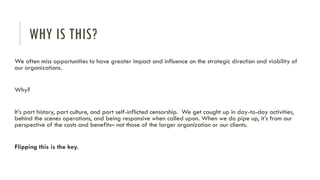
WHY IS THIS?
We often miss opportunities to have greater impact and influence on the strategic direction and viability of
our organizations.
Why?
It’s part history, part culture, and part self-inflicted censorship. We get caught up in day-to-day activities,
behind the scenes operations, and being responsive when called upon. When we do pipe up, it’s from our
perspective of the costs and benefits– not those of the larger organization or our clients.
Flipping this is the key.
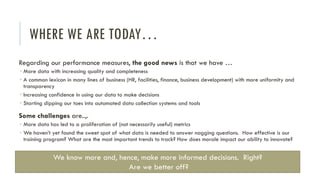
WHERE WE ARE TODAY…
Regarding our performance measures, the good news is that we have …
 More data with increasing quality and completeness
 A common lexicon in many lines of business (HR, facilities, finance, business development) with more uniformity and
transparency
 Increasing confidence in using our data to make decisions
 Starting dipping our toes into automated data collection systems and tools
Some challenges are..,.
 More data has led to a proliferation of (not necessarily useful) metrics
 We haven’t yet found the sweet spot of what data is needed to answer nagging questions. How effective is our
training program? What are the most important trends to track? How does morale impact our ability to innovate?
We know more and, hence, make more informed decisions. Right?
Are we better off?
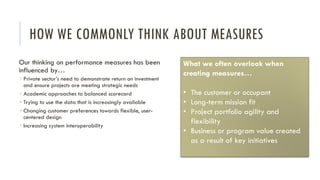
HOW WE COMMONLY THINK ABOUT MEASURES
Our thinking on performance measures has been
influenced by…
 Private sector’s need to demonstrate return on investment
and ensure projects are meeting strategic needs
 Academic approaches to balanced scorecard
 Trying to use the data that is increasingly available
 Changing customer preferences towards flexible, user-
centered design
 Increasing system interoperability
What we often overlook when
creating measures…
• The customer or occupant
• Long-term mission fit
• Project portfolio agility and
flexibility
• Business or program value created
as a result of key initiatives
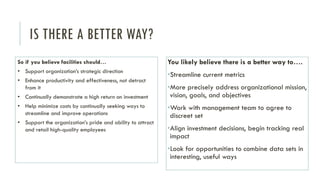
IS THERE A BETTER WAY?
You likely believe there is a better way to….
•Streamline current metrics
•More precisely address organizational mission,
vision, goals, and objectives
•Work with management team to agree to
discreet set
•Align investment decisions, begin tracking real
impact
•Look for opportunities to combine data sets in
interesting, useful ways
So if you believe facilities should…
• Support organization’s strategic direction
• Enhance productivity and effectiveness, not detract
from it
• Continually demonstrate a high return on investment
• Help minimize costs by continually seeking ways to
streamline and improve operations
• Support the organization’s pride and ability to attract
and retail high-quality employees
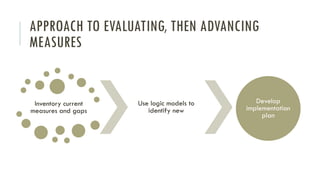
APPROACH TO EVALUATING, THEN ADVANCING
MEASURES
Inventory current
measures and gaps
Use logic models to
identify new
Develop
implementation
plan
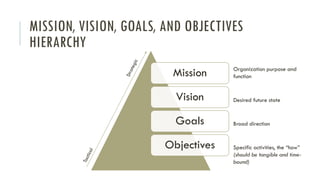
MISSION, VISION, GOALS, AND OBJECTIVES
HIERARCHY
Mission
Vision
Goals
Objectives
Organization purpose and
function
Desired future state
Specific activities, the “how”
(should be tangible and time-
bound)
Broad direction
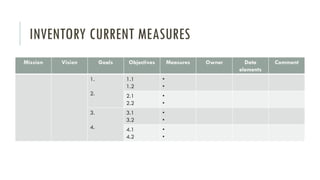
INVENTORY CURRENT MEASURES
Mission Vision Goals Objectives Measures Owner Data
elements
Comment
1.
2.
1.1
1.2
•
•
2.1
2.2
•
•
3.
4.
3.1
3.2
•
•
4.1
4.2
•
•
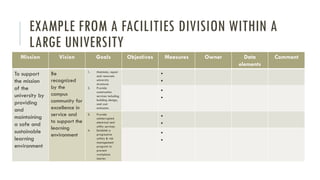
EXAMPLE FROM A FACILITIES DIVISION WITHIN A
LARGE UNIVERSITY
Mission Vision Goals Objectives Measures Owner Data
elements
Comment
To support
the mission
of the
university by
providing
and
maintaining
a safe and
sustainable
learning
environment
Be
recognized
by the
campus
community for
excellence in
service and
to support the
learning
environment
1. Maintain, repair
and renovate
university
structures
2. Provide
construction
services including
building design,
and cost
estimates
•
•
•
•
3. Provide
uninterrupted
electrical and
utility services
4. Establish a
progressive
safety & risk
management
program to
prevent
workplace
injuries
•
•
•
•
MAKING THE MOST OF THE MEASURES
INVENTORY EXERCISE (PREVIOUS SLIDE)
Populate the tracker with input from a variety of sources
Schedule time with key program leads to share the findings
Use spreadsheet with the filter function to ease sorting
Capture comments and caveats within the same spreadsheet
Note duplicate or overlapping measures
Flag similar measures that appear from multiple owners or sources, as this may
indicate some organizational priority or importance
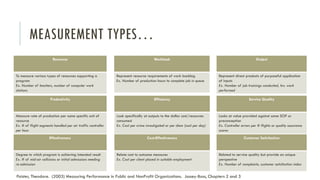
Resource
To measure various types of resources supporting a
program
Ex. Number of teachers, number of computer work
stations
Workload
Represent resource requirements of work backlog
Ex. Number of production hours to complete job in queue
Output
Represent direct products of purposeful application
of inputs
Ex. Number of job trainings conducted, hrs. work
performed
Productivity
Measure rate of production per some specific unit of
resource
Ex. # of flight segments handled per air traffic controller
per hour
Efficiency
Look specifically at outputs to the dollar cost/resources
consumed
Ex. Cost per crime investigated or per diem (cost per day)
Service Quality
Looks at value provided against some SOP or
preconception
Ex. Controller errors per # flights or quality assurance
scores
Effectiveness
Degree to which program is achieving intended result
Ex. # of mid-air collisions or initial admissions needing
re-admission
Cost-Effectiveness
Relate cost to outcome measures
Ex. Cost per client placed in suitable employment
Customer Satisfaction
Related to service quality but provide an unique
perspective
Ex. Number of complaints, customer satisfaction index
Poister, Theodore. (2003) Measuring Performance in Public and NonProfit Organizations. Jossey-Bass, Chapters 2 and 3
MEASUREMENT TYPES…
USE LOGIC MODELS
Logic models– based on organization’s mission, vision, goals, and objectives– will help you sort
through what’s good, what’s not worth the effort, and where the gaps might be
Why use logic models?
 Provide focus on objective outcome
 Help to identify data and process needed
 Communicate priorities and strategies
 Measure what is strategically important, rather than simply what is easily measured
 Establish accountability for program goals
Often we actually help organizations focus on measuring intermediate outcomes when end
outcomes are not directly achievable (because they’re so far out in time)
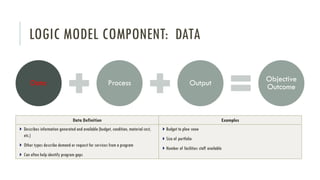
LOGIC MODEL COMPONENT: DATA
Data Process Output Objective
Outcome
Data Definition Examples
Describes information generated and available (budget, condition, material cost,
etc.)
Other types describe demand or request for services from a program
Can often help identify program gaps
Budget to plow snow
Size of portfolio
Number of facilities staff available
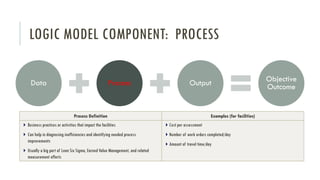
LOGIC MODEL COMPONENT: PROCESS
Data Process Output Objective
Outcome
Process Definition Examples (for facilities)
Business practices or activities that impact the facilities
Can help in diagnosing inefficiencies and identifying needed process
improvements
Usually a big part of Lean Six Sigma, Earned Value Management, and related
measurement efforts
Cost per assessment
Number of work orders completed/day
Amount of travel time/day
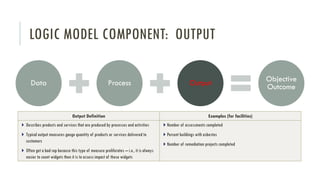
LOGIC MODEL COMPONENT: OUTPUT
Data Process Output Objective
Outcome
Output Definition Examples (for facilities)
Describes products and services that are produced by processes and activities
Typical output measures gauge quantity of products or services delivered to
customers
Often get a bad rap because this type of measure proliferates – i.e., it is always
easier to count widgets then it is to assess impact of those widgets
Number of assessments completed
Percent buildings with asbestos
Number of remediation projects completed
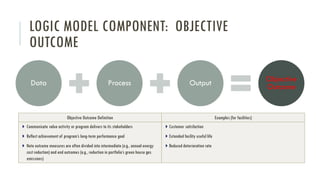
LOGIC MODEL COMPONENT: OBJECTIVE
OUTCOME
Data Process Output Objective
Outcome
Objective Outcome Definition Examples (for facilities)
Communicate value activity or program delivers to its stakeholders
Reflect achievement of program’s long-term performance goal
Note outcome measures are often divided into intermediate (e.g., annual energy
cost reduction) and end outcomes (e.g., reduction in portfolio’s green house gas
emissions)
Customer satisfaction
Extended facility useful life
Reduced deterioration rate
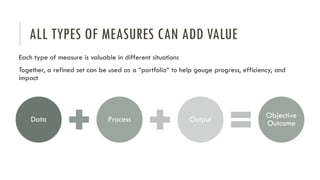
ALL TYPES OF MEASURES CAN ADD VALUE
Each type of measure is valuable in different situations
Together, a refined set can be used as a “portfolio” to help gauge progress, efficiency, and
impact
Data Process Output Objective
Outcome
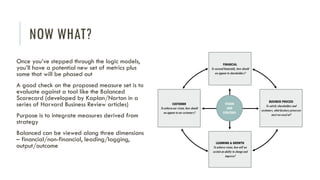
NOW WHAT?
Once you’ve stepped through the logic models,
you’ll have a potential new set of metrics plus
some that will be phased out
A good check on the proposed measure set is to
evaluate against a tool like the Balanced
Scorecard (developed by Kaplan/Norton in a
series of Harvard Business Review articles)
Purpose is to integrate measures derived from
strategy
Balanced can be viewed along three dimensions
– financial/non-financial, leading/lagging,
output/outcome
FINANCIAL
To succeedfinancially, how should
we appearto shareholders?
LEARNING & GROWTH
To achievevision, how will we
sustain an ability to changeand
improve?
CUSTOMER
To achieveour vision, how should
we appearto our customers?
BUSINESS PROCESS
To satisfy shareholdersand
customers, what business processes
must we excel at?
VISION
AND
STRATEGY
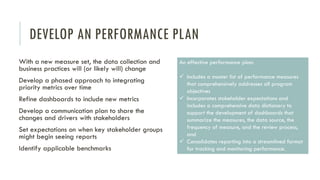
DEVELOP AN PERFORMANCE PLAN
With a new measure set, the data collection and
business practices will (or likely will) change
Develop a phased approach to integrating
priority metrics over time
Refine dashboards to include new metrics
Develop a communication plan to share the
changes and drivers with stakeholders
Set expectations on when key stakeholder groups
might begin seeing reports
Identify applicable benchmarks
An effective performance plan:
 Includes a master list of performance measures
that comprehensively addresses all program
objectives
 Incorporates stakeholder expectations and
includes a comprehensive data dictionary to
support the development of dashboards that
summarize the measures, the data source, the
frequency of measure, and the review process,
and
 Consolidates reporting into a streamlined format
for tracking and monitoring performance.
REFERENCES
Gary R. Bettger, Professor at University of Delaware course in Performance Management, Fall
2012
“Performance Measurement in Facility Management The Environment Management Maturity Model
BEM3,” by Thomas Madritsch and Matthias Ebinger, Journal of Economics, Business, and ICT, Volume
2, 2011
“The Best Practices in Facility Management: Creating an Environment of Operational Excellence,”
by Kit Tuveson, CFM, IFMA Fellow & Chris Hodges, P.E., CFM, LEED-AP, FRICS, IFMA Fellow
“Facility Executives Discuss Data Management, Performance Metrics, and Communication Strategies
That Can Help Strengthen Key Relationships,” by Ed Sullivan, Facilities Management, May 2005
“Key Performance Indicators for Federal Facilities Portfolios”, Cable Davis (2010), Federal
Facilities Council Technical Report #147, The National Academies Press, Washington, DC8
“Key Performance Indicators for Strategic Healthcare Facilities Maintenance”, Shoet (2006),
Journal of Construction Engineering and Management, Vol. 132, No. 4, pp. 345-352

Metrics Mapping

  • 1.
    METRICS MAPPING TheWhat, Why, and How to
  • 2.
  • 3.
    WHY IS THIS? Weoften miss opportunities to have greater impact and influence on the strategic direction and viability of our organizations. Why? It’s part history, part culture, and part self-inflicted censorship. We get caught up in day-to-day activities, behind the scenes operations, and being responsive when called upon. When we do pipe up, it’s from our perspective of the costs and benefits– not those of the larger organization or our clients. Flipping this is the key.
  • 4.
    WHERE WE ARETODAY… Regarding our performance measures, the good news is that we have …  More data with increasing quality and completeness  A common lexicon in many lines of business (HR, facilities, finance, business development) with more uniformity and transparency  Increasing confidence in using our data to make decisions  Starting dipping our toes into automated data collection systems and tools Some challenges are..,.  More data has led to a proliferation of (not necessarily useful) metrics  We haven’t yet found the sweet spot of what data is needed to answer nagging questions. How effective is our training program? What are the most important trends to track? How does morale impact our ability to innovate? We know more and, hence, make more informed decisions. Right? Are we better off?
  • 5.
    HOW WE COMMONLYTHINK ABOUT MEASURES Our thinking on performance measures has been influenced by…  Private sector’s need to demonstrate return on investment and ensure projects are meeting strategic needs  Academic approaches to balanced scorecard  Trying to use the data that is increasingly available  Changing customer preferences towards flexible, user- centered design  Increasing system interoperability What we often overlook when creating measures… • The customer or occupant • Long-term mission fit • Project portfolio agility and flexibility • Business or program value created as a result of key initiatives
  • 6.
    IS THERE ABETTER WAY? You likely believe there is a better way to…. •Streamline current metrics •More precisely address organizational mission, vision, goals, and objectives •Work with management team to agree to discreet set •Align investment decisions, begin tracking real impact •Look for opportunities to combine data sets in interesting, useful ways So if you believe facilities should… • Support organization’s strategic direction • Enhance productivity and effectiveness, not detract from it • Continually demonstrate a high return on investment • Help minimize costs by continually seeking ways to streamline and improve operations • Support the organization’s pride and ability to attract and retail high-quality employees
  • 7.
    APPROACH TO EVALUATING,THEN ADVANCING MEASURES Inventory current measures and gaps Use logic models to identify new Develop implementation plan
  • 8.
    MISSION, VISION, GOALS,AND OBJECTIVES HIERARCHY Mission Vision Goals Objectives Organization purpose and function Desired future state Specific activities, the “how” (should be tangible and time- bound) Broad direction
  • 9.
    INVENTORY CURRENT MEASURES MissionVision Goals Objectives Measures Owner Data elements Comment 1. 2. 1.1 1.2 • • 2.1 2.2 • • 3. 4. 3.1 3.2 • • 4.1 4.2 • •
  • 10.
    EXAMPLE FROM AFACILITIES DIVISION WITHIN A LARGE UNIVERSITY Mission Vision Goals Objectives Measures Owner Data elements Comment To support the mission of the university by providing and maintaining a safe and sustainable learning environment Be recognized by the campus community for excellence in service and to support the learning environment 1. Maintain, repair and renovate university structures 2. Provide construction services including building design, and cost estimates • • • • 3. Provide uninterrupted electrical and utility services 4. Establish a progressive safety & risk management program to prevent workplace injuries • • • •
  • 11.
    MAKING THE MOSTOF THE MEASURES INVENTORY EXERCISE (PREVIOUS SLIDE) Populate the tracker with input from a variety of sources Schedule time with key program leads to share the findings Use spreadsheet with the filter function to ease sorting Capture comments and caveats within the same spreadsheet Note duplicate or overlapping measures Flag similar measures that appear from multiple owners or sources, as this may indicate some organizational priority or importance
  • 12.
    Resource To measure varioustypes of resources supporting a program Ex. Number of teachers, number of computer work stations Workload Represent resource requirements of work backlog Ex. Number of production hours to complete job in queue Output Represent direct products of purposeful application of inputs Ex. Number of job trainings conducted, hrs. work performed Productivity Measure rate of production per some specific unit of resource Ex. # of flight segments handled per air traffic controller per hour Efficiency Look specifically at outputs to the dollar cost/resources consumed Ex. Cost per crime investigated or per diem (cost per day) Service Quality Looks at value provided against some SOP or preconception Ex. Controller errors per # flights or quality assurance scores Effectiveness Degree to which program is achieving intended result Ex. # of mid-air collisions or initial admissions needing re-admission Cost-Effectiveness Relate cost to outcome measures Ex. Cost per client placed in suitable employment Customer Satisfaction Related to service quality but provide an unique perspective Ex. Number of complaints, customer satisfaction index Poister, Theodore. (2003) Measuring Performance in Public and NonProfit Organizations. Jossey-Bass, Chapters 2 and 3 MEASUREMENT TYPES…
  • 13.
    USE LOGIC MODELS Logicmodels– based on organization’s mission, vision, goals, and objectives– will help you sort through what’s good, what’s not worth the effort, and where the gaps might be Why use logic models?  Provide focus on objective outcome  Help to identify data and process needed  Communicate priorities and strategies  Measure what is strategically important, rather than simply what is easily measured  Establish accountability for program goals Often we actually help organizations focus on measuring intermediate outcomes when end outcomes are not directly achievable (because they’re so far out in time)
  • 14.
    LOGIC MODEL COMPONENT:DATA Data Process Output Objective Outcome Data Definition Examples Describes information generated and available (budget, condition, material cost, etc.) Other types describe demand or request for services from a program Can often help identify program gaps Budget to plow snow Size of portfolio Number of facilities staff available
  • 15.
    LOGIC MODEL COMPONENT:PROCESS Data Process Output Objective Outcome Process Definition Examples (for facilities) Business practices or activities that impact the facilities Can help in diagnosing inefficiencies and identifying needed process improvements Usually a big part of Lean Six Sigma, Earned Value Management, and related measurement efforts Cost per assessment Number of work orders completed/day Amount of travel time/day
  • 16.
    LOGIC MODEL COMPONENT:OUTPUT Data Process Output Objective Outcome Output Definition Examples (for facilities) Describes products and services that are produced by processes and activities Typical output measures gauge quantity of products or services delivered to customers Often get a bad rap because this type of measure proliferates – i.e., it is always easier to count widgets then it is to assess impact of those widgets Number of assessments completed Percent buildings with asbestos Number of remediation projects completed
  • 17.
    LOGIC MODEL COMPONENT:OBJECTIVE OUTCOME Data Process Output Objective Outcome Objective Outcome Definition Examples (for facilities) Communicate value activity or program delivers to its stakeholders Reflect achievement of program’s long-term performance goal Note outcome measures are often divided into intermediate (e.g., annual energy cost reduction) and end outcomes (e.g., reduction in portfolio’s green house gas emissions) Customer satisfaction Extended facility useful life Reduced deterioration rate
  • 18.
    ALL TYPES OFMEASURES CAN ADD VALUE Each type of measure is valuable in different situations Together, a refined set can be used as a “portfolio” to help gauge progress, efficiency, and impact Data Process Output Objective Outcome
  • 19.
    NOW WHAT? Once you’vestepped through the logic models, you’ll have a potential new set of metrics plus some that will be phased out A good check on the proposed measure set is to evaluate against a tool like the Balanced Scorecard (developed by Kaplan/Norton in a series of Harvard Business Review articles) Purpose is to integrate measures derived from strategy Balanced can be viewed along three dimensions – financial/non-financial, leading/lagging, output/outcome FINANCIAL To succeedfinancially, how should we appearto shareholders? LEARNING & GROWTH To achievevision, how will we sustain an ability to changeand improve? CUSTOMER To achieveour vision, how should we appearto our customers? BUSINESS PROCESS To satisfy shareholdersand customers, what business processes must we excel at? VISION AND STRATEGY
  • 20.
    DEVELOP AN PERFORMANCEPLAN With a new measure set, the data collection and business practices will (or likely will) change Develop a phased approach to integrating priority metrics over time Refine dashboards to include new metrics Develop a communication plan to share the changes and drivers with stakeholders Set expectations on when key stakeholder groups might begin seeing reports Identify applicable benchmarks An effective performance plan:  Includes a master list of performance measures that comprehensively addresses all program objectives  Incorporates stakeholder expectations and includes a comprehensive data dictionary to support the development of dashboards that summarize the measures, the data source, the frequency of measure, and the review process, and  Consolidates reporting into a streamlined format for tracking and monitoring performance.
  • 21.
    REFERENCES Gary R. Bettger,Professor at University of Delaware course in Performance Management, Fall 2012 “Performance Measurement in Facility Management The Environment Management Maturity Model BEM3,” by Thomas Madritsch and Matthias Ebinger, Journal of Economics, Business, and ICT, Volume 2, 2011 “The Best Practices in Facility Management: Creating an Environment of Operational Excellence,” by Kit Tuveson, CFM, IFMA Fellow & Chris Hodges, P.E., CFM, LEED-AP, FRICS, IFMA Fellow “Facility Executives Discuss Data Management, Performance Metrics, and Communication Strategies That Can Help Strengthen Key Relationships,” by Ed Sullivan, Facilities Management, May 2005 “Key Performance Indicators for Federal Facilities Portfolios”, Cable Davis (2010), Federal Facilities Council Technical Report #147, The National Academies Press, Washington, DC8 “Key Performance Indicators for Strategic Healthcare Facilities Maintenance”, Shoet (2006), Journal of Construction Engineering and Management, Vol. 132, No. 4, pp. 345-352