Introduction to Balanced Scorecard
An internal strategic management tool
Introduction to Balanced Scorecard

• Developed by
   – Robert Kaplan (Harvard) and David Norton
   – early 90s
• Earlier measurements focused mainly on financial
  measures
• The balanced scorecard is a strategic management
  system (not only a measurement system)
   – Internal assessment, improvement and reporting system
   – Key is the link to the strategic plan
• System to turn strategy into action
• The balanced scorecard retains traditional
  financial measures. But financial measures tell the
  story of past events, an adequate story for
  industrial age companies for which investments in
  long-term capabilities and customer relationships
  were not critical for success. These financial
  measures are inadequate, however, for guiding
  and evaluating the journey that information age
  companies must make to create future value
  through investment in customers, suppliers,
  employees, processes, technology, and
  innovation.                       Kaplan & Norton
How does a Balanced Scorecard help?

•   Comprehensive view of the organization
     – Covers financial and non-financial perspectives
     – Covers short-term and long-term planning and measurement
•   Lag and lead indicators
•   Translating the vision
     – Forces managers to agree on metrics for operationalizing company vision
•   Communicating and linking
     – Connects individual and departmental performance measures to corporate vision
•   Business Planning
     – Integration of functions so that budgets support long term goals
•   Feedback and Learning
     – Helps course correction and rethink measures
Perspectives

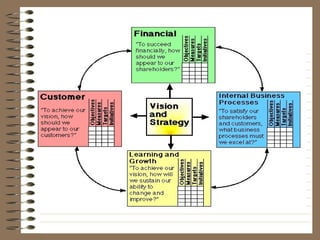
• The balanced scorecard suggests that we view the
  organization from four perspectives:
   –   The learning growth perspective
   –   The business process perspective
   –   The customer perspective
   –   The financial perspective
• Develop metrics, collect data and analyze relative
  to each of these perspectives
Learning and Growth Perspective
• Development of the human resources
  – This perspective supports the concept that people are
    a company's main resource and most valuable asset
  – metrics defined for this perspective must measure
    various aspects of employee improvement, growth,
    and satisfaction.
     • personnel training and improvement
     • cultivation of corporate culture
     • organizational development, including the nurturing of
       corporate experts, gurus, and mentors
     • setting up of fast and efficient knowledge transfer
       infrastructure
     • opening up of communication lines among personnel
Business Processes Perspective

• Internal business processes
  – These metrics, which measure various aspects
    (efficiency, speed, quality, etc.) of how well the
    company's products, services and internal
    support systems are produced or delivered
The Customer Perspective

• Focus on customer satisfaction.
  – Rigorous data analysis to understand the
    customer
  – Difficult to reflect the true sentiment of the
    customer
Financial Perspective

• Indicates if the transformation of strategy leads
  to economic success
• Define the financial performance that the
  strategy is to achieve
   – Revenue growth
   – Cost reduction
      • Cost reduction from energy efficiency
• Measures the effectiveness of the other
  perspectives
Characteristics of good metrics

• reflect the true present status of the company from many
  different perspectives
• provide constructive feedback to various company
  processes, leading to continuous improvement
• show trends in company performance over time,
  facilitating adjustments to changes
• quantify many things, making analyses more accurate and
  solutions more effective
Close the loop

• Once the metrics have been defined and
  implemented
      • scorecard data becomes available
      • follow-through becomes imperative
• Movements in the metrics must be analyzed to
  identify their causes
• Causes that produce positive (negative) changes
  must be sustained or enhanced (eliminated)

Intro to balanced scorecard

  • 1.
    Introduction to BalancedScorecard An internal strategic management tool
  • 2.
    Introduction to BalancedScorecard • Developed by – Robert Kaplan (Harvard) and David Norton – early 90s • Earlier measurements focused mainly on financial measures • The balanced scorecard is a strategic management system (not only a measurement system) – Internal assessment, improvement and reporting system – Key is the link to the strategic plan • System to turn strategy into action
  • 3.
    • The balancedscorecard retains traditional financial measures. But financial measures tell the story of past events, an adequate story for industrial age companies for which investments in long-term capabilities and customer relationships were not critical for success. These financial measures are inadequate, however, for guiding and evaluating the journey that information age companies must make to create future value through investment in customers, suppliers, employees, processes, technology, and innovation. Kaplan & Norton
  • 4.
    How does aBalanced Scorecard help? • Comprehensive view of the organization – Covers financial and non-financial perspectives – Covers short-term and long-term planning and measurement • Lag and lead indicators • Translating the vision – Forces managers to agree on metrics for operationalizing company vision • Communicating and linking – Connects individual and departmental performance measures to corporate vision • Business Planning – Integration of functions so that budgets support long term goals • Feedback and Learning – Helps course correction and rethink measures
  • 5.
    Perspectives • The balancedscorecard suggests that we view the organization from four perspectives: – The learning growth perspective – The business process perspective – The customer perspective – The financial perspective • Develop metrics, collect data and analyze relative to each of these perspectives
  • 7.
    Learning and GrowthPerspective • Development of the human resources – This perspective supports the concept that people are a company's main resource and most valuable asset – metrics defined for this perspective must measure various aspects of employee improvement, growth, and satisfaction. • personnel training and improvement • cultivation of corporate culture • organizational development, including the nurturing of corporate experts, gurus, and mentors • setting up of fast and efficient knowledge transfer infrastructure • opening up of communication lines among personnel
  • 8.
    Business Processes Perspective •Internal business processes – These metrics, which measure various aspects (efficiency, speed, quality, etc.) of how well the company's products, services and internal support systems are produced or delivered
  • 9.
    The Customer Perspective •Focus on customer satisfaction. – Rigorous data analysis to understand the customer – Difficult to reflect the true sentiment of the customer
  • 10.
    Financial Perspective • Indicatesif the transformation of strategy leads to economic success • Define the financial performance that the strategy is to achieve – Revenue growth – Cost reduction • Cost reduction from energy efficiency • Measures the effectiveness of the other perspectives
  • 11.
    Characteristics of goodmetrics • reflect the true present status of the company from many different perspectives • provide constructive feedback to various company processes, leading to continuous improvement • show trends in company performance over time, facilitating adjustments to changes • quantify many things, making analyses more accurate and solutions more effective
  • 12.
    Close the loop •Once the metrics have been defined and implemented • scorecard data becomes available • follow-through becomes imperative • Movements in the metrics must be analyzed to identify their causes • Causes that produce positive (negative) changes must be sustained or enhanced (eliminated)