For
Business Intelligence Managers
25/06/2014 J.Gretzitz 2
THE ORIGINS OF PERFORMANCE
MANAGEMENT
Performance Management originated as a broad
term coined by Dr. AUBREY DANIELS in the late
1970s to describe a technology (i.e. science
imbedded in applications methods) for managing
both BEHAVIORS and RESULTS, two critical
elements of what is known as performance
25/06/2014 J.Gretzitz 3
A formal definition of PERFORMANCE
MANAGEMENT, according to Daniels’s:
A scientifically based, data-oriented management
system that consists of three primary elements -
Measurement, Feedback and POSITIVE
REINFORCEMENT
DEFINITION
25/06/2014 J.Gretzitz 4
Performance Management (PM) - Includes activities
which ensure that goals are consistently being
met in an effective and efficient manner
Performance Management can focus on the
performance of an organization, a department,
employee, or even the processes to build a
product or service, as well as many other areas
Also known as a process by which organizations align
their resources, systems and employees to the
enterprise’s strategic objectives and priorities
Performance Management (PM) can be defined
as a set of management processes supported by
information technology (IT), that help to improve the
Management, Strategy execution and Decision
making in organizations
Performance management processes help companies
define STRATEGIC OBJECTIVES, measure
performance, analyse and report performance as
well as align people and culture
25/06/2014 J.Gretzitz 5
Performance Management is what organizations do
to become more successful and stay ahead of their
competitors.
In fact, managing performance is the most critical
task of any executive or manager
If performance management processes allow
organizations best to define and communicate their
strategies, measure, report and monitor progress in
order to manage and improve business performance
25/06/2014 J.Gretzitz 6
Towards better decisions making
Performance Management can also be defined as a
set of management processes, that help to improve
the strategic decisions people make every day
THE QUALITY OF THOSE DECISIONS THAT WILL
SEPARATE SUCCESSFUL COMPANIES FROM
THE REST
25/06/2014 J.Gretzitz 7
Performance Management is therefore a modern
term for a set of management approaches that
enable organizations to DEFINE and EXECUTE their
strategy, and to MEASURE and MONITOR
performance in order to inform strategic decision
making and learning
Towards better decision making
25/06/2014 J.Gretzitz 8
Towards better decision making
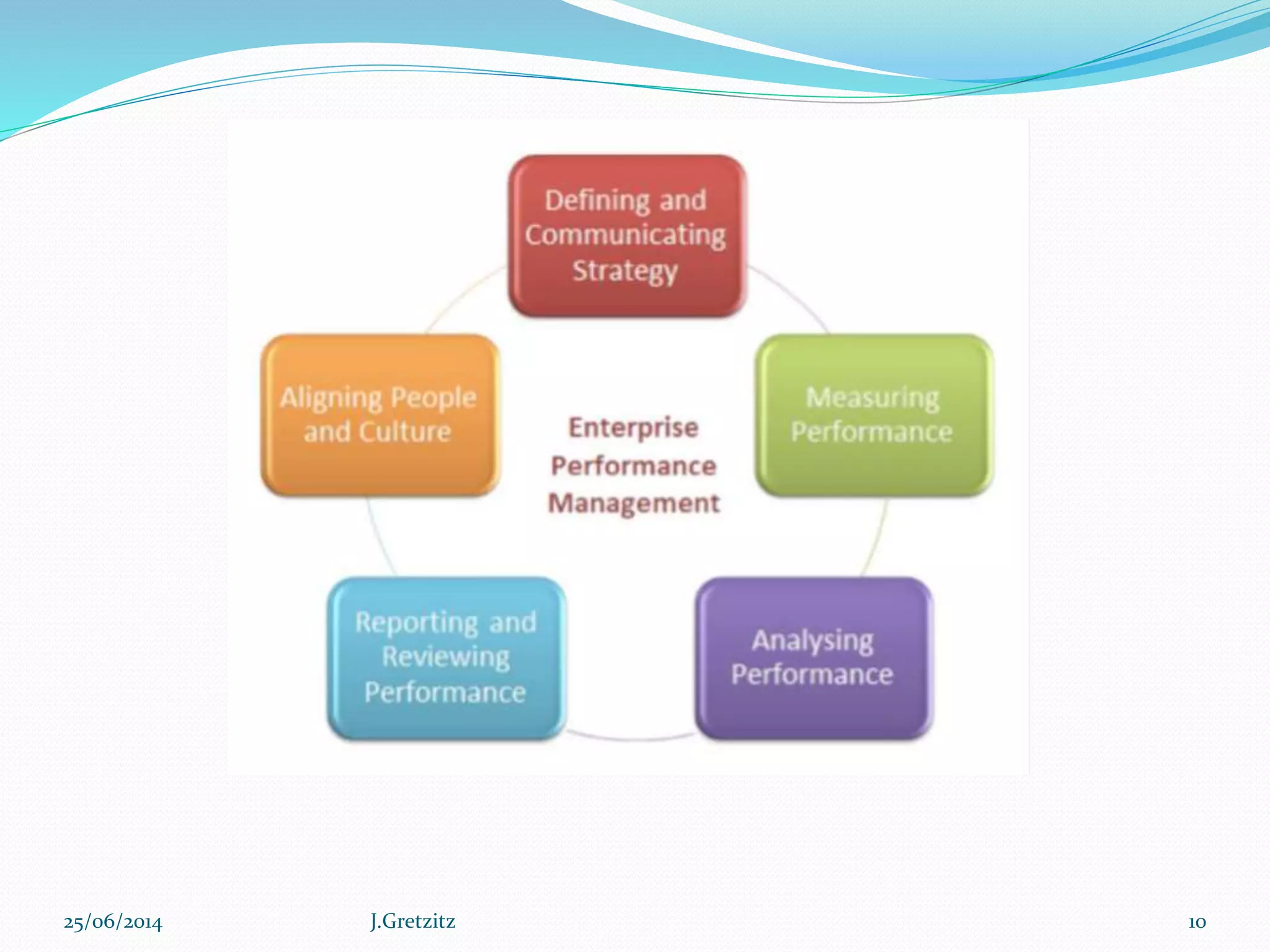
Basic performance management model
integrates processes for DEFINING strategic
objectives, MEASURING performance,
ANALYSING performance and REPORTING
and REVIEWING performance
ALIGNING PEOPLE AND CULTURE
All of these are focused on PERFORMANCE
IMPROVEMENT which is the CENTRAL
PREMISE of performance management
See Figure below:
25/06/2014 J.Gretzitz 9
25/06/2014 J.Gretzitz 10
Beyond People Management and
Performance Monitoring
The following processes and terms are often
associated with performance management:
STRATEGIC PLANNING, performance
measurement and monitoring, BUSINESS
INTELLIGENCE, analytics, people management,
reporting, financial planning & budgeting,
forecasting, data warehousing, risk management,
project & programme management, business
process optimisation, knowledge management,
dashboards, scorecards, metrics and key
performance indicators
25/06/2014 J.Gretzitz 11
25/06/2014 J.Gretzitz 12
Modern performance management
approaches bring together these key aspects
of management to form an INTEGRATED
APPROACH
25/06/2014 J.Gretzitz 13
Performance management was sometimes narrowly
associated with either People Management (e.g.
performance appraisals and dealing with
underperforming individuals) or Performance
Monitoring (e.g. collecting and reporting of
performance indicators) To avoid this confusion, new
terms such as EPM, CPM or SPM have been created
Beyond People Management and
Performance Monitoring
25/06/2014 J.Gretzitz 14
Integrated Performance Management
Organisations that are serious about managing
performance will move beyond the basic model
shown in the figure above and INTEGRATE IT WITH
OTHER KEY BUSINESS PROCESSES
See Figure below:
25/06/2014 J.Gretzitz 15
25/06/2014 J.Gretzitz 16
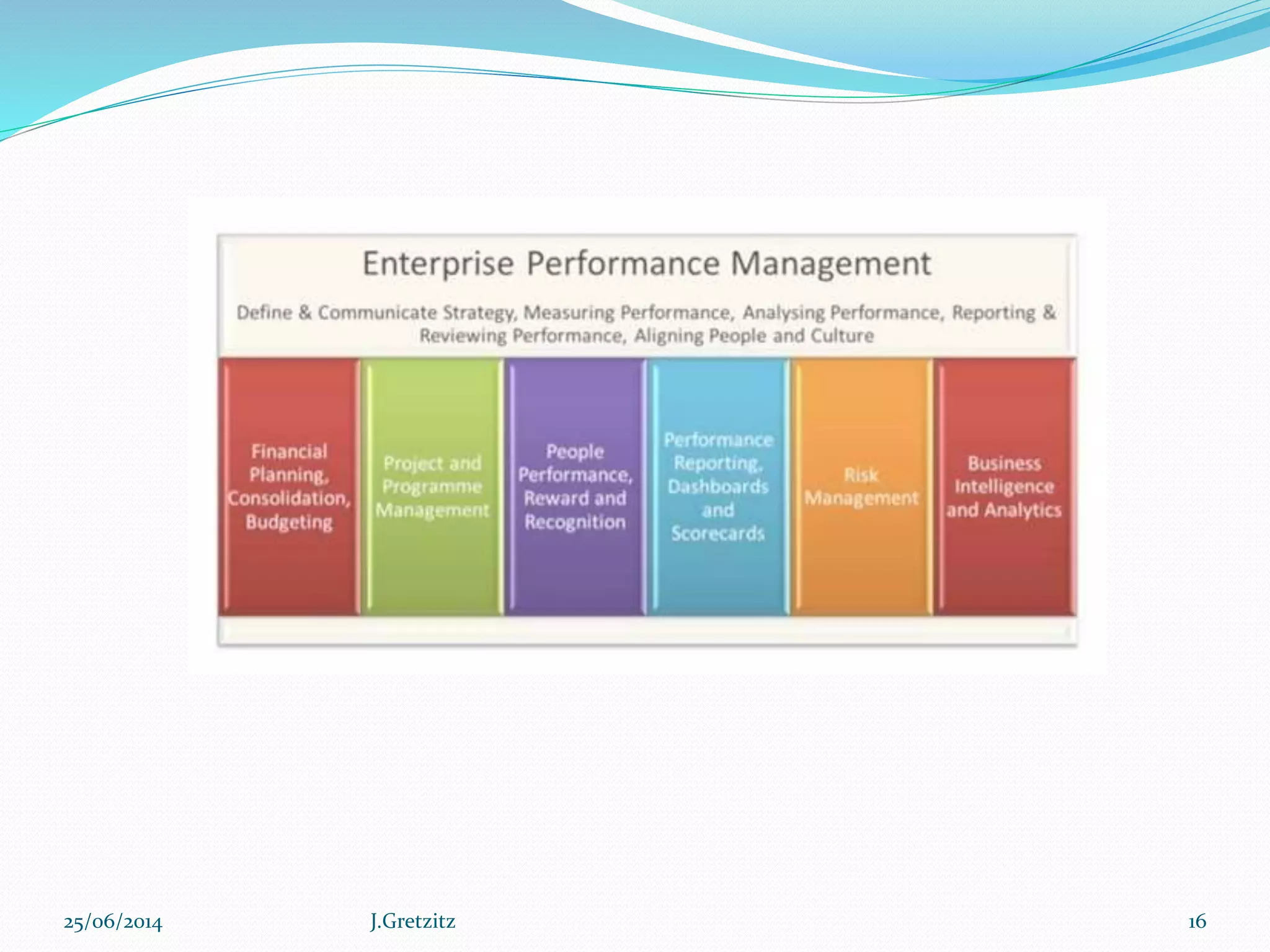
In order to gain maximum benefits from performance
management initiatives organisations need to ensure
they ALIGN AND INTEGRATE PROCESSES
including:
financial planning and budgeting, project and
programme management, people management and
rewards, performance reporting, risk management as
well as
BUSINESS INTELLIGENCE AND ANALYTICS
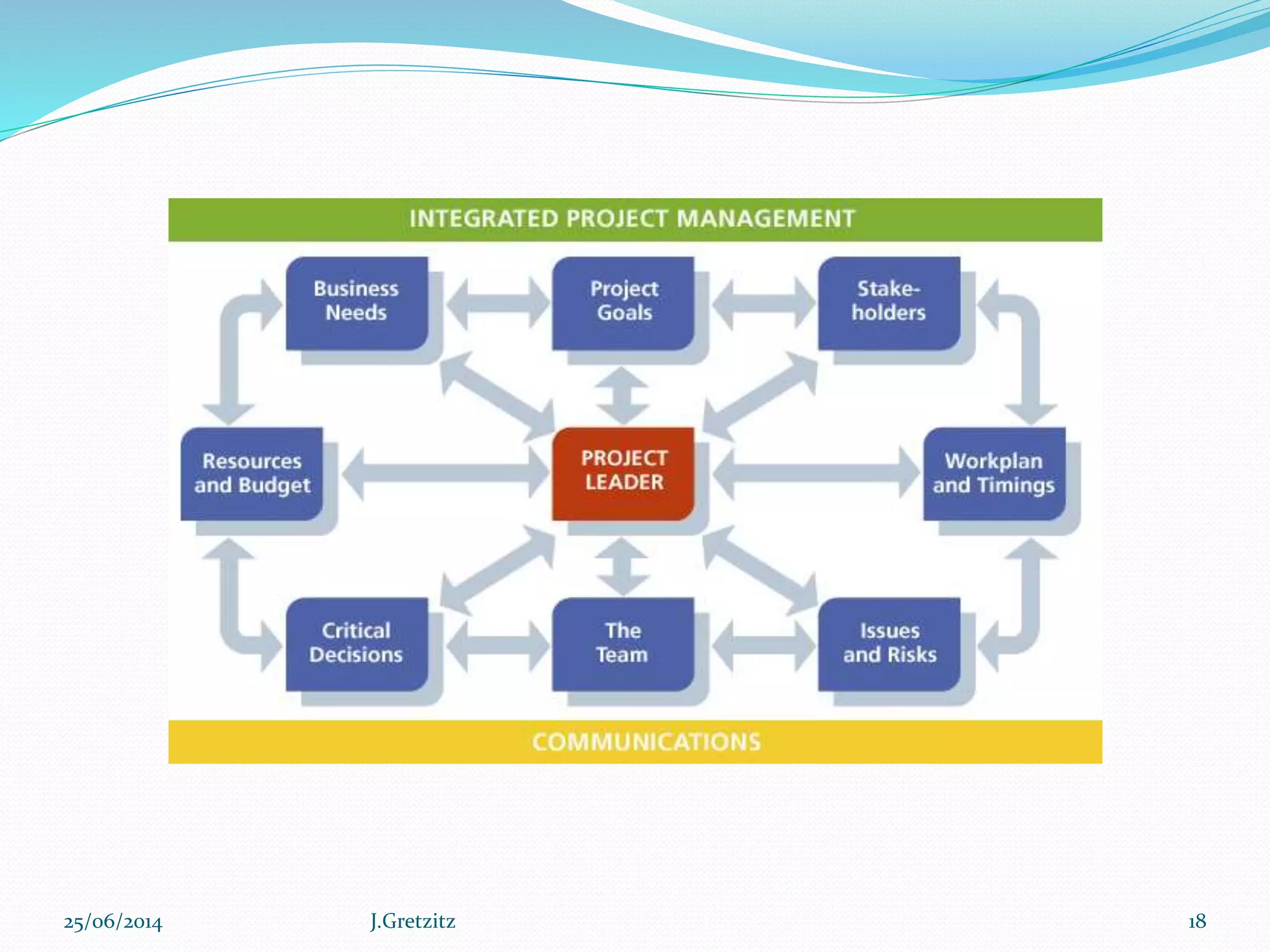
A INTEGRATED PROJECT MANAGEMENT, as
shown bellow:
Integrated Performance Management
25/06/2014 J.Gretzitz 17
25/06/2014 J.Gretzitz 18
Enterprise Performance Management
Basics
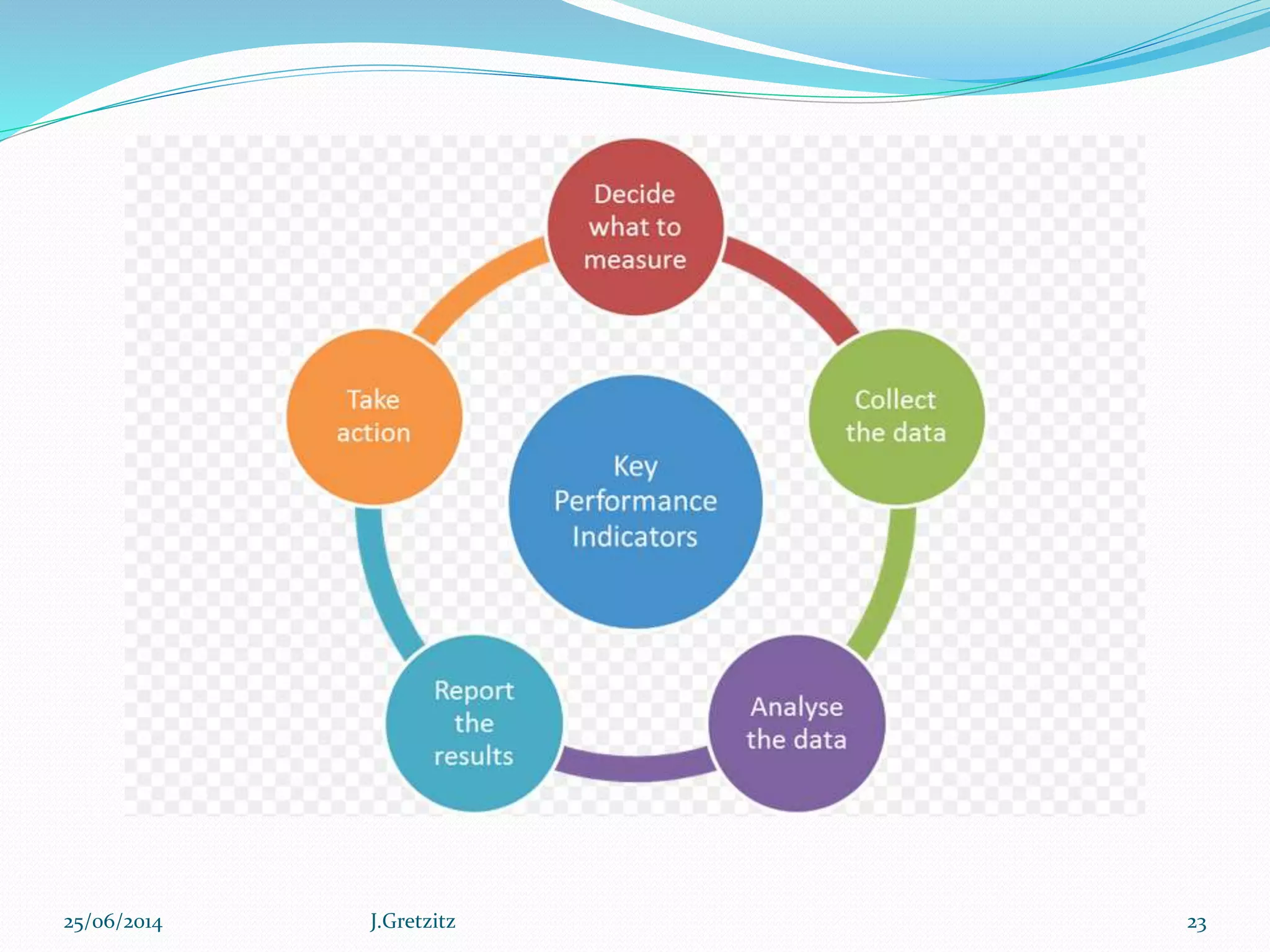
Using the basic strategic performance management
model, organisations start with defining their strategy,
then move on to measuring performance, then use
these indicators to analyse performance in order to
extract insights and make BETTER INFORMED
DECISIONS WHICH LEAD TO ACTIONS AND
PERFORMANCE IMPROVEMENTS
Let’s briefly look at each of the following steps:
25/06/2014 J.Gretzitz 19
Strategic Planning
This step involves creating a business model and
strategy (either corporately or for a business unit)
State of the art tools that are commonly used
here include Balanced Scorecard Strategy Maps
and value-driver mapping
Informed by strategic analyses organisations
identify what strategic objectives they plan to
accomplish and how they plan to accomplish
them
25/06/2014 J.Gretzitz 20
Performance Measurement and
Monitoring
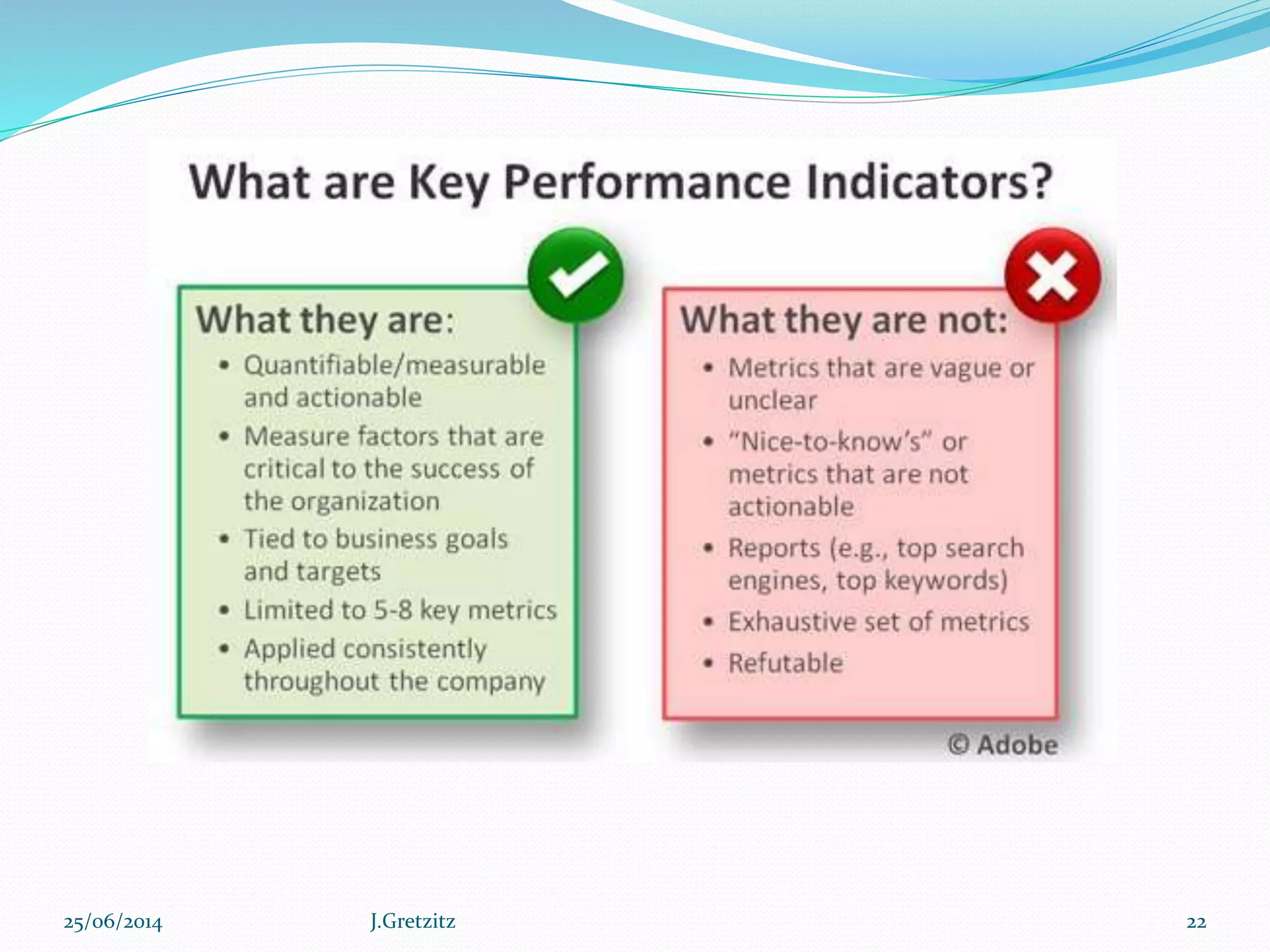
Here organisations design key performance
indicators (KPIs) to measure and monitor how well
they are delivering on their strategic objectives
Most important is to ensure that metrics are relevant
and meaningful
Many fall into the trap of measuring what is easy to
measure instead of what will provide the best
insights
25/06/2014 J.Gretzitz 21
25/06/2014 J.Gretzitz 22
25/06/2014 J.Gretzitz 23
Business Intelligence (BI), Analytics
and Modelling
In this step organisations use their performance
data and metrics to analyse performance
This step is all about creating a solid evidence-
base to inform decision making
Examples of analytics, BI and modelling
approaches include marketing and sales analytics,
customer analysis or click stream analysis
25/06/2014 J.Gretzitz 24
Reporting & Reviewing Performance
In this step organisations translate the insights
gained from their performance information into
management reports and dashboard and put the
review processes in place to act on the data
It is all about evidence-based decision making
facilitated by the performance review processes
Leading edge organisations put in place
performance improvement meetings to create a
dialogue about performance leading to JOINT
DECISION MAKING
25/06/2014 J.Gretzitz 25
Aligning People and Culture
In this final step organisations ensure the
people, culture and leadership approaches are
Focused on performance improvement
It is about creating the soft elements of a high
performance organisation to ensure the performance
management processes actually lead to improved
performance
This means organisations have to close the knowing-
doing gap and act on the insights
gained and decisions made in order to
generate real performance improvements
25/06/2014 J.Gretzitz 26
Integrated Enterprise Performance
Management
More advanced performance management
approaches integrate with other key
management processes
Here we briefly look at some of those processes
in turn and explore the need for alignment
25/06/2014 J.Gretzitz 27
Financial Planning, Consolidation &
Budgeting
By integrating your budgeting and financial
planning with your corporate objectives and
priorities you ensure that the financial resources
are spent on the things that actually matter the
most
Some of the leading organisations are now able to
update their budgets and forecasts on the fly,
based on a continuous inflow of both financial
and non-financial data
25/06/2014 J.Gretzitz 28
Project and Programme Management
Projects and programms needs to be aligned with
the corporate objectives and priorities in order to
ensure that efforts are focused on what matters the
most
The activities (projects and programms) need to be
prioritized based on strategic needs and therefore
have to be aligned with the strategic performance
framework of an organisation
25/06/2014 J.Gretzitz 29
People Performance, Rewards and
Recognition
For most organisations their people are their most
valuable and most expensive assets
In the end it is people who deliver the projects and
implement the strategic plans
By aligning budgets and projects with the strategic
performance framework you have made major steps
towards alignment
25/06/2014 J.Gretzitz 30
However, by further aligning reward and
recognition systems as well as personal
performance management processes to the
performance framework you can create a tight
integration between what matters the most and
what people perceive as important
ALIGNING REWARD AND RECOGNITION
SYSTEMS
25/06/2014 J.Gretzitz 31
Risk Management
The management of risk is too often narrowly
focused on just financial risks or the disaster risks
to buildings and infrastructure
While these are important, they are not enough The
performance framework has identified the key
drivers of future performance
25/06/2014 J.Gretzitz 32
25/06/2014 J.Gretzitz 33
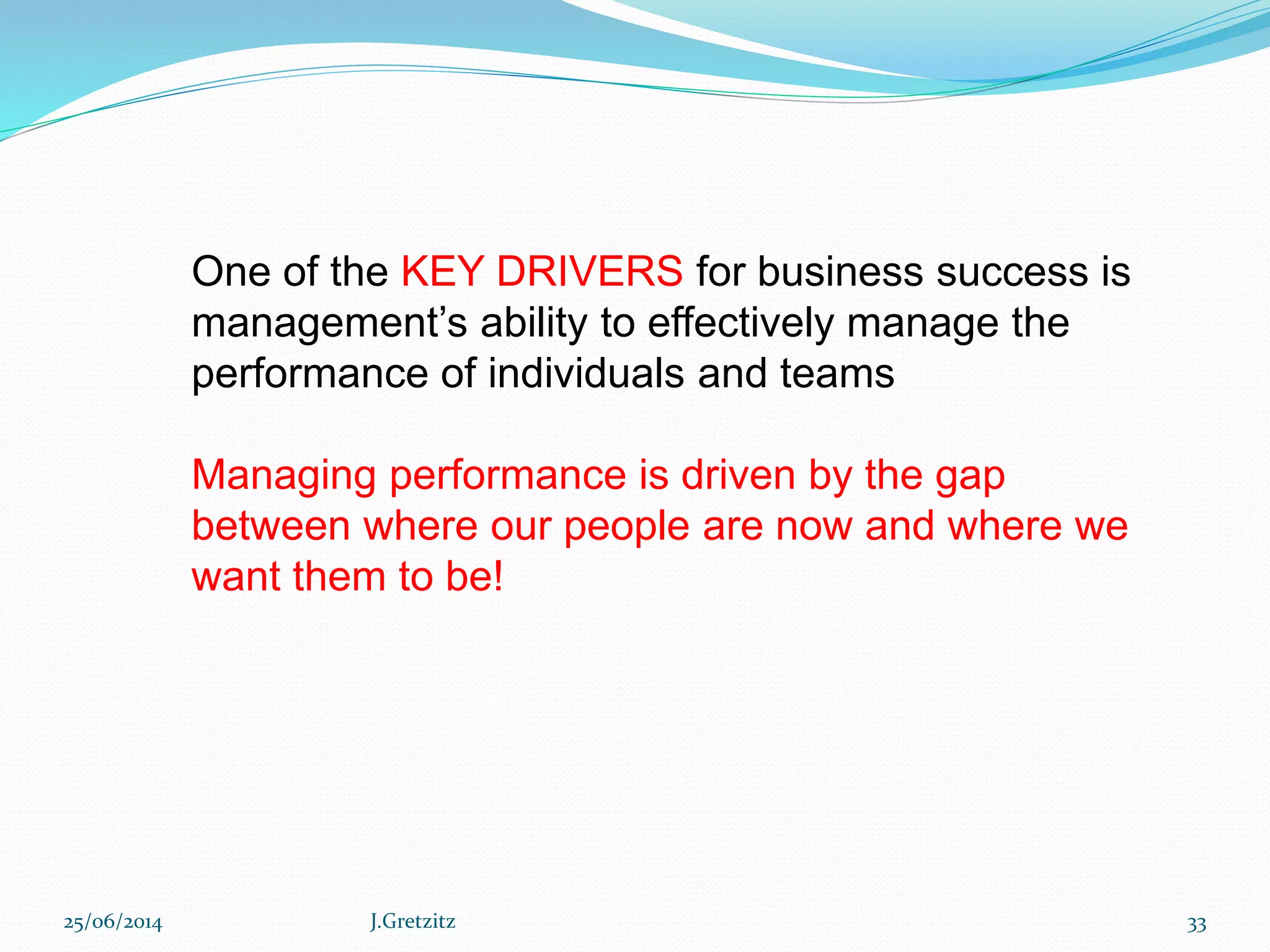
One of the KEY DRIVERS for business success is
management’s ability to effectively manage the
performance of individuals and teams
Managing performance is driven by the gap
between where our people are now and where we
want them to be!
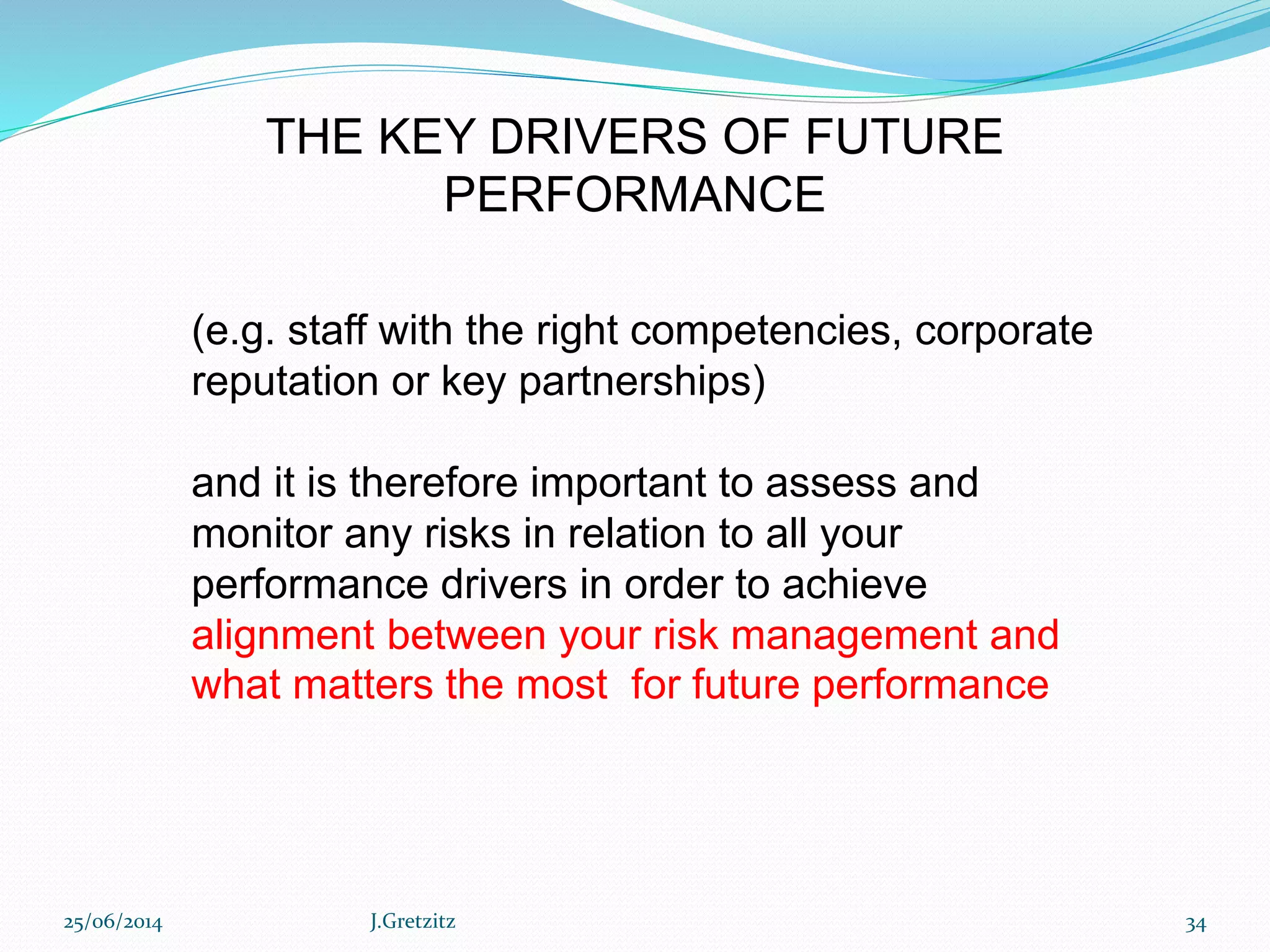
(e.g. staff with the right competencies, corporate
reputation or key partnerships)
and it is therefore important to assess and
monitor any risks in relation to all your
performance drivers in order to achieve
alignment between your risk management and
what matters the most for future performance
THE KEY DRIVERS OF FUTURE
PERFORMANCE
25/06/2014 J.Gretzitz 34
25/06/2014 J.Gretzitz 35
25/06/2014 J.Gretzitz 36
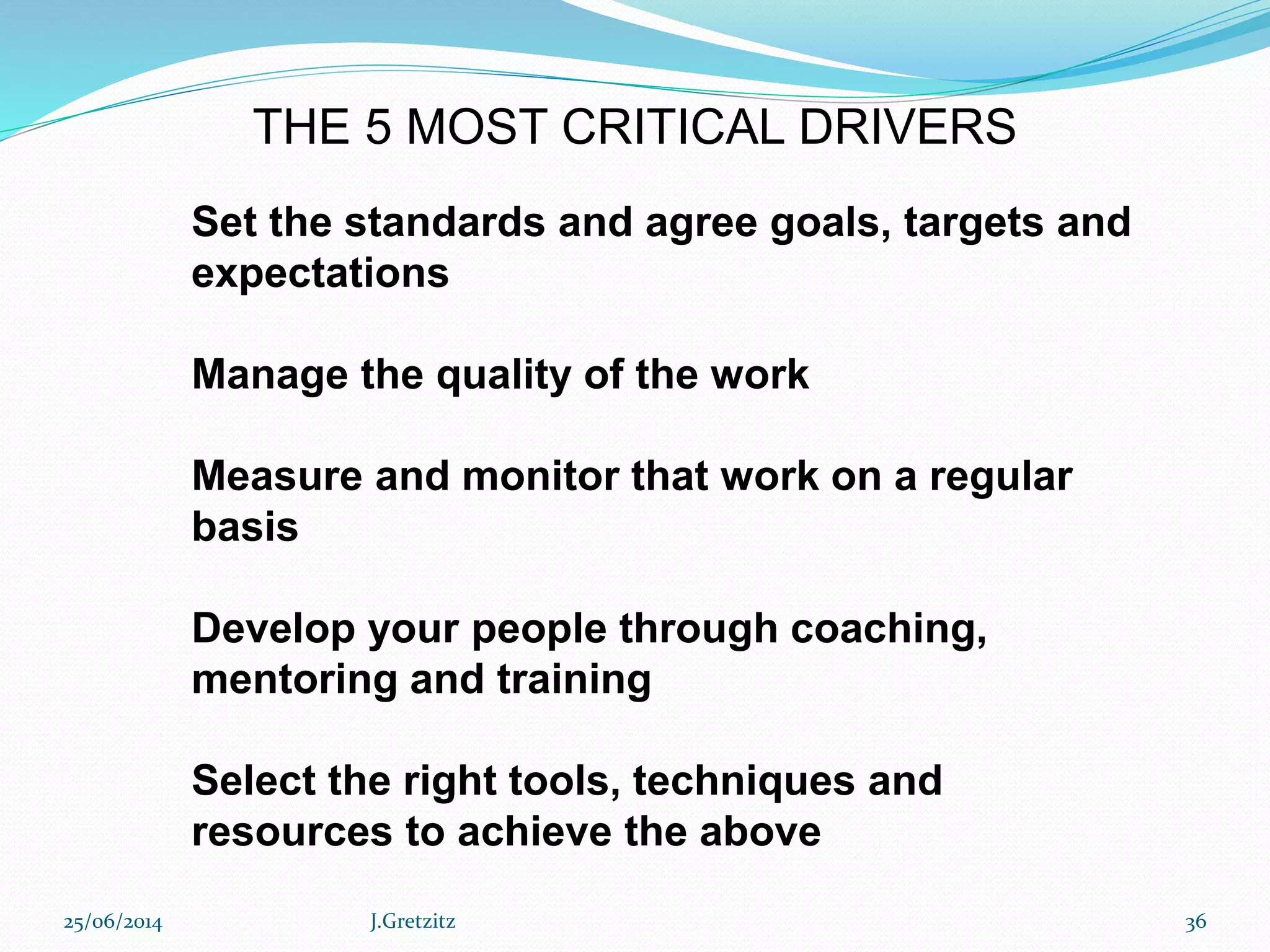
Set the standards and agree goals, targets and
expectations
Manage the quality of the work
Measure and monitor that work on a regular
basis
Develop your people through coaching,
mentoring and training
Select the right tools, techniques and
resources to achieve the above
THE 5 MOST CRITICAL DRIVERS
Performance Reporting, Dashboards and
Scorecards
Relevant performance information is not only crucial
for better decision making and performance
improvement, it is also a requirement for most
organisations to demonstrate to external
stakeholders and regulators that they have
delivered desired levels of performance and that
they have complied with rules and regulations
25/06/2014 J.Gretzitz 37
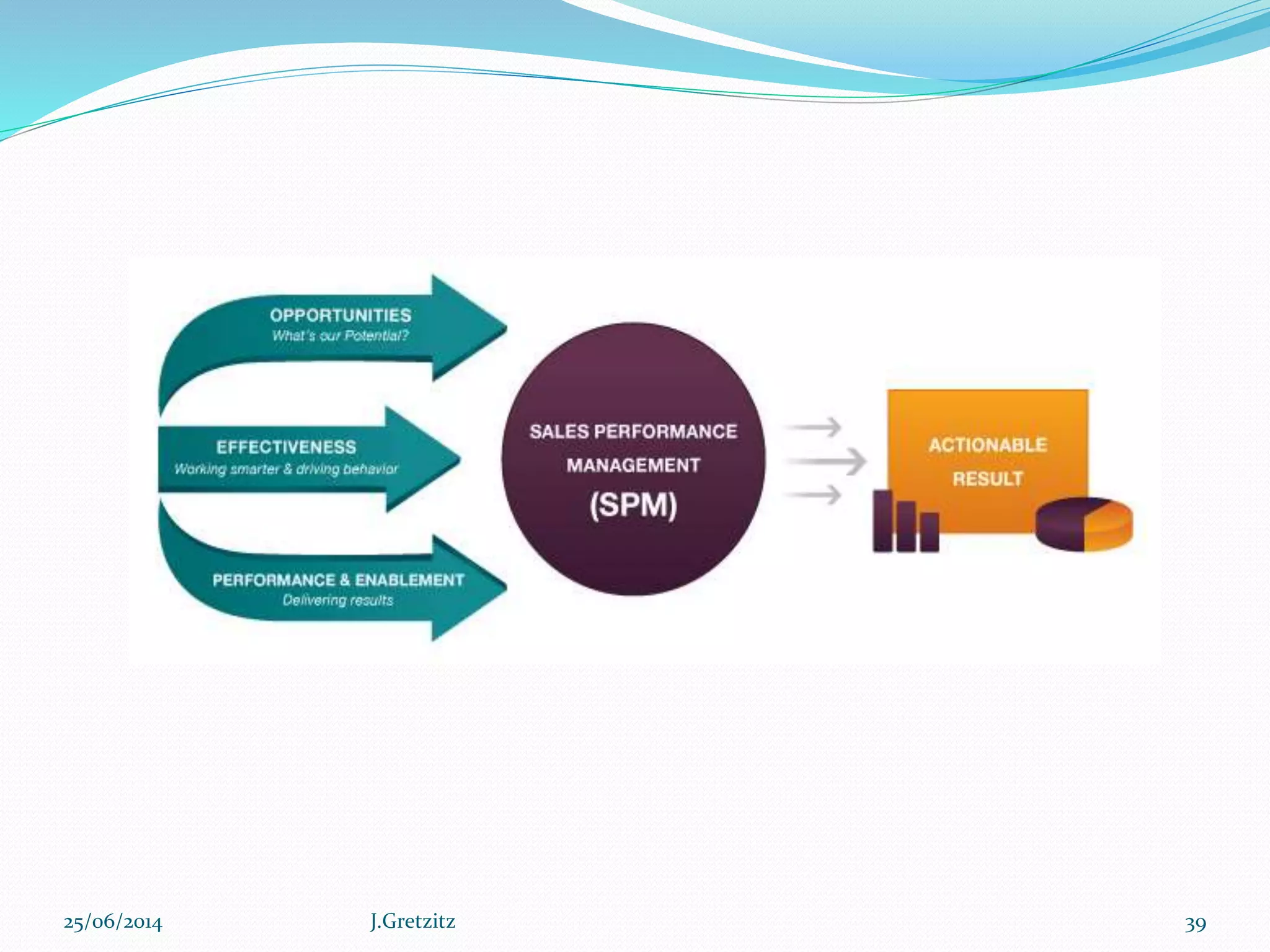
Sales Performance Management
INTEGRATED SPM SOLUTIONS
allow organisations to use any of their data
to produce and deliver reports, dashboards
and scorecards for their stakeholders –
internally or externally
25/06/2014 J.Gretzitz 38
25/06/2014 J.Gretzitz 39
Business Intelligence and full analytical
integration
By aligning and integrating the above processes with
the performance framework organisations create an
invaluable set of data which they can use, in an
integrated way, to inform decision making
For example, the information on value driver
analysis, customer relationship management,
financial forecasting, and risk logs can be used to
challenge, test and revise corporate strategies
25/06/2014 J.Gretzitz 40
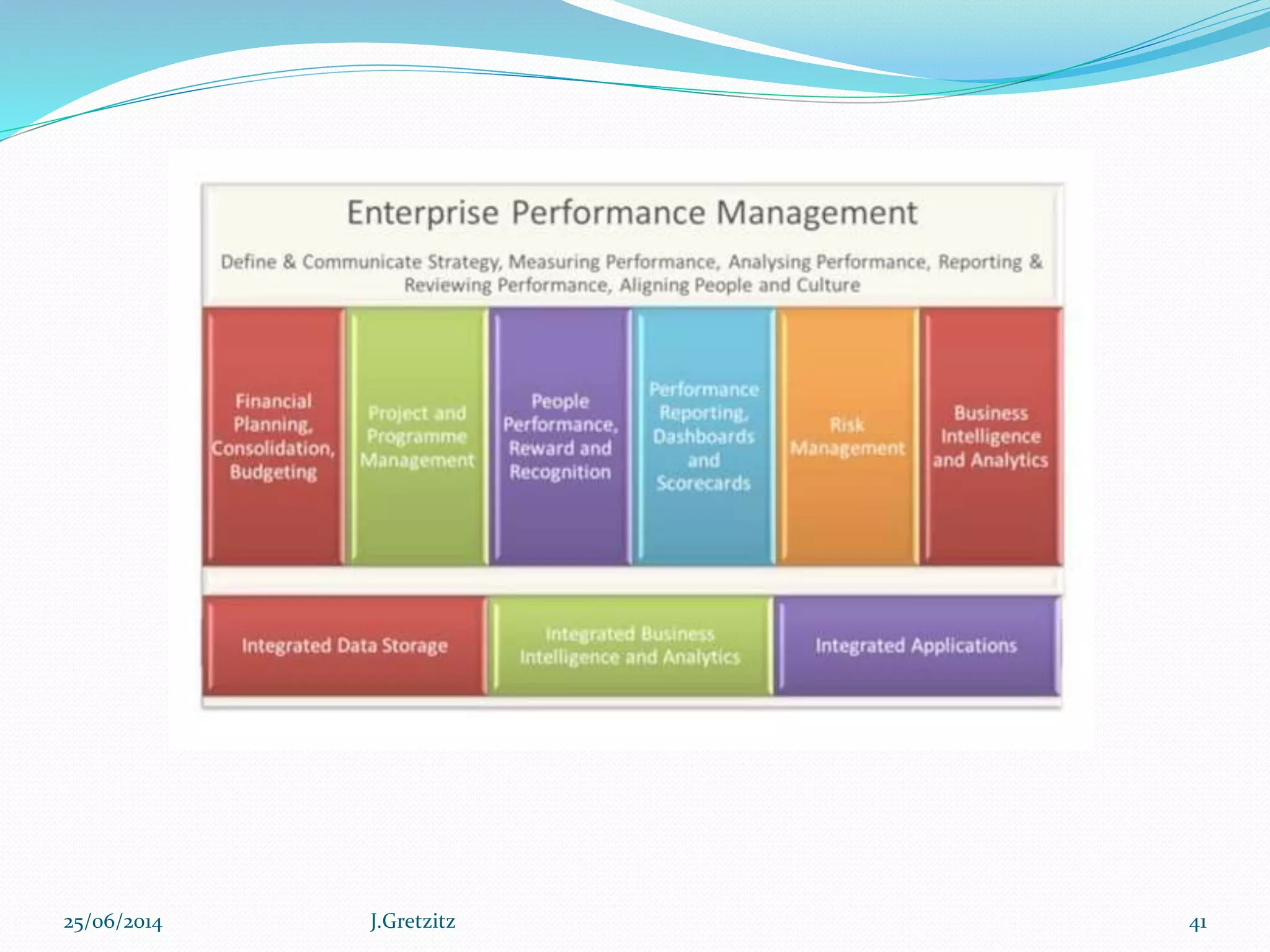
25/06/2014 J.Gretzitz 41
Performance Management Technology
The full level of integration between performance management and other key
management processes can only be achieved with the SUPPORT OF
TECHNOLOGY
Corporate Performance Management (CPM) or
Enterprise Performance Management (EPM) software suites
create a systematic and integrated approach that links corporate strategy to
core processes and activities
State-of-the-art software systems support strategic performance management
activities by (see Figure above):
a) bringing the data together into one single database
b) providing integrated analytics and business intelligence capabilities
c) integrating applications to create a tightly aligned and integrated approach
to corporate management
25/06/2014 J.Gretzitz 42
Bibliography
Key Performance Indicators (KPI): The 75 measures every
manager needs to know (Financial Times Series) - by Bernard
Marr (Jun 24, 2012)
The Intelligent Company: Five Steps to Success with Evidence-
Based Management - by Bernard Marr (Apr 5, 2010)
Strategic Performance Management - by Bernard Marr and Dina
Gray (Apr 20, 2006)
Source query:
The Advanced Performance Institute (API) at
http://www.ap-institute.com/Performance%20Management.html
25/06/2014 J.Gretzitz 43
25/06/2014 J.Gretzitz 44

Business Performance Management - Business Intelligence for Managers

  • 1.
  • 2.
    25/06/2014 J.Gretzitz 2 THEORIGINS OF PERFORMANCE MANAGEMENT Performance Management originated as a broad term coined by Dr. AUBREY DANIELS in the late 1970s to describe a technology (i.e. science imbedded in applications methods) for managing both BEHAVIORS and RESULTS, two critical elements of what is known as performance
  • 3.
    25/06/2014 J.Gretzitz 3 Aformal definition of PERFORMANCE MANAGEMENT, according to Daniels’s: A scientifically based, data-oriented management system that consists of three primary elements - Measurement, Feedback and POSITIVE REINFORCEMENT DEFINITION
  • 4.
    25/06/2014 J.Gretzitz 4 PerformanceManagement (PM) - Includes activities which ensure that goals are consistently being met in an effective and efficient manner Performance Management can focus on the performance of an organization, a department, employee, or even the processes to build a product or service, as well as many other areas Also known as a process by which organizations align their resources, systems and employees to the enterprise’s strategic objectives and priorities
  • 5.
    Performance Management (PM)can be defined as a set of management processes supported by information technology (IT), that help to improve the Management, Strategy execution and Decision making in organizations Performance management processes help companies define STRATEGIC OBJECTIVES, measure performance, analyse and report performance as well as align people and culture 25/06/2014 J.Gretzitz 5
  • 6.
    Performance Management iswhat organizations do to become more successful and stay ahead of their competitors. In fact, managing performance is the most critical task of any executive or manager If performance management processes allow organizations best to define and communicate their strategies, measure, report and monitor progress in order to manage and improve business performance 25/06/2014 J.Gretzitz 6
  • 7.
    Towards better decisionsmaking Performance Management can also be defined as a set of management processes, that help to improve the strategic decisions people make every day THE QUALITY OF THOSE DECISIONS THAT WILL SEPARATE SUCCESSFUL COMPANIES FROM THE REST 25/06/2014 J.Gretzitz 7
  • 8.
    Performance Management istherefore a modern term for a set of management approaches that enable organizations to DEFINE and EXECUTE their strategy, and to MEASURE and MONITOR performance in order to inform strategic decision making and learning Towards better decision making 25/06/2014 J.Gretzitz 8
  • 9.
    Towards better decisionmaking Basic performance management model integrates processes for DEFINING strategic objectives, MEASURING performance, ANALYSING performance and REPORTING and REVIEWING performance ALIGNING PEOPLE AND CULTURE All of these are focused on PERFORMANCE IMPROVEMENT which is the CENTRAL PREMISE of performance management See Figure below: 25/06/2014 J.Gretzitz 9
  • 10.
  • 11.
    Beyond People Managementand Performance Monitoring The following processes and terms are often associated with performance management: STRATEGIC PLANNING, performance measurement and monitoring, BUSINESS INTELLIGENCE, analytics, people management, reporting, financial planning & budgeting, forecasting, data warehousing, risk management, project & programme management, business process optimisation, knowledge management, dashboards, scorecards, metrics and key performance indicators 25/06/2014 J.Gretzitz 11
  • 12.
  • 13.
    Modern performance management approachesbring together these key aspects of management to form an INTEGRATED APPROACH 25/06/2014 J.Gretzitz 13
  • 14.
    Performance management wassometimes narrowly associated with either People Management (e.g. performance appraisals and dealing with underperforming individuals) or Performance Monitoring (e.g. collecting and reporting of performance indicators) To avoid this confusion, new terms such as EPM, CPM or SPM have been created Beyond People Management and Performance Monitoring 25/06/2014 J.Gretzitz 14
  • 15.
    Integrated Performance Management Organisationsthat are serious about managing performance will move beyond the basic model shown in the figure above and INTEGRATE IT WITH OTHER KEY BUSINESS PROCESSES See Figure below: 25/06/2014 J.Gretzitz 15
  • 16.
  • 17.
    In order togain maximum benefits from performance management initiatives organisations need to ensure they ALIGN AND INTEGRATE PROCESSES including: financial planning and budgeting, project and programme management, people management and rewards, performance reporting, risk management as well as BUSINESS INTELLIGENCE AND ANALYTICS A INTEGRATED PROJECT MANAGEMENT, as shown bellow: Integrated Performance Management 25/06/2014 J.Gretzitz 17
  • 18.
  • 19.
    Enterprise Performance Management Basics Usingthe basic strategic performance management model, organisations start with defining their strategy, then move on to measuring performance, then use these indicators to analyse performance in order to extract insights and make BETTER INFORMED DECISIONS WHICH LEAD TO ACTIONS AND PERFORMANCE IMPROVEMENTS Let’s briefly look at each of the following steps: 25/06/2014 J.Gretzitz 19
  • 20.
    Strategic Planning This stepinvolves creating a business model and strategy (either corporately or for a business unit) State of the art tools that are commonly used here include Balanced Scorecard Strategy Maps and value-driver mapping Informed by strategic analyses organisations identify what strategic objectives they plan to accomplish and how they plan to accomplish them 25/06/2014 J.Gretzitz 20
  • 21.
    Performance Measurement and Monitoring Hereorganisations design key performance indicators (KPIs) to measure and monitor how well they are delivering on their strategic objectives Most important is to ensure that metrics are relevant and meaningful Many fall into the trap of measuring what is easy to measure instead of what will provide the best insights 25/06/2014 J.Gretzitz 21
  • 22.
  • 23.
  • 24.
    Business Intelligence (BI),Analytics and Modelling In this step organisations use their performance data and metrics to analyse performance This step is all about creating a solid evidence- base to inform decision making Examples of analytics, BI and modelling approaches include marketing and sales analytics, customer analysis or click stream analysis 25/06/2014 J.Gretzitz 24
  • 25.
    Reporting & ReviewingPerformance In this step organisations translate the insights gained from their performance information into management reports and dashboard and put the review processes in place to act on the data It is all about evidence-based decision making facilitated by the performance review processes Leading edge organisations put in place performance improvement meetings to create a dialogue about performance leading to JOINT DECISION MAKING 25/06/2014 J.Gretzitz 25
  • 26.
    Aligning People andCulture In this final step organisations ensure the people, culture and leadership approaches are Focused on performance improvement It is about creating the soft elements of a high performance organisation to ensure the performance management processes actually lead to improved performance This means organisations have to close the knowing- doing gap and act on the insights gained and decisions made in order to generate real performance improvements 25/06/2014 J.Gretzitz 26
  • 27.
    Integrated Enterprise Performance Management Moreadvanced performance management approaches integrate with other key management processes Here we briefly look at some of those processes in turn and explore the need for alignment 25/06/2014 J.Gretzitz 27
  • 28.
    Financial Planning, Consolidation& Budgeting By integrating your budgeting and financial planning with your corporate objectives and priorities you ensure that the financial resources are spent on the things that actually matter the most Some of the leading organisations are now able to update their budgets and forecasts on the fly, based on a continuous inflow of both financial and non-financial data 25/06/2014 J.Gretzitz 28
  • 29.
    Project and ProgrammeManagement Projects and programms needs to be aligned with the corporate objectives and priorities in order to ensure that efforts are focused on what matters the most The activities (projects and programms) need to be prioritized based on strategic needs and therefore have to be aligned with the strategic performance framework of an organisation 25/06/2014 J.Gretzitz 29
  • 30.
    People Performance, Rewardsand Recognition For most organisations their people are their most valuable and most expensive assets In the end it is people who deliver the projects and implement the strategic plans By aligning budgets and projects with the strategic performance framework you have made major steps towards alignment 25/06/2014 J.Gretzitz 30
  • 31.
    However, by furtheraligning reward and recognition systems as well as personal performance management processes to the performance framework you can create a tight integration between what matters the most and what people perceive as important ALIGNING REWARD AND RECOGNITION SYSTEMS 25/06/2014 J.Gretzitz 31
  • 32.
    Risk Management The managementof risk is too often narrowly focused on just financial risks or the disaster risks to buildings and infrastructure While these are important, they are not enough The performance framework has identified the key drivers of future performance 25/06/2014 J.Gretzitz 32
  • 33.
    25/06/2014 J.Gretzitz 33 Oneof the KEY DRIVERS for business success is management’s ability to effectively manage the performance of individuals and teams Managing performance is driven by the gap between where our people are now and where we want them to be!
  • 34.
    (e.g. staff withthe right competencies, corporate reputation or key partnerships) and it is therefore important to assess and monitor any risks in relation to all your performance drivers in order to achieve alignment between your risk management and what matters the most for future performance THE KEY DRIVERS OF FUTURE PERFORMANCE 25/06/2014 J.Gretzitz 34
  • 35.
  • 36.
    25/06/2014 J.Gretzitz 36 Setthe standards and agree goals, targets and expectations Manage the quality of the work Measure and monitor that work on a regular basis Develop your people through coaching, mentoring and training Select the right tools, techniques and resources to achieve the above THE 5 MOST CRITICAL DRIVERS
  • 37.
    Performance Reporting, Dashboardsand Scorecards Relevant performance information is not only crucial for better decision making and performance improvement, it is also a requirement for most organisations to demonstrate to external stakeholders and regulators that they have delivered desired levels of performance and that they have complied with rules and regulations 25/06/2014 J.Gretzitz 37
  • 38.
    Sales Performance Management INTEGRATEDSPM SOLUTIONS allow organisations to use any of their data to produce and deliver reports, dashboards and scorecards for their stakeholders – internally or externally 25/06/2014 J.Gretzitz 38
  • 39.
  • 40.
    Business Intelligence andfull analytical integration By aligning and integrating the above processes with the performance framework organisations create an invaluable set of data which they can use, in an integrated way, to inform decision making For example, the information on value driver analysis, customer relationship management, financial forecasting, and risk logs can be used to challenge, test and revise corporate strategies 25/06/2014 J.Gretzitz 40
  • 41.
  • 42.
    Performance Management Technology Thefull level of integration between performance management and other key management processes can only be achieved with the SUPPORT OF TECHNOLOGY Corporate Performance Management (CPM) or Enterprise Performance Management (EPM) software suites create a systematic and integrated approach that links corporate strategy to core processes and activities State-of-the-art software systems support strategic performance management activities by (see Figure above): a) bringing the data together into one single database b) providing integrated analytics and business intelligence capabilities c) integrating applications to create a tightly aligned and integrated approach to corporate management 25/06/2014 J.Gretzitz 42
  • 43.
    Bibliography Key Performance Indicators(KPI): The 75 measures every manager needs to know (Financial Times Series) - by Bernard Marr (Jun 24, 2012) The Intelligent Company: Five Steps to Success with Evidence- Based Management - by Bernard Marr (Apr 5, 2010) Strategic Performance Management - by Bernard Marr and Dina Gray (Apr 20, 2006) Source query: The Advanced Performance Institute (API) at http://www.ap-institute.com/Performance%20Management.html 25/06/2014 J.Gretzitz 43
  • 44.