Measurement Standards
By
Prof N D Sadaphal
Assistant Professor
Sanjivani College of Engineering,
Kopargaon (Maharashtra State) 423601
Mechanical Engineering
7/17/2016
1
Mechanical
Engineering
COE, Kopargaon
Prof N D Sadaphal
Assistant Professor
Engineering Metrology and Quality Control
Measurement Standards
UNIT- I
METROLOGY
AND MEASUREMENTS
7/17/2016
2
Metrology.
Metrology defines as the Science of pure
measurement. But in engineering purposes,
it in restricted to measurements of length
and angles and other qualities which are
expressed in linear or angular terms.
Definition of Standards:
• A standard is defined as “something that is set up
and established by an authority as rule of the
measure of quantity, weight, extent, value or
quality”.
• Rule which is universally accepted.
7/17/2016
3
Line and End standard measurements
• Line standard
Length is expressed as the distance between two lines.
• End standard
Length is expressed as the distance between two flat
parallel faces
• Wavelength standard
Wavelength of monochromatic light is used to measure
length.
• Precision  Degree of repetitiveness. If an instrument
is not precise it will give different results for the same
dimension for the repeated readings.
• Accuracy  The maximum amount by which the result
differ from true value(ie) Closeness to true value
Terminology in Measurment
7/17/2016
4
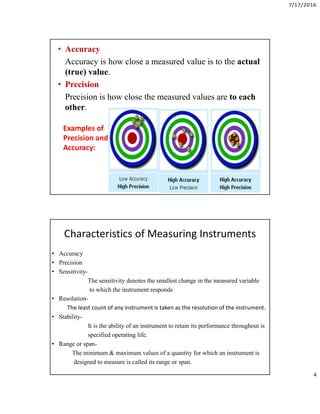
• Accuracy
Accuracy is how close a measured value is to the actual
(true) value.
• Precision
Precision is how close the measured values are to each
other.
Examples of
Precision and
Accuracy:
Characteristics of Measuring Instruments
• Accuracy
• Precision
• Sensitivity-
The sensitivity denotes the smallest change in the measured variable
to which the instrument responds
• Resolution-
The least count of any instrument is taken as the resolution of the instrument.
• Stability-
It is the ability of an instrument to retain its performance throughout is
specified operating life.
• Range or span-
The minimum & maximum values of a quantity for which an instrument is
designed to measure is called its range or span.
7/17/2016
5
Gauge R&R
Repeatability and Reproducibility in measurement systems
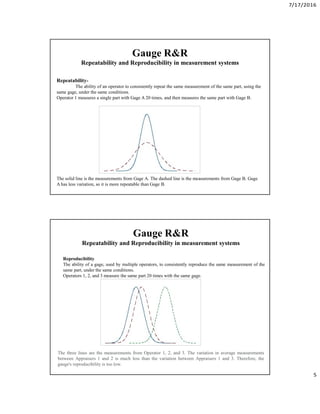
Repeatability-
The ability of an operator to consistently repeat the same measurement of the same part, using the
same gage, under the same conditions.
Operator 1 measures a single part with Gage A 20 times, and then measures the same part with Gage B.
The solid line is the measurements from Gage A. The dashed line is the measurements from Gage B. Gage
A has less variation, so it is more repeatable than Gage B.
Gauge R&R
Repeatability and Reproducibility in measurement systems
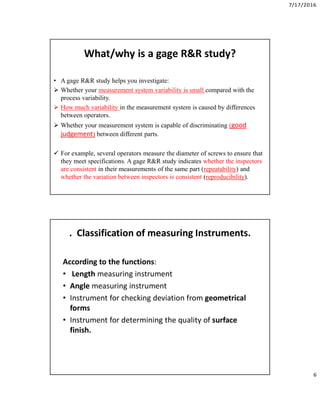
Reproducibility
The ability of a gage, used by multiple operators, to consistently reproduce the same measurement of the
same part, under the same conditions.
Operators 1, 2, and 3 measure the same part 20 times with the same gage.
The three lines are the measurements from Operator 1, 2, and 3. The variation in average measurements
between Appraisers 1 and 2 is much less than the variation between Appraisers 1 and 3. Therefore, the
gauge's reproducibility is too low.
7/17/2016
6
What/why is a gage R&R study?
• A gage R&R study helps you investigate:
 Whether your measurement system variability is small compared with the
process variability.
 How much variability in the measurement system is caused by differences
between operators.
 Whether your measurement system is capable of discriminating (good
judgement) between different parts.
 For example, several operators measure the diameter of screws to ensure that
they meet specifications. A gage R&R study indicates whether the inspectors
are consistent in their measurements of the same part (repeatability) and
whether the variation between inspectors is consistent (reproducibility).
. Classification of measuring Instruments.
According to the functions:
• Length measuring instrument
• Angle measuring instrument
• Instrument for checking deviation from geometrical
forms
• Instrument for determining the quality of surface
finish.
7/17/2016
7
Linear measuring instruments
• Straight edge (Steel rule)
• Outside caliper
• Inside caliper
• Vernier caliper
• Outside micrometer
• Inside micrometer
• Vernier height gauge
• Vernier depth gauge
• Dial gauges
Angular measurements
• Measuring the angle of Taper.
1. Bevel Protractor
2. Tool Makers microscope
3. Sine bar
4. Auto Collimator
5. Sine Centre
7/17/2016
8
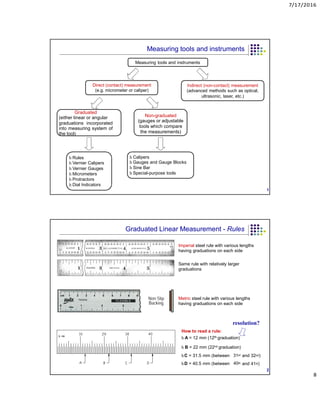
Measuring tools and instruments
Direct (contact) measurement
(e.g. micrometer or caliper)
Indirect (non-contact) measurement
(advanced methods such as optical,
ultrasonic, laser, etc.)
h Calipers
h Gauges and Gauge Blocks
h Sine Bar
h Special-purpose tools
h Rules
h Vernier Calipers
h Vernier Gauges
h Micrometers
h Protractors
h Dial Indicators
1
Measuring tools and instruments
Graduated
(either linear or angular
graduations incorporated
into measuring system of
the tool)
Non-graduated
(gauges or adjustable
tools which compare
the measurements)
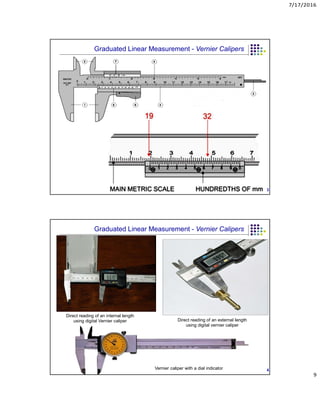
Imperial steel rule with various lengths
having graduations on each side
Same rule with relatively larger
graduations
Metric steel rule with various lengths
having graduations on each side
resolution?
How to read a rule:
h A = 12 mm (12th graduation)
h B = 22 mm (22nd graduation)
hC = 31.5 mm (between
hD = 40.5 mm (between
31st
40th
and 32nd)
and 41st)
2
Graduated Linear Measurement - Rules
7/17/2016
9
3
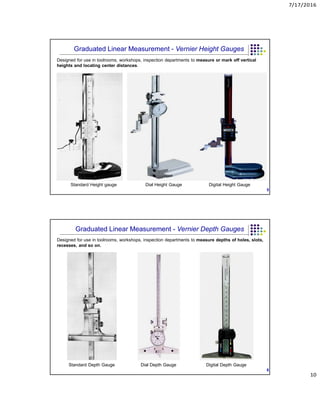
Graduated Linear Measurement - Vernier Calipers
Direct reading of an internal length
using digital Vernier caliper Direct reading of an external length
using digital vernier caliper
Vernier caliper with a dial indicator 4
Graduated Linear Measurement - Vernier Calipers
7/17/2016
10
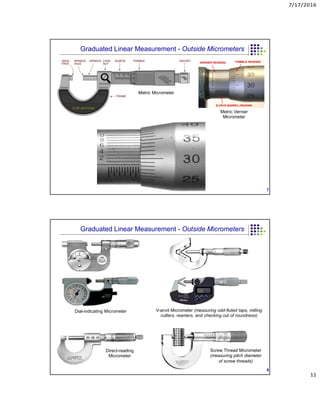
Designed for use in toolrooms, workshops, inspection departments to measure or mark off vertical
heights and locating center distances.
Standard Height gauge Dial Height Gauge Digital Height Gauge
5
Graduated Linear Measurement - Vernier Height Gauges
Designed for use in toolrooms, workshops, inspection departments to measure depths of holes, slots,
recesses, and so on.
Standard Depth Gauge Dial Depth Gauge Digital Depth Gauge
6
Graduated Linear Measurement - Vernier Depth Gauges
7/17/2016
11
THIMBLE READINGVERNIER READING
Metric Micrometer
SLEEVE (BARREL) READING
Metric Vernier
Micrometer
7
Graduated Linear Measurement - Outside Micrometers
V-anvil Micrometer (measuring odd-fluted taps, milling
cutters, reamers, and checking out of roundness)
Dial-indicating Micrometer
Screw Thread Micrometer
(measuring pitch diameter
of screw threads)
Direct-reading
Micrometer
8
Graduated Linear Measurement - Outside Micrometers
7/17/2016
12
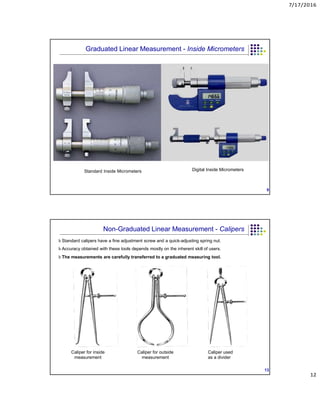
Standard Inside Micrometers Digital Inside Micrometers
9
Graduated Linear Measurement - Inside Micrometers
h Standard calipers have a fine adjustment screw and a quick-adjusting spring nut.
h Accuracy obtained with these tools depends mostly on the inherent skill of users.
h The measurements are carefully transferred to a graduated measuring tool.
Caliper for inside
measurement
Caliper for outside
measurement
Caliper used
as a divider
13
Non-Graduated Linear Measurement - Calipers
7/17/2016
13
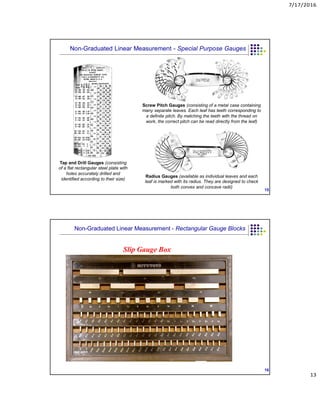
Screw Pitch Gauges (consisting of a metal case containing
many separate leaves. Each leaf has teeth corresponding to
a definite pitch. By matching the teeth with the thread on
work, the correct pitch can be read directly from the leaf)
Tap and Drill Gauges (consisting
of a flat rectangular steel plate with
holes accurately drilled and
identified according to their size)
Radius Gauges (available as individual leaves and each
leaf is marked with its radius. They are designed to check
both convex and concave radii)
15
Non-Graduated Linear Measurement - Special Purpose Gauges
16
Non-Graduated Linear Measurement - Rectangular Gauge Blocks
Slip Gauge Box
7/17/2016
14
(a)
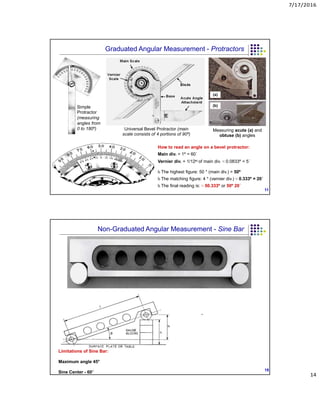
(b)Simple
Protractor
(measuring
angles from
0 to 180º) Universal Bevel Protractor (main
scale consists of 4 portions of 90º)
Measuring acute (a) and
obtuse (b) angles
How to read an angle on a bevel protractor:
Main div. = 1º = 60´
Vernier div. = 1/12th of main div. ≈ 0.0833º = 5´
h The highest figure: 50 * (main div.) = 50º
h The matching figure: 4 * (vernier div.) ≈ 0.333º = 20´
h The final reading is: ≈ 50.333º or 50º 20´
11
Graduated Angular Measurement - Protractors
*
Limitations of Sine Bar:
Maximum angle 45°
Sine Center - 60° 18
Non-Graduated Angular Measurement - Sine Bar
7/17/2016
15
Calibration
• Calibration is one of the primary processes used to maintain
instrument accuracy.
• Calibration is the process of configuring an instrument to provide a
result for a sample within an acceptable range.
• Measurement of Accuracy.
• Establishment the relation of an instrument’s accuracy to the
international standard.
Success of Calibration
• Consistency of results obtained
Need of Calibration
• Quality control & quality assurance in production.
• To meet requirement of ISO
• To comply with requirement of global market.
• To promote international recognition.
Benefits of Calibration
• Fulfils requirement of ISO 9000, ISO 14000.
• As a proof that the instrument is working properly.
• Confidence in using instrument.
• Reduce rejection, failure rate.
• Improved product & service quality leading to satisfied
customer.
• Cost saving, safety.
7/17/2016
16
Types and sources of ERRORS
Systematic Errors
• Systematic errors are regularly repetitive and can be
eliminated.
• They results from improper condition or procedure of
experiment .
• These error can be controlled & reduced if properly
analyze, so called as Controllable errors.
Errors may be of four kinds;
1. Instrumental : For example, a poorly calibrated
instrument such as a thermometer that reads 102° C
when immersed in boiling water and 2°C when
immersed in ice water at atmospheric pressure. Such a
thermometer would result in measured values that are
consistently too high.
2. Observational : For example, parallax in reading a
meter scale.
3. Environmental : Variation in atmospheric
condition i.e. temperature, pressure etc. at place of
measurement.
4. Stylus pressure :
Variation in Force applied by anvils of micrometer
on component to be measured results in different
reading.
7/17/2016
17
Random Errors
• Random errors in experimental measurements are caused by unknown
and unpredictable changes in the experiment. These changes may occur in
the measuring instruments or in the environmental conditions.
• Sources of random errors cannot always be identified. Possible sources of
random errors are small variations in the position of setting standards and
work piece, slight displacement of lever joints in the measuring joints in
the measuring instrument.
• Examples of causes of random errors are:
1. electronic noise in the circuit of an electrical instrument,
2. Irregular changes in the heat loss rate from a solar collector due to
changes in the wind.
• These error cannot be eliminated.
1. Observational : For example, errors in judgment of an observer when
reading the scale of a measuring device to the smallest division.
2. Environmental : For example, unpredictable fluctuations in line voltage,
temperature, or mechanical vibrations of equipment.
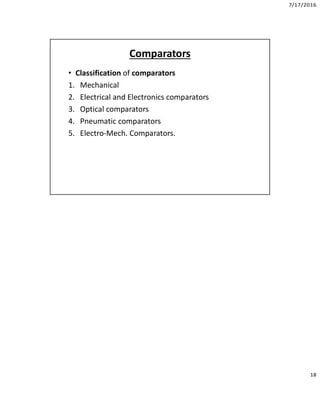
Parallax Error :
• Parallax is a displacement
or difference in the apparent
position of an object viewed
along two different lines of sight,
and is measured by the angle or
semi-angle of inclination
between those two lines.
7/17/2016
18
Comparators
• Classification of comparators
1. Mechanical
2. Electrical and Electronics comparators
3. Optical comparators
4. Pneumatic comparators
5. Electro-Mech. Comparators.

Measurement standards

  • 1.
    Measurement Standards By Prof ND Sadaphal Assistant Professor Sanjivani College of Engineering, Kopargaon (Maharashtra State) 423601 Mechanical Engineering
  • 2.
    7/17/2016 1 Mechanical Engineering COE, Kopargaon Prof ND Sadaphal Assistant Professor Engineering Metrology and Quality Control Measurement Standards UNIT- I METROLOGY AND MEASUREMENTS
  • 3.
    7/17/2016 2 Metrology. Metrology defines asthe Science of pure measurement. But in engineering purposes, it in restricted to measurements of length and angles and other qualities which are expressed in linear or angular terms. Definition of Standards: • A standard is defined as “something that is set up and established by an authority as rule of the measure of quantity, weight, extent, value or quality”. • Rule which is universally accepted.
  • 4.
    7/17/2016 3 Line and Endstandard measurements • Line standard Length is expressed as the distance between two lines. • End standard Length is expressed as the distance between two flat parallel faces • Wavelength standard Wavelength of monochromatic light is used to measure length. • Precision  Degree of repetitiveness. If an instrument is not precise it will give different results for the same dimension for the repeated readings. • Accuracy  The maximum amount by which the result differ from true value(ie) Closeness to true value Terminology in Measurment
  • 5.
    7/17/2016 4 • Accuracy Accuracy ishow close a measured value is to the actual (true) value. • Precision Precision is how close the measured values are to each other. Examples of Precision and Accuracy: Characteristics of Measuring Instruments • Accuracy • Precision • Sensitivity- The sensitivity denotes the smallest change in the measured variable to which the instrument responds • Resolution- The least count of any instrument is taken as the resolution of the instrument. • Stability- It is the ability of an instrument to retain its performance throughout is specified operating life. • Range or span- The minimum & maximum values of a quantity for which an instrument is designed to measure is called its range or span.
  • 6.
    7/17/2016 5 Gauge R&R Repeatability andReproducibility in measurement systems Repeatability- The ability of an operator to consistently repeat the same measurement of the same part, using the same gage, under the same conditions. Operator 1 measures a single part with Gage A 20 times, and then measures the same part with Gage B. The solid line is the measurements from Gage A. The dashed line is the measurements from Gage B. Gage A has less variation, so it is more repeatable than Gage B. Gauge R&R Repeatability and Reproducibility in measurement systems Reproducibility The ability of a gage, used by multiple operators, to consistently reproduce the same measurement of the same part, under the same conditions. Operators 1, 2, and 3 measure the same part 20 times with the same gage. The three lines are the measurements from Operator 1, 2, and 3. The variation in average measurements between Appraisers 1 and 2 is much less than the variation between Appraisers 1 and 3. Therefore, the gauge's reproducibility is too low.
  • 7.
    7/17/2016 6 What/why is agage R&R study? • A gage R&R study helps you investigate:  Whether your measurement system variability is small compared with the process variability.  How much variability in the measurement system is caused by differences between operators.  Whether your measurement system is capable of discriminating (good judgement) between different parts.  For example, several operators measure the diameter of screws to ensure that they meet specifications. A gage R&R study indicates whether the inspectors are consistent in their measurements of the same part (repeatability) and whether the variation between inspectors is consistent (reproducibility). . Classification of measuring Instruments. According to the functions: • Length measuring instrument • Angle measuring instrument • Instrument for checking deviation from geometrical forms • Instrument for determining the quality of surface finish.
  • 8.
    7/17/2016 7 Linear measuring instruments •Straight edge (Steel rule) • Outside caliper • Inside caliper • Vernier caliper • Outside micrometer • Inside micrometer • Vernier height gauge • Vernier depth gauge • Dial gauges Angular measurements • Measuring the angle of Taper. 1. Bevel Protractor 2. Tool Makers microscope 3. Sine bar 4. Auto Collimator 5. Sine Centre
  • 9.
    7/17/2016 8 Measuring tools andinstruments Direct (contact) measurement (e.g. micrometer or caliper) Indirect (non-contact) measurement (advanced methods such as optical, ultrasonic, laser, etc.) h Calipers h Gauges and Gauge Blocks h Sine Bar h Special-purpose tools h Rules h Vernier Calipers h Vernier Gauges h Micrometers h Protractors h Dial Indicators 1 Measuring tools and instruments Graduated (either linear or angular graduations incorporated into measuring system of the tool) Non-graduated (gauges or adjustable tools which compare the measurements) Imperial steel rule with various lengths having graduations on each side Same rule with relatively larger graduations Metric steel rule with various lengths having graduations on each side resolution? How to read a rule: h A = 12 mm (12th graduation) h B = 22 mm (22nd graduation) hC = 31.5 mm (between hD = 40.5 mm (between 31st 40th and 32nd) and 41st) 2 Graduated Linear Measurement - Rules
  • 10.
    7/17/2016 9 3 Graduated Linear Measurement- Vernier Calipers Direct reading of an internal length using digital Vernier caliper Direct reading of an external length using digital vernier caliper Vernier caliper with a dial indicator 4 Graduated Linear Measurement - Vernier Calipers
  • 11.
    7/17/2016 10 Designed for usein toolrooms, workshops, inspection departments to measure or mark off vertical heights and locating center distances. Standard Height gauge Dial Height Gauge Digital Height Gauge 5 Graduated Linear Measurement - Vernier Height Gauges Designed for use in toolrooms, workshops, inspection departments to measure depths of holes, slots, recesses, and so on. Standard Depth Gauge Dial Depth Gauge Digital Depth Gauge 6 Graduated Linear Measurement - Vernier Depth Gauges
  • 12.
    7/17/2016 11 THIMBLE READINGVERNIER READING MetricMicrometer SLEEVE (BARREL) READING Metric Vernier Micrometer 7 Graduated Linear Measurement - Outside Micrometers V-anvil Micrometer (measuring odd-fluted taps, milling cutters, reamers, and checking out of roundness) Dial-indicating Micrometer Screw Thread Micrometer (measuring pitch diameter of screw threads) Direct-reading Micrometer 8 Graduated Linear Measurement - Outside Micrometers
  • 13.
    7/17/2016 12 Standard Inside MicrometersDigital Inside Micrometers 9 Graduated Linear Measurement - Inside Micrometers h Standard calipers have a fine adjustment screw and a quick-adjusting spring nut. h Accuracy obtained with these tools depends mostly on the inherent skill of users. h The measurements are carefully transferred to a graduated measuring tool. Caliper for inside measurement Caliper for outside measurement Caliper used as a divider 13 Non-Graduated Linear Measurement - Calipers
  • 14.
    7/17/2016 13 Screw Pitch Gauges(consisting of a metal case containing many separate leaves. Each leaf has teeth corresponding to a definite pitch. By matching the teeth with the thread on work, the correct pitch can be read directly from the leaf) Tap and Drill Gauges (consisting of a flat rectangular steel plate with holes accurately drilled and identified according to their size) Radius Gauges (available as individual leaves and each leaf is marked with its radius. They are designed to check both convex and concave radii) 15 Non-Graduated Linear Measurement - Special Purpose Gauges 16 Non-Graduated Linear Measurement - Rectangular Gauge Blocks Slip Gauge Box
  • 15.
    7/17/2016 14 (a) (b)Simple Protractor (measuring angles from 0 to180º) Universal Bevel Protractor (main scale consists of 4 portions of 90º) Measuring acute (a) and obtuse (b) angles How to read an angle on a bevel protractor: Main div. = 1º = 60´ Vernier div. = 1/12th of main div. ≈ 0.0833º = 5´ h The highest figure: 50 * (main div.) = 50º h The matching figure: 4 * (vernier div.) ≈ 0.333º = 20´ h The final reading is: ≈ 50.333º or 50º 20´ 11 Graduated Angular Measurement - Protractors * Limitations of Sine Bar: Maximum angle 45° Sine Center - 60° 18 Non-Graduated Angular Measurement - Sine Bar
  • 16.
    7/17/2016 15 Calibration • Calibration isone of the primary processes used to maintain instrument accuracy. • Calibration is the process of configuring an instrument to provide a result for a sample within an acceptable range. • Measurement of Accuracy. • Establishment the relation of an instrument’s accuracy to the international standard. Success of Calibration • Consistency of results obtained Need of Calibration • Quality control & quality assurance in production. • To meet requirement of ISO • To comply with requirement of global market. • To promote international recognition. Benefits of Calibration • Fulfils requirement of ISO 9000, ISO 14000. • As a proof that the instrument is working properly. • Confidence in using instrument. • Reduce rejection, failure rate. • Improved product & service quality leading to satisfied customer. • Cost saving, safety.
  • 17.
    7/17/2016 16 Types and sourcesof ERRORS Systematic Errors • Systematic errors are regularly repetitive and can be eliminated. • They results from improper condition or procedure of experiment . • These error can be controlled & reduced if properly analyze, so called as Controllable errors. Errors may be of four kinds; 1. Instrumental : For example, a poorly calibrated instrument such as a thermometer that reads 102° C when immersed in boiling water and 2°C when immersed in ice water at atmospheric pressure. Such a thermometer would result in measured values that are consistently too high. 2. Observational : For example, parallax in reading a meter scale. 3. Environmental : Variation in atmospheric condition i.e. temperature, pressure etc. at place of measurement. 4. Stylus pressure : Variation in Force applied by anvils of micrometer on component to be measured results in different reading.
  • 18.
    7/17/2016 17 Random Errors • Randomerrors in experimental measurements are caused by unknown and unpredictable changes in the experiment. These changes may occur in the measuring instruments or in the environmental conditions. • Sources of random errors cannot always be identified. Possible sources of random errors are small variations in the position of setting standards and work piece, slight displacement of lever joints in the measuring joints in the measuring instrument. • Examples of causes of random errors are: 1. electronic noise in the circuit of an electrical instrument, 2. Irregular changes in the heat loss rate from a solar collector due to changes in the wind. • These error cannot be eliminated. 1. Observational : For example, errors in judgment of an observer when reading the scale of a measuring device to the smallest division. 2. Environmental : For example, unpredictable fluctuations in line voltage, temperature, or mechanical vibrations of equipment. Parallax Error : • Parallax is a displacement or difference in the apparent position of an object viewed along two different lines of sight, and is measured by the angle or semi-angle of inclination between those two lines.
  • 19.
    7/17/2016 18 Comparators • Classification ofcomparators 1. Mechanical 2. Electrical and Electronics comparators 3. Optical comparators 4. Pneumatic comparators 5. Electro-Mech. Comparators.