BROUGHT TO YOU BY:
866.855.6733
STRATEGIC PERFORMANCE MEASUREMENT:
4 STEPS TO BUILDING AN EFFECTIVE
PERFORMANCE MEASUREMENT PLAN
Donna Chrobak
Vice President QuintLoyalty
“Companies
can increase
performance
levels across
the entire
organization
in ways that
positively
impact
results.”
STRATEGIC PERFORMANCE MEASUREMENT:
4 STEPS TO BUILDING AN EFFECTIVE
PERFORMANCE MEASUREMENT PLAN
In
today’s changing business environment,
and the often volatile economic climate businesses
are facing, many organizations are searching for new
and innovative ways to improve the performance results of their
organization and gain a competitive advantage in the marketplace.
One of the biggest challenges many organizations face in achieving
these objectives, however, is that they are not always clear in their
strategic direction. While most organization invest significant amounts
of time and money in the development of strategic plans that outline
their ambitions, more often than not, these documents are left on
bookshelves to gather dust rather than being used by employees as
guides for daily decision making (Pershing, 2006).
The purpose of this paper is to discuss how organizations can
positively impact their financial results and gain a competitive
advantage by implementing a strategic performance measurement
plan that aligns their employee’s performance across all functional
areas of the organization with its strategic goals and objectives. By
investing in, what is quickly being realized as an organizations most
important asset, it’s employees, companies can increase performance
levels across the entire organization in ways that positively impact
bottom line results and, at the same time, build a competitive
advantage that will be difficult for competitors to duplicate.
THE GOAL OF PERFORMANCE MEASUREMENT
Performance measurement is primarily about managing results.
The goal is to give employees the tools to make sound business
decisions and to help them understand how these decisions impact
the organization’s ability to achieve its strategic goals and objectives.
Research shows that, when employees understand the impact their
work has on the organization as a whole, they feel more invested in
the company and tend to make better business decisions. And when
they know that their improved performance is being recognized, they
become more engaged because they feel more personal accountability
towards the success of the organization.
2
“Following
these steps
will ensure
that your plan
is built on a
solid design
structure. ”
THE KEY TO AN EFFECTIVE PERFORMANCE MEASUREMENT PLAN
You must understand what measureable behaviors impact your
organization’s ability to achieve its strategic and tactical goals and
objectives, and then design a plan that measures, analyzes, and
provides feedback on the data, and is flexible enough to be adjusted
when necessary. A recent study by the Pew Research Center (Morin,
2014) found that bosses are happier than their employees. You might
think that’s a no brainer since bosses typically make more money,
but the study also showed that other intangible measurements like
more autonomy, more authority to make decisions, and a better
understanding of the big picture and how their job impacts the
organization contributes significantly towards their happiness. So
why wouldn’t we want to incorporate these intangibles throughout the
organization?
CREATING A PERFORMANCE MEASUREMENT PLAN
How then do you go about creating a performance measurement
strategy that drives organizational objectives, builds a culture of
collaboration and engagement, gives employees the tools they
need to make good business decisions, and positively impacts your
organization’s financial performance? Outlined here are 4 basic
steps that any organization can follow when implementing a strategic
performance measurement plan. Following these steps will ensure
that your plan is built on a solid design structure that defines and
communicates key objectives, delivers clear and consistent feedback,
provides flexibility to grow with your organization, and most importantly,
provides measureable results.
IMPORTANT POINTS TO REMEMBER
It is important to remember that each organizations goals and
objectives are different, as are the variable elements that will impact
their ability to achieve them. You don’t necessarily want to follow
another organization’s plan, or what your competitors are doing
because your processes may be very different and will impact how you
align your goals and objectives. While these steps may seem basic
and simple, very often organizations will begin the process, and get
through 1 or 2 of these steps, skip a step, or not complete the step
accurately, and then wonder why their plan did not accomplish its
goals. It is important, therefore, to follow the steps in order and through
completion, even if some of the work has already been done.
3
STEP 1: PRE-PROGRAM ANALYSIS (ASSESSMENT)
Whether your organization already has a strategic performance
measurement plan in place or you are in the beginning stages of
developing one, it’s always important to start with a pre-program
analysis. It will help you understand where performance gaps lie,
how they are impacting your organization, and whether or not they
are currently being measured effectively (or even being measured
at all), and will set the stage for defining an effective performance
measurement plan.
CLEARLY DEFINE THE MISSION STATEMENT
A mission statement defines what an organization is, why it exists, its
reason for being. At a minimum, your mission statement should define
who your primary customers are, identify the products and services you
produce, and describe the geographical location in which you operate
(Entrepreneur).
	 If You Don’t Have a Mission Statement
	 Create one by writing down in one sentence what the purpose of your
	 business is. Ask two or three of the key people in your company to
	 do the same thing. Then discuss the statements and come up with
	 one sentence everyone agrees with. Once you have finalized your
	 mission statement, communicate it to everyone in the company.
	 If You Already Have a Mission Statement
	 You will need to periodically review and possibly revise it to make
	 sure it accurately reflects your goals as your company and the
	 business and economic climates evolve. If your review results in a
	 revision of the statement be sure everyone in the company is aware
	 of the change (Entrepreneur).
4
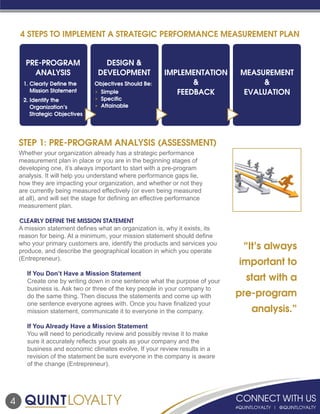
PRE-PROGRAM
ANALYSIS
1. Clearly Define the
Mission Statement
2. Identify the
Organization’s
Strategic Objectives
DESIGN &
DEVELOPMENT
Objectives Should Be:
• Simple
• Specific
• Attainable
IMPLEMENTATION
&
FEEDBACK
MEASUREMENT
&
EVALUATION
4 STEPS TO IMPLEMENT A STRATEGIC PERFORMANCE MEASUREMENT PLAN
“It’s always
important to
start with a
pre-program
analysis.”
“Your mission
is your
destination
and your
strategic
goals are
your road
map on how
to get there.”
5
IDENTIFY THE ORGANIZATION’S STRATEGIC OBJECTIVES
Using the mission statement as a guide, define at the macro level, or
the organization as a whole, what your organizations key goals and
objectives are. For example profitability, market share, quality, and
innovation, may be some of your organizations strategic objectives.
Then determine:
			
		a.	 Which strategic objectives are not being achieved
			(performance gaps),
		b.	 Whether or not the are being measured (results), and
		c.	 If they are being measured, how? (metrics)
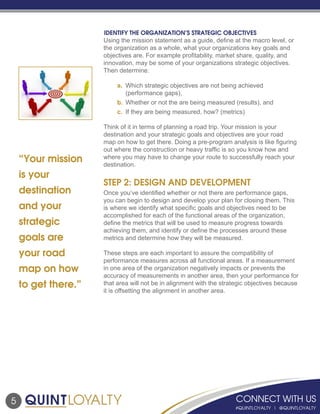
Think of it in terms of planning a road trip. Your mission is your
destination and your strategic goals and objectives are your road
map on how to get there. Doing a pre-program analysis is like figuring
out where the construction or heavy traffic is so you know how and
where you may have to change your route to successfully reach your
destination.
STEP 2: DESIGN AND DEVELOPMENT
Once you’ve identified whether or not there are performance gaps,
you can begin to design and develop your plan for closing them. This
is where we identify what specific goals and objectives need to be
accomplished for each of the functional areas of the organization,
define the metrics that will be used to measure progress towards
achieving them, and identify or define the processes around these
metrics and determine how they will be measured.
These steps are each important to assure the compatibility of
performance measures across all functional areas. If a measurement
in one area of the organization negatively impacts or prevents the
accuracy of measurements in another area, then your performance for
that area will not be in alignment with the strategic objectives because
it is offsetting the alignment in another area.
6
“You need
to ensure
that each
objective
is simple,
specific and
attainable.”
DEFINE YOUR PROGRAM’S OBJECTIVES
Start by developing an understanding of each functional area’s role
as it relates to the performance gaps and develop specific goals and
objectives that will close the gaps. When defining your program’s
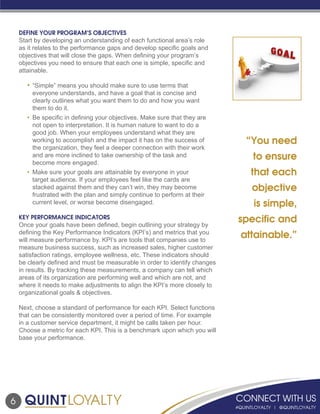
objectives you need to ensure that each one is simple, specific and
attainable.
	•	“Simple” means you should make sure to use terms that
		 everyone understands, and have a goal that is concise and
		 clearly outlines what you want them to do and how you want
		 them to do it.
	 •	 Be specific in defining your objectives. Make sure that they are
		 not open to interpretation. It is human nature to want to do a
		 good job. When your employees understand what they are
		 working to accomplish and the impact it has on the success of 		
		 the organization, they feel a deeper connection with their work
		and are more inclined to take ownership of the task and
		 become more engaged.
	 •	 Make sure your goals are attainable by everyone in your
		 target audience. If your employees feel like the cards are
		 stacked against them and they can’t win, they may become
		 frustrated with the plan and simply continue to perform at their
		 current level, or worse become disengaged.
KEY PERFORMANCE INDICATORS
Once your goals have been defined, begin outlining your strategy by
defining the Key Performance Indicators (KPI’s) and metrics that you
will measure performance by. KPI’s are tools that companies use to
measure business success, such as increased sales, higher customer
satisfaction ratings, employee wellness, etc. These indicators should
be clearly defined and must be measurable in order to identify changes
in results. By tracking these measurements, a company can tell which
areas of its organization are performing well and which are not, and
where it needs to make adjustments to align the KPI’s more closely to
organizational goals & objectives.
Next, choose a standard of performance for each KPI. Select functions
that can be consistently monitored over a period of time. For example
in a customer service department, it might be calls taken per hour.
Choose a metric for each KPI. This is a benchmark upon which you will
base your performance.
7
For example, if you are evaluating a KPI to measure sales, select a
factor such as volume, percentage or profit margin as the metric by
which to measure it. The metrics should be measurable over a period
of time - not just a small block of it, and like everything else, should be
aligned to organizational goals and objectives.
Lastly, define the goal that you want to reach for each KPI. This might
be based on historical data and may include a comparison to a prior
period, or it may be based on numbers needed to break even. For
example, you may choose to monitor the quarterly increase in sales
percentage by year. A target, such as “a 12 percent increase,” will
help direct the organization toward a common goal and increase the
likelihood of success.
STEP 3: IMPLEMENTATION AND FEEDBACK
For your plan to be effective, your employees must first understand
what you expect them to do, how you expect them to do it, and why
you want it done. Once you have your plan defined, communication
becomes critical to making it a success. Communicate strategic
objectives and performance goals at all levels of the organization.
Then monitor the program to ensure that employees are engaged and
actively working towards performance goals.
COMMUNICATION, COMMUNICATION, COMMUNICATION
The target group needs clear, consistent communication and timely
feedback on measurement of their performance. You can’t just
communicate at the beginning of the program and then expect
employees to carry out the plan. Think back to the road trip example.
When you plug an address or a destination into your navigation
system, it doesn’t just spit out all of the directions to you at once and
then shut off. It confirms where you’re going, gives you the directions
step by step, lets you know when there are traffic cameras ahead or
when you are going over the speed limit, corrects your course when
you make a wrong turn, finds a new route if you encounter a road
block, and lets you know when you’ve arrived at your destination.
An effective communication plan should do the same thing for
your performance measurement strategy. It should continually help
employees move toward the desired behavior or performance, let
them know when they are veering off course, modify the plan when
necessary, and let them know when they’ve accomplished their goals.
“Once you
have your
plan defined,
communication
becomes
critical to
making it a
success.”
8
STEP 4: MEASUREMENT AND EVALUATION
When performance measurements are working effectively, they let
us know:
			
	 •	 How well we are doing
	 •	 If we are meeting our goals
	 •	 If our customers are satisfied
	 •	 If our processes are effective and efficient and,
	 •	 If and where improvements are necessary
I’ve helped design and implement a lot of performance improvement
programs over the years and have learned a lot about the right way
and the wrong way to measure performance. One of the biggest
lesson’s I’ve learned, and something that I’ve encountered over and
over again, is that you cannot rely on financial performance as the sole
indicator of organizational success.
Traditional financial measures are better at measuring the
consequences of yesterday’s actions than at projecting tomorrow’s
performance. To get the whole picture we must measure both tangible
and intangible factors.
Traditional financial measures
are better at measuring the
consequences of yesterday’s
actions than at projecting
tomorrow’s performance.
9
JUST THE TIP OF THE ICEBERG
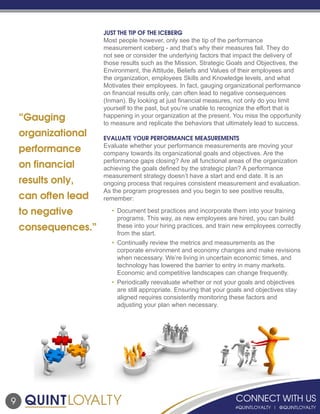
Most people however, only see the tip of the performance
measurement iceberg - and that’s why their measures fail. They do
not see or consider the underlying factors that impact the delivery of
those results such as the Mission, Strategic Goals and Objectives, the
Environment, the Attitude, Beliefs and Values of their employees and
the organization, employees Skills and Knowledge levels, and what
Motivates their employees. In fact, gauging organizational performance
on financial results only, can often lead to negative consequences
(Inman). By looking at just financial measures, not only do you limit
yourself to the past, but you’re unable to recognize the effort that is
happening in your organization at the present. You miss the opportunity
to measure and replicate the behaviors that ultimately lead to success.
EVALUATE YOUR PERFORMANCE MEASUREMENTS
Evaluate whether your performance measurements are moving your
company towards its organizational goals and objectives. Are the
performance gaps closing? Are all functional areas of the organization
achieving the goals defined by the strategic plan? A performance
measurement strategy doesn’t have a start and end date. It is an
ongoing process that requires consistent measurement and evaluation.
As the program progresses and you begin to see positive results,
remember:
	 •	 Document best practices and incorporate them into your training
			 programs. This way, as new employees are hired, you can build
			 these into your hiring practices, and train new employees correctly
			 from the start.
	 •	 Continually review the metrics and measurements as the
			 corporate environment and economy changes and make revisions
			 when necessary. We’re living in uncertain economic times, and
			 technology has lowered the barrier to entry in many markets.
			 Economic and competitive landscapes can change frequently.
	 •	 Periodically reevaluate whether or not your goals and objectives
			 are still appropriate. Ensuring that your goals and objectives stay
			 aligned requires consistently monitoring these factors and
			 adjusting your plan when necessary.
“Gauging
organizational
performance
on financial
results only,
can often lead
to negative
consequences.”
10
If you would like to discss how QuintLoyalty can help you design
an effective performance measurement plan, please contact:
Donna Chrobak
Email: dchrobak@quintloyalty.com
LinkedIn
Phone: 704-926-2710						QuintLoyalty.com
connect with us
11
REFERENCES
1.	 Behn, R. D. Why measure Performance? Different Purposes Require Different Measures.
2003.
2.	 Bradford, R. (2002). Aligning employees with strategy. Inc.com. Retrieved December 27,
2013, from www.inc.com/articles/2002/04/24063.html
3.	 Inman, R. A. Performance Measurement. Reference for Business. Retrieved January 21,
2014 from http://www.referenceforbusiness.com/management/Or-Pr/Performance-Measure-
ment.html
4.	 Kaufman, R., Oaklye-Brown, H., Watkins, R., and Leigh, D. (2003). Strategic planning for
success: Aligning people, performance, and payoffs. San Francisco: Jossey-Bass.
5.	 Moullin, M. Delivering Excellence in Health and Social Care. Buckingham: Open University
Press, 2002. Print.
6.	 Moullin, M. “Performance Measurement Definitions. Linking Performance Measurement and
Organizational Excellent.” Emerald. 	 International Journal of Health Care Quality Assur-
ance, 2007. 20:3,pp. 181-183.
7.	 Neely, A. D., Chris Adams, and Mike Kennerley. The Performance Prism: The Scorecard for
Measuring and Managing Business Success. London: Financial Times/Prentice Hall, 2002.
Print.
8.	 Office of the Chief Information Officer (OCIO) Enterprise Architecture Program. Treasury IT
Performance Measures Guide. U.S. Department of the Treasury. May 2007
9.	 Pershing, J. A. (2006). Handbook of Human Performance Technology. San Francisco:
Pfieffer.
10.	Slide 11: http://www.zthree.com/performance_alignment.php
11.	Watkins, R., Triner, D., and Kaufman, R. (1996). The death and resurrection of strategic
planning: A review of Mintzberg’s The rise and fall of strategic planning.
International Journal of Educational Reform, 5(3), 390-393.
12.	Read more at http://www.business2community.com/social-business/collaboration-project-
management-social-business-2014-trends-watch-0727305#1RZacqU7u55Twm1Y.99
13.	Read more: http://www.referenceforbusiness.com/management/Or-Pr/Performance-Mea-
surement.html#ixzz2pFwd7j5w
14.	Read more: http://www.incentivemarketing.org/?page=DevelIncentProg
12
REFERENCES CONTINUED
15.	Read more: http://www.referenceforbusiness.com/management/Or-Pr/Performance-Mea-
surement.html#ixzz2pByhMTYR
16.	Read more: http://www.orau.gov/pbm/handbook/Section-1.html
17.	Read more: http://www.ehow.com/how_7291887_define-kpi-metrics.html#ixzz2qByy1hF4
18.	Read more: http://ezinearticles.com/?Defining-Primary-Metrics---Starting-Off-on-the-Right-
Path&id=2357418
19.	http://www.pewsocialtrends.org/2014/01/09/why-its-great-to-be-the-boss/
20.	http://www.entrepreneur.com/encyclopedia/mission-statement

Webinar white paper 1

  • 1.
    BROUGHT TO YOUBY: 866.855.6733 STRATEGIC PERFORMANCE MEASUREMENT: 4 STEPS TO BUILDING AN EFFECTIVE PERFORMANCE MEASUREMENT PLAN Donna Chrobak Vice President QuintLoyalty
  • 2.
    “Companies can increase performance levels across theentire organization in ways that positively impact results.” STRATEGIC PERFORMANCE MEASUREMENT: 4 STEPS TO BUILDING AN EFFECTIVE PERFORMANCE MEASUREMENT PLAN In today’s changing business environment, and the often volatile economic climate businesses are facing, many organizations are searching for new and innovative ways to improve the performance results of their organization and gain a competitive advantage in the marketplace. One of the biggest challenges many organizations face in achieving these objectives, however, is that they are not always clear in their strategic direction. While most organization invest significant amounts of time and money in the development of strategic plans that outline their ambitions, more often than not, these documents are left on bookshelves to gather dust rather than being used by employees as guides for daily decision making (Pershing, 2006). The purpose of this paper is to discuss how organizations can positively impact their financial results and gain a competitive advantage by implementing a strategic performance measurement plan that aligns their employee’s performance across all functional areas of the organization with its strategic goals and objectives. By investing in, what is quickly being realized as an organizations most important asset, it’s employees, companies can increase performance levels across the entire organization in ways that positively impact bottom line results and, at the same time, build a competitive advantage that will be difficult for competitors to duplicate. THE GOAL OF PERFORMANCE MEASUREMENT Performance measurement is primarily about managing results. The goal is to give employees the tools to make sound business decisions and to help them understand how these decisions impact the organization’s ability to achieve its strategic goals and objectives. Research shows that, when employees understand the impact their work has on the organization as a whole, they feel more invested in the company and tend to make better business decisions. And when they know that their improved performance is being recognized, they become more engaged because they feel more personal accountability towards the success of the organization. 2
  • 3.
    “Following these steps will ensure thatyour plan is built on a solid design structure. ” THE KEY TO AN EFFECTIVE PERFORMANCE MEASUREMENT PLAN You must understand what measureable behaviors impact your organization’s ability to achieve its strategic and tactical goals and objectives, and then design a plan that measures, analyzes, and provides feedback on the data, and is flexible enough to be adjusted when necessary. A recent study by the Pew Research Center (Morin, 2014) found that bosses are happier than their employees. You might think that’s a no brainer since bosses typically make more money, but the study also showed that other intangible measurements like more autonomy, more authority to make decisions, and a better understanding of the big picture and how their job impacts the organization contributes significantly towards their happiness. So why wouldn’t we want to incorporate these intangibles throughout the organization? CREATING A PERFORMANCE MEASUREMENT PLAN How then do you go about creating a performance measurement strategy that drives organizational objectives, builds a culture of collaboration and engagement, gives employees the tools they need to make good business decisions, and positively impacts your organization’s financial performance? Outlined here are 4 basic steps that any organization can follow when implementing a strategic performance measurement plan. Following these steps will ensure that your plan is built on a solid design structure that defines and communicates key objectives, delivers clear and consistent feedback, provides flexibility to grow with your organization, and most importantly, provides measureable results. IMPORTANT POINTS TO REMEMBER It is important to remember that each organizations goals and objectives are different, as are the variable elements that will impact their ability to achieve them. You don’t necessarily want to follow another organization’s plan, or what your competitors are doing because your processes may be very different and will impact how you align your goals and objectives. While these steps may seem basic and simple, very often organizations will begin the process, and get through 1 or 2 of these steps, skip a step, or not complete the step accurately, and then wonder why their plan did not accomplish its goals. It is important, therefore, to follow the steps in order and through completion, even if some of the work has already been done. 3
  • 4.
    STEP 1: PRE-PROGRAMANALYSIS (ASSESSMENT) Whether your organization already has a strategic performance measurement plan in place or you are in the beginning stages of developing one, it’s always important to start with a pre-program analysis. It will help you understand where performance gaps lie, how they are impacting your organization, and whether or not they are currently being measured effectively (or even being measured at all), and will set the stage for defining an effective performance measurement plan. CLEARLY DEFINE THE MISSION STATEMENT A mission statement defines what an organization is, why it exists, its reason for being. At a minimum, your mission statement should define who your primary customers are, identify the products and services you produce, and describe the geographical location in which you operate (Entrepreneur). If You Don’t Have a Mission Statement Create one by writing down in one sentence what the purpose of your business is. Ask two or three of the key people in your company to do the same thing. Then discuss the statements and come up with one sentence everyone agrees with. Once you have finalized your mission statement, communicate it to everyone in the company. If You Already Have a Mission Statement You will need to periodically review and possibly revise it to make sure it accurately reflects your goals as your company and the business and economic climates evolve. If your review results in a revision of the statement be sure everyone in the company is aware of the change (Entrepreneur). 4 PRE-PROGRAM ANALYSIS 1. Clearly Define the Mission Statement 2. Identify the Organization’s Strategic Objectives DESIGN & DEVELOPMENT Objectives Should Be: • Simple • Specific • Attainable IMPLEMENTATION & FEEDBACK MEASUREMENT & EVALUATION 4 STEPS TO IMPLEMENT A STRATEGIC PERFORMANCE MEASUREMENT PLAN “It’s always important to start with a pre-program analysis.”
  • 5.
    “Your mission is your destination andyour strategic goals are your road map on how to get there.” 5 IDENTIFY THE ORGANIZATION’S STRATEGIC OBJECTIVES Using the mission statement as a guide, define at the macro level, or the organization as a whole, what your organizations key goals and objectives are. For example profitability, market share, quality, and innovation, may be some of your organizations strategic objectives. Then determine: a. Which strategic objectives are not being achieved (performance gaps), b. Whether or not the are being measured (results), and c. If they are being measured, how? (metrics) Think of it in terms of planning a road trip. Your mission is your destination and your strategic goals and objectives are your road map on how to get there. Doing a pre-program analysis is like figuring out where the construction or heavy traffic is so you know how and where you may have to change your route to successfully reach your destination. STEP 2: DESIGN AND DEVELOPMENT Once you’ve identified whether or not there are performance gaps, you can begin to design and develop your plan for closing them. This is where we identify what specific goals and objectives need to be accomplished for each of the functional areas of the organization, define the metrics that will be used to measure progress towards achieving them, and identify or define the processes around these metrics and determine how they will be measured. These steps are each important to assure the compatibility of performance measures across all functional areas. If a measurement in one area of the organization negatively impacts or prevents the accuracy of measurements in another area, then your performance for that area will not be in alignment with the strategic objectives because it is offsetting the alignment in another area.
  • 6.
    6 “You need to ensure thateach objective is simple, specific and attainable.” DEFINE YOUR PROGRAM’S OBJECTIVES Start by developing an understanding of each functional area’s role as it relates to the performance gaps and develop specific goals and objectives that will close the gaps. When defining your program’s objectives you need to ensure that each one is simple, specific and attainable. • “Simple” means you should make sure to use terms that everyone understands, and have a goal that is concise and clearly outlines what you want them to do and how you want them to do it. • Be specific in defining your objectives. Make sure that they are not open to interpretation. It is human nature to want to do a good job. When your employees understand what they are working to accomplish and the impact it has on the success of the organization, they feel a deeper connection with their work and are more inclined to take ownership of the task and become more engaged. • Make sure your goals are attainable by everyone in your target audience. If your employees feel like the cards are stacked against them and they can’t win, they may become frustrated with the plan and simply continue to perform at their current level, or worse become disengaged. KEY PERFORMANCE INDICATORS Once your goals have been defined, begin outlining your strategy by defining the Key Performance Indicators (KPI’s) and metrics that you will measure performance by. KPI’s are tools that companies use to measure business success, such as increased sales, higher customer satisfaction ratings, employee wellness, etc. These indicators should be clearly defined and must be measurable in order to identify changes in results. By tracking these measurements, a company can tell which areas of its organization are performing well and which are not, and where it needs to make adjustments to align the KPI’s more closely to organizational goals & objectives. Next, choose a standard of performance for each KPI. Select functions that can be consistently monitored over a period of time. For example in a customer service department, it might be calls taken per hour. Choose a metric for each KPI. This is a benchmark upon which you will base your performance.
  • 7.
    7 For example, ifyou are evaluating a KPI to measure sales, select a factor such as volume, percentage or profit margin as the metric by which to measure it. The metrics should be measurable over a period of time - not just a small block of it, and like everything else, should be aligned to organizational goals and objectives. Lastly, define the goal that you want to reach for each KPI. This might be based on historical data and may include a comparison to a prior period, or it may be based on numbers needed to break even. For example, you may choose to monitor the quarterly increase in sales percentage by year. A target, such as “a 12 percent increase,” will help direct the organization toward a common goal and increase the likelihood of success. STEP 3: IMPLEMENTATION AND FEEDBACK For your plan to be effective, your employees must first understand what you expect them to do, how you expect them to do it, and why you want it done. Once you have your plan defined, communication becomes critical to making it a success. Communicate strategic objectives and performance goals at all levels of the organization. Then monitor the program to ensure that employees are engaged and actively working towards performance goals. COMMUNICATION, COMMUNICATION, COMMUNICATION The target group needs clear, consistent communication and timely feedback on measurement of their performance. You can’t just communicate at the beginning of the program and then expect employees to carry out the plan. Think back to the road trip example. When you plug an address or a destination into your navigation system, it doesn’t just spit out all of the directions to you at once and then shut off. It confirms where you’re going, gives you the directions step by step, lets you know when there are traffic cameras ahead or when you are going over the speed limit, corrects your course when you make a wrong turn, finds a new route if you encounter a road block, and lets you know when you’ve arrived at your destination. An effective communication plan should do the same thing for your performance measurement strategy. It should continually help employees move toward the desired behavior or performance, let them know when they are veering off course, modify the plan when necessary, and let them know when they’ve accomplished their goals. “Once you have your plan defined, communication becomes critical to making it a success.”
  • 8.
    8 STEP 4: MEASUREMENTAND EVALUATION When performance measurements are working effectively, they let us know: • How well we are doing • If we are meeting our goals • If our customers are satisfied • If our processes are effective and efficient and, • If and where improvements are necessary I’ve helped design and implement a lot of performance improvement programs over the years and have learned a lot about the right way and the wrong way to measure performance. One of the biggest lesson’s I’ve learned, and something that I’ve encountered over and over again, is that you cannot rely on financial performance as the sole indicator of organizational success. Traditional financial measures are better at measuring the consequences of yesterday’s actions than at projecting tomorrow’s performance. To get the whole picture we must measure both tangible and intangible factors. Traditional financial measures are better at measuring the consequences of yesterday’s actions than at projecting tomorrow’s performance.
  • 9.
    9 JUST THE TIPOF THE ICEBERG Most people however, only see the tip of the performance measurement iceberg - and that’s why their measures fail. They do not see or consider the underlying factors that impact the delivery of those results such as the Mission, Strategic Goals and Objectives, the Environment, the Attitude, Beliefs and Values of their employees and the organization, employees Skills and Knowledge levels, and what Motivates their employees. In fact, gauging organizational performance on financial results only, can often lead to negative consequences (Inman). By looking at just financial measures, not only do you limit yourself to the past, but you’re unable to recognize the effort that is happening in your organization at the present. You miss the opportunity to measure and replicate the behaviors that ultimately lead to success. EVALUATE YOUR PERFORMANCE MEASUREMENTS Evaluate whether your performance measurements are moving your company towards its organizational goals and objectives. Are the performance gaps closing? Are all functional areas of the organization achieving the goals defined by the strategic plan? A performance measurement strategy doesn’t have a start and end date. It is an ongoing process that requires consistent measurement and evaluation. As the program progresses and you begin to see positive results, remember: • Document best practices and incorporate them into your training programs. This way, as new employees are hired, you can build these into your hiring practices, and train new employees correctly from the start. • Continually review the metrics and measurements as the corporate environment and economy changes and make revisions when necessary. We’re living in uncertain economic times, and technology has lowered the barrier to entry in many markets. Economic and competitive landscapes can change frequently. • Periodically reevaluate whether or not your goals and objectives are still appropriate. Ensuring that your goals and objectives stay aligned requires consistently monitoring these factors and adjusting your plan when necessary. “Gauging organizational performance on financial results only, can often lead to negative consequences.”
  • 10.
    10 If you wouldlike to discss how QuintLoyalty can help you design an effective performance measurement plan, please contact: Donna Chrobak Email: dchrobak@quintloyalty.com LinkedIn Phone: 704-926-2710 QuintLoyalty.com connect with us
  • 11.
    11 REFERENCES 1. Behn, R.D. Why measure Performance? Different Purposes Require Different Measures. 2003. 2. Bradford, R. (2002). Aligning employees with strategy. Inc.com. Retrieved December 27, 2013, from www.inc.com/articles/2002/04/24063.html 3. Inman, R. A. Performance Measurement. Reference for Business. Retrieved January 21, 2014 from http://www.referenceforbusiness.com/management/Or-Pr/Performance-Measure- ment.html 4. Kaufman, R., Oaklye-Brown, H., Watkins, R., and Leigh, D. (2003). Strategic planning for success: Aligning people, performance, and payoffs. San Francisco: Jossey-Bass. 5. Moullin, M. Delivering Excellence in Health and Social Care. Buckingham: Open University Press, 2002. Print. 6. Moullin, M. “Performance Measurement Definitions. Linking Performance Measurement and Organizational Excellent.” Emerald. International Journal of Health Care Quality Assur- ance, 2007. 20:3,pp. 181-183. 7. Neely, A. D., Chris Adams, and Mike Kennerley. The Performance Prism: The Scorecard for Measuring and Managing Business Success. London: Financial Times/Prentice Hall, 2002. Print. 8. Office of the Chief Information Officer (OCIO) Enterprise Architecture Program. Treasury IT Performance Measures Guide. U.S. Department of the Treasury. May 2007 9. Pershing, J. A. (2006). Handbook of Human Performance Technology. San Francisco: Pfieffer. 10. Slide 11: http://www.zthree.com/performance_alignment.php 11. Watkins, R., Triner, D., and Kaufman, R. (1996). The death and resurrection of strategic planning: A review of Mintzberg’s The rise and fall of strategic planning. International Journal of Educational Reform, 5(3), 390-393. 12. Read more at http://www.business2community.com/social-business/collaboration-project- management-social-business-2014-trends-watch-0727305#1RZacqU7u55Twm1Y.99 13. Read more: http://www.referenceforbusiness.com/management/Or-Pr/Performance-Mea- surement.html#ixzz2pFwd7j5w 14. Read more: http://www.incentivemarketing.org/?page=DevelIncentProg
  • 12.
    12 REFERENCES CONTINUED 15. Read more:http://www.referenceforbusiness.com/management/Or-Pr/Performance-Mea- surement.html#ixzz2pByhMTYR 16. Read more: http://www.orau.gov/pbm/handbook/Section-1.html 17. Read more: http://www.ehow.com/how_7291887_define-kpi-metrics.html#ixzz2qByy1hF4 18. Read more: http://ezinearticles.com/?Defining-Primary-Metrics---Starting-Off-on-the-Right- Path&id=2357418 19. http://www.pewsocialtrends.org/2014/01/09/why-its-great-to-be-the-boss/ 20. http://www.entrepreneur.com/encyclopedia/mission-statement