The Balanced Scorecard
ApproachProfessor, Entrepreneur & Lawyer.
Puttu Guru Prasad,
The Balanced Scorecard
Approach
Professor, Entrepreneur & Lawyer.
Puttu Guru Prasad,
M.Com. M.B.A., L.L.B., M.Phil. PGDFTM.
AP.SET., ICFAI TMF., (PhD) at JNTUK.
Senior Faculty for Management Science,
S&H Department, VVIT, Nambur, NSS P.O
My Blog: puttuguru.blogspot.in
93 94 96 98 98, 807 444 95 39, 9885 96 36 36
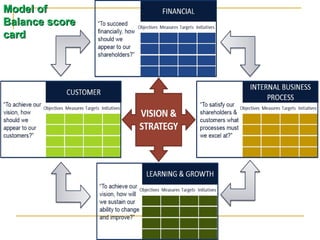
Model ofModel of
Balance scoreBalance score
cardcard
What is a Balanced Scorecard?What is a Balanced Scorecard?
The Balanced Scorecard is a
strategic planning and managementstrategic planning and management
systemsystem used to align businessalign business
activities to the vision and strategyto the vision and strategy of
the organization by monitoringby monitoring
performance against strategic goals.against strategic goals.
What is a Balanced Scorecard?What is a Balanced Scorecard?
• A balanced scorecard is a
performance metricperformance metric used in
strategic management to identifyidentify
and improve various internaland improve various internal
functionsfunctions of a business and theirtheir
resulting external outcomes.resulting external outcomes. It is
used to measuremeasure and provide
feedbackfeedback to organizations.
BalancedScorecard
Concept


Was first published in 1992 by
Kaplan and Norton, a book followed
in 1996.
Traditional performance measurement
that only focus on external
accounting data are obsolete.
The approach is to provide 'balance'
to the financial perspective.
Why Use a Balanced
Scorecard?






Improve organizational performance by
measuring what matters
Increase focus on strategy and results
Align organization strategy with workers on a
day-to-day basis
Focus on the drivers key to future performance
Improve communication of the organization’s
Vision and Strategy
Prioritize Projects / Initiatives
4 Original Business
Perspectives
Adapted from The Balanced Scorecard by Kaplan & Norton
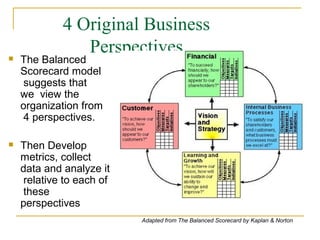
 The Balanced
Scorecard model
suggests that
we view the
organization from
4 perspectives.
 Then Develop
metrics, collect
data and analyze it
relative to each of
these
perspectives
4 Business Perspectives
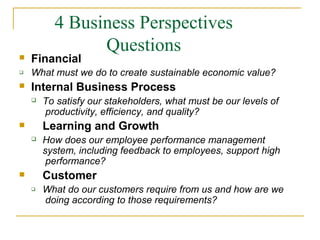
Questions Financial
 What must we do to create sustainable economic value?
 Internal Business Process


To satisfy our stakeholders, what must be our levels of
productivity, efficiency, and quality?
Learning and Growth


How does our employee performance management
system, including feedback to employees, support high
performance?
Customer
 What do our customers require from us and how are we
doing according to those requirements?
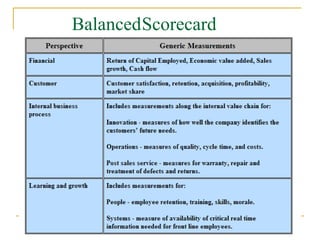
BalancedScorecard
Measurements
Key Implementation Success
Factors




Obtaining executive sponsorship and commitment
Involving a broad base of leaders, managers and
employees in scorecard development
Choose the right Scorecard Champion
Beginning interactive (two-way) communication
first
Viewing the scorecard as a long-term journey
rather than a short-term project
Getting outside help if needed
Balanced Scorecard
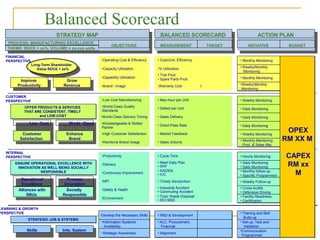
ExampleSTRATEGY MAP BALANCED SCORECARD
MEASUREMENT
PROCESS: MANUFACTURING EXCELLENCE
THEME: ROCE > xx%, VOLUME = xx,xxx units
OBJECTIVES TARGET
ACTION PLAN
INITIATIVE BUDGET
FINANCIAL
PERSPECTIVE
Improve
Productivity
OFFER PRODUCTS & SERVCIES
THAT ARE CONSISTENT, TIMELY
and LOW-COST
Long-Term Shareholder
Value ROCE > xx%
Grow
Revenue
CUSTOMER
PERSPECTIVE
•Operating Cost & Efficiency
•Capacity Utilization
•Capability Utilization
•Brand / Image
• Monthly Monitoring
• Weekly/Monthly
Monitoring
• Monthly Monitoring
•Weekly/Monthly
Monitoring
•Low Cost Manufacturing
•World-Class Quality
Standards
•World-Class Delivery Timing
•Knowledgeable & Skilled
Partner
•High Customer Satisfaction
•Reinforce Brand Image
• Man-hour per Unit
• Defect per Unit
• Sales Delivery
• Direct Pass Rate
• Market Feedback
• Sales Volume
• Weekly Monitoring
• Daily Monitoring
• Daily Monitoring
• Daily Monitoring
• Weekly Monitoring
• Monthly Monitoring
Prod. & Sales Mtg.
Low Cost World Class
ENSURE OPERATIONAL EXCELLENCE WITH
INNOVATION AS WELL BEING SOCIALLY
RESPONSIBLE
INTERNAL
PERSPECTIVE
Customer
Satisfaction
Enhance
Brand
Operational
Excellence
Process
Innovation
Alliances with
SBUs
Socially
Responsible
•Productivity
•Delivery
•Continuous Improvement
•NPI
•Safety & Health
•Environment
• Cycle Time
• Meet Daily Plan
• WIP
• KAIZEN
• ICC
• Timely Introduction
• Industrial Accident
• Commuting Accident
• Toxic Waste Disposal
• ISO 9002
• Hourly Monitoring
• Daily Monitoring
• Daily Monitoring
• Monthly follow-up
• Specific Programmed
• Weekly Follow-up
• Cross Audits
• Defensive Driving
• Facility Readiness
• Certification
STRATEGIC JOB & SYSTEMS
LEARNING & GROWTH
PERSPECTIVE
Skills Info. System
•Develop the Necessary Skills
•Information Systems
Availability
•Strategic Awareness
• R&D & Development
• ALC, Procurement,
Financial
• Alignment
• Training and Skill
Build-up
• Set-up, Test and
Validation
•Communication
Programmed
• Cost/Unit, Efficiency
•% Utilization
• Trial Prod.
• Spare Parts Prod
•Warranty Cost t
OPEX
RM XX M
CAPEX
RM xx
M
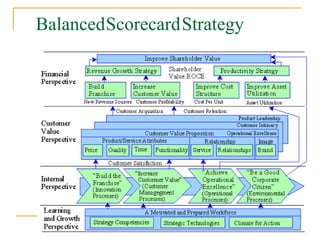
BalancedScorecardStrategy
Map
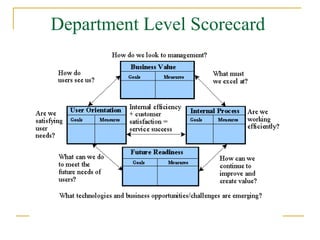
Department Level Scorecard
Example
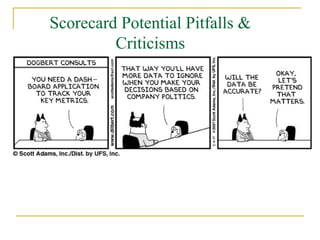
Scorecard Potential Pitfalls &
Criticisms
Scorecard Potential Pitfalls &
Criticisms
 Lack of a well Defined Strategy


The balanced scorecard relies on a well defined strategy and
understanding of linkages between strategic objections and
metrics. Without this foundation the implementation could fail.
Too much focus on the lagging measures


Focusing on only the lagging measures may cause a lack of
priority or opportunity for the leading measures.
Use of Generic Metrics


Don’t just copy metrics from another firm. Identify the measures
that apply to your strategy and competitive position .
Self-serving managers
 Managers whose goal is to achieve a desired result in order to
obtain a bonus or other self reward.
BalancedScorecardBenefit Re-
Cap




Helps align key performance measures with strategy at all levels of
an organization
The methodology facilitates communication and understanding of
business goals and strategies at all levels of an organization
Strategic initiatives that follow "best practices" methodologies that
cascade through the entire organization
Transforms an organization’s mission statement and strategic plan
from a passive document into the "marching orders" for the
organization on a daily basis.
It enables executives to truly execute their strategies by identifying
what should be done and measured.
To date, some form of a Balanced Scorecard is used by nearly 60% of
Fortune 500 companies
Thank You for Your
Time
Questions?

5. balanced scorecard pgp1

  • 1.
    The Balanced Scorecard ApproachProfessor,Entrepreneur & Lawyer. Puttu Guru Prasad,
  • 2.
    The Balanced Scorecard Approach Professor,Entrepreneur & Lawyer. Puttu Guru Prasad, M.Com. M.B.A., L.L.B., M.Phil. PGDFTM. AP.SET., ICFAI TMF., (PhD) at JNTUK. Senior Faculty for Management Science, S&H Department, VVIT, Nambur, NSS P.O My Blog: puttuguru.blogspot.in 93 94 96 98 98, 807 444 95 39, 9885 96 36 36
  • 3.
    Model ofModel of BalancescoreBalance score cardcard
  • 4.
    What is aBalanced Scorecard?What is a Balanced Scorecard? The Balanced Scorecard is a strategic planning and managementstrategic planning and management systemsystem used to align businessalign business activities to the vision and strategyto the vision and strategy of the organization by monitoringby monitoring performance against strategic goals.against strategic goals.
  • 5.
    What is aBalanced Scorecard?What is a Balanced Scorecard? • A balanced scorecard is a performance metricperformance metric used in strategic management to identifyidentify and improve various internaland improve various internal functionsfunctions of a business and theirtheir resulting external outcomes.resulting external outcomes. It is used to measuremeasure and provide feedbackfeedback to organizations.
  • 6.
    BalancedScorecard Concept   Was first publishedin 1992 by Kaplan and Norton, a book followed in 1996. Traditional performance measurement that only focus on external accounting data are obsolete. The approach is to provide 'balance' to the financial perspective.
  • 7.
    Why Use aBalanced Scorecard?       Improve organizational performance by measuring what matters Increase focus on strategy and results Align organization strategy with workers on a day-to-day basis Focus on the drivers key to future performance Improve communication of the organization’s Vision and Strategy Prioritize Projects / Initiatives
  • 8.
    4 Original Business Perspectives Adaptedfrom The Balanced Scorecard by Kaplan & Norton  The Balanced Scorecard model suggests that we view the organization from 4 perspectives.  Then Develop metrics, collect data and analyze it relative to each of these perspectives
  • 9.
    4 Business Perspectives QuestionsFinancial  What must we do to create sustainable economic value?  Internal Business Process   To satisfy our stakeholders, what must be our levels of productivity, efficiency, and quality? Learning and Growth   How does our employee performance management system, including feedback to employees, support high performance? Customer  What do our customers require from us and how are we doing according to those requirements?
  • 10.
  • 11.
    Key Implementation Success Factors     Obtainingexecutive sponsorship and commitment Involving a broad base of leaders, managers and employees in scorecard development Choose the right Scorecard Champion Beginning interactive (two-way) communication first Viewing the scorecard as a long-term journey rather than a short-term project Getting outside help if needed
  • 12.
    Balanced Scorecard ExampleSTRATEGY MAPBALANCED SCORECARD MEASUREMENT PROCESS: MANUFACTURING EXCELLENCE THEME: ROCE > xx%, VOLUME = xx,xxx units OBJECTIVES TARGET ACTION PLAN INITIATIVE BUDGET FINANCIAL PERSPECTIVE Improve Productivity OFFER PRODUCTS & SERVCIES THAT ARE CONSISTENT, TIMELY and LOW-COST Long-Term Shareholder Value ROCE > xx% Grow Revenue CUSTOMER PERSPECTIVE •Operating Cost & Efficiency •Capacity Utilization •Capability Utilization •Brand / Image • Monthly Monitoring • Weekly/Monthly Monitoring • Monthly Monitoring •Weekly/Monthly Monitoring •Low Cost Manufacturing •World-Class Quality Standards •World-Class Delivery Timing •Knowledgeable & Skilled Partner •High Customer Satisfaction •Reinforce Brand Image • Man-hour per Unit • Defect per Unit • Sales Delivery • Direct Pass Rate • Market Feedback • Sales Volume • Weekly Monitoring • Daily Monitoring • Daily Monitoring • Daily Monitoring • Weekly Monitoring • Monthly Monitoring Prod. & Sales Mtg. Low Cost World Class ENSURE OPERATIONAL EXCELLENCE WITH INNOVATION AS WELL BEING SOCIALLY RESPONSIBLE INTERNAL PERSPECTIVE Customer Satisfaction Enhance Brand Operational Excellence Process Innovation Alliances with SBUs Socially Responsible •Productivity •Delivery •Continuous Improvement •NPI •Safety & Health •Environment • Cycle Time • Meet Daily Plan • WIP • KAIZEN • ICC • Timely Introduction • Industrial Accident • Commuting Accident • Toxic Waste Disposal • ISO 9002 • Hourly Monitoring • Daily Monitoring • Daily Monitoring • Monthly follow-up • Specific Programmed • Weekly Follow-up • Cross Audits • Defensive Driving • Facility Readiness • Certification STRATEGIC JOB & SYSTEMS LEARNING & GROWTH PERSPECTIVE Skills Info. System •Develop the Necessary Skills •Information Systems Availability •Strategic Awareness • R&D & Development • ALC, Procurement, Financial • Alignment • Training and Skill Build-up • Set-up, Test and Validation •Communication Programmed • Cost/Unit, Efficiency •% Utilization • Trial Prod. • Spare Parts Prod •Warranty Cost t OPEX RM XX M CAPEX RM xx M
  • 13.
  • 14.
  • 15.
  • 16.
    Scorecard Potential Pitfalls& Criticisms  Lack of a well Defined Strategy   The balanced scorecard relies on a well defined strategy and understanding of linkages between strategic objections and metrics. Without this foundation the implementation could fail. Too much focus on the lagging measures   Focusing on only the lagging measures may cause a lack of priority or opportunity for the leading measures. Use of Generic Metrics   Don’t just copy metrics from another firm. Identify the measures that apply to your strategy and competitive position . Self-serving managers  Managers whose goal is to achieve a desired result in order to obtain a bonus or other self reward.
  • 17.
    BalancedScorecardBenefit Re- Cap     Helps alignkey performance measures with strategy at all levels of an organization The methodology facilitates communication and understanding of business goals and strategies at all levels of an organization Strategic initiatives that follow "best practices" methodologies that cascade through the entire organization Transforms an organization’s mission statement and strategic plan from a passive document into the "marching orders" for the organization on a daily basis. It enables executives to truly execute their strategies by identifying what should be done and measured. To date, some form of a Balanced Scorecard is used by nearly 60% of Fortune 500 companies
  • 18.
    Thank You forYour Time Questions?