Office Buildings BOMA Measurement Standard s
Overview Overview  > Key Concepts > 1980 > 1996 > 2010 > Method A > Method B BOMA: Building Owners and Managers Association International ( www.boma.org )   Accepted and approved by the American National Standards Institute (ANSI)       1980 - 1989      1996       2010    -      Method A     -      Method B    
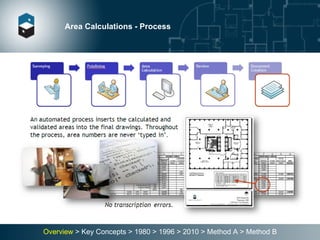
Area Calculations - Process Overview  > Key Concepts > 1980 > 1996 > 2010 > Method A > Method B
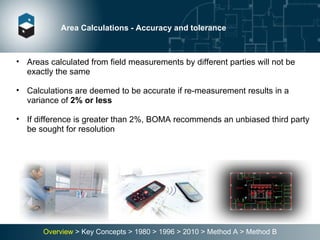
Area Calculations - Accuracy and tolerance Areas calculated from field measurements by different parties will not be exactly the same Calculations are deemed to be accurate if re-measurement results in a variance of  2% or less If difference is greater than 2%, BOMA recommends an unbiased third party be sought for resolution Overview  > Key Concepts > 1980 > 1996 > 2010 > Method A > Method B
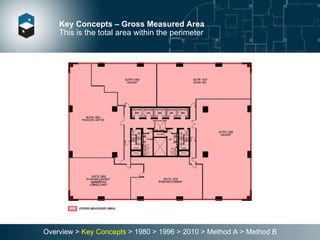
Key Concepts – Gross Measured Area This is the total area within the perimeter Overview >  Key Concepts  > 1980 > 1996 > 2010 > Method A > Method B
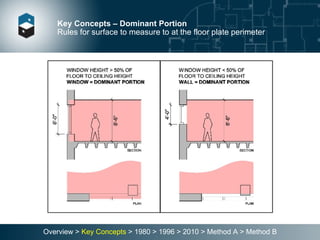
Key Concepts – Dominant Portion Rules for surface to measure to at the floor plate perimeter Overview >  Key Concepts  > 1980 > 1996 > 2010 > Method A > Method B
Key Concepts – Major Vertical Penetrations These are excluded from Rentable Area Overview >  Key Concepts  > 1980 > 1996 > 2010 > Method A > Method B
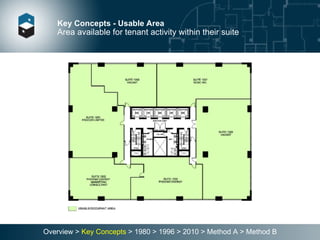
Key Concepts - Usable Area Area available for tenant activity within their suite Overview >  Key Concepts  > 1980 > 1996 > 2010 > Method A > Method B
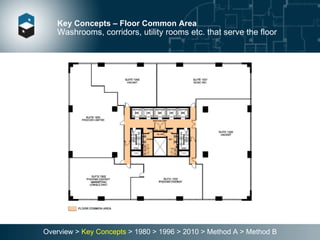
Key Concepts – Floor Common Area Washrooms, corridors, utility rooms etc. that serve the floor Overview >  Key Concepts  > 1980 > 1996 > 2010 > Method A > Method B
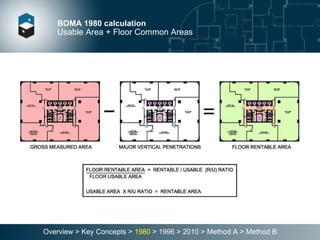
BOMA 1980 calculation Usable Area + Floor Common Areas Overview > Key Concepts >  1980  > 1996 > 2010 > Method A > Method B
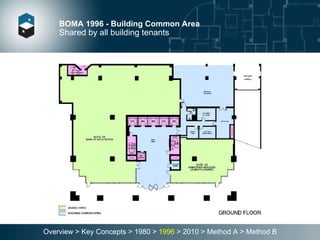
BOMA 1996 - Building Common Area Shared by all building tenants Overview > Key Concepts > 1980 >  1996  > 2010 > Method A > Method B
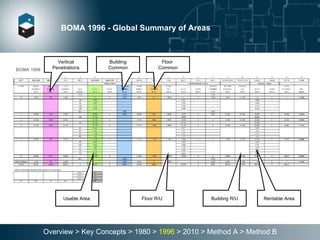
BOMA 1996 - Global Summary of Areas Overview > Key Concepts > 1980 >  1996  > 2010 > Method A > Method B Usable Area  Floor R/U Building R/U Rentable Area Vertical Penetrations Building Common Floor  Common
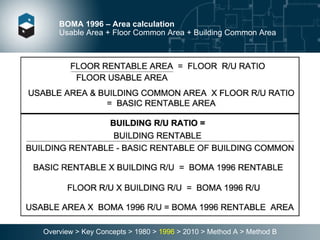
BOMA 1996 – Area calculation Usable Area + Floor Common Area + Building Common Area Overview > Key Concepts > 1980 >  1996  > 2010 > Method A > Method B
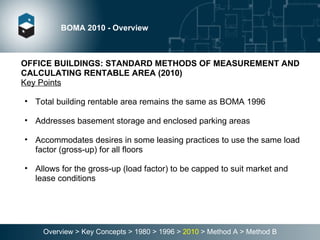
BOMA 2010 - Overview Overview > Key Concepts > 1980 > 1996 >  2010  > Method A > Method B OFFICE BUILDINGS: STANDARD METHODS OF MEASUREMENT AND CALCULATING RENTABLE AREA (2010) Key Points   Total building rentable area remains the same as BOMA 1996   Addresses basement storage and enclosed parking areas   Accommodates desires in some leasing practices to use the same load factor (gross-up) for all floors   Allows for the gross-up (load factor) to be capped to suit market and lease conditions
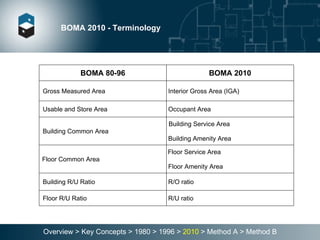
BOMA 2010 - Terminology Overview > Key Concepts > 1980 > 1996 >  2010  > Method A > Method B BOMA 80-96 BOMA 2010    Gross Measured Area   Interior Gross Area (IGA)     Usable and Store Area   Occupant Area    Building Common Area     Building Service Area   Building Amenity Area     Floor Common Area   Floor Service Area   Floor Amenity Area    Building R/U Ratio   R/O ratio    Floor R/U Ratio   R/U ratio
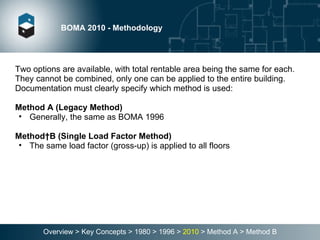
BOMA 2010 - Methodology Overview > Key Concepts > 1980 > 1996 >  2010  > Method A > Method B Two options are available, with total rentable area being the same for each. They cannot be combined, only one can be applied to the entire building. Documentation must clearly specify which method is used: Method A (Legacy Method) Generally, the same as BOMA 1996   Method B (Single Load Factor Method) The same load factor (gross-up) is applied to all floors
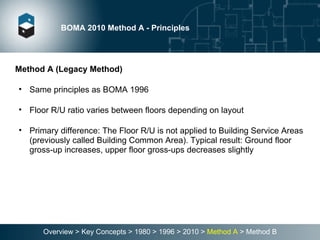
BOMA 2010 Method A - Principles Overview > Key Concepts > 1980 > 1996 >   2010 >  Method A  > Method B Method A (Legacy Method) Same principles as BOMA 1996 Floor R/U ratio varies between floors depending on layout Primary difference: The Floor R/U is not applied to Building Service Areas (previously called Building Common Area). Typical result: Ground floor gross-up increases, upper floor gross-ups decreases slightly  
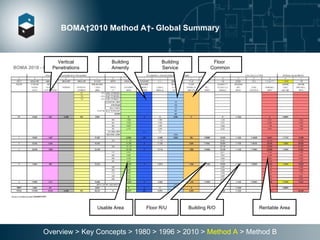
BOMA 2010 Method A - Global Summary Overview > Key Concepts > 1980 > 1996 >   2010 >  Method A  > Method B Usable Area  Floor R/U Building R/O Rentable Area Vertical Penetrations Building Amenity Floor  Common Building Service
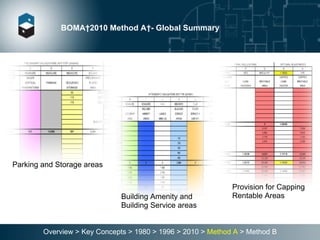
BOMA 2010 Method A - Global Summary Parking and Storage areas Building Amenity and Building Service areas Provision for Capping Rentable Areas Overview > Key Concepts > 1980 > 1996 >   2010 >  Method A  > Method B
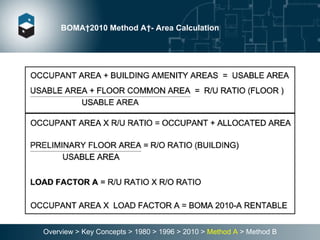
BOMA 2010 Method A - Area Calculation Overview > Key Concepts > 1980 > 1996 >   2010 >  Method A  > Method B
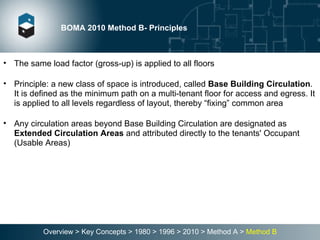
BOMA 2010 Method B- Principles Overview > Key Concepts > 1980 > 1996 >   2010 > Method A >  Method B The same load factor (gross-up) is applied to all floors Principle: a new class of space is introduced, called  Base Building Circulation . It is defined as the minimum path on a multi-tenant floor for access and egress. It is applied to all levels regardless of layout, thereby “fixing” common area Any circulation areas beyond Base Building Circulation are designated as  Extended Circulation Areas  and attributed directly to the tenants' Occupant (Usable Areas)
BOMA 2010 Method B Base Building Circulation and Extended Circulation Areas Overview > Key Concepts > 1980 > 1996 >   2010 > Method A >  Method B
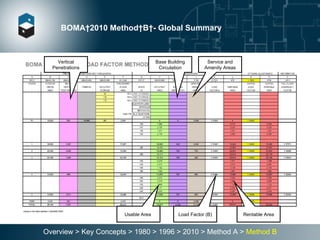
BOMA 2010 Method B - Global Summary Overview > Key Concepts > 1980 > 1996 >   2010 > Method A >  Method B Usable Area  Load Factor (B) Rentable Area Vertical Penetrations Service and Amenity Areas Base Building Circulation
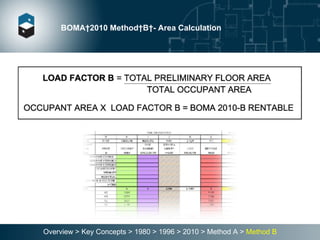
BOMA 2010 Method B - Area Calculation Overview > Key Concepts > 1980 > 1996 >   2010 > Method A >  Method B
Summary Summary BOMA 1980 : Common areas distributed on a floor by floor basis BOMA 1996 : Allows for building common areas to be distributed to all tenants BOMA 2010 Method A : Similar to BOMA 1996 BOMA 2010 Method B : The same gross-up is applied to all the floors by creating “base building circulation” and assigning it to all floors regardless of layout More information Copies of measurement standards can ordered online:  www.boma.org Link to this presentation:  http://tinyurl.com/29xwcuc

BOMA Measurement Standards

  • 1.
    Office Buildings BOMAMeasurement Standard s
  • 2.
    Overview Overview > Key Concepts > 1980 > 1996 > 2010 > Method A > Method B BOMA: Building Owners and Managers Association International ( www.boma.org )   Accepted and approved by the American National Standards Institute (ANSI)      1980 - 1989      1996       2010   -     Method A   -     Method B    
  • 3.
    Area Calculations -Process Overview > Key Concepts > 1980 > 1996 > 2010 > Method A > Method B
  • 4.
    Area Calculations -Accuracy and tolerance Areas calculated from field measurements by different parties will not be exactly the same Calculations are deemed to be accurate if re-measurement results in a variance of 2% or less If difference is greater than 2%, BOMA recommends an unbiased third party be sought for resolution Overview > Key Concepts > 1980 > 1996 > 2010 > Method A > Method B
  • 5.
    Key Concepts –Gross Measured Area This is the total area within the perimeter Overview > Key Concepts > 1980 > 1996 > 2010 > Method A > Method B
  • 6.
    Key Concepts –Dominant Portion Rules for surface to measure to at the floor plate perimeter Overview > Key Concepts > 1980 > 1996 > 2010 > Method A > Method B
  • 7.
    Key Concepts –Major Vertical Penetrations These are excluded from Rentable Area Overview > Key Concepts > 1980 > 1996 > 2010 > Method A > Method B
  • 8.
    Key Concepts -Usable Area Area available for tenant activity within their suite Overview > Key Concepts > 1980 > 1996 > 2010 > Method A > Method B
  • 9.
    Key Concepts –Floor Common Area Washrooms, corridors, utility rooms etc. that serve the floor Overview > Key Concepts > 1980 > 1996 > 2010 > Method A > Method B
  • 10.
    BOMA 1980 calculationUsable Area + Floor Common Areas Overview > Key Concepts > 1980 > 1996 > 2010 > Method A > Method B
  • 11.
    BOMA 1996 -Building Common Area Shared by all building tenants Overview > Key Concepts > 1980 >  1996 > 2010 > Method A > Method B
  • 12.
    BOMA 1996 -Global Summary of Areas Overview > Key Concepts > 1980 >  1996 > 2010 > Method A > Method B Usable Area Floor R/U Building R/U Rentable Area Vertical Penetrations Building Common Floor Common
  • 13.
    BOMA 1996 –Area calculation Usable Area + Floor Common Area + Building Common Area Overview > Key Concepts > 1980 >  1996 > 2010 > Method A > Method B
  • 14.
    BOMA 2010 -Overview Overview > Key Concepts > 1980 > 1996 > 2010 > Method A > Method B OFFICE BUILDINGS: STANDARD METHODS OF MEASUREMENT AND CALCULATING RENTABLE AREA (2010) Key Points   Total building rentable area remains the same as BOMA 1996   Addresses basement storage and enclosed parking areas   Accommodates desires in some leasing practices to use the same load factor (gross-up) for all floors   Allows for the gross-up (load factor) to be capped to suit market and lease conditions
  • 15.
    BOMA 2010 -Terminology Overview > Key Concepts > 1980 > 1996 > 2010 > Method A > Method B BOMA 80-96 BOMA 2010   Gross Measured Area   Interior Gross Area (IGA)   Usable and Store Area   Occupant Area   Building Common Area   Building Service Area   Building Amenity Area   Floor Common Area   Floor Service Area   Floor Amenity Area   Building R/U Ratio   R/O ratio   Floor R/U Ratio   R/U ratio
  • 16.
    BOMA 2010 -Methodology Overview > Key Concepts > 1980 > 1996 > 2010 > Method A > Method B Two options are available, with total rentable area being the same for each. They cannot be combined, only one can be applied to the entire building. Documentation must clearly specify which method is used: Method A (Legacy Method) Generally, the same as BOMA 1996   Method B (Single Load Factor Method) The same load factor (gross-up) is applied to all floors
  • 17.
    BOMA 2010 MethodA - Principles Overview > Key Concepts > 1980 > 1996 > 2010 > Method A > Method B Method A (Legacy Method) Same principles as BOMA 1996 Floor R/U ratio varies between floors depending on layout Primary difference: The Floor R/U is not applied to Building Service Areas (previously called Building Common Area). Typical result: Ground floor gross-up increases, upper floor gross-ups decreases slightly  
  • 18.
    BOMA 2010 Method A -Global Summary Overview > Key Concepts > 1980 > 1996 > 2010 > Method A > Method B Usable Area Floor R/U Building R/O Rentable Area Vertical Penetrations Building Amenity Floor Common Building Service
  • 19.
    BOMA 2010 Method A -Global Summary Parking and Storage areas Building Amenity and Building Service areas Provision for Capping Rentable Areas Overview > Key Concepts > 1980 > 1996 > 2010 > Method A > Method B
  • 20.
    BOMA 2010 Method A -Area Calculation Overview > Key Concepts > 1980 > 1996 > 2010 > Method A > Method B
  • 21.
    BOMA 2010 MethodB- Principles Overview > Key Concepts > 1980 > 1996 > 2010 > Method A > Method B The same load factor (gross-up) is applied to all floors Principle: a new class of space is introduced, called Base Building Circulation . It is defined as the minimum path on a multi-tenant floor for access and egress. It is applied to all levels regardless of layout, thereby “fixing” common area Any circulation areas beyond Base Building Circulation are designated as Extended Circulation Areas and attributed directly to the tenants' Occupant (Usable Areas)
  • 22.
    BOMA 2010 MethodB Base Building Circulation and Extended Circulation Areas Overview > Key Concepts > 1980 > 1996 > 2010 > Method A > Method B
  • 23.
    BOMA 2010 Method B - GlobalSummary Overview > Key Concepts > 1980 > 1996 > 2010 > Method A > Method B Usable Area Load Factor (B) Rentable Area Vertical Penetrations Service and Amenity Areas Base Building Circulation
  • 24.
    BOMA 2010 Method B - AreaCalculation Overview > Key Concepts > 1980 > 1996 > 2010 > Method A > Method B
  • 25.
    Summary Summary BOMA1980 : Common areas distributed on a floor by floor basis BOMA 1996 : Allows for building common areas to be distributed to all tenants BOMA 2010 Method A : Similar to BOMA 1996 BOMA 2010 Method B : The same gross-up is applied to all the floors by creating “base building circulation” and assigning it to all floors regardless of layout More information Copies of measurement standards can ordered online: www.boma.org Link to this presentation: http://tinyurl.com/29xwcuc

Editor's Notes

  • #3 The BOMA Standards are the most widely accepted method of measureing area in commercial buildings and enable direct comparisons to be made between different properties. First standard was established back in 1915, with revisions over the years (52, 55, 71). Current standard in use are 80-89, 96. Latest one is 2010.
  • #16 Differences in terminology with previous standards