DEM 325

  THE NATURE, SCOPE,
   AND FUNCTION OF
SCHOOL ADMINISTRATION


     RAMIL P. POLINTAN
      Student, Ph.D. EM
Landmark in the history of the
     Philippine Educational System

        EDUCATION ACT OF 1982

  Human Uplift        Social Progress
The act restates the policy of the state
  to establish and maintain a complete,
   adequate, and integrated system of
   education relevant to the goals of
 national development, and it delineates
specific provisions relevant to various
 concerns of the educational enterprise.
A Challenge to School Administrator

The Education Act of 1982 provides
that every school administrator
shall:


 1. Perform his duties to the
   school by discharging his
responsibilities in accordance
  with the philosophy, goals,
 and objectives of the school;
A Challenge to School Administrator

The Education Act of 1982 provides
that every school administrator
shall:


   2. be accountable for the
    efficient and effective
 administration and management
         of the school;
A Challenge to School Administrator

The Education Act of 1982 provides
that every school administrator
shall:

3.   develop and maintain a school
    atmosphere conducive to the
   promotion and preservation of
  academic freedom and effective
   teaching and learning and to
harmonious and progressive school-
      personnel relationship;
A Challenge to School Administrator

The Education Act of 1982 provides
that every school administrator
shall:

      4. assume and maintain
professional behaviour in his work
and in his dealings with students,
 teachers, academic non-teaching
 personnel, administrative staff,
     and parents or guardians;
A Challenge to School Administrator

The Education Act of 1982 provides
that every school administrator
shall:

  5. render adequate reports to
  teachers, academic non-teaching
 personnel, and non-academic staff
  on their actual performance and
  counsel them on ways to improve
             the same;
A Challenge to School Administrator

The Education Act of 1982 provides
that every school administrator
shall:

    6. observe due process,
fairness, promptness, privacy,
     constructiveness, and
  consistency in disciplining
     his teachers and other
           personnel;
A Challenge to School Administrator

The Education Act of 1982 provides
that every school administrator
shall:

 7. maintain adequate records
and submit required reports to
 the Department of Education.
Educational Community

 Educational community refers
to “those persons or group of
persons as such or associated
 in institutional involved in
    organized teaching and
       learning system.”
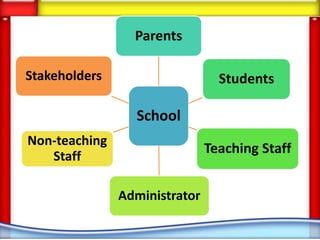
Parents

Stakeholders                     Students

                 School
Non-teaching
                               Teaching Staff
   Staff

               Administrator
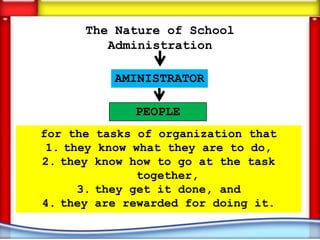
The Nature of School
         Administration

          AMINISTRATOR

             PEOPLE
for the tasks of organization that
 1. they know what they are to do,
2. they know how to go at the task
               together,
      3. they get it done, and
4. they are rewarded for doing it.
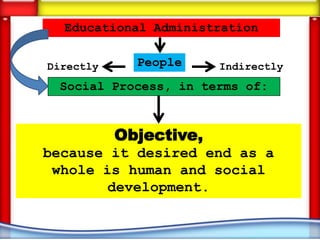
Educational Administration


Directly     People     Indirectly
 Social Process, in terms of:


           Objective,
because it desired end as a
 whole is human and social
        development.
Educational Administration


  Directly    People     Indirectly
    Social Process, in terms of:


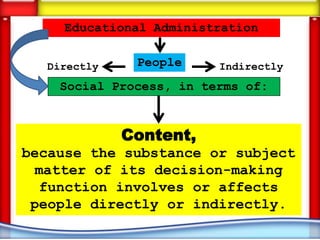
             Content,
because the substance or subject
  matter of its decision-making
  function involves or affects
 people directly or indirectly.
Educational Administration


  Directly    People    Indirectly
   Social Process, in terms of:


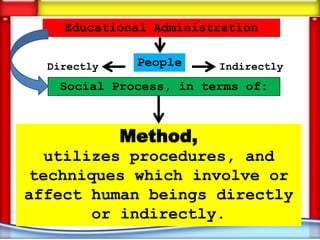
             Method,
  utilizes procedures, and
techniques which involve or
affect human beings directly
       or indirectly.
The Nature of Educational
               Administration


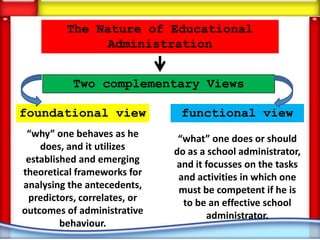
           Two complementary Views

foundational view              functional view
 “why” one behaves as he       “what” one does or should
    does, and it utilizes     do as a school administrator,
 established and emerging     and it focusses on the tasks
theoretical frameworks for     and activities in which one
analysing the antecedents,     must be competent if he is
 predictors, correlates, or     to be an effective school
outcomes of administrative            administrator.
         behaviour.
Scope and Function of
        School Administration

    Scope                 function

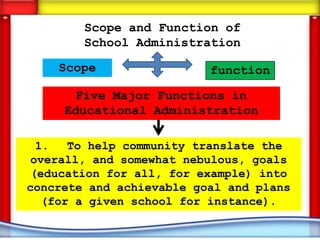
       Five Major Functions in
     Educational Administration

  1.   To help community translate the
 overall, and somewhat nebulous, goals
 (education for all, for example) into
concrete and achievable goal and plans
   (for a given school for instance).
Five major Functions in
     Educational Administration


    2.   To direct and supervise the
  amazingly complex task of bringing
    together the necessary teachers,
students, and support personnel, along
 with the required physical plant and
 educational equipment and materials,
   into an operating unit known as a
                 school.
Five major Functions in
      Educational Administration

  3.    To establish and maintain effective
   “feedback” circuits so that an adequate
 evaluation of “how are we doing” is always
     available. This will include research
  operations of two kinds: (1) research to
gather data and present an accurate picture
 of the operation “as is”; (2) experimental
    research to utilize new facts from the
 physical and human sciences along with new
theories of learning in an effort to produce
 improved teaching and learning situations.
Five major Functions in
     Educational Administration

   4. To initiate new structures,
 processes, or procedures that become
necessary for goal achievement or for
changing existing goals and purposes.
  The necessity for such initiatory
 activities and the indication of the
 kind needed will be derived from the
      aforementioned evaluation.
Five major Functions in
     Educational Administration


   5. To communicate with the body
  politic regarding all phases of the
educational institution. This involves
  two-way communication, not a simple
 one-group telling another process but
 a true and continuous conversation-a
    dialectic concerning education.
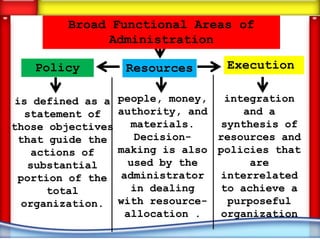
Broad Functional Areas of
             Administration

   Policy           Resources      Execution

 is defined as a   people, money,  integration
   statement of    authority, and      and a
those objectives     materials.    synthesis of
 that guide the       Decision-   resources and
    actions of     making is also policies that
   substantial       used by the        are
 portion of the    administrator  interrelated
      total          in dealing    to achieve a
  organization.    with resource-   purposeful
                    allocation .  organization
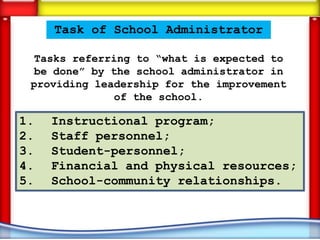
Task of School Administrator

  Tasks referring to “what is expected to
  be done” by the school administrator in
 providing leadership for the improvement
              of the school.

1.   Instructional program;
2.   Staff personnel;
3.   Student-personnel;
4.   Financial and physical resources;
5.   School-community relationships.
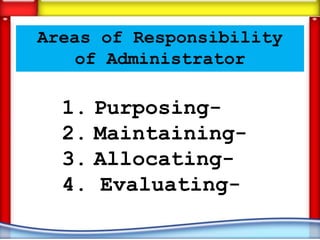
Areas of Responsibility
   of Administrator

  1.   Purposing-
  2.   Maintaining-
  3.   Allocating-
  4.   Evaluating-
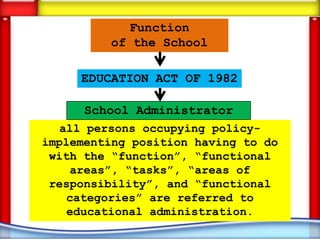
Function
         of the School

     EDUCATION ACT OF 1982

      School Administrator
   all persons occupying policy-
implementing position having to do
 with the “function”, “functional
     areas”, “tasks”, “areas of
 responsibility”, and “functional
    categories” are referred to
    educational administration.
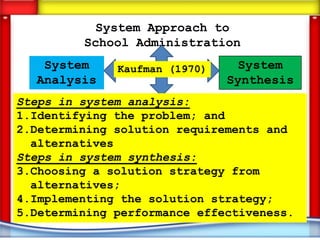
System Approach to
         School Administration
   System     Kaufman (1970)    System
  Analysis                     Synthesis
Steps in system analysis:
1.Identifying the problem; and
2.Determining solution requirements and
  alternatives
Steps in system synthesis:
3.Choosing a solution strategy from
  alternatives;
4.Implementing the solution strategy;
5.Determining performance effectiveness.
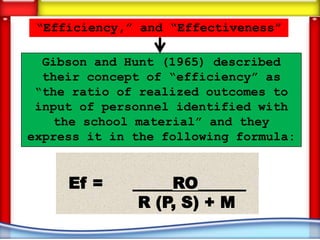
“Efficiency,” and “Effectiveness”

  Gibson and Hunt (1965) described
  their concept of “efficiency” as
 “the ratio of realized outcomes to
 input of personnel identified with
    the school material” and they
express it in the following formula:


     Ef =     _____RO______
               R (P, S) + M
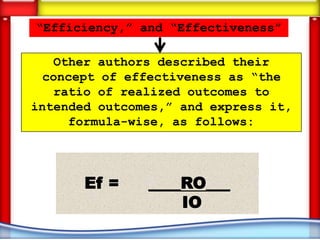
“Efficiency,” and “Effectiveness”

   Other authors described their
 concept of effectiveness as “the
   ratio of realized outcomes to
intended outcomes,” and express it,
     formula-wise, as follows:


       Ef =    ____RO___
                   IO
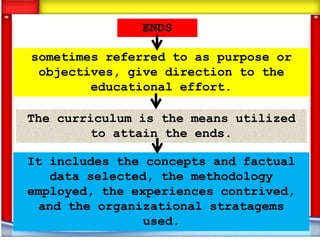
ENDS

sometimes referred to as purpose or
 objectives, give direction to the
        educational effort.

The curriculum is the means utilized
         to attain the ends.

It includes the concepts and factual
   data selected, the methodology
employed, the experiences contrived,
 and the organizational stratagems
                used.
Efficiency of Means and
Effectiveness of Means as Applied to
      Evaluation of Curriculum
        Efficiency of Means

      Involves time and money

         “Will the curriculum means
         accomplish the attainment
        of the intended goal within
        the reasonable time and for
            reasonable amount of
                   money?”
Efficiency of Means

 if a particular means is both
   appropriate and valid but
requires too much time, then it
   does not meet criterion of
  efficiency. Or a given means
may be very quick to accomplish
the intended objectives, but if
    it’s extremely costly to
 employ, then it does not meet
   the efficiency criterion.
Effective of Means

content, methodology, organizational
     arrangements, experience.

         “Are the curriculum ends
       actually attained?” “Do the
    students learn what is intended
      for them to learn?” “Are the
     desired objectives realized?”
      “Do the arrangement of time,
       space, and staff maximally
    contribute to the attainment of
        the intended objectives?”
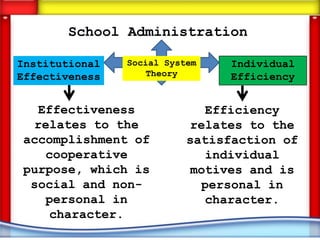
School Administration

Institutional   Social System   Individual
Effectiveness      Theory       Efficiency


  Effectiveness               Efficiency
  relates to the            relates to the
accomplishment of          satisfaction of
   cooperative                individual
purpose, which is           motives and is
 social and non-             personal in
    personal in               character.
    character.
School Administration

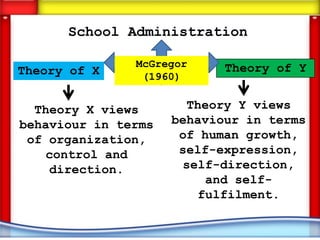
               McGregor     Theory of Y
Theory of X     (1960)


  Theory X views       Theory Y views
behaviour in terms   behaviour in terms
 of organization,     of human growth,
    control and       self-expression,
    direction.        self-direction,
                          and self-
                        fulfilment.
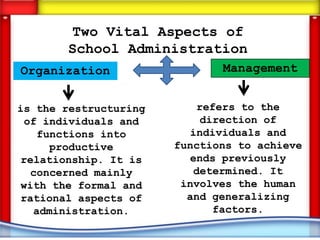
Two Vital Aspects of
       School Administration
Organization                  Management


is the restructuring       refers to the
  of individuals and       direction of
    functions into        individuals and
      productive       functions to achieve
 relationship. It is      ends previously
   concerned mainly       determined. It
 with the formal and    involves the human
 rational aspects of     and generalizing
   administration.           factors.
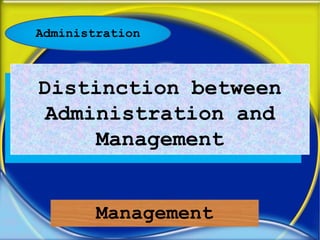
Administration


Distinction between
 Administration and
     Management


        Management
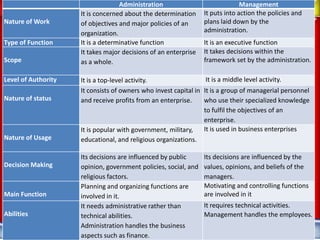
Administration                              Management
                     It is concerned about the determination     It puts into action the policies and
Nature of Work       of objectives and major policies of an      plans laid down by the
                     organization.                               administration.
Type of Function     It is a determinative function              It is an executive function
                     It takes major decisions of an enterprise   It takes decisions within the
Scope                as a whole.                                 framework set by the administration.

Level of Authority   It is a top-level activity.                  It is a middle level activity.
                     It consists of owners who invest capital in It is a group of managerial personnel
Nature of status     and receive profits from an enterprise.     who use their specialized knowledge
                                                                 to fulfil the objectives of an
                                                                 enterprise.
                     It is popular with government, military,    It is used in business enterprises
Nature of Usage      educational, and religious organizations.

                     Its decisions are influenced by public      Its decisions are influenced by the
Decision Making      opinion, government policies, social, and   values, opinions, and beliefs of the
                     religious factors.                          managers.
                     Planning and organizing functions are       Motivating and controlling functions
Main Function        involved in it.                             are involved in it
                     It needs administrative rather than         It requires technical activities.
Abilities            technical abilities.                        Management handles the employees.
                     Administration handles the business
                     aspects such as finance.
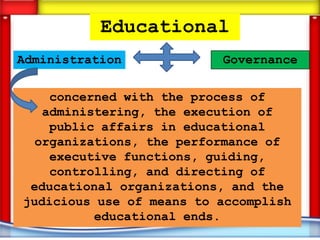
Educational
Administration            Governance


    concerned with the process of
   administering, the execution of
    public affairs in educational
  organizations, the performance of
    executive functions, guiding,
    controlling, and directing of
 educational organizations, and the
judicious use of means to accomplish
          educational ends.
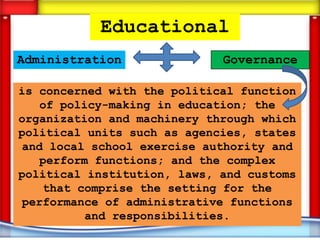
Educational
Administration               Governance

is concerned with the political function
    of policy-making in education; the
organization and machinery through which
political units such as agencies, states
and local school exercise authority and
    perform functions; and the complex
political institution, laws, and customs
     that comprise the setting for the
 performance of administrative functions
           and responsibilities.
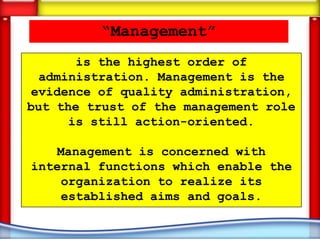
“Management”
       is the highest order of
  administration. Management is the
evidence of quality administration,
but the trust of the management role
      is still action-oriented.

   Management is concerned with
internal functions which enable the
    organization to realize its
    established aims and goals.
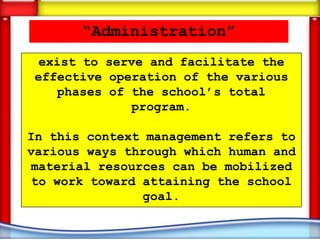
“Administration”
 exist to serve and facilitate the
effective operation of the various
   phases of the school’s total
             program.

In this context management refers to
various ways through which human and
material resources can be mobilized
to work toward attaining the school
               goal.
“Administration”
 Sergiovanni defines administration
   in its management sense as “the
     science and art of achieving
    organizational objectives in a
fashion which is cost-effective and
which obtains sufficient teacher and
   consumer satisfaction to ensure
  their continued participation and
              support.”
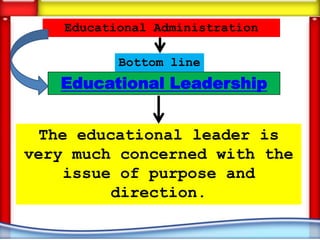
Educational Administration

           Bottom line
   Educational Leadership


 The educational leader is
very much concerned with the
    issue of purpose and
         direction.
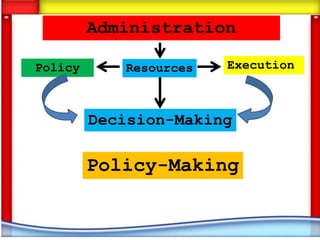
Administration

Policy      Resources   Execution


         Decision-Making

         Policy-Making
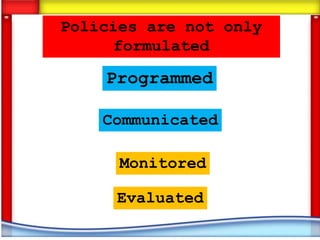
Policies are not only
      formulated

    Programmed

    Communicated

      Monitored

     Evaluated
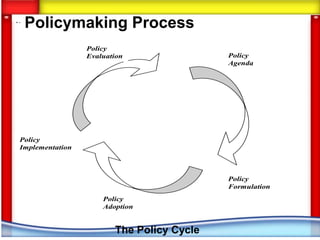
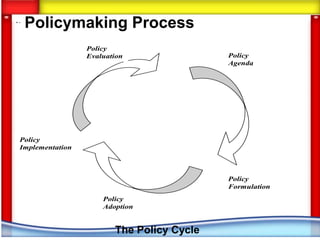
pattern of action involving a cycle of activities referred to as policy cycle, Figure

1.
     Policymaking Process
                     Policy
                     Evaluation                                    Policy
                                                                   Agenda


 Policy
 Implementation


                                                                   Policy
                                                                   Formulation
                          Policy
                          Adoption


                              The Policy Cycle
Video of
K+12 Enhanced Basic
 Education Program
Policymaking Process
• Problem Identification and Agenda
  Setting
  Problem Identification

  – What is the problem? What happens if, we do nothing?

  – Demand for government action to resolve a problem or take advantage
    of an opportunity

  – Getting the government to see the problem

  – Problems capture the attention of policymakers through indicators,
    focusing events (disasters), crises, feedback or problems just fade away

  – Budget (money makes the world go around) is a special problem
Policymaking Process
Agenda Setting
 – Those items policymakers are discussing and
   seriously considering

 – Getting the government to begin to act on the
   problem

 – Output that transform the problem into an ISSUE
    • Issue – conflict between two or more identifiable groups
      over procedural or substantive matters relating to the
      distribution of positions and resources
Policymaking Process
• Policy Formulation

 –Development of a plan to solve the
  problem
 –Government’s proposed solution to the
  problem
Policymaking Process
• Policy Adoption/Legitimation

  – Decision – making state
  – Development of support for a specific proposal
    such that the policy is legitimized or authorized
  – Getting the government to accept a particular
    solution to the problem
  – Policy decisions rests on public officials or body
    to adopt, modify or reject a preferred policy
    alternative
Policymaking Process
• Policy Implementation
  – Application of the adopted policy by the government’s
    bureaucracy to the problem
  – Execution of a program that has been adopted by
    legislation or by executive or judicial order
  – Control (designed to cause people to do things, refrain
    from doing things, or continue doing things that they
    otherwise would not do) Ex. Coercive/non coercive,
    inspection, licensing, contracts, taxation, sanctions, etc.
  – Compliance (induce people to act in accordance with
    governmentally prescribed rules and regulations)
Policymaking Process
• Policy Evaluation – estimation, assessment, or
  appraisal of policy including its content,
  implementation and effects
  – Effectiveness: Has the valued outcome been achieved?
  – Efficiency: How much effort was required to achieve a
    valued result?
  – Adequacy: To what extent does the achievement of a
    valued outcome resolve the problem?
  – Equity: Are costs and benefits distributed equitably
    among different groups?
  – Responsiveness: Do policy outcomes satisfy the needs,
    preferences or values of particular groups?
  – Appropriateness: Are desired outcomes (objectives)
    actually worthy and valuable?
DepEd Order No. 31 s. 201

 Policy Guidelines on
the Implementation of
     K to 12 Basic
Education Curriculum
pattern of action involving a cycle of activities referred to as policy cycle, Figure

1.
     Policymaking Process
                     Policy
                     Evaluation                                    Policy
                                                                   Agenda


 Policy
 Implementation


                                                                   Policy
                                                                   Formulation
                          Policy
                          Adoption


                              The Policy Cycle
Video of
K+12 Enhanced Basic
 Education Program
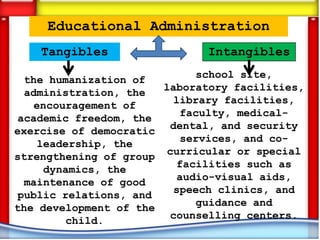
Educational Administration
    Tangibles                 Intangibles
                             school site,
  the humanization of
                       laboratory facilities,
  administration, the
                         library facilities,
    encouragement of
                          faculty, medical-
 academic freedom, the
exercise of democratic dental, and security
    leadership, the        services, and co-
strengthening of group curricular or special
                          facilities such as
     dynamics, the
                          audio-visual aids,
  maintenance of good
 public relations, and   speech clinics, and
                             guidance and
the development of the
                        counselling centers.
         child.
School Administration
Tangibles              Intangibles


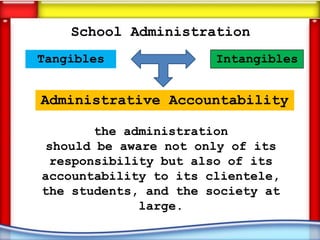
Administrative Accountability

        the administration
 should be aware not only of its
  responsibility but also of its
accountability to its clientele,
the students, and the society at
              large.