RAMIL P. POLINTAN
 Head, Mathematics
 Department, TNHS
Strategy Analysis & Choice

                        
 Strategic analysis and choice largely involve
 making subjective decisions based on objective
 information.
This report introduces important concepts that
 can help strategists generate feasible
 alternatives, evaluate those alternatives, and
 choose a specific course of action. Behavioral
 aspects of strategy formulation are
 described, including politics, culture, ethics, and
 social responsibility considerations.
Nature of Strategy Analysis & Choice

                  
-- Establishing long-term objectives
-- Generating alternative strategies
-- Selecting strategies to pursue
-- Best alternative - achieve mission &
   objectives
Strategy Analysis & Choice
Alternative Strategies Derive From --

Vision
Mission
Objectives

External audit
Internal audit

Past successful strategies
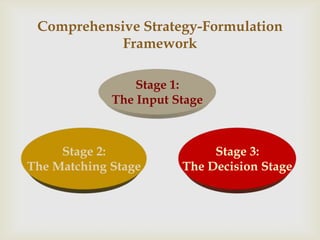
Comprehensive Strategy-Formulation
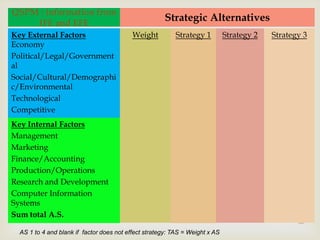
            Framework

                 Stage 1:
             The Input Stage


     Stage 2:                Stage 3:
The Matching Stage      The Decision Stage
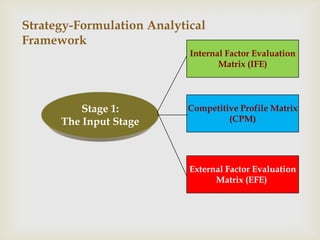
Strategy-Formulation Analytical
Framework
                            Internal Factor Evaluation
                                   Matrix (IFE)


          Stage 1:          Competitive Profile Matrix
      The Input Stage                (CPM)


                            External Factor Evaluation
                                  Matrix (EFE)
Stage 1: The Input Stage


Basic input information for the matching &
decision stage matrices
Requires strategists to quantify subjectivity early
in the process
Good intuitive judgment always needed
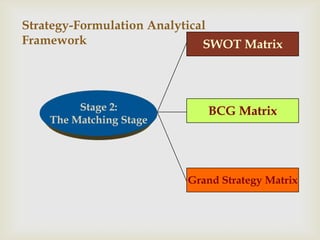
Strategy-Formulation Analytical
Framework                     SWOT Matrix


         Stage 2:            BCG Matrix
    The Matching Stage


                          Grand Strategy Matrix
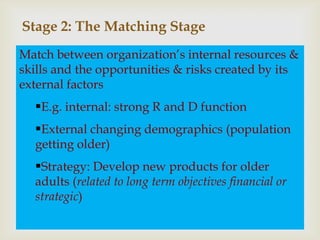
Stage 2: The Matching Stage
Match between organization’s internal resources &
skills and the opportunities & risks created by its
external factors
  E.g. internal: strong R and D function
  External changing demographics (population
  getting older)
  Strategy: Develop new products for older
  adults (related to long term objectives financial or
  strategic)
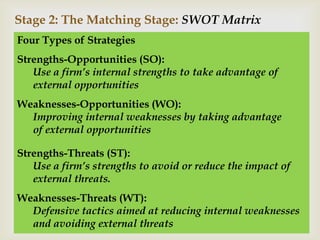
Stage 2: The Matching Stage: SWOT Matrix
Four Types of Strategies
Strengths-Opportunities (SO):
   Use a firm’s internal strengths to take advantage of
   external opportunities
Weaknesses-Opportunities (WO):
  Improving internal weaknesses by taking advantage
  of external opportunities

Strengths-Threats (ST):
   Use a firm’s strengths to avoid or reduce the impact of
   external threats.
Weaknesses-Threats (WT):
  Defensive tactics aimed at reducing internal weaknesses
  and avoiding external threats
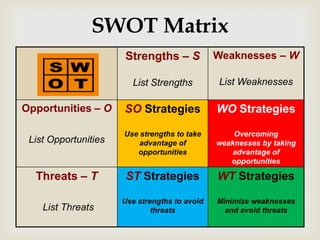
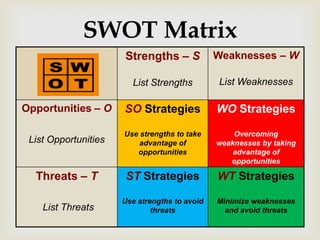
SWOT Matrix
                      Strengths – S            Weaknesses – W

                        List Strengths         List Weaknesses

Opportunities – O     SO Strategies            WO Strategies

                      Use strengths to take        Overcoming
 List Opportunities       advantage of         weaknesses by taking
                         opportunities             advantage of
                                                  opportunities

  Threats – T          ST Strategies           WT Strategies

                      Use strengths to avoid   Minimize weaknesses
    List Threats              threats            and avoid threats
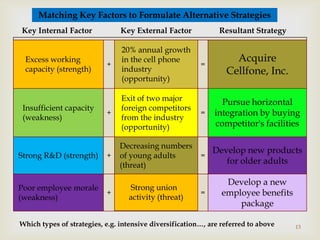
Matching Key Factors to Formulate Alternative Strategies
Key Internal Factor             Key External Factor            Resultant Strategy

                                20% annual growth
 Excess working
                           +
                                in the cell phone
                                                         =
                                                                   Acquire
 capacity (strength)            industry                         Cellfone, Inc.
                                (opportunity)

                                Exit of two major
                                                               Pursue horizontal
 Insufficient capacity          foreign competitors
                           +                             =   integration by buying
 (weakness)                     from the industry
                                (opportunity)                competitor's facilities

                               Decreasing numbers
                                                             Develop new products
Strong R&D (strength)      +   of young adults           =
                               (threat)                         for older adults

                                                                 Develop a new
Poor employee morale              Strong union
                           +
                                  activity (threat)
                                                         =      employee benefits
(weakness)
                                                                    package

Which types of strategies, e.g. intensive diversification…, are referred to above   13
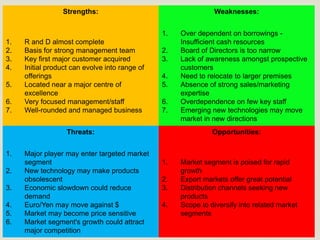
Strengths:                                    Weaknesses:


                                                1.   Over dependent on borrowings -
1.   R and D almost complete                         Insufficient cash resources
2.   Basis for strong management team           2.   Board of Directors is too narrow
3.   Key first major customer acquired          3.   Lack of awareness amongst prospective
4.   Initial product can evolve into range of        customers
     offerings                                  4.   Need to relocate to larger premises
5.   Located near a major centre of             5.   Absence of strong sales/marketing
     excellence                                      expertise
6.   Very focused management/staff              6.   Overdependence on few key staff
7.   Well-rounded and managed business          7.   Emerging new technologies may move
                                                     market in new directions
                   Threats:                                    Opportunities:


1.   Major player may enter targeted market
     segment                                    1.   Market segment is poised for rapid
2.   New technology may make products                growth
     obsolescent                                2.   Export markets offer great potential
3.   Economic slowdown could reduce             3.   Distribution channels seeking new
     demand                                          products
4.   Euro/Yen may move against $                4.   Scope to diversify into related market
5.   Market may become price sensitive               segments
6.   Market segment's growth could attract
     major competition
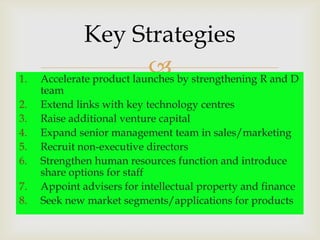
Key Strategies
1.
                            by strengthening R and D
     Accelerate product launches
     team
2.   Extend links with key technology centres
3.   Raise additional venture capital
4.   Expand senior management team in sales/marketing
5.   Recruit non-executive directors
6.   Strengthen human resources function and introduce
     share options for staff
7.   Appoint advisers for intellectual property and finance
8.   Seek new market segments/applications for products
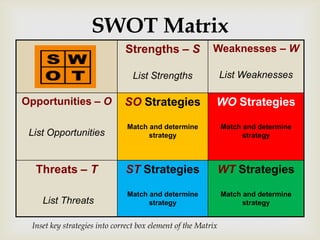
SWOT Matrix
                              Strengths – S               Weaknesses – W

                                 List Strengths                List Weaknesses

Opportunities – O             SO Strategies                WO Strategies

                               Match and determine             Match and determine
 List Opportunities                  strategy                        strategy


  Threats – T                 ST Strategies                    WT Strategies

                               Match and determine             Match and determine
    List Threats                     strategy                        strategy


 Inset key strategies into correct box element of the Matrix
Limitations with SWOT Matrix

                    
Does not show how to achieve a competitive
 advantage
Provides a static assessment in time
May lead the firm to overemphasize a single
 internal or external factor in formulating
 strategies
BCG Matrix

Boston Consulting Group Matrix
 Enhances multi-divisional firm in formulating
 strategies
 Autonomous divisions = business portfolio
 Divisions may compete in different industries
 Focus on market-share position & industry
 growth rate
BCG Matrix

Relative Market Share Position


Ratio of a division’s own market share
in an industry to the market share held
by the largest rival firm in that industry
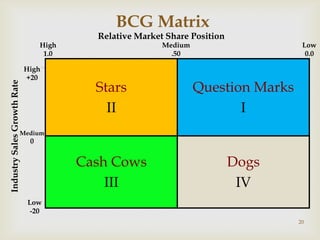
BCG Matrix
                                           Relative Market Share Position
                                  High                    Medium                     Low
                                   1.0                      .50                       0.0

                             High
                             +20
                                                      
                                           Stars                   Question Marks
Industry Sales Growth Rate


                                             II                           I
                         Medium
                              0


                                         Cash Cows                          Dogs
                                             III                             IV
                             Low
                              -20
                                                                                    20
BCG Matrix

Question Marks
 Low relative market share – compete in high-
 growth industry
   Cash needs are high
   Case generation is low
 Decision to strengthen (intensive strategies) or
 divest
BCG Matrix

Stars
 High relative market share and high growth
 rate
   Best long-run opportunities for growth &
   profitability

 Substantial investment to maintain or
 strengthen dominant position
   Integration strategies, intensive strategies, joint
   ventures
BCG Matrix

Cash Cows
 High relative market share, competes in low-
 growth industry
   Generate cash in excess of their needs
   Milked for other purposes
 Maintain strong position as long as possible
   Product development, concentric diversification
   If weakens—retrenchment or divestiture
BCG Matrix

Dogs

 Low relative market share & compete in slow
 or no market growth
   Weak internal & external position


 Liquidation, divestiture, retrenchment
Grand Strategy Matrix


 Tool for formulating alternative strategies
 Based on two dimensions
   Competitive position
   Market growth
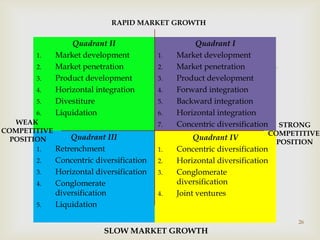
RAPID MARKET GROWTH

                  Quadrant II                        Quadrant I
       1.     Market development           1.   Market development
       2.
       3.
              Market penetration
              Product development
                                           
                                           2.
                                           3.
                                                Market penetration
                                                Product development
       4.     Horizontal integration       4.   Forward integration
       5.     Divestiture                  5.   Backward integration
       6.     Liquidation                  6.   Horizontal integration
   WEAK                                    7.   Concentric diversification  STRONG
COMPETITIVE                                                              COMPETITIVE
  POSITION        Quadrant III                       Quadrant IV
                                                                           POSITION
       1.     Retrenchment                 1.   Concentric diversification
       2.     Concentric diversification   2.   Horizontal diversification
       3.     Horizontal diversification   3.   Conglomerate
       4.     Conglomerate                      diversification
              diversification              4.   Joint ventures
       5.     Liquidation

                                                                               26
                           SLOW MARKET GROWTH
Grand Strategy Matrix

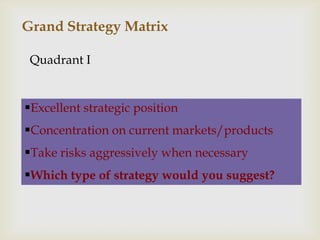
 Quadrant I


Excellent strategic position
Concentration on current markets/products
Take risks aggressively when necessary
Which type of strategy would you suggest?
Grand Strategy Matrix

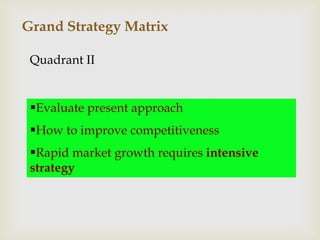
 Quadrant II


 Evaluate present approach
 How to improve competitiveness
 Rapid market growth requires intensive
 strategy
Grand Strategy Matrix

 Quadrant III


 Compete in slow-growth industries
 Weak competitive position
 Drastic changes quickly
 Cost & asset reduction (retrenchment)
Grand Strategy Matrix

 Quadrant IV


 Strong competitive position
 Slow-growth industry
 Diversification to more promising growth
 areas
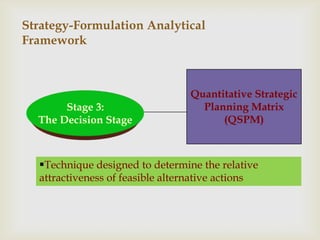
Strategy-Formulation Analytical
Framework


                                 Quantitative Strategic
       Stage 3:                    Planning Matrix
  The Decision Stage                   (QSPM)


  Technique designed to determine the relative
  attractiveness of feasible alternative actions
Steps to Develop a QSPM
1. Make a list of the firm’s key external
                      
   opportunities/threats and internal
   strengths/weaknesses in the left column
2. Assign weights to each key external and
   internal factor
3. Examine the Stage 2 (matching) matrices, and
   identify alternative strategies that the
   organization should consider implementing
4. Determine the Attractiveness Scores (A.S)
5. Compute the Total Attractiveness Scores
6. Compute the Sum Total Attractiveness Score
QSPM : information from
    IFE and EFE
                                                      Strategic Alternatives
Key External Factors                       Weight          Strategy 1         Strategy 2   Strategy 3
Economy
Political/Legal/Government
al
Social/Cultural/Demographi
                                                 
c/Environmental
Technological
Competitive
Key Internal Factors
Management
Marketing
Finance/Accounting
Production/Operations
Research and Development
Computer Information
Systems
Sum total A.S.
                                                                                                  33
  AS 1 to 4 and blank if factor does not effect strategy: TAS = Weight x AS
QSPM

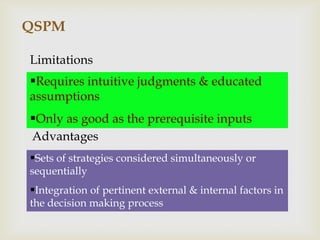
Limitations
Requires intuitive judgments & educated
assumptions
Only as good as the prerequisite inputs
Advantages
Sets of strategies considered simultaneously or
sequentially
Integration of pertinent external & internal factors in
the decision making process
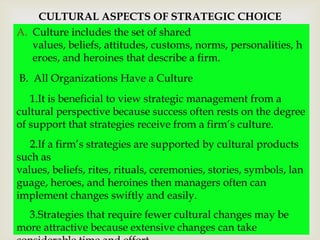
CULTURAL ASPECTS OF STRATEGIC CHOICE
A. Culture includes the set of shared
   values, beliefs, attitudes, customs, norms, personalities, h
   eroes, and heroines that describe a firm.
                          
B. All Organizations Have a Culture
   1.It is beneficial to view strategic management from a
cultural perspective because success often rests on the degree
of support that strategies receive from a firm’s culture.
   2.If a firm’s strategies are supported by cultural products
such as
values, beliefs, rites, rituals, ceremonies, stories, symbols, lan
guage, heroes, and heroines then managers often can
implement changes swiftly and easily.
  3.Strategies that require fewer cultural changes may be
more attractive because extensive changes can take
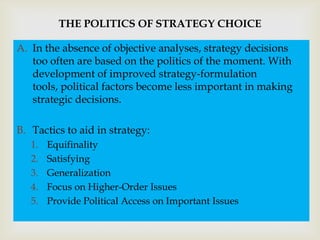
THE POLITICS OF STRATEGY CHOICE

A. In the absence of objective analyses, strategy decisions

                               
   too often are based on the politics of the moment. With
   development of improved strategy-formulation
   tools, political factors become less important in making
   strategic decisions.

B. Tactics to aid in strategy:
   1.   Equifinality
   2.   Satisfying
   3.   Generalization
   4.   Focus on Higher-Order Issues
   5.   Provide Political Access on Important Issues
THE ROLE OF A BOARD OF DIRECTORS


                     
A director is one of a group of persons
 entrusted with the overall direction of a
 corporate enterprise. A board of directors is
 a group of persons elected by the
 ownership of a corporation to have
 oversight and guidance over management
 and to look out for the shareholders’
 interests.
SWOT Analysis
            
SWOT Analysis is an effective way of
identifying the strengths and weaknesses of the
impact of legislation, policy, protocols, parent-
partnership arrangements, and so on, and of
examining the opportunities and threats your
organisation/school may face as a result of
implementing such policies, protocols, and
arrangements.

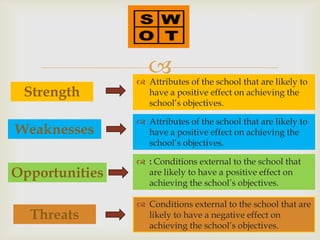
                 Attributes of the school that are likely to
 Strength         have a positive effect on achieving the
                  school’s objectives.

                 Attributes of the school that are likely to
Weaknesses        have a positive effect on achieving the
                  school’s objectives.

                 : Conditions external to the school that
Opportunities     are likely to have a positive effect on
                  achieving the school’s objectives.

                 Conditions external to the school that are
  Threats         likely to have a negative effect on
                  achieving the school’s objectives.
Purpose
                  
In sum, the purpose of a SWOT analysis is
 to develop strategies that capitalise on the
 school’s strengths, minimise the effects of
 any weaknesses, exploit available
 opportunities and defend against threats.
 Implementing these strategies should lead
 to achieving the school’s objectives.
How to use the tool ?
               
To carry out a SWOT Analysis, write down
 answers to the following questions. Where
 appropriate, use similar questions and,
 whenever possible, consider your answers
 from your own point of view and from the
 point of view of the people you deal with.
Strength
                  
1. What advantages does this
   policy/protocol/arrangement/other
   present?
2. What do we currently do well?
3. What relevant resources do we access to?
4. What do other people see as your
   strengths?
Weaknesses
                      
 1. What can we improve?
 2. What do we not do well? Consider what you
    are criticised for or what you receive
    complaints about.
 3. Where are we vulnerable?
 Remember to consider this from an internal and external
  perspective. Do other people perceive weaknesses that
  you do not see? Are other schools doing any better than
  you in this area? It is best to be realistic now, and face any
  unpleasant truths as soon as possible.
Opportunities
                    
1. What opportunities do we know about but have
   not addressed?
2. Are there emerging trends on which we can
   capitalise?
 Useful opportunities can come from such things as:
1. changes in technology and educational markets on both a
   broad and narrow scale
2. changes in government policy related to your field
3. changes in social patterns, population profiles, lifestyle
   changes, and so on
4. local events
Opportunities
             
A useful approach to considering
opportunities is to look at your strengths
and ask yourself whether these open up
any opportunities. Alternatively, examine
your weaknesses and ask yourself whether
you could open up opportunities by
eliminating them.
Threats
1.
                         
   What obstacles do we face?
2. Are economic conditions affecting our financial
   viability? Ask yourself, what would be the
   financial, social, educational impact of not
   implementing changes?
3. Are the required specifications for our services
   changing?
4. Is changing technology threatening our position?
5. Could any of our weaknesses seriously threaten our
   business, children’s educational attainment, and so on?
   In other words, are weaknesses likely to make us
   critically vulnerable?
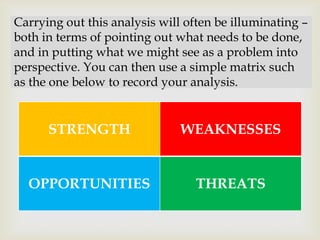
Carrying out this analysis will often be illuminating –
both in terms of pointing out what needs to be done,
and in putting what we might see as a problem into
                         
perspective. You can then use a simple matrix such
as the one below to record your analysis.


      STRENGTH                 WEAKNESSES


  OPPORTUNITIES                   THREATS
We will use an example of a teacher working within a local
      primary school who is keen to review and improve
                   relationships with parents.

TASK                         
1. Consider what practices you currently have in place to
   encourage parent-partnerships within your school.
2. Use this to conduct a SWOT analysis, identifying your
   current strengths and realistically appraising your current
   weaknesses.
3. Then suggest up to three opportunities for improving your
   current systems and, for each, list a possible threat that
   would need to be managed if you were to pursue each
   opportunity.
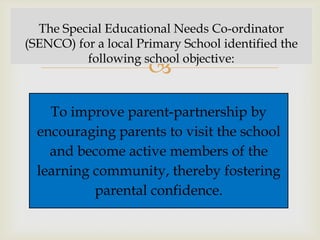
The Special Educational Needs Co-ordinator
(SENCO) for a local Primary School identified the
          following school objective:
                      
    To improve parent-partnership by
  encouraging parents to visit the school
    and become active members of the
  learning community, thereby fostering
           parental confidence.
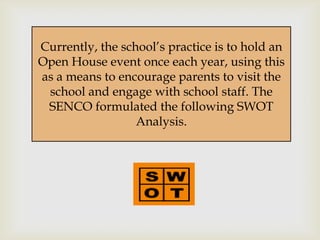
Currently, the school’s practice is to hold an
                    
Open House event once each year, using this
as a means to encourage parents to visit the
 school and engage with school staff. The
 SENCO formulated the following SWOT
                  Analysis.
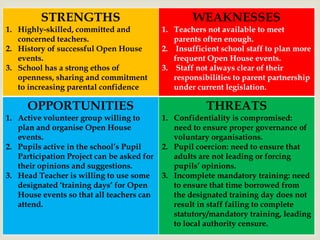
STRENGTHS                                  WEAKNESSES
1. Highly-skilled, committed and            1. Teachers not available to meet
   concerned teachers.                         parents often enough.
2. History of successful Open House         2. Insufficient school staff to plan more

                                       
   events.                                     frequent Open House events.
3. School has a strong ethos of             3. Staff not always clear of their
   openness, sharing and commitment            responsibilities to parent partnership
   to increasing parental confidence           under current legislation.

      OPPORTUNITIES                                     THREATS
1. Active volunteer group willing to        1. Confidentiality is compromised:
   plan and organise Open House                need to ensure proper governance of
   events.                                     voluntary organisations.
2. Pupils active in the school’s Pupil      2. Pupil coercion: need to ensure that
   Participation Project can be asked for      adults are not leading or forcing
   their opinions and suggestions.             pupils’ opinions.
3. Head Teacher is willing to use some      3. Incomplete mandatory training: need
   designated ‘training days’ for Open         to ensure that time borrowed from
   House events so that all teachers can       the designated training day does not
   attend.                                     result in staff failing to complete
                                               statutory/mandatory training, leading
                                               to local authority censure.
SWOT Matrix
                      Strengths – S            Weaknesses – W

                        List Strengths         List Weaknesses

Opportunities – O     SO Strategies            WO Strategies

                      Use strengths to take        Overcoming
 List Opportunities       advantage of         weaknesses by taking
                         opportunities             advantage of
                                                  opportunities

  Threats – T          ST Strategies           WT Strategies

                      Use strengths to avoid   Minimize weaknesses
    List Threats              threats            and avoid threats

Thank You….

Strategy analysis andchoice

  • 1.
    RAMIL P. POLINTAN Head, Mathematics Department, TNHS
  • 2.
    Strategy Analysis &Choice   Strategic analysis and choice largely involve making subjective decisions based on objective information. This report introduces important concepts that can help strategists generate feasible alternatives, evaluate those alternatives, and choose a specific course of action. Behavioral aspects of strategy formulation are described, including politics, culture, ethics, and social responsibility considerations.
  • 3.
    Nature of StrategyAnalysis & Choice  -- Establishing long-term objectives -- Generating alternative strategies -- Selecting strategies to pursue -- Best alternative - achieve mission & objectives
  • 4.
    Strategy Analysis &Choice Alternative Strategies Derive From -- Vision Mission Objectives External audit Internal audit Past successful strategies
  • 6.
    Comprehensive Strategy-Formulation Framework Stage 1: The Input Stage Stage 2: Stage 3: The Matching Stage The Decision Stage
  • 7.
    Strategy-Formulation Analytical Framework Internal Factor Evaluation Matrix (IFE) Stage 1: Competitive Profile Matrix The Input Stage (CPM) External Factor Evaluation Matrix (EFE)
  • 8.
    Stage 1: TheInput Stage Basic input information for the matching & decision stage matrices Requires strategists to quantify subjectivity early in the process Good intuitive judgment always needed
  • 9.
    Strategy-Formulation Analytical Framework SWOT Matrix Stage 2: BCG Matrix The Matching Stage Grand Strategy Matrix
  • 10.
    Stage 2: TheMatching Stage Match between organization’s internal resources & skills and the opportunities & risks created by its external factors E.g. internal: strong R and D function External changing demographics (population getting older) Strategy: Develop new products for older adults (related to long term objectives financial or strategic)
  • 11.
    Stage 2: TheMatching Stage: SWOT Matrix Four Types of Strategies Strengths-Opportunities (SO): Use a firm’s internal strengths to take advantage of external opportunities Weaknesses-Opportunities (WO): Improving internal weaknesses by taking advantage of external opportunities Strengths-Threats (ST): Use a firm’s strengths to avoid or reduce the impact of external threats. Weaknesses-Threats (WT): Defensive tactics aimed at reducing internal weaknesses and avoiding external threats
  • 12.
    SWOT Matrix Strengths – S Weaknesses – W List Strengths List Weaknesses Opportunities – O SO Strategies WO Strategies Use strengths to take Overcoming List Opportunities advantage of weaknesses by taking opportunities advantage of opportunities Threats – T ST Strategies WT Strategies Use strengths to avoid Minimize weaknesses List Threats threats and avoid threats
  • 13.
    Matching Key Factorsto Formulate Alternative Strategies Key Internal Factor Key External Factor Resultant Strategy 20% annual growth Excess working + in the cell phone = Acquire capacity (strength) industry Cellfone, Inc. (opportunity) Exit of two major Pursue horizontal Insufficient capacity foreign competitors + = integration by buying (weakness) from the industry (opportunity) competitor's facilities Decreasing numbers Develop new products Strong R&D (strength) + of young adults = (threat) for older adults Develop a new Poor employee morale Strong union + activity (threat) = employee benefits (weakness) package Which types of strategies, e.g. intensive diversification…, are referred to above 13
  • 14.
    Strengths: Weaknesses: 1. Over dependent on borrowings - 1. R and D almost complete Insufficient cash resources 2. Basis for strong management team 2. Board of Directors is too narrow 3. Key first major customer acquired 3. Lack of awareness amongst prospective 4. Initial product can evolve into range of customers offerings 4. Need to relocate to larger premises 5. Located near a major centre of 5. Absence of strong sales/marketing excellence expertise 6. Very focused management/staff 6. Overdependence on few key staff 7. Well-rounded and managed business 7. Emerging new technologies may move market in new directions Threats: Opportunities: 1. Major player may enter targeted market segment 1. Market segment is poised for rapid 2. New technology may make products growth obsolescent 2. Export markets offer great potential 3. Economic slowdown could reduce 3. Distribution channels seeking new demand products 4. Euro/Yen may move against $ 4. Scope to diversify into related market 5. Market may become price sensitive segments 6. Market segment's growth could attract major competition
  • 15.
    Key Strategies 1.  by strengthening R and D Accelerate product launches team 2. Extend links with key technology centres 3. Raise additional venture capital 4. Expand senior management team in sales/marketing 5. Recruit non-executive directors 6. Strengthen human resources function and introduce share options for staff 7. Appoint advisers for intellectual property and finance 8. Seek new market segments/applications for products
  • 16.
    SWOT Matrix Strengths – S Weaknesses – W List Strengths List Weaknesses Opportunities – O SO Strategies WO Strategies Match and determine Match and determine List Opportunities strategy strategy Threats – T ST Strategies WT Strategies Match and determine Match and determine List Threats strategy strategy Inset key strategies into correct box element of the Matrix
  • 17.
    Limitations with SWOTMatrix  Does not show how to achieve a competitive advantage Provides a static assessment in time May lead the firm to overemphasize a single internal or external factor in formulating strategies
  • 18.
    BCG Matrix Boston ConsultingGroup Matrix Enhances multi-divisional firm in formulating strategies Autonomous divisions = business portfolio Divisions may compete in different industries Focus on market-share position & industry growth rate
  • 19.
    BCG Matrix Relative MarketShare Position Ratio of a division’s own market share in an industry to the market share held by the largest rival firm in that industry
  • 20.
    BCG Matrix Relative Market Share Position High Medium Low 1.0 .50 0.0 High +20  Stars Question Marks Industry Sales Growth Rate II I Medium 0 Cash Cows Dogs III IV Low -20 20
  • 21.
    BCG Matrix Question Marks Low relative market share – compete in high- growth industry Cash needs are high Case generation is low Decision to strengthen (intensive strategies) or divest
  • 22.
    BCG Matrix Stars Highrelative market share and high growth rate Best long-run opportunities for growth & profitability Substantial investment to maintain or strengthen dominant position Integration strategies, intensive strategies, joint ventures
  • 23.
    BCG Matrix Cash Cows High relative market share, competes in low- growth industry Generate cash in excess of their needs Milked for other purposes Maintain strong position as long as possible Product development, concentric diversification If weakens—retrenchment or divestiture
  • 24.
    BCG Matrix Dogs Lowrelative market share & compete in slow or no market growth Weak internal & external position Liquidation, divestiture, retrenchment
  • 25.
    Grand Strategy Matrix Tool for formulating alternative strategies Based on two dimensions Competitive position Market growth
  • 26.
    RAPID MARKET GROWTH Quadrant II Quadrant I 1. Market development 1. Market development 2. 3. Market penetration Product development  2. 3. Market penetration Product development 4. Horizontal integration 4. Forward integration 5. Divestiture 5. Backward integration 6. Liquidation 6. Horizontal integration WEAK 7. Concentric diversification STRONG COMPETITIVE COMPETITIVE POSITION Quadrant III Quadrant IV POSITION 1. Retrenchment 1. Concentric diversification 2. Concentric diversification 2. Horizontal diversification 3. Horizontal diversification 3. Conglomerate 4. Conglomerate diversification diversification 4. Joint ventures 5. Liquidation 26 SLOW MARKET GROWTH
  • 27.
    Grand Strategy Matrix Quadrant I Excellent strategic position Concentration on current markets/products Take risks aggressively when necessary Which type of strategy would you suggest?
  • 28.
    Grand Strategy Matrix Quadrant II Evaluate present approach How to improve competitiveness Rapid market growth requires intensive strategy
  • 29.
    Grand Strategy Matrix Quadrant III Compete in slow-growth industries Weak competitive position Drastic changes quickly Cost & asset reduction (retrenchment)
  • 30.
    Grand Strategy Matrix Quadrant IV Strong competitive position Slow-growth industry Diversification to more promising growth areas
  • 31.
    Strategy-Formulation Analytical Framework Quantitative Strategic Stage 3: Planning Matrix The Decision Stage (QSPM) Technique designed to determine the relative attractiveness of feasible alternative actions
  • 32.
    Steps to Developa QSPM 1. Make a list of the firm’s key external  opportunities/threats and internal strengths/weaknesses in the left column 2. Assign weights to each key external and internal factor 3. Examine the Stage 2 (matching) matrices, and identify alternative strategies that the organization should consider implementing 4. Determine the Attractiveness Scores (A.S) 5. Compute the Total Attractiveness Scores 6. Compute the Sum Total Attractiveness Score
  • 33.
    QSPM : informationfrom IFE and EFE Strategic Alternatives Key External Factors Weight Strategy 1 Strategy 2 Strategy 3 Economy Political/Legal/Government al Social/Cultural/Demographi  c/Environmental Technological Competitive Key Internal Factors Management Marketing Finance/Accounting Production/Operations Research and Development Computer Information Systems Sum total A.S. 33 AS 1 to 4 and blank if factor does not effect strategy: TAS = Weight x AS
  • 34.
    QSPM Limitations Requires intuitive judgments& educated assumptions Only as good as the prerequisite inputs Advantages Sets of strategies considered simultaneously or sequentially Integration of pertinent external & internal factors in the decision making process
  • 35.
    CULTURAL ASPECTS OFSTRATEGIC CHOICE A. Culture includes the set of shared values, beliefs, attitudes, customs, norms, personalities, h eroes, and heroines that describe a firm.  B. All Organizations Have a Culture 1.It is beneficial to view strategic management from a cultural perspective because success often rests on the degree of support that strategies receive from a firm’s culture. 2.If a firm’s strategies are supported by cultural products such as values, beliefs, rites, rituals, ceremonies, stories, symbols, lan guage, heroes, and heroines then managers often can implement changes swiftly and easily. 3.Strategies that require fewer cultural changes may be more attractive because extensive changes can take
  • 36.
    THE POLITICS OFSTRATEGY CHOICE A. In the absence of objective analyses, strategy decisions  too often are based on the politics of the moment. With development of improved strategy-formulation tools, political factors become less important in making strategic decisions. B. Tactics to aid in strategy: 1. Equifinality 2. Satisfying 3. Generalization 4. Focus on Higher-Order Issues 5. Provide Political Access on Important Issues
  • 37.
    THE ROLE OFA BOARD OF DIRECTORS  A director is one of a group of persons entrusted with the overall direction of a corporate enterprise. A board of directors is a group of persons elected by the ownership of a corporation to have oversight and guidance over management and to look out for the shareholders’ interests.
  • 40.
    SWOT Analysis  SWOT Analysis is an effective way of identifying the strengths and weaknesses of the impact of legislation, policy, protocols, parent- partnership arrangements, and so on, and of examining the opportunities and threats your organisation/school may face as a result of implementing such policies, protocols, and arrangements.
  • 41.
     Attributes of the school that are likely to Strength have a positive effect on achieving the school’s objectives.  Attributes of the school that are likely to Weaknesses have a positive effect on achieving the school’s objectives.  : Conditions external to the school that Opportunities are likely to have a positive effect on achieving the school’s objectives.  Conditions external to the school that are Threats likely to have a negative effect on achieving the school’s objectives.
  • 42.
    Purpose  In sum, the purpose of a SWOT analysis is to develop strategies that capitalise on the school’s strengths, minimise the effects of any weaknesses, exploit available opportunities and defend against threats. Implementing these strategies should lead to achieving the school’s objectives.
  • 43.
    How to usethe tool ?  To carry out a SWOT Analysis, write down answers to the following questions. Where appropriate, use similar questions and, whenever possible, consider your answers from your own point of view and from the point of view of the people you deal with.
  • 44.
    Strength  1. What advantages does this policy/protocol/arrangement/other present? 2. What do we currently do well? 3. What relevant resources do we access to? 4. What do other people see as your strengths?
  • 45.
    Weaknesses  1. What can we improve? 2. What do we not do well? Consider what you are criticised for or what you receive complaints about. 3. Where are we vulnerable?  Remember to consider this from an internal and external perspective. Do other people perceive weaknesses that you do not see? Are other schools doing any better than you in this area? It is best to be realistic now, and face any unpleasant truths as soon as possible.
  • 46.
    Opportunities  1. What opportunities do we know about but have not addressed? 2. Are there emerging trends on which we can capitalise?  Useful opportunities can come from such things as: 1. changes in technology and educational markets on both a broad and narrow scale 2. changes in government policy related to your field 3. changes in social patterns, population profiles, lifestyle changes, and so on 4. local events
  • 47.
    Opportunities  A useful approach to considering opportunities is to look at your strengths and ask yourself whether these open up any opportunities. Alternatively, examine your weaknesses and ask yourself whether you could open up opportunities by eliminating them.
  • 48.
    Threats 1.  What obstacles do we face? 2. Are economic conditions affecting our financial viability? Ask yourself, what would be the financial, social, educational impact of not implementing changes? 3. Are the required specifications for our services changing? 4. Is changing technology threatening our position? 5. Could any of our weaknesses seriously threaten our business, children’s educational attainment, and so on? In other words, are weaknesses likely to make us critically vulnerable?
  • 49.
    Carrying out thisanalysis will often be illuminating – both in terms of pointing out what needs to be done, and in putting what we might see as a problem into  perspective. You can then use a simple matrix such as the one below to record your analysis. STRENGTH WEAKNESSES OPPORTUNITIES THREATS
  • 50.
    We will usean example of a teacher working within a local primary school who is keen to review and improve relationships with parents. TASK  1. Consider what practices you currently have in place to encourage parent-partnerships within your school. 2. Use this to conduct a SWOT analysis, identifying your current strengths and realistically appraising your current weaknesses. 3. Then suggest up to three opportunities for improving your current systems and, for each, list a possible threat that would need to be managed if you were to pursue each opportunity.
  • 51.
    The Special EducationalNeeds Co-ordinator (SENCO) for a local Primary School identified the following school objective:  To improve parent-partnership by encouraging parents to visit the school and become active members of the learning community, thereby fostering parental confidence.
  • 52.
    Currently, the school’spractice is to hold an  Open House event once each year, using this as a means to encourage parents to visit the school and engage with school staff. The SENCO formulated the following SWOT Analysis.
  • 53.
    STRENGTHS WEAKNESSES 1. Highly-skilled, committed and 1. Teachers not available to meet concerned teachers. parents often enough. 2. History of successful Open House 2. Insufficient school staff to plan more  events. frequent Open House events. 3. School has a strong ethos of 3. Staff not always clear of their openness, sharing and commitment responsibilities to parent partnership to increasing parental confidence under current legislation. OPPORTUNITIES THREATS 1. Active volunteer group willing to 1. Confidentiality is compromised: plan and organise Open House need to ensure proper governance of events. voluntary organisations. 2. Pupils active in the school’s Pupil 2. Pupil coercion: need to ensure that Participation Project can be asked for adults are not leading or forcing their opinions and suggestions. pupils’ opinions. 3. Head Teacher is willing to use some 3. Incomplete mandatory training: need designated ‘training days’ for Open to ensure that time borrowed from House events so that all teachers can the designated training day does not attend. result in staff failing to complete statutory/mandatory training, leading to local authority censure.
  • 54.
    SWOT Matrix Strengths – S Weaknesses – W List Strengths List Weaknesses Opportunities – O SO Strategies WO Strategies Use strengths to take Overcoming List Opportunities advantage of weaknesses by taking opportunities advantage of opportunities Threats – T ST Strategies WT Strategies Use strengths to avoid Minimize weaknesses List Threats threats and avoid threats
  • 55.