Administrative System
Bai Sittie Norhannie S. Abpi
Educational Administration
• Administration has been defined by
Ordway Tead as, “a comprehensive
effort to direct, guide and integrate
associating human strivings which are
focused towards some specific ends or
aims.”
Educational Administration
• Educational administration is also a
comprehensive effort intended to
achieve specific educational objectives
and it deals with educational practices,
whereas educational philosophy sets
the goal and educational psychology
explains the principles, educational
administration tells the do-how of
educational objectives and principles. It
is, in fact, the dynamic side of
Educational Administration
• Educational administration deals with
educational institutions – right from the schools
and colleges to the secretariat.
• It is concerned with both human and material
resources. The human elements include –
Children, Parents, Teachers and other employees
in general – university or board of education at
local, state and national levels of government.
On the material side are: Money, Buildings and
grounds, Equipment and Instructional Supplies.
Educational Administration
• Beyond these two elements are ideas,
laws and regulations, community needs
and so on. All of these have a bearing
on the educational process.
• The “integration” of these “parts” into a
“whole” is educational administration.
Example of
Administrative
System
1. DepEd Central Office
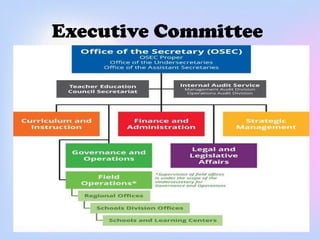
• Executive Committee
– Office of the DepEd Secretary
– Strategic Management
– School Infrastructure & Facilities
– Adminisrtation
– Curriculum & Teaching
– Procurement
– Operations
– Legal and Legislative Affairs
– Human Resource and Organizational Development
– Finance
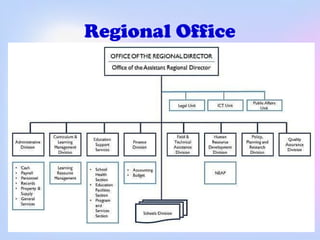
DepEd Regional Office
• Regional Director
• Assistant Regional Director
• Curriculum and Learning Management Division
• Education Support Services Division
• Policy Planning and Research Division
• Field Technical Assistance Division
• Quality Assurance Division
• Administrative Division
• Finance Division
3. DepEd Regional Office (BARMM)
• Minister of Basic Education
• Assistance Secretariat for Academics
• Assistant Secretary for Special Projects
and Programs
• Assistant Secretary for Operations
3. DepEd Division Office
• Superintendent
• Assistant Superintendent
4. DepEd Division Office
• Public school district
supervisor
• Principal / School Head
Parameters,
Roles &
Functions
Executive Committee
DepEd: Executive Committee
• The Secretary of the DepEd
provides overall leadership and
direction at the national level.
• Attached and support agencies
to the department of education
are included in the OSEc.
DepEd Secretary: Roles & Functions
• The Secretary exercises supervision and control over
the entire department and performs the following
functions:
– Advises the President on matters related to
education.
– Establishes policies and standards for the
operation of the Department pursuant to the
approved programs of the government.
– Promulgates rules and regulations necessary to
carry out the objectives, policies, functions, plans,
programs and projects of the department.
– Promulgates issuances necessary for the efficient
administration of the offices under him and proper
DepEd Secretary: Roles & Functions
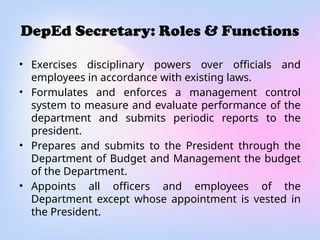
• Exercises disciplinary powers over officials and
employees in accordance with existing laws.
• Formulates and enforces a management control
system to measure and evaluate performance of the
department and submits periodic reports to the
president.
• Prepares and submits to the President through the
Department of Budget and Management the budget
of the Department.
• Appoints all officers and employees of the
Department except whose appointment is vested in
the President.
Undersecretary: Roles & Functions
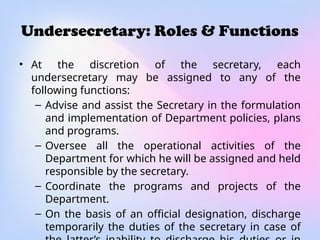
• At the discretion of the secretary, each
undersecretary may be assigned to any of the
following functions:
– Advise and assist the Secretary in the formulation
and implementation of Department policies, plans
and programs.
– Oversee all the operational activities of the
Department for which he will be assigned and held
responsible by the secretary.
– Coordinate the programs and projects of the
Department.
– On the basis of an official designation, discharge
temporarily the duties of the secretary in case of
Assistant secretary: Roles &
Functions
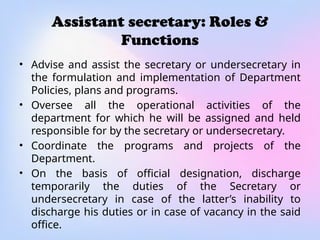
• Advise and assist the secretary or undersecretary in
the formulation and implementation of Department
Policies, plans and programs.
• Oversee all the operational activities of the
department for which he will be assigned and held
responsible for by the secretary or undersecretary.
• Coordinate the programs and projects of the
Department.
• On the basis of official designation, discharge
temporarily the duties of the Secretary or
undersecretary in case of the latter’s inability to
discharge his duties or in case of vacancy in the said
office.
Internal Audit Service:
Roles & Functions
• The internal Audit service serves as
the watchdog of the Department
through:
–Appraising existing procedures and
related matters as to efficiency and
adequacy; and
–Detecting and preventing frauds or
dishonesty in verifying the extent of
compliance in a protective nature to
the extent possible.
Curriculum & Instruction:
Roles & Functions
• Curriculum and Instruction ensures that
the organization focuses on the delivery
of a relevant, responsive and effective
basic education curriculum around
which all other strands and offices
provide support.
Finance & Administration:
Roles & Functions
• Finance and Administration ensures the
efficiency to support the organization as
a whole to focus on its core business
and thus attain its targets through the
provision of finance and administrative
services.
Governance & Operations:
Roles & Functions
• Governance and Operations ensures
the capacity of the organization to
continuously improve and be strategic
in managing the environment for which
“teaching and Learning” takes place.
Legal & Legislative Affairs: Roles &
Functions
• Legal and Legislative affairs enhances
capacity of the organization to deal with
legal matters and to be proactive in
moving forward its legislative agenda.
Strategic Management:
Roles & Functions
• Strategic Management enables the
organization to focus on long-term
directions and interface with the
internal and external environment and
stakeholders.
Regional Office
Regional Director:
Roles & Functions
• Defining a regional educational policy framework
which reflects the values, needs and expectations
of the communities they serve.
• Developing regional basic education plan.
• Developing regional education standards with a
view towards benchmarking for international
competitiveness.
• Monitoring, evaluating and assessing regional
learning outcomes.
• Undertaking research projects and developing
and managing regionwide projects which may be
funded through official development assistance
and /or other funding agencies
Regional Director:
Roles & Functions
• Ensuring strict compliance with prescribed
national criteria for the recruitment, selection
and training for all staff in the region and
divisions;
• Formulating, in coordination with the regional
development council, the budget to support the
regional education plan which shall take into
account the educational plans of the divisions
and districts.
• Determining the organization component of the
divisions and districts and approving the
proposed staffing patterns for all employees in
the divisions and districts.
Regional Director:
Roles & Functions
• Evaluating all schools division superintendents
and assistant division superintendents in the
region;
• Planning and managing the effective and
efficient use of all personnel, physical and fiscal
resources of the regional office, including
professional staff development.
• Managing the database and management
information system of the region.
• Approving the establishment of public and
private elementary and high schools and learning
centers.
• Performing such other functions as may be
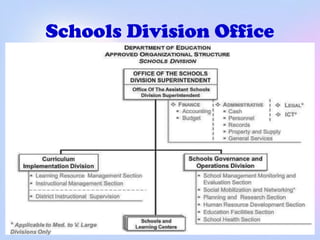
Schools Division Office
Division Superintendent:
Roles & Functions
• Developing and implementing division education
development plans;
• Planning and managing effective and efficient
use of all personnel, physical and fiscal resources
of the division, including professional staff
development;
• Hiring, placing and evaluating all division
supervisors and schools district supervisors as
well as all employees in the division, both
teaching and non teaching personnel, including
school heads, except for the assistant division
superintendent.
Division Superintendent:
Roles & Functions
• Monitoring the utilization of funds provided by the
national government and the local government units
to the schools and learning centers.
• Ensuring the compliance of the quality standards for
basic education programs and for this purpose
strengthening the role of division supervisors as
subject area specialists.
• Promoting awareness and of adherence by all
schools and learning centers to accreditation
standards prescribed by the Secretary of Education.
• Supervising the operations of all public and private
elementary, secondary and integrated schools, and
learning centers; and
• Performing such other functions as may be assigned
District Supervisor:
Roles & Functions
• Providing professional and
instructional advise and support to
the school heads and
teachers/facilitators of schools and
learning centers in the district or
cluster thereof;
• Curricula supervision;
• Performing such other functions as
may be assigned by other
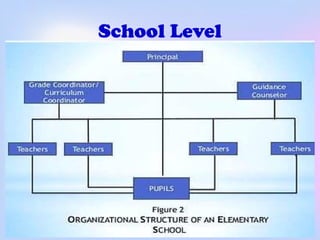
School Level
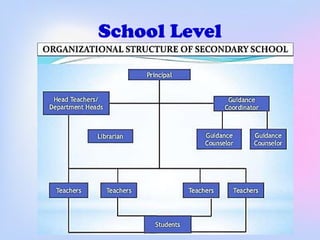
School Level
Principal/ School Head:
Roles & Functions
• Setting Mission, Vision, Goals and Objectives
of the school;
• Creating an environment within the school
that is conducive to teaching and learning;
• Implementing the school curriculum and
being accountable for higher learning
outcomes;
• Developing the school education program
and school improvement plan;
• Offering educational programs, projects and
services which provide equitable
opportunities for all learners in the
Principal/ School Head:
Roles & Functions
• Introducing new and innovative modes of
instruction to achieve higher learning
outcomes;
• Administering and managing all personnel,
physical and fiscal resources of the school;
• Recommending the staffing complement of the
school based on its needs;
• Encouraging staff development;
• Establishing school and community networks
and encouraging the active participation of
teachers’ organizations, non –academic
personnel of public schools, and parents-
Principal/ School Head
Roles & Functions
• Accepting donations, gifts, bequests and grants
for the purpose of upgrading teachers’/learning
facilitators’ competencies, improving and
expanding school facilities and providing
instructional materials and equipment. Such
donations or grants must be reported to the
appropriate district supervisors and division
superintendents; and
• Performing such other functions as may be
assigned by proper authorities.

Educational Administrative System powerpoint

  • 1.
  • 2.
    Educational Administration • Administrationhas been defined by Ordway Tead as, “a comprehensive effort to direct, guide and integrate associating human strivings which are focused towards some specific ends or aims.”
  • 3.
    Educational Administration • Educationaladministration is also a comprehensive effort intended to achieve specific educational objectives and it deals with educational practices, whereas educational philosophy sets the goal and educational psychology explains the principles, educational administration tells the do-how of educational objectives and principles. It is, in fact, the dynamic side of
  • 4.
    Educational Administration • Educationaladministration deals with educational institutions – right from the schools and colleges to the secretariat. • It is concerned with both human and material resources. The human elements include – Children, Parents, Teachers and other employees in general – university or board of education at local, state and national levels of government. On the material side are: Money, Buildings and grounds, Equipment and Instructional Supplies.
  • 5.
    Educational Administration • Beyondthese two elements are ideas, laws and regulations, community needs and so on. All of these have a bearing on the educational process. • The “integration” of these “parts” into a “whole” is educational administration.
  • 6.
  • 7.
    1. DepEd CentralOffice • Executive Committee – Office of the DepEd Secretary – Strategic Management – School Infrastructure & Facilities – Adminisrtation – Curriculum & Teaching – Procurement – Operations – Legal and Legislative Affairs – Human Resource and Organizational Development – Finance
  • 8.
    DepEd Regional Office •Regional Director • Assistant Regional Director • Curriculum and Learning Management Division • Education Support Services Division • Policy Planning and Research Division • Field Technical Assistance Division • Quality Assurance Division • Administrative Division • Finance Division
  • 9.
    3. DepEd RegionalOffice (BARMM) • Minister of Basic Education • Assistance Secretariat for Academics • Assistant Secretary for Special Projects and Programs • Assistant Secretary for Operations
  • 10.
    3. DepEd DivisionOffice • Superintendent • Assistant Superintendent
  • 11.
    4. DepEd DivisionOffice • Public school district supervisor • Principal / School Head
  • 12.
  • 13.
  • 14.
    DepEd: Executive Committee •The Secretary of the DepEd provides overall leadership and direction at the national level. • Attached and support agencies to the department of education are included in the OSEc.
  • 15.
    DepEd Secretary: Roles& Functions • The Secretary exercises supervision and control over the entire department and performs the following functions: – Advises the President on matters related to education. – Establishes policies and standards for the operation of the Department pursuant to the approved programs of the government. – Promulgates rules and regulations necessary to carry out the objectives, policies, functions, plans, programs and projects of the department. – Promulgates issuances necessary for the efficient administration of the offices under him and proper
  • 16.
    DepEd Secretary: Roles& Functions • Exercises disciplinary powers over officials and employees in accordance with existing laws. • Formulates and enforces a management control system to measure and evaluate performance of the department and submits periodic reports to the president. • Prepares and submits to the President through the Department of Budget and Management the budget of the Department. • Appoints all officers and employees of the Department except whose appointment is vested in the President.
  • 17.
    Undersecretary: Roles &Functions • At the discretion of the secretary, each undersecretary may be assigned to any of the following functions: – Advise and assist the Secretary in the formulation and implementation of Department policies, plans and programs. – Oversee all the operational activities of the Department for which he will be assigned and held responsible by the secretary. – Coordinate the programs and projects of the Department. – On the basis of an official designation, discharge temporarily the duties of the secretary in case of
  • 18.
    Assistant secretary: Roles& Functions • Advise and assist the secretary or undersecretary in the formulation and implementation of Department Policies, plans and programs. • Oversee all the operational activities of the department for which he will be assigned and held responsible for by the secretary or undersecretary. • Coordinate the programs and projects of the Department. • On the basis of official designation, discharge temporarily the duties of the Secretary or undersecretary in case of the latter’s inability to discharge his duties or in case of vacancy in the said office.
  • 19.
    Internal Audit Service: Roles& Functions • The internal Audit service serves as the watchdog of the Department through: –Appraising existing procedures and related matters as to efficiency and adequacy; and –Detecting and preventing frauds or dishonesty in verifying the extent of compliance in a protective nature to the extent possible.
  • 20.
    Curriculum & Instruction: Roles& Functions • Curriculum and Instruction ensures that the organization focuses on the delivery of a relevant, responsive and effective basic education curriculum around which all other strands and offices provide support.
  • 21.
    Finance & Administration: Roles& Functions • Finance and Administration ensures the efficiency to support the organization as a whole to focus on its core business and thus attain its targets through the provision of finance and administrative services.
  • 22.
    Governance & Operations: Roles& Functions • Governance and Operations ensures the capacity of the organization to continuously improve and be strategic in managing the environment for which “teaching and Learning” takes place.
  • 23.
    Legal & LegislativeAffairs: Roles & Functions • Legal and Legislative affairs enhances capacity of the organization to deal with legal matters and to be proactive in moving forward its legislative agenda.
  • 24.
    Strategic Management: Roles &Functions • Strategic Management enables the organization to focus on long-term directions and interface with the internal and external environment and stakeholders.
  • 25.
  • 26.
    Regional Director: Roles &Functions • Defining a regional educational policy framework which reflects the values, needs and expectations of the communities they serve. • Developing regional basic education plan. • Developing regional education standards with a view towards benchmarking for international competitiveness. • Monitoring, evaluating and assessing regional learning outcomes. • Undertaking research projects and developing and managing regionwide projects which may be funded through official development assistance and /or other funding agencies
  • 27.
    Regional Director: Roles &Functions • Ensuring strict compliance with prescribed national criteria for the recruitment, selection and training for all staff in the region and divisions; • Formulating, in coordination with the regional development council, the budget to support the regional education plan which shall take into account the educational plans of the divisions and districts. • Determining the organization component of the divisions and districts and approving the proposed staffing patterns for all employees in the divisions and districts.
  • 28.
    Regional Director: Roles &Functions • Evaluating all schools division superintendents and assistant division superintendents in the region; • Planning and managing the effective and efficient use of all personnel, physical and fiscal resources of the regional office, including professional staff development. • Managing the database and management information system of the region. • Approving the establishment of public and private elementary and high schools and learning centers. • Performing such other functions as may be
  • 29.
  • 30.
    Division Superintendent: Roles &Functions • Developing and implementing division education development plans; • Planning and managing effective and efficient use of all personnel, physical and fiscal resources of the division, including professional staff development; • Hiring, placing and evaluating all division supervisors and schools district supervisors as well as all employees in the division, both teaching and non teaching personnel, including school heads, except for the assistant division superintendent.
  • 31.
    Division Superintendent: Roles &Functions • Monitoring the utilization of funds provided by the national government and the local government units to the schools and learning centers. • Ensuring the compliance of the quality standards for basic education programs and for this purpose strengthening the role of division supervisors as subject area specialists. • Promoting awareness and of adherence by all schools and learning centers to accreditation standards prescribed by the Secretary of Education. • Supervising the operations of all public and private elementary, secondary and integrated schools, and learning centers; and • Performing such other functions as may be assigned
  • 32.
    District Supervisor: Roles &Functions • Providing professional and instructional advise and support to the school heads and teachers/facilitators of schools and learning centers in the district or cluster thereof; • Curricula supervision; • Performing such other functions as may be assigned by other
  • 33.
  • 34.
  • 35.
    Principal/ School Head: Roles& Functions • Setting Mission, Vision, Goals and Objectives of the school; • Creating an environment within the school that is conducive to teaching and learning; • Implementing the school curriculum and being accountable for higher learning outcomes; • Developing the school education program and school improvement plan; • Offering educational programs, projects and services which provide equitable opportunities for all learners in the
  • 36.
    Principal/ School Head: Roles& Functions • Introducing new and innovative modes of instruction to achieve higher learning outcomes; • Administering and managing all personnel, physical and fiscal resources of the school; • Recommending the staffing complement of the school based on its needs; • Encouraging staff development; • Establishing school and community networks and encouraging the active participation of teachers’ organizations, non –academic personnel of public schools, and parents-
  • 37.
    Principal/ School Head Roles& Functions • Accepting donations, gifts, bequests and grants for the purpose of upgrading teachers’/learning facilitators’ competencies, improving and expanding school facilities and providing instructional materials and equipment. Such donations or grants must be reported to the appropriate district supervisors and division superintendents; and • Performing such other functions as may be assigned by proper authorities.