Aggregate demand and
  aggregate supply
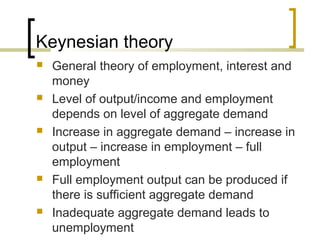
Keynesian theory
   General theory of employment, interest and
    money
   Level of output/income and employment
    depends on level of aggregate demand
   Increase in aggregate demand – increase in
    output – increase in employment – full
    employment
   Full employment output can be produced if
    there is sufficient aggregate demand
   Inadequate aggregate demand leads to
    unemployment
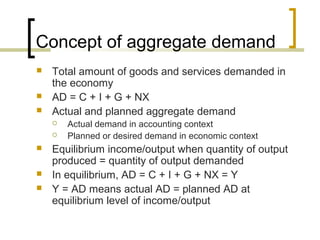
Concept of aggregate demand
   Total amount of goods and services demanded in
    the economy
   AD = C + I + G + NX
   Actual and planned aggregate demand
       Actual demand in accounting context
       Planned or desired demand in economic context
   Equilibrium income/output when quantity of output
    produced = quantity of output demanded
   In equilibrium, AD = C + I + G + NX = Y
   Y = AD means actual AD = planned AD at
    equilibrium level of income/output
Consumption demand
   Keynes – psychological law of consumption
    – C varies with the level of disposable
    income
   Franco Modigliani – life cycle theory of
    consumption – individuals plan consumption
    over long periods to allocate it over entire
    lifetime – C as a function of wealth and
    labour income
   Milton Friedman – permanent income theory
    of consumption – consumption related to
    longer term estimate of income called
    permanent income
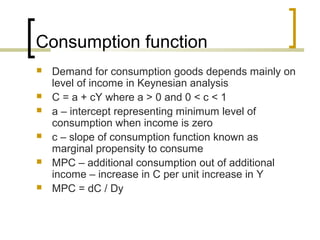
Consumption function
   Demand for consumption goods depends mainly on
    level of income in Keynesian analysis
   C = a + cY where a > 0 and 0 < c < 1
   a – intercept representing minimum level of
    consumption when income is zero
   c – slope of consumption function known as
    marginal propensity to consume
   MPC – additional consumption out of additional
    income – increase in C per unit increase in Y
   MPC = dC / Dy
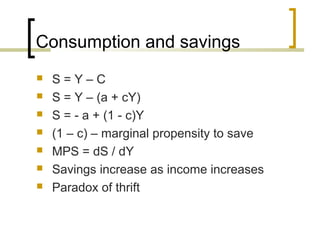
Consumption and savings
   S=Y–C
   S = Y – (a + cY)
   S = - a + (1 - c)Y
   (1 – c) – marginal propensity to save
   MPS = dS / dY
   Savings increase as income increases
   Paradox of thrift
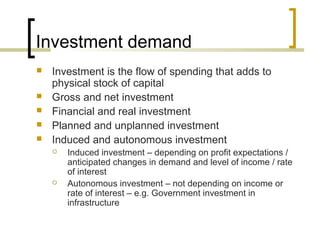
Investment demand
   Investment is the flow of spending that adds to
    physical stock of capital
   Gross and net investment
   Financial and real investment
   Planned and unplanned investment
   Induced and autonomous investment
       Induced investment – depending on profit expectations /
        anticipated changes in demand and level of income / rate
        of interest
       Autonomous investment – not depending on income or
        rate of interest – e.g. Government investment in
        infrastructure
Investment function
   Keynesian investment function
   Volume of induced investment
    depends on
       MEC – marginal efficiency of capital –
        determined by expected income flow
        from capital asset and its purchase price
       Market rate of interest
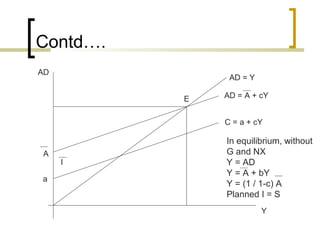
Consumption, planned
investment and AD
   Assuming planned investment spending
    constant and equal to I and also assuming
    G and NX equal to zero,
       AD = C + I
       = (a + I) + bY
       = A + bY
       where A – part of AD independent of
    income or autonomous
Contd….
AD
               AD = Y

          E   AD = A + cY


              C = a + cY

              In equilibrium, without
A             G and NX
     I        Y = AD
              Y = A + bY
a
              Y = (1 / 1-c) A
              Planned I = S
                        Y
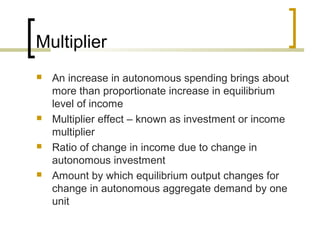
Multiplier
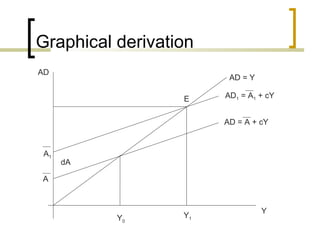
   An increase in autonomous spending brings about
    more than proportionate increase in equilibrium
    level of income
   Multiplier effect – known as investment or income
    multiplier
   Ratio of change in income due to change in
    autonomous investment
   Amount by which equilibrium output changes for
    change in autonomous aggregate demand by one
    unit
Derivation
  Y = AD
  dY = dAD
  dAD = dA + cdY
     dA – change in autonomous spending
     dY – change in income
  dY = dA + cdY
  dY = (1/1-c) dA
  α = 1 / 1 – c – multiplier
  Larger the MPC, greater the multiplier
Graphical derivation
AD
                        AD = Y

                  E    AD1 = A1 + cY


                       AD = A + cY


 A1
      dA

A


                                 Y
           Y0     Y1
Government spending
   Governments affect AD in two ways
       G – government spending
       Taxes and transfers affecting YD
   Consumption now depends on YD and not Y
       C = a + cYD = a + c (Y + TR – TA)
       TA = t Y
       C = a + cTR + c (1-t) Y
       Assuming that G and TR are constant,
        AD = (a+ cTR+ I+ G) + c(1-t) Y
           = A + c(1-t) Y
Contd….
   In equilibrium, Y = AD
   Y = A + c(1-t) Y
   Y [1-c(1-t)] = A where A = a+ cTR+ I+ G
   Y = A / 1-c(1-t)
   Multiplier in presence of taxes = α = 1 / 1–c(1-t)
   Government spending can increase A by the
    amount of purchases G and by the amount of
    induced spending out of transfers bTR
   Increased A will increase Y depending on the value
    of MPC and tax rate
   When tax rates (t) are higher, value of multiplier is
    lower
Government budget
   Plan of the intended expenses and revenues of the
    government
   Budget surplus = TA – G – TR
   BS = tY – G – TR
   At low levels of income, budget is in deficit, since
    govt spending (G+TR) > tax collection (tY)
   At high levels of income, budgets are in surplus
   Budget deficits typically persist during recessions
    when tax collections are low and transfers like
    unemployment allowances increase
AD curve
   Represents the quantity of goods and services households,
    firms and government want to buy at each price level
   When prices fall
       real wealth of households increases inducing more
        consumption
       Interest rates fall inducing more investment
       Exchange rates depreciate inducing more exports

           P


                                   AD
                                           Y
Aggregate supply
   Total amount of goods and services produced in the
    economy over a specific time period
   Classical AS – vertical line indicating that same
    amount of goods and services will be supplied
    irrespective of price level
       Assumption – labour market is always in equilibrium with
        full employment
   Keynesian AS – horizontal line indicating that firms
    will supply whatever amount of g & s is demanded
    at existing price level
       Assumption – unemployment leading to hiring labour at
        prevailing wage rate
   In practice, AS is positively sloped lying between
    Keynesian and classical AS
Contd….
   Upwards sloping AS in the short run
       Misperceptions – changes in price level can mislead the
        suppliers about individual markets in which they sell their
        output, resulting in changes in supply
       Sticky wages – nominal wages are sticky or slow to adjust
        in the short run - slow adjustments can be due to long-
        term contracts or work/social norms
           When P falls, W/P (real wage) rises, increasing the real cost to the
            firm, thus making employment and production less profitable
           Firms cut down on employment and production and thus on supply
       Sticky prices – prices of some goods and services are
        slow in adjustment – they lag behind when overall price
        level declines thus affecting their demand – this induces
        firms to reduce supply in the short run
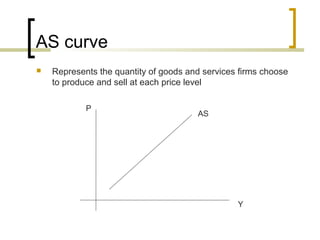
AS curve
   Represents the quantity of goods and services firms choose
    to produce and sell at each price level

            P
                                       AS


                                                 Y
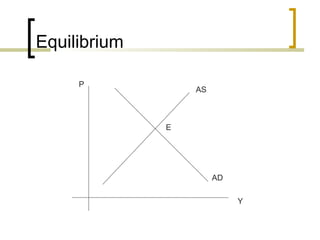
Equilibrium

     P
                  AS


              E


                       AD

                            Y

Aggregate demand and supply

  • 1.
    Aggregate demand and aggregate supply
  • 2.
    Keynesian theory  General theory of employment, interest and money  Level of output/income and employment depends on level of aggregate demand  Increase in aggregate demand – increase in output – increase in employment – full employment  Full employment output can be produced if there is sufficient aggregate demand  Inadequate aggregate demand leads to unemployment
  • 3.
    Concept of aggregatedemand  Total amount of goods and services demanded in the economy  AD = C + I + G + NX  Actual and planned aggregate demand  Actual demand in accounting context  Planned or desired demand in economic context  Equilibrium income/output when quantity of output produced = quantity of output demanded  In equilibrium, AD = C + I + G + NX = Y  Y = AD means actual AD = planned AD at equilibrium level of income/output
  • 4.
    Consumption demand  Keynes – psychological law of consumption – C varies with the level of disposable income  Franco Modigliani – life cycle theory of consumption – individuals plan consumption over long periods to allocate it over entire lifetime – C as a function of wealth and labour income  Milton Friedman – permanent income theory of consumption – consumption related to longer term estimate of income called permanent income
  • 5.
    Consumption function  Demand for consumption goods depends mainly on level of income in Keynesian analysis  C = a + cY where a > 0 and 0 < c < 1  a – intercept representing minimum level of consumption when income is zero  c – slope of consumption function known as marginal propensity to consume  MPC – additional consumption out of additional income – increase in C per unit increase in Y  MPC = dC / Dy
  • 6.
    Consumption and savings  S=Y–C  S = Y – (a + cY)  S = - a + (1 - c)Y  (1 – c) – marginal propensity to save  MPS = dS / dY  Savings increase as income increases  Paradox of thrift
  • 7.
    Investment demand  Investment is the flow of spending that adds to physical stock of capital  Gross and net investment  Financial and real investment  Planned and unplanned investment  Induced and autonomous investment  Induced investment – depending on profit expectations / anticipated changes in demand and level of income / rate of interest  Autonomous investment – not depending on income or rate of interest – e.g. Government investment in infrastructure
  • 8.
    Investment function  Keynesian investment function  Volume of induced investment depends on  MEC – marginal efficiency of capital – determined by expected income flow from capital asset and its purchase price  Market rate of interest
  • 9.
    Consumption, planned investment andAD  Assuming planned investment spending constant and equal to I and also assuming G and NX equal to zero, AD = C + I = (a + I) + bY = A + bY where A – part of AD independent of income or autonomous
  • 10.
    Contd…. AD AD = Y E AD = A + cY C = a + cY In equilibrium, without A G and NX I Y = AD Y = A + bY a Y = (1 / 1-c) A Planned I = S Y
  • 11.
    Multiplier  An increase in autonomous spending brings about more than proportionate increase in equilibrium level of income  Multiplier effect – known as investment or income multiplier  Ratio of change in income due to change in autonomous investment  Amount by which equilibrium output changes for change in autonomous aggregate demand by one unit
  • 12.
    Derivation Y= AD dY = dAD dAD = dA + cdY dA – change in autonomous spending dY – change in income dY = dA + cdY dY = (1/1-c) dA α = 1 / 1 – c – multiplier Larger the MPC, greater the multiplier
  • 13.
    Graphical derivation AD AD = Y E AD1 = A1 + cY AD = A + cY A1 dA A Y Y0 Y1
  • 14.
    Government spending  Governments affect AD in two ways  G – government spending  Taxes and transfers affecting YD  Consumption now depends on YD and not Y  C = a + cYD = a + c (Y + TR – TA)  TA = t Y  C = a + cTR + c (1-t) Y  Assuming that G and TR are constant, AD = (a+ cTR+ I+ G) + c(1-t) Y = A + c(1-t) Y
  • 15.
    Contd….  In equilibrium, Y = AD  Y = A + c(1-t) Y  Y [1-c(1-t)] = A where A = a+ cTR+ I+ G  Y = A / 1-c(1-t)  Multiplier in presence of taxes = α = 1 / 1–c(1-t)  Government spending can increase A by the amount of purchases G and by the amount of induced spending out of transfers bTR  Increased A will increase Y depending on the value of MPC and tax rate  When tax rates (t) are higher, value of multiplier is lower
  • 16.
    Government budget  Plan of the intended expenses and revenues of the government  Budget surplus = TA – G – TR  BS = tY – G – TR  At low levels of income, budget is in deficit, since govt spending (G+TR) > tax collection (tY)  At high levels of income, budgets are in surplus  Budget deficits typically persist during recessions when tax collections are low and transfers like unemployment allowances increase
  • 17.
    AD curve  Represents the quantity of goods and services households, firms and government want to buy at each price level  When prices fall  real wealth of households increases inducing more consumption  Interest rates fall inducing more investment  Exchange rates depreciate inducing more exports P AD Y
  • 18.
    Aggregate supply  Total amount of goods and services produced in the economy over a specific time period  Classical AS – vertical line indicating that same amount of goods and services will be supplied irrespective of price level  Assumption – labour market is always in equilibrium with full employment  Keynesian AS – horizontal line indicating that firms will supply whatever amount of g & s is demanded at existing price level  Assumption – unemployment leading to hiring labour at prevailing wage rate  In practice, AS is positively sloped lying between Keynesian and classical AS
  • 19.
    Contd….  Upwards sloping AS in the short run  Misperceptions – changes in price level can mislead the suppliers about individual markets in which they sell their output, resulting in changes in supply  Sticky wages – nominal wages are sticky or slow to adjust in the short run - slow adjustments can be due to long- term contracts or work/social norms  When P falls, W/P (real wage) rises, increasing the real cost to the firm, thus making employment and production less profitable  Firms cut down on employment and production and thus on supply  Sticky prices – prices of some goods and services are slow in adjustment – they lag behind when overall price level declines thus affecting their demand – this induces firms to reduce supply in the short run
  • 20.
    AS curve  Represents the quantity of goods and services firms choose to produce and sell at each price level P AS Y
  • 21.
    Equilibrium P AS E AD Y